Hubbry Logo
Cruiser Mk IVCruiser Mk IVMain
Open search
Cruiser Mk IV
Community hub
Cruiser Mk IV
logo
8 pages, 0 posts
0 subscribers
Be the first to start a discussion here.
Cruiser Mk IV
Cruiser Mk IV
from Wikipedia

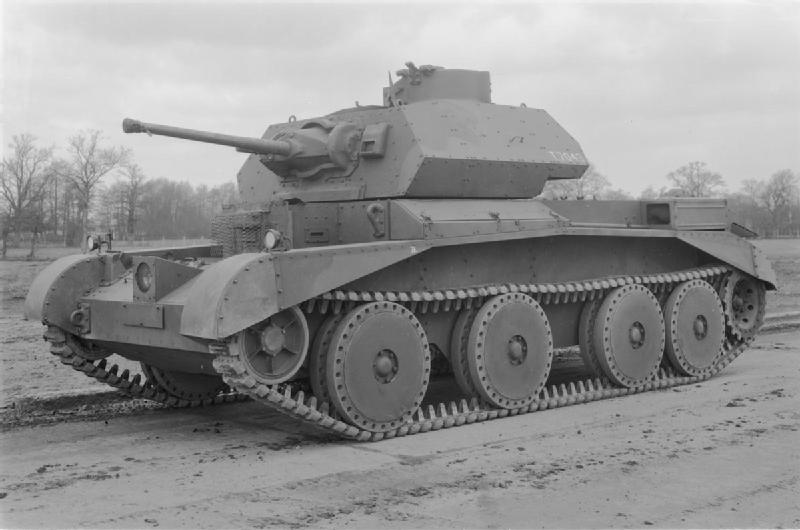
The Cruiser Tank Mk IV (A13 Mk II) was a British cruiser tank of the Second World War. It followed directly on from the Tank, Cruiser, Mk III (A13 Mk I). The first Mk IVs were Mk IIIs with extra armour fitted to the turret. Later Mk IVAs were built with the complete extra armour. The tank was used in France in 1940 and in the early part of the war in North Africa, before being withdrawn from service. A fast vehicle compared to other British tanks of the early part of the war, it was probably the best cruiser tank Britain had in 1940.[3] In total, 955 of these tanks were built.

Key Information

Design and development

[edit]

Britain became interested in fast tanks after observing the Soviet BT tanks during the 1936 Red Army manoeuvres. The BT was based on the revolutionary designs of American J. Walter Christie and a team from Morris Motors was sent to the United States to purchase a Christie tank and the rights to build more. The tank was given the General Staff designation "A13E1" and was delivered in late 1936, but the hull was too small and this led to a second British-built prototype.

The A13E2 was built to mount the turret of the Vickers-designed Cruiser Mk I (A9). This carried a 40 mm Ordnance QF 2-pounder gun and a co-axial .303 water-cooled Vickers machine gun. The drivetrain was also revised, with the ability to run on its road wheels as a wheeled vehicle. Better tracks were used, with rear-mounted drive sprockets and in trials, over 40 miles per hour (64 km/h) was attained on them but later the speed was governed down to 30 miles per hour (48 km/h). The armour of the A13E2 was 15 mm (0.59 in), in line with other pre-war fast tank designs.

The A13E3 was the final trials model, which led to the production tank, A13 MkI, Cruiser Tank Mk III, which entered production in 1939 at Nuffield Mechanizations and Aero, a munitions subsidiary within the Nuffield Organization. An order for 65 tanks was placed and at least 30 tanks completed when the War Office decided to build a new model with thicker armour. The A13 MkII, Cruiser Tank Mk IV, had a maximum armour thickness of 30 mm (1.2 in) and faceted armour was mounted on the original turret sides and rear. This gave the tank a far more modern appearance; some Mk III tanks were re-built to Mk IV standard while at the factory.

The .303 Vickers machine gun gave constant trouble and was replaced by the 7.92 mm BESA machine gun. All British tanks were to have their designs modified to mount the new weapon from early 1940. This led to the main production version, the A13 MkIIA, Cruiser Tank MkIVA. A few examples were sent with the BEF to France, along with most of the earlier A13s. It is not known how many A13 MkIVA tanks were built - the numbers depending on the source. Between the Cruiser Mark III and Cruiser Mark IV, 665 had been built when production ended in 1941.[2] English Electric, Leyland and LMS Railway were also involved in A13 production.

During the Battle of France, the A13 did not perform well, due to poor crew training as a result of being rushed into service. Many tanks shipped to France were in poor condition and some were so new that they had vital parts missing. The A13 performed much better in the deserts of the North Africa campaign and coped with the conditions better than some other designs. It was fast, adequately armed and armoured against Italian and German tanks.The A13 MkII had armour up to 30mm and was armed with an OQF 2 Pounder (40mm) gun wit co-avial .303 Vickers medium machine gun. Powered by a 340 bhp Nuffield Liberty engine it had a maximum road speed of 30 mph (48 km/h). In 1940 the co-axial .303 Vickers was replaced by the 7.92mm Besa, this led to a re-design of the turret face with a new external gun mantlet. This was to be the main production version designated the A13 MkIIA, at least 640 of this type were built 1940-41.

The Nuffield A13 MkIIA equipped the 1st Armoured Division in the UK in 1940, the division also had a few older A9 and A10 in its ranks. Its normal establishment was 45 Heavy Cruiser (2 Pounder) and 24 Cruisers Close Support (3" Howitzer) It was tasked with anti-Invasion duties and as a result was stationed in Southern England. As more tanks became available the A13 MkIIA also equipped the 2nd Armoured Division in late 1940 with the same mix of tanks. This division was preparing for service in North Africa early in1941

The A13 MkIIA remained an effective weapon until late 1941, when newer models of the Panzer III and Panzer IV appeared with thicker armour and larger guns. In North Africa, it was the anti-tank gun that claimed the vast majority of British tanks lost in battle; German tanks accounted for few British losses, contrary to popular belief.[4] The A13 MkIIA, Cruiser MkIV was replaced by two tank designs, the Cruiser MkV Covenanter tank and the A15 Crusader tank. The A13 Covenanter was a radical departure from the original A13 design and constituted an entirely new tank, though design flaws meant it was unsuitable for warfare and it was used only for training. The A15 Crusader used the same Liberty engine but in all other respects was a new design.

Production history and variants

[edit]
A Cruiser Mk IV tank destroyed in the North African Campaign

Sixty-five Mk III were built in 1939 by Nuffield; some of these were converted to Mk IV

Pre-war Sep-Dec 1939 1940 1941
Cruiser, Mk. IV (A.13 Mk. II) 8 89
Cruiser, Mk. IVA (A.13 Mk. IIA) 169 6
  • MkIV CS, not built
  • MkV, re-design by LMS Railway as Cruiser Tank Mk V Covenanter (general staff specification A13 Mark III)
Mk IVA (AC Mk IIA)

The .303 Vickers machine gun was replaced with 7.92-millimetre (0.312 in) Besa machine gun. The MkIVA featured a new gun mantlet and was built at several factories, including LMS Railway. It was the main type used in the desert from 1940 to 1942.

Combat history

[edit]

Approximately 40 Cruiser Mk IV and MkIVA, saw service in France in 1940 with the 1st Armoured Division of the British Expeditionary Force.[citation needed] Most were abandoned at Calais, and the few tanks that did see action were destroyed by the numerically superior[citation needed] German armoured forces.

From October 1940, MkIVA cruisers were sent to the war in North Africa, where it was used with the older A9, Cruiser Tank MkI and A10 Cruiser Tank MkII. The A13 was never available in sufficient numbers and a typical armoured brigade would have a mixture of relatively slow 10–20 mph (16–32 km/h) Mk I and Mk II cruisers with faster 30–40 mph (48–64 km/h) Mark IVs and Light Tank Mk VI (the latter acting as cruiser tanks), this caused tactical and supply difficulties.

Nine Mark IV tanks captured by the Germans after the Battle of France were reused as command vehicles for Panzer Abteilung (Flamm) 100 ("Flame tank battalion 100") during Operation Barbarossa. They were given the German designations Pz.Kpf.Wg.A13(e) or MK IV 744(e); the 'e' signifying their origin as 'English'.[5]

References

[edit]
[edit]
Revisions and contributorsEdit on WikipediaRead on Wikipedia
from Grokipedia
The Cruiser Tank Mk IV (A13 Mk II) was a British medium cruiser tank introduced in 1940, featuring an up-armoured design based on the preceding A13 Mk I (), with for enhanced mobility and a 2-pounder (40 mm) main as its primary armament. It measured approximately 19.8 feet in length, 8.5 feet in width, and 8.5 feet in height, weighed 16.6 tons, and was powered by a 340 horsepower Nuffield Liberty V12 gasoline engine, achieving a top speed of 30 mph on roads with a range of about 90 miles. Developed by Nuffield Mechanizations & Aero Ltd. in response to the need for faster, more mobile tanks inspired by observations of Soviet Christie-suspended designs in 1936, the Mk IV addressed the thin 15 mm armour of its predecessor by increasing protection to up to 30 mm, particularly on the turret and hull front. Production totaled 655 units, with variants including the Mk IVA featuring an improved and replacement of the coaxial .303-inch with a 7.92 mm Besa. Its crew consisted of four members: commander, gunner, loader, and driver. In service from 1940 to 1942, the Cruiser Mk IV saw combat primarily with the British 1st Armoured Division during the Battle of France in May 1940, where examples were knocked out by German anti-tank fire, including 88 mm Flak guns at Huppy, and later with the 7th Armoured Division in the North African Campaign against Italian and German forces from 1940 to 1941. It also participated in operations in Greece and was deployed by units like the 5th Royal Tank Regiment in Egypt, though mechanical unreliability and vulnerability to enemy fire led to high losses—such as 41 breakdowns out of 52 tanks in one 1941 engagement—and its rapid replacement by more robust designs like the Crusader. Only one example survives today, restored at The Tank Museum in Bovington, England, representing the type's role in early British armoured doctrine emphasizing speed over heavy protection.

Background and Development

Influences and Prototypes

The development of the Cruiser Mk IV drew heavily from the , which emphasized high-speed mobility and cross-country performance as a core philosophy for fast tanks intended for exploitation roles. British military observers, during a 1936 visit to maneuvers, were particularly impressed by the BT-5's capabilities, leading to a push for similar designs in the British program. This influence was amplified by the BT series' adoption of J. Walter Christie's innovative suspension system, originally an American design featuring large road wheels and long-travel springs for superior speed over rough terrain. In 1936, Britain acquired Christie's M1931 tank for evaluation, designating it the A13E1 and conducting extensive trials near that covered over 1,085 km, including significant off-road segments. This vehicle served as a mock-up without a turret, powered by a rated at approximately 338 horsepower, and demonstrated speeds up to 30 mph during testing, validating the suspension's potential for high-mobility cruiser tanks. Building on these results, the A13E2 emerged in late from Morris Commercial Cars, incorporating the Christie suspension with a Nuffield-Liberty and weighing about 14 tons, though initial armament consisted of mock-ups for a 40 mm 2-pounder gun and a .303-inch . The A13E3, completed in early 1938, refined these elements with improved tracks and actual armament integration, allowing for dedicated gunnery trials of the 2-pounder gun and to assess firing stability at speeds up to 30 mph. These prototypes directly informed the (A13 Mk I), the immediate predecessor to the Mk IV, with production of 65 units commencing in late 1938 and completing by mid-1939 at Nuffield Mechanizations and Aero. The Mk III embodied Britain's initial doctrine, prioritizing speed and firepower for mobile exploitation of breakthroughs created by slower infantry tanks, though its thin armor prompted refinements in the subsequent Mk IV, including added protection.

Design Refinements for Mk IV

The Cruiser Mk IV, designated as the A13 Mk II, represented an evolutionary step from the Mk III by incorporating targeted enhancements to address vulnerabilities exposed in early testing and combat simulations, particularly in protection while preserving mobility. A key refinement was the addition of 30 mm frontal plating on the hull nose, , and turret front, doubling the Mk III's 15 mm thickness to better withstand anti-tank gunfire without excessively compromising the vehicle's lightweight design. This upgrade added approximately 0.5 tons of plates, strategically applied to critical areas while maintaining the overall . Further structural improvements focused on the turret, where sloped V-shaped side was introduced as faceted, spaced plates—typically two per side—angled to deflect projectiles and enhance effective thickness against impacts, all without a significant weight penalty that could hinder speed. These modifications transformed the originally flat-sided turret into a more resilient configuration. The suspension system remained unchanged from the Mk III, retaining the Christie design with four large road wheels per side, which allowed for a top road speed of 30 mph (48 km/h) even after the additions; this setup, originally adapted from American engineer J. Walter Christie's interwar prototypes, prioritized high mobility over heavy cross-country capability. Internal layout adjustments emphasized crew efficiency in the three-man turret, with distinct roles for the commander, gunner, and loader; repositioning of controls and observation devices, including a revised round cupola, reduced clutter and improved situational awareness, addressing ergonomic shortcomings noted in Mk III trials by allowing faster target acquisition. The design was finalized in late 1939 following directives to standardize protection at 30 mm, with the first prototypes—converted from existing Mk III —undergoing mobility and trials in early 1940 to validate these refinements before full-scale production.

Technical Specifications

Armament and Engine

The primary armament of the Cruiser Mk IV consisted of an (40 mm) gun mounted in the turret, capable of carrying 87 rounds of . This weapon was effective against light and early medium tanks at engagement ranges up to 500 yards, providing the tank with sufficient anti-armor capability for its cruiser role during the early war period. The gun's design was refined from earlier cruiser prototypes to improve firing angles, achieving an of -15° to +20° and full 360° turret traverse via hydraulic mechanisms. Secondary armament included a coaxial .303-inch with 3,750 rounds of ammunition in the initial production models, intended for anti-infantry support. Later variants incorporated an upgrade to the 7.92 mm for improved reliability, though retaining similar ammunition capacity. The Cruiser Mk IV was powered by a Nuffield V12 , delivering 340 horsepower at 1,500 rpm, which emphasized speed over endurance in line with doctrine. This engine enabled a combat weight of approximately 14.75 long tons while achieving a maximum road speed of 30 mph and an operational range of 90 miles. was limited, typical of early war petrol designs, contributing to the tank's tactical focus on rapid advances rather than prolonged operations.

Armour, Suspension, and Crew

The Cruiser Mk IV employed a riveted scheme designed to balance with mobility, featuring 30 mm thick plates on the front of the hull and turret to resist light anti-tank fire and shell fragments. Sides were armoured with 14 mm plates, providing minimal safeguarding against small-calibre weapons but offering little defence against dedicated anti-tank rounds. The construction method, relying on rivets to join plates, proved vulnerable to spalling during impacts, as noted in contemporary trials where penetrating hits could shear off rivets, creating lethal secondary fragments inside the vehicle. Rear armour was 14 mm, providing basic against small arms. The tank's system utilized independent coil springs for each wheel, enabling high-speed cross-country performance while maintaining stability. It incorporated five large wheels per side, each with a 32-inch , which distributed weight effectively over rough terrain and contributed to a ground clearance of 0.41 m (16 inches). This setup, inherited from earlier prototypes, emphasized the cruiser's role as a fast rather than a heavily armoured brawler, though it could suffer from mechanical strain under prolonged heavy loads. The consisted of four members: , gunner, loader (who also operated the ), and . These roles were tightly integrated within the compact interior, with the positioned in the turret for oversight and the others in the hull to manage driving, loading, and secondary armament. The vehicle's overall dimensions—length of 6.02 m, width of 2.59 m, and height of 2.59 m—facilitated its transport by rail while accommodating the and essential without excessive bulk.

Production and Variants

Manufacturing Process

The manufacturing process for the Cruiser Mk IV tank commenced in 1938 under the primary responsibility of Nuffield Mechanization & Aero Ltd., which assembled an initial order of 65 units as part of the transition from the preceding Mk III model. This early production phase focused on incorporating enhanced plating onto the existing design, leveraging Nuffield's expertise in to adapt Liberty V12 petrol engines for tank use. Production breakdown: 168 units delivered in 1939, 256 in 1940, and 6 in 1941. Manufacturers included Nuffield (over 200 units), LMS (65 units), Leyland, and English Electric. Production expanded rapidly in 1940 amid escalating wartime demands, with facilities at Midland and Scottish (LMS), Leyland, and English Electric contributing to the output of 89 Mk IV units and 169 Mk IVA variants, the latter featuring auxiliary turret armour for improved protection. These efforts marked a shift toward distributed to accelerate assembly lines, though the process involved complex integration of components and 2-pounder gun turrets. Overall production for the base Mk IV and its variants reached approximately 430 units. Significant challenges plagued the manufacturing timeline, including supply chain disruptions from shortages of Liberty engines, which were originally adapted from American aircraft designs and suffered from reliability issues like overheating and part scarcity. Wartime bombing raids further delayed output, damaging factories and forcing temporary halts in component fabrication and final assembly. To mitigate these constraints, a conversion program retrofitted some existing Mk III tanks to Mk IV standards in 1940, adding extra armour and minor mechanical upgrades at Nuffield facilities without requiring full new builds.

Variant Configurations

The primary variant of the Cruiser Mk IV was the Mk IVA, designated A13 Mk IIA, which introduced targeted modifications to enhance operational efficiency. The key upgrade involved replacing the coaxial .303-inch Vickers machine gun with the more reliable 7.92 mm BESA machine gun, accompanied by a revised gun mantlet featuring an integrated observation slit for improved visibility. This change addressed persistent reliability issues with the water-cooled Vickers, providing the BESA with superior performance in dusty environments and a total ammunition capacity of 3,045 rounds. A total of 175 Mk IVA units were produced, comprising 169 vehicles in 1940 and an additional 6 in 1941. In addition to standard configurations, two Mk IV hulls were converted into armoured observation posts equipped for spotting duties, utilizing the tank's mobility while removing armament to accommodate radio equipment and periscopes. No significant sub-variants, such as dedicated command or recovery vehicles, were developed for the Mk IV series, limiting adaptations to these minor conversions.

Operational History

European Theater 1940

The Cruiser Mk IV entered operational service in the European Theater during the in May 1940, forming part of the British Expeditionary Force's 1st Armoured Division. The division deployed to northern in mid-May with a mix of cruiser tanks, including a limited number of Mk IV and Mk IVA variants assigned to units such as the 5th within the 3rd Armoured Brigade. These tanks were intended to provide mobile armored support against the rapidly advancing German forces, but their deployment highlighted early design limitations in a high-intensity combat environment. In the Battle of Calais from 22 to 26 May 1940, elements of the 1st Armoured Division, including cruiser tanks from the 3rd Royal Tank Regiment, conducted defensive actions to delay the German 10th Panzer Division's push toward . This effort succeeded in buying critical time for the Allied evacuation but at significant cost, with British cruiser tanks suffering heavy attrition from German anti-tank defenses and heavier tanks, resulting in 7–12 tanks knocked out. As the campaign deteriorated, the majority of the remaining Mk IV tanks in the 1st Armoured Division were abandoned during the retreat to due to acute fuel shortages and widespread mechanical failures. The tanks' untested engines and complex contributed to a high breakdown rate, often exceeding 50% in operational units under field conditions, leaving crews stranded far from recovery points. Tactical shortcomings became evident in these engagements, as the Mk IV's armor—ranging from 14 to 30 mm in thickness—was readily penetrated by the standard German 37 mm Pak 36 anti-tank gun at typical combat ranges. This, combined with the tank's emphasis on speed over protection, limited its effectiveness against coordinated German infantry and panzer tactics. By the end of the French campaign, the 1st Armoured Division had been reduced to about 20% of its initial strength in operational vehicles and personnel, necessitating a full reconstitution in Britain. A small number of Cruiser Mk IV tanks also saw service in the Greek Campaign of April–May 1941 as part of the 1st Armoured Brigade, where they engaged German forces but suffered heavy losses to and IV tanks and anti-tank guns, contributing to the eventual Allied withdrawal.

North African Campaigns

The Cruiser Mk IV tanks began arriving in in September 1940, with the 2nd receiving approximately 18 units alongside other cruiser types, and were promptly integrated into the 4th Armoured Brigade of the 7th Armoured Division. These vehicles provided critical mobile firepower for the during the initial phases of the campaign against Italian forces. In (December 1940–February 1941), the Mk IV proved effective in exploiting breakthroughs, particularly against lightly armored Italian units such as the tankettes and M11/39 mediums, contributing to decisive victories at , El Mechili, and Beda Fomm where British cruisers outmaneuvered and outgunned their opponents. The tank's 2-pounder gun and superior speed allowed it to support advances and disrupt Italian retreats, aiding in the capture of over 130,000 prisoners. Desert operations highlighted significant environmental challenges for the Mk IV, including frequent sand filter failures that clogged engines and persistent overheating in temperatures exceeding 100°F (38°C), reducing operational range to 300–900 miles before major maintenance. By mid-1941, these issues combined with mechanical wear led to a roughly 50% loss rate among deployed units due to breakdowns and attrition, exacerbating supply strains in the theater. From mid-1941 onward, the Mk IV was phased out in favor of the Cruiser Mk V Covenanter and A15 Crusader tanks, which offered improved desert adaptations, though the older models lingered in secondary roles until early 1942. Overall, around 100 Mk IV units saw service in , with approximately 60 lost to enemy action, mechanical failure, or abandonment.

Captured Vehicles and Legacy

During the , a number of Cruiser Mk IV tanks were captured by Axis forces, though records indicate limited operational reuse compared to other British designs. captured at least nine examples, primarily from earlier engagements but some potentially from desert battles, redesignating them as Panzerkampfwagen Mk IV 744(e). These vehicles were modified with German equipment, such as Notek and additional storage racks, and repurposed primarily as command tanks due to their reliable and mobility. In , they were assigned to Panzer-Abteilung (Flamm) 100, a specialized flamethrower unit, where they supported on the Eastern Front alongside Panzer II flamethrower variants and Panzer IIIs; however, mechanical breakdowns and spare parts shortages rendered them inoperable by mid-July. Italian forces also captured several Cruiser Mk IV tanks during operations around and other North African sites in 1941, as evidenced by contemporary photographs of intact vehicles in Italian hands. These captures were minimal in number and saw no documented combat employment; instead, they were utilized sparingly for purposes within Italian armored units, reflecting the Regio Esercito's logistical challenges in maintaining foreign equipment. The Cruiser Mk IV's service underscored key limitations in British cruiser tank doctrine, particularly its thin —maximum 30 mm—which proved vulnerable to anti-tank guns and even small-arms fire in prolonged engagements, prompting a doctrinal reevaluation toward emphasizing heavier without sacrificing mobility. This realization contributed to a gradual shift in design philosophy, favoring infantry tank principles of robust for frontline support over pure exploitation roles, influencing the broader evolution of British tactics. In terms of legacy, the Mk IV directly informed successor cruiser designs, notably the A15 Crusader, which adopted plating to enhance protection against penetrators while retaining the high-speed , and upgraded Liberty engines for improved reliability in desert conditions. Post-war, no Cruiser Mk IV tanks entered active service, but several surviving examples preserve its historical significance; a notable restored , featuring the Mk IV turret on an upgraded Mk III hull, is displayed at in Bovington, Dorset, serving as a key artifact for studying early WWII British armor development.

References

Add your contribution
Related Hubs
User Avatar
No comments yet.