


Community hub
Recent from talks
Contribute something
Nothing was collected or created yet.
Ram tank
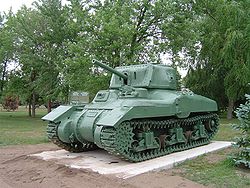
View on WikipediaThe Ram was a cruiser tank designed and built by Canada in the Second World War, based on the U.S. M3 Medium tank chassis. Due to standardization on the American Sherman tank for frontline units, it was used exclusively for training purposes for the Ontario regiment and was never used in combat as a gun tank. The chassis was used for several other combat roles however, such as a flamethrower tank, observation post and armoured personnel carrier.
Key Information


Development
[edit]
Even before the loss of the majority of the United Kingdom's tank force in France in 1940 after Dunkirk, it was recognised that tank production in the UK at the start of the war was insufficient and capacity in the US was taken for British needs.[2] So it was necessary that if Canada was to equip with tanks they would have to be manufactured locally.[3] In June 1940 the Canadian Pacific Railway's Angus Shops in Montreal, as the only large firm with spare capacity, had received a contract to produce 300 partially fitted out Valentine tanks for the British; this was followed later with one for 488 complete tanks for Canada.[4] However the Valentine was an infantry tank and Canada required a cruiser tank for its recently formed armoured division. In the end 1,420 Valentines were produced by CPR, most of which were supplied to the USSR. Although the Valentine used a number of American produced parts, its reliance on British components, difficulties in adapting its manufacture to North American methods, and other problems such as limitations to the availability of the right type of armour plate affected Valentine production. The Canadian Joint Committee on Tank Development concluded, in September 1940, that its cruiser tank should be based on a US rather than a British design.[5] This would be quicker and allow it to use components already in production for the US design.[6]
The Canadians were interested in production of the M3 Medium. However the M3 was an interim design; its main armament was in a side sponson, it was tall and under-armoured, and it was clear that it would be unsatisfactory for Canadian and British use. In early 1941 the Canadian Interdepartmental Tank Committee adopted a compromise: to develop a superior design locally but still using the M3 chassis.[7] The British Tank Mission, which was involved in the modifications of the M3 for British use, contributed a tank expert, L.E. Carr, to design a new hull and turret for the Canadian tank which could take a 6-pounder (57 mm) or 75mm gun while retaining the lower hull of the US M3 Medium.[8]
The new hull was cast rather than welded or riveted and lower than that of the M3. The pilot model's turret and upper hull casting was produced in the US by General Steel Castings and later they aided the set up of Canadian production.[3] Montreal Locomotive Works (MLW) was chosen to make the new Canadian M.3 Cruiser Tank (as it was then known) and was given the funding to set up the Canadian Tank Arsenal at Longue Pointe. MLW was a subsidiary of the American Locomotive Company, which had experience in producing large castings and Alco was producing cast hulls for the M3 Medium.
Canadian engineers ran into many challenges when developing the tank as Canada had never produced a tank before. Along with the lack of knowledge, it took time for Canadian factories to gear up for the production of many of the Ram's components.
Initially Canada relied heavily on United States and British materials to complete the construction of the Ram. Most critically the Ram's Continental engine and transmissions were available only in the USA and these were always in short supply. The Ram tank was developed with a turret which unlike the US M3 could traverse the main armament 360 degrees. Its fully cast armoured steel hull gave reinforced protection and, with the driver's seat repositioned to meet British requirements for right-hand drive,[3] lower height; while the U.S.-designed chassis and power train ensured its overall reliability.[9]
Although it could mount a US 75 mm gun, the preferred armament for the Ram was the QF 6 pounder which had superior armour-piercing capability. As neither the 6 pounder nor the Canadian-designed mounting for it was immediately available, early production (50 tanks) were fitted with the 40 mm QF 2-pounder gun.[8][10]

A prototype Ram was completed in June 1941 and general production of the Ram I began in November of the same year. The Ram I and early Ram IIs were fitted with side doors in the hull and an auxiliary machine gun turret in the front. The former weakened the hull and complicated production, and the doors and the machine gun turret were discarded in later modifications. By February 1942 production had switched to the Ram II model with a 6-pounder gun and continued until July 1943. In March 1942 a decision had been made to change production over to the automotively-similar M4A1 Sherman tank for all British and Canadian units. Ram production continued due to delay in starting the new M4 production lines and a reluctance to let the plant lie idle.[3] By July 1943 1,948 vehicles plus 84 artillery observation post (OP) vehicles had been completed.
The official Canadian history of the war compares the Ram to the Ross rifle as examples of unsuccessful Canadian weapon designs. It states that given the Sherman's superiority, in retrospect it would probably have been better for the United States to produce more tanks, and for Canada to have focused on manufacturing more transport vehicles such as the successful Canadian Military Pattern truck designs. The Sexton self-propelled gun based on the Ram chassis, however, was very successful.[11]
Combat history
[edit]
As built, the Ram was never used in combat as a tank, but was used for crew training in Canada and Great Britain up to mid 1944. The observation post vehicles and Armoured Personnel Carrier, gun tractor, and munitions carrier versions of the Ram saw considerable active service in North West Europe. These tanks were mainly rebuilt by Canadian Army workshops in the United Kingdom. Conversions of Ram tanks with the Wasp II flamethrower gear were used by the 5th Canadian Armoured Brigade in the Netherlands in 1945.[12]
Export
[edit]Netherlands
[edit]
In 1945 the Royal Netherlands Army got permission from the Canadian government to take free possession of all Ram tanks in army dumps on Dutch territory.[citation needed] Those not already converted into Kangaroos were used to equip the 1st and 2nd Tank Battalion (1e en 2e Bataljon Vechtwagens), the very first Dutch tank units. These had a nominal organic strength of 53 each. However it proved to be impossible to ready enough tanks to attain this strength because the vehicles were in a very poor state of maintenance. In 1945 it was also reported that the Dutch government was negotiating the purchase of 44 Ram tanks that were stationed in England alongside the purchase of other military equipment of Canadian origin.[13][14][15] In 1947 the UK provided 44 Ram tanks from its stocks, that were in a better condition.[citation needed] Forty of these had been rebuilt with the British 75 mm gun; four were OP/Command vehicles with a dummy gun. This brought the operational total for that year to just 73, including two Mark Is.[citation needed] In 1950 only fifty of these were listed as present. The Ram tanks were replaced, together with the Sherman tanks, by Centurion tanks beginning in 1953.[16] Some Ram tanks were used in the 1950s as static pillboxes in the IJssel Line, their hulls dug in and embedded within two feet of concrete.
Survivors
[edit]One Dutch Ram tank, an OP/Command vehicle, survives at the Dutch Cavalry Museum in Amersfoort.
A Ram tank modified as a Kangaroo serves as a memorial to the 1st Canadian Armoured Carrier Regiment in Mill, Netherlands.
Ram tanks can also be seen at the Canadian War Museum (the Kangaroo version), in Worthington Park at Canadian Forces Base Borden, in front of the Beatty Street Drill Hall in Vancouver, and at the Bovington Tank Museum (both a tank [17] and a Kangaroo[18])
A Ram Tank can also be seen outside of the Armoured Trial and Development Unit based at Bovington Camp.
Variants
[edit]- Tank Cruiser, Ram Mk I
- Ordnance QF 2 pounder / 40mm gun (171 rounds).
- Tank Cruiser, Ram Mk II
- Early production — QF 6 pounder Mk III (57 mm L/43) gun with 92 rounds.
- Late production — QF 6 pounder Mk V (57 mm L/50) gun. Auxiliary turret and sponson door removed. Browning .303 in (7.7 mm) machine gun fitted in ball mount.
- Badger
- A flamethrower equipped tank. The first Badgers were Ram Kangaroos with the Wasp II flamethrowing equipment (as used on the Universal Carrier) installed in place of the bow MG. Later models were turreted Rams with the equipment in place of the main gun.
- Ram Kangaroo
- Ram with turret removed to give an armoured personnel carrier capable of carrying 11 battle-ready troops (or -- more often -- as many as could fit) as well as the two crew. See Kangaroo.
- Ram OP/Command (84)
- An armoured vehicle to function as a mobile observation posts for the Forward Observation Officers (FOO) of Sexton self-propelled gun units, based on Ram Mk II. The gun was replaced by a dummy, and two Wireless Set No. 19 radios were fitted with a No. 58 set. Crew of six. They were built from the last 84 Rams off the production line in 1943.[3]
- Ram GPO
- Like OP but with special equipment for "Gun Position Officers" of self-propelled artillery regiments. Had Tannoy loudspeakers mounted.
- Sexton "25-pdr, SP, Tracked"
- Self-propelled artillery vehicle armed with QF 25 pounder gun in open-topped superstructure.
- Ram Ammunition Carrier
- Also called "Wallaby", an armoured ammunition supply vehicle, converted as for the Kangaroo but used to carried 25-pdr ammunition for Sexton.
- Ram ARV Mk I
- Armoured recovery vehicle created by adding winch gear added to Ram Mark I .
- Ram ARV Mk II
- Armoured Recovery Vehicle based on Ram Mk II. Jibs and earth spade added, turret replaced by dummy.
- Ram Gun Tower
- Armoured artillery tractor for use with Ordnance QF 17 pounder towed Anti-tank gun.
In addition, a Ram was used in an attempt to produce a self-propelled QF 3.7 inch AA gun but got no further than testing.[19]
-
 Ram Mk I
 -
 Ram Mk II – early production
 -
 Ram Mk II – later production, with Mk III QF 6 pounder but still with auxiliary turret
 -
 Ram OP/Command tank at Amersfoort
 -
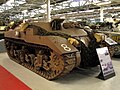 Ram Kangaroo at The Tank Museum, Bovington
 -
 Sexton I
 -
 Ram 3.7 inch during testing


.jpg)

See also
[edit]Tanks of comparable role, performance, and era
- Australian Sentinel
- British Cromwell
- German Panzer IV
- Hungarian Turán III
- Italian Carro Armato P 40
- Italian P43 (proposal)
- Japanese Type 3 Chi-Nu
- Soviet T-34
- Swedish Stridsvagn m/42
- American M4 Sherman
- Argentinian Nahuel DL 43
Other Commonwealth Tanks of the Second World War
- Bob Semple tank – New Zealand indigenous tank design
- Grizzly tank – Canadian licence built M4A1 Sherman
- Schofield tank – New Zealand indigenous tank design
- Sentinel tank - Australian indigenous tank design
Notes
[edit]- ^ Hunnicutt, R.P. (1978). Sherman: A history of the American medium tank. Presidio Press. pp. 535–536.
- ^ Ellis and Chamberlain p3
- ^ a b c d e Ellis and Chamberlain
- ^ Ellis & Chamberlain p5
- ^ Cameron, L.R.Tank Production in Canada AHQ Report 38, Department of National Defence Directorate of History and Heritage (DHH), 27 July 1950
- ^ Chamberlain & Ellis (1969) p172
- ^ Ellis and Chamberlain p6
- ^ a b Fletcher, Great Tank Scandal, p. 94.
- ^ Broad p27
- ^ Chamberlain and Ellis p172
- ^ Stacey, C. P. (1970). Arms, Men and Government: The War Policies of Canada, 1939–1945 (PDF). The Queen's Printer by authority of the Minister of National Defence. pp. 513–514. Archived from the original (PDF) on 26 February 2021. Retrieved 2 January 2012.
- ^ Ellis and Chamberlain p18
- ^ "Nederland koopt Canadeesch legermaterieel: Uitrusting voor vier divisies". De Maasbode (in Dutch). 7 December 1945.
- ^ "Regering koopt legeruitrusting: Tanks, geschut, auto's en geweren". Het Binnenhof (in Dutch). 7 December 1945.
- ^ "Nederland koopt Canadese legeruitrusting: Voor gebruik in het Oosten". De Waarheid (in Dutch). 7 December 1945.
- ^ Henny de Boer (18 March 2025). "Materieel van toen: Centurion". Materieelgezien (in Dutch). Defensie.nl.
- ^ Tank Cruiser, Ram Mark II (E1988.23), Tank Museum
- ^ Ram Kangaroo, Armoured Personnel Carrier, Full Tracked (E1985.121), Tank Museum
- ^ Chamberlain & Ellis (1969) p 174
References
[edit]- Chris Ellis, Peter Chamberlain – AFV No. 13 – Ram and Sexton, Profile Publications, England
- Chamberlain, Peter; Ellis, Chris (1969), British and American Tanks of World War II (2nd US (1981) ed.), Arco Publishing
- Roberts, Paul – The Ram – Developments and Variants, Vol. 1, Service Publications, Ottawa, Canada 2002
- Roberts, Paul – The Ram – Developments and Variants, Vol. 2, Service Publications, Ottawa, Canada 2004
- Law, Clive – Making Tracks – Tank Production in Canada, Service Publications, Ottawa, Canada 2001
- Fletcher, David (1989). The Great Tank Scandal: British Armour in the Second World War - Part 1. HMSO. ISBN 978-0-11-290460-1.
- Broad, Graham – "Not competent to produce tanks" The Ram and Tank Production in Canada, 1939-1945, Canadian Military History Volume 11 Number 1, Beacon Herald Fine Printing Division, Stratford, Canada 2002
- Wallace, John F. – Dragons of Steel: Canadian Armour in Two World Wars, The General Store Publishing House, Burnstown, Canada 1995
External links
[edit]
- Newsreel of Ram tanks in production and testing. Archived 11 June 2011 at the Wayback Machine
- WWII vehicles
- Mapleleafup.org
- Ram Tank registry
- Dutch Cavalry Museum has a RAM Tank Mk.2 in its collection.
Ram tank
View on GrokipediaDevelopment and Design
Origins and Requirements
In the wake of the Fall of France and the Dunkirk evacuation in 1940, Britain faced acute shortages of armored vehicles for the Commonwealth forces, prompting Canada to expand its nascent munitions industry to support the Allied war effort.[1] The Department of Munitions and Supply, established in 1939 under Minister C. D. Howe, played a pivotal role in coordinating this expansion, initiating projects for domestic production of tanks to alleviate reliance on imports from Britain and the United States, where orders were prioritized for other allies.[5] Senior military leaders, including General A. G. L. McNaughton, who served as Chief of the General Staff in the interwar period and commanded Canadian forces early in the war, advocated for mechanized capabilities that aligned with these strategic imperatives.[6] Canadian armored vehicle development accelerated in 1940–1941, with the Ram tank project emerging as a response to the need for a cruiser-style medium tank suitable for rapid production in North America. Influenced by the American M3 Medium tank's reliable chassis and powertrain—already in limited supply to Canada—the design incorporated British cruiser tank concepts to enhance mobility and firepower, addressing the M3's drawbacks such as its high silhouette and limited sponson-mounted gun traverse.[7] A key decision was the adoption of a two-man turret, which improved operational efficiency by reducing crew size compared to larger three-man designs, allowing for a lower profile and better balance while maintaining combat effectiveness.[8] The first prototype was completed in July 1941, with production beginning in November 1941 at the Montreal Locomotive Works.[9] Specific requirements emphasized compatibility with British armament standards, including provision for a 6-pounder (57 mm) gun to counter evolving German threats, while adhering to a 30-ton weight limit to ensure transportability across North American rail and road networks.[10] The design prioritized industrial feasibility, leveraging U.S.-sourced components like the Continental R-975 radial engine for the chassis, enabling mass production at facilities such as the Montreal Locomotive Works without extensive retooling.[7] This approach reflected Canada's strategic goal of contributing over 2,000 tanks to the Commonwealth by mid-1943, though the Ram ultimately served more in training roles due to the influx of superior models like the Sherman.[8]Technical Specifications
The Ram tank, adapted from the M3 medium tank chassis, incorporated a compact layout optimized for cruiser roles, with dimensions of 19 feet (5.8 meters) in length, 9 feet 5 inches (2.87 meters) in width, and 8 feet 9 inches (2.67 meters) in height.[2][7] These measurements contributed to its relatively low silhouette compared to some contemporaries, aiding maneuverability in varied terrains.[11] Weighing approximately 29 tons in combat configuration, the tank balanced protection and mobility effectively for its era.[2][11] It was powered by a Continental R-975 9-cylinder radial gasoline engine delivering 400 horsepower at 2,400 rpm, enabling a maximum road speed of 25 miles per hour (40 km/h) and an operational range of 144 miles (232 km) on internal fuel stores.[7][2] The suspension utilized a vertical volute spring system (VVSS), featuring five dual road wheels per side to absorb shocks and maintain traction across uneven ground.[11] The standard crew consisted of five members: commander, gunner, loader, driver, and co-driver/hull gunner, allowing for efficient operation of its systems during training and potential field use.[2][7] To contextualize its capabilities, the following table compares key specifications of the Ram tank against contemporaries like the American M3 Grant (a direct design predecessor) and the British Cromwell cruiser tank:| Specification | Ram Tank | M3 Grant | Cromwell Tank |
|---|---|---|---|
| Weight (tons) | 29 | 30 | 28 |
| Length (ft/m) | 19 / 5.8 | 18.5 / 5.64 | 20.8 / 6.35 |
| Width (ft/m) | 9.5 / 2.87 | 8.7 / 2.65 | 9.5 / 2.91 |
| Height (ft/m) | 8.8 / 2.67 | 10.3 / 3.14 | 8.2 / 2.49 |
| Engine Power (hp) | 400 | 400 | 600 |
| Top Speed (mph/km/h) | 25 / 40 | 26 / 42 | 40 / 64 |
| Range (miles/km) | 144 / 232 | 120 / 193 | 165 / 265 |
| Crew | 5 | 6 | 5 |
Armament and Protection
The Ram tank's primary armament consisted of the British Ordnance QF 6-pounder anti-tank gun mounted in a two-man turret, designed to engage German medium tanks like the Panzer IV at typical combat ranges. This 57 mm gun, specifically the Mk III variant with an L/43 barrel length, carried 92 rounds of ammunition and provided effective armor-piercing capability, with solid-shot AP rounds penetrating approximately 84 mm of armor at 500 yards on a perpendicular surface—sufficient to defeat the frontal armor of most Panzer IV variants encountered in 1942-1943.[13] Complementing the main gun were secondary weapons, including a coaxial 0.30-inch (7.62 mm) Browning machine gun for close-range anti-infantry fire and a hull-mounted 0.30-inch Browning in the assistant driver's position, with an optional roof-mounted 0.30-inch machine gun for anti-aircraft defense; these were supplied with around 4,000 rounds total.[7] The armament suite addressed wartime needs for versatile anti-tank and suppressive fire, though the 6-pounder's limited high-explosive shell options—such as the HE round with a 0.91 kg filling—restricted its utility against soft targets compared to later 75 mm guns. The tank's protection emphasized frontal defense through layered rolled homogeneous armor, with the turret front reaching up to 80 mm thick and the hull upper glacis plate measuring 50-89 mm, sloped at 56 degrees to increase effective thickness against incoming projectiles. Hull sides and rear were thinner at 38-50 mm, while the turret sides and rear provided 38-44 mm, prioritizing survival in head-on engagements typical of Allied armored doctrine. This layout, influenced by North American production techniques, offered respectable resistance to 50 mm anti-tank guns at 500 yards but was vulnerable to heavier German weapons like the 75 mm Pak 40 beyond close range. Overall, the armor scheme balanced weight constraints with tactical requirements for crew protection during training and potential combat, achieving a combat weight of about 30 tons without compromising mobility unduly. Fire control systems were rudimentary by mid-war standards, relying on manual turret traverse via a hydraulic assist and a basic telescopic sight—likely the No. 15 or equivalent—for the gunner, with elevation ranging from -10 to +20 degrees and traverse of 360 degrees. These limitations, including no stabilization and restricted depression angles that hindered indirect fire over obstacles, reflected the Ram's intended role in open terrain engagements rather than urban or hull-down positions. Ammunition versatility included armor-piercing capped ballistic cap (APCBC) rounds for improved penetration against sloped armor, alongside high-explosive shells for versatility, though tungsten-core APDS rounds were not widely issued to Ram units due to shortages.Production and Deployment
Manufacturing Details
Production of the Ram tank commenced in late 1941 at the Montreal Locomotive Works in Montreal, Canada, with the majority of output occurring from 1942 onward, culminating in a total of 1,949 units (comprising 50 Ram Mk I and 1,899 Ram Mk II) completed by the summer of 1943.[1] The facility, originally a locomotive manufacturer, adapted its lines to tank assembly under government contracts to bolster Allied armored vehicle supplies. This effort marked one of Canada's earliest forays into heavy armored vehicle production, aligning with broader wartime mobilization to produce over 2,000 tanks and related vehicles by war's end. The assembly process relied heavily on imported components to overcome domestic limitations in scale and expertise. Hulls and turrets were cast in the United States at facilities like the General Steel Castings Corporation's Commonwealth Plant in Granite City, Illinois, due to the size exceeding Canadian casting capabilities at the time. These were then shipped to Montreal for integration with other parts, including the American-sourced Continental R-975 radial gasoline engine providing 400 horsepower, transmissions, and tracks derived from the U.S. M3 Medium Tank design. British-designed elements, such as the initial 2-pounder or later 6-pounder main gun, were mounted in the turret, requiring precise alignment during final assembly to ensure operational reliability. Several challenges impeded efficient production. Supply chain delays arose from the integration of British gun components, particularly the switch to the 6-pounder Ordnance QF 57 mm gun, which postponed full output as shipments from the United Kingdom were sporadic amid wartime priorities. Machine tool shortages further slowed manufacturing, as Canada lacked sufficient specialized equipment for precision work on armored components. Labor constraints, exacerbated by wartime demands across industries, prompted the recruitment of women into factory roles, shifting operations toward more streamlined U.S.-style mass production methods to accelerate throughput despite initial inexperience with tank fabrication. The Ram tank program significantly contributed to the expansion of Canada's wartime industrial base, fostering skills in heavy engineering and assembly that supported subsequent projects like the Grizzly and Sexton vehicles, while generating employment and infrastructure investments valued in the millions of dollars.Initial Deployment and Training Role
The Ram tank began entering service with Canadian Armoured Corps units in late 1941, with initial allocations supporting the expansion of armored training programs across Canada and the United Kingdom. By early 1942, deliveries had ramped up, enabling the equipping of regiments such as Lord Strathcona's Horse (Royal Canadians), which conducted two years of intensive training in England using the Canadian-built vehicles. These early deployments focused on domestic and overseas preparation rather than immediate combat readiness, as the tanks were integrated into regimental and divisional exercises to build crew proficiency.[7][14] Primarily employed at key training centers like Camp Borden in Ontario, the Ram served as a surrogate for the M4 Sherman tank, sharing similar hull dimensions, turret ring size, and automotive components that facilitated a smooth transition for crews to frontline equipment. Its mechanical reliability and ease of maintenance made it ideal for simulating Sherman operations in gunnery, driving, and tactical maneuvers, with units such as the Ontario Regiment conducting brief familiarization courses in early 1943 before re-equipping. By 1944, nearly all of the approximately 1,950 produced Rams were dedicated to crew instruction, supporting the preparation of thousands of personnel across armored divisions and contributing significantly to their operational readiness for overseas deployment.[15][16][17] Beyond direct crew training, Rams fulfilled various non-combat support roles within Canadian forces, including as observation posts (Ram OP variants with dummy guns for artillery coordination), target towing vehicles during live-fire exercises, and improvised recovery platforms like the Ram Porpoise beach armored recovery vehicle prototype. The preference for U.S. Lend-Lease Shermans, driven by Allied standardization efforts and the Ram's armament limitations against evolving threats, confined these tanks to rear-area duties and ensured their extensive use in accelerating the buildup of experienced armored units for campaigns like Normandy.[18][19][7][20]Operational History
Combat Engagements
The Ram tank saw no combat use during World War II, primarily serving as a training vehicle for Canadian forces rather than in frontline roles. Although issued to the 1st Canadian Armoured Brigade in March 1943 as a replacement for Churchill tanks, the brigade transitioned to Sherman tanks by May 1943 in preparation for deployment, ensuring no Ram tanks participated in the Sicilian campaign starting July 10, 1943.[21] This rapid replacement was driven by logistical standardization and the preference for Sherman tanks in overseas operations, leaving the Ram confined to home defense and training establishments.[18] No verified records exist of Ram tanks engaging in direct combat with German forces. The tank's obsolescence against upgraded German armor, including vulnerability to 88 mm guns, contributed to its exclusion from active theaters, with units withdrawn for conversion to other roles by late 1943.[21] While the gun tank variants saw no combat losses, the Ram chassis was employed in operational roles through conversions, such as observation posts used by Canadian forces in the Normandy campaign of 1944 for reconnaissance and command purposes.Export and Foreign Service
Following World War II, a number of Ram tanks were transferred to allied nations for training and defensive roles, with the Netherlands receiving the largest allocation. In 1946–1947, the United Kingdom supplied 44 Ram tanks to the Royal Netherlands Army, consisting of 40 Ram II models armed with 6-pounder guns, 2 Ram I Armoured Recovery Vehicles, and 2 Ram 2D command tanks. Additional surplus Ram tanks were provided, bringing the total to 73 vehicles.[9][22] The Dutch Rams were operated by units including the Prins Bernhard Brigade, but saw no major combat deployments abroad; instead, they were employed for training and static defense. By the early 1950s, the vehicles were phased out due to mechanical wear and obsolescence, with many embedded as concrete-filled pillboxes along the IJssel Line defensive barrier and replaced by more modern Centurion tanks.[9] Other exports were minor, including a small number of Ram tanks to Belgium for training purposes in the late 1940s. The United Kingdom also received Ram tanks as training aids in 1943, using them until mid-1944 before converting many to other roles such as observation posts. Over 1,400 Ram tanks were shipped to the UK during the war, with additional post-war transfers to nations like the Netherlands.[23]Variants and Conversions
Armored Personnel Carrier Versions
The Ram Kangaroo was developed in 1944 as an armored personnel carrier by converting surplus Ram tank hulls, primarily to address the need for protected infantry transport during the later stages of the Second World War.[24][25] These conversions involved removing the turret and superstructure to create space for troops, installing a rear ramp for rapid entry and exit, and modifying the interior to accommodate 10-12 infantrymen plus a crew of two (driver and commander).[24][26] The design retained the original Ram's Continental R-975 radial gasoline engine producing 400 horsepower and frontal armor up to 76 mm thick, providing effective protection against small arms and shrapnel while maintaining mobility for close infantry support.[26][25] Additional modifications included pintle mounts for a .30-caliber M1919 Browning machine gun or sometimes a .50-caliber M2 Browning for suppressive fire, enhancing the vehicle's role in accompanying assaults.[26][25] In combat, the Ram Kangaroos proved invaluable for delivering infantry under fire, first seeing action during the Normandy breakout in August 1944 as part of the 1st Canadian Armoured Carrier Regiment.[24] They played a key role in Operation Totalize, where they transported troops across open ground to support the advance toward Falaise, and later provided mobile cover for infantry during the Scheldt offensive in late 1944, enabling Canadian forces to clear vital ports despite muddy terrain and German defenses.[24] The vehicle's speed was approximately 25 mph (40 km/h) on roads unloaded, though this reduced to around 20 mph when fully loaded with troops and equipment, reflecting the added weight of roughly 23.5 tons in battle configuration.[26][25] Production of the Ram Kangaroos was carried out in Canadian Army workshops in the United Kingdom, with over 100 units converted from existing Ram tanks by early 1945 to replace earlier Priest-based Kangaroos.[24] Total conversions reached approximately 500, equipping one Canadian and one British armored carrier regiment for operations through the end of the war in Europe.[24][27][25] These vehicles marked an innovative use of obsolete tank chassis, influencing post-war APC designs by demonstrating the effectiveness of tracked, armored troop carriers in combined arms tactics.[24][25]Self-Propelled Gun Adaptations
The Sexton self-propelled gun was developed in 1943 as a Canadian adaptation of the Ram tank hull to provide mobile artillery support for British Commonwealth forces during World War II.[28] The Sexton I variant utilized the Ram chassis directly, with the turret removed and replaced by an open-top superstructure mounting the Ordnance QF 25-pounder gun-howitzer; only 125 units of this mark were produced before shifting to the more readily available Grizzly chassis for the Sexton II.[29] Overall, 2,150 Sextons were manufactured between 1943 and 1945 at the Montreal Locomotive Works, with approximately 2,025 being the Sexton II model, which included minor improvements such as additional rear storage for batteries and a generator.[30][28] The primary armament was the 87.6 mm (3.45-inch) Ordnance QF 25-pounder gun-howitzer, capable of firing a 25-pound high-explosive shell to a maximum range of about 12,000 yards using standard charges, or up to 13,400 yards with super charges.[31] The vehicle carried 105 rounds of ammunition, primarily high-explosive, stored in rear lockers and ready racks, and was operated by a crew of six: commander, gunner, loader, driver, wireless operator, and ammunition handler.[32] Secondary armament consisted of two .303-inch Bren machine guns for self-defense.[28] Sextons were deployed with the 21st Army Group in North-West Europe starting from the Normandy landings in June 1944, equipping field artillery regiments of British, Canadian, Polish, and other Allied units.[33] They played a crucial role in providing rapid indirect fire support during key operations, including the closure of the Falaise Pocket in August 1944, where batteries from units like the 1st Polish Armoured Division and Canadian regiments delivered concentrated barrages to trap retreating German forces.[34] Later, Sextons supported the Allied advance across the Rhine River in March 1945, maintaining mobility and firepower during the rapid exploitation phase into Germany.[28] The Sexton's tracked design offered significant advantages in mobility over towed 25-pounders, allowing it to keep pace with armored divisions across varied terrain and reposition quickly for counter-battery fire or close support.[32] However, its open-top mounting limited protection against shrapnel and air attack, and the fixed traverse restricted its effectiveness in direct-fire roles compared to fully enclosed tank destroyers.[33]Other Modifications
The Ram Badger was a flamethrower variant developed in 1945 by converting Ram Kangaroo armored personnel carriers, replacing the main armament with a Wasp II flamethrower projector mounted in the hull front.[35] This adaptation aimed to provide close-support fire capability in urban and fortified areas, with the flamethrower fed by fuel tanks carrying up to 300 imperial gallons for sustained operation.[36] A total of 24 Badgers were produced and deployed with units like The Lake Superior Regiment (Motor) starting in February 1945, seeing limited combat in the Netherlands until the war's end, after which the project was not pursued further due to the cessation of hostilities.[35] Several Ram tanks were converted into command and observation posts, primarily for artillery forward observation officers, by removing the turret and enhancing the hull with additional radio equipment for improved communication.[37] These turretless vehicles, designated Ram OP/Command, retained the original armor and mobility while incorporating dummy gun fittings in some cases to maintain a low profile, allowing crews to direct fire support from forward positions.[3] Approximately 84 such conversions were completed, mainly used in training roles within Canada and by Canadian forces in Europe, where they supported field artillery coordination without entering direct combat.[37] Recovery vehicles based on surplus Ram hulls included the Ram ARV Mk I and Mk II, with the former featuring a simple winch and A-frame for towing, while the latter added a turret-mounted jib crane and an earth spade for stabilization and light earth-moving tasks.[37] Around 20 units were produced from existing chassis, primarily for workshop and training recovery operations rather than frontline use, as the end of the war reduced the need for additional specialized vehicles.[19] Experimental trials on the Ram chassis explored anti-aircraft capabilities through the OQF 3.7-inch AA mounting, a prototype that replaced the turret with a twin 3.7-inch gun for both aerial and ground targets, tested in Canada during 1944 but abandoned due to the gun's excessive weight compromising mobility and the arrival of more suitable Allied platforms.[38] Dozer blade attachments were also trialed on select hulls, integrated as rear spades on ARV prototypes for anchoring during recoveries, but limited adoption occurred because wartime priorities shifted away from further engineering variants by 1945.[37]Legacy
Post-War Assessment
The Ram tank's rapid production during World War II significantly bolstered Allied armored readiness, with Montreal Locomotive Works manufacturing 1,949 units between 1941 and 1943, achieving rates of up to 10 tanks per day by mid-1942 through innovative welding techniques.[39][40] This output provided essential training platforms for Canadian and British crews, compensating for initial shortages in modern tanks. Furthermore, the Ram's versatile chassis enabled widespread repurposing, with a significant portion converted into support variants such as observation posts (84 units), armored personnel carriers (Kangaroos), and other roles; the Sexton self-propelled artillery, newly built on the Ram chassis design, was produced in large numbers (2,150 total) for use in northwest Europe, extending the design's utility beyond its original cruiser role.[39] Despite these advantages, the Ram exhibited notable weaknesses that limited its viability as a combat vehicle. By 1944, it was obsolete against heavy German tanks like the Panther and Tiger, vulnerable to 50mm and 75mm anti-tank guns due to inadequate armor and the 6-pounder gun's limited penetration at range.[40] Mechanical reliability was further compromised by the Continental R-975 radial engine, which suffered from overheating, fuel line vibrations, and occasional fires during trials, though improvements in the Mk II variant mitigated some early issues.[39][40] These factors, combined with the arrival of superior designs like the M4 Sherman in 1942, ensured the Ram never entered frontline combat as a gun tank.[39] The Ram holds historical significance as a symbol of Canadian industrial independence, marking the only tank fully designed and produced domestically during the war and fostering local manufacturing expertise in armor and components.[39][40] This capability not only supported Allied efforts but also influenced post-war Canadian armored vehicle development through demonstrated chassis versatility.[39] In modern assessments, the Ram is viewed as a successful interim solution that bridged early-war gaps, despite its flaws; analyses in the 2020s highlight its role in military history, with occasional restorations of surviving examples underscoring ongoing interest in its legacy. In 2022, a long-lost Ram tank was discovered abandoned in a British field, further emphasizing continued discoveries related to the vehicle.[19][41][42]Surviving Examples
Several intact examples of the Ram tank survive in museums, primarily in Canada and the United Kingdom, serving as key artifacts for understanding Canadian armored vehicle production during World War II. According to preserved armored vehicle databases, fewer than 30 complete or substantially complete Ram tanks and their variants exist worldwide, with most in static display or storage.[42][43] In Canada, the Canadian War Museum in Ottawa houses a Ram Mk II Kangaroo armored personnel carrier, originally converted from a standard Ram hull for troop transport during the Normandy campaign; this example was restored to operational condition in the early 2010s and features period markings from the 1st Canadian Armoured Carrier Regiment.[44] Another intact Ram Mk II is preserved at the Worthington Tank Museum within Canadian Forces Base Borden, Ontario, where it represents early production models used for training by the Canadian Armoured Corps.[16] A third Canadian example, a Ram Mk II lower hull originally modified as a snowplow post-war, is also held in storage at the Canadian War Museum.[45] The United Kingdom preserves notable Ram variants at major institutions. The Bovington Tank Museum displays a Ram Mk II used as an evasive target tank (serial CT-159418), acquired on loan from Canada in exchange for other vehicles, highlighting post-war training adaptations.[25] Additionally, the museum holds a Ram Kangaroo APC in its reserve collection, built in 1942 and converted during wartime service.[46] At the Imperial War Museum in London, a Sexton self-propelled gun—based on the Ram chassis and mounting a 25-pounder gun—stands as a representative of the artillery variants produced in large numbers for British and Commonwealth forces.[30] In the Netherlands, a single Ram OP/Command vehicle survives at the Cavalry Museum in Amersfoort, acquired post-war for Dutch army training and serving briefly in the Indonesian War of Independence before preservation; this example retains its original 2-pounder turret adapted for observation duties.[47] While Dutch forces operated a small number of Rams in Indonesia during the late 1940s, no complete examples remain there, though partial remnants from that service are noted in regional military collections. Recent preservation efforts in the 2020s have focused on documentation and partial restorations, including digital imaging projects at institutions like the Bovington Tank Museum to create 3D models for educational and maintenance purposes, ensuring long-term accessibility without risking original components.[49] Overall, these surviving Rams underscore the vehicle's role in Allied training and conversion programs rather than frontline combat.References
- https://www.[reddit](/page/Reddit).com/r/TankPorn/comments/g8xp8y/canadian_ram_tanks_in_england_the_rams_never_saw/