Hubbry Logo
Excelsior tankExcelsior tankMain
Open search
Excelsior tank
Community hub
Excelsior tank
logo
8 pages, 0 posts
0 subscribers
Be the first to start a discussion here.
Excelsior tank
Excelsior tank
from Wikipedia

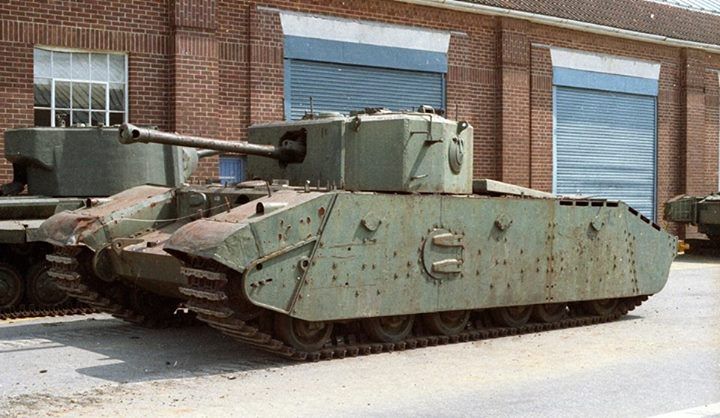
The Tank, Heavy Assault, A33 (Excelsior) was a British experimental heavy tank based on the Cromwell (A27) design developed in the Second World War. It was developed when there were concerns as to performance of the Churchill tank.

Key Information

Development

[edit]

After the Dieppe Raid in August 1942, there was concern that the Churchill infantry tank was slow and too unreliable and it was suggested that production of the Churchill stop in 1943 in order to manufacture more of the A27 (Cromwell) design, which was performing well in trials. While two lines of tanks were still policy, there was interest in a "universal tank chassis" from which infantry tanks, cruiser tanks, and other vehicles could be built. Until then an interim design based on the A27 to replace the Churchill as an infantry tank was considered.[1]

Rolls-Royce proposed an up-armoured A27M (Cromwell): A31 was a Cromwell with more armour and A32 was a more thorough redesign of the A27 with stronger suspension and armour equivalent to the Churchill. English Electric, contracted to build Cromwells, proposed using the A27 hull and turret with extra armour[note 1] and the track and suspension of the 50-ton US M6 Heavy Tank which had been developed for both US and British use.[1] This scheme received the General Staff number A33.

English Electric built two prototypes on a Cromwell tank hull, the first with the suspension and T1 track of the M6 tank in 1943 but with a 6-pounder gun. The second was built with a widened Cromwell track and suspension by LMS and different armoured skirts. The design included extra armour and an Ordnance QF 75 mm gun. When the problems of the early Churchill models were worked out, the A33 was no longer required and the project was dropped.[2]

Survivors

[edit]

The second pilot vehicle is in the collection of The Tank Museum in Bovington, UK.

See also

[edit]

Tanks of comparable role, performance, and era

[edit]
  • British Churchill – heavy tank, entered service in 1941
  • American-British T14 – another prototype heavy assault tank with similar specifications to Excelsior
  • American M6 – heavy tank, saw trials but never entered service
  • Soviet KV-1 – heavy tank, entered service in 1939

Notes

[edit]

References

[edit]

Bibliography

[edit]
Revisions and contributorsEdit on WikipediaRead on Wikipedia
from Grokipedia
The Tank, Heavy Assault, A33 (commonly known as the ) was a British prototype heavy assault tank developed during as a potential replacement for the unreliable and slow Churchill infantry tank. Initiated in 1942 under the Cromwell Rationalization Programme following combat experiences in North Africa that highlighted the need for a more versatile "universal" tank chassis capable of infantry support and cruiser roles, the A33 was designed by English Electric in collaboration with Rolls-Royce for the chassis and engine components. The project aimed to combine the mobility of the Cromwell cruiser tank (A27M) with enhanced armor and firepower to address the Churchill's (A22) shortcomings in reliability and speed, while also serving as a basis for assault tank variants. The design featured a weight of approximately 40 tons in battle-ready configuration, with a of five: commander, driver, gunner, loader, and radio operator/machine gunner. Its primary armament consisted of a 75 mm QF Mk.V gun (adapted from the 57 mm 6-pounder by boring out the barrel for better anti-infantry performance; the first mounted a 57 mm gun), carrying 35 to 80 rounds, supplemented by two 7.92 mm Besa machine guns with 5,000 rounds and optional twin "K" guns. Armor protection was significantly thicker than the Cromwell's, with up to 114 mm (4.5 inches) on the frontal hull and turret front, 76-92 mm on turret sides and rear, approximately 50-63 mm on hull sides (sloped), and a minimum of 20 mm on the roof, providing robust defense against German anti-tank threats. Powered by the V12 gasoline engine delivering 600–620 horsepower, the Excelsior achieved a top speed of 24–25 mph (39–40 km/h) on roads and about 19 km/h off-road, with a range of around 100–160 km depending on terrain. Suspension evolved across prototypes: the initial A33/1 used an American-influenced T1E2 system, while the improved A33/2 adopted a redesigned R.L.-type for better cross-country performance. Only two prototypes were constructed by English Electric in 1943, with testing revealing issues such as limited range and poor maneuverability on rough terrain. The project was cancelled in 1944 as upgrades to the Churchill— including a 75 mm gun and improved reliability—made it redundant, and the broader shift toward cruiser tanks like the (A34) aligned better with wartime priorities. The Excelsior never entered or production, though it influenced later concepts like the unbuilt A37. One surviving prototype, the A33/2, is preserved at The Tank Museum in Bovington, Dorset, , offering a rare glimpse into Britain's experimental armored vehicle efforts during the war.

Background and Development

Historical Context

The British tank doctrine in the early years of World War II was shaped by interwar concepts that categorized tanks into two primary types: cruiser tanks, which prioritized speed and lighter armor for rapid exploitation of breakthroughs, and infantry tanks, which emphasized heavy armor and slower speeds to accompany and protect advancing foot soldiers. This division, formalized in , aimed to support tactics but created challenges in adapting to the dynamic demands of , where versatility was increasingly vital. The , introduced as the leading , embodied these principles with its robust armor plating but was hampered by inherent design flaws, including a maximum speed of around 15 mph and persistent mechanical unreliability, such as gearbox and suspension failures that plagued early models during initial deployments. These shortcomings limited its effectiveness in providing sustained support, as demonstrated in operations where its sluggish pace failed to keep up with evolving battlefield needs and its frequent breakdowns reduced operational readiness. The of August 1942 acted as a pivotal catalyst, exposing these vulnerabilities on a large scale when Churchill tanks, intended to spearhead the assault, encountered severe mobility issues on the and reliability failures under combat stress, resulting in most being immobilized or destroyed before reaching key objectives. This disastrous operation, involving approximately 6,000 Allied troops, including nearly 5,000 Canadians, and 27 Churchill tanks that reached the shore, underscored the urgent strategic imperative for an interim heavy assault tank capable of combining enhanced protection with improved performance to address the doctrinal gaps between slow infantry tanks and faster cruisers like the Cromwell A27.

Design Initiation

In the aftermath of the in August 1942, which underscored vulnerabilities in armored infantry support, British tank designers accelerated efforts to develop a more reliable heavy assault tank to complement or replace the problematic Churchill. Rolls-Royce, as the primary developer of the (A27M), proposed up-armored variants in 1942 to meet the need for enhanced protection without a complete redesign. These included the A31 Heavy Cromwell, which added extra armor plating to the standard A27M hull, and the A32, a more substantial redesign incorporating a 6-pounder gun and armor comparable to the Churchill's for better infantry support capabilities. In parallel, English Electric pursued its own initiative for what became the A33 Excelsior, adapting the Cromwell hull as the base while integrating the suspension system from the American —featuring six pairs of road wheels per side—and bolting on additional armor plates to fulfill an role. The formal specification for the A33 was issued in September 1942 by the Department of Tank Design, with detailed work commencing at English Electric in October 1942; the project targeted initial production by mid-1943 to address urgent wartime demands. The overarching goal was to produce a "universal" that could be configured for either or duties, mitigating the Churchill's mechanical unreliability and limited mobility through shared components with the proven Cromwell , thereby avoiding the resource-intensive development of an entirely new vehicle.

Design and Specifications

Armament and Armor

The Excelsior tank's primary armament was the gun, a versatile weapon adapted from the 6-pounder by increasing its bore to enhance high-explosive performance for support while retaining anti-tank capability against German armor. This gun was mounted in the turret and carried 64 rounds of ammunition, allowing sustained engagement in assault roles. Complementing the main gun were two 7.92 mm Besa machine guns—one coaxial to the 75 mm for close-range anti- fire and one hull-mounted for additional suppression—along with 5,000 rounds; optional twin "K" 7.92 mm machine guns could be fitted on the turret roof for anti-aircraft defense (2,000 rounds), and a smoke mortar with 30 rounds was provided. This configuration reflected the tank's dual role in operations. The Excelsior's armor emphasized frontal protection to withstand German anti-tank weapons during breakthroughs, with up to 114 mm (4.5 inches) on the turret front and hull glacis, providing superior resistance compared to standard cruiser tanks. Hull sides were 51 mm (2 inches) thick, turret sides 89 mm (3.5 inches), and rear armor 76 mm (3 inches) across the turret and hull, with additional 25 mm (1 inch) skirt plates and 20 mm turret roof for comprehensive protection. Built on the Cromwell A27 hull base, the design incorporated additional bolted armor plates to augment baseline protection, enabling the Excelsior to function as a heavy assault vehicle despite its cruiser origins. The crew consisted of five members: , gunner, loader, , and co-driver/hull gunner, arranged in a layout akin to the Cromwell but with a reinforced turret to handle the heavier 75 mm 's recoil and operational stresses. This configuration supported efficient fire control and vehicle operation under combat conditions. To future-proof the design for escalating threats, the Excelsior featured a widened turret ring capable of accommodating upgrades to the more powerful 17-pounder , though this modification was never implemented in production prototypes.

Mobility and Engine

The Excelsior tank was powered by a V12 gasoline engine, producing 620 horsepower at 2,550 rpm. This engine, derived from the aero engine used in aircraft such as the , provided reliable propulsion adapted for armored vehicle use. The tank's suspension underwent variations across prototypes to address its increased weight compared to the base Cromwell design. The first prototype (A33/1) incorporated an American T1E2-type horizontal suspension derived from the , paired with wider tracks measuring approximately 19 inches (482 mm) to improve weight distribution and cross-country performance. The second prototype (A33/2) featured a British-designed R.L.-type suspension, developed jointly by Rolls-Royce and the London, Midland and Scottish Railway, which offered longer spring travel using horizontal units for enhanced mobility under heavy loads, though it proved complex and costly. Weighing 40 long tons (41 tonnes) in combat configuration, measured 22 feet 8 inches (6.91 m) in length, 11 feet 2 inches (3.40 m) in width, and 8 feet (2.44 m) in height. Performance specifications included a maximum road speed of 24 mph (39 km/h), an off-road speed of 12 mph (19 km/h), and an operational range of approximately 100 miles (160 km) on roads.

Prototypes and Evaluation

Construction of Prototypes

The two prototypes of the A33 Excelsior tank were constructed by English Electric at their works in the . These vehicles drew heavily on components from existing Cromwell (A27) production lines, including modified hull elements and the uprated engine, to streamline fabrication. The first prototype, designated A33/1, was completed in early 1943 and incorporated an American M6 heavy tank-inspired suspension system with six small-diameter road wheels per side and narrower tracks derived from the T1E2 type. It was armed with a 6-pounder (57 mm) and primarily intended for initial mobility evaluations. The second prototype, A33/2, followed in mid-1943 with upgrades including a refined UK-designed R.L. suspension featuring larger-diameter road wheels and widened tracks adapted from the Cromwell, measuring approximately 18 inches (457 mm). This version mounted a 75 mm Ordnance QF gun and was prepared for comprehensive armament trials. No further production was authorized beyond these two examples.

Testing and Performance

The prototypes of the A33 Excelsior tank underwent evaluation trials in 1943, primarily at the Lulworth Ranges and the Fighting Vehicles Proving Establishment (FVPE). These tests assessed the 's performance under various conditions, focusing on its potential as a heavy derived from components. Mobility trials demonstrated respectable performance for a weighing approximately 40 tons in battle configuration, with the uprated engine (producing 620 hp) enabling a top road speed of 24.8 mph (39.9 km/h). The engine proved generally reliable during the trials, though minor oil leaks occurred in cold weather—attributed to seal issues and resolved by installing rubber gaskets—along with electrical faults similar to those observed in the . However, the suspension systems presented notable challenges on rough terrain; the initial T1E2 (M6-type) setup experienced loose track guides in the first 300 miles of testing and was prone to bogging in muddy conditions, while a later R.L.-type suspension was deemed expensive and unreliable for production. Armament evaluations confirmed the effectiveness of the QF 75 mm Mk. V gun, which achieved reliable performance against simulated targets at ranges up to 1,000 yards, supported by 80 rounds of ammunition and elevation/depression angles of 20°/10°. The coaxial 7.92 mm (with 5,000 rounds) and twin 0.303-inch Vickers "K" machine guns (2,000 rounds) integrated well for roles. Nonetheless, the added weight slowed turret traverse compared to the lighter Cromwell, impacting responsiveness in dynamic scenarios. Overall, the trials highlighted the Excelsior's viability as an assault tank with strong terrain-crossing capabilities in dry conditions and no major reliability failures, but underscored integration difficulties with adapted components, particularly in suspension and muddy environments. These findings informed assessments of its suitability without leading to further development.

Cancellation and Legacy

Reasons for Cancellation

By mid-1943, significant upgrades to the , including improved tracks and engine modifications, had addressed its earlier issues with speed and mechanical reliability, eliminating the need for a dedicated replacement like the A33 Excelsior. These enhancements allowed the Churchill to continue serving effectively in its infantry support role, making the Excelsior's heavier assault design superfluous within the British Army's evolving armored doctrine. As preparations for the Normandy invasion intensified, military priorities shifted toward the of established tanks such as the Cromwell cruiser and the upgraded Churchill, which were better suited to the demands of large-scale operations. , envisioned as an interim solution, was seen as diverting scarce resources from these urgent needs without offering long-term strategic advantages. This redirection reflected a broader British for specialized tank types—infantry tanks for close support and cruisers for exploitation—over universal designs attempting to combine both roles. The project's fate paralleled that of the American , developed to similar specifications under a joint agreement but also cancelled due to resolved reliability issues in existing models and shifting wartime priorities. Following trials that demonstrated adequate but unexceptional performance, the A33 program was officially terminated in , with the two prototypes placed in storage.

Influence and Survivors

The A33 Excelsior's experimental design contributed to the evolution of British heavy tank concepts by demonstrating the potential of adapting the Cromwell chassis for enhanced armor and suspension. Its development underscored the operational challenges of hybrid cruiser-infantry tanks, which combined cruiser mobility with infantry-level protection but proved complex to produce efficiently, ultimately supporting the British Army's doctrinal pivot toward universal main battle tanks that integrated these attributes more seamlessly. In concept, the Excelsior paralleled the U.S. T14 heavy assault tank, both developed to identical specifications in as faster alternatives to tanks like the Churchill for breakthrough roles, though neither entered production due to resolved issues with existing designs. Although the prototypes saw no combat deployment, their evaluation provided insights into armored warfare tactics employed during the 1944 Normandy campaign, where British forces relied on mixed cruiser and formations for combined-arms operations. Only one of the two built prototypes, the A33/2 with its revised suspension, survives today; it is preserved at in Bovington, Dorset, , and is the sole example following the scrapping of A33/1. The vehicle is stored in the museum's Vehicle Conservation Centre. The Excelsior's design also influenced later concepts, such as the unbuilt A37. In contemporary contexts, the Excelsior appears in military simulations and media, notably as a playable Tier V premium in , where its historical fast-assault characteristics are adapted for gameplay, highlighting British experimental innovations in armored vehicle design.
Add your contribution
Related Hubs
User Avatar
No comments yet.