Hubbry Logo
Mount BehistunMount BehistunMain
Open search
Mount Behistun
Community hub
Mount Behistun
logo
8 pages, 0 posts
0 subscribers
Be the first to start a discussion here.
Mount Behistun
Mount Behistun
from Wikipedia

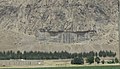
Mount Bisotoun (or Behistun and Bisotun) is a mountain of the Zagros Mountains range, located in Kermanshah Province, western Iran. It is located 525 kilometers (326 mi) west of Tehran.

Key Information

Behistun Inscription of Darius the Great

Cultural history

[edit]

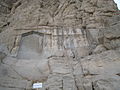
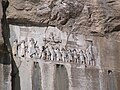
Mount Bisotoun, aka Bīsitūn (referring to the mountain and the nearby village), is a mountain with a rock precipice in the Zagros Mountains in Kermanshah, Iran. Darius I inscribed the flat rock face in three languages c. 500 BC, known as the Behistun Inscription.[1]

Legends

[edit]
Shirin on horseback visiting Farhad on Mount Bisotun, who is shown carving out the mountain. Created in 19th-century Qajar Iran

A legend began around Mount Bisotoun, as written about by the Persian poet Nezami about a man named Farhad, who was a lover of Shirin.

[edit]

References

[edit]
Revisions and contributorsEdit on WikipediaRead on Wikipedia
from Grokipedia
Mount Behistun, also known as Bisotun or Bisotoun, is a sacred mountain in the Zagros range of western , celebrated for its monumental ancient rock reliefs and multilingual inscriptions that illuminate the history of the . Located approximately 30 kilometers northeast of in at coordinates 34°23'18"N, 47°26'12"E, the mountain rises to an elevation of about 2,300 meters above sea level and features steep limestone cliffs overlooking a historic that connected the to . Its most iconic feature is the , commissioned by Darius I in 521 BCE, consisting of a 3-by-5.5-meter bas-relief depicting the king triumphing over rebels, accompanied by around 1,200 lines of cuneiform text in , Elamite, and Babylonian, carved approximately 100 meters above the plain on a sheer cliff face. This inscription, spanning 15 meters high and 25 meters wide, not only chronicles Darius's consolidation of power but also served as a pivotal "" for the 19th-century decipherment of scripts by scholars like Henry Rawlinson. The site encompasses archaeological remains from caves (dating to c. 40,000 BCE) through , Achaemenid, Seleucid, Parthian, Sassanian, and Ilkhanid periods, including additional reliefs such as a Seleucid statue of (148 BCE), Parthian carvings, a Sassanian , and an Ilkhanid , reflecting continuous human occupation and cultural exchanges over millennia. Designated a World Heritage Site in 2006 under criteria (ii) and (iii) for its exceptional testimony to intercultural influences in monumental art and writing, as well as its unique documentation of Persian imperial history, the 187-hectare core zone is managed by Iran's , Handicrafts and Tourism Organization to preserve its integrity amid natural and developmental threats.

Geography

Location and access

Mount Behistun is situated at coordinates 34°23′18″N 47°26′12″E in , western , as part of the range. The mountain lies approximately 30 km northeast of city, adjacent to the modern town of Bisotun, positioned along an ancient that linked the Mesopotamian plains to the Iranian plateau and supported historical connectivity between these regions. Access to Mount Behistun is primarily via the Kermanshah-Hamedan Highway (Route 48), with public transportation options including buses from to Bisotun, followed by trails to the mountain's base. The base sits at an of about 1,340 m above , rising to a summit of 2,752 m. As part of the UNESCO-designated Bisotun World Heritage spanning 361 hectares, the site integrates with the surrounding fertile plains and the adjacent Qareh Su River.

Topography and geology

Mount Behistun, situated in the of western , features a prominent topography characterized by steep cliffs that rise approximately 100 meters from the surrounding plain, providing an elevated platform historically utilized for monumental carvings. The mountain's southern face forms a dramatic vertical big wall spanning about 1,200 meters from base to summit, with an overall width of roughly 5 kilometers, making it one of the largest continuous rock faces in the region. The summit reaches an elevation of 2,752 meters above , overlooking the fertile plains of the region. Geologically, Mount Behistun is composed primarily of limestone from the Bisotun Formation, a thick succession deposited in an open marine environment during the Lower period as part of the Neotethys Ocean margin. This formation is integrated into the broader Zagros fold-thrust belt, which developed through the collision of the Arabian and Eurasian plates, with main deformation phases occurring during the era. The limestone exhibits features, including caves located at altitudes of 1,500 to 1,600 meters, resulting from dissolution processes in the soluble rock under varying climatic conditions. The mountain's natural features include seasonal springs emerging at its base, supporting a with annual precipitation ranging from 400 to 600 millimeters, primarily during winter and spring. Vegetation on the slopes consists of adapted woodlands featuring (Quercus brantii) and wild (Pistacia atlantica), which thrive in the region's Mediterranean-influenced conditions. Ongoing seismic activity within the Zagros belt, driven by continued plate convergence, contributes to patterns by promoting uplift and fracturing of the , enhancing landscape dynamism. The durable nature of the cliffs has aided in the long-term preservation of ancient inscriptions carved into the rock face.

History

Prehistoric settlement

Archaeological evidence indicates early human occupation in the vicinity of Mount Behistun dating back to the Middle Paleolithic period, with rock shelters and caves serving as primary habitation sites. Excavations at Bisitun Cave, also known as Hunter's Cave, located at an elevation of approximately 1,500 meters on the mountain's slopes, have yielded Mousterian stone tools and faunal remains from Pleistocene mammals, suggesting use as a temporary shelter for hunting activities. Human skeletal remains, identified as Neanderthal, were discovered in Middle Paleolithic layers of the same cave during 1949 excavations, pointing to sustained hominin presence in the Zagros Mountains region. Similarly, Ghar-e Khar Cave, situated nearby in the central Zagros, contains stratified lithic assemblages spanning the Middle to Upper Paleolithic transition, including bladelet technologies associated with the Baradostian industry around 40,000 years ago. These finds, including over 100 species of animal bones indicative of hunting economies, underscore the area's role in early human adaptation to mountainous environments. The prehistoric record extends into the Upper Paleolithic and Epipaleolithic periods, with artifacts such as microliths and bone tools recovered from sites like Mar Tarik Cave, also at 1,500–1,600 meters elevation, reflecting technological continuity and seasonal exploitation of local resources. By the Neolithic period, around 10,000 BCE, human activity shifted toward more sedentary patterns in the surrounding plains of Kermanshah Province, where numerous sites demonstrate early animal domestication, particularly of goats, and the beginnings of plant cultivation. This transition is exemplified by nearby settlements like Ganj Dareh Tepe, dated to approximately 8,450 BCE, which provide evidence of proto-agricultural communities in the intermontane valleys adjacent to Mount Behistun. No monumental structures from this era have been identified at the mountain itself, but the abundance of Neolithic sites in the province— the highest concentration in Iran—highlights the region's fertility for early farming and herding. Culturally, these prehistoric inhabitants relied on a mobile economy centered on large game, such as deer and equids, and seasonal along the mountain passes of the Zagros, which facilitated early exchanges of materials like and flint between highland and lowland groups. The absence of permanent villages on the mount proper suggests transient use for resource procurement, contrasting with the more stable settlements in the plains. This pattern persisted into the period (circa 5,500–3,500 BCE), where copper tools and fragments appear in regional surveys, predating later Elamite cultural influences in the broader area. Overall, the chronology of prehistoric settlement at Mount Behistun spans from the (over 40,000 years ago) through the , , and into the , establishing the site as a key node in the long-term human occupation of the .

Median period

Archaeological remains from the Median period (8th–7th centuries BCE) include a fortress structure located on the mountain slope just below the later Achaemenid monument. Identified through excavations, this fortress features rectangular towers and is associated with artifacts such as a bronze triangular , indicating a fortified settlement or outpost during the rise of the Median kingdom in the region. These findings highlight Mount Behistun's strategic importance in the prior to Achaemenid dominance.

Achaemenid period

During the , Mount Behistun emerged as a pivotal site for royal propaganda following the turbulent accession of Darius I (r. 522–486 BCE). After defeating the Gaumata in September 522 BCE and subsequently quelling multiple rebellions across the empire between 522 and 521 BCE, Darius sought to consolidate his legitimacy through monumental displays of power. The mountain's prominent cliff face, rising steeply above a major travel route, was selected for its visibility to passersby, drawing inspiration from earlier local rock reliefs such as the Anubanini relief at Sar-e Pol-e Zohab, approximately 150 km to the west. This choice underscored the site's role in broadcasting Darius's narrative of victory over nine key rebels and 19 battles, symbolizing his dominion over the empire's 23 satrapies. The mountain's strategic position along the Royal Road—a vital artery connecting to (modern ) and integrating into the broader network from to —amplified its administrative significance within the Achaemenid communication and trade system. Spanning key passes in the , the route facilitated rapid imperial messaging via the chapar postal relay and supported , with Behistun serving as a natural checkpoint for travelers and goods moving between Mesopotamian and heartlands. This integration highlighted the empire's emphasis on efficient governance, where prominent natural features like Behistun were leveraged to reinforce royal authority and monitor provincial loyalty. Around 520–518 BCE, artisans under Darius's commission carved a massive and accompanying trilingual inscription high on the cliff, approximately 100 meters above the plain, to immortalize these triumphs. Construction involved erecting a temporary wooden platform or ledge at the base and along the face for access, enabling sculptors to depict Darius triumphing over bound figures representing the subdued rebels. Once completed, the access structure was dismantled—likely a stairway or —to prevent tampering, ensuring the monument's enduring inaccessibility and symbolic permanence. This engineering feat not only propagated imperial ideology but also transformed the mountain into a enduring emblem of Achaemenid stability.

Post-Achaemenid eras

Following the fall of the in 330 BC, Mount Behistun continued to serve as a site of symbolic and political importance for subsequent rulers, who added monuments to assert their authority and cultural continuity. During the under Seleucid rule (c. 312–140 BC), a of was carved into the rock, dated to 148 BC, representing a fusion of with the local landscape and symbolizing the overlay of Hellenistic culture on Persian heritage. This addition, discovered in 1958 and later restored after damage, underscores the Seleucids' efforts to integrate their rule into the region's monumental tradition. In the Parthian period (c. 247 BC–224 AD), the Arsacid dynasty further layered the site's significance by commissioning reliefs that evoked Achaemenid precedents to legitimize their . A notable free-standing attributed to King Vologases (likely Vologases I, r. 51–78 AD, or a later in the 1st–2nd century AD) was carved adjacent to earlier Achaemenid works, depicting the king in a pose that emphasized continuity with ancient Iranian kingship and asserted Parthian dominion over the region. These additions, blending Iranian and Hellenistic artistic elements, highlight how the Parthians used the mountain to bridge their empire's diverse cultural influences while reinforcing legitimacy against rivals. The Sassanid Empire (224–651 AD) marked a peak in the site's architectural development, with major constructions at the mountain's base during the 3rd–7th centuries AD. King (r. 590–628 AD) initiated an unfinished complex, including sculpted capitals and associated structures like a bridge and , transforming the area into a royal complex that served as a strategic and ceremonial retreat overlooking key trade routes. This , positioned near the ancient inscription site, integrated Zoroastrian elements and exemplified Sassanid imperial architecture, emphasizing the mountain's enduring role in royal propaganda and governance. After the Sassanid collapse in the AD, Mount Behistun largely faded from prominent historical use, with the site seeing limited activity through the medieval Islamic periods, including minor Ilkhanid (13th–14th ) constructions like a and that were later destroyed by earthquakes. The mountain's monuments remained largely forgotten in the wider world until their rediscovery by European travelers in the , such as early visitors who documented the visible carvings, sparking initial scholarly interest that grew substantially in the amid broader explorations of Persian antiquities.

Archaeological sites

Behistun Inscription

The Behistun Inscription is a monumental multilingual text and accompanying carved into a cliff approximately 100 meters above the ancient road at the base of Mount Behistun. The inscription measures about 15 meters in height and 25 meters in width, encompassing the relief and the texts in three languages: with 414 lines, Elamite with 593 lines, and Babylonian with 112 lines. The texts are arranged in columns below and beside the relief, creating a vast, irregular rectangular composition on the smoothed surface of the cliff face. The depicts King Darius I (r. 522–486 BCE) in a heroic pose, standing tall with his left foot trampling the chest of the defeated impostor Gaumata, while his right hand holds a bow and his left grasps a . Flanking Darius are nine figures representing rebel leaders from various provinces, their hands bound behind their backs and ethnic attire distinguishing their origins; a tenth figure, possibly another rebel, lies prostrate beneath Darius's foot. Above the scene hovers a symbolic figure representing , the supreme deity, with outstretched wings, underscoring divine endorsement of Darius's victories. The figures are carved in low , with Darius life-sized at around 1.7 meters tall, emphasizing imperial dominance and legitimacy. The inscription and relief were created in multiple stages between 520 and 518 BCE by royal sculptors and scribes under Darius I's commission, beginning with the and initial Elamite text, followed by revisions and additions in the other languages. Artisans employed iron chisels and hammers to incise the signs and sculpt the figures into the hard , accessing the site via temporary , ramps, and ladders constructed from and rope. After completion, a ledge below the carving was deliberately removed to deter alterations or defacement, ensuring the monument's permanence. Positioned on the southern face of the cliff, the inscription remains visible from the road connecting ancient and , serving as a prominent roadside of Achaemenid power. Over time, it has suffered partial damage from natural , including rainwater runoff causing cracks and deposits, as well as human , such as 19th-century target practice by soldiers that chipped sections of the . Despite these threats, the monument's elevated has preserved much of its detail for over two millennia.

Other monuments and reliefs

Mount Behistun features several rock-cut monuments and reliefs from periods predating and postdating the Achaemenid era, showcasing the site's enduring role as a place of royal commemoration across millennia. From the Seleucid period, a prominent rock-cut figure of the god , carved in high relief and depicting him in a recumbent pose with his right hand resting on his leg, measures 1.47 meters in length and dates to 148 BCE, accompanied by a Greek dedication inscription from a local . Parthian reliefs include one depicting Mithridates II (r. 124–88 BCE) standing with four satraps in profile before him, and another of Gotarzes II (r. ca. 40–4 BCE) showing the on horseback accompanied by attendants and a figure of Nike. Additionally, a free-standing Parthian stone portrays a sacrificial victim on an with an accompanying figure and an inscription mentioning a named Vologases, highlighting the continuity of the mountain as a venue for dynastic imagery. Sassanid-era remnants encompass the ruins of the Behistun Palace, known as Tarāš-e Farhād, featuring a vast chiseled rock face about 200 meters wide and 30 meters high, interpreted as a royal palace or with preserved column bases bearing sculptured capitals from the reign of (r. 590–628 CE) that depict the king alongside the goddess Anahid; nearby, fragmentary inscriptions and a possible fire altar structure further attest to Zoroastrian ritual elements. Ruins of an Ilkhanid (13th–14th century CE) near the base of the mountain indicate its role in medieval trade routes along the historic path, later partially rebuilt and renovated in the Safavid period. Although the mountain lacks monumental prehistoric art, three identified cave sites—part of a larger cluster of five—yielded artifacts, including stone tools from human occupations dating back over 40,000 years, confirming early habitation around the spring-fed pool at the base without evidence of carved reliefs.

Cultural significance

Linguistic and historical importance

The Behistun Inscription serves as a primary historical document detailing Darius I's genealogy, tracing his lineage from Achaemenes through Hystaspes, positioning him as the ninth king in the Achaemenid dynasty. It recounts his ascension to the throne following the death of Cambyses II in 522 BCE, during which the Magian impostor Gaumâta seized power by masquerading as the murdered Smerdis; Darius, with divine aid from Ahuramazda, overthrew Gaumâta and claimed kingship. The text describes Darius's subsequent suppression of 19 rebellions led by nine usurpers across various regions, framing these victories—achieved in a single year—as restorations of rightful order over 23 subject territories, from Persia to Egypt and Lydia. This narrative is inherently propagandistic, emphasizing Darius's divine mandate from Ahuramazda, his role as a truthful warrior-king, and the empire's stability under his rule, while invoking curses on any who deface the monument. Linguistically, the inscription's trilingual format in , Elamite, and Babylonian Akkadian proved pivotal for the of scripts. British diplomat Henry Creswicke Rawlinson first accessed the site in 1835, copying the portion between 1836 and 1837, which he partially translated by 1838 using prior work on similar scripts; he completed full copies of the Elamite and Akkadian versions by 1847 through daring climbs and molds. These efforts enabled the translation of as an alphabetic system by the early 1840s, providing a "key" to unlock the more complex Elamite and Akkadian languages, with collaborative publications appearing in the 1850s. The inscription offers critical historical insights into the early , corroborating key elements of Herodotus's accounts in his Histories (Book 3), such as the intrigue surrounding Gaumâta and Darius's consolidation of power, though with a self-serving Persian perspective. It illuminates the empire's administrative structure through references to satrapies and systems, highlighting the ethnic and of its 23 territories, which encompassed Indo-Iranian, Semitic, and other groups under centralized Persian authority. Scholars often compare the Behistun Inscription to the for its role in enabling the reading of multiple ancient languages and revitalizing the study of Mesopotamian and Iranian history. Its decipherment catalyzed 19th-century , fostering international scholarly collaboration and leading to full translations of its texts by the , which profoundly influenced understandings of Achaemenid governance and ideology.

Legends and folklore

The name Bagastana, the term for Mount Behistun, translates to "place of the gods" or "where the gods dwell," reflecting pre-Islamic beliefs in the mountain as a divine abode central to Zoroastrian reverence for sacred natural landmarks. This etymology underscores the site's perceived holiness, where the rugged cliffs were seen as a barrier between earthly and celestial realms, embodying spiritual protection and isolation in ancient Iranian cosmology. Such traditions positioned the mountain as a liminal space, akin to other Zoroastrian holy sites, evoking awe and ritual significance long before the Achaemenid era. A prominent from Persian folklore, recounted in Ferdowsi's (c. 1000 CE), centers on the tragic figure of , a skilled sculptor exiled to Mount Behistun for his love of Queen . Tasked by King with the impossible feat of carving a through the mountain to reach water—and thus win Shirin's hand— toiled heroically, symbolizing unyielding perseverance and the trials of forbidden love. Deceived by a false report of Shirin's death, he struck his head with his in despair, and a spring miraculously emerged from his blood, perpetuating of sacrifice and divine intervention at the site. This narrative, drawn from broader Sasanian romantic traditions, has influenced Persian cultural motifs of the mountain as a testing ground for heroic endurance. In the 16th and early 19th centuries, European explorers interpreted the mountain's reliefs through a Christian lens, further enriching its . British diplomat Robert Sherley, visiting in 1598, described the inscriptions as a Christian monument, while French General Gardanne in 1807 viewed the figures as Christ flanked by his twelve apostles. Similarly, British artist Sir Robert Ker Porter, who sketched the site in 1818, speculated it depicted the Lost Tribes of , blending biblical mythology with the mountain's enigmatic carvings. These misinterpretations highlight the site's allure as a mysterious sacred barrier in Western imagination. Mount Behistun's legends permeate and art, often portraying it as a symbol of insurmountable challenges and romantic heroism. The Farhad-Shirin episode inspired numerous miniatures, such as 16th-century Safavid illustrations from Nizami's Khamsa depicting visiting amid the cliffs, emphasizing themes of devotion and labor. These motifs extend to broader Persian and visual traditions, where the mountain represents a sacred threshold for epic trials, distinct from its historical role.

Preservation and modern use

Conservation efforts

In 2006, the Bisotun site, encompassing Mount Behistun, was designated a under criteria (ii) for its role in the interchange of human values through monumental art and writing, and (iii) as an exceptional testimony to a cultural tradition of the . The inscribed property covers a core area of 187 hectares, with a of 361 hectares to safeguard its integrity. The site's management plan, initially approved in 2004 and periodically updated, incorporates regular monitoring through biannual photographic documentation, decennial photogrammetric surveys, and ongoing archaeological assessments to track condition changes. The site faces multiple modern threats that compromise its structural and visual integrity. During , Allied soldiers used parts of the inscriptions and reliefs for target practice, causing bullet-induced damage visible on the rock faces. Natural from water seepage and has exacerbated cracks in the cliff, while , including the 1993 theft of the statue head, poses ongoing risks. Urban encroachment from nearby population growth and traffic, coupled with seismic pressures from adjacent Zagros faults—evidenced by historical earthquakes and recent crack formation—further heightens vulnerability in this tectonically active region. Conservation initiatives have intensified since the late 1990s under the leadership of the Iranian Cultural Heritage, Handicrafts and Tourism Organization (ICHTO). Key efforts include photogrammetric mapping of the Darius, Mithradates, and reliefs conducted between 2001 and 2005 in collaboration with University, alongside emergency stabilization of the Darius inscription and rehabilitation of surrounding archaeological features. Restoration projects have targeted palace ruins and other monuments, such as the restoration and replication of the statue head in 2004 following its recovery after the 1993 theft, with advanced documentation techniques like integrated into broader site surveys by the early to support precise reconstruction. International partnerships, including the 2003 Iran-France archaeological campaign, have aided these works, though specific climate adaptation measures remain limited amid regional challenges. Legal protections for Mount Behistun are enshrined in Iran's 1982 Law on the Conservation of National Monuments, which designates the site as immovable and imposes restrictions on , excavation, and land use within core and buffer zones. ICHTO enforces these provisions, with ongoing 2020s initiatives focusing on graffiti removal from rock surfaces and stabilization of access trails to mitigate human-induced degradation.

Tourism and recreation

Mount Behistun is accessible year-round, attracting visitors interested in its blend of historical and natural features. The site charges a nominal entry of approximately 50,000 tomans for access to the main area. Guided tours are readily available from nearby , typically lasting 1-2 hours and providing context for the site's significance. The optimal times to visit are spring (March to May) and fall (September to November), when mild temperatures facilitate comfortable exploration and avoid the intense summer heat or winter chill. Key attractions include along metallic stairs and paths to a viewpoint of the ancient inscription, offering panoramic vistas without requiring advanced fitness. For adventure seekers, the mountain's 1,200-meter vertical limestone big wall presents challenging opportunities, with over 100 routes such as Gharargah (5.10c) and suited for experienced climbers. Annual events, including celebrations, draw crowds for cultural festivities at the base. Facilities at the site include parking areas, public restrooms, and a small shop for basic needs, with English- and Persian-speaking guides on hand. Accommodation options are available in Bisotun town or , with hotels ranging from budget to mid-range. The site attracted approximately 100,000 visitors annually before 2020; post-pandemic recovery has been supported by Iran's overall growth, with recording over 5 million visits as of 2024. As of 2024, Iran's sector has seen significant recovery, contributing to increased visits to sites like Bisotun, though exact figures remain unavailable. Visitors should be aware of potential risks above 2,000 meters, particularly during climbing ascents reaching 2,800 meters; and hydration are recommended. The features uneven paths, so sturdy is essential for safe navigation.

References

Add your contribution
Related Hubs
User Avatar
No comments yet.