


Community hub
Recent from talks
Contribute something
Nothing was collected or created yet.
Mouse-eared bat
View on Wikipedia
| Mouse-eared bats | |
|---|---|

| |
| Whiskered bat (Myotis mystacinus) | |
Scientific classification 
| |
| Kingdom: | Animalia |
| Phylum: | Chordata |
| Class: | Mammalia |
| Order: | Chiroptera |
| Family: | Vespertilionidae |
| Subfamily: | Myotinae |
| Genus: | Myotis Kaup, 1829 |
| Type species | |
| Vespertilio myotis Borkhausen, 1797
| |
| Species | |
|
See text | |
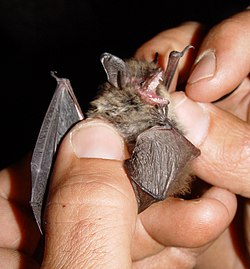
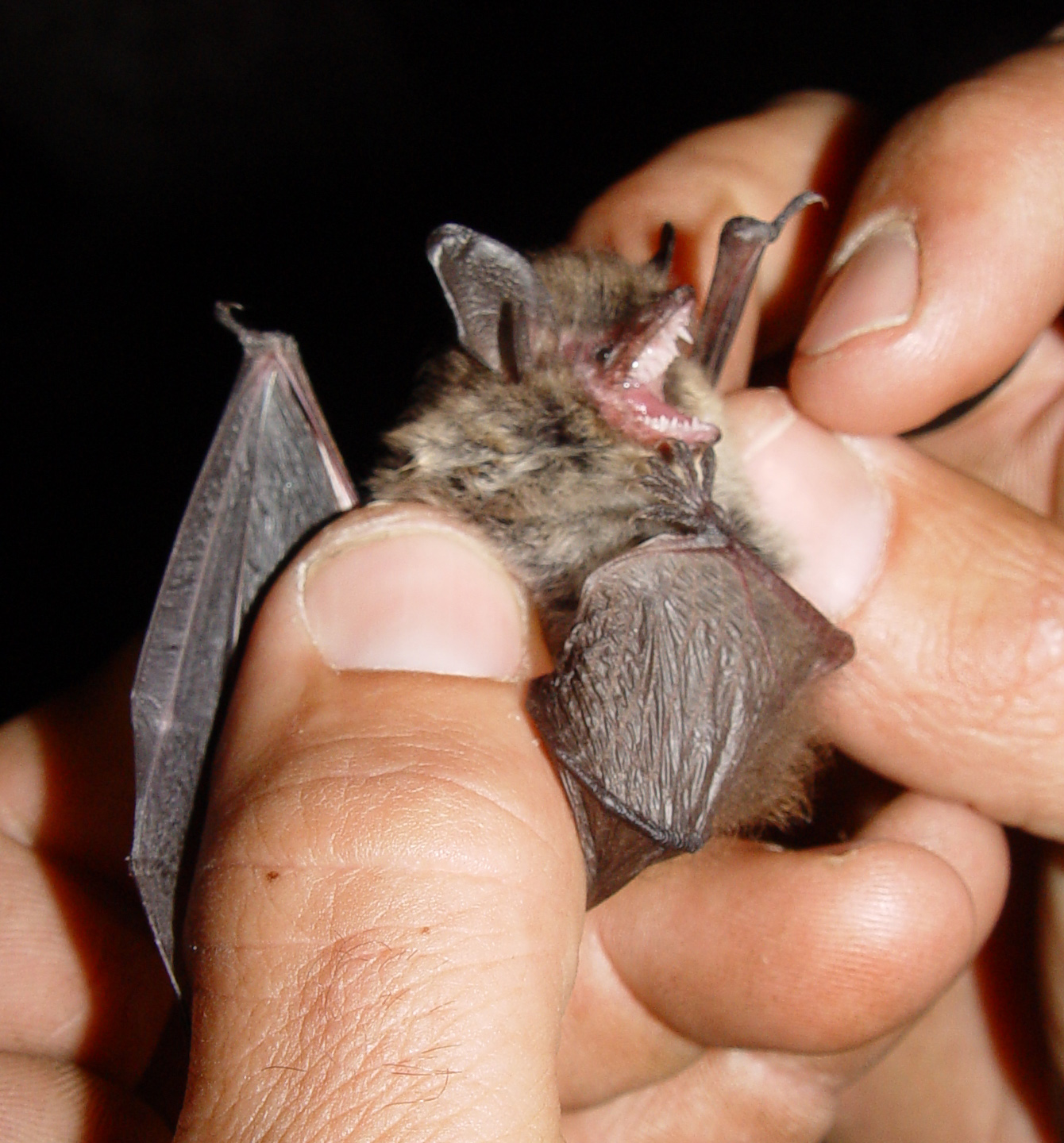
The mouse-eared bats or myotises are a diverse and widespread genus (Myotis) of bats within the family Vespertilionidae. The noun "myotis" itself is a Neo-Latin construction, from the Greek "muós (meaning "mouse") and "oûs" (meaning ear), literally translating to "mouse-eared".[2]
Relationships
[edit]Myotis has historically been included in the subfamily Vespertilioninae, but was classified in its own subfamily, Myotinae, by Nancy Simmons in 1998. In her 2005 classification in Mammal Species of the World, Simmons listed the genera Cistugo and Lasionycteris in the Myotinae in addition to Myotis itself.[3] However, molecular data indicate that Cistugo is distantly related to all other Vespertilionidae, so it was reclassified into its own family, the Cistugidae,[4] and that Lasionycteris belongs in the Vespertilioninae.[5] The genus Submyotodon has since been added to the subfamily, making it and Myotis its only members.[6]
Appearance and behavior
[edit]Their ears are normally longer than they are wide, with a long and lance-shaped tragus, hence their English and zoological names. The species within this genus vary in size from very large to very small for vesper bats, with a single pair of mammary glands.
Mouse-eared bats are generally insectivores. M. vivesi, and several members of the trawling bat ecomorph Leuconoe, have relatively large feet with long toes, and take small fish from the water surface (they also take insects).[7]
Longevity
[edit]Myotis species are remarkably long-lived for their size; in 2018, researchers revealed that a longitudinal study appears to indicate that Myotis telomeres do not shrink with age, and that telomerase does not appear to be present in the Myotis metabolism. 13 species of Myotis bats live longer than 20 years and 4 species live longer than 30 years.[8][9] The longest-living species of Myotis, and longest-living bat in general, is thought to be the Siberian bat (M. sibiricus); one individual discovered in 2005 was found to be over 41 years old at the time.[10]
Species
[edit]
| |||||||||||||||||||||||||||
| Relationships among Myotis species according to molecular data[11] |
Traditionally, Myotis was divided into three large subgenera—Leuconoe, Myotis, and Selysius. However, molecular data indicate that these subgenera are not natural groups, but instead unnatural assemblages of convergently similar species.[12] Instead, Myotis species largely fall in two main clades, one containing Old World and the other New World species.[11] The ITIS presently divides it into three subgenera: Chrysopteron (containing most reddish-colored Old World species), Myotis (containing almost all other Old World species), and Pizonyx (containing all New World species and the Eurasian Myotis brandtii and Myotis sibiricus, which are more closely related to New World species than to other Old World species).[13][14] The Asian species Myotis latirostris falls outside the clade formed by these main groups, and has since been reclassified into a separate genus, Submyotodon, alongside several others.[15]

.jpg)


.jpg)
_(11362476624).jpg)


Myotis is a highly species-rich genus, and the classification of many species remains unsettled. The taxonomy below is based on that of the ITIS in 2021.[16] Some differences in taxonomy from the 2005 third edition of Mammal Species of the World[17] are indicated in footnotes.
- Subgenus Chrysopteron:
- Myotis anjouanensis (Dorst, 1960) - Anjouan myotis
- Myotis bartelsii (Jentink, 1910) - Bartels's myotis
- Myotis bocagii (Peters, 1870) - rufous mouse-eared bat
- Myotis dieteri (Happold, 2005) - Kock's mouse-eared bat
- Myotis emarginatus (E. Geoffroy, 1806) - Geoffroy's bat
- Myotis formosus (Hodgson, 1835) - Hodgson's bat, copper-winged bat
- Myotis goudotii (A. Smith, 1834) - Malagasy mouse-eared bat
- Myotis hermani Thomas, 1923 - Herman's myotis
- Myotis morrisi Hill, 1971 - Morris's bat
- Myotis nimbaensis (Simmons et al., 2021) - Nimba mountain bat
- Myotis rufoniger (Tomes, 1858)[footnote 1] - reddish-black myotis
- Myotis rufopictus (Waterhouse, 1845)[footnote 2] - orange-fingered myotis
- Myotis scotti Thomas, 1927 - Scott's mouse-eared bat
- Myotis tricolor (Temminck, 1832) - Cape hairy bat, little brown bat, Temminck's mouse-eared bat, Cape myotis, tricoloured mouse-eared bat, Cape hairy myotis, Temminck's hairy bat, three-coloured bat
- Myotis weberi (Jentink, 1890)[footnote 3] - Weber's myotis
- Myotis welwitschii (Gray, 1866) - Welwitsch's bat, Welwitsch's mouse-eared bat, Welwitsch's myotis
- Subgenus Myotis:
- Myotis adversus (Horsfield, 1824) - large-footed bat, large-footed mouse-eared bat, large-footed myotis
- Myotis aelleni (Baud, 1979) - southern myotis (disputed species)
- Myotis alcathoe (von Helversen and Heller, 2001) - Alcathoe bat
- Myotis altarium (Thomas, 1911) - Szechwan myotis
- Myotis alticraniatus Osgood, 1932 - Indochinese whiskered myotis
- Myotis ancricola Kruskop, Borisenko, Dudorova, & Artyushin, 2018 - valley myotis
- Myotis annamiticus (Kruskop and Tsytsulina, 2001) - Annamit myotis
- Myotis annatessae Kruskop & Borisenko, 2013 - Anna Tess's myotis
- Myotis annectans (Dobson, 1871) - hairy-faced bat
- Myotis ater (Peters, 1866) - Peters's myotis, small black myotis
- Myotis badius Tiunov, Kruskop, & Feng Jiang, 2011 - chestnut myotis
- Myotis bechsteinii (Kuhl, 1817) - Bechstein's bat
- Myotis blythii (Tomes, 1857) - lesser mouse-eared bat
- Myotis bombinus (Thomas, 1906) - Far Eastern myotis, bombinus bat
- Myotis borneoensis Hill & Francis, 1984[footnote 4] - Bornean whiskered myotis
- Myotis browni E. H. Taylor, 1934 - Brown's whiskered myotis
- Myotis bucharensis (Kuzyakin, 1950) - Bocharic myotis, Bokhara whiskered bat
- Myotis capaccinii (Bonaparte, 1837) - long-fingered bat
- Myotis chinensis (Tomes, 1857) - large myotis
- Myotis crypticus Ruedi, Ibáñez, Salicini, Juste & Puechmaille, 2019 - cryptic myotis
- Myotis csorbai (Topál, 1997) - Csorba's mouse-eared bat
- Myotis dasycneme (Boie, 1825) - pond bat
- Myotis daubentonii (Kuhl, 1817) - Daubenton's bat
- Myotis davidii (Peters, 1869) - David's myotis
- Myotis escalerai Cabrera, 1904[footnote 5] - Escalera's bat
- Myotis federatus Thomas, 1916[footnote 6] - Malaysian whiskered myotis
- Myotis fimbriatus (Peters, 1871) - fringed long-footed myotis
- Myotis frater G.M. Allen, 1923 - fraternal myotis
- Myotis gomantongensis Francis and Hill, 1998 - Gomantong myotis
- Myotis hajastanicus Argyropulo, 1939 - Armenian whiskered bat, Hajastan myotis, Armenian myotis (disputed species)
- Myotis hasseltii (Temminck, 1840) - lesser large-footed bat
- Myotis horsfieldii (Temminck, 1840) - Horsfield's bat
- Myotis hoveli Harrison, 1964 - Hovel's myotis
- Myotis hyrcanicus Benda et al., 2012 - Hyrcanian myotis
- Myotis ikonnikovi Ognev, 1912 - Ikonnikov's bat
- Myotis indochinensis Son et al., 2013 - Indochinese myotis
- Myotis insularum (Dobson, 1878) - insular myotis
- Myotis laniger Peters, 1871 - Chinese water myotis
- Myotis longicaudatus Ognev, 1927[footnote 7] - long-tailed myotis
- Myotis longipes (Dobson, 1873) - Kashmir cave bat
- Myotis macrodactylus (Temminck, 1840) - eastern long-fingered bat, big-footed myotis
- Myotis macropus (Gould, 1854) - southern myotis, large-footed myotis
- Myotis macrotarsus (Waterhouse, 1845) - pallid large-footed myotis, Philippine large-footed myotis
- Myotis melanorhinus Merriam, 1890 - dark-nosed small-footed myotis (disputed species)
- Myotis moluccarum (Thomas, 1915) - Maluku myotis, Arafura large-footed bat
- Myotis montivagus (Dobson, 1874) - Burmese whiskered bat
- Myotis muricola (Gray, 1846) - wall-roosting mouse-eared bat, Nepalese whiskered myotis
- Myotis myotis (Borkhausen, 1797) - greater mouse-eared bat
- Myotis mystacinus (Kuhl, 1817) - whiskered bat
- Myotis nattereri (Kuhl, 1817) - Natterer's bat
- Myotis nipalensis Dobson, 1871 - Nepal myotis
- Myotis pequinius Thomas, 1908 - Beijing mouse-eared bat, Peking myotis
- Myotis petax Hollister, 1912[footnote 8] - eastern water bat, Sakhalin bat
- Myotis peytoni Wroughton & Ryley, 1913[footnote 9] - Peyton's myotis
- Myotis phanluongi Borisenko, Kruskop and Ivanova, 2008 - Phan Luong's myotis[footnote 10]
- Myotis pilosus Peters, 1869 - Rickett's big-footed bat
- Myotis pruinosus Yoshiyuki, 1971 - frosted myotis
- Myotis punicus Felten, Spitzenberger and Storch, 1977 - Felten's myotis
- Myotis ridleyi Thomas, 1898 - Ridley's bat
- Myotis rosseti (Oey, 1951) - thick-thumbed myotis
- Myotis schaubi Kormos, 1934 - Schaub's myotis
- Myotis secundus Ruedi, Csorba, Lin, & Chou, 2015 - long-toed myotis
- Myotis sicarius Thomas, 1915 - Mandelli's mouse-eared bat
- Myotis siligorensis (Horsfield, 1855) - Himalayan whiskered bat
- Myotis soror Ruedi, Csorba, Lin, & Chou, 2015 - reddish myotis
- Myotis sowerbyi Howell, 1926 - Sowerby's whiskered myotis
- Myotis stalkeri Thomas, 1910 - Kei myotis
- Myotis tschuliensis Kuzyakin, 1935 - Tschuli myotis
- Myotis yanbarensis Maeda and Matsumara, 1998 - Yanbaru whiskered bat
- Myotis zenatius Ibáñez, Juste, Salicini, Puechmaille & Ruedi, 2019 - Zenati myotis
- Subgenus Pizonyx:
- Myotis albescens (E. Geoffroy, 1806) - silver-tipped myotis
- Myotis armiensis Carrión-Bonilla & Cook, 2020 - Armién's myotis
- Myotis atacamensis (Lataste, 1892) - Atacama myotis
- Myotis attenboroughi Moratelli et al., 2017[footnote 11] - Sir David Attenborough's myotis
- Myotis auriculus (Baker and Stains, 1955) - southwestern myotis
- Myotis austroriparius (Rhoads, 1897) - southeastern myotis
- Myotis bakeri Moratelli, Novaes, Bonilla, & D. E. Wilson, 2019 - Baker's myotis
- Myotis brandtii (Eversmann, 1845) - Brandt's bat
- Myotis californicus (Audubon and Bachman, 1842) - California myotis
- Myotis caucensis Allen, 1914 - Colombian black myotis
- Myotis chiloensis (Waterhouse, 1840) - Chilean myotis
- Myotis ciliolabrum (Merriam, 1886) - western small-footed bat, western small-footed myotis
- Myotis clydejonesi Moratelli, D. E. Wilson, A. L. Gardner, Fisher, & Gutierrez, 2016 - Clyde Jones's myotis
- Myotis cobanensis (Goodwin, 1955) - Guatemalan myotis
- Myotis diminutus Moratelli & Wilson, 2011 - diminutive myotis
- Myotis dinellii Thomas, 1902[footnote 12] - Dinelli's myotis
- Myotis dominicensis Miller, 1902 - Dominican myotis
- Myotis elegans Hall, 1962 - elegant myotis
- Myotis evotis (H. Allen, 1864) - long-eared myotis
- Myotis findleyi Bogan, 1978 - Findley's myotis
- Myotis fortidens Miller and Allen, 1928 - cinnamon myotis
- Myotis grisescens A.H. Howell, 1909 - gray bat
- Myotis handleyi Moratelli, A. L. Gardner, J. A. Oliveira, & D. E. Wilson, 2013 - Handley's myotis
- Myotis izecksohni Moratelli, Peracchi, Dias & de Oliveira, 2011 - Izecksohn's myotis[18]
- Myotis keaysi J.A. Allen, 1914 - hairy-legged myotis
- Myotis keenii (Merriam, 1895) - Keen's myotis
- Myotis larensis LaVal, 1973 - Lara myotis
- Myotis lavali Moratelli, Peracchi, Dias, & Oliveira, 2011 - LaVal's Myotis
- Myotis leibii (Audubon and Bachman, 1842) - eastern small-footed bat
- Myotis levis (I. Geoffroy, 1824) - yellowish myotis
- Myotis lucifugus (Le Conte, 1831) - little brown bat, little brown myotis
- Myotis martiniquensis LaVal, 1973 - Schwartz's myotis
- Myotis midastactus Moratelli & Wilson, 2014 - golden myotis[footnote 13]
- Myotis nesopolus Miller, 1900 - Curacao myotis
- Myotis nigricans (Schinz, 1821) - black myotis
- Myotis nyctor LaVal & Schwartz, 1974 - Barbados myotis[footnote 14]
- Myotis occultus Hollister, 1909 - Arizona myotis
- Myotis oxyotus (Peters, 1867) - montane myotis
- Myotis peninsularis Miller, 1898 - peninsular myotis
- Myotis pilosatibialis LaVal, 1973 - northern hairy-legged myotis
- Myotis planiceps Baker, 1955 - flat-headed myotis
- Myotis riparius Handley, 1960 - riparian myotis
- Myotis ruber (E. Geoffroy, 1806) - red myotis
- Myotis septentrionalis (Trouessart, 1897) - northern long-eared bat, northern myotis
- Myotis sibiricus (Kastschenko, 1905) - Siberian bat or Siberian whiskered myotis[footnote 15]
- Myotis simus Thomas, 1901 - velvety myotis
- Myotis sodalis Miller and Allen, 1928 - Indiana bat
- Myotis thysanodes Miller, 1897 - fringed myotis
- Myotis velifer (J.A. Allen, 1890) - cave myotis
- Myotis vivesi Menegaux, 1901 - fish-eating bat, fish-eating myotis
- Myotis volans (H. Allen, 1866) - long-legged myotis
- Myotis yumanensis (H. Allen, 1864) - Yuma myotis
- Unclassified & dubious species:
- Myotis australis (Dobson, 1878) - Australian myotis (disputed species)
- Myotis oreias (Temminck, 1840) - Singapore whiskered bat
See also
[edit]Notes
[edit]- ^ Split from M. formosus (Csorba et al., 2014).
- ^ Split from M. formosus (Csorba et al., 2014).
- ^ Split from M. formosus (Csorba et al., 2014).
- ^ Split from M. montivagus (Görföl et al., 2013).
- ^ Split from M. nattereri (Ibáñez et al., 2006).
- ^ Split from M. montivagus (Görföl et al., 2013).
- ^ Split from M. frater (Ruedi et al., 2015).
- ^ Split from M. daubentonii (Matveev et al., 2005). Includes M. abei (Tsytsulina, 2004, as daubentonii).
- ^ Split from M. montivagus (Görföl et al., 2013).
- ^ A new species (Borisenko et al., 2008).
- ^ Split from M. nigricans (Moratelli et al., 2017).
- ^ Split from M. levis (Barquez et al., 2006).
- ^ Split from M. simus (Moratelli & Wilson, 2014).
- ^ Split from M. martiniquensis (Larsen et al., 2012).
- ^ Split from M. brandtii (Kruskop, Borisenko, Ivanova, Lim & Eger, 2012).
References
[edit]- ^ "Fossilworks: Myotis".
- ^ Schwartz, Charles Walsh; Schwartz, Elizabeth Reeder (2001). The Wild Mammals of Missouri (illustrated ed.). University of Missouri Press. p. 69. ISBN 9780826213594.
- ^ Simmons, 2005, p. 499
- ^ Lack et al., 2010
- ^ Roehrs et al., 2010
- ^ Ruedi, Manuel; Csorba, Gábor; Lin, Liang-Kong; Chou, C-H (2015-02-20). "Molecular phylogeny and morphological revision of Myotis bats (Chiroptera: Vespertilionidae) from Taiwan and adjacent China". Zootaxa. 3920 (2): 301–342. doi:10.11646/zootaxa.3920.2.6. PMID 25781252.
- ^ Levin, E.; A. Barnea; Y. Yovel; and Y. Yom-Tov (2006). Have introduced fish initiated piscivory among the long-fingered bat? Mammalian Biology 71(3): 139–143.
- ^ Growing old, yet staying young: The role of telomeres in bats' exceptional longevity, doi:10.1126/sciadv.aao0926
- ^ These Bats Don't Seem to Die of Old Age—Can They Help Extend the Human Lifespan?, by Kate Lunau, at Vice; published February 7, 2018; retrieved June 12, 2018
- ^ Podlutsky, A. J.; Khritankov, A. M.; Ovodov, N. D.; Austad, S. N. (2005-11-01). "A New Field Record for Bat Longevity". The Journals of Gerontology Series A: Biological Sciences and Medical Sciences. 60 (11): 1366–1368. doi:10.1093/gerona/60.11.1366. ISSN 1079-5006. PMID 16339320.
- ^ a b Stadelmann et al., 2007, fig. 2; Lack et al., 2010, figs. 1, 2
- ^ Simmons, 2005, p. 500
- ^ "ITIS - Report: Myotis". www.itis.gov. Retrieved 2022-02-01.
- ^ Stadelmann et al., 2007, fig. 2
- ^ Lack et al., 2010, p. 984
- ^ Mammal Diversity Database (2021-08-10), Mammal Diversity Database, doi:10.5281/zenodo.5175993, retrieved 2021-09-11
- ^ Simmons, 2005, pp. 500–518
- ^ Moratelli, Ricardo; Peracchi, Adriano L.; Dias, Daniela; De Oliveira, João A. (2011). "Geographic variation in South American populations of Myotis nigricans ( ) (Chiroptera, Vespertilionidae), with the description of two new species". Mammalian Biology. 76 (5): 592–607. doi:10.1016/j.mambio.2011.01.003.
Literature cited
[edit]- Borisenko, A.V., Kruskop, S.V. and Ivanova, N.V. 2008. A new mouse-eared bat (Mammalia: Chiroptera: Vespertilionidae) from Vietnam. Russian Journal of Theriology 7(2):57–69.
- Han, N., Zhang, J., Reardon, T., Lin, L., Zhang, J. and Zhang, S. 2010. Revalidation of Myotis taiwanensis Ärnbäck-Christie-Linde 1908 and its molecular relationship with M. adversus (Horsfield 1824) (Vespertilionidae, Chiroptera) (subscription required). Acta Chiropterologica 12(2):449–456.*Happold, M. 2005. A new species of Myotis (Chiroptera: Vespertilionidae) from central Africa. Acta Chiropterologica 7(1):9–21.
- Ibáñez, C., García-Mudarra, J.L., Ruedi, M., Stadelmann, B. and Juste, J. 2006. The Iberian contribution to cryptic diversity in European bats. Acta Chiropterologica 8(2):277–297.
- Jiang, T., Sun, K., Chou, C., Zhang, Z. and Feng, J. 2010. First record of Myotis flavus (Chiroptera: Vespertilionidae) from mainland China and a reassessment of its taxonomic status. Zootaxa 2414:41–51.
- Lack, J.B., Roehrs, Z.P., Stanley, C.E., Ruedi, M. and Van Den Bussche, R.A. 2010. Molecular phylogenetics of Myotis indicate familial-level divergence for the genus Cistugo (Chiroptera) (subscription required). Journal of Mammalogy 91(4):976–992.
- Matveev, V.A., Kruskop, S.V. and Kramerov, D.A. 2005. Revalidation of Myotis petax Hollister, 1912 and its new status in connection with M. daubentonii (Kuhl, 1817) (Vespertilionidae, Chiroptera). Acta Chiropterologica 7(1):23–37.
- Mayer, F., Dietz, C. and Kiefer, A. 2007. Molecular species identification boosts bat diversity. Frontiers in Zoology 4(1):239–255.
- Moratelli, R.; Wilson, D. E.; Novaes, R. L. M.; Helgen, K. M.; Gutiérrez, E. E. (2017-06-07). "Caribbean Myotis (Chiroptera, Vespertilionidae), with description of a new species from Trinidad and Tobago". Journal of Mammalogy. 98 (4): 994–1008. doi:10.1093/jmammal/gyx062.
- Roehrs, Z.P., Lack, J.B. and Van Den Bussche, R.A. 2010. Tribal phylogenetic relationships within Vespertilioninae (Chiroptera: Vespertilionidae) based on mitochondrial and nuclear sequence data (subscription required). Journal of Mammalogy 91(5):1073–1092.
- Simmons, N.B. 2005. Order Chiroptera. Pp. 312–529 in Wilson, D.E. and Reeder, D.M. (eds.). Mammal Species of the World: A Taxonomic and Geographic Reference. 3rd ed. Baltimore: The Johns Hopkins University Press, 2 vols., 2142 pp. ISBN 978-0-8018-8221-0
- Stadelmann, B., Lin, L.-K., Kunz, T.H. and Ruedi, M. 2007. Molecular phylogeny of New World Myotis (Chiroptera, Vespertilionidae) inferred from mitochondrial and nuclear DNA genes (subscription required). Molecular Phylogenetics and Evolution 43(1):32–48.
- Tsytsulina, K. 2004. On the taxonomical status of Myotis abei Yoshikura, 1944 (Chiroptera, Vespertilionidae). Zoological Science 21:963–966.
- Simmons, Nancy B.; Flanders, J.; Bakwo Fils, E. M.; Parker, Guy; Suter, Jamison D.; Bamba, Seinan; Keita, Mamady Kobele; Morales, Ariadna E.; Frick, Winifred F. 2021. A new dichromatic species of Myotis (Chiroptera: Vespertilionidae) from the Nimba Mountains, Guinea (American Museum novitates, no. 3963) American Museum Novitates. ISSN 0003-0082.
External links
[edit]

Mouse-eared bat
View on GrokipediaTaxonomy
Etymology
The genus name Myotis was established by the German naturalist Johann Jakob Kaup in his 1829 work Skizzirte Entwickelungs-Geschichte und natürliches System der europäischen Thierwelt, a key contribution to the early taxonomic classification of European bats within the family Vespertilionidae.[8][9] The term Myotis is a Neo-Latin construction derived from the Ancient Greek muós (μυός, genitive of "mouse") and oûs (οὖς, "ear"), directly translating to "mouse-eared" to reflect the distinctive ear morphology of bats in this genus.[10] This naming convention aligns with the broader historical context of 19th-century chiropterology, where Vespertilionidae—named after the Latin vesper for "evening" due to their nocturnal habits—was being systematically organized, with Myotis emerging as one of its most diverse and widespread genera.[11] The common English name "mouse-eared bat" similarly emphasizes the large, mouse-like ears typical of the group, which feature a long, lance-shaped tragus that aids in echolocation and distinguishes them from other vespertilionid bats.[12][13]Phylogenetic relationships
The genus Myotis is placed within the order Chiroptera, family Vespertilionidae, and subfamily Myotinae.[14] This subfamily classification for Myotis was established by Nancy B. Simmons in 1998 through a morphological analysis that separated it from the traditional inclusion in Vespertilioninae, emphasizing unique craniodental and postcranial synapomorphies.[15] Within Myotinae, Myotis is closely related to genera such as Submyotodon, which shares nyctalodont or semi-nyctalodont lower molars and forms a distinct Himalayan lineage with genetic distances of 16–23% from typical Myotis species, supporting its recognition as a separate but allied genus.[16] However, other taxa previously associated with Myotis have been excluded; for instance, Cistugo exhibits familial-level divergence (22.17% genetic distance) and has been reclassified into the distinct family Cistugidae within Vespertilionoidea, diverging around 34 million years ago.[17] Similarly, Lasionycteris is positioned within Vespertilioninae, as molecular analyses confirm the monophyly of that subfamily excluding Myotis.[14] The fossil record of Myotis begins in the early Oligocene, with the oldest known species, Myotis belgicus, dated to approximately 33.5 million years ago from deposits in Belgium, indicating an early diversification during the Eocene-Oligocene radiation of modern bats.[18] Subsequent fossils are more abundant from the late Oligocene through the Miocene in Europe and extend into the Plio-Pleistocene across multiple continents.[18] Molecular phylogenetic studies have refined these relationships; a 2014 analysis using cytochrome b and RAG2 genes across 88+ Myotis taxa identified East Asia as the evolutionary cradle, with an origin around 21 million years ago and subsequent intercontinental dispersals.[19] Between 2014 and 2017, revisions based on integrated molecular and morphological data led to species splits, such as the recognition of distinct lineages in Taiwan and adjacent China previously lumped under broader taxa.[20] Taxonomy within Myotis remains unsettled due to the prevalence of cryptic species, which molecular and integrative approaches continue to uncover, complicating species boundaries and phylogenetic resolution.[21] Post-2021 revisions have described new cryptic taxa, including Myotis guarani from South American savannas in 2024, Myotis moratellii from Ecuador in 2021, Myotis himalaicus from the Himalayas in 2025, a new species from Peru in 2025, and a new member of the siligorensis group from China in November 2025, highlighting ongoing adjustments to the genus's diversity through genetic and ecological niche analyses.[21][22][23][24][25]Description
Physical characteristics
Mouse-eared bats (genus Myotis) are small to medium-sized vespertilionid bats, with head-body lengths ranging from 3.5 to 8.5 cm and weights from 3 to 45 g across the genus.[4][26] Their fur is typically soft and dense, appearing mouse-like, with dorsal coloration in shades of brown or gray and ventral fur often paler.[3] A defining feature of the genus is the large, rounded ears, which are generally longer than the head and equipped with a lance-shaped tragus; many species also possess a low keel on the calcar.[3] The wings are structured for agile, maneuverable flight, featuring moderately long forearms and broad membranes supported by elongated finger bones.[27] Internally, Myotis bats share a typical vespertilionid dental formula of 2/3, 1/1, 3/3, 3/3, totaling 38 teeth adapted for crushing insect prey.[28] While body size varies considerably among species, these morphological traits are largely uniform across the genus.[4]Intraspecific variation
The genus Myotis exhibits considerable intraspecific variation in body size across its diverse species, ranging from diminutive forms to notably larger ones. For instance, Myotis leibii represents one of the smallest species, with a head-body length of approximately 3.0–3.5 cm, while Myotis myotis stands out as one of the largest, achieving a total length of up to 14 cm including the tail.[29][26] Pelage coloration in Myotis species shows marked geographic variation, often correlating with environmental conditions; desert-dwelling forms tend toward paler tones for camouflage, such as the light brown to buff hues in Myotis ciliolabrum, whereas tropical species display darker browns, as seen in Myotis nigricans.[30][31] Sexual dimorphism in size is prevalent in several species, with females generally larger than males to support reproductive demands, a pattern evident in Myotis myotis where female wing measurements exceed those of males.[32][33] Certain Myotis species have evolved specialized morphological traits adapted to specific foraging niches, exemplified by the piscivorous Myotis vivesi, which possesses enlarged hind feet averaging 23 mm in length with robust claws for gaffing fish from the water surface.[34][35] Identification challenges arise from cryptic species complexes within Myotis, where subtle differences in skull shape, such as braincase height or dental metrics, and ear morphology, like length or tragus form, are often required for accurate discrimination, as demonstrated in complexes involving Myotis nattereri and related taxa.[36][37] These fine-scale variations necessitate multivariate analyses of craniodental traits for reliable taxonomic resolution.[38]Distribution and habitat
Geographic range
The genus Myotis exhibits a nearly cosmopolitan distribution, occurring naturally on every continent except Antarctica and spanning a wide range of latitudes from boreal forests to tropical regions.[39] This broad range excludes polar and subpolar areas, extreme deserts, and certain oceanic islands where suitable habitats are absent.[4] With over 140 species recognized, Myotis represents the most speciose genus of bats, demonstrating remarkable adaptability across diverse biogeographic realms.[40] The Holarctic region hosts the majority of Myotis diversity, including high species richness in the Palearctic (particularly East Asia) and Nearctic.[41] Extensions into southern realms include the Afrotropics (with about 11 species, mostly in sub-Saharan Africa), Indomalaya (encompassing diverse Oriental assemblages), and Neotropics (around 33 species across Central and South America as of 2022).[42][9] Recent discoveries, including new species in Peru, Brazil, and the Himalayas in 2025, continue to increase the recognized diversity and refine distribution patterns.[24][43][44] East Asia stands out as the evolutionary cradle, with maximum diversification occurring there before transcontinental dispersals.[45] Historical range expansions of Myotis are linked to Pleistocene climatic oscillations, which facilitated migrations across land bridges and refugia, particularly from East Asian origins into the New World and other regions.[46] These events, including post-glacial recolonizations, contributed to the genus's current near-global footprint while limiting presence in isolated southern areas like much of Australasia.[45]Habitat preferences
Mouse-eared bats of the genus Myotis primarily inhabit temperate regions, favoring deciduous and mixed forests, riparian zones, and karst landscapes with caves and rock formations.[4] These bats often select areas with access to water bodies, such as rivers and lakes, which support insect abundance for foraging.[47] Some tropical Myotis species occupy rainforests and mangroves, where dense vegetation and humid conditions provide suitable microhabitats.[4] Roosting sites for Myotis are diverse and include natural features like caves, abandoned mines, tree hollows, and rock crevices, as well as human-modified structures such as attics and bridges.[48][49] Species like the little brown bat (Myotis lucifugus) and Indiana bat (Myotis sodalis) preferentially use tree cavities and loose bark in forested areas during summer, while hibernating in cooler cave interiors during winter.[48] Foraging habitats typically encompass open woodlands, forest edges, and areas over calm waters, where bats can efficiently pursue aerial insects.[50][47] The altitudinal distribution of Myotis spans from sea level to over 3,000 m, with some species recorded up to approximately 3,600 m in montane regions such as the Himalayas.[51] These bats have evolved adaptations to varied climates, including torpor and hibernation in temperate and boreal zones to endure cold winters.[4] In arid environments, desert species such as the California myotis (Myotis californicus) feature specialized kidneys that concentrate urine to conserve water and rely on daily torpor to reduce metabolic demands during hot, dry periods.[52][53]Ecology and behavior
Diet and foraging
Mouse-eared bats of the genus Myotis are primarily insectivorous, consuming a diverse array of arthropods such as moths (Lepidoptera), beetles (Coleoptera), and flies (Diptera), which they capture using echolocation to detect prey in flight or on surfaces.[54] For instance, the Indiana bat (Myotis sodalis) relies heavily on Diptera, which comprise up to 37% of its diet, supplemented by Lepidoptera and spiders (Araneae), reflecting a generalist foraging strategy adapted to available prey in riparian habitats.[54] These bats employ two main foraging styles: aerial hawking, where they pursue flying insects in open spaces, and gleaning, in which they pluck stationary prey like spiders or ground-dwelling insects from foliage or the substrate using passive listening and subtle echolocation to avoid detection.[55] Peak foraging activity occurs at dusk, allowing them to exploit emerging insect populations while minimizing energy expenditure during daylight hours. While most Myotis species adhere to insectivory, specialized diets occur in certain taxa, particularly in marine or tropical environments. The fish-eating myotis (Myotis vivesi), endemic to the Gulf of California, is notably piscivorous, primarily targeting small schooling fish like the California anchovy (Engraulis mordax) and crustaceans such as krill (Nyctiphanes simplex), which it captures through foot-gleaning by raking its elongated hind feet through the water surface during low-altitude flights over the ocean.[56] In tropical regions, some species opportunistically incorporate frugivory or nectarivory, marking a dietary expansion from strict insectivory; for example, the black myotis (Myotis nigricans) has been observed consuming fruits, representing the first documented case of such behavior in the genus. These adaptations highlight the genus's flexibility in exploiting niche resources, though insects remain the dietary core for the majority of species. In temperate zones, Myotis diets exhibit seasonal shifts driven by prey availability and environmental conditions. Temperate species like the little brown bat (Myotis lucifugus) and notched-eared bat (Myotis emarginatus) consume more beetles and other Coleoptera during summer months when these are abundant, transitioning to flies and spiders as autumn progresses and aerial insects decline. Such variations underscore the bats' opportunistic nature, with broader dietary niches in northern latitudes where prey predictability is lower, ensuring nutritional needs are met across fluctuating seasons.Reproduction and development
Mouse-eared bats in the genus Myotis exhibit a reproductive strategy adapted to temperate climates, characterized by delayed fertilization where mating typically occurs in autumn and stored sperm fertilizes the ovum in spring following hibernation arousal.[57] In species like Myotis myotis, copulation peaks from late summer to autumn, with females storing viable sperm in the reproductive tract for up to several months until ovulation in February or March, ensuring birth aligns with favorable summer conditions.[58] This delay allows females to enter hibernation without the energetic demands of pregnancy during winter.[57] Gestation lasts approximately 50-70 days across Myotis species, with embryonic development commencing post-fertilization in spring and culminating in births during late May to early July.[57][59] Females form large maternity colonies in caves, attics, or other sheltered sites to give birth, providing communal warmth and protection for the altricial pups.[60] In Myotis myotis, the gestation period averages 65 days, influenced by environmental factors such as temperature that may extend development if females enter torpor.[61][59] Litter sizes in Myotis range from 1 to 4 pups, though singletons predominate in most temperate species; twins are more common in larger forms like Myotis myotis and Myotis austroriparius, where combined pup mass can approach 50% of maternal body weight.[57][62] Pups are born hairless, blind, and weighing about 20-30% of the mother's mass, relying on strong claws to cling to fur or roost surfaces during early mobility.[57][61] Parental care is provided solely by females, who nurse pups with high-fat milk for 3-4 weeks until weaning, during which time they may carry young in flight for the first 7-10 days before leaving them in the colony roost.[57][59] In Myotis myotis, lactation peaks in June, supporting rapid growth to fledging at around 4-5 weeks, when juveniles begin short foraging flights.[60][62] Sexual maturity is attained at 1-2 years of age, with females often breeding in their first year but males typically requiring an additional season to reach full reproductive capacity.[57][58] Yearling females in Myotis lucifugus may mate but frequently delay first parturition until the second year, correlating with attainment of sufficient body size for sustained flight and energy demands.[57] In tropical Myotis species, such as Myotis nigricans, reproduction deviates from strict seasonality, featuring near year-round breeding with peaks tied to rainfall and insect abundance rather than hibernation cycles.[57] These populations exhibit shorter sperm storage periods and potential for multiple litters annually, contrasting the single annual reproductive event in temperate congeners.[57]Roosting and social structure
Mouse-eared bats, exemplified by the greater mouse-eared bat (Myotis myotis), select day roosts in a variety of human-modified and natural structures, including caves, attics, and bridges, which provide shelter and protection from predators. These roosts support large colonies numbering from 50 to 2,000 individuals, with high site fidelity among group members that promotes stable social bonds while allowing occasional exchanges between colonies.[63][26] Social organization in these species features sex-segregated groups, where females form cohesive colonies for resting, while males remain largely solitary during the summer months. This segregation influences group dynamics, with female groups exhibiting stronger associations compared to mixed-sex interactions. Fission-fusion dynamics occur to some extent, as subgroups temporarily divide and reunite based on roost availability and environmental conditions, though overall colony structure remains relatively stable.[63] During hibernation, individuals cluster in dense aggregations within underground sites, maintaining body contact to enhance thermoregulation and conserve energy. Communication within roosts relies on vocalizations, such as trill-like calls for coordination and interaction, supplemented by olfactory cues through scent marking from facial glands to recognize colony mates and territories.[63][64][65] In dense roosting environments, allogrooming serves to maintain hygiene and strengthen social ties, with individuals licking and nibbling conspecifics, often incurring energetic costs due to parasite loads. Conflict resolution in crowded roosts involves aggressive displays like wing strikes and biting to settle disputes over space, ensuring orderly group cohesion without escalation.[66][67]Physiology and longevity
Lifespan records
In the wild, mouse-eared bats (genus Myotis) typically have an average lifespan of 5 to 10 years, though maximum recorded ages exceed 30 years in several species.[3][68] For example, the greater mouse-eared bat (Myotis myotis) has a documented maximum longevity of 37.1 years based on banding studies.[61] The genus holds notable longevity records among mammals, with Myotis brandtii (Brandt's bat) achieving the highest at 41 years in the wild, confirmed through recapture of a banded male in Siberia.[68] Additionally, at least 13 Myotis species, ranging from 7 to 25 grams in body mass, have been documented living over 20 years in the wild via banding efforts.[68] These extended lifespans are supported by banding studies across Europe and North America, which reveal low annual mortality rates.[69] Key influencing factors include reduced predation risk due to flight capabilities and efficient metabolic regulation through torpor and hibernation, which minimize energy expenditure and oxidative stress.[70] Compared to other small mammals of similar size, Myotis bats live 8 to 10 times longer than predicted by body mass alone.[71]Adaptations for longevity
Mouse-eared bats in the genus Myotis exhibit several physiological adaptations that contribute to their exceptional longevity relative to body size, including mechanisms for telomere maintenance, efficient DNA repair, reduced oxidative stress, and enhanced cancer resistance. These traits are particularly pronounced in long-lived species such as Myotis myotis, which can live over 30 years in the wild.[72] One key adaptation is the maintenance of telomere length without significant age-related shortening, observed in several Myotis species. Unlike in humans and many other mammals, where telomeres progressively erode with each cell division, leading to cellular senescence, Myotis bats possess alternative lengthening of telomeres (ALT) pathways that sustain telomere integrity throughout life. This is facilitated by the upregulation of genes such as TERF1 and POT1, which regulate telomere-binding proteins, preventing replicative senescence even in the absence of high telomerase activity. For instance, in M. myotis, telomere length remains stable across ages up to 6 years, contrasting with shortening in shorter-lived bat species. Hibernation further supports this by minimizing cell divisions during periods of torpor, reducing telomere attrition.[72][73] Myotis bats also demonstrate superior DNA repair efficiency and low levels of oxidative stress, which mitigate age-related cellular damage. Their cells exhibit enhanced expression of DNA repair genes, including those in the base excision repair pathway, allowing rapid correction of oxidative lesions. Protein oxidation rates remain low even in advanced age, as fibroblasts from Myotis species show resistance to induced oxidative stress compared to mice. This resilience is partly attributable to hibernation, which lowers metabolic rates by up to 99% during torpor, thereby reducing the production of reactive oxygen species and minimizing cumulative wear on biomolecules over decades.[74][70][75] Cancer resistance in Myotis is bolstered by robust apoptosis pathways, particularly involving the tumor suppressor p53. Genomic analyses reveal duplications and elevated expression of TP53 in long-lived Myotis species, leading to heightened p53-dependent apoptosis in response to DNA damage or oncogenic stress. This results in the programmed cell death of potentially cancerous cells, as evidenced by increased apoptosis rates in bat fibroblasts exposed to gamma radiation compared to other mammals. Studies on gene expression profiles further indicate bat-specific microRNAs that downregulate pro-tumorigenic pathways, contributing to low cancer incidence despite long lifespans.[76][77][78] These longevity adaptations involve evolutionary trade-offs, notably slower reproductive rates that prioritize survival over rapid population growth. In Myotis bats, delayed maturity and low annual fecundity—typically one pup per year—correlate with extended lifespans, as energy allocation shifts from frequent reproduction to maintenance and repair processes. This strategy, common in hibernating species, allows individuals to accumulate fewer somatic costs from breeding, supporting multi-decade survival.[79][80]Conservation
Population status
The genus Myotis, comprising over 140 species worldwide, exhibits varied conservation statuses according to the IUCN Red List, with approximately 60% of assessed species classified as Least Concern, reflecting relatively stable or widespread populations in many regions. However, around 15-20% are categorized as Vulnerable, Endangered, or Critically Endangered, particularly those impacted by disease and habitat loss, while a substantial number—especially in tropical regions—are Data Deficient due to insufficient ecological data. For instance, the Alcathoe bat (Myotis alcathoe) is assessed as Data Deficient globally, highlighting gaps in understanding its distribution and abundance despite its restricted range in Europe and the Near East.[81] In North America, populations of several Myotis species have undergone drastic declines, primarily due to white-nose syndrome, a fungal disease first detected in 2006 that has caused mortality rates exceeding 90% in affected hibernacula. For example, the northern long-eared bat (Myotis septentrionalis) is listed as federally endangered under the U.S. Endangered Species Act, while the little brown bat (Myotis lucifugus)—assessed as Endangered by the IUCN—is under review for federal listing.[82][49] These declines contribute to an estimated 90% of North American bat species showing population decreases or likely decreases over the past 15 years. As of 2025, the tricolored bat (Perimyotis subflavus), another North American species affected by WNS, has been proposed for endangered status under the ESA.[83] In contrast, European Myotis populations have demonstrated recovery trends, with overall bat abundances increasing by more than 40% between 1993 and 2011, though localized declines persist from habitat fragmentation and agricultural intensification.[84][85] Many Myotis species in Asia and Africa remain poorly studied, with data deficiencies complicating accurate assessments; post-2021 IUCN evaluations have underscored heightened risks to cryptic species within the genus, where morphological similarities often lead to underestimation of diversity and vulnerability. These challenges are exacerbated by limited monitoring in biodiverse hotspots. The genus benefits from protections under international frameworks, including the Agreement on the Conservation of Populations of European Bats (EUROBATS), which covers 52 European species and promotes habitat safeguards and research, as well as national legislation like the U.S. Endangered Species Act, which lists multiple North American Myotis as threatened or endangered.[86][87]Threats and conservation
Mouse-eared bats (genus Myotis) face multiple anthropogenic threats that have contributed to population declines across their range. Habitat loss, primarily from deforestation and urbanization, reduces foraging areas and summer roosts, with mature forests and water bodies being critical for species like the little brown bat (Myotis lucifugus). Cave tourism and human disturbance at hibernation sites further exacerbate this, causing energy depletion and roost abandonment in cave-dependent species such as the greater mouse-eared bat (Myotis myotis). In North America, white-nose syndrome (WNS), a fungal disease caused by Pseudogymnoascus destructans, has decimated hibernating Myotis populations, killing millions since 2006 by disrupting torpor and leading to premature fat depletion. Pesticide use in agriculture diminishes insect prey availability, indirectly starving insectivorous Myotis and even directly poisoning bats through contaminated prey. Climate change alters hibernation patterns, with warmer winters prompting earlier arousals or shortened torpor periods, increasing energy demands and mortality risks for temperate species. Additionally, collisions with wind turbine blades during migration pose a significant mortality factor, with Myotis species comprising a large proportion of documented fatalities at wind energy facilities. Conservation efforts for Myotis bats emphasize habitat protection and disease management to mitigate these threats. Establishing protected reserves and safeguarding roosts through gating and access restrictions have proven effective in preserving hibernation sites, particularly in Europe under the Agreement on the Conservation of Populations of European Bats (EUROBATS), an instrument of the Convention on Migratory Species (CMS). Artificial roosts like bat boxes are deployed to supplement lost natural habitats, providing alternative summer and maternity sites while aiding recovery from disturbances. Research into WNS mitigation includes antifungal treatments and genetic monitoring for resistant populations, with ongoing trials aiming to reduce transmission in affected North American caves. International collaboration via CMS and regional action plans promotes transboundary protection, including insect habitat restoration to counter pesticide impacts. A notable success story is the recovery of Myotis myotis populations in Europe, where targeted roost safeguards and legal protections under EUROBATS have led to exponential growth in hibernating colonies since the 1970s, demonstrating the efficacy of disturbance minimization. These measures, combined with broader insect conservation, underscore the potential for Myotis recovery when threats are addressed proactively.Species
Subgenera
The subgeneric classification of the genus Myotis remains debated and subject to revision, as molecular phylogenetic studies have revealed that many traditional subgenera are not monophyletic, often resulting from convergent evolution rather than shared ancestry.[88] Current taxonomy, as reflected in databases like ITIS and batnames.org, primarily recognizes three main subgenera: Chrysopteron (reddish-furred Old World species, e.g., M. bartelsii), Myotis s.s. (cosmopolitan core group, including gleaning and aerial insectivores like M. lucifugus and M. myotis), and Pizonyx (New World fishing bats with enlarged hind feet, e.g., M. vivesi).[89] Other proposed subgenera, such as Leuconoe and Selysius, are sometimes used but lack consistent support from genetic data.[90] Historical reclassifications continue, with some forms elevated to full genera (e.g., Scoteanax for Australian species), emphasizing the genus's biogeographic origins in East Asia and ongoing taxonomic refinements.[18]Species diversity
The genus Myotis encompasses approximately 140 extant species worldwide as of 2025, incorporating recent taxonomic splits such as those within the M. formosus complex based on molecular and morphological analyses.[9][91] This count reflects ongoing discoveries, including new species descriptions in Southeast Asia and other regions post-2021, such as Myotis cf. frater from Vietnam and Laos, and 2025 additions like Myotis himalaicus in the Himalayas, Myotis guarani in Brazil, Myotis huariorum in Peru, and Myotis kalkoae in China, highlighting the genus's dynamic taxonomy.[92][25][23][43][93] Species diversity is unevenly distributed across regions, with Asia hosting the highest richness due to its varied habitats and historical biogeography. Over 50 species occur in Asia, including numerous endemics adapted to montane and forested environments. Europe and the Nearctic together support around 30 species, many of which are temperate cave-dwellers with broad distributions. The Neotropics harbor more than 35 species, often in humid tropical settings, though recent studies suggest potential for higher counts through cryptic diversity.[91][94][43]| Region | Approximate Number of Species | Notes on Diversity and Endemics |
|---|---|---|
| Asia | 50+ | Greatest richness; endemics include M. pequinius (restricted to northern China) and recent additions like M. himalaicus and M. kalkoae in the Himalayas and China.[88][25][23] |
| Europe and Nearctic | ~30 | Temperate focus; examples include widespread M. myotis in Europe and M. lucifugus in North America.[4] |
| Neotropics | 35+ | Tropical emphasis; potential cryptic species in complexes like M. nigricans; recent additions include M. guarani and M. huariorum.[94][43][93] |