


Community hub
0 subscribers8 pages, 0 posts
Recent from talks
All channels
Be the first to start a discussion here.
Be the first to start a discussion here.
Be the first to start a discussion here.
Be the first to start a discussion here.
Contribute something
Welcome to the community hub built to collect knowledge and have discussions related to Lanternfish.
Nothing was collected or created yet.
Lanternfish
View on Wikipediafrom Wikipedia
Not found
Lanternfish
View on Grokipediafrom Grokipedia
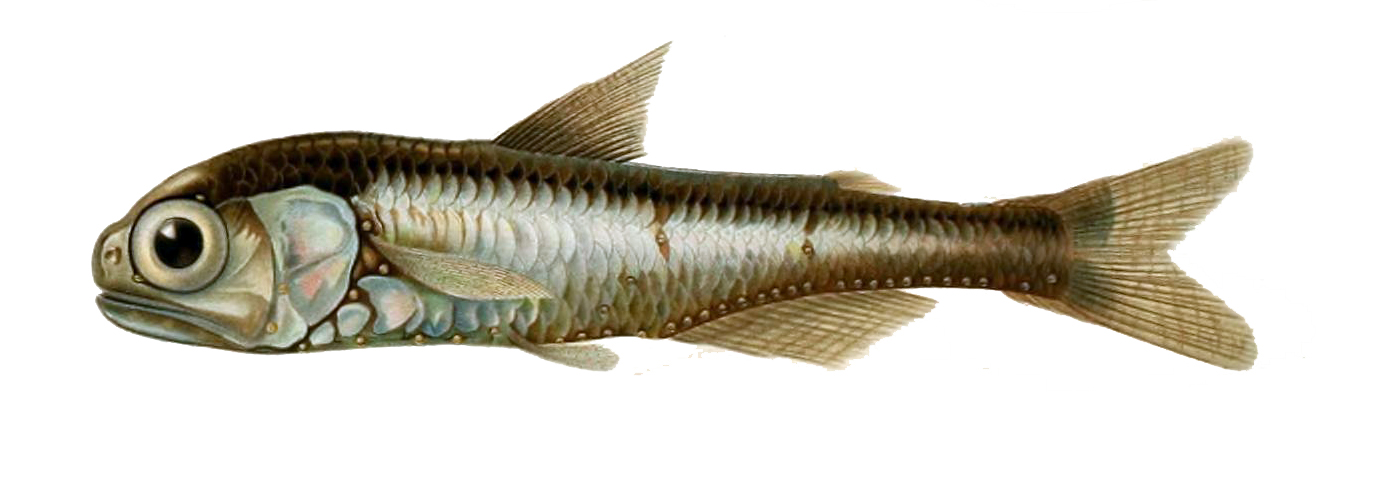
Lanternfishes (Myctophidae) are a family of small, bioluminescent mesopelagic fishes in the order Myctophiformes, characterized by their species-specific patterns of photophores that produce glowing blue-green lights for camouflage, communication, and predator evasion.[1] With approximately 252 valid species across 34 genera, they represent one of the most diverse and abundant vertebrate groups in the ocean, comprising over 60% of the biomass of deep-sea fishes.[2] These fishes typically measure 2–15 cm in length, though some reach up to 30 cm, and possess large eyes adapted for low-light conditions, along with slender bodies and adipose fins.[1][3]
Found throughout the world's oceans from the Arctic to Antarctic regions, lanternfishes primarily inhabit the mesopelagic or "twilight" zone at depths of 200–1,000 meters during the day, where sunlight barely penetrates.[3] They exhibit pronounced diurnal vertical migration, ascending to the surface at night to feed on zooplankton and returning to deeper waters by dawn to avoid predators, a behavior facilitated by gas-filled swim bladders for buoyancy control.[1] This migration, observable via sonar as a "false bottom" layer, underscores their massive scale, with global biomass estimates ranging from 600 million to 1 billion metric tons.[4][5]
Ecologically, lanternfishes play a pivotal role as a foundational prey species in marine food webs, supporting predators such as tunas, sharks, squid, and marine mammals, while also contributing to nutrient cycling through their migrations that transport organic matter vertically.[1] Their bioluminescence, generated by luciferin-based reactions in specialized photocytes within photophores, enables counter-illumination to match downwelling light and evade detection, as well as rapid flashes from caudal organs to disorient pursuers.[3] Despite their ubiquity and ecological significance, lanternfishes remain understudied due to the challenges of deep-sea sampling, though ongoing research highlights their vulnerability to ocean changes like warming and deoxygenation.[6]