Hubbry Logo
SerrasalmidaeSerrasalmidaeMain
Open search
Serrasalmidae
Community hub
Serrasalmidae
logo
8 pages, 0 posts
0 subscribers
Be the first to start a discussion here.
Serrasalmidae
Serrasalmidae
from Wikipedia

Serrasalmidae
Temporal range: Late Eocene to present Possible Maastrichtian occurrence
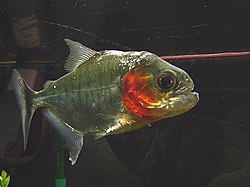
Serrasalmus manueli
Scientific classification Edit this classification
Kingdom: Animalia
Phylum: Chordata
Class: Actinopterygii
Order: Characiformes
Suborder: Characoidei
Family: Serrasalmidae
Bleeker, 1859[1]
Type genus
Serrasalmus[1]
Genera[2]

See text

The Serrasalmidae (serrasalmids) are a family of characiform fishes native to freshwater habitats of South America. They include more than 90 species. The name means "serrated salmon family", which refers to the serrated keel running along the belly of these fish. Fish classified as Serrasalmidae are also known by these common names: pacu, piranha, and silver dollar. These common names generally designate differing dental characteristics and feeding habits.[4]

Description

[edit]

Serrasalmids are medium- to large-sized characiform bony fishes that reach about 1 m (3.3 ft) long, generally characterized by a deep, laterally compressed body with a series of midventral abdominal spines or scutes, and a long dorsal fin (over 16 rays). Most species also possess an anteriorly directed spine just before the dorsal fin extending from a supraneural bone; exceptions include members of the genera Colossoma, Piaractus, and Mylossoma.[5]

Most serrasalmids have about 60 chromosomes, ranging from 54 to 62. Metynnis has 62 chromosomes, as does Catoprion, Pristobrycon striolatus, and Pygopristis.[6]

Evolution

[edit]

Taxonomy

[edit]

The Serrasalmidae were until, recently, classified as a subfamily of the Characidae, with their taxonomic relationships uncertain at the time.[7] More recent studies have found them to belong to a wider clade of South American characoids, being most closely related to the Hemiodontidae.[8] The Serrasalmidae are relatively well understood, and agreement is wide on the genera and species included.[5]

The family is classified as follows:[8][9][10]

Fossil record

[edit]

The fossil record, particularly for piranhas, is relatively sparse. Most known fossils are from the Miocene.[6] The earliest definitive serrasalmid fossil teeth are known from the Late Eocene-aged (~38 mya) sediments of the Santa Luca Formation in Bolivia.[11] Teeth resembling those of pacus have been recovered from the late Maastrichtian-aged El Molino Formation, which could potentially suggest a Late Cretaceous occurrence for the family,[13] but these teeth show significant differences from modern serrasalmids, and their assignment to the family is uncertain.[11] Fossils of a living species of Colossoma from the Miocene have been described, suggesting a very conservative history for a specialized herbivorous fish.[14] All serrasalmine genera had originated by the middle Miocene, with the possible exception of three of the four piranha genera (Pygocentrus, Pristobrycon, and Serrasalmus).[6]

Distribution

[edit]

Serrasalmids inhabit all major and some minor Atlantic river systems in South America east of the Andes, but have been introduced to other areas.[14] Species range from about 10°N latitude south to about 35°S latitude.[7]

Ecology

[edit]

The diets of the various serrasalmid fishes include seeds, fruits, leaves, and various invertebrate and vertebrate prey, as well as fish flesh, scales, and fins. To emphasize the diversity of diets, authors commonly highlight the fruit- and leaf-eating pacus and the highly carnivorous piranhas. Most in the family other than piranhas are primarily herbivorous. In contrast, piranhas have been long believed to be strict carnivores.[6] Many species change diets depending on age and resource availability.[6]

The primarily carnivorous piranha group comprises the genera Catoprion, Pristobrycon, Pygocentrus, Pygopristis and Serrasalmus, but based on phylogeny also the mainly herbivorous (although with omnivorous tendencies) Metynnis.[15] The remaining primarily herbivorous species can be divided into two groups based on ecology and, to some extent, phylogeny: Colossoma, Mylossoma and Piaractus are mainly found in relatively slow-moving waters, and feed extensively on fruits, nuts and seeds, playing an important role as seed dispersers. Mylesinus, Myleus, Ossubtus, Tometes and Utiaritichthys are found in fast-flowing sections of rivers, and mainly feed on aquatic plants, especially Podostemaceae.[15] Myloplus mostly feed on plant material and some of its species are phylogenetically related with the previous group, but this genus includes species of both slow and fast-flowing waters.[16]

Relationship to humans

[edit]

Many serrasalmids are in demand as aquarium ornamentals, and several pacus, such as Piaractus and Colossoma, are economically important to commercial fisheries and aquaculture.[7]

Piranhas are generally less valued, although they are commonly consumed by subsistence fishers and frequently sold for food in local markets. A few piranha species occasionally appear in the aquarium trade, and, in recent decades, dried specimens have been marketed as tourist souvenirs.[7] Piranhas occasionally bite and sometimes injure bathers and swimmers, but serious attacks are rare and the threat to humans has been exaggerated.[7] However, piranhas are a considerable nuisance to commercial and sport fishers because they steal bait, mutilate catch, damage nets and other gear, and may bite when handled.[7]

References

[edit]
Revisions and contributorsEdit on WikipediaRead on Wikipedia
from Grokipedia
Serrasalmidae is a family of Neotropical characiform fishes comprising 17 genera and 104 valid species, primarily inhabiting freshwater environments in South American river basins such as the , , and Paraná. These fishes are characterized by their deep, laterally compressed bodies, often with silvery or colorful scales, and exhibit a wide range of feeding strategies from carnivory and lepidophagy to herbivory and omnivory. The family includes well-known groups such as the predatory , noted for their sharp, triangular teeth adapted for slicing flesh, and the larger, more peaceful pacus, which feature robust jaws for crushing fruits and seeds. Taxonomically, Serrasalmidae was elevated to family status in recent classifications, confirming its within the order Characiformes and distinguishing it from related families like Cynodontidae. Phylogenetic studies divide the family into three main subfamilies: Colossomatinae and Myleinae, encompassing herbivorous and omnivorous forms like the (Colossoma macropomum), and Serrasalminae, which includes the carnivorous in tribes such as Serrasalmini. Genera within the family show morphological diversity, including the presence or absence of a pre-dorsal spine and polymorphic dentition, reflecting adaptive radiations in Neotropical ecosystems. is highest in the , where they occupy slow-moving waters, floodplains, and vegetated river margins. Ecologically, serrasalmids play key roles in aquatic food webs as both predators and prey, with some forming large schools during spawning migrations. They are of significant economic importance, with pacus like Colossoma macropomum widely cultured in for their fast growth and high-quality flesh, while occasionally impact fisheries through predation on stocked . Conservation concerns arise from habitat loss due to and , affecting endemic in the rapidly changing Neotropical landscapes.

Classification and Evolutionary History

Taxonomy

Serrasalmidae is a family of characiform fishes, positioned within the order and suborder Characoidei, distinct from the larger family . Historically classified as the subfamily Serrasalminae within , it was elevated to full family status based on molecular phylogenetic analyses that demonstrated its and separation from other characids, with this recognition solidifying around 2017 following key studies on Neotropical characiform relationships. The name "Serrasalmidae" derives from Latin serra (saw) and salmo (salmon), alluding to the serrated abdominal keel characteristic of many members. As of 2025, the family is recognized as comprising 17 valid genera and 103 valid species, with Serrasalmus serving as the type genus. These genera are distributed across three subfamilies: Colossomatinae (3 genera), Myleinae (9 genera), and Serrasalminae (5 genera). Representative genera include Colossoma, Piaractus, Mylossoma, Metynnis, and Colossomabrycon, among others. Key genera and their approximate species counts are as follows:
GenusApproximate Species Count
Serrasalmus32
Piaractus3
Colossoma2
Myloplus15
Metynnis14
Major taxonomic revisions have included the separation of Serrasalmidae from the African Alestiidae (formerly grouped under broader characins) and the Neotropical Hemiodontidae, now recognized as a sister family based on shared morphological and molecular traits. Ongoing debates center on the of certain genera, such as , where molecular phylogenomics has revealed non- due to morphological convergence driven by similar diets, prompting calls for further revisions.

Fossil Record

The fossil record of Serrasalmidae is sparse and fragmentary, primarily consisting of isolated teeth and partial skeletal elements, with significant temporal gaps that limit detailed understanding of their evolutionary history. The earliest fossils associated with the family are isolated pacu-like teeth from the El Molino Formation in , dating to the to early (approximately 73–60 million years ago), though these are considered tentative and may represent stem-group characiforms rather than definitive serrasalmids. Characiform-like teeth from the stage of the suggest early presence of stem-group forms in southern South American freshwater systems, but assignment to Serrasalmidae remains equivocal due to the primitive morphology. Definitive serrasalmid fossils appear later in the Late Eocene (around 38 million years ago) from the Santa Lucía Formation in , where isolated teeth exhibit characteristic serrasalmid dentition, marking the earliest unambiguous evidence of the family. The record then shows a notable gap until the , when more complete remains emerge, indicating early diversification. In , fossils from the Middle La Venta fauna include specimens identified as Colossoma macropomum, a species morphologically indistinguishable from modern forms, suggesting evolutionary stasis in this lineage during the . Comparable serrasalmid fossils, including teeth and jaws attributable to genera like Mylossoma (closely related to Colossoma), are known from the Pebas Formation in , spanning approximately 23–5 million years ago and reflecting adaptation to wetland environments of the proto-Amazon basin. Overall, the fossil record lacks or Pleistocene representatives, highlighting a post-Miocene decline in preservational opportunities or possible shifts in distribution tied to Andean uplift and Amazonian changes. This pattern implies an origin for Serrasalmidae in Andean proto-river systems during the , with subsequent radiation facilitated by the isolation of South American freshwater habitats following the Gondwanan breakup around 100 million years ago, promoting among characiforms.

Physical Characteristics

Morphology

Serrasalmidae fishes exhibit a distinctive deep, laterally compressed body shape, often described as rhomboid, which facilitates maneuverability in dense aquatic vegetation and rapid schooling behaviors. This body form varies in depth from about one-third to nearly 80% of standard length across the family, with species ranging in maximum size from approximately 10 cm in smaller forms like certain silver dollars (Metynnis spp.) to over 1 m in larger pacus such as Colossoma macropomum. A key morphological feature is the serrated abdominal , composed of imbricated bony scutes extending from the gular to the , often bridging the pelvic for enhanced protection against predation and improved hydrodynamics. These scutes vary in shape and count—typically 24–35 wide, flat serrae in (e.g., spp.) versus 26–56 tall, thin serrae in pacus (e.g., Myloplus spp.)—with higher damage rates (up to 57% incidence of perforations or fusions) indicating a defensive role in aggressive interactions. The is prominent, usually bearing 16 or more rays (ranging 10–20 overall), while pelvic fins occupy an abdominal position and an adipose is present; in rheophilic species, pelvic fins are enlarged, correlating with reduced or absent anterior keels. Dentition shows marked variation adapted to dietary niches, with triangular, sharp, multicusped teeth in (e.g., spp.) arranged in interlocking rows for shearing flesh, typically 6 premaxillary and 7 dentary teeth per quadrant. In contrast, pacus (e.g., Colossoma spp.) possess broad, molariform teeth in double rows on the upper for grinding, featuring thicker enameloid and interlocking cusps to process hard material. Scales are and range from moderate to large, contributing to the family's streamlined profile. Coloration in Serrasalmidae is often silvery overall, providing in open waters, though many display red hues on the fins, belly, or flanks (e.g., reddish overtones in breeding Tometes siderocarajensis), with some featuring black spots or stripes. is evident in several genera, particularly during breeding, where mature males develop extended or bilobed anal fins, such as an additional lobe centered on the 13th–14th ray in Myloplus and Tometes .

Genetic Traits

Serrasalmidae species generally possess a diploid chromosome number (2n) of approximately 60, with reported ranges spanning 54 to 62 across taxa, reflecting a pattern of relative karyotypic stability within major clades. For instance, members of the subfamily Colossomatinae consistently exhibit 2n = 54, while species in Myleini show 2n = 58 and those in Serrasalmini display 2n = 60 or 62. This conservation arises from limited chromosomal rearrangements, such as pericentromeric inversions and Robertsonian fusions or fissions, which have not drastically altered fundamental karyotype structures despite the family's morphological diversity. Ribosomal DNA sites, including 18S and 5S rDNA, serve as reliable cytotaxonomic markers, often localized to specific pairs that remain syntenic or conserved across related species, underscoring the evolutionary stability of these genomes. Karyotypic variations within Serrasalmidae correlate with dietary guilds, with herbivorous pacus (e.g., in Colossomatinae) typically maintaining lower counts around 2n = 54 through descending dysploidy, in contrast to carnivorous (e.g., in Serrasalmini) that exhibit higher counts of 2n = 60–64 via ascending dysploidy. These differences may reflect adaptive chromosomal evolution tied to metabolic demands, as higher counts in carnivorous lineages coincide with accelerated diversification rates during the , potentially influencing for energy-intensive foraging strategies. distribution, predominantly in pericentromeric regions, further highlights subtle divergences, though no direct heteromorphism has been detected in cytogenetic analyses of the family. Reproduction in Serrasalmidae proceeds through , with eggs released into the water column and no evidence of or chromosomal mechanisms for sex determination beyond autosomal systems. Molecular evidence strongly affirms the of Serrasalmidae, derived from both mitochondrial and nuclear markers. Early phylogenies based on mtDNA sequences, such as 12S and 16S rRNA genes, resolved three primary s within the family: a "" group, a "silver dollar" assemblage, and a , supporting its cohesive evolutionary history. Contemporary phylogenomic approaches using nuclear ultraconserved elements (UCEs) and exon-capture data from thousands of loci have corroborated this while refining intrafamilial relationships, revealing non- in several genera like Myloplus and . These studies also position Hemiodontidae as the closest sister taxon to Serrasalmidae, forming a robust within based on shared molecular synapomorphies in both mitochondrial and nuclear datasets. Post-2020 genomic investigations have illuminated adaptive genetic traits in Serrasalmidae, particularly through host sequencing integrated with microbiome profiling, which highlights loci involved in environmental resilience. These analyses identify candidate genes for freshwater , such as those regulating ion transport and stress responses in epithelia, enabling tolerance to fluctuating Amazonian water chemistry including low oxygen and variable . Such adaptations underscore the family's evolutionary success in dynamic Neotropical rivers, where genomic signatures of selection on osmoregulatory pathways correlate with habitat-specific physiological demands.

Distribution and Habitat

Geographic Range

Serrasalmidae, commonly known as and pacus, are native to the freshwater systems of , primarily east of the , where they inhabit major river basins including the Amazon, , Essequibo, Paraná-Paraguay, and São Francisco. Their distribution spans from approximately 10°N latitude in the northern to 35°S in the southern Paraná Basin, encompassing a wide latitudinal range across tropical and subtropical regions. The family is absent from Pacific coastal drainages and high-altitude Andean streams west of the , with only a single species recorded in the Basin. The Amazon Basin supports the highest species diversity within the family, with approximately 70 species across 16 genera documented in its drainages as of 2025, representing over 65% of the family's approximately 105 valid species. Recent studies have described new species, such as Myloplus sauron and Serrasalmus magallanesi, from Amazonian tributaries, indicating continued discovery of endemic taxa. This concentration reflects the basin's extensive floodplain systems and connectivity, though diversity gradients exist due to sub-basin variations. Some genera and species show pronounced endemism, restricted to specific tributaries; for instance, the genus Ossubutus is confined to the middle Xingu River in the eastern Amazon. Introduced populations of Serrasalmidae have been reported outside their native range, primarily through aquarium trade releases and escapes. In the United States, species such as pacus (Piaractus spp.) and red-bellied piranhas ( nattereri) have established feral populations in canals and ponds since the mid-1960s, though occurrences remain sporadic and subject to eradication efforts. In , lineages of Pygocentrus nattereri have been introduced to rivers in the and , often via illegal smuggling, leading to self-sustaining groups. The biogeographic patterns of Serrasalmidae have been profoundly influenced by historical events, including the Miocene uplift of the Andes around 20 million years ago, which created barriers separating eastern lowlands from western Pacific slopes and fragmented proto-Amazonian connections. Subsequent Pleistocene climate fluctuations further shaped distributions by altering river connectivity through avulsions and captures, such as the diversion of the Japurá River into the Amazon, promoting isolation in certain sub-basins while facilitating dispersal in others.

Habitat Preferences

Serrasalmidae species predominantly inhabit warm freshwater environments in , favoring temperatures between 24°C and 30°C, which align with the thermal regimes of tropical river systems. They thrive in low-oxygen conditions typical of blackwater and clearwater rivers, where dissolved oxygen levels can drop below 3 mg/L during certain periods, and ranges from 5.5 to 7.5, reflecting the acidic to near-neutral conditions of these habitats. These fishes prefer microhabitats such as lakes, slow-moving channels, and vegetated backwaters, where water flow is minimal and cover from aquatic vegetation or submerged structures provides refuge. They generally avoid fast-flowing rapids and high-velocity sections of s, which are less suitable due to increased energy demands and reduced opportunities. Juveniles, in particular, seek out shallower, vegetated marginal areas for protection during early development. Adaptations to hypoxic conditions include facultative air-breathing in certain genera, such as Colossoma, where the intestine functions as an accessory respiratory organ to gulp atmospheric oxygen when aquatic levels are insufficient. Many also exhibit tolerance to seasonal flooding, enabling them to exploit nutrient-rich flooded forests during high-water periods. Vertically, adults occupy benthic to mid-water zones in river channels and lakes, facilitating schooling and opportunistic feeding. Habitat alteration poses significant threats to Serrasalmidae, particularly in regions, which disrupts connectivity between rivers and adjacent forests, reducing access to seasonal breeding and foraging grounds. Such changes exacerbate vulnerability to isolation during flood pulses and degrade through increased . These preferences overlap with major basins like the Amazon and , where dynamics are critical.

Ecology and Behavior

Diet and Foraging

The family Serrasalmidae displays a broad dietary spectrum, encompassing herbivory, omnivory, and carnivory across its diverse genera. Herbivorous species, particularly in the clade such as Colossoma macropomum (), primarily consume fruits, seeds, leaves, stems, flowers, and aquatic plants, with plant material often comprising over 90% of stomach contents during peak seasons. In contrast, carnivorous species like Serrasalmus rhombeus and S. gibbus predominantly feed on , along with scales, fins, , and crustaceans, exhibiting piscivory rates exceeding 80% in many cases. Omnivorous forms, such as those in the Myleus clade, incorporate a mix of plant and animal matter, reflecting adaptive flexibility within the family. Foraging strategies vary markedly between herbivorous and carnivorous lineages. employ schooling tactics for opportunistic feeding, forming shoals that enhance predator avoidance while enabling coordinated attacks on prey, such as nipping fins or scales from larger . This behavior is particularly evident in species like the ( nattereri), where larger groups reduce individual stress and facilitate rapid exploitation of food resources. Herbivorous pacus, however, typically solitarily or in small groups, browsing on submerged and fallen fruits during accessible periods; they use hypertrophied lips and robust dentition to manipulate and crush hard plant items exceeding their gape size. Serrasalmids fulfill key ecological roles through their feeding activities. Herbivorous pacus act as primary seed dispersers in Amazonian floodplains, with Colossoma macropomum and related species like Piaractus brachypomus transporting viable seeds from up to 35% of fruiting trees and lianas—potentially over 500 plant species—via endozoochory, promoting forest regeneration as seeds germinate post-flood. Carnivorous piranhas contribute to nutrient cycling by preying on weaker individuals, while the scat of all serrasalmids recycles organic matter, enriching riverine and floodplain ecosystems. Seasonal dynamics influence these patterns, as flooding events increase frugivory in herbivores by providing access to riparian fruits, shifting diets toward >90% plant-based intake, whereas dry periods prompt greater reliance on alternative foods like fish or algae in both clades. Nutritional adaptations underpin these dietary specializations. In carnivores, composition aligns with protein-rich diets, supporting proteolytic functions, though covariation with host phylogeny and further modulates microbial communities across the family. morphology briefly complements these adaptations, with piranha blade-like teeth for shearing flesh and pacu molariform teeth for grinding seeds.

Reproduction and Social Behavior

Members of the Serrasalmidae family reproduce through , with spawning events synchronized to seasonal flood pulses in riverine and habitats, where pairs release gametes near submerged . Eggs are and typically attach to aquatic plants or substrates, facilitating oxygenation and protection from currents. For instance, female Colossoma macropomum (, a representative species) produce between 10,000 and 50,000 eggs per spawning event, though can vary widely based on body size and environmental conditions. In contrast, species like Pygocentrus nattereri () release batches of 5,000 to 16,000 mature oocytes during each of their two annual spawning periods, often in marginal flooded . The life cycle of Serrasalmidae begins with planktonic larvae that disperse in the shortly after , relying on reserves before transitioning to exogenous feeding. Juveniles form schools to enhance predator avoidance and efficiency, a that persists into subadulthood. is attained between 1 and 3 years of age, depending on and productivity; for example, Mylossoma albiscopum reaches maturity at approximately 1.1–1.3 years, while larger pacus like Colossoma macropomum may take closer to 3 years at lengths of 24–60 cm. Social structures in Serrasalmidae vary by subfamily and life stage, with piranhas (Serrasalmus and Pygocentrus spp.) commonly forming schools of 20–30 individuals for collective defense against predators and to facilitate group hunting of prey. Pacus (Colossoma and Piaractus spp.), being more herbivorous, exhibit less obligatory schooling as adults. Parental care is minimal across the family, absent in most species, though males of some piranhas briefly guard nests and early larvae post-spawning to deter egg predators. Population dynamics are shaped by high reproductive output, which compensates for intense predation on eggs, larvae, and juveniles, resulting in variable success. Seasonal flooding plays a critical role, providing expansive nursery habitats that boost larval survival and juvenile growth during high-water periods, as observed in Amazonian floodplains where post-flood peaks align with influxes.

Interactions with Humans

Economic Importance

Serrasalmidae species play a significant role in commercial fisheries across the Amazon basin, where they constitute a primary source of protein and income for local communities. The tambaqui (Colossoma macropomum), a key member of the family, is heavily targeted in capture fisheries due to its high market value and nutritional quality, contributing to regional landings that support food security in Brazil, Peru, and Colombia. Annual capture production of Amazonian fisheries, including tambaqui, reached approximately 704,100 tonnes in 2017, with serrasalmids forming a substantial portion amid ongoing pressures from overexploitation. Piranhas, such as the red-bellied piranha (Pygocentrus nattereri), are caught for use as bait in larger fisheries and as niche food sources in artisanal markets, though their commercial harvest remains secondary to pacus and tambaqui. In aquaculture, serrasalmids are increasingly farmed to alleviate pressure on wild stocks, with species like the pirapitinga () raised for both domestic consumption and export markets in and beyond. Brazilian production of C. macropomum and its hybrids exceeded 156,600 tonnes in 2023, representing about 18% of the nation's continental output and highlighting the shift toward to meet demand. cultivation faces challenges from of in natural habitats, prompting efforts to develop hatchery-based seed production for sustainable exports. Brazilian production overall grew by 9.21% in 2024, reaching 968,745 tonnes, suggesting continued expansion for serrasalmids. Post-2020, Brazilian serrasalmid has seen growth driven by hybrid strains and improved feeds to enhance yields while reducing reliance on wild captures. The aquarium trade further underscores the economic value of serrasalmids, with species like the and silver dollars (Metynnis spp.) prized for their striking appearance and schooling behavior, fueling a global market worth over $10 billion at retail. Exports from the Brazilian Amazon generated $23 million between 2006 and 2015, including serrasalmids shipped to , , and , though wild collection raises concerns. Regulations in importing countries, such as bans on releases to prevent invasive establishment, have prompted standards to curb illegal trade. Processing byproducts from serrasalmid fisheries and farms, including viscera and frames, are converted into for animal feeds, adding value to operations and minimizing waste in Amazonian facilities. Overall, these activities sustain livelihoods for local fishers and processors in Brazil's Amazon region, bolstering rural economies through a combination of capture, farming, and trade revenues estimated in the hundreds of millions annually.

Cultural and Conservation Aspects

Serrasalmidae species, particularly , hold a prominent place in Amazonian as symbols of danger and ferocity, often depicted in local stories as relentless predators capable of stripping flesh from bones, a notion amplified by early 20th-century accounts from explorers like who described them as "tooth fish" in the . In media portrayals, films such as the 1978 Piranha and its 2010 remake exaggerate these traits, presenting swarms of bloodthirsty fish attacking humans, which reinforces global misconceptions despite rare real incidents. Conversely, pacus like Colossoma macropomum feature positively in indigenous Amazonian cultures, serving as a staple in diets due to their nutritious flesh and role in traditional fishing practices that sustain riverine communities. Conservation efforts for Serrasalmidae face significant challenges, with Colossoma macropomum classified as Near Threatened by the IUCN due to ongoing habitat loss from and river alterations, while many species remain owing to limited population data. Major threats include hydroelectric dams that fragment migration routes and spawning grounds, pollution from mining and agriculture that degrades water quality, and climate change-induced shifts in river flows and temperatures affecting reproductive cycles. Although no Serrasalmidae species are currently listed under appendices, has implemented fishing quotas to regulate harvests of commercially important taxa like , limiting catches to sustainable levels amid pressures. Restocking programs in , active since the mid-2010s, have released millions of juveniles of species such as Colossoma macropomum and Piaractus hybrids into depleted Amazonian rivers to bolster populations affected by , with efforts coordinated by federal agencies and facilities. Introduced populations of in non-native regions, such as parts of the Merin Lagoon basin, pose invasive risks by competing with local fauna, prompting control measures including monitoring, removal campaigns, and regulatory bans on possession to prevent further spread. Studies indicate loss in some Serrasalmidae species due to , with low variability observed in species like the black piranha (Serrasalmus rhombeus), raising concerns for long-term resilience.

References

Add your contribution
Related Hubs
User Avatar
No comments yet.