Hubbry Logo
NBA on ESPNNBA on ESPNMain
Open search
NBA on ESPN
Community hub
NBA on ESPN
logo
7 pages, 0 posts
0 subscribers
Be the first to start a discussion here.
NBA on ESPN
NBA on ESPN
from Wikipedia

NBA on ESPN
Current logo used since the 2017–18 season
GenreNBA game telecasts
StarringVarious personalities (see below)
Country of originUnited States
Production
Running time150 minutes or until game ends
Original release
Network
Release1982 (1982) –
1984 (1984)
ReleaseOctober 30, 2002 (2002-10-30) –
present
Related
NBA on ABC
NBA Countdown
Inside the NBA
WNBA on ESPN
NBA on Prime Video

NBA on ESPN is an American television sports presentation show broadcast by ESPN. It aired from 1982 to 1984. The show returned on October 30, 2002. It consists of branding used for the presentation of National Basketball Association (NBA) games.

ABC began televising NBA games under full ESPN production in 2006 (ABC Sports aired NBA games under the title of the NBA on ABC from 2002 to 2006). On October 6, 2014, ESPN and the NBA renewed their agreement through 2025, and on July 24, 2024, its agreement was renewed through 2036.[1][2][3]

History

[edit]

1982–1984

[edit]

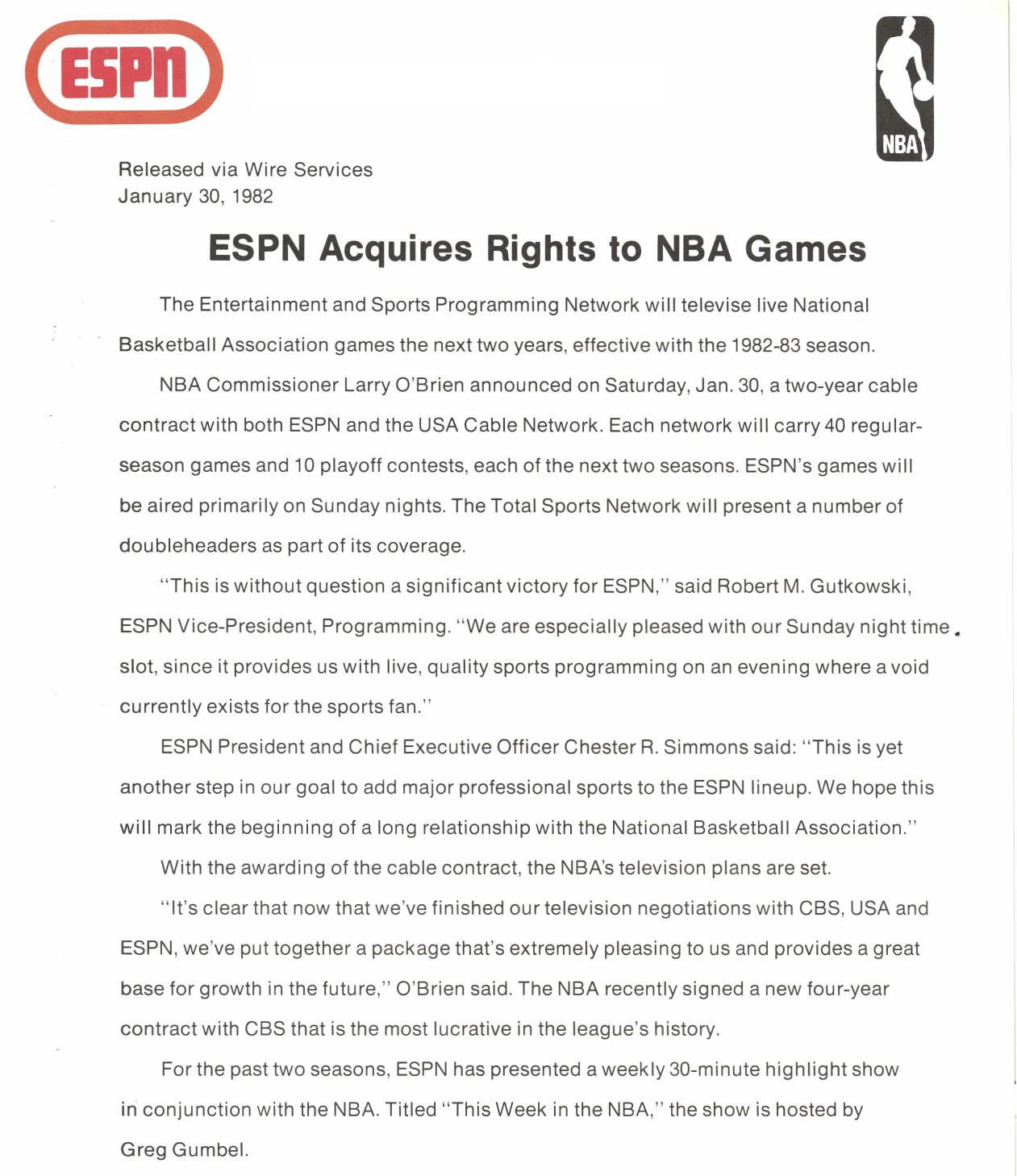
On January 30, 1982, the NBA reached a two-year agreement with ESPN to broadcast the league's 40 regular season and 10 playoff games from 1982–83 to 1983–84.[4][5][6]

Initially from 1982-83 to 1983–84, ESPN aired the NBA's regular season games every Sunday.[4]

2002–present

[edit]

On January 22, 2002, the NBA signed an initial six-year agreement with The Walt Disney Company that allowed ABC and its sister network ESPN (of which Disney owned an 80% stake) to broadcast the NBA's 75 regular season and 24 playoff games.[7][8] Currently, ESPN airs games on Wednesdays and Fridays, with select games broadcast on ESPN or ABC on select Saturdays, Sundays, and Mondays, as well as much of the Christmas Day games. Regular season broadcasts on ESPN are usually billed as NBA (name of day) since the 2008–09 season. ABC holds the exclusive broadcast rights to the NBA Finals. ESPN/ABC also has the rights to air the NBA draft.

In June 2007, the NBA renewed its television agreement with ESPN and ABC through 2016, which included expanded digital rights and an increased number of playoff games on ABC and ESPN.[9] This agreement was renewed again through 2025 in 2014.[1][2]

ESPN renewed its agreement again in 2024 to take its coverage through to 2036, but with NBC Sports and Amazon Prime Video replacing TNT as broadcasters, national rights were split differently. Among the changes, ESPN's Friday schedule was reduced from spanning the entire regular season to only selected weeks and it will no longer air Sunday night games during the second half of the season, ABC/ESPN coverage during the first two playoff rounds was reduced to about 18 games (with all games being exclusive rather than first round games being co-existed with RSN's), and the final season of the contract (2035–36 season) is when ABC/ESPN will not air any conference finals.[3][10] As part of a separate sublicensing agreement with Disney and TNT parent company Warner Bros. Discovery, ESPN and ABC gained the broadcasting rights to TNT Sports' Inside the NBA beginning in the 2025–26 season, the first season of their renewed agreement. TNT Sports will continue to produce the show for ESPN and ABC.[11][12][13][14]

During the period TNT shared the broadcast rights with the NBA, ESPN/ABC also held the exclusive rights to air the Eastern Conference Finals every even year except 2003, and the Western Conference Finals every odd year since 2005, with TNT airing the other conference finals series. For 2026, ESPN will air with Eastern Conference Finals while NBC carries the Western Conference Finals; the future Conference Finals rotation between ESPN, NBC and Prime will be announced in later years.

Commentators

[edit]

ESPN's best-known NBA broadcast team consists of Mike Breen on play-by-play, with Jeff Van Gundy and Mark Jackson as analysts. The trio called 15 NBA Finals together from 2007 to 2011, and again from 2014 to 2023. Other notable commentators throughout the years include Al Michaels, Mark Jones, Dave Pasch, Mike Tirico, Adam Amin, Ryan Ruocco, Hubie Brown, Richard Jefferson, JJ Redick, among others. Notable sideline reporters include Michele Tafoya, Doris Burke (later a game analyst), Israel Gutierrez, Rachel Nichols, Lisa Salters, Malika Andrews, Cassidy Hubbarth, Ros Gold-Onwude, Jorge Sedano, among others.

Since the 2017–18 season, Doris Burke became a regular analyst for the NBA on ESPN, replacing Doug Collins.[15]

The 2021–22 season marked the addition of Beth Mowins to the roster of play-by-play commentators. She is the first woman to call an NBA regular season (and playoff) game.[16] In the same season, JJ Redick joined the crew as analyst following his retirement from playing basketball.[17]

In August 2023, as part of a shakeup following the company's layoffs of many of its employees and personalities,[18] ESPN announced major changes in its commentator lineup for the 2023–24 season. The new lead broadcast team consists of Mike Breen, Doris Burke, and former NBA coach Doc Rivers. Burke will become the first female TV analyst in a major men's championship round.[19] Burke and Rivers replace lead analysts Jeff Van Gundy and Jackson, who were laid off by the network after the 2023 NBA Finals.[20][21][22] Additionally, a second core broadcast team consisting of Ryan Ruocco, JJ Redick, and Richard Jefferson was formed. The team calls the NBA Sunday Showcase games and works together for other marquee events throughout the season and into the playoffs. The trio debuted during the opening week of the regular season rather than the preseason, due to Ruocco's assignment for the 2023 WNBA Finals. The first game they called was the game between the visiting Dallas Mavericks and the San Antonio Spurs, notable for 2023 first draft pick Victor Wembanyama's regular season debut. That same year, Bob Myers joined the broadcast team as game analyst.[23] After Rivers was hired as head coach of the Milwaukee Bucks in January 2024, Redick joined Breen and Burke on the lead team.[24] Ahead of the 2024–25 season, ESPN started using a rotating cast of second analysts to join Breen and Burke after Redick became head coach of the Los Angeles Lakers; ESPN then announced on February 24, 2025, that Jefferson will remain with Breen and Burke for the rest of the season.[25] They also added Tim Legler, Cory Alexander and Jay Bilas as game analysts, and also hired Minnesota Timberwolves TV play-by-play announcer Michael Grady. Shams Charania replaced Adrian Wojnarowski as NBA insider before the season.[26]

Ahead of the 2025–26 season, ESPN replaced Doris Burke with Tim Legler on the lead team with Mike Breen and Richard Jefferson, though Burke would remain on the network in some capacity.[27]

Visual presentation

[edit]

Starting with 2006–07 NBA season, ESPN used ABC's theme music from two years prior, making it the second time the network had used its corporate sibling's NBA theme. Since ABC had undergone the transition from the former ABC Sports to merge with ESPN, forming ESPN on ABC, ESPN's music, graphics, and overall presentation have been used for all of their telecasts on the network.

Following the branding merge, ESPN began to use variations of the graphics used on ESPN Monday Night Football for their NBA broadcasts. With an updated graphics package debuting on Monday Night Football during the 2008–09 season [1], the same graphics were introduced in the April 8, 2009 telecast of NBA on ESPN.

On March 14, 2010, the graphics were refreshed and used in the NBA on ABC "Sunday Showcase". ESPN then used the refreshed graphics for their NBA telecasts the following day. Starting with the 2010–11 season, timeout indicators were added to the score banner, adopting the feature from ESPN's college football broadcasts.

Beginning with the 2011 NBA Playoffs, an updated composition of ESPN's theme "Fast Break" was introduced for the postseason, along with new in-game presentations. The score banner and other graphics retained their design, and the original composition of "Fast Break" remained as the theme song for the regular season.

During the 2013 Western Conference Finals, a new graphics package debuted for ESPN's NBA telecasts. The graphics featured 3-dimensional renderings of the team logos, along with the use of specific themes and backgrounds to accompany each of them. During the 2015 NBA Finals, the graphics were updated to reflect the new design used in ESPN's NBA Countdown broadcasts. However, during 2015-16 NBA season, the graphics were reverted to the previous package used since 2013. On May 17, 2016, the graphics, which were first seen during the previous year's championship, were used again for the 2016 Eastern Conference Finals and NBA Finals.

For the 2016–17 NBA season, ESPN introduced a revamped on-air presentation and branding for its NBA coverage, developed with the creative agency Big Block, as well as a new logo. The new design was inspired by "premium" consumer brands, and places a heavier focus on team logos and colors as the basis of its design, as opposed to visual environments and settings.[28] When introduced during the pre-season, the new package used a noticeably large scorebar, although it has since been reduced in size.[29] A season later, the logo was tweaked due to change in the NBA's logo.[30]

During every NBA Finals since 2019, the team logos are colored in gold in the scoreboard.

For the 2020-21 NBA season, ESPN introduced a new scoreboard, which is seen across the bottom of the screen (similar to Monday Night Football).

On October 6, 2022, ahead of the 2022–23 NBA season, ESPN unveiled a new visual identity for their NBA coverage. This features a new animated version of the NBA silhouette, a new 3D graphics, a flat scorebord, and a new hip-hop-influenced theme music composed by Made Music Studios. The overall identity was done by FutureDeluxe and Two Fresh.[31] ESPN and ABC began using the 2002 NBA on TNT theme music for Inside the NBA in 2025.

Studio shows

[edit]

NBA Countdown

[edit]

NBA Countdown, previously NBA Shootaround, is ESPN's main studio program, airing before each game telecast. ESPN's in-game studio programs originally consisted of Kevin Frazier and Tim Hardaway on Fridays with Stuart Scott replacing Frazier on Wednesdays. After horrible reviews for Hardaway, ESPN brought in Greg Anthony to replace him on Friday nights. Frazier and Anthony became ESPN's main studio team and worked most of the playoffs. For the 2003 Eastern Conference Finals, ESPN used ABC's halftime team of Mike Tirico and Sean Elliott for all the games.

2003–04 was the first year of the longest-tenured ESPN studio team. Frazier and Anthony were joined by controversial writer Stephen A. Smith and NBA legend Bill Laimbeer. Laimbeer, departing to continue coaching in the WNBA, was replaced by Tim Legler during the 2004 NBA playoffs. Smith, Legler and Anthony were joined by John Saunders (replacing Frazier, who left to host Entertainment Tonight) from late 2004 to the end of the 2005–2006 season.

ESPN's studio team has generally been more criticized[32] than praised. After the Pacers–Pistons brawl, ESPN's studio team came under severe criticism, both by the media[33] and by ESPN itself[34] for their stance regarding the actions of Indiana Pacer Ron Artest (who entered the stands to confront a fan, sparking the melee). Saunders came down hard on Detroit fans, referring to them as "punks," while Anthony and Legler defended Artest.

For the 2006–07 NBA season, Saunders was replaced by Fred Hickman, with the remaining team left intact.[35] Previous reports by The Big Lead.com and The New York Post indicated that Anthony, Legler and Smith along with Saunders would be replaced by Dan Patrick, Michael Wilbon and Mark Jackson.[36] Smith's role was significantly reduced, as he would no longer appear in studio with Hickman, Legler and Anthony, instead appearing during "The A List", a segment during the pregame show.

The program was hosted by either Hannah Storm, Stuart Scott or Mark Jones, alongside analysts Chris Mullin, Jalen Rose, Jamal Mashburn, Jon Barry and Michael Wilbon.

The program was also moved from ABC-owned studios at Times Square in New York City to ESPN's headquarters in Bristol, Connecticut.

The format changed for the 2011–2012 season. The show moved from Bristol to ESPN's West Coast headquarters in Los Angeles. Storm, Scott and Jones were dropped from the program and the host role abandoned. Instead, four analysts (Wilbon, Barry, Magic Johnson, and Chris Broussard) discuss scores, games, and other topics in more of a free form style than previously used.

In 2023, as part of major changes to its commentary team, Malika Andrews became the new lead host of NBA Countdown.[23]

Inside the NBA

[edit]

On November 16, 2024, Warner Bros. Discovery (WBD), parent company of TNT Sports, reached a settlement with the NBA involving TNT's coverage rights. WBD and Disney also entered into a sub-licensing agreement to broadcast TNT's studio show Inside the NBA on ESPN and ABC beginning the 2025–26 season, with TNT Sports continuing to produce the show with its existing personalities. Inside the NBA airs during ESPN and ABC's "high-profile live events" and "other marquee live events."[11] For the 2025–26 season, ESPN has scheduled 20 dates where Inside the NBA would air; ESPN will continue to air NBA Countdown.[37]

Ratings

[edit]

ESPN's highest rated NBA game was Game 5 of the 2006 Eastern Conference Finals between the Miami Heat and Detroit Pistons. The game scored a 5.5 cable Nielsen rating, with nearly five million viewers. To put that in context, Monday Night Football on ESPN posted ratings of 9+ in two of its first three telecasts. ESPN's highest rated regular season contest was the first matchup between Shaquille O'Neal and Yao Ming. The game between the Los Angeles Lakers and Houston Rockets scored a 3.82 cable Nielsen rating.

Generally, ESPN's regular season ratings are the same as competitor TNT's. During the playoffs, TNT has higher ratings, especially during the Conference Finals (from 2003 to 2005, TNT's Conference Final ratings were at least a full ratings point higher than ESPN's: 4.6 to 2.8 in 2003, 6.3 to 3.8 in 2004 and 5.0 to 4.0 in 2005). In 2006, for the first time ever, ESPN's Conference Final coverage averaged higher ratings than TNT's, averaging a 4.8 to TNT's 4.6.

Other ESPN channels

[edit]

United States

[edit]

ESPN2 aired a handful of NBA regular season games from 2002 to 2006, typically in January, when prime time golf tournaments preempted coverage on ESPN. On several occasions, ESPN2 would air the first game of a doubleheader, while ESPN air the second game. Starting with the 2006–2007 season, regular season games on ESPN2 were discontinued. During the playoffs, ESPN2 airs games that otherwise would not have appeared on any outlet other than NBA TV, mostly on Friday nights and only during the first round.

ESPN2 NBA coverage is mostly made up of studio shows, notably NBA Coast to Coast. NBA Coast to Coast, formerly known as NBA Fastbreak Tuesday and NBA Nation, is a two-hour long Tuesday night studio show that features live cut-ins to games throughout the league. In addition to Coast to Coast, ESPN2 airs several editions of NBA Fastbreak, ESPN's NBA oriented highlight show.

Despite airing fewer than forty NBA games in its eleven years of existence, ESPN2 did televise NBA legend Michael Jordan's final game in Chicago in January 2003.

ESPN2 also aired Kobe Bryant's final game against the Utah Jazz on April 13, 2016.

ESPN2 also aired a LeBron James potential record breaking game on February 3, 2023[38]

ESPN2 is the primary outlet for ESPN WNBA coverage, televising regular season games, the WNBA Finals and the WNBA draft. WNBA Shootaround, the WNBA equivalent of ESPN's NBA pregame show, airs sporadically on the network, typically before presentations of WNBA Tuesday.

Beginning with the 2022–23 season, ESPN2 began airing alternate presentations of select NBA games in a similar vein to Manningcast and KayRod Cast during Monday Night Football and Sunday Night Baseball respectively, with Stephen A. Smith as host. The series was titled NBA in Stephen A.'s World.

ESPNU aired two playoff games alongside NBA TV due to ESPN2 airing the NFL draft. The first came on April 28, 2017, during Game 6 of the Washington WizardsAtlanta Hawks first round series. The next came on April 25, 2025, during Game 3 of the Indiana PacersMilwaukee Bucks first round series. ESPNU primarily televises NBA G League games.

ESPNews serves as an overflow channel in case the first game of a doubleheader goes overtime.

Canada

[edit]

In Canada, through ESPN's partial ownership of CTV Specialty Television, TSN (which adopted ESPN's imagery since 2001) has aired selected NBA games as well as their sole Canadian franchise, the Toronto Raptors. Notable personalities include John Saunders, Leo Rautins, Paul Romanuk, Chuck Swirsky, Matt Devlin and Jack Armstrong.

See also

[edit]

References

[edit]
[edit]
Revisions and contributorsEdit on WikipediaRead on Wikipedia
from Grokipedia
NBA on ESPN is the branding for the National Basketball Association's (NBA) television coverage on the ESPN and ABC networks, including live broadcasts of regular-season games, playoff matchups, the NBA Finals, and complementary studio programming such as pre- and post-game analysis. ESPN first began televising NBA games during the 1982–83 season, initially offering limited coverage as part of its early expansion into professional sports broadcasting. This partnership evolved significantly with a landmark six-year agreement in 2002, which granted ESPN and ABC rights to over 100 regular- and post-season games annually, including the NBA Finals exclusively on ABC, marking ESPN's entry as a primary NBA broadcaster. Subsequent extensions, including a nine-year deal in 2014 covering the 2016–17 through 2024–25 seasons, solidified ESPN's role with up to 100 games per year, innovative production elements like all-women-led broadcasts, and global distribution through digital platforms. In 2024, the NBA announced an 11-year media rights extension worth $76 billion, commencing with the 2025–26 season and running through 2035–36, positioning and ABC as the league's cornerstone broadcast partners alongside and . Under this agreement, will air 60 regular-season games primarily on Wednesdays and Fridays, while ABC features 20 games on Saturdays and Sundays, with additional shared broadcasts; the networks will also exclusively cover all games on ABC, one Conference Finals series on , and key events like the and . Notable programming enhancements for 2025–26 include the integration of TNT's acclaimed —featuring hosts , Ernie Johnson, , and —airing at least 20 times on and ABC, alongside 's flagship for in-depth analysis. This coverage emphasizes high-profile matchups, such as opening-night doubleheaders and a Thanksgiving Eve tripleheader, underscoring 's commitment to delivering premier NBA content to a global audience.

History

1982–1984

The NBA and entered into a two-year broadcasting agreement on January 30, 1982, under which the network would air 40 regular-season games and 10 playoff games beginning with the 1982–83 season. This marked ESPN's initial foray into national NBA coverage, just three years after the network's launch in , as began expanding its role in sports programming. The deal provided ESPN with exclusive cable rights for these games, complementing the league's existing over-the-air broadcasts on . ESPN's first NBA game aired on January 2, 1983. As a nascent cable outlet with constrained budgets and infrastructure, ESPN relied on in-house production for many broadcasts, occasionally simulcasting local feeds to manage costs and logistical challenges. Key personnel during this period included play-by-play announcer Bob Neal, who handled several games, and occasional color commentary from figures like for Lakers-involved telecasts. The partnership concluded after the 1983–84 season, with ESPN choosing not to renew amid the network's focus on establishing in its early years. ESPN did not regain NBA television rights until , during which time cable coverage was provided by Turner Sports. This brief era laid groundwork for ESPN's later return to NBA coverage.

2002–2025

In , ESPN and ABC secured a renewed partnership with the NBA that significantly expanded their coverage under the Walt Disney Company umbrella. On January 22, , the NBA finalized a six-year agreement worth $4.6 billion collectively with Disney (encompassing ABC and ESPN) and AOL Time Warner (for TNT), with Disney's portion valued at $2.4 billion; this deal allocated 75 regular-season games and 24 playoff games to ESPN and ABC, while returning the exclusively to ABC beginning in the 2002–03 season. ESPN's programming emphasized doubleheader formats, particularly on Wednesday and Friday nights, which became staples for national exposure and helped grow the annual game load to over 100 by the 2010s, integrating seamlessly with ABC's weekend and holiday slots to maximize viewership across linear and emerging digital platforms. This expansion reflected ESPN's evolving role in delivering comprehensive NBA content, including exclusive national telecasts that highlighted marquee matchups and supported the league's global reach. The partnership evolved further with a 2014 renewal, extending through the 2024–25 season in a nine-year, $24 billion agreement split between and Turner Sports, generating approximately $2.6 billion annually for the NBA and granting enhanced rights to more exclusive regular-season and playoff games alongside robust digital streaming capabilities via . These additions allowed to broadcast up to 100 regular-season games per year by the late , fostering deeper integration with ABC's premium packages and emphasizing multi-platform access for fans. Production innovations marked this era, beginning with the introduction of 3D broadcasts in , when ESPN 3D aired its first NBA regular-season game on December 17 featuring the at the , followed by 14 total games that season to pioneer immersive viewing experiences. In 2017, contributed to NBA-wide virtual reality experiments, including player-perspective VR content and early live game streams via partnerships like NextVR, enhancing analytical breakdowns and fan immersion during the and Stephen Curry-dominated years. Post-2014, enhanced analytics graphics became a hallmark, incorporating visualizations such as player tracking metrics and shot probability overlays to deepen on-air insights without overwhelming the broadcast flow. ESPN adapted to disruptions with modified production approaches, as seen during the 2011 lockout-shortened season, where a condensed 66-game schedule led to adjusted doubleheader lineups and focused playoff coverage starting December 25. The 2020 prompted further changes for the Orlando bubble playoffs, with ESPN employing virtual crowd renderings, remote integration for some elements, and a studio-like setup devoid of live audiences to maintain broadcast continuity across the conference finals and on ABC. Throughout the era (peaking with his 2010s championships) and the Stephen Curry-led three-point revolution, shifted toward analyst-driven commentary, featuring expanded studio segments with experts dissecting strategic shifts like pace-and-space offenses and emphasizing narrative-driven analysis over traditional play-by-play dominance. This approach, amplified by the 2014 deal's digital rights, positioned as a central hub for interpretive coverage, blending highlights with expert opinions to engage a broadening .

Recent Developments (2024–present)

On July 24, 2024, the NBA announced a landmark 11-year media rights extension with (encompassing and ABC), valued at approximately $2.6 billion annually as part of a collective $76 billion deal that also includes and , running through the 2035–36 season and solidifying ESPN's position as the primary broadcaster with exclusive rights to the . This agreement, which builds on the prior nine-year pact established in 2014, expands ESPN/ABC's coverage starting with the 2025–26 season to include 80 regular-season games annually—with at least 20 airing on ABC—alongside one Conference Finals series each year, alongside one Conference Finals series. A significant component of the new arrangement involves the integration of TNT's flagship studio show , acquired through an exclusive licensing deal with following the resolution of their legal dispute over matching rights. The program, featuring its original Atlanta-based crew of host , analysts , , and , debuted on and ABC platforms on October 22, 2025, serving as the pregame show for opening night matchups, including the at the . This move preserves the show's irreverent format while enhancing ESPN's studio programming for high-profile games, with episodes airing approximately 20 times during the regular season, primarily on Wednesdays, Fridays, Saturdays, and Sundays. To accommodate Inside the NBA, ESPN adjusted its longstanding NBA Countdown format, positioning the acquired show as the lead-in for marquee broadcasts like the "NBA Sunday Showcase" on ABC, while Countdown handles secondary games and incorporates cross-promotions, such as guest appearances by Inside panelists like on Countdown episodes. These changes, implemented from the season's outset, have aimed to blend the networks' styles without fully replacing Countdown, fostering a complementary ecosystem for pregame analysis. The transition was facilitated by a November 2024 settlement between the NBA and , which resolved WBD's lawsuit alleging over the rights deal and granted ESPN exclusive distribution rights to Inside the NBA for the deal's duration, ensuring continuity for the production team and avoiding further litigation. Early impacts in the 2025–26 season included strong viewership for the debut episode, which averaged 1 million viewers across ESPN and ABC, signaling a successful merger of programming legacies.

Studio Programming

NBA Countdown

NBA Countdown is ESPN's flagship pregame studio show for NBA coverage, providing , previews, and insights ahead of key games on ESPN and ABC. The program debuted on October 25, 2002, as a 30-minute preview offering breakdowns of upcoming matchups, player performances, and league news. It expanded to a one-hour format in 2016 during the regular season and playoffs, incorporating dedicated segments on player statistics, injury updates, and highlight reels to deepen viewer engagement with the day's action. This evolution has positioned NBA Countdown as a central component of ESPN's NBA programming, emphasizing structured and predictive to build anticipation for broadcasts. The show's current format centers on a host leading discussions with a rotating panel of analysts, fostering lively exchanges on team strategies, matchup advantages, and season narratives. As of the 2025-26 season debuting November 19, 2025, serves as the primary host, drawing on her background in NBA reporting to guide conversations, with core analysts including for insider reporting, Michael Malone for coaching insights, and for player perspective. Signature elements include recaps of recent game highlights—often focusing on dramatic moments like buzzer-beaters—and panel predictions for game outcomes, which add an interactive layer by inviting viewer polls and expert picks. Commentators such as occasionally appear as guests to provide specialized breakdowns. Over the years, has adapted to technological and logistical challenges to maintain high production standards. During the in Orlando amid the , the show utilized virtual production techniques, including remote green-screen setups and overlays, to simulate a live studio environment while adhering to health protocols. Since 2021, it has integrated advanced graphics for play breakdowns, allowing analysts to visualize player movements and defensive schemes in real-time during discussions. The program has earned recognition for its excellence, including multiple Sports Emmy nominations and wins in the outstanding studio show category during the , highlighting its impact on sports broadcasting. NBA Countdown airs prior to ESPN's Thursday and Friday night doubleheaders, Sunday showcases on ABC, and playoff games, typically starting one hour before tip-off to align with the expanded format. Special editions precede NBA All-Star events, featuring extended previews of the weekend's festivities. Unlike TNT's , which emphasizes post-game entertainment and unscripted humor, NBA Countdown maintains an ESPN-branded, debate-oriented approach focused on pre-game preparation and analytical depth.

Inside the NBA

Inside the NBA originated on TNT in 1989, coinciding with the network's acquisition of NBA broadcast rights for the 1989–90 season, where it served as a post-game program following nationally televised games. As part of the NBA's new 11-year media rights deal valued at $77 billion, the show's rights transferred to beginning with the 2025–26 season through a licensing agreement with (WBD), allowing it to continue airing immediately after select ESPN and ABC national broadcasts. The program's core format remains an hour-long post-game show hosted by Ernie Johnson since 1990, featuring analysts Kenny Smith (since 1998), (since 2000), and (since 2008), who deliver a mix of analysis, humor, and banter. Signature comedic segments, such as O'Neal's "," which highlights players' on-court blunders through highlight reels and mockery, exemplify the show's irreverent style that prioritizes entertainment alongside insights. Under ESPN, production continues from TNT Sports' Atlanta studios to preserve its authentic vibe, but incorporates ESPN-specific graphics overlays for replays and statistics, along with occasional crossovers featuring hosts from the network's pre-game show. The first episode aired on October 22, 2025, following an ESPN doubleheader, marking a seamless debut that retained the original theme music and set design. The schedule positions the show after high-profile games on ESPN and ABC, with at least 20 regular-season appearances planned, and additional episodes during the playoffs covering one Conference Finals series on ESPN and all games on ABC. Prior to the ESPN move, Inside the NBA had earned 21 for categories including outstanding studio show and live sports coverage, underscoring its production excellence. The program has cultivated significant cultural impact through viral moments, such as Barkley's candid player interviews and the crew's humorous takes on league news, which often generate millions of views and influence broader NBA discourse. This transition followed the resolution of legal disputes between the NBA and WBD in November 2024, where WBD sued over matching rights but settled to license the show to , ensuring its continuity without altering the core team.

On-Air Personnel

Play-by-Play Announcers

has served as the primary play-by-play announcer for ESPN's NBA coverage since 2006, particularly noted for his energetic calls during the , where he has provided commentary for every series since the 2006 matchup between the and . 's signature exclamations, such as "Bang!" for emphatic three-pointers, have become hallmarks of his style, enhancing the drama of pivotal moments in high-stakes games. Joining him as alternates are Mark Jones, , and , who handle regular-season and playoff assignments. Historically, ESPN's NBA play-by-play evolved through key figures who shaped its early sound. anchored coverage in the network's inaugural NBA broadcasts from 1982 to 1984, delivering a straightforward, radio-influenced that emphasized game flow amid the league's growing visibility on cable. took over as a prominent voice from 1989 to 2002, infusing broadcasts with his rapid-paced, authoritative style that bridged local radio traditions and national television excitement during ESPN's partnership with ABC for NBA rights. followed from 2002 to 2016, modernizing the role with versatile, conversational calls that adapted to the faster tempo of 2000s , calling approximately 375 regular-season and playoff games across , ABC, and . The style of ESPN's play-by-play announcing has shifted from the measured, descriptive narration of the —rooted in radio heritage—to the high-energy, immersive delivery prominent in the and beyond, reflecting advancements in camera angles, replay technology, and audience engagement. Breen exemplifies this evolution in his work, pairing rhythmic pacing with exclamatory to capture the intensity of playoff basketball, often alongside color commentators like for balanced game flow description. Assignments for play-by-play announcers are structured around priority matchups, with Breen leading the and Conference Finals since 2006, while regional rotations feature Jones, Pasch, and Ruocco for regular-season games to cover ESPN's slate of up to 100 contests annually. Production support has advanced with in-ear monitors (IFBs) for real-time producer communication and integrated stats feeds, standard since the early , allowing announcers to access live data like player efficiency ratings and shot charts during broadcasts. A key diversity milestone came in 2002 when became ESPN's first female sideline reporter for NBA coverage, providing on-court reporting that added depth to play-by-play narratives and paved the way for greater inclusion in sports broadcasting. Salters continues in this role as part of the lead broadcast team for the 2025-26 season.

Analysts and Color Commentators

Analysts and color commentators for NBA on ESPN provide in-depth strategic analysis during game broadcasts, breaking down plays, predicting potential outcomes, and discussing coaching decisions to enhance viewer understanding of the game's complexities. These experts, often former players or coaches, collaborate closely with play-by-play announcers to offer insights that go beyond the action on the . Their roles emphasize tactical breakdowns, such as defensive schemes and offensive adjustments, helping audiences appreciate the nuances of professional . Historically, delivered renowned tactical breakdowns as an NBA analyst starting in 2004, drawing from his coaching experience with teams like the and , though his national broadcasting career began earlier with in the 1980s and 1990s. Brown retired from broadcasting after his final game on February 9, 2025. served a brief stint as a studio and game analyst for from 2002 to 2004, bringing his legendary playing perspective before departing due to other commitments. Prominent figures include Jeff Van Gundy, who joined ESPN as a lead game analyst in 2007 and provided ex-coach insights, particularly on defensive strategies, until his departure in 2023; his analysis was especially valued during playoff coverage for dissecting complex schemes. Mark Jackson offered a player perspective as an ESPN analyst from 2006 to 2023, frequently highlighting on-court decision-making after returning from a coaching hiatus with the Golden State Warriors. For the 2025-26 season, the lead game analysts are Tim Legler and Richard Jefferson, pairing with Mike Breen and reporter Lisa Salters for marquee matchups including the NBA Finals. Other contributors include Doris Burke, Jay Bilas, and Bob Myers. Jefferson, who became an ESPN game and studio analyst in 2019, continues this tradition with fresh takes from his 17-year NBA career. Pairings often feature these analysts alongside lead play-by-play voice for high-stakes games like the , as seen with Van Gundy and Jackson calling 15 together from 2007 to 2022. Promoting gender diversity, has emerged as a rising analyst since joining ESPN's NBA coverage in 2020, providing multifaceted analysis as a former WNBA All-Star, primarily in studio programming. Innovations in their work include the adoption of telestration tools for diagramming plays, a technique integrated into NBA broadcasts including ESPN's since the to visually illustrate strategies. Post-2020, analysts have increasingly incorporated commentary, addressing issues like during broadcasts amid the league's efforts, as exemplified by discussions around player protests and systemic change. Van Gundy's long tenure was supported by multi-year ESPN contracts, including renewals prior to 2023 that solidified his exclusive role, though he was released amid cost-cutting measures despite remaining time on his deal.

Game Coverage

Regular Season Broadcasts

ESPN's regular season NBA broadcasts feature a structured schedule emphasizing key nights throughout the 82-game season, with the network airing 60 games in the 2025–26 season, primarily on Wednesdays and Fridays. These broadcasts often include doubleheaders starting at 7:00 p.m. ET, allowing viewers to catch multiple high-profile matchups in a single evening, such as the opening night slate or holiday specials like Eve games. Production for these games employs a multi-camera setup, typically including up to 12 handheld and fixed HDC-5500 cameras, along with isolated feeds and a clean host feed from regional sports networks, to capture dynamic action without the extensive resources of playoff coverage. segments incorporate condensed game recaps and analysis, often transitioning seamlessly from the preceding pregame show, while utilizing enhanced world feed models for efficient remote integration of graphics and replays. Game selection prioritizes star-driven narratives, including debut spotlights for rookies like in the 2023–24 season, alongside marquee clashes featuring players such as and . Viewer access has expanded with free streaming options on the ESPN app since 2019 for authenticated users, complemented by Spanish-language commentary on for broader reach. Compared to playoff productions, regular season telecasts incorporate fewer layered graphics and more frequent commercial interruptions to accommodate the lighter scheduling demands of the 82-game slate.

Playoff and Finals Coverage

Under the media rights agreement effective for the 2025–26 season and beyond, and ABC will provide extensive coverage of the , including about 18 first-round and conference semifinal games, and one conference final series. Prior agreements provided varying allocations, such as shared coverage of early rounds and alternating conference finals with TNT. ABC has exclusively broadcast the since the 2003 season, marking a shift from previous networks and emphasizing its role in delivering the league's championship climax. This structure ensures broad national exposure for high-stakes matchups, with handling a significant portion of the postseason slate to build toward the Finals. The NBA Finals follow a best-of-seven format, typically commencing on a Thursday evening and alternating with Sunday afternoon or evening games to maximize weekend viewership, as seen in the 2025 series between the and that concluded on June 22 with a Thunder victory in Game 7. ABC's lead announcing team for the Finals has evolved, with serving as play-by-play voice since 2006, initially paired with as analyst until 2023, and in 2025 joined by and sideline reporter for the championship coverage. This setup underscores the playoffs' compressed intensity, contrasting the regular season's role in qualifying teams for postseason contention. Production for playoff and Finals broadcasts has seen significant upgrades, deploying over 40 cameras—including , RF shallow-depth-of-field units, and live drones—for dynamic angles and immersive viewing, with drone shots integrated since 2018 to capture arena atmospheres and key moments. While standard broadcasts remain in HD, select elements like certain camera feeds have utilized 4K and HDR capabilities starting in 2021 to enhance visual quality in and replays. Additional features include integrated post-game press conferences aired immediately following games and increased use of player microphones during action to provide authentic on-court audio, heightening the drama of pivotal series. Among historic playoff series, the between the and —part of a three-year (2015–2017)—drew record audiences, with Game 7 averaging 30.8 million viewers on ABC, the highest for any NBA game and featuring intense coverage of the Cavaliers' comeback from a 3-1 deficit. For the 2025-26 season, a notable change includes serving as the official postgame show for ABC's Finals coverage, extending its studio analysis immediately after championship games for the first time.

Notable Broadcasts

All-Star Game Productions

ESPN has provided extensive coverage of NBA All-Star Weekend since the mid-1980s, encompassing the full slate of events including the , Skills Challenge, 3-Point Contest, and the Sunday , which alternates broadcast rights between ESPN/ABC and TNT under the league's media agreements. The network's involvement grew with the NBA's cable rights deals, offering multi-platform programming across , , and to capture the weekend's entertainment-focused atmosphere. 's last broadcast of the All-Star Game itself occurred in 2023 on ABC, marking the end of its rotation turn before TNT handled the 2025 event in the as its final NBA production. This comprehensive approach emphasizes fan engagement through live events, highlight recaps, and digital streams, distinguishing All-Star Weekend from regular-season telecasts. Production highlights from recent All-Star Weekends underscore ESPN's role in amplifying the league's celebratory elements. The 2020 Chicago event, broadcast primarily on TNT with ESPN contributing to ancillary programming, featured poignant tributes to , including pregame videos narrated by Jordan himself and former President , celebrating the city's basketball heritage. Held on February 16, 2020, the weekend proceeded without delay but served as the final major in-person gathering before the forced the NBA to suspend its season days later, prompting ESPN to pivot to remote and virtual coverage formats in subsequent months. These productions often incorporate thematic elements tied to host cities, blending nostalgia with current star power to enhance viewer immersion. Format evolutions have been a key focus in ESPN's All-Star coverage, reflecting the NBA's efforts to boost competitiveness and entertainment value. In 2020, the league experimented with a target-score system—known as the —where the fourth quarter concluded when one team reached a score 24 points above the leading team's total after three quarters, aiming to eliminate and encourage all-out play; Team LeBron defeated Team Giannis 157-155 under this rule during the game. The format carried over to the 2021 event but was reverted in 2023 to the traditional East vs. West matchup amid mixed player and fan feedback, with ESPN's broadcasts highlighting these changes through pregame analysis and post-event breakdowns. For events like the 3-Point Contest, which ESPN has aired in rotation years, productions feature interactive on-site fan cams and graphics to showcase shooter precision and crowd reactions, adding a layer of immediacy to the competition. Key personnel assignments elevate ESPN's All-Star presentations, with reporters like Lisa Salters handling special features such as red carpet arrivals and player interviews to capture off-court glamour and insights. Salters, a veteran sideline reporter since joining ESPN's NBA coverage in 2005, has contributed to All-Star Weekend reporting, including practice sessions and celebrity integrations. Viewership for these events peaked in the 2000s during the Michael Jordan era, with the 2003 All-Star Game on TNT drawing a 6.6 household rating and 10.8 million viewers—among the highest for the exhibition since the late 1990s—fueled by Jordan's farewell performance. These broadcasts not only celebrate star talent but also preview playoff dynamics in a low-stakes setting. The 2025 All-Star Weekend in the San Francisco Bay Area marked a transitional moment ahead of the new media rights deal, with ESPN providing coverage of ancillary events like the Celebrity Game and practice sessions. ESPN's promotions frequently tie into NBA Cares initiatives, spotlighting charity events such as community service days and youth basketball clinics during the weekend. These crossovers underscore the weekend's broader community role, with ESPN using airtime to amplify the NBA's philanthropic commitments.

Historic Game Telecasts

One of the most iconic performances in NBA history, Bryant's 81-point game on January 22, 2006, when the defeated the 122-104, was highlighted extensively on 's SportsCenter, where anchor provided live updates and post-game analysis that amplified its cultural impact. 's post-game recaps and ongoing coverage played a key role in dissecting the controversy surrounding the 2002 Western Conference Finals Game 7 between the and , a 112-106 overtime victory for on June 2, 2002. The broadcast, originally on , drew scrutiny for alleged officiating biases favoring the , with analysts later examining free-throw disparities— attempted 27 compared to 's 19—and missed calls in extended segments that fueled debates about playoff integrity. The Game 6, featuring Michael Jordan's game-winning to secure Chicago's 87-86 win over the on June 14, 1998, was referenced prominently in ESPN's recap programming despite airing on . ESPN's replays and analysis of Jordan's final play with the Bulls cemented it as a landmark moment, emphasizing its role in ending the dynasty with six championships in eight years. In the at , ABC broadcasted the milestone game where clinched his fourth championship on October 11, 2020, as the Lakers defeated the 106-93 in Game 6 of the Finals, with ESPN production support. This fanless production, the first of its kind due to the , featured innovative remote camera setups and virtual crowd simulations, with James earning Finals MVP honors for averaging 29.8 points per game. ESPN pioneered 3D broadcasting in NBA coverage with the December 17, 2010, regular-season game between the Miami Heat and New York Knicks, marking the network's first 3D telecast and showcasing enhanced depth for dunks and fast breaks. This technical innovation extended to playoff broadcasts, influencing future immersive viewing experiences. Game 7 of the 2016 NBA Finals, broadcast on ABC with ESPN production support, saw the Cleveland Cavaliers overcome a 3-1 deficit to beat the Golden State Warriors 93-89 on June 19, 2016, achieving a historic comeback analyzed live for its strategic shifts, including LeBron James' block on Andre Iguodala. The game drew a record 30.8 million viewers and an 18.9 U.S. rating, the highest for an NBA Finals since 1998. The inaugural NBA In-Season Tournament Final on December 9, 2023, featured ESPN's coverage of the Lakers' 123-109 victory over the , highlighted by ' 41 points and 20 rebounds, with earning tournament MVP. This event introduced a new mid-season format with a $500,000 prize per player and on-court trophy presentation, blending regular-season play with championship pageantry. In the 2025–26 season, the debut of on ESPN platforms following the October 21, 2025, opening night doubleheader—featuring the vs. and vs. —marked a significant milestone in ESPN's NBA coverage, blending TNT's studio format with ESPN's analysis.

Ratings and Impact

The NBA on ESPN has experienced significant fluctuations in viewership since its inception in , with peaks driven by star power and rebounds influenced by external events. The highest viewership for NBA broadcasts overall, including those in the shared era with ESPN's involvement in regular season coverage, occurred during the , which averaged 29.0 million viewers across six games on . For ESPN specifically, regular season games reached highs of 2.51 million average viewers during the 2010-11 and 2011-12 seasons, fueled by the popularity of stars like and the Miami Heat's contention for titles. Following Michael Jordan's retirement in 1998, NBA viewership on declined sharply in the early 2000s, with regular season averages dipping to around 1.5 million viewers amid a broader post-Jordan slump that saw Finals ratings fall from 18.7 to as low as 12.5 by 2003. A notable rebound occurred during the playoffs, where coverage averaged 3.04 million viewers per game across networks, benefiting from captive audiences during the lockdowns despite an initial drop in seeding games to 1.28 million. In the 2024-25 regular season, ESPN's NBA games averaged 1.32 million viewers, part of an overall national average of 1.53 million across ABC, , and TNT, reflecting a slight 2% decline from the prior year according to Nielsen data, though ABC's slate saw a 10% increase. Key factors mitigating linear TV declines include the growth of streaming platforms like , which offset traditional drops by capturing younger audiences and contributing up to 18% of total viewership in select windows. Since 2010, on ABC (ESPN's parent network) have averaged 11-15 million viewers per series, with peaks like 19.94 million in 2015 but recent lows around 7.5 million in 2020. The 2025 on ABC averaged 10.2 million viewers per game across seven games. Comparatively, ESPN has outperformed TNT in playoff viewership, averaging 4.45 million viewers through the first two rounds of the 2025 playoffs (up 13% year-over-year), while TNT's coverage averaged 4.7 million in 2023 but lagged in recent head-to-head matchups. However, ESPN/ABC trails standalone ABC Finals broadcasts in total draw, where series like the 2025 Finals averaged under 9 million for Game 1. Looking ahead, the 2025-26 media rights deal, which integrates TNT's Inside the NBA onto ESPN platforms for 20 high-profile dates, is projected to boost viewership by up to 20% through enhanced star-driven analysis and broader distribution across NBC, Amazon, and Disney networks. Early 2025-26 regular season national games have seen viewership up 92% in the first two weeks, the highest in 15 years.

Cultural and Industry Influence

NBA on ESPN has played a pivotal role in popularizing global stars, notably through its coverage of the , where became the first international player selected No. 1 overall by the , sparking widespread interest in the league across and beyond. This broadcast exposure helped transform Yao into a , boosting NBA fandom in —where the Rockets instantly became the nation's favorite team—and challenging stereotypes about Asian athletes in American sports. By highlighting such international talents, ESPN's programming contributed to the league's , drawing in diverse audiences and fostering a more inclusive culture worldwide. In terms of industry innovations, advanced sports broadcasting by integrating advanced into its NBA coverage, including the (PER) developed by John Hollinger, which began prominently featuring in its statistical breakdowns starting around the 2003-04 season. This emphasis on metrics like PER, which measures per-minute player production relative to league averages, helped popularize data-driven analysis within NBA telecasts and influenced broader sports media practices, encouraging other networks to adopt similar quantitative approaches for evaluating performance. 's analytics push marked a shift toward more sophisticated commentary, elevating viewer engagement with strategic insights beyond traditional box scores. Economically, NBA on ESPN has significantly bolstered the league's growth, contributing to its annual revenues exceeding $10 billion as of the 2021-22 season, with media rights deals—where ESPN holds a major stake—accounting for over half of the NBA's overall income. These partnerships have driven substantial financial expansion for the NBA, enabling investments in player development and global outreach. Additionally, ESPN has advanced diversity in , increasing opportunities for female and minority talent post-2015, culminating in milestones like the network's first all-women-led national NBA game production in February 2022, featuring on play-by-play and as analyst, alongside over 70 women in key roles. Such initiatives have set standards for inclusive representation in sports media. While praised for its innovations, NBA on ESPN has faced criticisms for excessive advertising during broadcasts, particularly in the when commercial interruptions disrupted game flow, though the league and network responded in the 2020s by experimenting with reduced timeout lengths to shorten breaks and improve pacing. Overall, the program's legacy lies in solidifying the NBA as a 24/7 media phenomenon through comprehensive coverage, including shows like The Jump (–2021), hosted by Rachel Nichols, which provided daily analysis and interviews, inspiring ongoing round-the-clock NBA programming across platforms.

Distribution Across ESPN Networks

ESPN2 and Additional Channels

ESPN2 plays a key supplementary role in NBA coverage by airing select regular-season games, overflow matchups, and studio programming that extends the reach of ESPN's primary broadcasts. The channel frequently handles doubleheaders, such as those during high-profile nights like the final day of the regular season, providing live look-ins and analysis to capture multiple games simultaneously. In the 2025-26 season, ESPN2 participated in opening-week doubleheaders on October 22 and 23, alongside ESPN, with games also available via streaming on the ESPN App and ESPN+. Since 2021, ESPN2 has incorporated alternate broadcast formats, including betting-focused specials that integrate odds, props, and analytics to appeal to a growing of sports wagerers. These productions often utilize advanced stats overlays to enhance viewer insights without overwhelming the core gameplay. Beyond , other ESPN networks contribute niche NBA extensions. The focuses on sports but includes NBA tie-ins through segments tracking former SEC players' professional performances, fostering regional fan connections. Since its 2018 launch, ESPN+ has expanded digital access with streaming of all ESPN- and ABC-aired NBA games—approximately 80 regular-season contests—plus exclusive originals, out-of-market options, and on-demand highlights, making it essential for cord-cutters seeking comprehensive coverage. In the 2025-26 season, ESPN2 has increased its integration with flagship programming, airing pregame editions of Inside the NBA—produced by TNT Sports—on select dates, such as October 22 from 6-7 p.m. ET, to build hype for marquee doubleheaders. These expansions aim to broaden accessibility across linear and streaming bundles. Technically, ESPN2 shares production infrastructure with ESPN's main feeds, employing Enhanced World Feed (EWF) models for core video and Graphics REMote Integration (GREMI) for tailored, simplified overlays that reduce on-site complexity while maintaining quality. Viewership on for NBA content typically ranges in the hundreds of thousands, serving as a complementary outlet that averages lower than ESPN's flagship games but supports overall network engagement for non-traditional audiences.

Integration with ABC

Since 2002, ABC has played a pivotal role in NBA as part of a joint agreement with ESPN, under , which secured rights for over 100 regular-season and postseason games annually starting with the 2002-03 season. This deal established ABC as the exclusive broadcaster of the beginning in 2003, a position it has maintained through subsequent renewals, providing access to the league's championship series. Additionally, ABC airs a limited slate of premium regular-season games, including the NBA Sunday Showcase series, typically featuring 10-15 afternoon matchups from February to April each year, designed to highlight marquee contests and build toward the . The integration between ESPN and ABC emphasizes shared production resources, with ESPN handling the on-air crews and technical elements for ABC's telecasts to ensure consistency across Disney's platforms. For instance, veteran play-by-play announcer serves as the lead voice for both ESPN's cable broadcasts and ABC's over-the-air presentations, often paired with analysts like and . Since 2006, following the rebranding of ABC Sports to "," the networks have utilized a unified graphics package—initially adapted from ESPN's ""—featuring synchronized score bugs, replay overlays, and data visualizations that appear identically on both channels. This collaborative model extends to streaming, where ABC games are on the ESPN app, allowing viewers to access the same feed across devices. Key events underscore this partnership's adaptability, such as ABC's coverage of the in the Orlando bubble, where ESPN's extended studio segments with additional pregame and to contextualize the unprecedented pandemic-era format, drawing an average of 7.7 million viewers across the series. In 2024, cross-promotions between NBA and WNBA programming on ABC and highlighted the leagues' synergy, including shared talent appearances and bundled rights under the new media agreements to amplify visibility for both. ABC's broadcast reach significantly enhances audience totals for high-profile events; for example, the 2025 averaged 10.27 million viewers on ABC's over-the-air platform, compared to ESPN's cable telecasts of conference finals or regular-season games, which typically draw 2-3 million. Looking ahead, the 11-year media rights extension from 2025-26 through 2035-36 further deepens the ESPN-ABC collaboration, with ABC incorporating crossovers from TNT's "Inside the NBA" as pregame and postgame programming for select ABC events, such as Sunday Showcase and Finals lead-ins. This arrangement, valued at $2.6 billion annually for ESPN/ABC's package, preserves ABC's status as the Finals' exclusive home while integrating streaming and multi-network elements to broaden accessibility.

References

Add your contribution
Related Hubs
User Avatar
No comments yet.