Hubbry Logo
Narceus americanusNarceus americanusMain
Open search
Narceus americanus
Community hub
Narceus americanus
logo
8 pages, 0 posts
0 subscribers
Be the first to start a discussion here.
Narceus americanus
Narceus americanus
from Wikipedia

Narceus americanus
Scientific classification Edit this classification
Kingdom: Animalia
Phylum: Arthropoda
Subphylum: Myriapoda
Class: Diplopoda
Order: Spirobolida
Family: Spirobolidae
Genus: Narceus
Species:
N. americanus
Binomial name
Narceus americanus

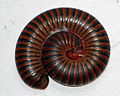
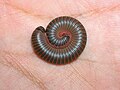
Narceus americanus is a large millipede of eastern North America. Common names include American giant millipede,[1] worm millipede, and iron worm.[2] It inhabits the eastern seaboard of North America west to Georgetown, Texas, north of the Ottine wetlands.[3] It has a nearly cylindrical gray body, reaching a length of 4 inches (100 mm).[4] They can be commonly found in or under decaying logs from March to October.[5] When threatened, they sometimes curl up or release a noxious liquid that contains large amounts of benzoquinones which can cause dermatological burns. This fluid may irritate eyes or skin. Many other millipedes secrete hydrogen cyanide, and while there have also been claims that N. americanus releases hydrogen cyanide, they are unsubstantiated. They do, however, excrete a substance that causes a temporary, non-harmful discoloration of the skin known as millipede burn.[6]

Ecology and behavior

[edit]

Diet

[edit]

N. americanus are detritivores, primarily consuming decaying wood and leaf litter. They have also been found to feed on deer scat and fresh fruit, preferring these to their typical diet when given the choice.[7] Most feeding activity occurs at night.

Behavior

[edit]

Though capable of releasing irritating and foul-smelling liquid from ozopores when aggressively disturbed, they can typically be safely handled by humans and are not uncommon on the arthropod pet market.[8]

Their cuticle is somewhat water permeable, so they seek out damp or humid environments and have exhibited specific behaviors in response to desiccation stress. If exposed to a dry or actively desiccating environment, they will first expend energy trying to find a more favorable environment, and if this fails they reflexively curl into the typical defensive position. This position closes spiracles located at the base of legs, preventing further water loss.[9] From a partially dehydrated state they can reabsorb moisture from high-humidity air, but moisture-rich food is necessary for complete recovery to a fully hydrated state. Molting while burrowed into the ground or into rotting wood can also be a response to chronic dehydrating conditions.

Burrowing

[edit]

Source:[10]

Burrowing is initiated by the millipede picking up sediment grains with its mandibles and using legs to pass them along its body segments, where the sediment is then deposited at the posterior end of the body. This process from start to finish can take anywhere between five and sixty minutes, depending on the size of the burrow and qualities of the soil.

Burrows can be used as temporary or more permanent dwellings, and are used to escape dry or cold surface conditions. Millipedes will typically spend non-feeding time in their burrows, which is why they are difficult to find during the day. Molting is almost exclusively done in burrows.

Susceptibility to predation

[edit]

In some regions Narceus americanus seems to be subject to predation by an as yet unidentified organism that eats the head and the first few segments of the body, discarding the rest of the carcase. This seems to happen mainly, if not exclusively, on Tuckernuck Island. The observation is interpreted as reflecting the fact that some predator has discovered that only the anterior part of the animal is non-toxic. Proposed perpetrators include voles and eastern towhee.[11]

Reproduction

[edit]

The average lifespan of these millipedes is unknown, but they can live up to eleven years in captivity or in the wild. Sexual maturity is not reached until 1–2 years of age.

Mating occurs at the beginning of spring through to early summer.[12] Males mate via transfer of a spermatophore, and females are able to store this sperm to fertilize eggs at a later time. Other millipede species may lay 20–300 eggs, but N. americanus lay just one egg in a nest made of chewed leaf litter and excrement. The female millipede will wrap herself around the egg and nest until it hatches several weeks later, producing a millipede with seven body segments and only three leg pairs. The number of body segments and leg pairs are increased with each molting, and there is no parental investment after egg hatching.

Photos

[edit]

See also

[edit]

References

[edit]
[edit]
Revisions and contributorsEdit on WikipediaRead on Wikipedia
from Grokipedia
Narceus americanus is a large species of in the order Spirobolida and family Spirobolidae, native to eastern . It is one of the largest millipedes in the region, reaching lengths of up to 10.2 cm (4 inches) and weights of about 2.5 g, with a long, cylindrical body featuring approximately 30 to 50 segments and 60 to 100 pairs of legs. The body is primarily black or dark reddish-brown, accented by distinctive yellow, purple, pink, or red edges on each segment, and males possess longer legs and antennae compared to females. This millipede is widely distributed across all U.S. states east of the , extending into nine western states such as and , as well as Canadian provinces including and , though the may encompass a complex of cryptic species. It inhabits diverse environments, including forests, agricultural fields, urban, and suburban areas, favoring moist conditions in the soil-litter interface under rocks, logs, leaf litter, or dead trees due to its permeable requiring high humidity. As detritivores, individuals primarily consume decaying plant matter such as leaves, wood, and roots, along with fungi, dung, and associated microbes, using strong mandibles to process food and playing a key ecological role in and nutrient cycling, particularly calcium in forest soils. Narceus americanus exhibits solitary, nocturnal behavior, remaining active from spring through fall and hibernating in winter within rotting logs or . When threatened, it curls into a spiral and secretes irritating chemicals from repugnatorial glands, earning it common names like "iron worm" for its robust defense. is seasonal, occurring in spring and summer, with males depositing sperm webs and using pheromones to attract females; females lay eggs in nests constructed from chewed plant material and excrement, which they brood until hatching, and offspring reach maturity in 1 to 2 years with a potential lifespan of up to 11 years in captivity. While generally not of conservation concern, it can occasionally become a minor pest in or homes by feeding on crops or invading structures.

Taxonomy and description

Taxonomic classification

Narceus americanus belongs to the kingdom Animalia, phylum Arthropoda, subphylum , class Diplopoda, subclass Chilognatha, order Spirobolida, family Spirobolidae, genus Narceus, and species americanus. This placement situates it within the diverse class Diplopoda, which encompasses millipedes characterized by two pairs of legs per body segment and a cylindrical form. The family Spirobolidae includes several large-bodied species adapted to terrestrial environments, with Narceus distinguished by its North American distribution. Historically, millipedes like N. americanus were frequently misclassified as , arachnids, or worms owing to their elongated, segmented bodies and profusion of legs, which superficially resemble those groups. Early naturalists, including , initially grouped some under insect genera in works like , while common nomenclature often labeled them as "thousand-legged worms." In reality, they form a distinct lineage of myriapods separate from (Hexapoda) and arachnids (Arachnida). With over 13,000 described millipede worldwide, N. americanus represents one of the larger and more conspicuous members of this mega-diverse class. Taxonomic debate persists concerning the status of N. americanus, with some researchers viewing it as part of a that incorporates N. annularis as a or synonym, supported by overlapping distribution patterns across eastern and central and subtle morphological gradients. Evidence from peripheral localities, such as records west of the , suggests potential cryptic variation within the complex, though genitalia and gonopod structures provide key diagnostic traits for separation in some analyses. Other authorities, including the MilliBase database, maintain N. annularis and N. americanus as distinct valid based on historical descriptions and type specimens. At least 14 historical names have been proposed within the , many now subsumed into this complex. The genus name Narceus, established by in 1820, derives from the Greek "narkē" (νάρκη), meaning numbness or stupor, alluding to the millipede's defensive behavior of coiling into a tight, immobile spiral when threatened, resembling a state of . The specific americanus is a Latinized form denoting its origin in the , reflecting the species' endemic status in .

Physical characteristics

Narceus americanus exhibits a cylindrical typical of juliform millipedes, with a length reaching up to 10.2 cm and an average mass of 2.5 g. The body consists of a short head and a long, multi-segmented trunk comprising more than 50 rings, most of which are diplosegments formed by the fusion of paired segments. These diplosegments bear two pairs of legs each, resulting in numerous visible pairs of legs that vary with specimen size, up to 375 pairs recorded. The is a hardened, three-layered that provides protection and support. The coloration of N. americanus is predominantly black, with the edges of segments displaying yellow, purple, or pink hues, which may vary by geographic region or individual age. Antennae, used primarily for chemoreception including the detection of pheromones, taste, smell, temperature, and humidity via associated Tömösváry organs, are longer in males than in females to aid in mate location. Each antenna consists of seven articles and fits into a groove on the head when not in use. The head features lateral ocelli for light and movement detection, along with mouthparts including mandibles and a gnathochilarium. Internally, the includes spiracles—one pair per original segment, equating to two pairs per diplosegment—connecting to a tracheal network for . Defensive glands known as ozadenes, accessed through ozopores on the body, produce and release benzoquinones as a chemical deterrent. Excretory structures comprise a pair of Malpighian tubules and maxillary glands. Sexual dimorphism is evident in N. americanus, with females generally larger than males in body mass, length, width, and leg dimensions, a of reversed dimorphism common in many diplopod species. Males possess modified legs on the seventh body ring forming gonopods for transfer, along with a single gonopore on a retractable located between segments 2 and 3; the first five trunk segments each bear one pair of legs, while subsequent diplosegments have two. In contrast, females are larger overall and feature two gonopores on vulvae between segments 2 and 3, with the seventh ring unmodified and no gonopods.

Distribution and habitat

Geographic range

Narceus americanus is native to , with its primary geographic range encompassing all states east of the , from in the south to in the north, as well as portions of and in . The northernmost records occur in southern , near Saint-Nicolas in the Lévis Census Division, while the southern extent reaches the . The species' distribution extends westward across the into nine states: , , , , , , , , and . Western records are discontinuous and peripheral, with the farthest confirmed locality in , , and the range reaching west to , north of the Ottine wetlands. A notable is a single record from Lyon County, , potentially representing an allopatric population. Genetic analyses indicate that N. americanus likely constitutes a , with multiple lineages showing divergence and overlap in central regions, particularly with Narceus annularis, which suggests a more fragmented or broader overall distribution than previously recognized. Four distinct genetic lineages have been identified within alone, with southern Appalachian populations being the oldest and most divergent. Historically, the species originated in eastern , with post-glacial expansions from Pleistocene refugia in the southern and coastal plains facilitating its current spread northward and westward. While primarily naturally dispersed, isolated populations, such as one in , may reflect human-assisted transport, possibly via agricultural activities, though N. americanus holds no invasive status outside its native range.

Habitat preferences

Narceus americanus primarily inhabits moist environments such as forests, agricultural fields, and edges of urban or suburban areas, where decaying is abundant. These millipedes require high levels to prevent due to their permeable cuticles. Within these settings, N. americanus favors microhabitats at the -litter interface, including under rocks, boards, logs, and accumulations of leaf litter, where is retained. Individuals often into loose , constructing vertical or helical tunnels up to 26 cm deep for protection and molting. The species exhibits seasonal adaptations aligned with temperate climates, remaining active during warmer months from spring through fall, when it forages nocturnally to avoid direct . In winter, it hibernates in leaf litter, rotting logs, or upper layers to endure cold temperatures. N. americanus shows sensitivity to extreme conditions, seeking refuge in moist logs during droughts and migrating upslope to evade flooding. While it possesses a relatively high tolerance for dry conditions compared to other , prolonged low limits its activity and distribution.

Ecology

Diet and foraging

Narceus americanus is primarily a , consuming decaying plant matter including leaves, wood, roots, and associated , as well as fungi and . It occasionally feeds on live but rarely ingests animal tissue. Observations also indicate consumption of dung such as deer scat and, less commonly, fresh . Individuals exhibit coprophagous behavior, reingesting their own feces to access undigested nutrients and enhance overall nutrient extraction. is predominantly nocturnal and occurs on the surface within moist leaf litter layers, where N. americanus uses its strong mandibles to bite and crush soft, decaying materials. Salivary glands secrete a lubricating solution into the to facilitate processing of this fibrous diet. The calcium-rich composition of decayed wood in its diet supports maintenance and molting. Symbiotic gut microorganisms play a key role in nutrition by aiding the digestion of recalcitrant compounds such as and .

Ecosystem role

Narceus americanus serves as a key in forest ecosystems, contributing to the of by consuming decaying leaves, wood, bark, and roots, which fragments the material and increases its surface area for microbial colonization by and fungi. This process accelerates the breakdown of dead plant material, releasing nutrients such as , , and calcium back into the , thereby enhancing and supporting plant growth. Additionally, their burrowing aerates the , improving its and oxygen penetration, which further promotes nutrient cycling and microbial activity. In the , N. americanus occupies a basal position as prey for a wide array of vertebrates and , including , beetles, birds, centipedes, frogs, , moles, , raccoons, salamanders, , , and turtles, thereby transferring energy from to higher trophic levels. It also hosts various parasites, such as nematodes (Rhigonema sp.), acanthocephalans (Oligacanthorhynchus tortuosa and Macracanthorhynchus ingens), and protists (Enterobryus spp.), acting as an intermediate host that influences parasite distribution in communities. Commensal mites (Narceolaelaps americanus) are commonly found on these millipedes, contributing to ectoparasitic interactions within the . Beyond individual interactions, N. americanus supports broader by stimulating microbial and fostering healthy detrital food chains in forests, where its presence indicates robust and active nutrient recycling. Populations can produce substantial amounts of nutrient-rich —up to over 2 tons of per acre annually—further enriching the soil for vascular and facilitating the spread of fungi through on fungal growths on tree bark. In agricultural settings, they are primarily beneficial. Mutualistic relationships with certain ant species, where millipedes provide sanitary services in exchange for predator protection, exemplify their integrative role in community dynamics.

Behavior

Locomotion and burrowing

Narceus americanus exhibits slow locomotion characterized by a metachronal wave-like coordination of its legs, where each pair of legs on a body segment moves simultaneously, with subsequent pairs following in a propagating wave from anterior to posterior. This enables forward, backward, and lateral movement, with the undulating its cylindrical body to facilitate turns and navigate uneven terrain. The species uses its antennae to detect obstacles, sense environmental cues such as humidity and temperature via Tömösváry organs at their base, and explore the surroundings during travel. For burrowing, N. americanus employs a combination of compaction and excavation techniques in moist, organic-rich , primarily ramming its head and collum forward to compact while using mandibles and legs to excavate and eject material to the surface. It constructs vertical to subvertical tunnels, often helical or branched, reaching depths of up to 26 cm, with wider chambers—up to the body width—for refuge, molting, or . dimensions typically exceed the body diameter by 2–3 mm, and construction time ranges from 5 to 60 minutes depending on cohesion and , with the preferring clayey substrates over loose sands where progress is hindered. The activity cycle of N. americanus is predominantly nocturnal, with individuals emerging on the surface at night for foraging and movement while retreating into burrows during daylight to avoid and predators; this pattern persists year-round, supplemented by winter in deeper soil chambers. The is generally solitary, interacting minimally except during brief periods. Adaptations supporting locomotion and burrowing include a calcite-reinforced that enhances pushing force through the diplosegmented body structure, and a arrangement that distributes evenly to prevent clogging during excavation. The multi-layered , while somewhat permeable to water, permits prolonged submersion in moist without impairment, complemented by behavioral strategies like burrowing to maintain hydration.

Defensive mechanisms

Narceus americanus employs a multifaceted array of defensive mechanisms to deter predators, primarily relying on chemical secretions, physical posturing, and behavioral adaptations. The species possesses repugnatorial glands located along the lateral sides of its body, which release defensive fluids through microscopic pores known as ozopores when the is threatened. These secretions primarily consist of benzoquinones, including p-benzoquinones and toluquinone, which are volatile compounds producing a pungent that serves as a warning signal. The benzoquinones can constitute a significant portion of the 's defensive output, with the glands capable of ejecting irritating fluids that cause caustic chemical blisters, prolonged discoloration (often red, blue, or black lasting days to weeks), and potential eye irritation such as keratoconjunctivitis in predators or humans. In addition to chemical defenses, N. americanus utilizes physical strategies to minimize vulnerability. When disturbed, the rapidly coils its body into a tight spiral, its vulnerable legs and ventral surface beneath the protective dorsal composed of hardened chitinous plates. This posture not only shields soft tissues but also allows the to remain immobile, effectively feigning to discourage further investigation by predators. Behavioral evasions further enhance survival. As a primarily nocturnal species, N. americanus limits daytime encounters with diurnal predators by remaining hidden in burrows or under leaf litter during the day and becoming active at night. In acute threats, it can quickly burrow into soil or leaf litter for refuge. These combined mechanisms prove highly effective against predation. The chemical secretions damage the exoskeletons of predatory arthropods and repel larger vertebrates through irritation and odor, while coiling and burrowing reduce successful attacks in field observations. The repugnatorial glands can be temporarily depleted after discharge but regenerate over time, allowing repeated use.

Reproduction and life cycle

Mating and reproduction

Mating in Narceus americanus occurs during the breeding season from late spring through autumn, with individuals potentially multiple times within this period. Males initiate by emitting pheromones and spinning silken threads to attract females, often tapping or stroking the female's body with their antennae to stimulate receptivity. This indirect sperm transfer via spermatophore deposition on the substrate helps avoid physical combat between males, as the female uses her gonopods to uptake the . Females can store the for later fertilization, allowing delayed production. Following mating, females exhibit relatively low compared to other millipedes, laying up to 50 eggs over the season, with each deposited individually in a small nest. These nests are constructed from chewed leaves, , and for protection, typically containing only one per chamber. The eggs are brooded by the female curling around them for a few weeks until , providing brief thermal regulation and defense against predators. Parental investment ends shortly after , with females offering no further care to the juveniles, which emerge with three pairs of legs and seven body segments. This minimal post-hatching involvement aligns with the species' strategy of producing fewer but potentially higher-survival through guarded incubation.

Development and lifespan

The eggs of Narceus americanus are incubated by the female in individual nests and typically hatch after a few weeks, though the exact duration varies with environmental temperature. Upon , juveniles emerge resembling smaller versions of adults, with only seven body segments and three pairs of legs, lacking the full complement of segments and appendages seen in mature individuals. Growth proceeds through a series of molts, with juveniles undergoing multiple (typically 7-10) over 1-2 years to attain , during which they progressively add body segments and corresponding leg pairs with each molt. Molting occurs in moist microhabitats to facilitate water reabsorption through the and prevent , and the process slows in adults as growth becomes indeterminate but less frequent. The lifespan of N. americanus extends up to 11 years in both wild and captive conditions, with achieved at 1-2 years of age; males generally mature slightly earlier than females. Juvenile mortality is high in the first year due to vulnerability to and parasitic infections, while adults exhibit greater longevity thanks to enhanced chemical defenses and burrowing behaviors that mitigate these risks.

Human interactions

Predators and threats

Narceus americanus faces predation from a variety of natural enemies across different taxa. Birds, such as various ground-foraging species, consume these millipedes, while mammals including , moles, small , badgers, and foxes also prey upon them. Amphibians and reptiles, including frogs, toads, , and skinks, target millipedes as part of their diet. Invertebrate predators encompass , ground beetles, centipedes, and other predatory arthropods. Juveniles, being smaller and less armored, exhibit heightened vulnerability to these predators compared to adults. Predation dynamics are influenced by the millipede's defensive strategies, including into a protective spiral and secreting benzoquinones, which deter many potential attackers. These mechanisms reduce successful predation attempts, though risks increase during activities when individuals are more exposed or during molting, when the is temporarily soft. Anthropogenic threats pose additional risks to N. americanus populations. Habitat loss due to and disrupts their preferred moist, wooded environments, leading to fragmented ranges. applications in agricultural and urban settings directly harm millipedes and indirectly affect their prey base and habitat quality. exacerbates these pressures by altering humidity levels and increasing frequency, conditions that challenge the species' moisture-dependent physiology. Overall susceptibility remains relatively low thanks to effective defenses, but urban encroachment heightens exposure to hazards like and intensified use.

Economic and cultural significance

Narceus americanus is occasionally regarded as a pest due to its invasions of homes and agricultural areas. In residential settings, large swarms can enter buildings through cracks and crevices, particularly in moist environments, leading to nuisance infestations that are common in regions like Georgia. In , it feeds on seedlings, roots, and soft stems, causing economic damage in nurseries, greenhouses, and gardens. Additionally, its defensive secretions can foul produce and stain fabrics with irritating, foul-smelling compounds. Control measures focus on reducing moisture around foundations, removing decaying organic matter, sealing entry points with barriers, and applying residual insecticides if necessary. In the pet trade, N. americanus is popular for its low-maintenance care and striking appearance, often kept in captivity as an educational . Enthusiasts maintain them in humid enclosures, such as 10-gallon tanks with 2-3 inches of moist coconut coir or peat moss substrate, at 70-80% and 70-75°F temperatures, providing hiding spots like bark or leaves. They are social and can be housed in groups, with misting to sustain moisture and removal of uneaten food to prevent mold; occurs in laboratory and hobbyist settings to supply the trade. N. americanus serves as a valuable in scientific research, particularly for development, , and chemical defenses. Studies utilize it to investigate segmentation and in diplopods, as well as its role as a in cycling within forest ecosystems. Its defensive secretions are examined for potential applications in insecticides and pharmaceuticals. It is also employed in educational contexts to demonstrate invertebrate biology and ecological processes. Culturally, N. americanus is known by the common name "iron worm" in Appalachian folklore, reflecting its armored and perceived durability among local . It holds no major symbolic role but features prominently in nature education programs due to its accessibility and role in .

References

Add your contribution
Related Hubs
User Avatar
No comments yet.