Hubbry Logo
Alla NazimovaAlla NazimovaMain
Open search
Alla Nazimova
Community hub
Alla Nazimova
logo
8 pages, 0 posts
0 subscribers
Be the first to start a discussion here.
Alla Nazimova
Alla Nazimova
from Wikipedia

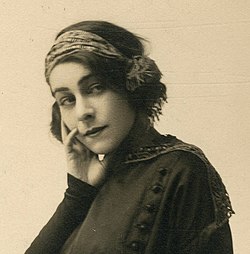
Alla Aleksandrovna Nazimova (Russian: Алла Александровна Назимова; born Marem-Ides Leventon; June 3 [O.S. May 22] 1879 – July 13, 1945) was a Russian-American actress, director, producer and screenwriter.

Key Information

On Broadway, she was noted for her work in the classic plays of Ibsen, Chekhov and Turgenev. She later moved to film, where she served many production roles, both writing and directing films under pseudonyms.

Her film Salome (1922) is regarded as a cultural landmark. Nazimova was bisexual and openly conducted relationships with women while being married to a man.[3] She created the Garden of Alla Hotel which became a retreat for many celebrities of the time. She is credited with having originated the phrase "sewing circle" as a discreet code for lesbian or bisexual actresses.

Early life

[edit]

Nazimova was born Marem-Ides Leventon[4] (Russian name: Adelaida Yakovlevna Leventon) in the resort town of Yalta, in Crimea, Russian Empire.[5] Her accepted birth year is 1879,[5] but other sources have mentioned 1876 as a possible birth year.[6] Her stage name Alla Nazimova was a combination of Alla (a diminutive of Adelaida) and the surname of Nadezhda Nazimova, the heroine of the Russian novel Children of the Streets.[7] She was widely known as just Nazimova. Her name was sometimes transcribed as Alia Nasimoff.[8] The youngest of three children born to Jewish parents Yakov Abramovich Leventon, a pharmacist, and Sarah Leivievna Gorowitz (later known as Sofia or Sophie Lvovna Gorovitz/Horovitz/Herowitz), who moved to Yalta in 1870 from Kishinev,[9] Nazimova grew up in a dysfunctional family. After her parents divorced when she was eight, she was shuffled among boarding schools, foster homes and relatives.

As a teenager, she began to pursue an interest in the theatre and took acting lessons at the Academy of Acting in Moscow. She joined Constantin Stanislavski's Moscow Art Theatre using the name of Alla Nazimova for the first time.[10] She studied with Vladimir Nemirovich-Danchenko, co-founder of the Moscow Art Theater.[5]

Career

[edit]
Alla Nazimova. Clockwise from upper left: in the 1911 Broadway play The Marionettes, in an ad for a film, as Marguerite Gautier in Camille, and with Elliot Cabot in A Month in the Country (1930).

Nazimova's theater career blossomed early, and by 1903, she was a major star in Moscow and Saint Petersburg. She toured Europe, including London and Berlin, with her boyfriend Pavel Orlenev,[7] a flamboyant actor and producer. In 1905, they moved to New York City and founded a Russian-language theater on the Lower East Side. The venture was unsuccessful, and Orlenev returned to Russia while Nazimova stayed in New York.[11]

She was signed by the American producer Henry Miller and made her Broadway debut in New York City in 1906 to critical and popular success. Her English-language premiere in November 1906 was in the title role of Hedda Gabler. She reportedly learned English in five months.[12] She quickly became extremely popular (Nazimova's 39th Street Theatre was named after her) and remained a major Broadway star, often starring in works by Ibsen and Chekhov.[13] Dorothy Parker described her as the finest Hedda Gabler she had ever seen.[citation needed]

Nazimova's film career began when she was 37 years old. Due to her notoriety in a 35-minute 1915 play entitled War Brides, Nazimova made her silent film debut in 1916 in the filmed version of the play, which was produced by Lewis J. Selznick. She was paid $1,000 per day, and the film was a success.[14] A young actor with a bit part in the movie was Richard Barthelmess, whose mother, Caroline W. Harris, had taught Nazimova English. Nazimova had encouraged him to try out for movies and he later became a star.[15]

In 1917, she negotiated a contract with Metro Pictures, a precursor to MGM, that included a weekly salary of $13,000. She moved from New York to Hollywood, where she made a number of highly successful films for Metro that earned her considerable money.

She created and worked under Nazimova Productions from 1917 to 1921. She filled many roles in film production, outside of acting. She served as a director, producer, editor, lighting designer, and received credit for costume design for the film Revelation.

She wrote screenplays under the pseudonym Peter M. Winters. She directed films credited to the name of her partner Charles Bryant.[4] In her film adaptations of works by such notable writers as Oscar Wilde and Ibsen, she developed filmmaking techniques that were considered daring at the time. Her film projects, including A Doll's House (1922), based on Ibsen, and Salomé (1923), based on Wilde's play, were critical and commercial failures. Salomé, however, has become a cult classic, regarded as a feminist milestone in film. In 2000, the film was added to the National Film Registry. By 1925, she could no longer afford to invest in more films, and financial backers withdrew their support.[16]

In 1927, she became a naturalized citizen of the United States. Left with few options in Hollywood, she returned to New York to perform on Broadway, notably starring as Natalya Petrovna in Rouben Mamoulian's 1930 New York production of Turgenev's A Month in the Country and having an acclaimed performance as Mrs. Alving in Ibsen's Ghosts. Critic Pauline Kael described this as the greatest performance she had ever seen on the American stage.

In the early 1940s, Nazimova returned to films, playing Robert Taylor's mother in Escape (1940) and Tyrone Power's mother in Blood and Sand (1941). This late return to motion pictures fortunately preserves Nazimova and her art on sound film.[17]

Personal life

[edit]

Marriages

[edit]
Nazimova and actor Charles Bryant in 1912

In 1899, she married Sergei Golovin, a fellow actor.[7] From 1912 to 1925, Nazimova maintained a "lavender marriage" with Charles Bryant (1879–1948),[18] a British-born actor.[7][19] To bolster this arrangement with Bryant, Nazimova kept her marriage to Golovin secret from the press, her fans, and even her friends. In 1923, she arranged to divorce Golovin without traveling to the Soviet Union. Her divorce papers, which arrived in the United States that summer, stated that on May 11, 1923, the marriage of "citizeness Leventon Alla Alexandrovna" and Sergius Arkadyevitch Golovin, "consummated between them in the City Church of Boruysk June 20, 1899", had been officially dissolved. A little over two years later, on November 16, 1925, Charles Bryant, then 43, surprised the press, Nazimova's fans, and Nazimova herself by marrying Marjorie Gilhooley, 23, in Connecticut. When the press uncovered the fact that Charles had listed his current marital status as "single" on his marriage license, the revelation that the marriage between Alla and Charles had been a sham from the beginning embroiled Nazimova in a scandal that damaged her career.[20]: 265–66, 285 

Relationships with women

[edit]

From 1917 to 1922, Nazimova wielded considerable influence and power in Hollywood.[7] She helped start the careers of both of Rudolph Valentino's wives, Jean Acker and Natacha Rambova. Although she was involved in an affair with Acker,[21] it is debatable as to whether her connection with Rambova ever developed into a sexual affair.

Nevertheless, there were rumors that Nazimova and Rambova were involved in a lesbian affair (they are discussed at length in Dark Lover, Emily Leider's biography of Rudolph Valentino) but those rumors never have been confirmed. She was very impressed by Rambova's skills as an art director, and Rambova designed the innovative sets for Nazimova's film productions of Camille and Salomé.[22] The list of those Nazimova is confirmed to have been involved with romantically includes actress Eva Le Gallienne, film director Dorothy Arzner, writer Mercedes de Acosta, and Oscar Wilde's niece Dolly Wilde.[23]

Bridget Bate Tichenor, a Magic Realist artist and Surrealist painter, was rumored to be one of Nazimova's favored lovers in Hollywood during 1940–1942.[24] The two had been introduced by the poet and art collector Edward James, and according to Tichenor, their intimate relationship angered Nazimova's longtime companion Glesca Marshall.[24]

Nazimova with Herbert Brenon, 1916

It is believed that Nazimova coined the phrase "sewing circle" as code to refer to lesbian or bisexual actresses of her day who concealed their true sexuality.[23][25]

Nazimova lived together with Glesca Marshall from 1929 until Nazimova's death in 1945.[20]: 289 

Friends and relations

[edit]

Edith Luckett, a stage actress and the mother of future U.S. First Lady Nancy Reagan, was a friend of Nazimova, having acted with her onstage. Edith married Kenneth Seymour Robbins, and following the birth of their daughter Nancy in 1921, Nazimova became her godmother. Nazimova continued to be friends with Edith and her second husband, neurosurgeon Loyal Davis, until her death.[26] She was also the aunt of American film producer Val Lewton.[19]

Garden of Alla

[edit]
Nazimova on the grounds of the Garden of Alla

Nazimova's private lifestyle gave rise to widespread rumors of outlandish and allegedly debauched parties at her mansion on Sunset Boulevard in Hollywood, California, known as The Garden of Alla, which she leased in 1918 and bought outright the next year. Facing near-bankruptcy in 1926, she converted the 2.5-acre estate into a hotel by building 25 villas on the property. The Garden of Alla Hotel opened in January 1927. But Nazimova was ill-equipped to run a hotel and eventually sold it and returned to Broadway and theatrical tours. By 1930, the hotel had been purchased by Central Holding Corporation, which changed the name to the Garden of Allah Hotel. When Nazimova moved back to Hollywood in 1938, she rented Villa 24 at the hotel and lived there until her death.[20]

Death and memorials

[edit]

On July 13, 1945, Nazimova died of a coronary thrombosis, at age 66,[2] in the Good Samaritan Hospital in Los Angeles.[19] Her ashes were interred in Forest Lawn Memorial Park Cemetery in Glendale, California.[27] Her contributions to the film industry have been recognized with a star on the Hollywood Walk of Fame.

Legacy

[edit]

Nazimova has been depicted a number of times in film and onstage. The first two were biographical films about Rudolph Valentino: The Legend of Valentino (1975), in which she was portrayed by Alicia Bond; and Valentino (1977), in which she was portrayed by Leslie Caron. She was featured in two 2013 silent films about Hollywood's silent movie era: Return to Babylon, in which she was played by Laura Harring,[28] and Silent Life, based on the life of Rudolph Valentino, where she was played by Sherilyn Fenn.[29]

The character of Nazimova also appears in Dominick Argento's opera Dream of Valentino,[30] in which she also played the violin. Nazimova was also featured in make-up artist Kevyn Aucoin's 2004 book Face Forward, in which he made up Isabella Rossellini to resemble her, particularly as posed in a certain photograph.[31]

Actress Romy Nordlinger first portrayed Alla Nazimova in The Society for the Preservation of Theatrical History production of Stage Struck: From Kemble to Kate staged at the Snapple Theater Center in New York City in December 2013.[32] In Fall 2016, PLACES, a multimedia solo show about Alla Nazimova, supported by the League of Professional Theatre Women's Heritage Program, written and performed by Romy Nordlinger debuted at Playhouse Theatre for a limited run.[33]

The Garden of Allah cabaret was an influential LGBTQ+ cabaret venue in the mid-20th century that took its name and inspiration from Nazimova's original Garden of Alla.[34]

Nazimova also appears in Medusa's Web,[35] a novel by fantasy-fiction writer Tim Powers.

Filmography

[edit]
Year Film Role Notes
1916 War Brides Joan Lost film
1918 Revelation Joline
Toys of Fate Zorah/Hagah
A Woman of France
Eye for Eye Hassouna Also producer and co-director
1919 Out of the Fog Faith & Eve Lost film
The Red Lantern Mahlee & Blanche Sackville
The Brat The Brat Also producer and writer
Lost film
1920 Stronger Than Death Sigrid Fersen Also producer
The Heart of a Child Sally Snape Also producer
Lost film
Madame Peacock Jane Gloring/Gloria Cromwell Also producer and writer (adaptation)
Billions Princess Triloff Also writer (titles) and editor
Lost film
1921 Camille Marguerite Gautier/Manon Lescaut in Daydream
1922 A Doll's House Nora Helmer Also producer and writer
Lost film
Salomé Salomé Also producer, writer and co-director
1924 Madonna of the Streets Mary Carlson/Mary Ainsleigh Lost film
1925 The Redeeming Sin Joan Lost film
My Son Ana Silva Lost film
1940 Escape Emmy Ritter
1941 Blood and Sand Señora Angustias Gallardo
1944 In Our Time Zofya Orvid
The Bridge of San Luis Rey Doña Maria – The Marquesa
Since You Went Away Zofia Koslowska

See also

[edit]

References

[edit]

Sources

[edit]

Further reading

[edit]
[edit]
Revisions and contributorsEdit on WikipediaRead on Wikipedia
from Grokipedia

Alla Nazimova (May 22, 1879 – July 13, 1945) was a Russian-American actress, director, and producer known for her commanding stage performances in Henrik Ibsen's dramas and her pioneering work in silent cinema. Born Marem-Ides Leventon in Yalta, Crimea, to a Jewish family, she trained under Konstantin Stanislavski at the Moscow Art Theatre before emigrating to the United States in 1905, where she achieved Broadway acclaim with roles in Hedda Gabler and A Doll's House.
Nazimova transitioned to film in 1916 with War Brides, quickly rising to become one of Hollywood's highest-paid actresses, earning up to $13,000 per week, and founding Nazimova Productions to exert creative control over her projects. She starred in and produced notable silent films such as Camille (1921) opposite Rudolph Valentino and Salomé (1923), the latter featuring innovative cubist sets and costumes that anticipated art deco aesthetics, though its experimental style contributed to limited commercial success. Her career declined in the late amid the advent of sound films and financial troubles, including the failure of her venture, leading her to return to theater and take supporting roles in sound pictures during the . Nazimova's Bohemian lifestyle and relationships with women, including prominent figures in artistic circles, marked her as a cultural iconoclast, though these aspects drew scrutiny in conservative Hollywood; she died penniless in after battling illness.

Early Life

Birth and Family Background

Alla Nazimova was born Mariam Edez Adelaida Leventon on June 3, 1879, in , , which was then part of the in the . Her birth name reflected her Jewish heritage, with the family adhering to traditional naming practices common among in the region. She was given the nickname "Alla" by her mother during childhood, a diminutive form that she later adopted professionally. Nazimova was the youngest of three children born to Yakov Abramovich Leventon, a of Ukrainian Jewish origin, and Sofia Lvovna Horowitz (also known as Sarah or Sonya), who came from a Jewish . The Leventon resided primarily in , where Yakov worked in his profession, though accounts describe the household as modest in means rather than affluent, consistent with the economic constraints faced by many Jewish professionals in the at the time. Her father's occupation as a —equivalent to a chemist or —provided a basic livelihood but did not elevate the family to significant wealth. The family environment was marked by instability, including tensions in her parents' marriage that contributed to a fractured home life during Nazimova's early years. As Jews in the Pale of Settlement's vicinity, the Leventons navigated restrictions on residence, occupation, and imposed by Tsarist policies, which likely influenced the family's relocations and economic pressures. These circumstances fostered Nazimova's independent streak from a young age, though specific details on her siblings' identities and roles remain sparsely documented in primary accounts.

Acting Aspirations and Training in Russia

Nazimova, born Mariam Edez Adelaida Leventon on June 4, 1879, in , , developed an early interest in theater amid a tumultuous family environment marked by her parents' unhappy marriage and her father's abusive behavior. At age seventeen in 1896, she abandoned her violin studies and relocated to to pursue acting, initially training under , co-founder of the . There, she adopted the stage name Alla Nazimova, derived from a character in a Russian novel, which facilitated her entry into professional circles despite her Jewish background in Tsarist . Nazimova enrolled in acting lessons at Moscow's Academy of Acting and apprenticed with Konstantin Stanislavski's , where she honed her craft through rigorous psychological realism techniques emphasized by the institution's founders. This training, spanning approximately three years, culminated in her graduating at the top of her class and earning a granting access to elite theater internships, though she prioritized practical experience over formal accolades. Stanislavski's influence instilled in her a method-oriented approach focused on emotional authenticity, which she later credited for her interpretive depth in roles, distinguishing her from more declamatory performers of the era. By 1899, after initial stints at the , Nazimova departed for provincial tours across to refine her skills through leading roles in regional productions, gaining versatility in diverse venues from small towns to larger cities. These tours provided essential on-stage seasoning, exposing her to varied audiences and logistical challenges absent in 's controlled environment, and by 1903, she had emerged as a prominent star in both and theaters. Her rapid ascent reflected not innate talent alone but the causal interplay of disciplined training, strategic networking in Stanislavski's circle, and the era's demand for innovative performers amid Russia's evolving dramatic traditions.

Emigration and Initial Struggles in America

In February 1905, Alla Nazimova sailed from to New York aboard a ship with Pavel Orlenev's theater company, with whom she had been touring and performing in Russian-language productions. Orlenev, her romantic partner and the company's director, aimed to capitalize on New York's large Russian immigrant community by staging plays like The Chosen People. Upon arrival, the troupe sought support from influential producers such as but initially performed at venues like for limited audiences. Nazimova adopted her during this period and continued acting in Russian, but the venture proved financially unsustainable due to low attendance and logistical challenges for a foreign ensemble. Facing mounting difficulties, Orlenev disbanded the company and returned to later in 1905, leaving Nazimova in New York without financial backing or proficiency in English. As an immigrant actress limited to non-English roles, she encountered barriers in accessing mainstream American theater, relying on tutoring to master the language starting in June 1906 under a contract provision from producer Lee Shubert. These early months involved persistent efforts to secure opportunities amid economic , as the failure of Orlenev's tour left her isolated and dependent on sporadic Russian-speaking engagements. By late 1906, Nazimova's determination culminated in her English-language debut as on November 13, marking the end of her initial phase of adaptation despite the preceding hardships of linguistic isolation and financial instability. This rapid transition from Russian repertory struggles to American stage preparation underscored her resilience, though it required forgoing immediate return to amid the troupe's collapse.

Stage Career

Broadway Breakthrough and Ibsen Interpretations

Nazimova arrived in New York in 1905 after emigrating from Russia and, having trained under Konstantin Stanislavski, rapidly learned English sufficiently to secure stage roles. Her Broadway breakthrough came on November 13, 1906, when she debuted as Hedda Tesman in Henrik Ibsen's Hedda Gabler at the Princess Theatre, a production that ran for 68 performances and established her as a commanding dramatic presence. This role, demanding a portrayal of a restless, manipulative woman trapped by societal constraints, showcased Nazimova's command of psychological nuance, drawing from her Moscow Art Theatre background to emphasize internal conflict over histrionics. Critics lauded her interpretation for its precision and emotional depth, with one contemporary observer noting her ability to reveal Hedda's "destructive manipulation" as a response to limited outlets for ambition, rendering the character as a universal rather than a mere . Nazimova herself described Ibsen's as straightforward, devoid of contrived mystery, allowing her to focus on realistic motivations rooted in personal frustration and powerlessness. The performance's success, despite her accented delivery, propelled her reputation, with reviewers hailing her as America's preeminent Ibsen interpreter for bringing "flexibility and persuasion" to roles that demanded subtlety. Building on this, Nazimova tackled additional Ibsen heroines in quick succession, starring as Nora Helmer in during a 1907 revival at the , where she depicted the protagonist's awakening to marital deception through layered vulnerability and resolve. That same year, she portrayed Hilda Wangel in , emphasizing the character's imaginative defiance against patriarchal authority. By 1908, she added Rita Allmers in Little Eyolf, further solidifying her command of Ibsen's themes of repressed desire and familial tragedy. These interpretations, performed in repertory with matinees and evenings alternating roles, attracted thousands and influenced subsequent American stagings by prioritizing causal motivations—such as societal and psychological pressures—over sentimental exaggeration.

Critical Acclaim and Signature Performances

Nazimova's Broadway debut on November 13, 1906, in the title role of Henrik Ibsen's at the Princess Theatre established her as a premier interpreter of Ibsen, with praising her English-language performance for providing "ample evidence of exceptional ability." This role, which she reprised multiple times including in 1918 at the Plymouth Theatre and a 1936 revival at the that drew 31 curtain calls, drew acclaim for her commanding portrayal of the complex antiheroine, influencing figures like , who reportedly viewed it ten times and described it as a . Following her debut, Nazimova excelled in other Ibsen works, including Nora Helmer in on January 14, 1907, at the Bijou Theatre and Hilde Wangel in the American premiere of on September 23, 1907, also at the Bijou. Her 1918 Ibsen season at the Plymouth Theatre—featuring (March 11, as Hedvig), (April 4), and (April 29)—earned her Theatre Magazine's designation as Actress of the Year, solidifying her reputation for psychologically nuanced renditions of Ibsen's protagonists. Later performances extended her acclaim beyond Ibsen. In Anton Chekhov's The Cherry Orchard (October 15, 1928, Civic Repertory Theatre, as Ranevskaya), she received enormous success for her poignant depiction of aristocratic decline. Her role as Christine Mannon in Eugene O'Neill's Mourning Becomes Electra (October 26, 1931) garnered positive reviews for its intensity, while her portrayal of Mrs. Helen Alving in Ibsen's Ghosts (December 12, 1935, Empire Theatre) prompted 28 curtain calls and rapturous notices, with critic Pauline Kael later hailing a performance in the role as the greatest on the American stage. Upon her death in 1945, The New York Times obituary recognized her as one of the most distinguished actresses of her era and among the finest exponents of Ibsen's works.

Innovations in Theatrical Presentation

Nazimova pioneered the integration of Konstantin Stanislavski's naturalistic acting principles into American theater, drawing from her training at the , where she performed under the stage name Alla Nazimova starting in 1899. Emigrating to the in 1905, she applied these methods—emphasizing emotional authenticity, psychological depth, and subtle physicality—to Broadway productions, contrasting sharply with the era's dominant melodramatic conventions of bombast and . This approach, characterized by internalized character motivations and realistic vocal modulation, marked an early importation of what would evolve into techniques. Her interpretations of Henrik Ibsen's works exemplified these innovations, as seen in her 1907 portrayal of , where she conveyed the protagonist's inner turmoil through restrained gestures and expressive silences rather than overt histrionics, earning praise for revealing the play's subversive undercurrents. Similarly, in (1909 revival), Nazimova's staging minimized scenic spectacle, focusing on intimate actor-audience dynamics to underscore themes of personal liberation, influencing playwrights like and who credited her vivid realism for shaping modern dramatic naturalism. In 1910, Nazimova opened her eponymous 39th Street Theatre (later renamed), granting her directorial control over productions like Little Eyolf (1911), where she experimented with fluid scene transitions and symbolic lighting to enhance psychological tension without relying on cumbersome period realism. This actor-driven presentation, prioritizing interpretive fidelity to the text over commercial embellishments, extended to her 1918 Ibsen repertory season, which featured streamlined sets and ensemble synchronization to amplify thematic causality. Her methods, though initially polarizing among critics accustomed to spectacle, established a precedent for introspective staging that prioritized causal character development over visual extravagance.

Film Career

Entry into Silent Cinema and Early Successes

Nazimova made her screen debut in 1916 at age 37 with War Brides, a adaptation of the 1915 anti-war play in which she had originated the lead role of Joan, a mother defying amid . Directed by Herbert Brenon and produced by Lewis J. Selznick, the film replicated her stage success, earning praise for her intense performance and establishing her as a star. The commercial triumph of War Brides prompted Metro Pictures to sign Nazimova to a contract at $13,000 per week, a record salary reflecting her drawing power. She relocated to California, where she starred in a series of vehicles tailored to showcase her dramatic range, often drawing from literary sources akin to her stage work. Early Metro productions included Revelation (1918), in which she portrayed dual roles as a nun and a modern woman; Toys of Fate (1918), a tale of redemption; and Out of the Fog (1919), exploring themes of justice and morality. By 1918, Nazimova had solidified her status as a box-office success, completing multiple features that capitalized on her reputation for emotional depth and exotic allure, though her high production values and artistic demands foreshadowed later tensions with studio constraints. Her films during this period grossed significantly, with leveraging her fame to compete in the burgeoning silent era market.

Production of Salome and Artistic Ambitions

In 1923, Alla Nazimova produced, co-directed, and starred as the titular character in the silent film Salomé, an adaptation of Oscar Wilde's 1891 play of the same name. The project was co-directed by her husband Charles Bryant, with Natacha Rambova credited as the writer adapting the scenario. Nazimova financed much of the production herself through her independent company, reflecting her desire to control artistic output amid declining studio interest in experimental works. The 's visual style emphasized Nazimova's ambitions to elevate cinema beyond commercial entertainment toward a "total ," integrating theatrical gesture, staging, and design. Rambova designed the costumes and sets directly inspired by Aubrey Beardsley's original illustrations for Wilde's play, employing stark black-and-white line drawings, geometric patterns, and non-realistic proportions that evoked a puppet-like, ultra-modern aesthetic rather than historical accuracy. This approach, deemed ahead of its time, prioritized symbolic expression over narrative accessibility, aiming to fuse traditions from Nazimova's stage background with 's potential for visual innovation. Production costs reached approximately $350,000, a substantial sum for the era that included elaborate custom costumes and stylized sets constructed as two-dimensional cutouts to mimic Beardsley's etchings. Nazimova's vision extended to casting and performance, selecting actors for interpretive depth and choreographing movements with balletic precision to convey the play's decadent themes without intertitles, relying on visual symbolism alone. Despite these artistic aspirations, Salomé achieved limited commercial release and failed at the , contributing to the financial ruin of Nazimova's production entity and marking a pivot from her earlier successes. Critics noted its pioneering status as one of the earliest American art films, though its esoteric style alienated mainstream audiences accustomed to more literal adaptations.

Commercial Decline and Critical Reception

Salomé (1923), Nazimova's most ambitious independent production, exemplified her artistic vision but precipitated commercial downfall, costing over $400,000—much of it her personal investment—and yielding negligible returns after its delayed release on August 25, 1923. The film's stylized aesthetic, drawn from Aubrey Beardsley's illustrations and Oscar Wilde's play, prioritized visual experimentation over narrative accessibility, leading to its shelving by distributor Allied Artists and ultimate financial ruin for Nazimova Productions. This flop stripped her of assets accumulated from earlier successes, curtailing her role as a film and compelling a retreat from major productions. Subsequent releases amplified the decline: Madonna of the Streets (1924), in which Nazimova played dual roles as a streetwalker and her refined , opened to generally unfavorable notices on October 19, 1924, and failed to attract audiences amid her tarnished star power. The Redeeming Sin (1925), a of redemption and crime directed by , premiered in New York on January 25, 1925, but similarly underperformed commercially, with both films now lost and emblematic of her waning viability in silent cinema. By mid-decade, shifting industry preferences toward cost-efficient, crowd-pleasing narratives—exacerbated by Nazimova's insistence on high-cost, auteur-driven projects—rendered her unbankable, prompting her full pivot to theater by 1925. Critically, Salomé elicited polarized responses, lauded retrospectively for modernist innovation but dismissed contemporaneously as esoteric excess unsuitable for general patronage; Photoplay deemed it "a hothouse orchid of decadent passion," cautioning audiences of its "bizarre stuff." Reviews highlighted Nazimova's commanding presence yet faulted the production's detachment from audience expectations, foreshadowing critiques of her later vehicles as overly theatrical relics in an evolving medium favoring realism over symbolism. While her pre-Salomé films like Camille (1921) garnered acclaim for emotive depth, post-1923 efforts were overshadowed by commercial imperatives, underscoring a disconnect between her Ibsen-derived intensity and Hollywood's profit-driven calculus.

Business and Creative Ventures

Establishment of the Garden of Allah

In , Alla Nazimova acquired a 3-acre estate known as at the corner of and Crescent Heights Boulevard in , originally developed by real estate investor William H. Hay. She invested approximately $30,000 in renovations, including planting mimosa trees and creating lush gardens inspired by her apartment and Russian heritage, transforming the property into a private residence that she dubbed the "Garden of Alla"—a playful nod to her name and Robert Hichens' 1904 novel The Garden of Allah. By the mid-1920s, Nazimova's film career had declined amid the transition to sound pictures and box-office disappointments, prompting financial pressures that led her to reconceive the estate as a commercial venture. In , she partnered with investors to expand the property into a residential , constructing 25 Spanish-style bungalows around the central mansion to accommodate transient guests, particularly actors and writers seeking affordable, bohemian lodging near Hollywood studios. The Garden of Allah officially opened as a on January 9, 1927, marked by an extravagant 18-hour launch party attended by luminaries including and , which established its reputation as a hub for creative excess and intellectual gatherings. Nazimova retained the main residence for her personal use while leasing the bungalows at rates starting around $5 per day, capitalizing on the site's seclusion and the growing demand for off-studio housing in the burgeoning . This pivot not only alleviated her debts but positioned the Garden of Allah as an early archetype of Hollywood's celebrity-favored complexes, blending residential privacy with communal allure.

Role as Producer and Screenwriter

Nazimova established Nazimova Productions in 1917 under an agreement with Corporation, granting her significant control over film projects and resulting in nine feature-length productions by 1921. Key films under this banner included Eye for Eye (1918), The Brat (1919), The Red Lantern (1919), The Heart of a Child (1920), Madame Peacock (1920), Stronger Than Death (1920), and Camille (1921), where she often assumed multiple roles beyond acting, such as supervision of direction and design. She received explicit credits for Camille (1921) and the independent Salomé (1923), the latter co-produced with Charles Bryant and financed largely from her own funds to realize her artistic vision of Oscar Wilde's play through stylized, cubist-inspired aesthetics. Nazimova contributed to screenwriting under the pseudonym Peter M. Winters, crafting scenarios and adaptations to suit her interpretive style. Verified credits include writing for The Brat (1919) and adapting Salomé (1923), as well as the scenario for A Doll's House (1922), an Ibsen adaptation she also produced. Additional uncredited or pseudonym-protected work extended to titles and edits in films like Billions (1920), reflecting her hands-on approach to narrative control amid the era's limited formal recognition for women in these roles.

Personal Relationships

Marriage to Charles Bryant

Alla Nazimova began a relationship with British actor Charles Bryant in 1912, which she publicly presented as a to align with societal expectations and bolster her career amid her attractions to women. On December 5, 1912, Nazimova informed friends that she and Bryant had wed that day in her New York apartment, with her sister Nina Lewton as the sole witness. However, no legal was issued, rendering the union a common-law or sham arrangement rather than a formal matrimony; Nazimova remained legally bound to her first husband, Sergei Golovin, until obtaining a from him in May 1923. The couple cohabited for approximately 14 years, appearing together in professional contexts such as the 1916 film War Brides, where Bryant played a supporting role opposite Nazimova's lead. This "lavender marriage"—a term retrospectively applied to unions masking non-heterosexual orientations—served Nazimova's public image in an era intolerant of open bisexuality, allowing her to navigate Hollywood and theater without overt scandal. Bryant benefited from association with Nazimova's rising stardom, though the partnership lacked genuine romantic commitment on her part. By the mid-1920s, the arrangement unraveled when Bryant pursued a new to 23-year-old Marjorie Gilhooley in , prompting public disclosure that Nazimova and Bryant had never legally wed despite living as spouses. No divorce proceedings occurred, as the union held no legal standing, effectively ending their collaboration without formal dissolution. This revelation underscored the pragmatic, image-driven nature of their bond, which had persisted amid Nazimova's separate romantic involvements.

Romantic Entanglements with Women

Nazimova conducted several documented romantic relationships with women concurrent with her marriage to Charles Bryant. In 1916, she initiated an affair with poet and playwright , which persisted amid de Acosta's own marriages and other liaisons, supported by de Acosta's personal correspondence and memoirs detailing intimate encounters and emotional attachments. Her professional collaborations with designer , beginning in 1919 on films such as Camille (1921), evolved into rumored romantic entanglements, as evidenced by contemporary accounts of their close personal proximity and Rambova's designs tailored explicitly for Nazimova's physique, though primary documentation remains indirect and contested by some biographers emphasizing artistic partnership over romance. Nazimova's most enduring female partnership was with Glesca Marshall, met around 1926 during a production at Eva Le Gallienne's Civic Repertory Theatre, where the 19-year-old Marshall served as Nazimova's devoted companion for nearly two decades until Nazimova's death in 1945, managing her household and providing emotional support amid career setbacks. These relationships occurred within Nazimova's broader network of female intimacies, including briefer involvements like one with writer Dolly Wilde in the mid-1920s, but sources consistently highlight her discretion due to era-specific professional risks, with evidence drawn primarily from letters, diaries, and posthumous biographies rather than public admissions.

Social Network in Bohemian Hollywood

Nazimova established herself as a prominent hostess in Hollywood's bohemian milieu, organizing lavish parties and salons at her Sunset Boulevard estate, acquired in 1919 for $65,000 and initially known as the Garden of Alla. These gatherings drew Russian émigrés, literary figures, and film industry elites, emphasizing artistic discourse and indulgence amid Prohibition-era constraints, with security ensuring discretion for unconventional behaviors. Her events featured bohemian excess, including costumed attire and screenings of experimental works like her 1923 film Salomé, positioning her mansion as a nexus for creative nonconformists in the 1920s. Central to her social orbit was the "sewing circle," a she reportedly coined for a discreet network of and bisexual women in theater and , facilitating mutual support and coded interactions to evade moral scrutiny. Associates in this circle included actress and director , with whom she co-starred in a 1928 revival of , and writer , who interviewed her in 1930 for Theatre Guild Magazine and shared connections through mutual acquaintances like painter Maurice Sterne. The network extended to Hollywood contemporaries such as and , reflecting Nazimova's influence in fostering a of sapphic artists amid the era's repressive norms. In 1927, Nazimova converted portions of her property into the , launching it with an 18-hour celebration attended by over 200 guests, including , , and , which solidified its status as a bohemian haven. The venue attracted Algonquin Round Table affiliates like , , and , alongside actors such as and writers including during his 1930s residencies, promoting cross-pollination between East Coast literati and West Coast filmmakers. This enterprise amplified her role in Hollywood's artistic underbelly, where bungalows provided privacy for collaborations, affairs, and intellectual pursuits until financial pressures forced her partial divestment in the early 1930s.

Lifestyle and Societal Controversies

Open Bisexuality Amid Era's Moral Norms

Alla Nazimova engaged in romantic and sexual relationships with women throughout her career, concurrent with her to actor Charles Bryant from 1916 to 1925, a union widely regarded as a to mask their respective same-sex orientations. Among her documented female partners were writer , with whom Nazimova began an affair in 1921, and actress , who became her devoted companion from around 1925 until Nazimova's death in 1945. Other associations included performer and designer , both married to , as well as director and actress . Within her bohemian Hollywood enclave, Nazimova pursued these liaisons with relative candor, hosting extravagant parties at her mansion that fueled rumors of sexual excess and same-sex encounters among guests. She contributed to the informal "" network—a coded reference to discreet alliances among and bisexual actresses—which she helped initiate as a haven for such women in the industry. This private openness contrasted sharply with prevailing 1920s moral standards, where sodomy laws criminalized in most U.S. states, and public scandals, such as the 1921 Arbuckle trial, heightened scrutiny on stars' personal lives, often equating deviance with professional ruin. Pre-Production Code Hollywood (prior to the 1930 enforcement of the Motion Picture Production Code) afforded Nazimova some leeway to incorporate queer undertones in her work, as in her 1923 adaptation of Salomé, which featured stylized sets, exotic costumes, and a cast rumored to consist entirely of gay and bisexual performers, including Rambova. Yet, even in this permissive window, Nazimova avoided explicit public acknowledgment of her bisexuality, relying on euphemisms and her influential status to shield her reputation amid a culture that pathologized non-heteronormative behavior as moral corruption. Biographies note that while her circle recognized the futility of her marital facade—"it fooled no one"—widespread public exposure risked ostracism, reflecting causal pressures from religious conservatism and emerging censorship bodies like the Hays Office, which by 1922 began pressuring studios against "immoral" content.

Associations with Vice and Excess

Nazimova's mansion became a focal point for extravagant gatherings in the 1920s, drawing Hollywood elites for events characterized by lavish entertainment and alcohol consumption despite national laws enacted in 1920. These parties, often extending late into the night, reinforced her reputation within bohemian circles as a hostess of uninhibited social affairs. Following financial pressures in 1926, Nazimova partnered to convert the estate into the , which opened with 25 bungalows around her original villa and quickly gained notoriety as a for creative excess. The venue hosted industry figures engaging in hedonistic pursuits, including clandestine drinking and romantic liaisons, perpetuating the site's association with moral laxity even as Nazimova's direct oversight diminished after her departure to New York in 1930. Contemporary accounts described the hotel's atmosphere as more akin to an ongoing than a conventional , underscoring its role in Hollywood's indulgent underbelly. While specific instances of Nazimova's personal indulgence in substances remain unverified in primary records, the venues she established symbolized the era's defiance of conventional norms, with rumors of debauchery amplifying her links to amid the scandal-prone film community. This environment contributed to broader perceptions of early Hollywood as a domain of unchecked libertinism, though evidence ties her more to facilitation than individual excess.

Consequences for Professional Standing

Nazimova's involvement in personal scandals, particularly those tied to her romantic entanglements and fabricated marriage, directly precipitated the termination of her lucrative contract with on April 20, 1921, after less than three years as a top star. This followed her as a in the 1921 bigamy trial involving , , and during production of Camille, where rumors of Nazimova's affairs with Acker and Rambova fueled industry gossip and studio concerns over her stability. The public unraveling of her sham "" to Charles Bryant, exposed around 1923 when he wed a younger , ignited a defamatory that tarnished her image as a reliable professional; contemporaries viewed the arrangement as a cover for her same-sex relationships, leading to a year-long hiatus from major work by and accelerating her shift to lower-profile circuits. Her insistence on artistic control in self-financed projects like Salomé (1923) compounded these setbacks, as the film's nude scenes and exotic themes drew accusations of vulgarity and sacrilege from critics and religious groups, resulting in a box-office disaster that cost her approximately $400,000 and eroded studio confidence in her commercial viability. These controversies, intertwined with her reputation for hosting lavish, bohemian parties at the Garden of Alla—frequented by actors and artists—fostered a of Nazimova as a "dangerous siren" prone to excess, prompting managers to urge discretion to avert deportation risks as an "undesirable alien" and limiting her to character roles in talkies rather than leads. By the late , the cumulative financial strain forced the sale of her estate in , symbolizing her diminished standing from highest-paid actress to industry fringe figure.

Later Life and Death

Health Issues and Retirement

In 1936, Nazimova was diagnosed with shortly after a successful Broadway revival of Hedda Gabler, in which she received thirty-one curtain calls. The diagnosis marked the onset of significant health challenges that curtailed her performing career, leading to a gradual withdrawal from the stage despite occasional appearances in the late and early . Treatment details from the era remain sparse in records, but the illness contributed to her financial strain and physical frailty, prompting a shift to quieter pursuits amid persistent professional setbacks. By the early 1940s, Nazimova had largely retired from acting, residing in a bungalow at the in Hollywood, where she lived modestly and supported herself through sporadic writing and mentoring young performers. Her health deteriorated further with cardiovascular problems; on June 30, 1945, she suffered a after dinner at the villa, requiring hospitalization at Good Samaritan Hospital. Subsequent attacks followed on July 2 and by July 11, exacerbating her condition without recovery. Nazimova died on July 13, 1945, at age 66, from , having spent her final years in relative seclusion, her once-vibrant career eclipsed by illness and the era's shifting industry demands. Her ashes were cremated and interred at Forest Lawn Memorial Park in .

Final Years and Memorials

In the early 1940s, Nazimova lived at the Garden of Allah complex in West Hollywood, California, where she rented Bungalow 24 starting in 1941 amid financial hardships that left her practically penniless by the end of her life. She continued acting in minor roles during this period, appearing in three films in 1944: Since You Went Away, In Our Time, and The Bridge of San Luis Rey. Nazimova died on July 13, 1945, at the age of 66, from coronary thrombosis while receiving treatment at Good Samaritan Hospital in Los Angeles. Following her death, Nazimova's ashes were interred in a niche at Forest Lawn Memorial Park in , where her gravesite remains a point of interest for film historians. In 2013, the Alla Nazimova Society was established to promote and preserve documentation of her career through events, archives, and public outreach. Modern commemorations, such as annual tributes tied to early Hollywood figures, occasionally reference her contributions, though no star on the was awarded during her lifetime or posthumously.

Legacy

Influence on Acting and Film Techniques

Nazimova trained at the under , where she absorbed principles of psychological realism emphasizing internal emotional processes over external declamation, an early precursor to . Upon emigrating to the in 1905 and establishing herself on Broadway by 1905, she applied these techniques to her performances, prioritizing character depth and naturalistic expression that contrasted with the period's more theatrical styles. Her stage work, including Ibsen roles, demonstrated versatile emotional range, influencing contemporaries by demonstrating how actors could embody complex psyches through subtle physical and vocal cues rather than overt gesture. Transitioning to film in 1916 with War Brides, Nazimova adapted Stanislavskian methods to the medium, leveraging cinema's ability to capture nuanced facial expressions and inner turmoil, which enhanced dramatic intimacy in silent adaptations like Camille (1921). In her self-produced Salomé (1923), she pioneered stylized filmmaking techniques, drawing from Oscar Wilde's play and Aubrey Beardsley's illustrations to create an aesthetic with geometric sets, flowing costumes, and marionette-like movements that prioritized symbolic abstraction over realism. This approach, executed on a single set over 62 minutes, aimed to elevate as high art, using deliberate poses and rhythmic editing to evoke erotic tension and biblical allegory, though it diverged from commercial naturalism and contributed to financial losses exceeding $200,000. Her innovations in Salomé, including custom-designed wardrobe with 2,500 yards of mosquito netting for ethereal effects and a cast trained in balletic precision, anticipated experimental cinema's focus on visual metaphor and performance artifice, influencing later directors seeking to blend theater's symbolism with film's plasticity. Despite limited immediate adoption in Hollywood's profit-driven industry, Nazimova's fusion of method-derived emotional authenticity with visuals provided a model for actors and filmmakers exploring psychological depth in stylized contexts, as evidenced by the film's enduring status as a silent-era landmark preserved in the .

Reassessments in Historical Context

In the post-silent era, Nazimova's oeuvre has undergone reevaluation as emblematic of early cinematic experimentation, particularly her self-produced films that prioritized aesthetic innovation over commercial viability. Her 1923 Salomé, adapted from Oscar Wilde's play with sets and costumes designed by in an style inspired by , featured minimalist staging and an all-male cast portraying female roles, diverging sharply from the era's epic spectacles like The Ten Commandments. Contemporary critics dismissed it as overly decadent and unprofitable, with production costs exceeding $1 million against negligible box-office returns, but scholars now view it as a landmark of female movie modernism for its sensual visuals and narrative boldness. The film entered the in 2000, underscoring its enduring artistic merit despite initial rejection by audiences seeking escapist fare. Nazimova's establishment of Nazimova Productions in marked her as a trailblazer in granting women unprecedented control over scripting, editing, lighting, and uncredited direction in nine features distributed by . This autonomy, yielding salaries up to $13,000 weekly by 1918, enabled risks like the feminist anti-war themes in War Brides (1916), but causal factors in her 1920s decline included misalignment with studio-driven rather than scandals alone. Film historians credit her Stanislavski-trained intensity—honed in Ibsen roles on Broadway from 1905—with advancing psychological realism in performance, influencing later method techniques amid Hollywood's shift to and standardized narratives. Reassessments of her personal conduct contextualize and associations within pre-Hays Code constraints, where public exposure of her to Charles Bryant in 1925 and liaisons amplified reputational damage but did not singularly cause obscurity; lost prints of over half her output and flops like Camille (1921) played larger roles. Queer-focused retrospectives since the portray her Garden of Alla estate as a nexus for discreet networks, yet empirical scrutiny reveals her professional marginalization stemmed primarily from rejecting formulaic output in favor of high-art pursuits, a choice vindicated in academic analyses of her as an auteur ahead of industrial norms. Recent initiatives, including 2023 film screenings and biographical revivals, signal growing recognition, tempered by the era's evidentiary gaps in preserved works.

Enduring Controversies and Cultural Footprint

Nazimova's personal life has sustained scholarly interest due to her and the 1925 public revelation that her marriage to actor Charles Bryant, contracted in 1918, was a sham arrangement intended to deflect over her relationships with women. This exposure, coupled with Bryant's subsequent remarriage amid financial disputes involving Nazimova's assets and IRS , exacerbated her career decline following earlier box-office disappointments. Her 1921 testimony in Rudolph Valentino's trial, stemming from co-star Jean Acker's divorce proceedings during production of Camille, further entangled her in Hollywood gossip, though it did not immediately derail her standing. The production of Salomé (1923), which Nazimova produced, wrote the scenario for, and starred in, generated lasting debate over its artistic merits versus perceived indecency; critics at the time decried its stylized sets, costumes, and rumored exclusively LGBTQ+ cast and crew as vulgar and sacrilegious, restricting its release and contributing to Nazimova Productions' financial ruin by 1925. These elements, drawn from Oscar Wilde's play and Aubrey Beardsley's illustrations, positioned the film as a bold but commercially failed experiment in symbolic, non-narrative cinema, with its poor reception underscoring tensions between Nazimova's ambitions and audience expectations in the silent era. Nazimova's cultural legacy endures through her foundational role in early Hollywood's queer networks, where she reportedly coined the term "" to discreetly denote groups of and bisexual actresses shielding their private lives from public view. Her estate, transformed into the in 1927, served as a bohemian gathering spot for luminaries including and , embedding her influence in the industry's social fabric until its demolition in 1959. In film history, Salomé is now regarded as a milestone in queer and art cinema, while her portrayals established the of the exotic, seductive foreign woman later embodied by and . Theatrically, her Stanislavski-trained inspired figures such as and , and posthumous honors include a 1960 star and the ongoing work of the Alla Nazimova Society to preserve her films and archive.

References

Add your contribution
Related Hubs
User Avatar
No comments yet.