Hubbry Logo
search
logo
Nebula
Nebula
current hub
2320128

Nebula

logo
Community Hub0 Subscribers
Read side by side
from Wikipedia
True color image of the Trifid Nebula, showing complex gas and plasma structure

A nebula (Latin for 'cloud, fog';[1] pl.nebulae or nebulas)[2][3][4][5] is a distinct luminescent part of interstellar medium, which can consist of ionized, neutral, or molecular hydrogen and also cosmic dust. Nebulae are often star-forming regions, such as the Pillars of Creation in the Eagle Nebula. In these regions, the formations of gas, dust, and other materials "clump" together to form denser regions, which attract further matter and eventually become dense enough to form stars. The remaining material is then thought to form planets and other planetary system objects.

Most nebulae are of vast size; some are hundreds of light-years in diameter. A nebula that is visible to the human eye from Earth would appear larger, but no brighter, from close by.[6] The Orion Nebula, the brightest nebula in the sky and occupying an area twice the angular diameter of the full Moon, can be viewed with the naked eye but was missed by early astronomers.[7] Although denser than the space surrounding them, most nebulae are far less dense than any vacuum created on Earth (105 to 107 molecules per cubic centimeter) – a nebular cloud the size of the Earth would have a total mass of only a few kilograms. Earth's air has a density of approximately 1019 molecules per cubic centimeter; by contrast, the densest nebulae can have densities of 104 molecules per cubic centimeter. Many nebulae are visible due to fluorescence caused by embedded hot stars, while others are so diffused that they can be detected only with long exposures and special filters. Some nebulae are variably illuminated by T Tauri variable stars.

Originally, the term "nebula" was used to describe any diffused astronomical object, including galaxies beyond the Milky Way. The Andromeda Galaxy, for instance, was once referred to as the Andromeda Nebula (and spiral galaxies in general as "spiral nebulae") before the true nature of galaxies was confirmed in the early 20th century by Vesto Slipher, Edwin Hubble, and others. Edwin Hubble discovered that most nebulae are associated with stars and illuminated by starlight. He also helped categorize nebulae based on the type of light spectra they produced.[8]

Observational history

[edit]
Portion of the Carina Nebula

Around 150 AD, Ptolemy recorded, in books VII–VIII of his Almagest, five stars that appeared nebulous. He also noted a region of nebulosity between the constellations Ursa Major and Leo that was not associated with any star.[9] The first true nebula, as distinct from a star cluster, was mentioned by the Muslim Persian astronomer Abd al-Rahman al-Sufi in his Book of Fixed Stars (964).[10] He noted "a little cloud" where the Andromeda Galaxy is located.[11] He also cataloged the Omicron Velorum star cluster as a "nebulous star" and other nebulous objects, such as Brocchi's Cluster.[10] The supernovas that created the Crab Nebula, SN 1054, was observed by Arabic and Chinese astronomers in 1054.[12][13]

In 1610, Nicolas-Claude Fabri de Peiresc discovered the Orion Nebula using a telescope. This nebula was also observed by Johann Baptist Cysat in 1618. However, the first detailed study of the Orion Nebula was not performed until 1659 by Christiaan Huygens, who also believed he was the first person to discover this nebulosity.[11]

In 1715, Edmond Halley published a list of six nebulae.[14] This number steadily increased during the century, with Jean-Philippe de Cheseaux compiling a list of 20 (including eight not previously known) in 1746. From 1751 to 1753, Nicolas-Louis de Lacaille cataloged 42 nebulae from the Cape of Good Hope, most of which were previously unknown. Charles Messier then compiled a catalog of 103 "nebulae" (now called Messier objects, which included what are now known to be galaxies) by 1781; his interest was detecting comets, and these were objects that might be mistaken for them.[15]

The number of nebulae was then greatly increased by the efforts of William Herschel and his sister, Caroline Herschel. Their Catalogue of One Thousand New Nebulae and Clusters of Stars[16] was published in 1786. A second catalog of a thousand was published in 1789, and the third and final catalog of 510 appeared in 1802. During much of their work, William Herschel believed that these nebulae were merely unresolved clusters of stars. In 1790, however, he discovered a star surrounded by nebulosity and concluded that this was a true nebulosity rather than a more distant cluster.[15]

Beginning in 1864, William Huggins examined the spectra of about 70 nebulae. He found that roughly a third of them had the emission spectrum of a gas. The rest showed a continuous spectrum and were thus thought to consist of a mass of stars.[17][18] A third category was added in 1912 when Vesto Slipher showed that the spectrum of the nebula that surrounded the star Merope matched the spectra of the Pleiades open cluster. Thus, the nebula radiates by reflected star light.[19]

In 1923, following the Great Debate, it became clear that many "nebulae" were in fact galaxies far from the Milky Way.

Slipher and Edwin Hubble continued to collect the spectra from many different nebulae, finding 29 that showed emission spectra and 33 that had the continuous spectra of star light.[18] In 1922, Hubble announced that nearly all nebulae are associated with stars and that their illumination comes from star light. He also discovered that the emission spectrum nebulae are nearly always associated with stars having spectral classifications of B or hotter (including all O-type main sequence stars), while nebulae with continuous spectra appear with cooler stars.[20] Both Hubble and Henry Norris Russell concluded that the nebulae surrounding the hotter stars are transformed in some manner.[18]

Formation

[edit]
NGC 604, a nebula in the Triangulum Galaxy

There are a variety of formation mechanisms for the different types of nebulae. Some nebulae form from gas that is already in the interstellar medium while others are produced by stars. Examples of the former case are giant molecular clouds, the coldest, densest phase of interstellar gas, which can form by the cooling and condensation of more diffuse gas. Examples of the latter case are planetary nebulae formed from material shed by a star in late stages of its stellar evolution.

Star-forming regions are a class of emission nebula associated with giant molecular clouds. These form as a molecular cloud collapses under its own weight, producing stars. Massive stars may form in the center, and their ultraviolet radiation ionizes the surrounding gas, making it visible at optical wavelengths. The region of ionized hydrogen surrounding the massive stars is known as an H II region while the shells of neutral hydrogen surrounding the H II region are known as photodissociation region. Examples of star-forming regions are the Orion Nebula, the Rosette Nebula and the Omega Nebula. Feedback from star-formation, in the form of supernova explosions of massive stars, stellar winds or ultraviolet radiation from massive stars, or outflows from low-mass stars may disrupt the cloud, destroying the nebula after several million years.

Other nebulae form as the result of supernova explosions; the death throes of massive, short-lived stars. The materials thrown off from the supernova explosion are then ionized by the energy and the compact object that its core produces. One of the best examples of this is the Crab Nebula, in Taurus. The supernova event was recorded in the year 1054 and is labeled SN 1054. The compact object that was created after the explosion lies in the center of the Crab Nebula and its core is now a neutron star.

Still other nebulae form as planetary nebulae. This is the final stage of a low-mass star's life, like Earth's Sun. Stars with a mass up to 8–10 solar masses evolve into red giants and slowly lose their outer layers during pulsations in their atmospheres. When a star has lost enough material, its temperature increases and the ultraviolet radiation it emits can ionize the surrounding nebula that it has thrown off. The Sun will produce a planetary nebula and its core will remain behind in the form of a white dwarf.

Types

[edit]

Classical types

[edit]

Objects named nebulae belong to four major groups. Before their nature was understood, galaxies ("spiral nebulae") and star clusters too distant to be resolved as stars were also classified as nebulae, but no longer are.

Not all cloud-like structures are nebulae; Herbig–Haro objects are an example.

Flux Nebulae

[edit]
M81 (upper right), M82 (left), and NGC 3077 (bottom right) with a large complex of IFN

Integrated flux nebulae are a relatively recently identified astronomical phenomenon. In contrast to the typical and well-known gaseous nebulae within the plane of the Milky Way galaxy, IFNs lie beyond the main body of the galaxy.

The term was coined by Steve Mandel, who defined them as "high galactic latitude nebulae that are illuminated not by a single star (as most nebulae in the plane of the galaxy are) but by the energy from the integrated flux of all the stars in the Milky Way. As a result, these nebulae are incredibly faint, taking hours of exposure to capture. These nebulae clouds, an important component of the interstellar medium, are composed of dust particles, hydrogen and carbon monoxide, and some other elements."[22] They are particularly prominent in the direction of both the north and south celestial poles. The vast nebula close to the south celestial pole is MW9, commonly known as the South Celestial Serpent.[23]

Diffuse nebulae

[edit]
The Carina Nebula is an example of a diffuse nebula

Most nebulae can be described as diffuse nebulae, which means that they are extended and contain no well-defined boundaries.[24] Diffuse nebulae can be divided into emission nebulae, reflection nebulae and dark nebulae.

Visible light nebulae may be divided into emission nebulae, which emit spectral line radiation from excited or ionized gas (mostly ionized hydrogen);[25] they are often called H II regions, (H II referring to ionized hydrogen), and reflection nebulae which are visible primarily due to the light they reflect.

Reflection nebulae themselves do not emit significant amounts of visible light, but are near stars and reflect light from them.[25] Similar nebulae not illuminated by stars do not exhibit visible radiation, but may be detected as opaque clouds blocking light from luminous objects behind them; they are called dark nebulae.[25]

Although these nebulae have different visibility at optical wavelengths, they are all bright sources of infrared emission, chiefly from dust within the nebulae.[25]

Planetary nebulae

[edit]
The Oyster Nebula is a planetary nebula located in the constellation of Camelopardalis

Planetary nebulae are the remnants of the final stages of stellar evolution for mid-mass stars (varying in size between 0.5-~8 solar masses). Evolved asymptotic giant branch stars expel their outer layers outwards due to strong stellar winds, thus forming gaseous shells while leaving behind the star's core in the form of a white dwarf.[25] Radiation from the hot white dwarf excites the expelled gases, producing emission nebulae with spectra similar to those of emission nebulae found in star formation regions.[25] They are H II regions, because mostly hydrogen is ionized, but planetary are denser and more compact than nebulae found in star formation regions.[25]

Planetary nebulae were given their own name by the first astronomical observers who were initially unable to distinguish them from planets, which were of more interest to them. The Sun is expected to spawn a planetary nebula about 12 billion years after its formation.[26]

Protoplanetary nebulae

[edit]
The Westbrook Nebula, a protoplanetary nebula.
A protoplanetary nebula or preplanetary nebula[27] (PPN, plural PPNe) is an astronomical object which is at the short-lived episode during a star's rapid evolution between the late asymptotic giant branch (LAGB)[a] phase and the subsequent planetary nebula (PN) phase. A PPN emits strongly in infrared radiation, and is a kind of reflection nebula. It is the second-from-the-last high-luminosity evolution phase in the life cycle of intermediate-mass stars (1–8 M).[28]: 469 

Supernova remnants

[edit]
The Crab Nebula, an example of a supernova remnant

A supernova occurs when a high-mass star reaches the end of its life. When nuclear fusion in the core of the star stops, the star collapses. The gas falling inward either rebounds or gets so strongly heated that it expands outwards from the core, thus causing the star to explode.[25] The expanding shell of gas forms a supernova remnant, a special diffuse nebula.[25] Although much of the optical and X-ray emission from supernova remnants originates from ionized gas, a great amount of the radio emission is a form of non-thermal emission called synchrotron emission.[25] This emission originates from high-velocity electrons oscillating within magnetic fields.

Examples

[edit]

Catalogs

[edit]

See also

[edit]

References

[edit]
[edit]
Revisions and contributorsEdit on WikipediaRead on Wikipedia
from Grokipedia
A nebula is a vast interstellar cloud of dust, hydrogen, helium, and other ionized gases, often spanning light-years and serving as a key site in the life cycle of stars.[1] These structures form either as stellar nurseries where new stars are born from collapsing gas clouds or as remnants from the explosive deaths of stars, enriching the cosmos with heavier elements essential for planet and life formation.[2] Nebulae are typically invisible to the naked eye but reveal stunning colors and shapes when observed through telescopes, glowing due to interactions with nearby stars or their own internal processes.[3] Nebulae are classified into several types based on their appearance, composition, and formation mechanisms. Emission nebulae, such as the Orion Nebula (Messier 42), shine with a reddish glow from ionized hydrogen excited by ultraviolet radiation from young, hot stars embedded within them.[2] In contrast, reflection nebulae, like NGC 1999, appear bluish as they scatter shorter-wavelength starlight from nearby sources without emitting their own light.[2] Dark nebulae, exemplified by the Horsehead Nebula, are dense clouds that obscure background starlight, appearing as silhouettes against brighter emissions.[2] Additional categories include planetary nebulae, which are expanding shells of gas ejected by dying low- to medium-mass stars like the Sun, often displaying intricate, ring-like structures despite the misleading name derived from their planet-like appearance in early telescopes.[4] Supernova remnants, such as the Crab Nebula (Messier 1), result from the cataclysmic explosions of massive stars, creating filamentary clouds that accelerate cosmic rays and distribute elements across interstellar space.[5] These diverse types highlight nebulae as dynamic laboratories for studying star formation, evolution, and the chemical evolution of galaxies.[3]

Observational History

Early Discoveries

The first accurate observation of a nebula was recorded by al-Sufi (also known as Azophi) in 964 CE. Unlike earlier Greek and other observers who described star clusters or diffuse milky patches like the Milky Way, al-Sufi identified a discrete nebula, describing the Andromeda Nebula as a 'small cloud' in his Book of Fixed Stars.[6] The introduction of the telescope in the early 17th century revolutionized these observations by revealing structure within the patches. In 1610, Galileo Galilei turned his instrument toward the constellation Orion and observed the Orion Nebula (M42) as a dense aggregation of numerous stars, resolving part of its light into discrete points rather than a uniform haze. This marked the first telescopic examination of a nebula and was documented in his seminal work Sidereus Nuncius.[7] By the early 18th century, astronomers began compiling dedicated lists of these objects. In 1715, Edmond Halley published the inaugural catalog of nebulae, enumerating six "lucid spots like clouds" among the fixed stars, including the Andromeda Nebula (M31), which he noted for its cloud-like appearance through the telescope. This list appeared in the Philosophical Transactions of the Royal Society. Systematic efforts intensified later in the 18th century amid growing interest in comet hunting and deep-sky phenomena. Charles Messier, a French astronomer, created a catalog of 103 nebulae and star clusters by 1781 to distinguish them from potential comets, emphasizing their fixed positions and non-cometary forms. The catalog was published in the Connaissance des Temps for 1784.[8] William Herschel's ambitious surveys from the 1780s onward dramatically expanded knowledge of nebulae, with his sister Caroline assisting in observations using large reflecting telescopes. In 1786, Herschel released a catalog of 1,000 newly discovered nebulae and clusters, derived from systematic sweeps of the heavens, bringing the total known objects to over 2,000 by the century's end. He also introduced the term "planetary nebula" in 1785 to describe a subset of round, disk-like nebulae resembling the appearance of planets such as Uranus.[9][10]

Modern Observations

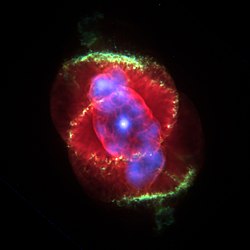
In 1864, astronomer William Huggins conducted the first spectroscopic observations of the Cat's Eye Nebula (NGC 6543), revealing a spectrum dominated by bright emission lines rather than a continuous spectrum, which confirmed that planetary nebulae consist of gaseous material rather than unresolved stars.[11][12] This breakthrough shifted the understanding of nebulae from stellar clusters to ionized gas clouds, paving the way for spectroscopy as a key tool in astrophysics.[11] During the 1920s, Edwin Hubble's observations using the 100-inch Hooker Telescope at Mount Wilson Observatory resolved individual stars and Cepheid variables within spiral "nebulae" such as the Andromeda Nebula (M31), establishing that many previously classified nebulae were actually distant external galaxies far beyond the Milky Way.[13][14] Hubble's work, including the identification of Cepheids in M31 in 1923 and NGC 6822 in 1925, measured distances exceeding 900,000 light-years, fundamentally redefining the scale of the universe and distinguishing true nebulae from extragalactic objects.[13][14] The advent of radio astronomy in the post-1930s era, following Karl Jansky's initial detections of cosmic radio noise, enabled the identification of non-thermal radio emissions from nebulae, with the Crab Nebula (M1) confirmed as a strong radio source by 1953 through observations revealing synchrotron radiation from relativistic electrons.[15] Subsequent 21 cm line surveys in the 1950s detected neutral hydrogen (HI) emissions in diffuse interstellar nebulae, mapping their distribution and kinematics, while observations of linearly polarized synchrotron emission from the Crab Nebula in the late 1950s yielded estimates of the magnetic field strength on the order of 10^{-4} gauss.[16][17] These radio techniques extended observations beyond optical limitations, uncovering dynamic processes in both ionized and neutral gas components of nebulae.[18] Launched in 2003, NASA's Spitzer Space Telescope revolutionized infrared astronomy until its conclusion in 2020, penetrating dust-obscured regions to reveal embedded protostars and star-forming activities within nebulae such as the Carina Nebula (NGC 3372).[19][20] Spitzer's Infrared Array Camera (IRAC) imaged polycyclic aromatic hydrocarbons and warm dust in these environments, highlighting bubble-like structures from stellar winds and massive star formation rates obscured at visible wavelengths.[21][22] Since its 2022 operational debut, the James Webb Space Telescope (JWST) has provided unprecedented near-infrared resolution of nebulae, exemplified by its 2022 imaging of the Pillars of Creation in the Eagle Nebula (M16), which unveiled hundreds of protostars, evaporating gas globules, and bipolar outflows from young stars embedded within the towering dust columns.[23] These observations, captured with JWST's Near-Infrared Camera (NIRCam), resolved features down to 0.1 light-years, revealing photoevaporation processes and young stellar objects previously invisible to Hubble.[24][25] In 2025, JWST's mid-infrared observations with the Mid-Infrared Instrument (MIRI) achieved the first detections of large solid-state complex organic molecules (COMs), including methanol (CH3OH), acetaldehyde (CH3CHO), and ethanol (CH3CH2OH), in protoplanetary disks around subsolar-metallicity protostars within nearby nebular regions.[26] These findings, reported from spectra of low-mass star-forming cores, indicate efficient ice-grain chemistry even in metal-poor environments, bridging interstellar medium evolution to planetary formation.[26][27]

Definition and Characteristics

Physical Structure

Nebulae are vast clouds of gas and dust distributed throughout interstellar and circumstellar space.[2] These structures typically span sizes from 1 to 100 light-years across, though larger examples can extend over hundreds of light-years.[28] Their densities vary significantly, ranging from about 1 atom per cubic centimeter in diffuse regions to 10,000 atoms per cubic centimeter in denser concentrations.[29] Nebulae often display distinctive morphological features, including elongated filaments, expansive shells, and hollow cavities that contribute to their irregular geometries.[3] These elements create complex three-dimensional structures observable across various nebula types.[30] In terms of scale, interstellar nebulae commonly extend across several parsecs, equivalent to roughly 3 to 30 light-years or more, highlighting their expansive nature.[29] By contrast, compact planetary nebulae are typically confined to scales of about 1 light-year.[31] Temperature gradients within nebulae reflect their diverse physical states, with ionized H II regions reaching approximately 10,000 K due to heating by embedded stars.[32] Cooler molecular clouds, on the other hand, maintain temperatures of 10 to 20 K, fostering conditions for denser aggregation.[29] A key concept in understanding nebula stability is the Jeans mass, which represents the critical mass threshold for gravitational collapse in a self-gravitating cloud.[33] This is given by the formula
MJ=(5kTGμmH)3/2(34πρ)1/2, M_J = \left( \frac{5 k T}{G \mu m_H} \right)^{3/2} \left( \frac{3}{4\pi \rho} \right)^{1/2},
where kk is Boltzmann's constant, TT is the temperature, GG is the gravitational constant, μ\mu is the mean molecular weight, mHm_H is the hydrogen atom mass, and ρ\rho is the density.[33] Clouds exceeding this mass become unstable to perturbations, leading to fragmentation and potential collapse, while those below it remain supported by thermal pressure.[33]

Composition and Properties

Nebulae are primarily composed of gas, with approximately 90% hydrogen and 9% helium by number of atoms, along with trace amounts of heavier elements such as carbon, nitrogen, and oxygen produced through stellar nucleosynthesis.[34] These heavier elements constitute less than 1% of the total mass but play crucial roles in the chemical processes within nebulae.[34] Interspersed within this gaseous medium are dust grains, which account for about 1% of the total mass yet are responsible for absorbing a significant fraction—up to 50%—of the interstellar radiation, particularly ultraviolet and optical light from embedded stars.[35] These grains primarily consist of silicates and carbonaceous compounds, such as graphite and polycyclic aromatic hydrocarbons, which contribute to the obscuration and reddening of light passing through nebular regions.[35] The ionization states of nebular gas vary depending on density and proximity to ionizing sources. In H II regions, ultraviolet radiation from hot, massive O and B-type stars ionizes hydrogen atoms, producing a plasma of protons and free electrons with temperatures around 10,000 K.[32] This ionization creates expansive, low-density zones where recombination lines dominate the emission spectrum. In contrast, denser cores within molecular clouds harbor neutral molecular hydrogen (H₂), shielded from UV photons by dust and self-shielding effects, enabling the formation of complex molecules and facilitating gravitational collapse toward star formation.[36] Magnetic fields permeate nebulae, with typical strengths ranging from 10 to 100 microgauss, as measured in regions like the Pillars of Creation and Orion.[37] These fields influence the dynamics by providing magnetic support against gravitational collapse and aligning elongated dust grains, which in turn polarizes transmitted starlight.[38] Turbulence drives much of the internal motion, manifesting as velocity dispersions and outflows with speeds of 10–50 km/s, often detected through Doppler shifts in emission lines from expanding shells or bipolar jets.[39] Such turbulent flows regulate the energy balance and mixing of materials, contributing to the overall evolution of the nebular environment.[40]

Formation and Evolution

Origin Mechanisms

Nebulae primarily originate from the gravitational collapse of molecular clouds within the interstellar medium (ISM), where regions of enhanced density become unstable and contract under their own gravity. This process is often triggered by density waves propagating through the spiral arms of galaxies, which compress interstellar gas and dust, leading to the formation of denser clumps that initiate collapse. For instance, in the Milky Way, these density waves accumulate molecular hydrogen and heavier elements, fostering conditions for cloud fragmentation and subsequent nebula development.[41][42] Another key mechanism involves supernova shockwaves propagating through the ISM, which compress and heat ambient gas clouds, triggering gravitational instabilities and nebula formation. These high-velocity shocks, reaching speeds of hundreds to thousands of kilometers per second, sweep up interstellar material into dense shells that can evolve into diffuse nebulae. A prominent example is the Cygnus Loop, a supernova remnant where the blast wave from an ancient stellar explosion has interacted with surrounding gas, compressing it into filamentary structures visible across multiple wavelengths.[43][44] Stellar winds from massive O-type stars also play a crucial role by excavating bubbles in the surrounding ISM through powerful outflows and ionizing radiation. These stars, with masses exceeding 20 solar masses, emit winds at velocities up to 2,000 km/s, displacing gas and creating expanding cavities filled with hot plasma that outline nebular structures. The feedback from these winds ionizes nearby hydrogen, forming H II regions that delineate the boundaries of the bubbles and contribute to the overall morphology of emission nebulae.[45][46] Galactic shear, arising from differential rotation, combined with supersonic turbulence in the ISM, further influences nebula origins by fragmenting large-scale molecular clouds into filamentary structures. Shear forces stretch and align gas flows, while turbulence—driven by supernovae, stellar feedback, and large-scale instabilities—generates shocks that promote density enhancements and cloud subdivision. These processes create elongated filaments, often spanning tens of parsecs, that serve as precursors to denser cores where nebular emission becomes prominent.[47][48] The timescale for gravitational collapse in these molecular clouds is characterized by the free-fall time, given by the equation
tff=3π32Gρ, t_{ff} = \sqrt{\frac{3\pi}{32 G \rho}},
where $ G $ is the gravitational constant and $ \rho $ is the cloud density. For typical molecular cloud densities of $ 10^{-20} $ to $ 10^{-19} $ g cm3^{-3}, this yields collapse times of $ 10^5 $ to $ 10^6 $ years, setting the pace for rapid nebula formation in dense regions.[49]

Evolutionary Processes

Nebulae undergo dynamic evolutionary changes after their initial gravitational collapse, transitioning through phases dominated by star formation, expansion, and eventual dispersal. In the star formation phase, dense regions within the nebula collapse to form protostellar cores, where massive stars emerge and ionize surrounding gas, creating H II regions that expand outward and disrupt the parent molecular cloud. This expansion arises from the pressure imbalance between the ionized gas and the neutral envelope, with H II regions growing at rates that can trigger sequential star formation in compressed shells while limiting further collapse in the core.[50][51] The expansion and ionization phase intensifies as newly formed stars continue to influence the nebula's structure. For planetary nebulae, which form from the ejected envelopes of low- to intermediate-mass stars, the ionized shell expands at velocities typically ranging from 20 to 50 km/s, driven by thermal pressure from the central star's ultraviolet radiation. This phase lasts 10,000 to 50,000 years, during which the nebula's morphology evolves from compact to extended forms before recombination dims its visibility.[52][53] Stellar feedback mechanisms, including radiation pressure on dust grains and powerful stellar winds, create loops that accelerate material dispersal and chemical enrichment. These processes inject momentum and energy into the surrounding gas, sweeping away remnants of the nebula and releasing metals synthesized in stellar interiors into the interstellar medium, thereby enhancing its metallicity. In the case of supernova remnants, the blast wave expands rapidly before entering a radiative phase, where cooling leads to fading and integration into the hot ionized medium after approximately 10^5 years.[54] Nebulae serve as critical sites for the recycling of interstellar material across multiple stellar generations, facilitating the buildup of metallicity over cosmic time. Dispersed gases and dust from evolved nebulae mix with the broader medium, providing enriched feedstock for subsequent star formation, which progressively increases the abundance of heavy elements as galaxies age.[55]

Classification

Interstellar Nebulae

Interstellar nebulae are vast clouds of gas and dust distributed throughout the interstellar medium (ISM), serving as primary sites for star formation due to their relatively high densities compared to the surrounding diffuse ISM. These structures, often spanning scales of 10 to 100 parsecs (pc), consist primarily of hydrogen and helium with trace amounts of heavier elements and dust grains, and they interact dynamically with the galactic environment to trigger gravitational collapse and new star birth.[56] Unlike compact stellar ejecta, interstellar nebulae represent ambient ISM components that are not directly tied to individual star deaths but rather to the broader cycle of galactic material recycling.[57] Emission nebulae, also known as H II regions, form when ultraviolet radiation from nearby hot, massive O- and B-type stars ionizes surrounding hydrogen gas, creating a glowing plasma that emits light through electron recombination. The characteristic red hue arises from prominent recombination lines, such as H-alpha at 656.3 nm, where electrons cascade from higher energy levels to the n=2 orbital of hydrogen protons.[58] These nebulae, like the Orion Nebula, can extend over tens of parsecs and are key indicators of active star formation, as the ionizing stars are often embedded within or adjacent to the cloud.[2] Reflection nebulae appear as hazy patches illuminated by the scattered light of nearby stars, without significant ionization or emission. Dust grains in these clouds preferentially scatter shorter wavelengths, resulting in a bluish appearance due to the inverse wavelength dependence of Rayleigh scattering, where blue light (around 450 nm) is more efficiently redirected than red.[59] Examples include the nebulosity surrounding the Pleiades star cluster, where the reflection occurs off silicate and carbon-rich dust particles without the high temperatures needed for emission.[2] Dark nebulae are dense, opaque concentrations of dust and molecular gas that absorb and block background starlight, creating silhouettes against brighter emission or stellar fields. These cold structures, typically at temperatures around 10 K, serve as molecular cloud cores where star formation initiates, as seen in the Horsehead Nebula (Barnard 33), a prominent dark feature in Orion spanning about 0.5 pc and obscuring the glow of the adjacent IC 434 emission region.[60] Their visibility relies on contrast with illuminated backgrounds, highlighting the patchy density variations in the ISM.[61] Integrated flux nebulae (IFN), a subtype observed at high galactic latitudes far from the plane, are faint, extended veils of diffuse dust illuminated not by local stars but by the integrated light from the entire galaxy, including scattered starlight and cosmic background radiation. These structures, often classified as galactic cirrus, lack sharp boundaries and appear as low-surface-brightness glows, with examples visible around galaxies like M81, where they form complex screens of interstellar material at distances of several kiloparsecs.[62] IFN represent the most tenuous interstellar clouds, detectable primarily through broadband imaging that captures their subtle scattering of diffuse galactic light.[63]

Stellar Remnants as Nebulae

Planetary nebulae form from the ejected outer envelopes of low- to intermediate-mass stars, typically those with initial masses between 1 and 8 solar masses, as they evolve off the main sequence and conclude their asymptotic giant branch phase. These stars undergo rapid mass loss in a superwind, expelling hydrogen-rich layers that surround the emerging hot white dwarf core, which then ionizes the material to produce glowing emission structures.[64] The nebulae often display disk-like or toroidal appearances due to enhanced ejection along the equatorial plane, shaped by the progenitor's rotation or the presence of a binary companion.[65] Prior to this ionized stage lies the protoplanetary nebula phase, a short-lived transition lasting roughly 1,000 years, during which the ejected envelope remains largely neutral and is heavily obscured by thick dust tori concentrated in the equatorial regions. These tori, formed from the densest parts of the outflow, scatter and reprocess ultraviolet light into infrared emission, making protoplanetary nebulae prominent in mid-infrared observations before the central star's temperature rises sufficiently for full photoionization.[66][67] Asymmetries are prevalent in planetary nebulae, with many exhibiting bipolar morphologies characterized by two collimated lobes flanking a dense equatorial torus. Such shapes arise from binary interactions during the common-envelope phase, where orbital dynamics direct outflows into jets, or from magnetic fields in the stellar wind that collimate the ejecta along polar axes.[65][68] Supernova remnants constitute another key category of nebulae linked to stellar endpoints, originating from the cataclysmic explosions of massive stars in core-collapse supernovae (Types II, Ib, Ic) or from white dwarf disruptions in Type Ia events. These remnants manifest as rapidly expanding shells of shocked gas and dust, propelled by blast waves that sweep up interstellar material at velocities spanning 1,000 to 10,000 km/s, depending on the remnant's age and ambient density.[69][70] During the Sedov-Taylor phase, which follows the initial free-expansion stage once swept-up mass equals ejecta mass, the remnant's evolution follows a self-similar solution for adiabatic blast waves in a uniform medium. The radius $ R $ evolves as
R=(Et2ρ)1/5, R = \left( \frac{E t^2}{\rho} \right)^{1/5},
where $ E $ represents the explosion's kinetic energy (typically $ 10^{51} $ erg), $ t $ is the time elapsed, and $ \rho $ is the preshock ambient density. This relation highlights how remnant size scales with energy input and inversely with surrounding medium density, governing the phase until radiative losses become significant.

Study and Detection

Observational Techniques

Observing nebulae requires a range of telescopes and instruments sensitive to different wavelengths, as these extended structures emit or reflect light across the electromagnetic spectrum depending on their temperature, density, and composition. Optical telescopes have long been essential for capturing visible-light images of bright emission nebulae, where ionized gases glow from excitation by nearby stars. Ground-based observatories, such as those at the European Southern Observatory, provide wide-field views, but space-based instruments like the Hubble Space Telescope (HST) excel in high-resolution imaging by avoiding atmospheric interference, revealing intricate details in structures like filaments and bubbles. For instance, HST's Wide Field Camera 3 has produced detailed false-color composites that highlight hydrogen-alpha emissions at 656 nm, allowing astronomers to map the morphology of nebulae with angular resolutions down to 0.04 arcseconds. In the radio regime, telescopes are crucial for detecting cold, dense regions within nebulae that are obscured at optical wavelengths. Arrays like the Atacama Large Millimeter/submillimeter Array (ALMA) map molecular line emissions, such as the 115 GHz carbon monoxide (CO) transition, which traces neutral molecular gas in star-forming regions. ALMA's interferometric capabilities achieve resolutions as fine as 0.01 arcseconds, enabling the study of velocity fields and mass distributions without relying on shorter wavelengths. Similarly, the Very Large Array (VLA) in New Mexico observes continuum radio emission from free-free processes in ionized gases, providing insights into the overall extent of H II regions. Infrared observations penetrate the dust that veils nebular interiors, uncovering embedded protostars and warm dust components. The James Webb Space Telescope (JWST), launched in 2021, uses its Near-Infrared Camera (NIRCam) to image at wavelengths from 0.6 to 5 microns, resolving features hidden from optical view and detecting polycyclic aromatic hydrocarbon emissions around 3-12 microns. Ground-based facilities like the Spitzer Space Telescope, operational until 2020, complemented this by surveying large areas, though JWST's superior sensitivity and resolution—down to 0.03 arcseconds—have revolutionized the imaging of young stellar objects within molecular clouds. For high-energy phenomena, X-ray observatories target the hot plasmas in supernova remnants and planetary nebulae outflows. The Chandra X-ray Observatory, operational since 1999, detects emissions from temperatures reaching 10^7 K, using its Advanced CCD Imaging Spectrometer to produce maps of shocked gas with spatial resolutions of 0.5 arcseconds. This allows visualization of diffuse X-ray structures that indicate shock heating, often co-aligned with optical data for multiwavelength composites. To enhance ground-based observations, techniques like adaptive optics and interferometry correct for atmospheric turbulence and boost resolution. Adaptive optics systems, implemented on telescopes such as the Keck Observatory's 10-meter mirrors, use deformable mirrors and laser guide stars to achieve near-diffraction-limited imaging at optical and near-infrared wavelengths, resolving nebular features down to 50 milliarcseconds. Optical interferometry, as with the Very Large Telescope Interferometer (VLTI), combines multiple telescopes to simulate a larger aperture, enabling detailed imaging of compact nebular components like protoplanetary disks. These methods have been pivotal since the 1990s in bridging the gap between space-based clarity and ground-based light-gathering power.

Spectroscopic Analysis

Spectroscopic analysis of nebulae employs emission and absorption line studies to quantify their physical properties, such as composition, temperature, density, and motion, complementing imaging data by revealing velocity fields and ionization states. Emission spectra from ionized gas dominate in H II regions and planetary nebulae, where forbidden lines arise from low-density environments, while absorption features trace intervening dust. These techniques enable mapping of kinematic structures and elemental abundances, essential for understanding nebula dynamics and evolution.[71] Emission line spectroscopy is fundamental for probing the ionized components of nebulae, particularly through forbidden transitions that are prominent in low-density plasmas (n_e < 10^6 cm^{-3}). For instance, the [O III] λ5007 nm line, emitted by doubly ionized oxygen in the ^1D_2 to ^3P_2 transition, serves as a key diagnostic of photoionized gas, as its excitation requires collisional processes in nebular conditions where radiative de-excitation dominates over collisional. Such lines, forbidden by quantum selection rules in high-density laboratory settings, become observable in the dilute interstellar medium, indicating electron densities typically around 10^3–10^4 cm^{-3} in H II regions. Absorption spectra reveal dust properties via extinction curves, which quantify how interstellar grains attenuate light across wavelengths. In the galactic plane, the visual extinction A_V averages about 1 mag kpc^{-1}, reflecting the cumulative effect of dust along sightlines through molecular clouds and diffuse ISM.[72] These curves, often parameterized by the total-to-selective extinction R_V = A_V / E(B-V) ≈ 3.1 in the diffuse ISM, show a rise toward ultraviolet wavelengths due to small silicate and carbonaceous grains, allowing corrections for reddening in nebular observations.[73] Radial velocity mapping utilizes Doppler shifts in emission lines to infer nebula kinematics, including expansion and internal motions. By measuring line-of-sight velocities from resolved profiles (e.g., in [O III] or Hα), expansion rates are derived, often corrected for projection effects using models of ellipsoidal geometries, yielding velocities of 10–50 km s^{-1} for planetary nebulae.[74] Integral field spectroscopy further enables 2D velocity maps, distinguishing radial expansion from toroidal rotation or bipolar outflows in asymmetric structures.[75] Abundance determination relies on line intensity ratios to estimate electron temperatures and ionic concentrations, crucial for deriving chemical compositions. The electron temperature T_e([N II]) is derived from the intensity ratio of the [N II] auroral line at λ5755 to the nebular lines at λ6548 + λ6584, typically yielding T_e ≈ 8000–12000 K in nebulae. This method, calibrated via detailed atomic models, enables abundance calculations via the ionization correction factor and recombination coefficients.[76] Recent applications of mid-infrared spectroscopy with the James Webb Space Telescope (JWST) have enhanced insights into nebulae, revealing polycyclic aromatic hydrocarbons (PAHs) through characteristic bands at 3–20 μm, such as the 11.2 μm feature from C-H bending modes, indicating their role in UV-pumped fluorescence.

Notable Examples

Iconic Nebulae

The Orion Nebula, designated M42, is the nearest major star-forming region to Earth, located approximately 1,300 light-years away in the constellation Orion.[77] This vast emission nebula spans about 24 light-years in diameter and serves as a stellar nursery where thousands of young stars are actively forming. At its core lies the Trapezium Cluster, a dense group of massive, hot O- and B-type stars that emit intense ultraviolet radiation, ionizing the surrounding hydrogen gas and causing it to glow brightly. The Trapezium's four brightest stars, within a compact region of roughly 1.5 light-years, dominate the ionization process, illuminating intricate structures like proplyds—protoplanetary disks being sculpted by stellar winds and radiation. Recent James Webb Space Telescope (JWST) observations have revealed finer details of these proplyds in infrared, enhancing understanding of disk formation.[78] Observations reveal a dynamic environment with dust lanes, Herbig-Haro objects, and evaporating gaseous globules, making M42 a key case study for understanding early stellar evolution and feedback mechanisms in star clusters. The Eagle Nebula, known as M16, lies about 7,000 light-years distant in the constellation Serpens and exemplifies a region of active star formation sculpted by intense stellar radiation.[79] Its most iconic feature, the Pillars of Creation, consists of towering columns of interstellar gas and dust extending approximately 4 to 5 light-years in height, where ultraviolet light from the embedded young star cluster NGC 6611 erodes the dense material.[80] These pillars harbor evaporating gaseous globules (EGGs), dense clumps of hydrogen that resist immediate photoevaporation and may contain protostars in various stages of formation.[81] The nebula's glowing filaments and dark silhouettes highlight the interplay between gravitational collapse and radiative destruction, providing insights into the hierarchical structure of molecular clouds.[79] The Crab Nebula, cataloged as M1, is a pulsar wind nebula and supernova remnant resulting from a core-collapse explosion observed in 1054 CE, positioned 6,500 light-years away in Taurus.[82] At its center is the Crab Pulsar, a rapidly rotating neutron star that powers the nebula through a relativistic wind, inflating a shell of ejected material spanning about 11 light-years.[83] This central engine accelerates charged particles along magnetic field lines, producing synchrotron radiation that dominates the nebula's emission across radio to gamma-ray wavelengths, with prominent X-ray and optical jets extending from the pulsar's equatorial disk. JWST imaging in 2023 revealed intricate dust structures in the inner torus, aiding studies of element distribution.[84][85] Filamentary structures of ionized gas trace the supernova's original debris, while dust grains in the torus absorb and re-emit light, offering a laboratory for studying particle acceleration and high-energy astrophysics in supernova remnants.[85] The Helix Nebula, NGC 7293, represents one of the closest planetary nebulae at 650 light-years in the constellation Aquarius, formed by the ejection of outer layers from a low- to intermediate-mass star now collapsed into a white dwarf.[86] This expanding shell, approximately 3 light-years in diameter, displays a complex ring-like structure with intricate inner features, including thousands of cometary knots—dense, tadpole-shaped globules of molecular gas up to 0.1 light-years long, oriented radially away from the central star due to photoevaporation by its ultraviolet flux.[87] The central white dwarf, with a surface temperature exceeding 100,000 K, ionizes the surrounding helium and oxygen-rich gas, producing the nebula's blue-green hues and revealing stratified layers from successive ejection episodes.[88] These knots, containing up to 100 times the mass of Earth, illustrate late-stage mass loss and the transition to white dwarf cooling.[89] The Ring Nebula, M57 or NGC 6720, is a classic example of a planetary nebula located 2,500 light-years away in Lyra, where a Sun-like star has shed its envelope to expose a hot central white dwarf.[90] The nebula's prominent toroidal shell, expanding at about 20 km/s and measuring 1.3 light-years across, consists of ionized oxygen and nitrogen emitting in the visible spectrum, with fainter halos indicating earlier ejection phases. JWST observations in 2023 uncovered a dusty disk around the central stars, providing new data on post-AGB evolution.[91] As the shell propagates outward, its density decreases, causing the ionization front to recede and revealing clumpy structures shaped by instabilities in the stellar wind.[92] This archetypal object, observed since the 18th century, demonstrates the rapid evolution of planetary nebulae over 5,000–10,000 years, with recent infrared imaging uncovering a circumstellar disk of dust around the progenitor remnants.[93]

Catalog Systems

The Messier Catalog, compiled by French astronomer Charles Messier and published in its final form in 1781, enumerates 110 deep-sky objects, including numerous nebulae, primarily to assist comet hunters in avoiding confusion with these fixed, nebulous appearances.[94] This catalog emphasized prominent, easily observable features visible from the Northern Hemisphere, serving as an early systematic reference for nebulae and other non-stellar phenomena despite its limited scope.[94] Building on earlier efforts, the New General Catalogue (NGC), published in 1888 by Danish-British astronomer J. L. E. Dreyer, expanded the documentation to 7,840 celestial objects, encompassing galaxies, star clusters, and nebulae, with detailed entries including equatorial coordinates, angular sizes, and qualitative descriptions derived from visual observations.[95] Dreyer supplemented the NGC with the Index Catalogues (IC) in 1895 and 1908, adding 5,386 further entries of similar objects discovered between 1888 and 1907, thereby creating a foundational framework for nebular studies that integrated historical observations with precise positional data.[95] These catalogs organized nebulae by right ascension and provided textual notes on brightness, structure, and resolvability, facilitating targeted astronomical surveys and cross-referencing in subsequent research.[95] The Principal Galaxies Catalogue (PGC), first released in 1989 and updated as PGC2003, extends cataloging to over one million extragalactic objects, including some nebular features within galaxies, with associated redshifts enabling distance measurements and cosmological analyses.[96] This machine-readable resource, maintained under the HYPERLEDA framework, supports nebular research by linking spectral data to positional and photometric parameters, aiding in the study of emission regions in distant systems.[96] Specialized catalogs like the Sharpless Catalog, published in 1959 by American astronomer Stewart Sharpless, focus on 313 H II regions—ionized hydrogen emission nebulae—north of declination −27°, cataloged using photographic plates from the Palomar Observatory Sky Survey to highlight their diffuse, glowing structures.[97] It provides coordinates, estimated sizes, and classifications based on ionization extent, proving invaluable for targeted studies of star-forming regions without overlapping broader deep-sky inventories.[97] Modern digital catalogs have revolutionized nebular research through integrated, queryable databases. The SIMBAD astronomical database, operated by the Centre de Données astronomiques de Strasbourg, compiles data on over 13 million objects including nebulae, aggregating multi-wavelength observations from radio to gamma-ray regimes with cross-identifications, bibliographies, and measurements for comprehensive analysis. Similarly, the NASA/IPAC Extragalactic Database (NED), updated through October 2025, ingests literature data on millions of extragalactic sources, including planetary and emission nebulae in other galaxies, offering redshifts, photometry, and spectral integrations to support multi-mission studies.[98] These resources enhance research utility by enabling efficient data mining, error corrections, and linkages across observatories, far surpassing the static formats of historical catalogs.[98]

References

User Avatar
No comments yet.