


Community hub
Recent from talks
Contribute something
Nothing was collected or created yet.
Never Mind the Bollocks, Here's the Sex Pistols
View on Wikipedia
| Never Mind the Bollocks, Here's the Sex Pistols | ||||
|---|---|---|---|---|
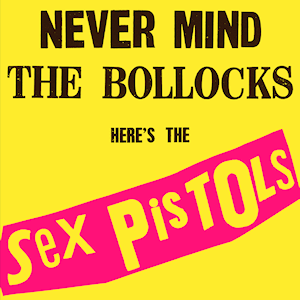
 Original yellow UK variant (US variant is pink) | ||||
| Studio album by | ||||
| Released | 28 October 1977 | |||
| Recorded |
| |||
| Studio | Wessex Sound, London | |||
| Genre | Punk rock | |||
| Length | 38:44 | |||
| Label | Virgin | |||
| Producer | ||||
| Sex Pistols chronology | ||||
| ||||
| Singles from Never Mind the Bollocks, Here's the Sex Pistols | ||||
| ||||
Never Mind the Bollocks, Here's the Sex Pistols (often shortened to Never Mind the Bollocks) is the only studio album by the English punk rock band the Sex Pistols. It was released on 28 October 1977 through Virgin Records. As a result of the Sex Pistols' volatile internal relationships, the band's lineup saw changes during the recording of the album. Original bass guitarist Glen Matlock left the band early in the recording process, and while he is credited as a co-writer on all but two of the tracks, he only played bass and sang backing vocals on one track, "Anarchy in the U.K." Recording sessions continued with a new bass player, Sid Vicious, who is credited on two of the songs written by the band after he joined. While Vicious's bass playing appeared on two tracks, his lack of skill on the instrument meant that many of the tracks were recorded with guitarist Steve Jones playing bass instead. Drummer Paul Cook, Jones and singer Johnny Rotten appear on every track. The various recording sessions were led alternately by Chris Thomas or Bill Price, and sometimes both together, but as the songs on the final albums often combined mixes from different sessions, and as it is unclear who of them was present in the recording booth each time, each song is jointly credited to both producers.
By the time of its release, the Sex Pistols were already controversial, having spoken profanity on live TV, been fired from two record labels, and been banned from playing live in some parts of Britain. The album title added to that controversy, with some people finding the word "bollocks" offensive. Many record stores refused to carry it and some record charts refused to list its title, showing just a blank space instead. Due in part to its notoriety, and in spite of many sales bans at major retailers, the album debuted at number one on the UK Album Charts. It achieved advance orders of 125,000 copies after a week of its release and went gold only a few weeks later, on 17 November. It remained a best-seller for nearly a year, spending 48 weeks in the top 75.[1] The album has also been certified platinum by the RIAA. It has seen several reissues, the latest in 2017.
The album has influenced many bands and musicians, and the industry in general. In particular, the album's raw energy, and Johnny Rotten's sneering delivery and "half-singing", are often considered game-changing. It is frequently listed as the most influential punk album, and one of the greatest and most important albums of all time. In 1987, Rolling Stone magazine named the album the second best of the previous 20 years, behind only the Beatles' Sgt. Pepper's Lonely Hearts Club Band. The same magazine ranked it 73rd on their list of the 500 greatest albums of all time in 2020. In 2006, it was chosen by Time magazine as one of the 100 greatest albums ever.
Production
[edit]Writing
[edit]John Lydon, Steve Jones and Paul Cook wrote the album's 12 tracks between August of 1975 and June of 1976, with Glen Matlock acting as a co-writer on most of the tracks, written before his departure in February of 1977, and Sid Vicious co-writing the two written after his entry into the group.
The first track written by the group was 'Pretty Vacant,'[2][3] and by their 6 November 1975 concert at Central Saint Martins College of Art and Design they had written 'Seventeen', which closed their set.[4] The next day the group performed at The Holborn Central School of Art and debuted 'Pretty Vacant' and 'Submission'.[5] On the 21st, they debuted the song 'New York'.[6] By February 1976, the group had gained traction[7] and debuted the song 'Problems' for their second encore on 14 February. Their setlists at this time were becoming more filled with their material[8] and less reliant on covers, as their earlier shows had been. By 3 April, they were playing 'No Feelings' in concert,[9] and on 20 July, debuted 'Anarchy In the U.K', which was seemingly influenced by Vivienne Westwood and Jamie Reid,[10] the latter of which had begun creating publicity material for the group that spring.[11] By 14 August the group were performing 'Liar' live.[12]
Recording
[edit]On 8 October 1976, EMI signed the group into a two-year contract.[13] For EMI, they recorded 'Anarchy In the U.K' and began sessions for the newly written 'God Save The Queen' that month. On 26 November 1976, the group's first single was released to great commercial success. But due to the nature of the material and the band's image, they caused heavy controversy, and were dropped from the label on 6 January 1977.
In February of 1977, founding member and original bassist Glen Matlock quit,[14] reportedly over the lyrics to God Save The Queen.[15] Matlock had co-written a majority of the album's tracks and was replaced by Sid Vicious.
Close to completing a deal with A&M Records, in March 1977 the Sex Pistols entered Wessex Sound Studios to record with producer Chris Thomas and engineer Bill Price. New bassist Sid Vicious played on the tracks "Bodies" and "God Save the Queen",[16][17] but his performing skills were not considered fit to record the full album, so the band asked manager Malcolm McLaren to convince previous bassist Glen Matlock to perform the instrument for the sessions.[18] Matlock agreed on the condition that he was paid beforehand. When payment was not received, he declined to attend. As a result, Thomas asked guitarist Steve Jones to play bass so work could begin on the basic tracks. Jones' playing was so satisfactory that Thomas had him play the bass tracks for all the remaining songs recorded during the sessions.[19]
Four tracks—writer Clinton Heylin suspected they were "God Save the Queen" (Thomas stated he and Price "gave up" trying to use Vicious' bass track[16]), "Pretty Vacant", "E.M.I." and possibly "Did You No Wrong"—were recorded during the two days at Wessex, with "God Save the Queen" and "Pretty Vacant" receiving vocal tracking from Johnny Rotten and final mixing during the period.[citation needed] As a result of these sessions, Thomas and Price began work in earnest on what would become the Sex Pistols' full-length album.[20] Four days after recording was completed, the Sex Pistols signed with A&M, yet on 16 March the label terminated the contract, and several thousand pressed copies of the forthcoming "God Save the Queen" single were destroyed.[21]
Despite being dropped by A&M, McLaren instructed the Sex Pistols to continue work on the album. While McLaren pondered whether or not to sign the offer presented by Virgin Records, he signed a French deal for the group with Barclay Records in early May 1977. At the same time, the group resumed work with Thomas and Price.[22] Thomas temporarily departed the session partway through (a timeframe Heylin places as sometime in late April and early May), leaving Price to produce what Thomas estimated as five songs. Heylin narrowed down the potential Bollocks tracks Price may have produced to "Liar", "New York", "No Feelings", "Problems", "Seventeen" and "Submission", in addition to the non-album track "Satellite".[23]
Meanwhile, the Sex Pistols had been rejected by labels including CBS, Decca, Pye and Polydor, leaving only Virgin's offer. McLaren still hoped to sign with a major label, and posited issuing a one-off single with Virgin to increase the band's appeal to the larger record companies. Virgin owner Richard Branson refused, so on 18 May the Sex Pistols finally signed with Virgin. Two weeks later, the label rush-released "God Save the Queen" as a single.[24] During promotion of the single, Rotten stated that work on the album was ongoing, and, obscuring Jones's assumption of bass duties, insisted that the bass performances on the in-progress album were split between Matlock "on the Chris Thomas tracks" and Vicious.[25]
The band returned to the studio with Thomas and Price on 18 June to record "Holidays in the Sun", the first song they had written without Matlock. That night after visiting a nearby pub, Rotten, Thomas and Price were attacked by a group of men, and the incident made newspaper headlines the following Tuesday.[26] That month an eleven-track preview of the album began circulating, first reviewed in the fanzine 48 Thrills. At this point, Rotten maintained that the forthcoming album would include no cover songs, and none of the Sex Pistols' previously released singles bar "Anarchy in the U.K.", which was out of print. With "Pretty Vacant"'s release as a single, it was due to be replaced on the track list.[27] The Sex Pistols returned to Wessex once more that August to record a new song, "Bodies", that had Vicious on bass.[28][29] "Bodies" contained a second bass track played by Steve Jones, with the final version of the song "leaving Sid's down low".[16]
The time spent in the studio recording the album was, for Steve Jones, the "best part of being in the Pistols".[30] Jones spent many hours doing guitar overdubs with producer Chris Thomas and—repudiating punk's occasional embrace of musical sloppiness—has stated that both he and drummer Paul Cook "weren't just having a laugh" and were "really dedicated in the studio".
During this time period, bassist Sid Vicious stumbled into the same recording room as rock band Queen. Vicious aimed an insult at lead singer Freddie Mercury, saying "Have you brought ballet to the masses, yet?" Mercury got up and responded, "Aren't you Simon Ferocious or something? What're you gonna do about it?", took him by the collar and threw him out of the room. Later, Queen's producer Roy Thomas Baker, had a word with the Pistols' engineer over an interruption by Johnny Rotten, saying, "One of the band members just crawled on all fours across our studio up to the side of the piano, said, 'Hello Freddie,' and left on all fours. Could you make sure he doesn't do it again?"[31]
Release
[edit]With the completion of "Bodies", the time came to finalise the album's track list. Though Jon Savage wrote there were three versions of each track available, Heylin states that alternative versions for only five tracks ("E.M.I.", "No Feelings", "Seventeen" and "Submission", plus an "album" mix of "Satellite") existed.[32] It was not until 20 September that the track list was finalised, which Heylin said "suggests just how bogged down by the process they had become".[33] Richard Branson spent the night deciding the track list and which versions to use, and included all the hits on the record, despite the objections of the band, McLaren's management company Glitterbest and most of Virgin.[34] Due to the album's long completion time, the Sex Pistols and McLaren decided to release "Holidays in the Sun" backed with "Satellite" as the band's fourth single. "Holidays in the Sun" was not as successful as past singles—it charted at number eight and dropped out of the top 20 after four weeks—which Heylin attributed to the group's announcement that their album would be released on 4 November and that the single would be included on the LP, despite previous statements to the contrary. In an attempt to stem criticism over the decision to include all four previously released Sex Pistols singles on the forthcoming LP, Virgin indicated the possibility of an "alternative album" being issued simultaneously, featuring a new title and two new songs replacing "two of the former hit singles". A label spokesman stated, "We've put the singles on the LP because most people wanted it that way. But the alternative set would enable us to overcome the multiple stores' ban". A ten-song test pressing was made, though no new cuts were included, with "Satellite" and "Submission" being added as bonus tracks.[33]
The Sex Pistols' contract with Virgin stated that its music would be distributed by Virgin in the United States provided Branson matched any competing offers McLaren received. However, McLaren wanted to negotiate separate deals in every territory, regardless of what the contract stipulated, which angered Branson, as the clause for American distribution was an important one he had fought for. Branson knew he had been outmanoeuvred by McLaren, for he could not sue to enforce the contract or else be perceived as acting like EMI or A&M. Competition for the band in the United States narrowed down to Warner Bros., Arista, Columbia and Casablanca Records, with Warner Bros. signing the band on 10 October for £22,000.[35]
Before Virgin could release Never Mind the Bollocks, Branson discovered that two other Sex Pistols albums were competing with his label's.[36] In October, a bootleg named Spunk featuring high-quality recordings of Sex Pistols demos and recording sessions with Dave Goodman was released on a label called Blank. Among the rumours of who was behind the release of the tapes included Goodman, Glen Matlock and McLaren, who has always considered Goodman's versions to be a more accurate representation of the band.[37] Meanwhile, the French pressing of Never Mind the Bollocks on Barclay had added "Submission" to the slated 11-song track list, and was due for release a week before Virgin's edition. As McLaren's separate deal with Barclay meant that the French release could not be halted and given the Virgin head was aware of how easy it was for import records to arrive in Britain, Branson rushed production of Never Mind the Bollocks to ensure it would come out a week earlier than intended. Nevertheless, the Barclay version was already available in the UK at the time Virgin had its version ready. Ten thousand copies of Virgin's pressing erroneously only listed 11 tracks on the sleeve yet contained 12 on the actual record.[36]
Even with the availability of Spunk, the release of Never Mind the Bollocks, Here's the Sex Pistols was eagerly awaited in the United Kingdom. With advance orders of 125,000 copies, Never Mind the Bollocks debuted at number one on the UK Album Charts the week after its release.[38] A ban of the album enacted by major retailers resulted in the record selling well through independent vendors instead.[39]
Title, packaging and obscenity case
[edit]The album was originally going to be titled God Save Sex Pistols. Jamie Reid's cover concept refrained from including a picture of the group and instead was dayglo red and yellow in colour with cutout lettering and a finish resembling crude screen-prints while the US version was pink with a green Sex Pistols logo. The album's title changed in mid-1977, based on a phrase supplied by Steve Jones.[34] Jones said he picked up the phrase "Never mind the bollocks" from two fans who would always say it to one another. Johnny Rotten explained its meaning as a working-class expression to "stop talking rubbish".[16]
In the United Kingdom, the album was subject to what Heylin described as "blatant acts of censorship exercised by media and retail outlets alike". London police visited the city's Virgin record store branches and told them they faced prosecution for indecency as stipulated by the 1899 Indecent Advertisements Act if they continued to display posters of the album cover in their windows. The displays were either toned down or removed. However, on 9 November 1977 (just two days before the album was released in the US), the London Evening Standard announced on its front-page headline "Police Move in on Punk Disc Shops", and reported how a Virgin Records shop manager in Nottingham was arrested for displaying the record after being warned to cover up the word "bollocks".[40][41] Chris Seale, the shop's manager, "it would appear, willingly set himself up as a target, possibly at Branson's behest", according to Heylin, who noted that he had been visited by the police on four occasions and resumed displaying copies of the record in the store windows after they had left on each occasion. After Seale's arrest, Branson announced that he would cover the manager's legal costs and hired Queen's Counsel John Mortimer as defence. Meanwhile, advertisements for Never Mind the Bollocks appearing in music papers attempted to politicise the issue, showing newspaper headlines about Sex Pistols controversies that were underlined with the message "THE ALBUM WILL LAST. THE SLEEVE MAY NOT."[42]
The obscenity case was heard at Nottingham Magistrates' Court on 24 November.[42] Mortimer presented the case as a matter of police discrimination. During his cross-examination of the arresting officer, he asked why the newspapers The Guardian and Evening Standard (which had referred to the album's name) had not been charged under the same act. When the overseeing magistrate inquired about his line of questioning, Mortimer stated that a double standard was apparently at play, and that "bollocks" was only considered obscene when it appeared on the cover of a Sex Pistols album. The prosecutor conducted his cross-examination "as if the album itself, and not its lurid visage, was on trial for indecency", according to Heylin.[43] Mortimer produced an expert witness, Professor James Kinsley,[44] Head of the School of English at the University of Nottingham, who argued that the word "bollocks" was not obscene, and was actually a legitimate Old English term formerly used to refer to a priest,[45] and which, in the context of the title, meant "nonsense". Lawyer Geoffrey Robertson, who appeared with Mortimer, recalled the professor saying that early English translations of the Bible used "bollocks" to refer to testicles, this being replaced by the word "stones" in the King James Version of the Bible, at which point Rotten handed Robertson a note saying, "Don't worry. If we lose the case, we'll retitle the album Never Mind the Stones, Here's the Sex Pistols".[46] The chairman of the hearing concluded:
Much as my colleagues and I wholeheartedly deplore the vulgar exploitation of the worst instincts of human nature for the purchases of commercial profits by both you and your company, we must reluctantly find you not guilty of each of the four charges.[47]
Legacy
[edit]| Review scores | |
|---|---|
| Source | Rating |
| AllMusic |  [48] [48] |
| Christgau's Record Guide | A[49] |
| Classic Rock | 10/10[50] |
| Encyclopedia of Popular Music | [51] |
| The Guardian | [52] |
| Mojo | [53] |
| Q | [54] |
| The Rolling Stone Album Guide | [55] |
| Spin Alternative Record Guide | 10/10[56] |
| Uncut | 8/10[57] |
In Christgau's Record Guide: Rock Albums of the Seventies, Village Voice critic Robert Christgau reviewed Never Mind the Bollocks:
"Get this straight: no matter what the chicmongers want to believe, to call this band dangerous is more than a suave existentialist compliment. They mean no good. It won't do to pass off Rotten's hatred and disgust as role-playing—the gusto of the performance is too convincing. Which is why this is such an impressive record. The forbidden ideas from which Rotten makes songs take on undeniable truth value, whether one is sympathetic ('Holidays in the Sun' is a hysterically frightening vision of global economics) or filled with loathing ('Bodies,' an indictment from which Rotten doesn't altogether exclude himself, is effectively anti-abortion, anti-woman, and anti-sex). These ideas must be dealt with, and can be expected to affect the way fans think and behave. The chief limitation on their power is the music, which can get heavy occasionally, but the only real question is how many American kids might feel the way Rotten does, and where he and they will go next. I wonder—but I also worry."[49]
In 1983, the Bollock Brothers released a track-by track-cover version of the album, called Never Mind the Bollocks 1983.[58][59][60]
In 1985, NME writers voted Never Mind the Bollocks, Here's the Sex Pistols the thirteenth greatest album of all time.[61] In 1993, NME writers voted the album the third greatest of all time.[62] In 1987, Rolling Stone magazine named it the second best album of the previous 20 years, behind only the Beatles' Sgt. Pepper's Lonely Hearts Club Band. The same magazine named it 41st on their list of the five-hundred greatest albums ever in 2003,[63] maintaining the position in its updated 2012 list, but dropped to number 73 in a 2020 revision.[64] In an interview during 2002, Rolling Stone journalist Charles M. Young stated:
Never Mind the Bollocks changed everything. There had never been anything like it before and really there's never been anything quite like it since. The closest was probably Nirvana, a band very heavily influenced by the Sex Pistols.[65]
Kurt Cobain from Nirvana listed the album on his Top 50 favourite albums,[66] and the title of Nirvana's second album, Nevermind, was inspired by the Sex Pistols' album, which angered Rotten at the time.[67]
In 1997, Never Mind the Bollocks, Here's the Sex Pistols was named the 24th greatest album of all time in a Music of the Millennium poll conducted in the United Kingdom by HMV, Channel 4, The Guardian and Classic FM.[68]
In 2000 it was voted number 29 in Colin Larkin's All Time Top 1000 Albums.[69]
In 2005, the album was ranked number 276 in Rock Hard magazine's book The 500 Greatest Rock & Metal Albums of All Time.[70] In 2006, it was chosen by Time magazine as one of the 100 greatest albums ever,[71] and in the same year NME voted the album the fourth greatest British album.[72] In 2024, Loudwire staff elected it as the best hard rock album of 1977.[73]
Noel Gallagher was interviewed for a television programme called When Albums Ruled the World for the BBC, aired in early 2013. He said, of the album's opening with "Holidays in the Sun", "That is extremely provocative, what we can only assume is jackboots", which he followed by saying, "As soon as that starts, everything that has gone on before is now deemed fucking irrelevant, as soon as he (John Lydon) starts anti singing." He then said of "Pretty Vacant", "One of the 1st things you learn when you pick up the electric guitar is that riff." He then further commented, "I made 10 albums and in my mind they don't match up to that, and I'm an arrogant bastard. I'd give them all up to have written that, I truly would."[74] In 2015, the album was inducted into the Grammy Hall of Fame.[75]
Reissues
[edit]In 1996, Virgin reissued Never Mind the Bollocks as a double CD with the original 'Spunk' bootleg album as Spunk/This Is Crap.[76]
On 29 October 2007, Virgin released a special 30th-anniversary edition of the album in 180-gram vinyl LP format. The set included a 7-inch insert of "Submission" and poster, as originally released on 28 October 1977. Virgin also reissued the group's four singles, "Anarchy in the U.K.", "God Save the Queen", "Pretty Vacant" and "Holidays in the Sun", on 7-inch vinyl, before the album reissue.
In the US and Canada, these re-releases were handled by Warner Bros., which originally released the album in North America and (as of 2017) still owns the regional copyright to the album.
A four-disc boxed set reissue occurred on 24 September 2012. The set includes the original album, which for the first time was digitally remastered from the original master tapes, on disc one. The sound quality of this remaster is thus a significant improvement over all other reissues. The remastering process was overseen by original producer Chris Thomas. The second disc comprises all but one of the band's officially released B-sides (omitting "I Wanna Be Me"), which were also remastered. This disc also includes outtakes and demos from the recording sessions for 'NMTB', most notably the studio demo of "Belsen Was A Gas", which had been recently rediscovered and was previously thought lost forever. The third disc contains two live recordings from 1977 (Including the previously unreleased complete soundboard recording of their performance at the Happy House in Stockholm, Sweden on 28 June 1977). The fourth and final disc is a DVD of live and studio videos – as well as audio interviews from 1977. Also included is a full size 100 page hard cover, full color coffee table book which contains rare pictures, articles, and interviews that provides a timelime of the band throughout 1977. Additionally the set includes a full size replica "subway" promotional 'NMTB' poster, replicas of original promo stickers, a re-print of John Lydon's original hand-written lyrics to "God Save The Queen", and a replica of the original A&M copy of the "God Save the Queen" single. This UMG box set (SEXPISSBOX1977) and the 2002 Virgin box set (SEXBOX1) together contain almost the entire Sex Pistols studio/demo sessions – omitting only three of the June 1976 Dave Goodman demos which can be found on the 2006 officially released remaster of the "Spunk" bootleg.[77]
In 2015, as part of Record Store Day, the album was re-issued as a picture disc, reaching number 7 in the UK'S Top 40 Vinyl Album Chart.[78]
Track listing
[edit]11-track version (UK edition)
[edit]All tracks are written by Paul Cook, Steve Jones, Glen Matlock and Johnny Rotten except where noted.
| No. | Title | Writer(s) | Length |
|---|---|---|---|
| 1. | "Holidays in the Sun" | Cook, Jones, Rotten, Sid Vicious | 3:22 |
| 2. | "Liar" | 2:41 | |
| 3. | "No Feelings" | 2:53 | |
| 4. | "God Save the Queen" | 3:20 | |
| 5. | "Problems" | 4:11 |
| No. | Title | Writer(s) | Length |
|---|---|---|---|
| 6. | "Seventeen" | 2:02 | |
| 7. | "Anarchy in the U.K." | 3:32 | |
| 8. | "Bodies" | Cook, Jones, Rotten, Vicious | 3:03 |
| 9. | "Pretty Vacant" | 3:18 | |
| 10. | "New York" | 3:07 | |
| 11. | "E.M.I." | 3:10 | |
| Total length: | 38:44 | ||
- Note: According to a news item in Melody Maker prior to the album's release: "The first few thousand copies of the album will contain 'Submission' as a one-sided single, but for the rest of the 200,000 pressings the song will be included on the album."
12-track version (UK edition)
[edit]| No. | Title | Writer(s) | Length |
|---|---|---|---|
| 1. | "Holidays in the Sun" | Cook, Jones, Rotten, Vicious | 3:22 |
| 2. | "Bodies" | Cook, Jones, Rotten, Vicious | 3:03 |
| 3. | "No Feelings" | 2:53 | |
| 4. | "Liar" | 2:41 | |
| 5. | "God Save the Queen" | 3:20 | |
| 6. | "Problems" | 4:11 |
| No. | Title | Length |
|---|---|---|
| 7. | "Seventeen" | 2:02 |
| 8. | "Anarchy in the U.K." | 3:32 |
| 9. | "Submission" | 4:12 |
| 10. | "Pretty Vacant" | 3:18 |
| 11. | "New York" | 3:07 |
| 12. | "E.M.I." | 3:10 |
12-track version (US edition)
[edit]| No. | Title | Length |
|---|---|---|
| 1. | "Holidays in the Sun" | |
| 2. | "Bodies" | |
| 3. | "No Feelings" | |
| 4. | "Liar" | |
| 5. | "Problems" | |
| 6. | "God Save the Queen" |
| No. | Title | Length |
|---|---|---|
| 7. | "Seventeen" | |
| 8. | "Anarchy in the U.K." | |
| 9. | "Submission" | |
| 10. | "Pretty Vacant" | |
| 11. | "New York" | |
| 12. | "E.M.I." |
2012 remastered edition (Japan release)
[edit]| No. | Title | Writer(s) | Length |
|---|---|---|---|
| 1. | "Holidays in the Sun" | Cook, Jones, Rotten, Vicious | 3:22 |
| 2. | "Bodies" | Cook, Jones, Rotten, Vicious | 3:03 |
| 3. | "No Feelings" | 2:53 | |
| 4. | "Liar" | 2:41 | |
| 5. | "God Save the Queen" | 3:20 | |
| 6. | "Problems" | 4:11 | |
| 7. | "Seventeen" | 2:02 | |
| 8. | "Anarchy in the U.K." | 3:32 | |
| 9. | "Submission" | 4:12 | |
| 10. | "Pretty Vacant" | 3:18 | |
| 11. | "New York" | 3:07 | |
| 12. | "E.M.I." | 3:10 | |
| 13. | "No Feelings" (B-Side of A&M God Save the Queen) | 2:46 | |
| 14. | "Did You No Wrong" (B-Side of Virgin God Save the Queen) | Nightingale, Cook, Jones, Lydon and Matlock | 3:11 |
| 15. | "No Fun" (B-Side of Pretty Vacant) | The Stooges | 6:25 |
| 16. | "Satellite" (B-Side of Holidays in the Sun) | 4:00 | |
| Total length: | 51:17 | ||
| No. | Title | Writer(s) | Length |
|---|---|---|---|
| 1. | "Anarchy in the U.K." | 3:51 | |
| 2. | "I Wanna Be Me" | 3:05 | |
| 3. | "Seventeen" | 2:21 | |
| 4. | "New York" | 3:24 | |
| 5. | "E.M.I." | 3:26 | |
| 6. | "Submission" | 4:05 | |
| 7. | "No Feelings" | 3:05 | |
| 8. | "Problems" | 4:34 | |
| 9. | "God Save the Queen" | 4:31 | |
| 10. | "Pretty Vacant" | 4:14 | |
| 11. | "No Fun" | The Stooges | 5:29 |
| 12. | "Problems" | 3:41 | |
| 13. | "No Fun" | The Stooges | 5:32 |
| 14. | "Anarchy in the U.K." | 3:33 | |
| Total length: | 51:22 | ||
Notes
- Tracks 1–11 live at Happy House, Stockholm, Sweden, 28 July 1977
- Tracks 12–14 live at Penzance, Winter Gardens, Cornwall, 1 September 1977
Personnel
[edit]Sex Pistols
- Johnny Rotten – lead vocals
- Steve Jones – guitar, bass on all tracks except for "Anarchy in the UK", backing vocals
- Paul Cook – drums
- Glen Matlock – bass and backing vocals on "Anarchy in the UK"
- Sid Vicious – partial bass on "Bodies" and "God Save the Queen"
Production
- Chris Thomas – producer
- Bill Price – engineering, co-production
- Jon Walls – AIR Studios second engineer
Charts
[edit]
Weekly charts[edit]
|
Year-end charts[edit]
|
Certifications
[edit]| Region | Certification | Certified units/sales |
|---|---|---|
| Belgium (BRMA)[94] | Gold | 25,000* |
| Italy (FIMI)[95] | Gold | 25,000‡ |
| Netherlands (NVPI)[96] | Gold | 50,000^ |
| Sweden (GLF)[97] | Gold | 50,000^ |
| United Kingdom (BPI)[98] | 2× Platinum | 600,000* |
| United States (RIAA)[99] | Platinum | 1,000,000^ |
|
* Sales figures based on certification alone. | ||
Notes
[edit]- ^ "Never Mind the Bollocks Here's the Sex Pistols". Official Charts. Retrieved 22 February 2021.
- ^ Strongman, Phil, Pretty Vacant, pp. 99–100.
- ^ Reynolds, Simon, "Ono, Eno, Arto", p. 89.
- ^ "Sex Pistols Setlist at Central Saint Martins College of Art and Design, London". setlist.fm. Retrieved 19 November 2021.
- ^ "Sex Pistols Setlist at Holborn Central School of Art, London". setlist.fm. Retrieved 19 November 2021.
- ^ "Sex Pistols Setlist at Westfield College, London". setlist.fm. Retrieved 19 November 2021.
- ^ Robb, John, Punk Rock, pp. 147–148.
- ^ "Sex Pistols Setlist at Butler's Wharf, London". setlist.fm. Retrieved 19 November 2021.
- ^ "Sex Pistols Setlist at The Nashville Room, London". setlist.fm. Retrieved 19 November 2021.
- ^ Savage, Jon, England's Dreaming, p. 204.
- ^ Savage, Jon, England's Dreaming, pp. 201–202.
- ^ "Sex Pistols Setlist at Barbarella's, Birmingham". setlist.fm. Retrieved 19 November 2021.
- ^ Robb, John, Punk Rock, p. 241.
- ^ Gimarc, George, Punk Diary, p. 56.
- ^ Lydon, John, Rotten, p. 3. See also pp. 82, 103.
- ^ a b c d Classic Albums 2002.
- ^ Quirk, Tim (17 September 2012). "Never Mind the Bollocks | Steve Jones | Talks at Google". Talks at Google. Retrieved 15 December 2020.
- ^ Heylin 1998, p. 64.
- ^ Heylin 1998, p. 66.
- ^ Heylin 1998, p. 67.
- ^ Heylin 1998, p. 70.
- ^ Heylin 1998, p. 72.
- ^ Heylin 1998, p. 75,77.
- ^ Heylin 1998, p. 78.
- ^ Heylin 1998, p. 81.
- ^ Heylin 1998, p. 81-82.
- ^ Heylin 1998, p. 87-90.
- ^ Heylin 1998, p. 92,131.
- ^ Heylin 1998, p. 92.
- ^ Jones 2017.
- ^ Purvis, Georg (30 October 2018). Queen: Complete Works (revised and updated). Titan Books. ISBN 978-1789090000.
- ^ Heylin 1998, p. 94.
- ^ a b Heylin 1998, p. 97.
- ^ a b Savage 2001, p. 409.
- ^ Savage 2001, p. 408.
- ^ a b Heylin 1998, p. 98.
- ^ Heylin 1998, p. 99.
- ^ Heylin 1998, p. 105.
- ^ Heylin 1998, p. 109.
- ^ Heylin 1998, p. 112.
- ^ de Jongh, Nicholas (10 November 1977). "Punk record is a load of legal trouble". The Guardian. Retrieved 11 February 2021.
- ^ a b Heylin 1998, p. 113.
- ^ Heylin 1998, p. 114.
- ^ "University helps Virgin out of a Branson pickle". University of Nottingham. 2012. Retrieved 15 January 2020.
- ^ Richard Branson: Life at 30,000 feet TED interview (Mar 2007, posted in Oct 2007), in which Richard Branson discusses the Never mind the Bollocks... court case (at 18:30 minutes). Retrieved Dec 2012.
- ^ Robertson, Geoffrey (2011). The Justice Game. Random House. p. 47.
- ^ Patterson, Sylvia (27 October 2007). "Never Mind the Sex Pistols, Here's to 30 Years of Bollocks". The Herald (Glasgow). Glasgow, Scotland. Retrieved 7 October 2012.
- ^ Huey, Steve. "Never Mind the Bollocks Here's the Sex Pistols – Sex Pistols". AllMusic. Retrieved 7 October 2012.
- ^ a b Christgau, Robert (1981). "S". Christgau's Record Guide: Rock Albums of the Seventies. Ticknor and Fields. ISBN 0-89919-026-X. Retrieved 12 March 2019 – via robertchristgau.com.
- ^ Fortnam, Ian (December 2017). "Sex Pistols: Never Mind the Bollocks... Here's the Sex Pistols". Classic Rock. No. 243. p. 90.
- ^ Larkin, Colin (2011). "Sex Pistols". The Encyclopedia of Popular Music (5th concise ed.). Omnibus Press. ISBN 978-0-85712-595-8.
- ^ Humphries, Patrick (26 July 1996). "Sex Pistols: Never Mind the Bollocks... (Virgin) / Filthy Lucre – Live (Virgin)". The Guardian.
- ^ "Sex Pistols: Never Mind the Bollocks, Here's the Sex Pistols". Mojo. No. 227. October 2012.
- ^ Catchpole, Chris (February 2018). "Sex Pistols: Never Mind the Bollocks". Q. No. 381. p. 119.
- ^ Coleman, Mark (2004). "Sex Pistols". In Brackett, Nathan; Hoard, Christian (eds.). The New Rolling Stone Album Guide (4th ed.). Simon & Schuster. pp. 727–28. ISBN 0-7432-0169-8.
- ^ Weisbard, Eric (1995). "Sex Pistols". In Weisbard, Eric; Marks, Craig (eds.). Spin Alternative Record Guide. Vintage Books. pp. 346–47. ISBN 0-679-75574-8.
- ^ Lewis, John (24 September 2012). "The Sex Pistols – Never Mind The Bollocks Here's The Sex Pistols – 35th anniversary box set". Uncut. Archived from the original on 7 May 2015. Retrieved 7 July 2017.
- ^ Patrin, Nate (18 January 2018). "The Bollock Brothers (1983)". Stereogum. Retrieved 11 September 2020.
- ^ Robbins, Ira. "Bollock Brothers". Trouser Press. Retrieved 11 September 2020.
- ^ Burton, Lawrence (22 May 2019). "Bollock Brothers - Never Mind the Bollocks 1983". Bricklaying the Charleston. Retrieved 11 September 2020.
- ^ "New Musical Express Writers Top 100 Albums". NME. 30 November 1985. Archived from the original on 8 September 2012.
- ^ "New Musical Express Writers Top 100 Albums". NME. 2 October 1993. Archived from the original on 8 September 2012.
- ^ "500 Greatest Albums of All Time: Sex Pistols, 'Never Mind the Bollocks, Here's the Sex Pistols'". Rolling Stone. 31 May 2009. Retrieved 25 October 2016.
- ^ "500 Greatest Albums of All Time Rolling Stone's definitive list of the 500 greatest albums of all time". Rolling Stone. 2012. Retrieved 23 September 2019.
- ^ Young, Charles M. (2002). Classic Albums: Never Mind the Bollocks, Here's the Sex Pistols. Isis/Eagle Rock Entertainment.
- ^ Keeble, Edward (22 January 2014). "Hand-Written List of Kurt Cobain's Favourite Albums is Revealed Online". gigwise.com.
- ^ Britton, Luke Morgan (15 December 2016). "John Lydon has 'forgiven' Nirvana for 'copying' Sex Pistols". NME. Retrieved 11 July 2019.
- ^ "BBC News – UK – The Music of the Millennium". news.bbc.co.uk. 24 January 1998. Retrieved 7 October 2012.
- ^ Larkin, Colin (2000). All Time Top 1000 Albums (3rd ed.). Virgin Books. p. 48. ISBN 0-7535-0493-6.
- ^ Best of Rock & Metal - Die 500 stärksten Scheiben aller Zeiten (in German). Rock Hard. 2005. p. 103. ISBN 3-89880-517-4.
- ^ Tyrangiel, Josh (2 November 2006). "Never Mind the Bollocks, Here's the Sex Pistols | All-Time 100 Albums | Entertainment | time.com". time.com. Retrieved 7 October 2012.
- ^ "New Musical Express Writers Top 100 Albums". NME. 28 January 2006. Archived from the original on 25 May 2012.
- ^ "The Best Hard Rock Album of Each Year Since 1970". Loudwire. Townsquare Media. 4 December 2024. Archived from the original on 3 August 2025. Retrieved 30 September 2025.
- ^ 'When albums ruled the world', BBC4, 22:45, 9 Feb 2013
- ^ "GRAMMY Hall Of Fame | Hall of Fame Artists | GRAMMY.com". www.grammy.com. Retrieved 18 May 2025.
- ^ Heylin 1998, p. 155.
- ^ "'Never Mind the Bollocks, Here's the Sex Pistols' Gets 35th Anniversary Box Set". Rolling Stone. 25 July 2012. Retrieved 7 October 2012.
- ^ "The Top 40 Vinyl Album Chart". XFM. 29 April 2015. Archived from the original on 3 May 2015.
- ^ Kent, David (1993). Australian Chart Book 1970–1992 (illustrated ed.). St Ives, N.S.W.: Australian Chart Book. p. 269. ISBN 0-646-11917-6.
- ^ "Dutchcharts.nl – Sex Pistols – Never Mind The Bollocks - Here's The Sex Pistols" (in Dutch). Hung Medien. Retrieved 30 November 2021.
- ^ "Swedishcharts.com – Sex Pistols – Never Mind The Bollocks - Here's The Sex Pistols". Hung Medien. Retrieved 30 November 2021.
- ^ "Charts.nz – Sex Pistols – Never Mind The Bollocks - Here's The Sex Pistols". Hung Medien. Retrieved 30 November 2021.
- ^ "Norwegiancharts.com – Sex Pistols – Never Mind The Bollocks - Here's The Sex Pistols". Hung Medien. Retrieved 30 November 2021.
- ^ "Official Albums Chart Top 100". Official Charts Company. Retrieved 30 November 2021.
- ^ "Sex Pistols Chart History (Billboard 200)". Billboard. Retrieved 30 November 2021.
- ^ "Spanishcharts.com – Sex Pistols – Never Mind The Bollocks - Here's The Sex Pistols". Hung Medien. Retrieved 30 November 2021.
- ^ "Official Albums Chart Top 100". Official Charts Company. Retrieved 30 November 2021.
- ^ "Ultratop.be – Sex Pistols – Never Mind The Bollocks - Here's The Sex Pistols" (in Dutch). Hung Medien. Retrieved 30 November 2021.
- ^ "Ultratop.be – Sex Pistols – Never Mind The Bollocks - Here's The Sex Pistols" (in French). Hung Medien. Retrieved 30 November 2021.
- ^ "Lescharts.com – Sex Pistols – Never Mind The Bollocks - Here's The Sex Pistols". Hung Medien. Retrieved 30 November 2021.
- ^ "Offiziellecharts.de – Sex Pistols – Never Mind The Bollocks - Here's The Sex Pistols" (in German). GfK Entertainment Charts. Retrieved 30 November 2021.
- ^ "Official Albums Chart Top 100". Official Charts Company. Retrieved 30 November 2021.
- ^ "Top Albums 1977" (PDF). Music Week. 24 December 1977. p. 14. Archived (PDF) from the original on 9 March 2021. Retrieved 30 November 2021 – via worldradiohistory.com.
- ^ "European Gold & Platinum Awards 1986" (PDF). Music & Media. 27 December 1986. p. 33. Retrieved 10 June 2020.
- ^ "Italian album certifications – Sex Pistols – Never Mind the Bollocks, Here's the Sex Pistols" (in Italian). Federazione Industria Musicale Italiana. Retrieved 22 October 2020.
- ^ "Dutch album certifications – The Sex Pistols – Never Mind the Bollocks" (in Dutch). Nederlandse Vereniging van Producenten en Importeurs van beeld- en geluidsdragers. Retrieved 25 March 2019. Enter Never Mind the Bollocks in the "Artiest of titel" box. Select 1990 in the drop-down menu saying "Alle jaargangen".
- ^ "Guld- och Platinacertifikat − År 1987−1998" (PDF) (in Swedish). IFPI Sweden. Archived from the original (PDF) on 17 May 2011. Retrieved 26 December 2019.
- ^ "British album certifications – Sex Pistols – Never Mind the Bollocks". British Phonographic Industry. Retrieved 25 March 2019.
- ^ "American album certifications – Sex Pistols – Never Mind the Bollocks Here's the Sex Pistols". Recording Industry Association of America. Retrieved 25 March 2019.
References
[edit]- Heylin, Clinton (1998). Never Mind the Bollocks, Here's the Sex Pistols. Schirmer Books. ISBN 0028647262.
- Savage, Jon (2001). England's Dreaming: Sex Pistols and Punk Rock (Revised ed.). Faber and Faber. ISBN 0571207448.
- Jones, Steve (17 January 2017). Lonely Boy: Tales from a Sex Pistol. Hachette Books. ISBN 9780306824821.
- Classic Albums: Sex Pistols – Never Mind the Bollocks, Here's the Sex Pistols (Documentary). Isis Productions. 2002.
Further reading
[edit]- Draper, Jason (2008). A Brief History of Album Covers. London: Flame Tree Publishing. pp. 176–177. ISBN 9781847862112. OCLC 227198538.
External links
[edit]
Never Mind the Bollocks, Here's the Sex Pistols
View on GrokipediaBackground and Context
Band Origins and Managerial Strategy
The Sex Pistols coalesced in 1975 amid the disaffected youth patronizing Malcolm McLaren and Vivienne Westwood's Kings Road boutique, SEX, which specialized in provocative fetish and bondage attire. Guitarist Steve Jones and drummer Paul Cook, habitual loiterers at McLaren's prior ventures like Let It Rock since 1974, initiated the group with bassist Glen Matlock, encountered through shop connections. Vocalist John Lydon—subsequently Johnny Rotten—was scouted for his disruptive appearance, including a defaced Pink Floyd shirt pinned with safety clips, and auditioned by lip-syncing Alice Cooper's "School's Out" in the store.[8][9] McLaren, having briefly managed the New York Dolls in 1975 by outfitting them in crimson patent leather to exacerbate their onstage disorder, replicated this blueprint with heightened intent upon returning to London. Influenced by Situationist International tenets of détournement and spectacular subversion—gleaned from his Goldsmiths art education and associations like King Mob—McLaren engineered the Pistols as an engineered affront to bourgeois norms, functioning more as a viral media agitprop than a grassroots ensemble of virtuosos. He curated their aesthetics from boutique stock, rechristened the band from prosaic precursors like The Strand, and prioritized persona over pedigree, viewing members as malleable elements in a conceptual swindle.[10][11][12] Lacking prior proficiency—Jones, a self-taught illiterate with a history of truancy and theft, acquired gear illicitly—the core trio drilled relentlessly in ad hoc spaces, transcribing licks from influences including the Dolls and Mott the Hoople to build competence. Matlock contributed rudimentary songcraft, but McLaren's interventions centered on amplifying discord: scripting taunting interviews, fostering name clashes (e.g., Rotten's alias evoking decay), and staging early pub gigs rife with equipment failures and audience brawls to cultivate notoriety. This regimen transformed raw ineptitude into a serviceable racket, yet underscored the enterprise's contrivance over innate talent.[13][14] Their inaugural single, "Anarchy in the U.K.," issued November 26, 1976, epitomized this calculus: Lydon's barbed verses, proclaiming "I'm an Antichrist" and deriding systemic pieties, were honed for visceral affront rather than harmony, sparking immediate backlash including airplay prohibitions and tabloid hysteria. Clocking at 3:31 with Matlock's bass anchoring Jones's rudimentary chording, it gauged provocation's commercial viability, netting chart entry amid uproar but affirming McLaren's thesis that scandal supplanted sonics as the band's core commodity. Such machinations refute romanticized tales of unmediated insurrection, revealing the Pistols as McLaren's premeditated gambit for cultural detonation.[15][16]Socio-Political Climate in 1970s Britain
The 1970s in Britain were marked by severe economic stagnation, characterized by high inflation that peaked at over 25% in 1975, alongside rising unemployment that surpassed 1 million by the early part of the decade.[17][18] Energy shortages exacerbated the crisis, culminating in the Three-Day Week imposed from January 1, 1974, by the Conservative government under Edward Heath, which restricted commercial electricity use to three days per week amid a national miners' strike and coal supply disruptions, leading to widespread blackouts and factory closures affecting over 1.5 million workers within days.[19] By 1976, sterling's devaluation and a fiscal deficit reaching 9% of GDP forced the Labour government to seek an IMF bailout of $3.9 billion, conditional on $2 billion in public spending cuts and higher interest rates, underscoring the welfare state's fiscal inefficiencies and eroding public confidence in postwar economic consensus.[20][17] These pressures disproportionately impacted youth, with unemployment rates among those under 25 climbing amid the collapse of heavy industries like manufacturing and mining, fostering widespread disillusionment and a sense of entrapment in a decaying social order.[21][22] Cultural precursors such as pub rock, emerging in the early to mid-1970s as a raw, back-to-basics reaction against the excesses of progressive and glam rock, reflected this undercurrent of frustration by prioritizing unpolished live performances in working-class venues, yet lacked the confrontational edge that punk would later introduce.[23] The Sex Pistols' rise occurred against this backdrop of institutional strain, where mounting labor unrest—foreshadowing the Winter of Discontent's over 2,000 strikes from late 1978 to early 1979—highlighted inefficiencies in union power and government wage controls, amplifying generational alienation toward monarchy, religion, and state bureaucracies.[24][25] Punk's emergence provoked moral panics in media and establishment circles over youth subcultures, as seen in reactions to provocative incidents like the band's 1976 television appearance, which prioritized sensational coverage over organic grassroots appeal, thereby accelerating punk's visibility amid broader societal decay rather than stemming from a unified anti-establishment movement.[26][27]Production
Songwriting Process
The music for the majority of tracks on Never Mind the Bollocks, Here's the Sex Pistols was composed primarily by bassist Glen Matlock and guitarist Steve Jones through collaborative riff development and rehearsal, with Matlock credited on ten of the twelve songs.[28][29] Vocalist Johnny Rotten (John Lydon) contributed lyrics afterward, often adapting personal writings like poems into sarcastic critiques, as with "God Save the Queen," while emphasizing band-internal input over external songwriters.[5] This process prioritized raw group dynamics, with drummer Paul Cook supporting rhythmic foundations but minimal melodic authorship.[5] Demos from mid-1976, recorded at locations including Decibel Studios on July 30 and Denmark Street rehearsals, documented the songs' progression from rudimentary sketches to structured forms, featuring alternate takes of tracks like "No Feelings," "Pretty Vacant," and "Anarchy in the U.K." that reveal refinements in arrangement and energy.[30] These sessions underscored Matlock and Jones's foundational roles in evolving ideas iteratively before polished recording, countering narratives of spontaneous creation by showing premeditated band collaboration.[30][31] The compositions drew from rock precedents, including live covers of Small Faces tracks like "Whatcha Gonna Do About It," with riffs and structures echoing 1960s influences rather than emerging in isolation, thus qualifying authenticity claims tied to punk's supposed invention of forms.[32] Matlock's ousting in February 1977 stemmed from internal tensions, including perceived over-professionalism and clashes with Lydon's outlook—"it was kind of going a bit weird with me and John"—prioritizing chaotic image via Sid Vicious's replacement, who provided negligible songwriting despite occasional overdubs.[33][5]Recording and Technical Details
The album was recorded primarily at Wessex Sound Studios in Highbury, North London, during a compressed schedule spanning approximately 10 days in late July and early August 1977.[34] [35] This urgency stemmed from the band's recent contractual fallout with A&M Records in March 1977, following disruptive incidents that led to their abrupt dismissal, prompting a hasty pivot to Virgin Records for final production.[34] Producers Chris Thomas and engineer Bill Price oversaw the sessions, employing 24-track recording technology to layer multiple guitar and bass takes, which enhanced sonic clarity and punch while preserving the intended raw aggression—contrasting narratives of punk's supposed anti-professionalism.[35] [36] Bass parts were largely handled by former member Glen Matlock, who was recalled for overdubs after his February 1977 dismissal, with additional contributions from guitarist Steve Jones; Sid Vicious, the band's bassist at the time, participated minimally due to health issues including jaundice, attending only one session without significant musical input.[34] This reliance on the core rhythm section of Jones and drummer Paul Cook underscored their technical competence amid Vicious's image-focused role. For the track "Submission," originally from an earlier 1976 session, overdubs incorporated external session musicians, including guitarist Chris Spedding on lead parts and a brass section, to refine its texture before inclusion on the album.[34] [37]Musical and Lyrical Content
Sound and Instrumentation
The Sex Pistols' Never Mind the Bollocks, Here's the Sex Pistols features a guitar-centric sound dominated by Steve Jones's overdriven riffs and power chords, played primarily on a Gibson Les Paul through a Fender Twin Reverb amplifier, creating a thick, aggressive wall of distortion that drives tracks like "Anarchy in the U.K." and "Holiday in the Sun."[38][39] This approach prioritized riff-based structures over solos, echoing the power-chord emphasis in earlier rock acts like the Kinks, whose raw, riff-heavy style influenced Jones's economical phrasing, though the Pistols amplified it with punk's stripped-back intensity rather than garage-era looseness.[36] Paul Cook's drumming provides a straightforward, no-frills backbone, relying on basic beats with minimal fills to maintain relentless momentum, as heard in the basic kick-snare patterns that underpin the album's high-tempo aggression; sessions often began with just guitar and drums before overdubs, reflecting the band's post-Matlock lineup constraints.[40] Johnny Rotten's vocals deliver a snarling, nasal delivery—often described as a sneering wail—that cuts through the mix with raw venom, recorded in short bursts to capture unpolished urgency without multi-tracking excesses common in 1970s progressive rock.[41] Bass lines, largely composed by Glen Matlock during his tenure, were tracked early but supplemented with overdubs by Jones on guitar after Matlock's departure in February 1977, resulting in a buried, guitar-doubled low end that reinforces the riff foundation without melodic prominence; Sid Vicious contributed minimally to one track but was mixed low due to technical limitations.[42] Producers Chris Thomas and Bill Price engineered a hi-fi polish at Wessex Sound Studios, blending garage-like rawness with hard rock clarity—using compression and EQ to heighten guitar aggression while avoiding the lo-fi muddiness of contemporaries like the Ramones—yielding a sound more akin to the Who's amplified mod energy than pure proto-punk sparsity.[43][34] Tracks average 2 to 3 minutes in length, with structures favoring verse-chorus hooks and abrupt endings to maximize visceral impact over elaboration, as in "Bodies" at 3:03 or the shorter "New York" at 3:07, departing from the extended jams of 1970s arena rock predecessors while innovating punk's brevity through professional mixing that ensured AM radio punch without diluting edge.[35] This formula, while rooted in 1960s riff-rock templates, marked an empirical shift by wedding high-production aggression to minimalist forms, challenging claims of punk as mere amateur primitivism by delivering sonically refined fury that influenced subsequent genres' balance of polish and rebellion.[44]Themes and Lyrics Analysis
The lyrics of Never Mind the Bollocks, Here's the Sex Pistols, primarily penned by John Lydon (performing as Johnny Rotten), articulate raw discontent with institutional authority, societal stagnation, and personal alienation, rooted in the economic malaise and cultural entropy of 1970s Britain, including high unemployment, industrial strikes, and a perceived disconnect between elites and the working class.[5] Lydon's wordplay often merges visceral imagery with sardonic humor, eschewing structured political ideology for anecdotal barbs drawn from direct observations of human frailty and systemic inertia, as evidenced in his accounts of encounters with disturbed individuals and oppressive structures.[5] This approach yields a patchwork of grievances—against monarchy, media manipulation, and commodified misery—rather than a prescriptive manifesto, reflecting individual frustration with failures like unresponsive governance and cultural complacency amid Britain's post-war decline.[7] In "God Save the Queen," Lydon subverts the national anthem to assail the monarchy as emblematic of a "fascist regime" that fosters public docility and erodes agency, with lines like "She ain't no human being / There is no future / In England's dreaming" decrying elite detachment from working-class realities.[45] Lydon has clarified the track's intent as channeling solidarity with ordinary Britons ensnared by political inertia, not mere regal antagonism, underscoring resentment toward symbols of unaccountable power that perpetuate inequality without addressing tangible hardships like inflation and youth disenfranchisement.[46] Similarly, "Holidays in the Sun" draws from the band's 1977 Berlin visit, evoking the Wall's physical and ideological barriers with lyrics such as "I don't wanna holiday in the sun / I wanna go to the new Belsen," symbolizing a yearning to pierce illusions of prosperity amid global divides between consumerist escapism and authoritarian control.[47] Lydon framed this as paranoia born of entrapment, critiquing how ideological walls—mirroring Britain's internal class fractures—stifle authentic confrontation with history's residues, like unresolved post-war divisions.[5] "Bodies" stands as a stark visceral polemic against abortion's physical and psychological toll, inspired by Lydon's meeting with Pauline, a mentally unstable woman who underwent multiple procedures and displayed a preserved fetus to him, prompting lines like "She was a girl from Birmingham / She just had an abortion / Her name was Pauline, she lived in a tree / She was a case of insanity / Her name was Pauline, she lived in a tree / She didn't want to go to school / She just wanted to be free."[5] Lydon emphasized the song's basis in this encounter's horror—"I'm not an abortion," he spat, invoking his own precarious origins—highlighting abortion not as abstract policy but as a gritty outcome of unchecked personal chaos and institutional indifference to vulnerability.[48] Tracks like "Anarchy in the U.K." amplify this through self-proclaimed anti-Christ rhetoric ("I am an anti-Christ / I am an anarchist / Don't know what I want but I know how to get it"), embodying nihilistic impulses against passivity, yet revealing uncertainty as a hallmark of youthful, class-based alienation rather than revolutionary coherence.[49] Collectively, the album's lyrics prioritize unfiltered reportage of entropy—blending class-rooted bitterness with blackly comic exaggeration—over constructive alternatives, offering cathartic honesty about 1970s Britain's unraveling social fabric but risking redundancy in provocation without causal pathways to reform.[5] Lydon's reliance on personal anecdotes, as in his reflections on Pauline or Berlin's shadows, lends authenticity grounded in lived causality, yet the absence of solutions underscores a punk ethos of demolition over design, mirroring the era's pervasive disillusionment with both leftist promises and conservative stasis.[7] This renders the work a mirror to individual reckonings with systemic rot, potent in exposure but limited in transcendence.[50]Release and Marketing
Release Details
Following the Sex Pistols' contract terminations with EMI Records in January 1977 and A&M Records in May 1977—prompted by scandals including the Bill Grundy television confrontation and a physical altercation at A&M's offices—Virgin Records signed the band and assumed distribution rights for their debut album.[7] The album launched in the United Kingdom on 28 October 1977 via Virgin (catalogue V 2086), with initial vinyl pressings containing 11 tracks and a blank rear sleeve, omitting "Submission" which appeared on later editions alongside a bonus single or reissue.[3] In the United States, Warner Bros. Records handled release in November 1977, incorporating variations such as different mastering or track sequencing to align with American market preferences.[51] The sleeve artwork, created by Jamie Reid, utilized cut-and-paste collage techniques with irregular, newspaper-sourced lettering in black and yellow against a vivid pink background, embodying punk's anarchic visual ethos to challenge conventional record packaging norms.[52] Retail distribution encountered immediate resistance, as prominent chains including W. H. Smith, Woolworths, and Boots declined to stock the LP due to objections over the title's inclusion of the vulgar term "bollocks," compelling Virgin to rely on independent outlets and direct sales channels amid widespread moral backlash.[7]Promotional Efforts and Scandals
Manager Malcolm McLaren orchestrated the Sex Pistols' promotion through engineered provocations, leveraging public outrage and media scandals to cultivate a brand of anarchic rebellion that drove sales without conventional advertising expenditures.[10] This approach, rooted in McLaren's situationalist influences, prioritized shock value over musical merit, positioning the band as cultural disruptors to exploit establishment backlash for visibility.[53] The December 1976 Anarchy Tour, intended to support the single "Anarchy in the U.K.", exemplified this tactic, as numerous venues in cities including Norwich, Derby, and Newcastle cancelled appearances amid fears of unrest, transforming logistical failures into nationwide headlines that heightened the band's infamy.[54] Only a fraction of the scheduled dates proceeded, such as the opener at Leeds Polytechnic on December 3, but the cancellations fueled a narrative of suppressed danger, amplifying demand through perceived censorship.[54] A pivotal escalation occurred during the band's live television interview on the Today programme hosted by Bill Grundy on December 1, 1976, where guitarist Steve Jones and singer Johnny Rotten responded to taunts with profanities broadcast unfiltered, igniting tabloid frenzy under headlines like "The Filth and the Fury".[55][56] The incident prompted over 800 viewer complaints to Thames Television and prompted EMI to terminate the band's contract days later, yet it generated invaluable free publicity, with McLaren later defending the exchange as intentional baiting to dismantle bourgeois decorum.[57] Subsequent singles releases harnessed this accumulated notoriety; "Pretty Vacant" debuted on July 2, 1977, peaking at number 6 on the UK charts amid persistent media scrutiny, while "Holidays in the Sun", issued October 14, 1977, just weeks before the album, drew from the band's Berlin relocation—itself a McLaren ploy to evade UK pressures—and reinforced themes of alienation to sustain hype.[58][59] McLaren's manipulation extended to staging fan disruptions at press events and selective leaks, ensuring scandals overshadowed the music and propelled pre-album anticipation through controversy rather than airplay or endorsements.[60]Controversies
Obscenity Trial
In October 1977, shortly after the album's release on 28 October, Nottingham police arrested Chris Seale, the 28-year-old manager of a Virgin Records shop, for displaying Never Mind the Bollocks, Here's the Sex Pistols in the store window, charging him under the Indecent Advertisements Act 1889 for using the allegedly obscene word "bollocks".[61][62] The prosecution stemmed from a complaint by a local woman who viewed the term—slang for testicles—as indecent when prominent on the album cover, leading police to seize copies and warn retailers against open display.[61][6] The case proceeded to Nottingham Magistrates' Court on 24 November 1977, where Seale faced four counts of indecency.[6][61] Represented by barrister John Mortimer QC, the defense argued that "bollocks" held non-vulgar historical meanings, including "nonsense" and an Old English term for "priest," supported by testimony from Professor James Kinsley, head of English studies at the University of Nottingham.[61][62][6] Kinsley, himself a priest who revealed his dog collar in court, cited linguistic evidence showing the word's legitimate usage in contexts like newspapers such as The Guardian and Evening Standard without prior legal challenge, framing the title as akin to "Never Mind the Priests, Here's the Sex Pistols" rather than profane slang.[62][6] The magistrates acquitted Seale on all counts, ruling that "bollocks" did not constitute obscenity in the album's title, despite expressing disapproval of the record's overall vulgarity; this decision affirmed the word's acceptability in commercial display based on etymological and contextual evidence.[61][6] The outcome prevented broader censorship efforts against the album, serving as a de facto free speech victory that enhanced its notoriety.[61] Sales subsequently accelerated, exceeding 125,000 copies in the first month and propelling the record to number one on the UK charts by 3 December 1977.[61]Title and Artwork Disputes
The album title "Never Mind the Bollocks, Here's the Sex Pistols" draws from British slang, where "bollocks" refers to both testicles and rubbish or nonsense, a choice by manager Malcolm McLaren to signal dismissal of conventional rock discourse and hype surrounding the band.[63][64] The artwork, designed by Jamie Reid, utilized a collage aesthetic with ransom-note style cut-out lettering in garish pink and black against a yellow field, incorporating a altered image of a nude pin-up model from a 1950s pornographic magazine, with "SEX PISTOLS" pasted over the nipples to evade censorship while subverting commodified female imagery and establishment visual norms.[65][66] These elements sparked immediate backlash upon the album's 28 October 1977 release, as numerous retailers, including chains like Woolworths and W.H. Smith, refused to stock or display it, citing the title's profanity and the cover's provocative content as threats to public decency.[67][68] McLaren intended the title and artwork as deliberate anti-establishment provocations, echoing the band's broader assault on monarchy and societal authority through anarchic symbolism, though some observers critiqued them as contrived juvenile antics rather than substantive cultural critique.[7][65]Band Internal Conflicts
Glen Matlock, the Sex Pistols' original bassist and primary songwriter for much of Never Mind the Bollocks, was dismissed in February 1977 following escalating tensions with vocalist Johnny Rotten (John Lydon), who criticized Matlock's musical preferences as insufficiently aligned with punk's ethos, particularly his affinity for pre-1960s acts like the Beatles.[69][70] Manager Malcolm McLaren amplified this narrative in a statement to NME, attributing the exit to Matlock's "liking of the Beatles," though band members later acknowledged the decision undermined their musical cohesion.[71] Drummer Paul Cook reflected in 2024 that replacing the technically proficient Matlock was a "stupid" error driven by ideological posturing over practicality.[71] Matlock's departure paved the way for Sid Vicious (Simon Ritchie) to join as bassist on February 15, 1977, a choice prioritizing visual chaos and loyalty to McLaren's provocateur vision over instrumental skill—Vicious had minimal prior playing experience and relied on simple root-note patterns during live sets.[72] Vicious's integration exacerbated lineup instability, as his emerging heroin dependency led to erratic behavior, including self-mutilation and performance disruptions; he overdosed onstage during the band's subsequent US tour, rendering reliable contributions impossible.[73] This swap, intended to amplify the group's destructive persona, empirically curtailed their output, with Vicious unable to replicate Matlock's studio role on future material.[69] Parallel power struggles between Rotten and McLaren intensified post-album, with Rotten resenting McLaren's dominance over finances, publicity stunts, and creative direction, viewing the manager as prioritizing spectacle over the band's autonomy.[74] These egos clashed during the January 1978 US tour, culminating in the band's dissolution after their final performance on January 14 at San Francisco's Winterland Ballroom, where Rotten declared onstage, "You have to understand that this is the last gig of the Sex Pistols and I mean it," citing exhaustion with internal manipulations and McLaren's absenteeism.[75][76] The split, formalized days later amid legal disputes over royalties, underscored how personal animosities—fueled by McLaren's svengali tactics and Rotten's demands for control—halted momentum despite the album's success, producing no further original recordings.[77]Commercial Performance
Chart Achievements
Never Mind the Bollocks, Here's the Sex Pistols debuted at number one on the UK Albums Chart dated 12 November 1977, displacing Queen's News of the World from the summit, and held the top position for two consecutive weeks.[4] It remained in the top ten for a total of ten weeks despite widespread radio blacklisting of the band's singles.[4] The album accumulated 48 weeks on the UK Top 100 Albums Chart across multiple runs through 1979.[4] In the United States, the album entered the Billboard 200 at number 136 on the chart dated 10 December 1977 and achieved a peak position of number 106.[78]| Country | Peak Position | Source |
|---|---|---|
| United Kingdom | 1 | [4] |
| United States | 106 | [78] |
| New Zealand | 2 |
Sales and Certifications
Never Mind the Bollocks, Here's the Sex Pistols has sold over one million copies in the United States, earning platinum certification from the RIAA for shipments exceeding 1,000,000 units.[79] In the United Kingdom, the album received platinum certification from the BPI on January 15, 1988, for sales surpassing 300,000 units, with subsequent estimates indicating shipments of 600,000 copies, equivalent to double platinum status.[80][81] Global sales figures, compiled from certified units and reported shipments, total approximately 1.75 million copies as of recent aggregations.[82] Additional certifications include gold awards in the Netherlands (50,000 units, 1990) and Sweden (50,000 units).[83] The album's enduring demand is evidenced by periodic reissues, including the 2025 Rhino High Fidelity vinyl edition, which has sustained physical sales amid shifts to digital formats.[84]| Country | Certification | Units Sold | Date |
|---|---|---|---|
| United States (RIAA) | Platinum | 1,000,000+ | Certified prior to 1992[85] |
| United Kingdom (BPI) | Platinum (later 2× Platinum est.) | 300,000+ (600,000 est.) | January 15, 1988[80][81] |
| Netherlands (NVPI) | Gold | 50,000 | 1990[83] |
| Sweden | Gold | 50,000 | N/A[83] |
Reception
Initial Critical Reviews
Upon its release on 28 October 1977, Never Mind the Bollocks, Here's the Sex Pistols garnered predominantly positive notices in the British music press, which positioned the album as a defining achievement of punk rock for its raw energy and confrontational style. Julie Burchill's review in New Musical Express (NME) on 5 November praised tracks such as "Submission", "No Feelings", and "Bodies" as standout examples of the band's songwriting strength, emphasizing the album's musical potency beyond initial expectations, though she critiqued the lyrics of "Bodies" for risking misinterpretation as anti-abortion rhetoric rather than anti-fan sentiment.[86] Critics highlighted Johnny Rotten's (John Lydon) snarling, distorted vocals as a novel punk innovation, delivering lyrics with venomous disdain that amplified the record's anti-establishment fury.[87] However, not all responses were unqualified endorsements; some reviewers dismissed the album as failing to match the manufactured hype surrounding the band, viewing it more as a product of scandal than substantive artistry. In Trouser Press, Ira Robbins' January 1978 assessment opened with "Ho hum", expressing disappointment that the LP underwhelmed amid sky-high pre-release anticipation, with familiar singles like "Anarchy in the U.K." and "God Save the Queen" diluting novelty and the overall sound appearing derivative of prior rock influences rather than revolutionary.[87] Others echoed sentiments that the Sex Pistols' provocation overshadowed songcraft deficiencies, contrasting unfavorably with contemporaries like the Buzzcocks, whose tighter melodies demonstrated superior punk execution without relying on shock tactics.[88] These critiques framed the record as overhyped trash capitalizing on publicity stunts, though such views were outnumbered by acclaim for its visceral impact.[87]Audience and Media Response
The British media response to Never Mind the Bollocks, Here's the Sex Pistols was characterized by widespread condemnation and attempts at suppression, with major retailers including Woolworths, Boots, and WHSmith refusing to stock the album upon its 28 October 1977 release, citing its profane lyrics and provocative imagery as unsuitable for general sale.[7] [89] The BBC enforced a de facto ban on the band's airplay, extending from earlier singles controversies to the album's tracks, which limited broadcast exposure and framed the Sex Pistols as a societal menace.[90] These measures, rooted in fears of moral corruption and public disorder, inadvertently boosted the album's notoriety by generating free publicity and driving demand through perceived censorship, as evidenced by its rapid ascent to number one on the UK Albums Chart despite the obstacles.[91] Public reception revealed a stark generational divide. Urban youth, particularly working-class adolescents facing high unemployment and rigid social structures in 1970s Britain, embraced the album's raw aggression and anti-authoritarian themes—such as in "Anarchy in the U.K." and "God Save the Queen"—as a visceral expression of frustration with the status quo, viewing the Sex Pistols as catalysts for personal and cultural defiance.[92] Establishment critics, including politicians and traditional media outlets, decried it as an incitement to anarchy and ethical decay, associating the band's output with rising youth violence and a broader erosion of civil order, which intensified calls for intervention.[93] This tension played out viscerally at live events tied to the album's rollout, where fan fervor often erupted into chaos. Sex Pistols performances in 1977, including dates on their disrupted Anarchy Tour and standalone gigs, routinely devolved into riots involving bottle-throwing, police confrontations, and venue damage, as supporters clashed with authorities and detractors, highlighting the album's capacity to mobilize passionate, disruptive allegiance among its audience.[94] [95] The persistence of strong sales amid such backlash—reaching the top chart position shortly after release—illustrated empirical public endorsement overriding institutional resistance, as consumers bypassed bans via independent outlets.[89]Legacy
Musical Influence
The Sex Pistols' Never Mind the Bollocks, Here's the Sex Pistols exerted a profound sonic influence on punk rock by emphasizing raw aggression, simple chord structures, and high-energy delivery over technical proficiency, inspiring subsequent acts to prioritize attitude and speed in their compositions.[2] This approach directly shaped UK punk bands such as the Clash, who adopted the Pistols' confrontational riffing and rhythmic drive in tracks like "White Riot," and Siouxsie and the Banshees, whose early sound drew from the Pistols' abrasive guitar tones and minimalist arrangements to forge a post-punk edge.[96][97] In the US, the album fueled the hardcore punk scene, with Dead Kennedys channeling its snarling vocals and distorted power chords into faster, more politically charged songs like "Holiday in Cambodia," positioning them as a transatlantic extension of the Pistols' blueprint.[98][99] The album's stripped-down production—featuring prominent bass lines, buzzing guitars, and Johnny Rotten's sneering delivery—energized a DIY ethos that encouraged amateur musicians to record without polish, leading to widespread emulation in the late 1970s punk explosion.[79] However, this simplicity offered limited technical innovation, relying on mid-tempo rockers built around basic progressions rather than novel instrumentation or complexity, which some imitators quickly diluted into formulaic noise lacking the original's visceral punch.[100] Later alternative rock acts, including Nirvana, absorbed these elements; Kurt Cobain cited the Pistols as a key influence, evident in Nevermind's riff-heavy aggression echoing Steve Jones's style, though Nirvana layered it with heavier dynamics.[101][32] Never Mind the Bollocks received formal recognition for its enduring musical legacy, including induction into the Grammy Hall of Fame in 2015 for its role in defining punk's sonic parameters.[2] It also appears in curated lists such as 1001 Albums You Must Hear Before You Die, underscoring its foundational status in rock's evolution toward rawer expressions.[102]Cultural and Societal Impact
The release of Never Mind the Bollocks, Here's the Sex Pistols in October 1977 crystallized the band's role as a symbol of mid-1970s British youth discontent, channeling economic stagnation, high unemployment among young people (reaching 20% for those under 25 by 1976), and cultural alienation into a raw punk aesthetic that rejected prevailing rock norms.[7] This manifested in influences on fashion, such as Jamie Reid's ransom-note graphics and provocative imagery, which inspired DIY streetwear and subcultural rebellion among urban youth, though these elements were often commercially replicated rather than organically sustained.[103] The album's ethos extended to fanzine culture, promoting self-published, anti-establishment media that bypassed traditional gatekeepers, yet empirical evidence shows limited long-term proliferation beyond niche punk circles.[7] The single "God Save the Queen," featured on the album and released amid Queen Elizabeth II's Silver Jubilee on May 27, 1977, epitomized anti-monarchy sentiment by likening the institution to a "fascist regime," prompting widespread bans from BBC Radio 1 and outlets like The Daily Mirror, which deemed it "the most insulting thing" heard on air.[7] [104] Despite reaching number one on some charts (disputed official peak at number 2 due to alleged manipulation), it failed to ignite a sustained republican movement, with public opinion polls post-release showing monarchy approval steady at over 70% through the 1970s.[105] This episode pressured media discourse on censorship, highlighting state and corporate reluctance to air dissent, but causally, it amplified short-term outrage without altering institutional power structures.[104] Politically, the album's "anarchy" rhetoric commodified working-class frustration amid 1970s industrial decline, accelerating punk's entry into mainstream circuits via Virgin Records' signing in 1977, which democratized access for raw acts but enabled rapid co-optation by major labels seeking to repackage rebellion as profit.[106] [107] Independent labels proliferated briefly in punk's wake, fostering a DIY ethos that influenced subsequent genres, yet by the early 1980s, multinationals had absorbed much of the scene, diluting anti-capitalist edges into marketable "attitude."[108] Overall, while sparking subcultural shifts, the Pistols' impact substantively reinforced industry consolidation over transformative societal upheaval, as youth revolt translated more into aesthetic trends than causal political restructuring.[106][7]Reassessments and Critiques
Critics have argued that the Sex Pistols were less an organic punk rebellion than a contrived spectacle orchestrated by manager Malcolm McLaren, who assembled the group from non-musicians frequenting his and Vivienne Westwood's boutique to promote provocative fashion and generate cultural disruption.[109][110] McLaren's approach, likened by some to that of a svengali engineering a "boy band" for shock value rather than musical merit, prioritized image and media provocation over band autonomy, with members often portrayed as puppets in his conceptual schemes.[16][111] Musically, reassessments have questioned the album's purity as punk's foundational text, noting its polished production—overseen by Chris Thomas and Bill Price—and sonic debts to earlier glam and proto-punk acts like the New York Dolls or David Bowie, rendering it more a high-impact shock-rock statement than raw DIY innovation.[112] The mythos surrounding bassist Sid Vicious has also been critiqued as exaggerated; he contributed minimally to the album (replaced by session players on several tracks) and struggled with basic proficiency, with accounts indicating his bass was sometimes unplugged during live performances to mask incompetence, prioritizing chaotic persona over substance.[113][114] Later evaluations challenge the narrative of Never Mind the Bollocks as punk's "Year Zero," highlighting precedents in American garage rock, the Stooges, and New York scenes that predated the Sex Pistols' 1976 emergence, with McLaren himself drawing direct inspiration from U.S. acts during his 1975 New York trip.[115][116] In the 2020s, original frontman John Lydon (Johnny Rotten) has disputed the band's authenticity in reformations, decrying them as inauthentic cash-grabs lacking his confrontational essence and accusing associates of diluting the original anti-establishment edge into commercially palatable nostalgia.[117][118] Despite the internal turmoil, legal battles, and broadcast bans that fueled its notoriety, the album demonstrated commercial durability, peaking at number one on the UK charts upon its October 28, 1977 release and achieving platinum status amid widespread institutional resistance, underscoring an irony: lyrics decrying systemic rot ("EMI," "Holidays in the Sun") coexisted with market penetration that integrated punk aesthetics into the very establishment it ostensibly targeted, without precipitating the societal upheaval promised by its rhetoric.[119][120]Track Listing
Original and Variant Editions
The original UK edition of Never Mind the Bollocks, Here's the Sex Pistols, released on 28 October 1977 by Virgin Records (catalogue V 2086), featured 12 tracks divided across two sides of vinyl.[3][121] Side A- "Holidays in the Sun" (3:22)
- "Bodies" (3:03)
- "No Feelings" (2:53)
- "Liar" (2:41)
- "God Save the Queen" (3:20)
- "Problems" (4:11) [122][123]
- "Seventeen" (2:03)
- "Anarchy in the U.K." (3:32)
- "Submission" (4:12)
- "Pretty Vacant" (3:17)
- "New York" (3:07)
- "EMI" (3:10) [122][123]