Hubbry Logo
New RomneyNew RomneyMain
Open search
New Romney
Community hub
New Romney
logo
8 pages, 0 posts
0 subscribers
Be the first to start a discussion here.
New Romney
New Romney
from Wikipedia

New Romney is a market town in Kent, England, on the edge of Romney Marsh, an area of flat, rich agricultural land reclaimed from the sea after the harbour began to silt up. New Romney, one of the original Cinque Ports, was once a sea port, with the harbour adjacent to the church, but is now more than a mile from the sea. It is the headquarters of the Romney, Hythe and Dymchurch Railway.

Key Information

Geography

[edit]

New Romney is not significantly different in age from the nearby village of Old Romney. However New Romney, now about a mile and a half from the seafront, was originally a harbour town at the mouth of the River Rother. The Rother estuary was always difficult to navigate, with many shallow channels and sandbanks. One possible explanation for the names of two local settlements, Greatstone and Littlestone, is the effects of longshore drift, which disperses shingle and sand deposits, from west to east, with heavier stones accumulating in the area known as Greatstone, while far smaller shingle is to be found in great quantities at Littlestone. Very fine sand is found further east at neighbouring St Mary's Bay.

History

[edit]
New Romney Town Hall

The name Romney is of uncertain origin. The latter part of the name derives from the Old English ēa meaning 'river'. The first part of the name has a few possible derivations. It may derive from Rumen meaning 'the broad one' or perhaps a personal name. Another possibility is that it derives from Romanus, the name of a priest who held land in the area in the 7th century.[2]

In the latter part of the thirteenth century a series of severe storms weakened the coastal defences of Romney Marsh, and the South England flood of February 1287 almost destroyed the town, as it did destroy the nearby ancient parish of Broomhill. The harbour and town were filled with sand, silt, mud and debris, and the River Rother changed course to run out into the sea near Rye, Sussex. The mud, silt and sand were never entirely removed from the town, which is why many old buildings, especially the church, have steps leading down into them from the present pavement level.

New Romney is one of the original Cinque Ports of England, although its importance declined rapidly during the fourteenth and fifteenth centuries after the loss of the harbour. Archaeological investigations in 2007 during replacement of the town's main drainage have cast new light on the medieval origins and development of the town.[3][4][5][6] New Romney Town Hall was built in 1702.[7]

During World War II a fleet of floating concrete harbour sections (called Mulberry Harbours) were towed across the English Channel to France to aid the Allied landings. One of these harbour pieces remains, embedded in a sandbank just off the coast by Littlestone-on-Sea, and is clearly visible at low tide. Further up the coast during the Pipe Line Under The Ocean, or PLUTO, oil was pumped to France under the English Channel for use by allied troops.

New Romney is the main centre of population on the Romney Marsh. Founded in 1610 by John Southland and formerly known locally as just "Southland's", John Southland's Community Comprehensive School, the only secondary school in the area, was renamed The Marsh Academy in August 2007.

Town centre

[edit]

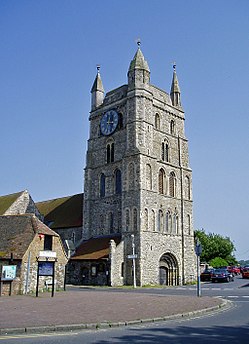
Like many towns on the marsh it has an impressive Norman church, the Church of St Nicholas, in the centre of town. This church originally stood at the harbourside, and its entrances are several feet below ground level. The church is also notable for the boat hooks still evident on the side walls.

New Romney's historic high street has several small and interesting shops. A few businesses closed after the opening of a branch of supermarket chain Sainsbury's, but the town retains much of its character. The former almshouses in West Street are noted historic buildings of Kent; they were founded in 1610 by John Southland, an important local magnate, and rebuilt in 1734. Adjacent to these is Plantagenet House and No 3 Old Stone Cottage, which originated as a single house constructed c. 1300–1350.[8] Researchers think it was originally the home of the Master of The Hospital of St John the Baptist, a large secular establishment. The hospital was operating by c. 1260 and flourished until the close of the fifteenth century.[9]

Three-quarters of a mile north of the town is the links golf course at Littlestone-on-Sea. The golf course was a favourite of Denis Thatcher, late husband of former British prime minister Margaret Thatcher, and has been used several times for the qualifying rounds of The Open Championship.

Transport

[edit]

The Romney, Hythe and Dymchurch Railway has a station at the extreme east of New Romney, which as well as being a major tourist attraction was also used by students travelling to school until 2015. The station is about three-quarters of a mile east of the historic town centre.

New Romney was once serviced by the New Romney and Littlestone-On-Sea railway station which was part of the Lydd Line. The station was sited halfway between New Romney and Littlestone-on-Sea. As built the station had two platforms and a small goods yard with four sidings, a goods shed, cattle dock, coal wharves, end loading dock, water tower and other small buildings. The up platform was rarely used in latter years other than as a livestock loading dock. The station was originally called New Romney & Littlestone with on-Sea being added in October 1888. In 1927 a single line extension was built with an unprotected level crossing to an exchange siding with the adjacent Romney Hythe and Dymchurch Railway station on the opposite side of the Station Road; it was used to deliver coal to that railway. The signal box was taken out of use in the 1950s and goods service was withdrawn in 1964. The station was closed in 1967 and replaced with a bus service.

New Romney is easily accessible by road, sitting astride the A259 (which runs from Folkestone to Havant). Several bus services run to and through New Romney from Hastings, Folkestone and Ashford. The former B2070 road from the town to Hamstreet and Ashford is now declassified while the B2071 still exists to Littlestone.

Media

[edit]

New Romney has one dedicated weekly newspaper, the Kentish Express (published by the KM Group) is the only weekly newspaper for the Romney Marsh covering the town. There is also the Folkestone Herald (which incorporated the Romney Marsh Herald in 2014, published by Kent Regional News and Media). The local radio station for New Romney is KMFM Ashford which contains Marsh-based adverts amongst a county-wide station, and New Romney is also served by the county-wide stations Heart South, Gold and BBC Radio Kent.

Cinque Ports Radio 100.2FM is the community radio station for Romney Marsh and has been broadcasting since 7 March 2022 replacing Shoreline FM which now broadcasts online to the same area as Shoreline Easy and previously broadcast on 100.2FM since January 2020 [10]

In 1951 the Richard Burton, Roger Livesey, and Honor Blackman film Green Grow the Rushes was made on location in and around New Romney and in nearby St Mary in the Marsh.

Namesakes

[edit]

In 1762 Thomas Fairfax, 6th Lord Fairfax of Cameron named the town of Romney in present-day West Virginia in the United States after the town of New Romney.

Arms

[edit]
Coat of arms of New Romney
Notes
Recorded at the Visitation of 1619, for the Borough of New Romney[11]
Escutcheon
Azure three Lions passant guardant in pale Or

See also

[edit]

References

[edit]
[edit]
Revisions and contributorsEdit on WikipediaRead on Wikipedia
from Grokipedia
New Romney is a historic and in the of , southeastern , located on the northern edge of , a vast, low-lying of reclaimed land renowned for its fertile pastures and sheep farming. One of the original five , it was granted a in 1155 to provide ships and men for national defense, emerging as a key medieval port at the mouth of the River Rother until the Great Storm of 1287 blocked the estuary with shingle, diverting the river eastward to and rendering the harbor unusable. The covers approximately 7.8 square kilometers and had a population of 7,256 at the 2021 census, making it the largest settlement and unofficial capital of the area. The town's geography reflects its marshland setting, with flat terrain protected by ancient sea walls and drainage systems dating back to at least century, transitioning from saline coastal zones to productive arable and grazing lands inland. Economically, New Romney has evolved from its maritime past to a focus on —particularly the renowned Romney Marsh sheep breed—local commerce, and tourism, bolstered by its proximity to the heritage Romney, Hythe & Dymchurch Railway and the nearby station, which has been undergoing decommissioning since 2021 (defuelling phase), supporting employment during cleanup and site preparation activities. Architecturally, New Romney preserves a rich medieval heritage, including the Church of St. Nicholas, a largely Norman structure from the that once served as a for shipping, and the 16th-century Town Hall, which houses local governance records. As part of the confederation, it retains ceremonial ties to this ancient maritime league, contributing to its cultural identity amid the broader Romney Marsh's designation as an . The town council, elected every four years, manages community services and environmental improvements, partnering with to address challenges like and flooding in this dynamic landscape.

Geography

Location and Topography

New Romney is located in the of , southeastern , at coordinates 50.985°N 0.941°E, corresponding to the grid reference TR066249. The town occupies a position on the northern edge of , a vast, flat expanse of reclaimed agricultural land covering approximately 100 square miles, characterized by low-lying terrain ideal for grazing and farming. This marshland, much of it below , has been progressively drained and dyked over centuries to prevent flooding and support productive use. Due to extensive silting over time, New Romney sits about 1.5 miles inland from the coastline. To the north and east, it borders coastal settlements such as Greatstone-on-Sea and Littlestone-on-Sea, where the shoreline is dynamically shaped by —the lateral movement of sediment along the coast driven by prevailing waves and currents from the southwest. This process contributes to ongoing erosion and deposition patterns that define the local topography, including shingle barriers and expansive sandy beaches. The of New Romney encompasses roughly 780 hectares of this varied terrain, blending urban fabric with surrounding marsh and agricultural fields. The River Rother, which historically flowed through the area, plays a key role in delineating and influencing the marsh's hydrological features.

Environmental Changes

New Romney was originally established as a coastal harbour town at the mouth of the River Rother, where the river met the directly adjacent to the settlement. The town's location facilitated maritime trade and its role as a key Cinque Port, with ships able to dock near St Nicholas Church until environmental shifts altered the coastline. Over centuries, —the lateral movement of sediments along the shore driven by wave action and —transported shingle, , and eastward from the west, gradually building up barrier beaches and spits that extended the shoreline. This process, combined with ongoing in river mouths and coastal inlets, caused the harbour to silt up progressively, shifting the effective coastline inland and isolating New Romney from direct sea access by approximately 1.5 miles over time. The accumulation of these materials not only choked navigation channels but also contributed to the formation of the broader landscape. A pivotal event accelerating these changes occurred in 1287, when a severe breached the shingle bank protecting the harbour, flooding the town with massive deposits of shingle, mud, and soil from nearby . The storm raised the land level in New Romney by about 5 inches through sediment deposition and completely silted the harbour, rendering it unusable. Critically, the deluge blocked the River Rother's original course, diverting it eastward to a new outlet at , roughly 15 miles away—a path it has maintained since, further hastening the harbour's abandonment. In response to these transformations, extensive reclamation efforts converted much of the former marshland and inundated areas of into fertile , primarily through the construction of embankments, dykes, and drainage systems starting in the medieval period and continuing into the . These initiatives, including the building of the Rhee Wall by the Romans and later "" that enclosed salt marshes for pasture, turned low-lying wetlands into productive fields suitable for sheep grazing and arable farming, supported by the nutrient-rich alluvial soils. Today, New Romney's low-lying terrain, much of which sits below , remains vulnerable to flooding from tidal surges and heavy rainfall, necessitating robust management through sea walls, such as the historic Dymchurch Wall, and an extensive network of over 220 miles of drainage channels, sluices, and pumping stations. These features, maintained by bodies like the Romney Marsh Area Internal Drainage Board and the , prevent widespread inundation and sustain the area's agricultural viability while adapting to ongoing coastal dynamics.

History

Early Settlement and Medieval Period

The settlement at New Romney originated in the Saxon period, with the name derived from Rumenea, meaning "at the spacious or wide river," first recorded in 895 AD and appearing as Rumenesea in a 914 AD charter. Evidence points to early habitation around AD 700, when a small fishing community and an oratory (possibly the precursor to St. Martin's Church) developed along the banks of the River Rother, leveraging the natural harbor for trade in fish, salt, and coastal goods. This trading post benefited from the marshlands' resources, including and maritime access, establishing New Romney as a key economic node in early . By 1086, the recorded the settlement as Romenal, under the ownership of the , with 156 burgesses (households) indicating a growing urban center supported by , meadows, and a productive harbor yielding annual renders of eels and salt. The survey highlighted its resources, including mills and fisheries, underscoring its role as a prosperous coastal manor amid the . Following the , founded or refounded the town between 1066 and 1086, transforming it into a structured after initial resistance from local defenders during his invasion. The Norman name evolved to Romenel, reflecting linguistic shifts, and the settlement saw consolidation under royal influence. By the , the Church of St. Nicholas was constructed in Norman style, serving as a central institution, while a market had likely operated since the late 10th or early , formalizing by around 1200 and laying groundwork for later maritime confederations.

Cinque Ports Era

New Romney was incorporated as one of the original five —alongside , Hythe, Dover, and Sandwich—during the mid-11th century under , with formal privileges solidified in the 12th century under the Plantagenet kings to bolster royal naval capabilities. This confederation emerged from earlier Saxon arrangements for coastal defense and trade, evolving into a structured alliance by the reign of , where New Romney's strategic position at the mouth of the River Rother made it essential for maritime operations. In exchange for providing ships and men to , New Romney enjoyed significant privileges, including exemptions from national taxes and tolls, as well as a degree of through its own courts and local levies. Specifically, as a head port, New Romney was obligated to supply five ships annually for 15 days of royal service, each crewed by 21 men and a boy, with provisions for extended duties during wartime; this quota later adjusted to contribute to a total of 57 ships across the ports by the 13th century. These obligations supported England's defense against invasions and facilitated naval campaigns, such as those under Henry V in 1415. New Romney reached its peak as a major port in the 13th century, serving as a hub for exporting from the surrounding and importing wine, while its fishing fleets contributed to local and regional markets. Trade records indicate wool shipments paying customs duties, alongside abundant sales like porpoises in town markets, underscoring the port's economic vitality during this period. Archaeological evidence from excavations reveals and repair activities, integrating the town's maritime economy with broader commerce. The town was governed by a , selected annually from the jurats—a body of prominent freemen who managed local affairs, enacted bylaws, and oversaw port operations— with records dating back to at least the in documents like Daniel Rough's 1352 journal. These archives detail port activities, including ship fittings for royal voyages and fines for maritime infractions, reflecting New Romney's administrative role within the confederation; as keeper of many records, the town preserved extensive historical documentation of collective duties. The onset of New Romney's decline as a functioning began after the great storm of 1287, which silted the harbor and diverted the River Rother, stranding the town inland due to environmental changes in coastal . Despite this physical loss, New Romney retained its symbolic status within the , continuing to participate in ceremonial and administrative functions of the confederation into later centuries.

Modern Developments

Following the silting of its harbor after the great storm of 1287, New Romney transitioned from a prominent to an inland , adapting its economy to and local while preserving its ceremonial role within the confederation. By the 18th century, the town had stabilized as a regional center, with ongoing participation in traditions such as the annual court sessions, despite the loss of maritime prominence. In the , the arrival of the railway in 1884 via the Railway facilitated growth as an agricultural hub, particularly for on the surrounding [Romney Marsh](/page/Romney Marsh). This connectivity supported the town's role in regional produce distribution, marking a period of modest expansion amid broader Victorian agricultural advancements. During , New Romney played a strategic role in Allied preparations for the D-Day invasion. In the post-war era, the Town Hall—built in 1702 as a market and administrative venue—continued to serve local functions, hosting council meetings and events as the town integrated into modern administrative structures. Population levels stabilized around 7,000 residents by the late , reflecting steady recovery from wartime disruptions without significant growth. Into the , efforts to combat and flooding have intensified, with major flood defense schemes in the area, including the £40 million Ranges project completed in 2024, protecting New Romney and nearby communities from . Concurrently, heritage preservation initiatives, such as the Heritage Strategy updated in 2025, emphasize conservation of the town's medieval core and legacy through targeted restoration and planning policies.

Demographics and Society

According to the 2011 , the population of New Romney stood at 6,996 residents. By the 2021 , this had increased to 7,256, reflecting a total growth of 3.75% over the decade. The annual growth rate during this period was approximately 0.37%, consistent with modest regional trends in driven by net . Mid-year estimates indicate further slight expansion, reaching approximately 7,290 residents by 2022 (ward level). New Romney's was approximately 930 people per square kilometer in 2021, calculated over an area of 7.8 km², highlighting its compact urban-rural character within the . The mean age of residents was around 49.5 years in 2021, above the national average, with a notable proportion of individuals over 65 indicating a higher share of retirees compared to younger working-age groups. Household data from the 2021 Census recorded 3,175 households in the parish, supporting an average household size of about 2.3 persons. Projections based on recent ONS mid-year estimates suggest the population may have continued steady, low-level growth beyond 2022.

Social and Cultural Composition

New Romney's population is characterized by a high degree of ethnic homogeneity, with the 2021 Census recording 97.7% of residents identifying as , predominantly , comprising over 95% of the total. Small minority groups include those of Asian descent (1.1%) and individuals from other ethnic backgrounds, such as mixed heritage (0.6%) and Black African or (0.3%), reflecting limited diversity influenced by the town's rural coastal location. European migrants form a minor presence within the category, often categorized as , while Asian communities are primarily from . Religiously, the community aligns with broader trends of secularization in rural , with remaining the largest affiliation at 51.3% of the population according to the 2021 Census. Approximately 42% reported no , indicating a significant rise in non-religious identification, while smaller groups include (0.4%), (0.3%), and Buddhists (0.2%). This composition supports a tolerant community atmosphere, with places of worship like St. Nicholas Church serving as focal points for Christian activities. in New Romney is provided through local institutions such as St. Nicholas Church of England Primary Academy and The Marsh Academy, a supported by the Skinners' Company, emphasizing a blend of academic and vocational training. Health outcomes are similar to Kent's averages, with at birth around 81 years—79.3 for males and 83.3 for females—though potentially lower in coastal areas; supported by access to regional NHS services. Community life thrives through active involvement with the New Romney Town Council, which coordinates various groups including the Romney Marsh Community Hub, New Romney In Bloom for environmental initiatives, and New Romney Amateur Dramatics for cultural engagement. Festivals tied to the town's heritage, such as the annual New Romney Country Fayre, foster social cohesion by celebrating and local crafts. Social challenges include an aging demographic, with nearly 49% of residents over 50, straining local services, alongside seasonal population influxes from that boost vibrancy but pressure and during peak summer months.

Economy

Traditional Industries

Following the decline of its maritime role as a Cinque Port, New Romney's economy from the 17th to 19th centuries centered on practices adapted to the reclaimed marshlands of , where low-lying, fertile soils supported intensive and . Farmers combined sheep rearing with crop cultivation, utilizing the marsh's natural grazing potential enhanced by drainage systems and sea walls that prevented flooding and expanded . Key crops included , , oats, peas, and fodder like and hay, often rotated to maintain on estates such as those in the surrounding parishes, where comprised roughly half of typical holdings by the mid-18th century. Sheep farming emerged as a cornerstone of this agrarian system, with the hardy breed—developed from medieval stock—dominating due to its suitability for the damp, windswept conditions and its production of high-quality long alongside mutton. Flocks numbered in the thousands across large estates, such as the 2,417 sheep managed by grazier William Haffenden in 1735 or the 2,274 held by Mark Skinner in 1722, often overseen by specialized "" who monitored herds from huts on the marsh. This breed's , prized for its crimp and length, sustained a legacy from the medieval export trade, but by the , restrictions like the Wool Acts of 1660 and 1699 shifted focus to domestic markets, supplying the Kentish industry and later carpet yarns, though prices fluctuated and prompted a partial pivot toward meat production in the . Remnants of the town's fishing heritage persisted on a small scale into the early , with local fishermen using modest coastal operations for and other marine catches, though this activity dwindled as silting harbors limited access and overshadowed it. By the , fishing contributed only marginally to the economy, supplemented by inland fish ponds on farms for household use rather than commercial trade. Supporting these agricultural pursuits were local crafts and trades, including carpenters who built and repaired barns and sea defenses, blacksmiths forging tools and plowshares, and market traders who facilitated the sale of wool, livestock, and produce at regional fairs. These artisans, often operating small workshops in New Romney and nearby villages, were integral to the rural , with brickmaking and wheelwrighting also common to maintain farming . The Enclosure Acts of the further shaped land use, promoting the consolidation of open marsh commons into hedged or dyked fields that boosted productivity and allowed larger-scale sheep grazing and . This process, evident in estates like George Carter's 935-acre consolidation by 1745, reduced common rights but increased yields, with agricultural output rising as enclosed lands supported higher stock densities and better drainage on the marsh.

Contemporary Economy and Tourism

New Romney's contemporary economy has diversified beyond its historical agrarian roots, with key sectors including retail, ongoing , , and the nuclear sector. The town's retail landscape is anchored by the Superstore on , which has served as a major local employer and shopping destination since at least the early 2010s. remains vital, particularly sheep farming on the surrounding , where farms like those managed by Romney Marsh Shepherds Huts maintain flocks of indigenous Romney ewes across thousands of acres, supporting wool production and livestock sales. contributes through sites such as the Mountfield Industrial Estate, a 10-hectare area offering opportunities for commercial development and small-scale . The nearby , particularly Dungeness B—which ceased in 2021 and entered the defueling phase—continue to support local employment during the ongoing decommissioning process, managed by Nuclear Restoration Services, with full site clearance expected beyond 2028. Historically, the nuclear industry accounted for approximately 8% of employment in the area. Tourism plays a central role in the local economy, driven by the town's heritage sites, the scenic , and its proximity to coastal beaches like those at and St Mary's Bay. These attractions draw visitors interested in the area's unique marshland landscape and historical significance, boosting seasonal revenue for hospitality and related services. The railway, in particular, enhances accessibility to these sites, serving as a key draw for families and heritage enthusiasts. While exact figures for New Romney-specific visitors are not comprehensively tracked, the broader area benefits from that supports local businesses through day trips and overnight stays. Employment in New Romney reflects a stable local market, with the unemployment rate in the encompassing at around 4% as of July 2025, above the county average of 3.2%. Many residents commute to nearby hubs like and Ashford for work in services and , underscoring the town's integration into the regional economy. Recent developments include the Council's 2025–2030 Corporate Plan, which emphasizes business hub initiatives such as the Business Hub at Mountfield Road to foster startups and light industry growth, through grants for sustainable business practices. Challenges persist, including seasonal fluctuations in tourism-related , which peak during summer months and wane in winter, affecting and retail sectors. Post-Brexit impacts on have compounded these issues, with the loss of subsidies prompting some farmers to for solar farms rather than traditional sheep , potentially altering the marsh's economic fabric.

Governance and Symbols

Local Government

New Romney holds civil parish status and is governed by the New Romney , an elected local authority comprising 16 councillors who serve four-year terms, with elections last held in 2023. The council is led by a , currently Cllr John Rivers, who was re-elected in May 2025, and a , Cllr . Councillors represent the Town and Coast wards and address local issues through monthly meetings and public surgeries. At the district level, New Romney forms part of the , administered by the Folkestone and Hythe District Council, which assumed its current name in April 2018 following a from the former Shepway District Council. In the UK Parliament, the town is included in the constituency, represented since the July 2024 general election by Tony Vaughan of the Labour Party. The town council is responsible for delivering key local services, including the maintenance of parks, play areas, allotments, and open spaces such as the Greens and Fairfield Road Recreation Ground; management of public buildings like the Town Hall and ; and organization of community events such as markets, boot fairs, and sports facilities. It also participates in planning consultations, emergency planning, and environmental upkeep like grass cutting and bench provision, while collaborating with higher-tier authorities on broader issues such as highways and refuse collection. An annual , held each , allows residents to review council activities, raise concerns, and celebrate community achievements. In its 2024/25 Annual Town Report, the council noted increasing service demands driven by steady population growth in New Romney and the wider , straining resources for amenities and infrastructure while emphasizing the need for sustainable planning to support residents.

Heraldry

The of New Romney was recorded during the heraldic Visitation of in 1619 for the Borough of New Romney. The is described as Azure three lions passant guardant in pale or, featuring a field with three golden lions arranged vertically. This design symbolizes the town's historical strength and its close ties to English royalty, as the three lions are derived from the royal arms of , while the azure background reflects the livery colors of the Cinque Ports Confederation, of which New Romney was an original member. The arms thus encapsulate New Romney's medieval role in maritime defense and governance under royal patronage, a tradition detailed in its history. No motto accompanies the arms, and the design has remained unchanged since its recording, continuing in use by the New Romney as successor to the . It appears on the town seal, flags, and documents to represent civic identity and . As of 2025, no modifications to the arms have been granted or adopted.

Landmarks and Culture

Historic Buildings and Sites

New Romney boasts a rich architectural heritage shaped by its history as a Cinque , with buildings reflecting medieval prosperity, post-flood reconstruction, and later civic developments. Key structures include the Church of St Nicholas, a Norman survivor of environmental catastrophe, and domestic examples like Plantagenet House, alongside 17th- and 18th-century additions such as almshouses and the Town Hall. These sites, many Grade I or II listed, illustrate the town's adaptation from a bustling to an inland settlement, with remnants of its maritime past and wartime contributions preserved nearby. The Church of St Nicholas, the town's parish church, originated in the Norman period during the mid-12th century under the patronage of the Archbishops of , constructed using by French masons. Its features original low Norman arcades with round and octagonal piers, while the east end was rebuilt in the with Kentish ragstone and reticulated windows, incorporating a harmonious facade of chancel and flanking chapels. The church endured the devastating storm of 1287, which inundated the port with sand and shingle, raising ground levels and silting the adjacent harbor; it remains the sole survivor of five medieval parish churches in New Romney. Grade I listed since 1950, it includes a multi-stage tower, eight bells with a 15-cwt , and historical memorials like the tomb of jurat Richard Stuppenye (d. 1526), underscoring its role as a maritime patron saint's dedication. Boat hooks embedded in its outer walls evoke the site's former harborside location, now over a mile from the due to centuries of silting. The Town Hall, a Grade II listed structure on the , was completed in as a commissioned by the local , exemplifying early Georgian Italianate style with a symmetrical five-bayed frontage. Its first floor houses a , and it continues to serve as the for New Romney Town Council meetings and private functions. Southlands Hospital Almshouses, also Grade I listed, were founded in 1610 by local magnate John Southland to provide housing for the parish poor, rebuilt in 1734 with funding from Sir Robert Andrew and Sir Henry Furness, and later endowed by Thomas Baker and Richard Rothwell Da Daglish. Located at 1-4 West Street, the two-storey brown brick buildings feature a tiled roof, modillion , and a medieval stone rubble plinth with flint galleting; each unit has an unusual arrangement and plain four-panel doors, marked by a plaque detailing their history. Plantagenet House at 3-4 West Street represents exemplary medieval domestic architecture as an early 14th-century aisled , originally a single merchant's dwelling later divided into two properties. Constructed around 1300-1350 in timber-framed style, it highlights the town's commercial elite during the era, with its modest terraced form now Grade II* listed. Other notable sites include remnants of the 17th-century quay and harbor infrastructure near the Church of St Nicholas, evidencing New Romney's faded port status after the 1287 storm altered the River Rother's course and caused silting. Additionally, the parish encompasses a WWII Mulberry Harbour assembly area off Littlestone-on-Sea, where a Phoenix caisson— a 1943-44 prefabricated breakwater unit measuring 200 feet long and 32 feet wide—was beached after becoming stuck in mud en route to , now a visible at .

Cultural Life and Notable Figures

New Romney's cultural life reflects its position within the historic confederation and the broader community, featuring a mix of traditional rural events and contemporary artistic expressions. The town hosts the annual New Romney Country Fayre, a large free family-oriented event held in on St Martin's Field, which includes market stalls, live entertainment, and arena displays such as equestrian acts and sheep shows, drawing thousands to celebrate local heritage and agriculture. Another key event is JAM on the Marsh, an 11-day and arts festival in that utilizes medieval churches across the , including those near New Romney, to present world-class concerts, exhibitions, and theater productions focused on new and contemporary works. These gatherings, alongside smaller folk festivals and markets tied to the area's agricultural traditions, foster and preserve the region's seafaring and rural identity. In the arts, New Romney has served as a filming location for the 1951 British comedy film Green Grow the Rushes, directed by Derek Twist, with scenes shot on capturing the area's marshland smuggling heritage. Nearby, the Littlestone-on-Sea golf course, located to the east of the town, is a championship links venue that has hosted final qualifying rounds on multiple occasions, including in 2011, attracting professional golfers and underscoring the region's sporting culture. The course has also been a favored spot for notable visitors, including , husband of former British Prime Minister , who frequently played there during his lifetime. Prominent historical figures associated with New Romney include John Adam, a local who served as for the town in several parliaments during the early , including 1410, 1413, and 1416, reflecting the borough's influence in medieval politics. Another key benefactor was John Southland, a 17th-century local magnate who founded Southland's Hospital almshouses in 1610 to support the poor, providing housing for a and four residents; the buildings were rebuilt in 1734 and remain a listed historic structure. Community activities center on the Romney Marsh's agricultural legacy, particularly sheep breeding, with events like the annual Romney Shears competition organized by the Romney Marsh Sheep Shearing Society since 1979, which showcases shearing skills and celebrates the breed's role in local farming. Sheep demonstrations also feature at the New Romney Country Fayre, highlighting the sheep, a hardy breed integral to the area's wool and meat production. Looking forward, the Folkestone & Hythe District Council's 2025-2030 Corporate Plan outlines the development of a new business hub in New Romney to support economic growth, including creative and sustainable enterprises within the district's burgeoning 8.7% creative sector. This initiative aligns with broader efforts to promote artistic and cultural attractions across the . The town's name has inspired international namesakes, notably , the oldest incorporated town in the state, founded and named in 1762 by , 6th , after New Romney in .

Transport

Road and Bus Services

New Romney is primarily accessed via the A259, a major coastal road that runs through the town, providing connections eastward to and westward to along the south coast of Kent. This route serves as the principal artery for vehicular traffic, facilitating travel to nearby coastal areas and supporting local commerce and tourism. Local roads complement the A259, with the B2071 extending southward from New Romney toward and the surrounding , offering access to rural and coastal destinations. Due to the low-lying nature of the , which is prone to tidal and flooding, traffic management measures are implemented, including temporary road closures, flood alerts, and diversion routes to ensure safety during high-risk periods. These strategies, coordinated by and the , mitigate disruptions from events such as heavy rainfall or sea wall overtopping. Public bus services in New Romney are operated mainly by South East, with key routes including the and 103 to , providing hourly connections to the town center and coastal areas, and the to Ashford via . The route 100 extends westward to and , serving additional coastal towns. Frequencies on these services have been enhanced since 2022 under Kent County Council's Bus Service Improvement Plan, with adjustments in November 2024 splitting the former coastal service into separate routes (: Lydd to Harbour; 103: Lydd-on-Sea to Harbour; plus new 104 and 105 in adjacent areas) to improve reliability and punctuality while largely preserving existing frequencies, such as up to daytime Monday to Saturday. The town's accessibility extends beyond local roads, with the approximately 10 miles north via Ashford, enabling efficient links to and the . Cycle paths along the provide sustainable alternatives, featuring flat, traffic-light routes such as the Romney Marsh Meanders network, which includes self-guided loops starting from New Romney for recreational and commuting use. These updates integrate with broader transport options, allowing seamless transfers to rail services at New Romney station for regional travel.

Railway Connections

The primary railway connection for New Romney is the (RH&DR), a 15-inch gauge heritage that opened on 16 July 1927. The line spans 13.5 miles along the coast from Hythe in the east to in the west, passing through New Romney where its headquarters station is located approximately half a mile east of the town center on Romney Road. Originally constructed by enthusiast Captain J. E. P. Howey and racing driver Count Louis Zborowski as a double-track miniature for leisure, it has operated continuously as a public service, now primarily using restored steam and diesel locomotives to haul passenger trains. The RH&DR focuses on tourist and leisure travel, with no regular freight services since the 1980s, following earlier limited operations that included wartime military use and post-war goods . From 1977 until 24 July 2015, the railway provided dedicated school trains to transport students to The Marsh Academy in New Romney, a service that ended due to declining usage and rising costs. As of 2025, operations remain stable under the Romney Hythe & Dymchurch Railway Public Limited Company, with year-round timetables featuring seasonal peaks during summer holidays and special events like Santa specials and steam galas to accommodate increased visitor numbers. New Romney previously had a standard-gauge station on the Railway branch line, known as New Romney and Littlestone-on-Sea, which opened on 19 June 1884 and served passengers and freight until its closure on 6 March 1967 as part of the . The station site has been redeveloped into an industrial estate with no visible remnants, though portions of the trackbed toward Romney Junction are traceable and incorporated into local footpaths for walking and cycling. For mainline rail access, the nearest station is Ashford International, approximately 9 miles north of New Romney, offering high-speed services on the HS1 line to London St Pancras and connections to the wider network via Southeastern and . The RH&DR contributes to local by providing scenic coastal journeys that attract visitors, complementing New Romney's economy.

References

Add your contribution
Related Hubs
User Avatar
No comments yet.