


Community hub
Recent from talks
Contribute something
Nothing was collected or created yet.
Newton-metre
View on Wikipedia| Newton-metre | |
|---|---|
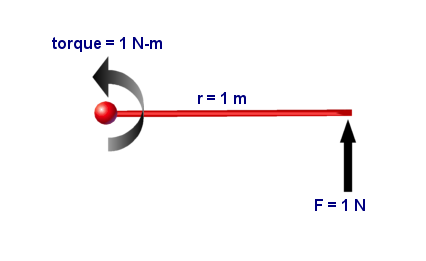
 One newton-metre is the torque resulting from a force of one newton applied perpendicularly to the end of a moment arm that is one metre long. | |
| General information | |
| Unit system | SI |
| Unit of | torque |
| Symbol | N⋅m, N m |
| Conversions | |
| 1 N⋅m in ... | ... is equal to ... |
| FPS system | 0.73756215 lbf.ft |
| inch⋅pound-force | 8.8507 in lbf |
| inch⋅ounce-force | 141.6 in oz |
The newton-metre or newton-meter (also non-hyphenated, newton metre or newton meter; symbol N⋅m[1] or N m[1])[a] is the unit of torque (also called moment) in the International System of Units (SI). One newton-metre is equal to the torque resulting from a force of one newton applied perpendicularly to the end of a moment arm that is one metre long.
The unit is also used less commonly as a unit of work, or energy, in which case it is equivalent to the more common and standard SI unit of energy, the joule.[2] In this usage the metre term represents the distance travelled or displacement in the direction of the force, and not the perpendicular distance from a fulcrum (i.e. the lever arm length) as it does when used to express torque. This usage is generally discouraged,[3] since it can lead to confusion as to whether a given quantity expressed in newton-metres is a torque or a quantity of energy.[4] "Even though torque has the same dimension as energy (SI unit joule), the joule is never used for expressing torque".[4]
Newton-metres and joules are dimensionally equivalent in the sense that they have the same expression in SI base units,

but are distinguished in terms of applicable kind of quantity, to avoid misunderstandings when a torque is mistaken for an energy or vice versa. Similar examples of dimensionally equivalent units include Pa versus J/m3, Bq versus Hz, and ohm versus ohm per square.
Conversion factors
[edit]- 1 kilogram-force metre = 9.80665 N⋅m[5][6]
- 1 newton-metre ≈ 0.73756215 pound-force-feet
- 1 pound-foot ≡ 1 pound-force-foot ≈ 1.35581795 N⋅m
- 1 ounce-inch ≡ 1 ounce-force-inch ≈ 7.06155181 mN⋅m (millinewton-metres)
- 1 dyne-centimetre = 10−7 N⋅m
See also
[edit]- Bending moment
- Spring scale
- Torque tester
- Newton-second, the derived SI unit of impulse
Notes
[edit]- ^ The nonstandard notation "Nm" occurs in some fields.
References
[edit]- ^ a b "BIPM – unit symbols". Archived from the original on 2017-10-01. Retrieved 2016-10-18.
- ^ For example: Eshbach's handbook of engineering fundamentals - 10.4 Engineering Thermodynamics and Heat Transfer "In SI units the basic unit of energy is newton-metre".
- ^ Fundamentals of Physics, 9th edition by Halliday Resnick Walker, p. 309. "The SI unit of torque is the newton-meter. In our discussion of energy we called this combination the joule. But torque is not work and torque should be expressed in newton-meters, not joules. google books link
- ^ a b "BIPM - special names". Archived from the original on 2019-03-21. Retrieved 2015-09-27.
- ^ Mechanical Engineering Formulas Pocket Guide, p6
- ^ Concise encyclopedia of plastics, by Donald V. Rosato, Marlene G. Rosato, Dominick V. Rosato, p621

Newton-metre
View on GrokipediaFundamentals
Definition
The newton-metre (symbol: N⋅m or N m with a space) is the SI derived unit of torque, representing the rotational equivalent of force in the International System of Units (SI).[1] Torque quantifies the tendency of a force to cause rotation about an axis, distinguishing it from linear force by incorporating the perpendicular distance from the axis of rotation.[2] In vector form, torque is defined as the cross product , where is the position vector from the axis of rotation to the point of force application, and is the force vector.[5] The magnitude of this torque is given by where is the magnitude of the position vector, is the magnitude of the force, and is the angle between and .[5] This formulation arises from the fundamental principles of mechanics, emphasizing the role of leverage in rotational motion. When the force is applied perpendicular to the position vector (, so ), one newton-metre equals the torque produced by a force of one newton acting at a distance of one metre from the pivot point.[1] This builds on the base SI units: the newton (N), defined as the force required to accelerate a one-kilogram mass by one metre per second squared, and the metre (m), the base unit of length defined by the distance light travels in vacuum in of a second.[1]Relation to Force and Distance
The newton-metre quantifies torque, defined as the rotational equivalent of linear force that tends to produce angular acceleration about an axis.[5] The torque emerges from the vector interaction between force and position, given by the cross product , where is the position vector from the axis of rotation to the point where the force is applied.[5] This operation yields a vector perpendicular to both and , with direction determined by the right-hand rule, emphasizing the three-dimensional nature of rotational dynamics.[5] The magnitude of this torque is , where is the distance from the axis, is the force magnitude, and is the angle between and . The factor captures the effective component of the force that is perpendicular to the position vector, as only this component contributes to rotation; when or , and no torque is produced.[5] The perpendicular distance from the axis to the line of action of the force, termed the moment arm , serves as the effective lever length in torque calculations. This reduces the magnitude formula to when the force is applied perpendicular to the lever arm (), maximizing the rotational effect for a given force and distance. For example, twisting a doorknob applies a force at the handle, where the moment arm is the radial distance from the hinge axis to the point of force application, producing torque proportional to this lever length. Similarly, tightening a bolt with a wrench involves applying force perpendicular to the handle, with the torque magnitude equaling the force times the wrench's length as the moment arm.[6] Dimensional analysis confirms the derived nature of the newton-metre: torque dimensions are , directly yielding the unit newton-metre in the SI system.[1]Measurement and Units
SI Designation
The newton metre is the official name of the SI unit for torque, expressed in lowercase letters without a hyphen to distinguish it from the unit newton per metre, though a hyphenated form "newton-meter" may be used in some national variants to avoid ambiguity.[1] The plural form is newton metres.[1] The symbol for the newton metre is N⋅m or N m, where either a middle dot (⋅) or a space indicates multiplication between the newton (N) and metre (m) symbols; the multiplication sign (×) must not be used, in accordance with BIPM and NIST guidelines for compound unit symbols.[7] Unit symbols are always written in roman (upright) typeface, never italicized, and remain unchanged in the plural.[7] As a coherent derived SI unit, the newton metre requires no numerical factor other than unity when formed from base units and does not need prefixes for standard values, ensuring consistency within the SI system.[1] It is derived from the base SI units as the product of the newton (kg⋅m⋅s⁻²) and the metre (m), yielding the dimensional expression kg⋅m²⋅s⁻².Conversions and Equivalents
The newton metre (N⋅m) is converted to the imperial foot-pound (lb⋅ft) using the approximate factor 1 N⋅m ≈ 0.737562 lb⋅ft, with the precise relation derived from 1 lb⋅ft = 1.3558179483314004 N⋅m exactly based on defined standards for force and length.[8] Additional equivalents include 1 N⋅m = 8.8507457916 inch-pounds (in⋅lbf), calculated from 1 in⋅lbf = 0.1129848 N⋅m, and 1 N⋅m = 0.1019716213 kilogram-force metres (kgf⋅m), stemming from 1 kgf⋅m = 9.80665 N⋅m.[8][9] For practical applications, the following table summarizes key conversions from 1 N⋅m to common torque units, using values aligned with SI and customary definitions:| Unit | 1 N⋅m equals |
|---|---|
| lb⋅ft | 0.7375621493 |
| in⋅lbf | 8.8507457916 |
| kgf⋅m | 0.1019716213 |
| dyne⋅cm | 10,000,000 |
| N⋅mm | 1000 |