


Community hub
Recent from talks
Contribute something
Nothing was collected or created yet.
Rhopalostylis sapida
View on Wikipedia
| Rhopalostylis sapida | |
|---|---|

| |
Scientific classification 
| |
| Kingdom: | Plantae |
| Clade: | Tracheophytes |
| Clade: | Angiosperms |
| Clade: | Monocots |
| Clade: | Commelinids |
| Order: | Arecales |
| Family: | Arecaceae |
| Genus: | Rhopalostylis |
| Species: | R. sapida
|
| Binomial name | |
| Rhopalostylis sapida | |

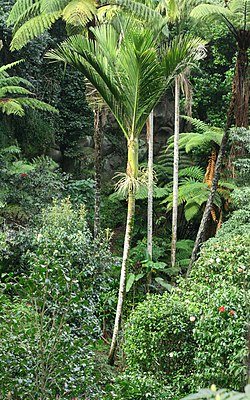
Rhopalostylis sapida, commonly known as nīkau, is a palm tree endemic to New Zealand, and the only palm native to mainland New Zealand.
Description
[edit]_by_Nina_Jones_ac134_(cropped).jpg)
Nīkau grow up to 15 m (49 ft) tall, with a stout, green trunk which bears grey-green leaf scars. The trunk is topped by a smooth, bulging crownshaft up to 1 m (3 ft 3 in) long. The fronds are up to 3 m (9.8 ft) long, and the closely set, sometimes overlapping leaflets are up to 1 m (3 ft 3 in) long. The inflorescence is multibranched and from 20–40 cm (7.9–15.7 in) long. The tightly packed flowers are unisexual and coloured lilac to pink. Male flowers are borne in pairs, and have six stamens. The female flowers are solitary. The fruit is elliptic or oblong, and generally measures about 10 by 7 mm, and is red when ripe. Nīkau produce flowers between November and April, and fruit ripens from February to November, taking almost a year to fully ripen.
Variation
[edit]The nīkau palm shows considerable variation in the wild. Plants from the South Island and the offshore islands of the North Island have larger, more-gracefully-arching fronds and are popular in cultivation. The Chatham Islands form is particularly different, having a distinct juvenile form and larger fruits, and a thicker covering of fine hairs on the fronds. More research is needed into its precise relationship with the mainland form. The nīkau palm of the New Zealand mainland is very similar to Rhopalostylis baueri of the Kermadecs and Norfolk Island, which can be distinguished by its more rounded or oval fruits, and by its leaflets which are broader than those found in most populations of R. sapida.
Taxonomy
[edit]The species was described using the name Areca sapida in 1786 by Georg Forster based on material and descriptions collected by Daniel Solander.[1] In 1878, the taxon was moved to the species' current scientific name, Rhopalostylis sapida, by Hermann Wendland and Carl Georg Oscar Drude.[2]
Etymology
[edit]Nīkau is a word borrowed and adapted from the Māori language; cognates of this word in the closely related Eastern Polynesian languages of the tropical Pacific refer to the fronds or the midrib of the coconut palm (niu).[3][4] A common folk etymology for nīkau is that the word means "no coconuts", but there is no evidence.[5] The species epithet sapida means "savoury", and is a reference to the edible nature of the plant.[5]
The English language name "cabbage palm" was first used in the journals of James Cook and Joseph Banks, used to refer to the edible palm heart of Rhopalostylis sapida.[5]
Ecology
[edit]_on_nikau_(Rhopalostylis_sapida)_Waitakere.jpg)
While tropical plants were more commonly found in New Zealand in past epochs, Rhopalostylis sapida is the sole member of Arecaceae to survive the ice ages in mainland New Zealand.[5]
Nīkau palm kernels are an important food source for kererū and kākā.[6]
Fungus pathogen Pseudocercospora arecacearum can be found on the fronds of the palm.[7]
Distribution and habitat
[edit]
The nīkau palm is the only palm species endemic to mainland New Zealand. Its natural range is coastal and lowland forest on the North Island, and on the South Island as far south as Ōkārito (43°20′S) in the west and Banks Peninsula (43°5′S) in the east. It also occurs on Chatham Island and Pitt Island/Rangiauria to the south-east of New Zealand, where it is the world's southernmost palm at 44° 18'S latitude.[8]
Cultivation
[edit] | This section may contain original research. (January 2025) |
Nīkau make an excellent potted plant, and are quite hardy. They tend to be slow-growing. They grow readily from seed if the fruit is soaked in water for a few days and then gently scrubbed to remove the flesh. The seed will then germinate readily if placed in sealed plastic bags in partial shade, after which they can be planted in deep pots. The pots should be tall and narrow to provide room for the taproot and to lessen the likelihood of root damage when transplanting.
Transplanting juveniles is generally successful if the main root is left intact. Nīkau do not have a true tap root. Once the main root has been established to a fairly shallow depth of about 400 mm (16 in), roots take on form consistent with other palms. Successful transplanting is possible, but nīkau are very fickle if any trunk is present. It is best done in summer, but a substantial root ball should be preserved, and shade should be provided at the new location – at the very least by tying the outer fronds closer to the centre. Ground watering is recommended because crown watering can induce terminal rot at the very slow-growing new spike. Delays should be avoided in getting nīkau into new ground, and substantial die-back of all but the central spike can be expected.
Nīkau thrive on cool temperatures, but are not commonly subject to freezing weather in their natural habitat. They can survive a few degrees of frost, but are damaged even more severely by sudden large drops in temperature even above freezing. Nīkau grow well in areas with a mild Mediterranean climate.
Māori cultural uses
[edit]Māori have many traditional cultural uses for nīkau. The bases of the inner leaves and the young flower clusters are a traditional food, eaten raw or cooked. Food was wrapped in the leaves for cooking, and the old fibrous leaves are used for kete, floor mats, and waterproof thatch for buildings.[8][5] Nīkau is a versatile material to use in weaving, as the fibres can be used raw without any need for processing.[9]
The heart of the palm, called rito, is a traditional delicacy, only rarely eaten as harvesting will kill the entire tree. Rito has importance in traditional rongoā medicinal practices due to its use as a laxative, seen as especially important for use prior to childbirth.[5] Unripe berries are a traditional food, while ripe berries are inedible, and are used to create traditional necklaces, and during the 19th century, were used as ammunition to shoot birds with muskets, when shot was scarce.[5]
Early European uses
[edit]Modern cultural importance
[edit]Nīkau palm has become a cultural icon of New Zealand, and is a common motif found in artworks and sculptures.[5] These include Nikau (2005), a sculpture by James Wright and Maui'atalanga 'Ofamo'oni at the Auckland Botanic Gardens,[10] and the Nīkau palm columns of the Wellington Central Library by Ian Athfield.[11]
Gallery
[edit]-
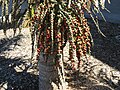 Ripe fruit of the nīkau
 -
 Nīkau palm trunk on Point Elizabeth walkway, Greymouth
 -
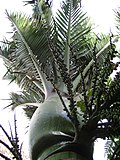 The Chatham Islands nīkau is particularly distinctive
 -
 Outstanding nīkau palm
 -
 Herbarium specimen
 -
 Seedlings
 -
 Flowers
 -
 Nīkau palm columns at the Wellington Central Library


.jpg)
.jpg)
.jpg)
.jpg)
References
[edit]
- ^ Forster, G. De Plantis Esculentis Insularum Oceani Australis Commentatio Botanica (in Latin). Berlin: Haude und Spener. p. 66-67.
- ^ "Rhopalostylis sapida H.Wendl. & Drude". Plants of the World Online. Retrieved 4 August 2025.
- ^ "Protoform: NII-KAU [CE] Coconut frond". Polynesian Lexicon Project Online. Retrieved 22 September 2019.
- ^ "Nīkau". Te Māra Reo. Benson Family Trust. 2023.
- ^ a b c d e f g h i Vennell, Robert (2019). The Meaning of Trees. Auckland: HarperCollins UK. pp. 210–215. ISBN 978-1-77554-130-1. LCCN 2019403535. OCLC 1088638115. OL 28714658M. Wikidata Q118646408.
- ^ "Nīkau palm". Department of Conservation. Retrieved 4 August 2025.
- ^ "Species Fungorum - Names Record". www.speciesfungorum.org. Retrieved 18 September 2023.
- ^ a b Esler, A. E. 'The Nikau Palm', New Zealand's Nature Heritage, Vol.2 Part 19 p.532, 1974
- ^ Mckendry, Lisa (2020). "Māori archaeological textiles: a structural analysis of Māori raranga 'woven' basketry from the Waitakere Ranges in Auckland Museum". Papahou: Records of the Auckland Museum. 55: 19–28. doi:10.32912/RAM.2020.55.2. ISSN 1174-9202. JSTOR 27008990. S2CID 229659991. Wikidata Q106827316.
- ^ "Nikau (original concept – Maui'atalanga 'Ofamo'oni)". Auckland Public Art. Retrieved 4 August 2025.
- ^ Honey, Tommy (23 June 2020). "30 years on: Wellington Central Library". Architecture Now. Retrieved 4 August 2025.
Rhopalostylis sapida
View on GrokipediaDescription
Physical characteristics
Rhopalostylis sapida is an unbranched, solitary palm tree that reaches heights of up to 10–15 meters, with a trunk diameter of approximately 25 cm. The trunk is typically green between closely spaced leaf scars, which appear grey-green, and it features a prominent, bulging crownshaft formed by the persistent leaf bases. This crownshaft measures up to 0.6 m in length, is smooth and dark green, and encircles the top of the trunk just below the leaf crown.[9][3][4] The leaves are pinnate, erect, and form a terminal crown of up to 8–10 fronds, each reaching 2–3 meters in length. Leaflets are numerous, linear, and closely spaced along the rachis, measuring 0.5–1 meter long, with sharply ascending orientation and smooth margins; fine hairs may be present on the surfaces. The petiole is short and sheathing at the base, contributing to the characteristic "shaving brush" appearance of the crown.[9][3][4] Reproductive structures emerge from the crown area. The inflorescence is branched, enclosed initially in two papery spathes that are 30 × 15 cm, turning from pink to yellow as they open; the ultimate branches are 20–30 cm long, pale cream, with tightly packed lilac flower buds. Flowers are small and unisexual, dioecious (separate male and female plants), arranged in groups of three (one female flanked by two males) along the branches, featuring three white sepals, three white petals, three stamens, and an ovary positioned above the petals. The fruit is a fleshy drupe, elliptic-oblong, measuring about 10 × 7 mm, ripening to brick-red and containing a long-oval seed encased in a smooth, whitish endocarp.[9][3][4]Variation
Rhopalostylis sapida exhibits notable intraspecific morphological variation, particularly between mainland New Zealand populations and those on the Chatham Islands, where the latter is sometimes designated as Rhopalostylis aff. sapida. This distinction arises from differences in adult, juvenile, and seedling traits, though the taxonomic status remains unresolved, with ongoing research needed to determine if the Chatham form warrants specific recognition.[9][3] In adult plants, the Chatham Islands variant features a silvery-grey to white indumentum on petioles, composed primarily of tangled ribbon-like scales, in contrast to the mainland form's larger scales with greater tessellation and tangled elements. Petiolar scale density provides a key differentiator in juveniles, averaging 750 scales per cm² on the mainland compared to 470 per cm² on the Chathams (P = 0.017 via ANOVA), while scale-base maximum height averages 100 µm mainland versus 61 µm on the islands (P = 0.015). Indumentum thickness also varies, measuring an average of 100 µm on the mainland and 61 µm on the Chathams. These traits were assessed using dissecting microscopy, scanning electron microscopy, and statistical analysis on samples from multiple sites.[10] Seedlings of the Chatham form differ from mainland counterparts in eophyll (first leaf) morphology and fruit size and shape, contributing to challenges in early identification for restoration efforts. Within mainland populations, subtler variations occur along environmental gradients, with the species ranging from 35°S to 43°S latitude and up to 700 m elevation, favoring higher rainfall areas, though pronounced morphological divergence is limited compared to the island form.[10]Taxonomy and nomenclature
Taxonomic history
The nīkau palm, Rhopalostylis sapida, was first encountered by European botanists during James Cook's voyages to New Zealand, with specimens collected by Daniel Solander in 1769–1770. In 1786, Georg Forster published the name Areca sapida Sol. ex G. Forst. based on Solander's material, but it was invalid as a nomen nudum, lacking a formal description.[11] The first valid description came in 1853, when Joseph Dalton Hooker published Areca sapida Sol. ex Hook.f. in his Flora of New Zealand, drawing on Solander's collections and providing diagnostic characters such as the ringed trunk and pinnate leaves.[12] The genus Rhopalostylis was established in 1875 by Hermann Wendland and Carl Otto Drude to accommodate feather-palm species from New Zealand and nearby islands, distinguished by their crownshaft and bulbous bases, separating them from the tropical Areca.[13] In 1878, Wendland and Drude transferred the New Zealand species to the new genus as Rhopalostylis sapida H. Wendl. & Drude, validating it by explicit reference to Hooker's 1853 description; this combination has remained the accepted name without synonyms.[12] The Norfolk Island population was similarly placed as R. baueri (Hook.f.) H. Wendl. & Drude, recognizing subtle morphological differences. Since its formal description, the taxonomy of R. sapida has been stable, with no major revisions. It is classified in the family Arecaceae, subfamily Arecoideae, tribe Areceae, and subtribe Rhopalostylidinae, reflecting molecular and morphological phylogenies that confirm its close relation to other Pacific palms like Hedyscepe canterburyana.[14] The species is recognized as New Zealand's only endemic palm, with its southern distribution underscoring its Gondwanan affinities.[3]Etymology
The genus name Rhopalostylis is derived from the Ancient Greek words rhopalon (ῥόπαλον), meaning "club" or "cudgel," and stylos (στῦλος), meaning "pillar" or "column," alluding to the distinctive club-like trunk of the palm.[15][16] The genus was established in 1875 by German botanists Hermann Wendland and Carl Otto Drude to accommodate New Zealand palms previously classified under other genera, emphasizing the characteristic swollen, ringed stem.[17] The specific epithet sapida originates from the Latin adjective sapidus, meaning "savory," "tasty," or "well-flavored," a reference to the palatable fruits and tender shoots of the plant that were recognized as edible by early observers.[18] This epithet traces back to the original 1786 description by Daniel Solander (ex Georg Forster) under the basionym Areca sapida, highlighting the plant's gustatory appeal in Polynesian contexts.[3] The Māori common name nīkau stems from Proto Central Eastern Polynesian *nīkau, which denotes the fronds or midribs of the coconut palm (Cocos nucifera), reflecting shared Polynesian terminology for palm foliage.[19] In Māori usage, it specifically identifies Rhopalostylis sapida as the sole native palm of New Zealand's mainland, and by the 19th century, the term expanded to encompass palms generally, including in translations of European texts like the Bible.[19] This linguistic adaptation underscores the plant's cultural significance upon Polynesian arrival, evoking comparisons to tropical coconut palms despite its temperate adaptations.[19]Distribution and habitat
Geographic range
Rhopalostylis sapida, commonly known as the nīkau palm, is endemic to New Zealand, where it is the only palm species native to the country. Its range spans the entirety of the North Island, from the far north near Ninety Mile Beach to the southern regions including the Wellington area. On the South Island, it is distributed across the northern and central portions, extending from the Marlborough Sounds and Nelson southward to approximately Okarito on the west coast and Banks Peninsula on the east coast. This southern limit on the mainland places populations at around 43°S latitude.[3][4] The species also occurs on the Chatham Islands, approximately 800 km east of the South Island, marking the southernmost extent of its natural distribution at 44°S. This positions R. sapida as the southernmost-growing palm in the world, thriving in a temperate oceanic climate despite the family's typical tropical associations. Populations on the Chathams represent a distinct form with differences in juvenile morphology, fruit size, and frond hairiness compared to mainland forms, and are isolated by oceanic barriers.[4][20] Outside New Zealand, R. sapida has no native range, though it has been introduced to other regions for ornamental purposes, such as parts of Australia and the United Kingdom, where it is cultivated in suitable mild climates. No wild populations exist beyond its endemic areas, and conservation efforts focus on protecting native habitats from fragmentation and invasive species.[3]Preferred habitats
Rhopalostylis sapida, commonly known as the nīkau palm, primarily inhabits coastal and lowland forests in the warmer regions of New Zealand, extending from the North Island southward to Okarito on the West Coast and Banks Peninsula on the East Coast of the South Island, as well as the Chatham Islands.[5][21] It thrives in environments with moderate to high rainfall, often found in areas receiving ample precipitation that supports its slow growth and subtropical appearance in a temperate setting.[22][23] The species prefers damp, shady understory positions within forests, where it can reach heights of up to 15 meters, but it demonstrates adaptability by tolerating exposed coastal sites and full sun exposure provided the roots remain consistently moist.[5][21] Well-drained soils are essential, typically loamy and fertile, often near streams or in gullies that prevent waterlogging while maintaining humidity.[23][21] In coastal zones, it frequently replaces tree ferns such as Cyathea dealbata, occupying similar niches in the forest canopy gaps or edges.[22] Elevationally, nīkau occurs from sea level up to approximately 700 meters above sea level, particularly in higher rainfall zones, though it is most abundant in lowlands.[22] Regeneration is favored in shaded microsites, where seedlings establish under the protection of surrounding vegetation before developing into mature palms that contribute to forest structure and wildlife habitat.[22][3] The palm tolerates light frosts down to a few degrees below freezing but prefers cool, maritime climates without extreme cold or heat.[20][23]Ecology
Interactions with wildlife
Rhopalostylis sapida, the nīkau palm, engages in several key mutualistic interactions with wildlife that facilitate its reproduction and provide ecological support within New Zealand's forests. Its inflorescences, bearing nectar-rich flowers from November to April, primarily attract insect pollinators such as native bees, which are drawn to the sticky blooms.[24][25] Vertebrate visitors, including introduced silvereyes (Zosterops lateralis) and invasive ship rats (Rattus rattus), also play roles in pollen transfer, partially compensating for declines in endemic pollinators like short-tailed bats and native birds.[26][25] Nectar-feeding birds such as tūī (Prosthemadera novaeseelandiae) and bellbirds (Anthornis melanura), along with geckos, further contribute to pollination by accessing the flowers.[26][25] Seed dispersal of R. sapida relies heavily on frugivorous birds, with the kererū (Hemiphaga novaeseelandiae), New Zealand's native pigeon, serving as the primary vector by consuming the calcium-rich red drupes and excreting intact seeds away from the parent tree.[27] Other native birds, including tūī, bellbirds, and silvereyes, also eat the fruits, aiding dispersal, while kākā (Nestor meridionalis) occasionally feed on ripening berries.[26] Introduced brushtail possums (Trichosurus vulpecula) consume the fruit pulp but rarely disperse viable seeds effectively, often dropping them near the parent plant.[28] Reduced densities of native frugivores due to predation and habitat loss have diminished dispersal efficiency, leading to clustered seedling recruitment and potential limits on forest regeneration.[29] Beyond reproduction, R. sapida provides habitat and sustenance for diverse wildlife. Its fronds and trunk offer nesting sites for kererū in the canopy and shelter for invertebrates, including weevils, the endemic gall mite Nameriophyes sapidae, and the scale insect Plumichiton nikau, while the overall structure supports lizards such as geckos that forage on flowers and associated insects.[26][7][8] The palm's seeds, incidentally ingested by kiwi (Apteryx spp.), function as gizzard stones to aid digestion, highlighting indirect nutritional interactions.[26] These associations underscore R. sapida's role in supporting understory biodiversity, though invasive mammals like rats also prey on seeds and seedlings, introducing antagonistic pressures.[26]Threats and conservation
Rhopalostylis sapida is classified as Not Threatened in the New Zealand Threat Classification System (NZTCS), reflecting its widespread distribution and abundance in suitable habitats across the North Island, South Island, and Chatham Islands.[30] This status, reaffirmed in the 2023 assessment, indicates that the population is stable and not at immediate risk of extinction, with no significant decline observed nationally.[31] However, local populations, especially in fragmented coastal areas, remain vulnerable to ongoing pressures that could affect long-term viability if not managed. The primary threats to R. sapida include habitat loss and modification due to urbanization, agriculture, and forestry activities, which have historically reduced available lowland forest and coastal ecosystems where the palm thrives.[32] Introduced mammals pose a substantial risk to reproduction; brushtail possums (Trichosurus vulpecula) heavily browse on leaves, flowers, and developing fruits, leading to reduced fruiting success. Ship rats (Rattus rattus) further exacerbate this by predating seeds and fruits, with research demonstrating that rat populations can surge following possum control, potentially offsetting benefits unless integrated pest management is applied.[33] Additionally, competition from invasive weeds can suppress seedling establishment in disturbed sites.[30] Conservation measures focus on mitigating these threats through targeted pest control and habitat restoration. Programs combining possum and rat eradication in protected areas have increased seed availability and palm regeneration rates, highlighting the value of multi-species control for ecosystem recovery.[33] The palm is safeguarded in national parks, reserves, and ecological sanctuaries, where fencing and ongoing monitoring prevent browsing damage.[34] Restoration initiatives, such as those at Zealandia Te Māra a Tāne, involve propagating and planting R. sapida to bolster populations in predator-free zones, supporting broader biodiversity goals despite the species' secure overall status.[34]Human uses
Traditional Māori uses
The nīkau palm (Rhopalostylis sapida) held significant practical and cultural value in traditional Māori society, with various parts of the plant utilized for food, medicine, and crafting.[35][36] For food, the tender rito, or heart consisting of developing leaf shoots, was prized for its nutty, succulent flavor resembling celery and coconut; it could be eaten raw or blanched, though harvesting it killed the tree.[35][36] Immature flower clusters were consumed cooked, similar to cauliflower, providing a vegetable-like addition to meals.[35][36] Young green berries offered a slight nutty taste when eaten fresh, while the pith of the stem and bases of inner leaves were also cooked and consumed as staples during times of scarcity.[35][37][36] Medicinally, the sap extracted from the trunk was drunk by pregnant women to alleviate labor pains, acting as a traditional remedy.[35][36][27] The pith served as a mild laxative, particularly beneficial for expectant mothers to relax the bowels and pelvic ligaments, and was sometimes compared to the effects of betel nut.[35][36][27] In crafting and daily life, the large fronds were harvested sustainably every eight months for thatching roofs, walls, and partitions of whare (houses), providing waterproof shelter.[35][36][27] Leaves were woven into practical items such as mats, baskets, hats, and leggings for protection during travel through undergrowth, and also used to wrap food parcels before cooking.[35][36][27] The stems of fronds functioned as splints for broken limbs, while the outer trunk was fashioned into storage containers and cooking pots.[35][36] Culturally, the nīkau was revered as a guardian plant associated with Tāne, the deity of forests, underscoring its integral role in Māori lore and sustainability practices, as reflected in proverbs warning against its overexploitation.[36][35]Historical European uses
Upon arrival in New Zealand during the 19th century, European settlers, including Bohemian immigrants at Puhoi in 1863, relied on the nīkau palm (Rhopalostylis sapida) for essential survival resources in the dense forests. The central heart of the palm was harvested and cooked, tasting similar to cabbage or lettuce, serving as a staple food when other provisions were scarce.[38] Early settlers also prepared the heart as a delicacy known as "millionaire's salad," so named because extracting it killed the entire palm, making it a rare treat.[27] Some preserved the heart by pickling it in vinegar for longer storage.[36] For shelter, settlers adopted Māori techniques, constructing temporary whares using nīkau fronds for thatching and cladding roofs and walls, which provided durable, weatherproof protection before the widespread availability of imported materials like corrugated iron.[19] At Puhoi, arriving Bohemians initially lived in such nikau whares, and additional nīkau whares were built for housing families.[38] In ceremonial and ornamental contexts from the 1850s to the early 1900s, nīkau fronds were harvested from wild stands to create decorative arches and displays for public events, such as royal visits in 1869 and 1901, railway openings in 1902, and garden parties in 1919.[39] By the mid-19th century, the palm was also cultivated in European gardens, with specimens featured in collections like those at Kew Gardens by 1882 and distributed internationally by botanists such as Ferdinand von Mueller.[39]Modern cultural and economic importance
Rhopalostylis sapida, commonly known as the nīkau palm, holds significant modern cultural importance in New Zealand as a national icon symbolizing the country's unique subtropical flora and natural heritage. Widely recognized as the only native palm species, it features prominently in contemporary art, design, and public spaces, reflecting its embodiment of Kiwi identity, particularly on the West Coast. For instance, artists like Stanley Palmer have depicted nīkau groves in paintings that capture the region's landscapes, using the palm as a symbolic marker of place and history.[27] Similarly, it appears in architectural elements, such as the metal nīkau sculptures surrounding Wellington's Central Library and Ian Athfield's nickel and steel designs in Civic Square, integrating the plant into urban aesthetics.[40] The palm's cultural resonance extends to everyday expressions, including pottery, clothing patterns, business names, and murals, such as the one above the Karamea general store, underscoring its role in fostering a sense of national pride and environmental connection. In botanic gardens and city parks, like Wellington's Otari-Wilton's Bush and Khandallah Park, nīkau palms are planted and allowed to naturalize, enhancing public appreciation of indigenous biodiversity.[40][35] This iconic status also influences literature and media, where it evokes New Zealand's temperate paradise, distinct from tropical palm stereotypes.[27] Economically, R. sapida contributes through horticulture and tourism, though on a modest scale compared to exotic palms. It is commercially propagated and sold by native plant nurseries as an ornamental feature tree, prized for its slow growth, distinctive ringed trunk, and broad fronds, with mature specimens fetching prices up to NZ$550.[41][42] Popular in gardens, parks, and urban landscapes across New Zealand, it supports the native plant trade and conservation efforts by encouraging propagation from sustainable sources. In tourism, nīkau-dominated sites like the groves at Punakaiki in Paparoa National Park and the extensive stands along the Heaphy Track in Kahurangi National Park draw eco-tourists year-round, bolstering regional economies in the North Island and northern South Island through guided walks and nature experiences.[35][27]Cultivation
Propagation and growth
Rhopalostylis sapida is primarily propagated from seeds, as vegetative propagation methods such as cuttings are not reliably effective.[43] To prepare seeds, ripe red fruits or even dull buff-colored fallen fruits can be collected, as both germinate well.[5] The fruit should be softened, mashed, and washed to remove pulp, or pressed whole into a firm bed of seed-raising mix, then lightly covered and watered.[5] Seeds are sown in a warm, shady position, with germination rates up to 95% under half-shade conditions.[44] Viability is around 80%, and germination typically occurs in spring (October to January), taking several months to a year at temperatures of 19-25°C.[44][3] Once germinated, seedlings remain attached to the embryo root and shoot for up to a year and should be pricked out into individual containers.[5] The species exhibits slow growth, characteristic of many understory palms, with stem height increments varying by developmental stage. In natural populations near Auckland, annual stem growth is highest at 7.96 cm/year for plants 20-60 cm tall, decreasing to 5.29 cm/year for mature stems over 6 m.[45] Frond production, measured by scar accumulation, ranges from 1.71 to 2.54 scars per year, peaking at intermediate sizes with 2.54 scars/year for plants with 180-240 scars.[45] Seedlings and juveniles have lower survival rates of 0.336-0.935 per year, improving to nearly 1.0 for mature palms over 6 m tall.[45] Time to reproductive maturity is approximately 90 years, with peak seed production of around 1,140 seeds per palm per year occurring in plants 6-8 m tall.[45] Overall population growth is stable, with a finite rate of increase of 1.004-1.007, driven more by high adult survival than fecundity.[45] In cultivation, trunks may take 10-15 years to form from seedlings, eventually reaching 10-15 m in height over many decades.[1]Cultivation requirements
Rhopalostylis sapida, commonly known as the nīkau palm, requires specific environmental conditions to thrive in cultivation, mirroring its native New Zealand habitats in damp, shaded forests and coastal areas. It prefers mild climates with protection from severe frost and strong winds, tolerating temperatures down to approximately -3°C (27°F) for mature specimens but needing shelter or frost cloth for younger plants during cold snaps.[46][23][47] Optimal growth occurs in regions with high humidity, moderate summers, and annual rainfall exceeding 1000 mm, as seen in lowland and coastal zones.[5] Soil for R. sapida should be rich, deep, and moist yet well-drained to prevent root rot, with a preference for loamy or alluvial types amended with organic matter such as compost, peat, or bark. Heavy clay soils benefit from incorporation of coarse sand or raised beds to enhance drainage, while avoiding consistently waterlogged conditions that mimic poorly drained sites.[48][46][23] The pH is ideally neutral to slightly acidic, supporting the palm's slow to moderate growth rate of 3–9 m over decades.[46] Light exposure varies by location: in coastal settings, R. sapida can handle partial sun or dappled light, but inland or in hotter climates, it demands filtered shade to avoid frond scorching and windburn. Young plants are particularly sensitive to direct sunlight and should be acclimated gradually.[48][5][47] Watering must maintain consistent soil moisture without saturation—thorough irrigation post-planting and during dry spells, supplemented by 5–10 cm of organic mulch annually to conserve humidity and suppress weeds.[48][23] For maintenance, apply a balanced, slow-release fertilizer (such as blood and bone or palm-specific formulas) in spring and possibly late summer to support nutrient demands, as palms are moderate feeders. Pruning is limited to removing dead or damaged fronds to maintain appearance and health, while monitoring for pests like scale insects, treatable with horticultural oils. Planting is best in spring or after autumn rains, with holes dug twice the root ball's width at the same depth as in the container, ensuring firm soil contact and initial watering to establish roots.[48][23]References
- https://en.wiktionary.org/wiki/%25E1%25BF%25A5%25CF%258C%25CF%2580%25CE%25B1%25CE%25BB%25CE%25BF%25CE%25BD