


Community hub
Recent from talks
Contribute something
Nothing was collected or created yet.
Norrbotten Wing
View on Wikipedia
| Norrbotten Wing | |
|---|---|
| Norrbottens flygflottilj | |
 | |
| Active | 1941–present |
| Country | Sweden |
| Allegiance | Swedish Armed Forces |
| Branch | Swedish Air Force |
| Type | Wing |
| Role | Recon wing (1949–1961) Fighter & recon wing (1961–2002) Fighter wing (2002–present) |
| Garrison/HQ | Luleå |
| March | "Stratos" (Råberg)[note 1] |
| Commanders | |
| Current commander | COL Peter Greberg |
| Insignia | |
| Roundels |   |
| Aircraft flown | |
| Attack | |
| Bomber | |
| Electronic warfare | |
| Fighter | |
| Multirole helicopter | |
| Reconnaissance | |
| Transport | |
Norrbotten Wing[2] (Swedish: Norrbottens flygflottilj), also F 21 Luleå, or simply F 21, is a Swedish Air Force wing with the main base located in Luleå Airport in northern Sweden. It is one of the three remaining wings in Sweden and currently has two squadrons of multirole aircraft. F 21 in the north and F 17 in the south are the two wings remaining to have operational squadrons. F 7 is a school where pilots begin their training in the JAS 39 Gripen. Once completed the pilot's training is moved out to the two operational wings where they acquire their final training.
History
[edit]Parts of the Swedish helicopter forces are today stationed at F 21 with MEDEVAC in subarctic climate as its main task. The wing uses the coat of arms of Luleå as the emblem. F 21 currently operates two HKP 10B in Afghanistan.
F 21 figures in the crime novel The Red Wolf by Liza Marklund.
Current fleet:
- JAS 39 Gripen
- NHIndustries NH90 (HKP 14)
Heraldry and traditions
[edit]Coat of arms
[edit]The unit's first coat of arms, used by the Royal Norrbotten Air Base Corps was used from 1941 to 1963. Blazon: "Azure, powdered with estoiles or, the provincial badge of Västerbotten, a reindeer courant argent, armed and langued gules".[3] The unit's second coat of arms, used by Norrbotten Wing, was used from 1963 to 1994. Blazon: "Argent, the town badge of Luleå, two keys azure in saltire, sinister inverted."[3] The current coat of arms has been used since 1994. Blazon: "Argent, the town badge of Luleå, two keys azure in saltire, sinister inverted, a chief azure charged with a winged two-bladed propeller or".[3]
-
 Coat of arms used from 1941 to 1963.
 -
 Coat of arms used from 1963 to 1994.
 -
 Coat of arms used from 1994.


Colours, standards and guidons
[edit]The colour was presented to the then Royal Norrbotten Air Base Corps (F 21) at Barkarby by His Majesty the King Gustaf V on 17 September 1944.[4] The colour is drawn by Brita Grep and embroidered by hand in insertion technique by the company Libraria. Blazon: "On blue cloth in the centre the badge of the Air Force; a winged two-bladed propeller under a royal crown proper, all in yellow. In the first corner the town badge of Luleå; two white keys in saltire, the left inverted."[4] On 2 September 2014 His Majesty the King Carl XVI Gustaf presented a new colour to wing commander colonel Fredrik Bergman. As a tradition-bearing unit of previously disbanded wings, the new colour added traditional heritage from Jämtland Wing (F 4) and Hälsinge Wing (F 15) in the form of each county's coat of arms. The town badge of Luleå, two white keys in saltire can also be found in the new colour.[5]
-
 Honor guard with the wing's colour
 -
 Honor guard with the wing's colour
 -
 Honor guard with the wing's colour


.jpg)
Medals
[edit]In 1996, the Norrbottens flygflottiljs (F 21) förtjänstmedalj ("Norrbotten Wing (F 21) Medal of Merit") in gold (NorrbffljGM) of the 8th size was established. The medal ribbon is blue with red edges and a yellow stripe on the middle.[6]
-
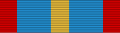 Ribbon bar of the medal of merit.

Commanding officers
[edit]From 1941 to 1963, the commanding officers was referred to as kårchef ("corps commander") and had the rank of lieutenant colonel. From 1942, the corps commander had the rank of colonel. From 1942 to 1957, the commanding officer of F 21 was also commanding officer of Upper Norrland Air Defence District (Flybo ÖN). When the wing organization was introduced in 1963, the commanding officer was referred to as flottiljchef ("wing commander"), and had the rank of colonel. From 1976 to 1994, the wing commander was referred to as sektorflottiljchef ("sector wing commander") and had the rank of senior colonel. From 1 July 1994, the commanding officer is again referred to as flottiljchef ("wing commander"), and has the rank of colonel.
Corps, wing and sector wing commanders
[edit].jpg)
- 1941–1942: Fredrik Adilz
- 1942–1946: Gösta von Porat
- 1946–1951: Lars-Erik Tornberg
- 1951–1957: Hugo Svenow
- 1957–1959: Gunnar Lindberg
- 1959–1965: Bengt Bellander
- 1965–1966: Jan Oterdahl
- 1966–1969: Tord Norlin
- 1969–1976: Rune Larsson
- 1976–1980: Hans Hansson
- 1980–1982: Lars-Bertil Persson
- 1982–1984: Bert Stenfeldt
- 1984–1987: Carl-Johan Rundberg
- 1987–1991: Roland Magndahl
- 1 January 1992 – 1993: Senior Colonel Kent Harrskog
- 1993–1994: Curt Westberg
- 1994–1998: Roland Sterner
- 1998–2001: Frank Fredriksson
- 2002–2005: Jan Otterström
- 2005–2008: Lars Jäderblom
- 2008–2011: Per Nilsson
- 2011–2015: Fredrik Bergman
- 2015–2018: Carl-Johan Edström
- 2018–2021: Claes Isoz
- 2021–2023: Carl-Fredrik Edström
- 2023–20xx: Peter Greberg
Deputy sector wing commanders
[edit]In order to relieve the sector wing commander, a deputy sector wing commander position was added in 1975. Its task was to lead the unit procurement, a task largely similar to the old wing commander position. Hence he was also referred to as flottiljchef ("wing commander"). The deputy sector wing commander had the rank of colonel. On 30 June 1993, the deputy sector wing commander position was terminated.
- 1975–1976: Hans Hansson
- 1977–1979: Bror Larsson
- 1980–1984: Carl-Johan Rundberg
- 1984–1988: Karl-Göte Widén
- 1988–1990: Kent Harrskog
- 1990–1993: ?
Names, designations and locations
[edit]| Name | Translation | From | To | |
|---|---|---|---|---|
| Kungl. Norrbottens flygbaskår | Royal Norrbotten Air Base Corps | 1941-07-01 | – | 1963-06-30 |
| Kungl. Norrbottens flygflottilj | Royal Norrbotten Wing | 1963-07-01 | – | 1974-12-31 |
| Norrbottens flygflottilj | Norrbotten Wing[2] Norrbotten Air Group[7] |
1975-01-01 | – | |
| Designation | From | To | ||
| F 21 | 1941-07-01 | – | 1957-09-30 | |
| F 21/Se ÖN1 | 1957-10-01 | – | 1965-??-?? | |
| F 21/Se ÖN3 | 1957-10-01 | – | 1981-??-?? | |
| F 21/Se ÖN | 1981-??-?? | – | 1993-06-30 | |
| F 21/FK N | 1993-07-01 | – | 1994-06-30 | |
| F 21 | 1994-07-01 | – | ||
| Location | From | To | ||
| Luleå Airport | 1941-07-01 | – |
Footnotes
[edit]References
[edit]Notes
[edit]- ^ Sandberg 2007, p. 27
- ^ a b Grafisk profil 2013, p. 64
- ^ a b c Braunstein 2006, p. 62
- ^ a b Braunstein 2004, p. 75
- ^ "Flottiljen tilldelades ny fana" (in Swedish). Swedish Armed Forces. 2 September 2014. Retrieved 19 May 2022.
- ^ Braunstein 2007, p. 101
- ^ Appich 1988, p. 42
- Braunstein, Christian (2004). Svenska försvarsmaktens fälttecken efter millennieskiftet [The flags and standards of the Swedish Armed Forces after the turn of the millennium] (PDF). Skrift / Statens försvarshistoriska museer, 1101-7023; 7 [dvs 8] (in Swedish). Stockholm: Statens försvarshistoriska museer. ISBN 91-971584-7-X. SELIBR 9815350.
- Braunstein, Christian (2006). Heraldiska vapen inom det svenska försvaret [Heraldry of the Swedish Armed Forces] (PDF). Skrift / Statens försvarshistoriska museer, 1101-7023; 9 (in Swedish). Stockholm: Statens försvarshistoriska museer. ISBN 91-971584-9-6. SELIBR 10099224.
- Braunstein, Christian (2007). Utmärkelsetecken på militära uniformer [Decorations on Swedish military uniforms] (PDF). Skrift / Statens försvarshistoriska museer, 1101-7023; 12 (in Swedish). Stockholm: Statens försvarshistoriska museer. ISBN 978-91-976220-2-8. SELIBR 10423295.
- Sandberg, Bo (2007). Försvarets marscher och signaler förr och nu: marscher antagna av svenska militära förband, skolor och staber samt igenkännings-, tjänstgörings- och exercissignaler (in Swedish) (New ed.). Stockholm: Militärmusiksamfundet med Svenskt marscharkiv. ISBN 978-91-631-8699-8. SELIBR 10413065.
Web
[edit]- Appich, Thomas W. Jr. (22 July 1988). "Reference Aid Swedish–English Glossary of Military and Technical Acronyms and Abbreviations" (PDF). United States Joint Publications Research Service. Foreign Broadcast Information Service. Archived (PDF) from the original on 20 February 2017. Retrieved 5 February 2021.
- "Försvarsmaktens gemensamma identitet – direktiv för användandet av Försvarsmaktens namn, profil och bild" (PDF). 1.3 (in Swedish). Swedish Armed Forces. 16 September 2013. Retrieved 5 February 2021.
Further reading
[edit]- Andersson, Karl-Gustav; Ekström, Karl-Erik; Jonsson, Anders, eds. (2003). F 21: nyckelflottilj i norr (in Swedish). Luleå: F 21 Norrbottens flygflottilj. ISBN 9163138395. SELIBR 9002377.
- Karlsson, Kurt; Åström, Signar; Magndahl, Roland; Blixt, Ivar (1991). F 21: 50 år och framåt (in Swedish). Luleå: Norrbottens flygflottilj. SELIBR 1278856.
External links
[edit]
| Swedish Air Force wings | |
|---|---|
| Currently active | |
| Inactive | |
Norrbotten Wing
View on GrokipediaHistory
Formation and Early Operations (1941–1961)
The Norrbotten Wing, designated as Kungl. Norrbottens Flygbaskår (F 21), was established on July 1, 1941, at Kallax airfield near Luleå in northern Sweden, following a government proposal in autumn 1940 to bolster air defense in the region amid escalating World War II tensions.[2] Initially organized as a base corps rather than a full flying wing, it served primarily as a support and logistical hub for transient units from southern Sweden, equipped with a limited number of light liaison aircraft such as the S 9 for operations in the subarctic environment, along with a single air ambulance.[5] This setup reflected Sweden's neutrality policy, focusing on rapid deployment capabilities across auxiliary fields in Boden, Kalix, Kiruna, and Nordmaling to counter potential threats from German and Soviet forces.[2] Soviet bombings at Kallaxön on January 14, 1940, and Pajala on February 21, 1940, highlighted the vulnerability of northern airspace and contributed to the decision to establish F 21.[5] During World War II, F 21's early operations centered on neutrality patrols and reconnaissance missions to monitor border violations.[5] The wing hosted emergency landings of over 20 foreign military aircraft, including 13 German models, and facilitated Allied logistics such as Operation Ball from December 1944 to August 1945, where 47 U.S. C-47 Dakotas operated from F 21 bases to transport Norwegian police troops.[2] By 1942, F 21 integrated into the Northern Air Base Area (Norra Flygbasområdet, Flybo N), with its commander also overseeing Flybo ÖN, expanding to 11 emergency airfields by 1943 for enhanced regional coverage; temporary use of Fiat CR.42 biplanes (J 11) from other wings, such as F 9, supported air defense exercises at Kallax around 1942.[6] As the war progressed, the unit transitioned toward more capable aircraft, incorporating Saab B 18 bombers and reconnaissance variants (S 18) by the late 1940s for improved intelligence gathering in harsh winter conditions.[2] Postwar reorganization in 1949 marked F 21's expansion into a dedicated reconnaissance wing, with the activation of its first squadron (1. divisionen) equipped with S 26 Mustang fighters and S 18A reconnaissance aircraft, joining the 4th Air Squadron (E 4) for specialized aerial photography and border surveillance missions.[2] This shift emphasized subarctic operations, including signal intelligence support and flights like Ingemar Wängström's 1949 reconnaissance over Soviet territory near the Finnish border to track military buildups.[5] By the mid-1950s, further modernization included the introduction of Saab J 21 fighters for transitional roles, alongside ongoing integration into the broader Swedish Air Force structure under northern commands, culminating in the establishment of a second division with J 32B Lansen aircraft in 1961 to enhance reconnaissance capabilities.[2]Cold War Era and Reconnaissance Role (1961–1990)
In 1961, the Norrbotten Wing (F 21) transitioned from a dedicated reconnaissance unit to a combined fighter and reconnaissance wing, reflecting Sweden's evolving defense needs amid escalating Cold War tensions. This shift enabled the wing to balance air defense with strategic intelligence gathering, particularly in the northern subarctic regions vulnerable to Soviet incursions. Based at Luleå-Kallax Airport, F 21 operated Saab J 35 Draken fighters for intercept duties alongside reconnaissance variants, ensuring rapid response capabilities in the expansive northern airspace.[7] The introduction of the Saab 32 Lansen in its S 32C reconnaissance configuration marked an early enhancement to F 21's capabilities, with the aircraft entering service at the wing in 1959 and continuing operations through the early 1960s. Equipped with PS-431/A radar for sea surveillance and multiple cameras (such as SKA 15 and SKA 23) for photographic reconnaissance, the S 32C allowed for effective monitoring of maritime threats in the Baltic and adjacent waters. By 1965, F 21 was officially designated F 21/R, emphasizing its reconnaissance focus, and received the S 35E Draken variant, a modified J 35D with advanced SKa 24 camera systems and IR reconnaissance pods for high-speed, low-altitude missions. Dedicated squadrons, such as the 211th, specialized in these RF-35 (S 35E) operations, conducting photo and electronic intelligence flights to track Soviet naval movements.[8][9] During the 1960s, F 21 established subarctic training areas north of Luleå, leveraging the wing's location to develop expertise in extreme cold-weather operations essential for Sweden's total defense strategy. This strategy integrated air reconnaissance with ground and naval forces to deter invasion across the nation's vast territory, positioning F 21 as a frontline asset in national surveillance networks akin to NORAD in monitoring the Barents Sea region. The wing's missions focused on detecting Soviet submarine and aircraft activity near the Kola Peninsula, providing critical intelligence to Swedish high command without formal alliance commitments.[10][11] In the 1970s, the integration of the Saab JA 37 Viggen further advanced F 21's reconnaissance role, with SF 37 overland and SH 37 maritime variants entering service around 1975. These aircraft featured sophisticated sensor suites, including VKA 702 IR cameras and reconnaissance radars, enabling all-weather, high-resolution imaging for strategic assessment. The designation F 21/R persisted until 1981, after which the wing maintained its dual-role structure while emphasizing reconnaissance amid heightened Soviet threats. F 21's contributions to total defense included routine patrols and data-sharing protocols that bolstered Sweden's non-aligned posture.[12] The 1980s saw F 21 intensify Arctic warfare simulations through large-scale exercises in its subarctic ranges, testing reconnaissance tactics in blizzards and low visibility to prepare for potential northern flank conflicts. These drills, often involving international observers under neutrality agreements, honed the wing's ability to operate Drakens and Viggens in simulated invasions, underscoring its strategic importance in deterring aggression along Sweden's Arctic borders. By 1990, F 21 had solidified its reputation as Sweden's premier northern reconnaissance force, having amassed extensive intelligence on regional threats.[13]Post-Cold War Reorganization and Modernization (1990–present)
Following the end of the Cold War, the Norrbotten Wing (F 21) underwent significant reorganization as part of broader Swedish Armed Forces reductions, including the disbandment of the 213th Squadron in the late 1990s to consolidate operations into multirole configurations.[14] This led to a reduction to two operational squadrons by the early 2000s, reflecting a shift from specialized reconnaissance roles to versatile fighter capabilities amid post-Cold War budget constraints and force streamlining.[14] The wing's transition from the AJ 37 Viggen reconnaissance aircraft began with the introduction of the JAS 39 Gripen in 2002, when the first squadron achieved operational status, marking F 21 as the third Gripen-equipped wing in the Swedish Air Force.[15] In 2002, the wing was formally designated a fighter wing, emphasizing its evolving multirole mission.[15] By 2008, the entire wing had upgraded to the JAS 39C/D variants, enhancing its adaptability for subarctic environments.[14] A key ceremonial milestone occurred on September 2, 2014, when King Carl XVI Gustaf presented a new unit standard (fana) to Wing Commander Colonel Fredrik Bergman during a ceremony at Luleå-Kallax Air Base.[16] This replaced the 70-year-old standard from 1944 and incorporated heraldic elements from the disbanded F 4 (Jämtland Wing) and F 15 (Hälsinge Wing), including their county coats of arms alongside Luleå's city emblem of crossed keys, to preserve traditions as a bearer unit.[16] The event underscored F 21's role in maintaining historical continuity amid structural changes. Modernization efforts have focused on subarctic operational readiness, with ongoing upgrades to the Gripen C/D fleet for improved electronic warfare and interoperability, supported by a 2025 contract extension for maintenance through 2029.[17] In October 2025, the Swedish Air Force formally inducted the advanced JAS 39E Gripen variant into service, with deliveries commencing to wings including F 21 to further enhance multirole capabilities in northern operations.[18] Additionally, in September 2025, F 21 personnel supported the operational debut of the Saab Loke counter-unmanned aerial system during a live NATO mission, integrating the technology developed with wing input for enhanced air defense.[19] The addition of NHIndustries NH90 helicopters (designated HKP 14) to the 1st Helicopter Squadron has bolstered medical evacuation (MEDEVAC) capabilities in extreme northern conditions, enabling rapid response in harsh terrains, with retrofits completed and aircraft transferred back in early 2025.[20][21] These enhancements align with Sweden's total defense strategy, heightened by Russia-Ukraine tensions since 2022, positioning F 21 as a critical northern deterrent.[20] Sweden's NATO accession in 2024 accelerated F 21's integration into alliance structures, culminating in its first Air Policing deployment from April to June 2025, when up to eight Gripen C/D aircraft from the wing's fighter squadrons supported NATO's enhanced Air Surveillance and Quick Reaction Alert missions in Poland.[4] This operation marked a pivotal step in transitioning from neutrality to collective defense, leveraging the wing's subarctic expertise for broader European security.[4]Organization and Structure
Current Squadrons and Units
The Norrbotten Wing (F 21) maintains two fighter squadrons, designated as the 211th Division and 212th Division, equipped with JAS 39C/D Gripen multirole fighters to conduct air superiority and ground attack operations across northern Sweden's challenging terrain and climate.[10][22] Co-located at Luleå Air Base with the wing is the 1st Helicopter Squadron, which operates NH90 (HKP 14) helicopters primarily for troop transport, utility missions, and search-and-rescue in Arctic conditions.[21] Support elements encompass dedicated logistics and maintenance squadrons to ensure operational readiness, alongside training units that facilitate pilot and ground crew development, including a Gripen-specific detachment linked to advanced flight instruction programs.[10] The wing's approximately 750 personnel enable seamless integration with the Norrbotten Regiment (I 19) for collaborative joint Arctic exercises, enhancing combined air-ground capabilities in northern defense scenarios.[1][23]Bases and Support Facilities
The primary base of the Norrbotten Wing (F 21) is Luleå-Kallax Airport, a dual-use civil-military facility in Luleå, northern Sweden, which has hosted the wing since its establishment in 1941. The airport features a main runway extended to 3,350 meters in length to accommodate heavy cargo and military operations, supporting the wing's multirole fighter squadrons in the subarctic region. Infrastructure at the base includes aircraft hangars, maintenance facilities, and support structures designed to withstand extreme cold temperatures, with heating systems and insulated enclosures essential for year-round operations in Norrbotten's harsh climate.[24] To enhance operational resilience, the base incorporates elements of Sweden's dispersed basing doctrine, enabling rapid Gripen aircraft dispersal to hardened shelters and forward locations during heightened alert states, minimizing vulnerability in contested environments. Fuel depots and logistics hubs at Luleå-Kallax provide sustained support for extended missions, with expansions in the 2010s improving interoperability through enhanced NATO-standard communication and refueling capabilities ahead of Sweden's alliance integration. These adaptations ensure reliable performance in subarctic conditions, where temperatures can drop below -30°C, through specialized de-icing equipment and cold-weather tested materials.[25][26] Additional support facilities include the Vidsel Test Range, located approximately 100 km northwest of Luleå, which serves as a key site for live-fire weapons testing and evaluation of air-to-ground munitions under realistic subarctic terrain conditions. Spanning 3,300 km² of restricted ground area and 8,800 km² of airspace, Vidsel offers one of Europe's largest overland proving grounds, allowing the wing to conduct trials with minimal population impact while simulating northern operational scenarios. The range features instrumentation for tracking missile trajectories and bomb impacts, supporting the wing's role in weapons certification.[27] The wing also utilizes temporary forward operating bases across Norrbotten County, leveraging road networks and remote airstrips for dispersed training and contingency operations, which are critical for maintaining agility in expansive, low-population areas. These sites, often established seasonally, include mobile radar units and satellite-linked command posts to extend surveillance coverage in the county's vast wilderness. Complementing these are networked radar facilities in the region, providing early warning and air traffic management tailored to the subarctic's challenging visibility and electromagnetic conditions.[28] Annually, the Norrbotten Wing accesses over 10,000 km² of training airspace—one of Europe's largest contiguous areas—encompassing Vidsel and adjacent zones for complex exercises involving multiple aircraft types and allied forces. This expansive infrastructure underscores the wing's specialization in subarctic aviation, with facilities equipped for cold-weather simulations, including environmental chambers for testing equipment resilience against frost and ice accumulation. Recent enhancements, driven by increased NATO cooperation since the mid-2010s, have integrated standardized logistics and joint-use protocols, bolstering the base's capacity to host international detachments without compromising operational tempo.[10][29]Role, Equipment, and Operations
Mission and Capabilities
The Norrbotten Wing serves as the primary air defense unit for northern Sweden, focusing on maintaining permanent mission readiness for rapid reaction to aerial incursions and supporting broader territorial defense operations. Its core mission emphasizes the generation of combat-ready fighter squadrons capable of deploying domestically or internationally to secure Swedish airspace and contribute to allied efforts. Following Sweden's accession to NATO in March 2024, the wing has integrated its operations to bolster the alliance's northern flank, providing quick-response air capabilities that enhance collective defense in the High North.[10][4][30] The wing's capabilities are tailored for subarctic and all-weather environments, enabling sustained operations in temperatures as low as -40°C through specialized cold-weather adaptations on its JAS 39 Gripen aircraft. These include robust electronic warfare systems integrated into the Gripen platform, such as advanced radar warning receivers and jamming pods, which allow for effective spectrum dominance during contested missions. Additionally, the wing supports joint operations with the Swedish Army and Navy, coordinating air support for ground and maritime forces in northern scenarios to ensure integrated multi-domain responses.[31][18][32] Strategically, the Norrbotten Wing plays a key role in deterring potential threats along Sweden's northern borders, including monitoring activities in adjacent regions like the Barents Sea, amid heightened geopolitical tensions. It also facilitates training for foreign NATO partners in Arctic conditions, leveraging its expansive flight training area—one of the largest globally—to build interoperability and share expertise in extreme-weather tactics. As the lead operational wing for the Swedish Air Force's northern sector, it ensures comprehensive coverage of this critical area, aligning with NATO's regional defense plans.[10][33][34]Aircraft and Helicopters
The Norrbotten Wing operates approximately 20–25 JAS 39C/D Gripen multirole fighter aircraft, serving as its primary fixed-wing assets, with initial deliveries of the JAS 39E variant beginning in 2025.[10][35] These fourth-generation fighters feature a delta wing and canard configuration with fly-by-wire controls, enabling relaxed stability for enhanced maneuverability. Equipped with the PS-05/A pulse-Doppler radar (with AESA upgrades on select aircraft as of 2025), the Gripen supports air-to-air and air-to-ground missions, including integration of the Meteor beyond-visual-range air-to-air missile for extended engagement capabilities. The aircraft has a combat radius exceeding 1,000 km on internal fuel and can carry a weapons payload of up to 7,200 kg across 10 hardpoints, accommodating a mix of missiles, bombs, and reconnaissance pods.[36][37] The wing's helicopter fleet consists of approximately 6–8 NH90 (designated HKP 14E) tactical transport helicopters as of 2025, configured for land-based operations including utility transport, medical evacuation (MEDEVAC), and limited anti-submarine warfare support when paired with appropriate sensors, though the type faces replacement with UH-60 Black Hawks in the mid-2020s.[38][39][40] These twin-engine, fly-by-wire rotorcraft offer a maximum takeoff weight of 10,600 kg and a range of about 800 km, with roles extending to search and rescue and special operations insertion in northern terrains. The HKP 10B (AS532 Cougar/Super Puma variant), previously used for similar utility and transport duties, was fully phased out by the early 2020s as the NH90 entered full operational capability.[20] Historically, the Norrbotten Wing's fixed-wing inventory has evolved to meet evolving reconnaissance and fighter requirements, beginning with early types such as the Beechcraft 18 in the 1940s for transport and reconnaissance duties.[41] By the 1960s, it transitioned to the Saab J 35 Draken, a supersonic interceptor with reconnaissance variants (S 35) featuring side-looking radar for tactical intelligence gathering. The 1970s introduced the Saab AJ 37 Viggen, an advanced attack and reconnaissance platform with STOL capabilities and a payload capacity of around 5,000 kg, optimized for short northern runways. The Gripen replaced the Viggen starting in 1998, marking the shift to a more versatile, network-centric multirole fighter with reduced lifecycle costs.[42] Maintenance for the wing's aircraft and helicopters is conducted through in-house depot-level facilities at Luleå-Kallax Air Base, supporting overhaul, upgrades, and sustainment to ensure high availability in subarctic conditions.[10] These capabilities include avionics testing, structural repairs, and integration of upgrades like enhanced electronic warfare systems for the Gripen fleet.Notable Deployments and Exercises
In the early 2000s, Swedish Air Force HKP 10B Super Puma helicopters from the Helicopter Wing supported medical evacuation operations in the International Security Assistance Force (ISAF) mission in Afghanistan from 2002 to 2014, performing numerous flights to transport over 1,000 casualties in total across the mission.[43][44] Following Sweden's accession to NATO in March 2024, the wing achieved a significant milestone with its first alliance deployment in April 2025, sending a squadron of JAS 39 Gripen fighters to Malbork Air Base in Poland for enhanced Air Policing duties until June. This rotation, involving up to eight aircraft and support personnel, focused on airspace surveillance over the Baltic region and marked Sweden's initial contribution to NATO's collective air defense, including intercepts of non-allied aircraft.[4][45][46] Domestically, the Norrbotten Wing has been a key participant in the biennial Arctic Challenge Exercise (ACE) since its inception in 2013, a multinational air operation hosted by the air forces of Sweden, Finland, and Norway to enhance interoperability in northern environments. These exercises typically involve over 100 aircraft from allied nations, with the 2023 iteration featuring more than 140 fixed- and rotary-wing platforms conducting complex scenarios such as air-to-air combat and tactical support across vast Arctic training areas.[47][48][49] In 2024, the wing supported U.S. Air Force Bomber Task Force operations by providing Gripen escorts for B-1B Lancer and B-52 Stratofortress bombers during joint training at Luleå-Kallax Air Base, integrating Swedish fighters into multinational missions to simulate high-threat deterrence and improve allied coordination. Additionally, post-NATO entry, the wing has contributed to Baltic Air Policing rotations, bolstering regional security through ongoing deployments that align with UN-mandated peacekeeping support frameworks.[50][51][52] Across 2024 exercises, including Nordic Response and Bomber Task Force integrations, Norrbotten Wing aircraft flew over 500 sorties, demonstrating operational readiness in large-scale NATO scenarios.[53]Heraldry and Traditions
Coat of Arms
The coat of arms of the Norrbotten Wing (F 21) originated in 1941 with the establishment of the unit as the Royal Norrbotten Air Base Corps, reflecting its northern regional identity through the adoption of Västerbotten's provincial emblem. The initial design featured a shield displaying an azure field powdered with golden estoiles, charged with a silver reindeer courant armed and langued gules, surmounted by a royal crown; this version symbolized the unit's ties to the northern landscape. Approved by King Gustaf V in 1941, it underscored the unit's royal designation and regional identity.[54] In 1963, coinciding with the redesignation as Norrbottens flygflottilj, the coat of arms was modified to incorporate aviation elements, changing to an argent field with Luleå's two azure keys crossed in saltire (sinister inverted), surmounted by a blue chief bearing a golden winged two-bladed propeller, all under a royal crown. These additions evoked vigilance and flight, aligning with the wing's growing operational focus on aerial reconnaissance and defense during the Cold War era. The propeller, in particular, represented aviation prowess, distinguishing the emblem from purely municipal heraldry.[2] The present iteration, introduced in 1994 amid post-Cold War restructuring, retained the 1963 design with the addition of the propeller chief (TFG 950009). The official blazon reads: I fält av silver två korslagda blå nycklar, den vänstra störtad; däröver en blå ginstam belagd med en vingad tvåbladig propeller av guld. Skölden krönt med en kunglig krona, where the silver field and blue keys maintain ties to Luleå, and the blue chief with golden propeller denotes aviation prowess. This version balances historical continuity with modern symbolism of territorial defense.[55] Throughout its history, the coat of arms has been prominently used on personnel uniforms, unit insignia, and aircraft markings to foster esprit de corps and visibility in operations. It integrates briefly with the wing's colours and standards, where the emblem appears embroidered on fabric banners presented during ceremonial events.[54]Colours, Standards, and Guidons
The original colour of the Norrbotten Wing, then known as the Royal Norrbotten Air Base Corps (F 21), was presented on 17 September 1944 by King Gustaf V during a ceremony at F 8 in Barkarby.[56] This colour featured a blue cloth field embroidered with the Swedish Air Force badge—a yellow winged two-bladed propeller beneath a royal crown—covering the central area, along with Luleå's coat of arms (two white keys in saltire, the left inverted) in the upper inner corner, and golden fringes along the edges.[56] The design, created by Brita Grep and embroidered by Libraria, symbolized the unit's ties to northern Sweden and its aviation heritage.[56] By 2014, the 1944 colour had deteriorated beyond restoration, prompting the presentation of a revised version on 2 September 2014 by King Carl XVI Gustaf during a formal ceremony in Luleå.[16][57] The new colour retained the traditional blue field but incorporated updated elements, including a golden winged propeller under a royal crown at the center and Luleå's crossed keys in the upper corners, while integrating heraldic motifs from the disbanded Jämtlands flygflottilj (F 4 Frösön) and Hälsinge flygflottilj (F 15 Söderhamn) through their respective county coats of arms to honor shared northern air defense traditions.[16][57] Prior to the handover, a flag-nailing ceremony on 9 May 2014 at the Army Museum secured the colour to its staff with brass nails, following established Swedish military protocol.[57] In addition to the wing's primary colour, squadron-specific guidons serve as standards for fighter and reconnaissance units within F 21, typically featuring blue fields with unit insignias derived from the overall coat of arms.[55] These guidons are employed in parades and ceremonial formations to represent individual squadrons' roles in air operations.[55]Medals and Awards
The Norrbotten Wing Medal of Merit, officially known as the Norrbottens flygflottiljs förtjänstmedalj (NorrbffljGM), was instituted in 1996 to recognize outstanding contributions to the unit.[58] Available in both gold and silver variants, the medal is awarded in the 8th size (approximately 33 mm in diameter) for meritorious service, such as long-term dedication or exceptional performance within the Norrbotten Wing (F 21).[59][58] It is suspended from a blue moiré ribbon featuring red edges and a central yellow stripe, reflecting elements of the Swedish Air Force's colors.[58] In addition to the wing-specific medal, personnel have received broader recognitions integrated with Swedish Armed Forces honors, including the general Försvarsmaktens förtjänstmedalj for valor or leadership under challenging conditions. In 2011, members of the Norrbotten Wing earned unit citations and NATO Non-Article 5 Medal awards for their contributions to international operations in Libya, particularly through participation in Operation Unified Protector.[60] These awards underscore the wing's role in multinational efforts while adhering to the Swedish Armed Forces' uniform regulations for decoration wear.[59]Commanding Officers
Wing and Sector Commanders
The primary leadership of the Norrbotten Wing, known in Swedish as Norrbottens flygflottilj (F 21), has been provided by a series of commanders since the unit's establishment on July 1, 1941, as the Norrbotten Air Corps (Norrbottens flygbaskår). Initially, the commanding officer held the title of corps commander (kårchef), a role that encompassed oversight of air base operations and support for transient southern units in northern Sweden during World War II. This title persisted until the unit's reorganization into a full wing (flygflottilj) on July 1, 1963, after which the position became known as wing commander (flottiljchef). Ranks for these leaders have evolved from lieutenant colonel (överstelöjtnant) in the early years to colonel (överste) in modern times, reflecting the unit's growth into a multi-role fighter wing.[5] Over its 84-year history, F 21 has had more than 27 commanders, each responsible for strategic direction, operational readiness, and the management of aircraft squadrons, support units, and international exercises. These officers have guided the wing through transitions from reconnaissance-focused missions with light aircraft like the Saab 9 to advanced multi-role operations with the JAS 39 Gripen, while adapting to Sweden's NATO accession in 2024. Commanders typically oversee approximately 750 military and civilian personnel, including pilots, ground crew, and technical specialists based at Luleå-Kallax Air Base.[1][10] The inaugural corps commander was Lieutenant Colonel Fredrik Adilz, who led the nascent unit from 1941 to 1942, establishing initial infrastructure for northern air operations amid wartime neutrality concerns.[5] Succeeding him was Colonel Gösta von Porat (1942–1946), a pioneering aviator with Swedish certificate number 7 and over 34 years of service; from 1942 to 1957, the F 21 commanding officer also led the Upper Norrland Air Base Area (Övre Norrlands flygbasområde), though von Porat's tenure in the dual role ended with his F 21 command in 1946.[5] Colonel Lars-Erik Tornberg followed (1946–1951), focusing on expansion and base development. The 1963 reorganization marked a pivotal shift, with Colonel Bengt Bellander serving as the final corps commander (1959–1963) and the first wing commander, integrating F 21 into the streamlined Air Force structure and introducing jet-era capabilities. Subsequent leaders oversaw key modernizations, such as the adoption of the Saab 35 Draken in the 1960s and the Saab 37 Viggen in the 1970s, enhancing reconnaissance and fighter roles in Arctic conditions. Notable later commanders include Hugo Svenow (1951–1957), who managed post-war adjustments, and Claes Isoz (2018–2021), who oversaw transitions to enhanced NATO cooperation. In recent decades, commanders have emphasized NATO interoperability. Lieutenant General Carl-Johan Edström held the position from 2015 to 2018, strengthening bilateral ties during pre-accession exercises. His successor, Colonel Carl-Fredrik Edström, took command as the 25th wing commander in August 2021, guiding initial Gripen E integrations.[61] The current wing commander, Colonel Peter Greberg, assumed the role in 2023 and has directed F 21's expanded NATO engagements, including the deployment of six JAS 39C Gripens to Poland for enhanced air policing from April to June 2025 and hosting French Rafale jets at Luleå-Kallax for the multinational Pégase 25 operation in April 2025.[4][62]Deputy Commanders
The position of deputy sector wing commander was established at the Norrbotten Wing in 1975 to assist the sector wing commander with operational and training responsibilities, including leading unit procurement and squadron oversight during the final phases of the Cold War. This role, equivalent to a wing commander and held by officers of colonel rank, emphasized administrative duties in supporting the wing's fighter and reconnaissance squadrons. It was discontinued on 30 June 1993 as part of broader Air Force restructuring. Selected incumbents during this period included:- 1975–1976: Colonel Hans Hansson, who managed flotilla-level production and operations.
- 1977–1979: Colonel Bror Larsson, focusing on squadron integration and training programs.
- 1980–1984: Colonel Carl-Johan Rundberg, overseeing aircraft maintenance and deployment readiness.[63]
- 1984–1988: Colonel Karl-Göte Widén, promoted to the role in October 1984 to handle administrative and logistical support.[64]
- 1988–1990: Colonel Kent Harrskog, appointed to support coordination of air defense activities (note: records also indicate acting sector wing role in 1988).
- 1990–1993: [Position held; details incomplete]
Designations and Locations
Name and Designation Changes
The Norrbotten Wing traces its origins to 1 July 1941, when it was established as the Kungliga Norrbottens Flygbaskår (Royal Norrbotten Air Base Corps), designated F 21, to serve as a support unit for air defense operations in northern Sweden during World War II.[5] This initial designation emphasized its role as a flygbaskår, or air base organization, hosting temporary squadrons from southern units rather than maintaining permanent flying formations.[66] On 1 July 1963, amid Swedish Air Force restructuring to enhance northern capabilities, the unit was reorganized and renamed the Kungliga Norrbottens Flygflottilj (Royal Norrbotten Air Wing), retaining the F 21 designation but shifting to a full flygflottilj structure with integrated flying squadrons, including the rebasing of J 32B Lansen fighters from F 12.[5] From 1957 to 1965, it also held the dual role of F 21/Se ÖN1, serving as command for the Eastern Norrland air sector (ÖN1) to coordinate regional defense, with subsequent variants including F 21/Se ÖN3 (1965–1981) and F 21/Se ÖN (1981–1993).[66] In 1975, following the implementation of the new Instrument of Government that curtailed the monarchy's formal influence on state institutions, the "Kungliga" (Royal) prefix was removed from the unit's name across the Swedish Armed Forces, establishing its current title as Norrbottens Flygflottilj, or in English Norrbotten Wing (F 21), a change that aligned with broader secularization of military nomenclature. This reform marked the end of royal designations for active units, emphasizing national over monarchical ties. The wing has retained the F 21 designation since, with its reconnaissance role operating under the standard F 21 designation from 1949 to 2003 and a shift to fighter focus from 2002 onward, coinciding with the adoption of multirole JAS 39 Gripen aircraft.[10] These evolutions mirror key Swedish Air Force reforms, such as post-war expansions, Cold War role specializations, and post-1975 modernization efforts to adapt to neutral defense postures without royal connotations.[5]| Period | Official Name | Designation | Key Notes |
|---|---|---|---|
| 1941–1963 | Kungliga Norrbottens Flygbaskår | F 21 | Air base support unit; WWII-era establishment.[5] |
| 1963–1974 | Kungliga Norrbottens Flygflottilj | F 21 | Reorganization to full air wing. |
| 1957–1965 | (Variant) F 21/Se ÖN1 | F 21/Se ÖN1 | Sector command for Eastern Norrland air defense (ÖN1). |
| 1965–1981 | (Variant) F 21/Se ÖN3 | F 21/Se ÖN3 | Continued sector command (ÖN3). |
| 1981–1993 | (Variant) F 21/Se ÖN | F 21/Se ÖN | Sector command for Eastern Norrland. |
| 1975–present | Norrbotten Wing / Norrbottens Flygflottilj | F 21 | Post-royal reform name; fighter focus since 2002.[10] |
Historical and Current Locations
The Norrbotten Wing, designated F 21, was established on 1 July 1941 as the Norrbottens flygbaskår, with its initial base at Kallax near Luleå in northern Sweden. This site served as the wing's primary location from inception, focusing on reconnaissance operations in the subarctic region during World War II. The base was developed as a military airfield to support the Swedish Air Force's northern defense needs, marking the first permanent air unit in Norrbotten County.[67][5] By 1944, the airfield transitioned to accommodate civilian operations alongside military activities, with the first commercial flights to Stockholm commencing on 11 September 1944. This integration solidified Luleå's role as a dual-use facility, with the wing's operations expanding to include land-based aircraft as seaplane capabilities were phased out post-war. The wing has maintained its core presence at this location ever since, evolving from a reconnaissance-focused unit in the 1940s to a multi-role fighter base by the 1960s.[24] During the 1950s, the wing conducted temporary reconnaissance detachments from forward sites in Boden and Kiruna to enhance coverage of northern territories, though these were not permanent relocations. Since the 1960s, F 21 has been permanently stationed at Luleå Air Base (ICAO: ESPA), with no major shifts in primary basing post-1990 amid Swedish Air Force consolidations. The base spans a shared civilian-military area, supporting ongoing fighter and training missions without significant infrastructure moves.[1] As of 2025, the wing's main base remains at Luleå Air Base, co-located with Luleå Airport, which handled 980,333 civilian passengers in 2024 and has seen a 5% year-on-year increase in traffic through October 2025. Auxiliary sites include side bases at Jokkmokk for training and Vidsel Test Range for testing operations, ensuring comprehensive northern coverage. This stable configuration reflects F 21's enduring role in subarctic air defense.[68][69][1]References
- https://commons.wikimedia.org/wiki/Category:F_21_Lule%C3%A5