


Community hub
Recent from talks
Contribute something
Nothing was collected or created yet.
Ogilvie Transportation Center
View on Wikipedia
The Richard B. Ogilvie Transportation Center (/ˈoʊɡəlviː/), on the site of the former Chicago and North Western Terminal, is a commuter rail terminal in downtown Chicago, Illinois, United States. For the last century, this site has served as the primary terminal for the Chicago and North Western Railway and its successors Union Pacific and Metra. Intercity services had disappeared by the 1970s, but commuter services on the three ex-CNW mainlines, Metra's UP District lines, continue to terminate here. The tracks are elevated above street level. The old CNW terminal building was replaced in the mid 1980s with a modern skyscraper, the 500 West Madison Street building. The modern building occupies two square city blocks, bounded by Randolph Street and Madison Street to the north and south and by Canal Street and Clinton Street to the east and west. It is the second busiest rail station in Chicago, after nearby Union Station, the sixth-busiest railway station in North America, and the third-busiest station (after Grand Central Terminal and Jamaica station in New York City) that exclusively serves commuter traffic.
Key Information


History
[edit]The 1911 station
[edit]The Chicago and North Western Railway built the Chicago and North Western Terminal in 1911 to replace its Wells Street Station across the North Branch of the Chicago River. The new station, in the Renaissance Revival style, was designed by Frost and Granger, also the architects for the 1903 LaSalle Street Station.[2]
The Tyler & Hippach Mirror Company Factory was moved 168 feet east and 52 feet south to make room for the station's construction.[3] At the time, this was the largest building ever moved.[4]
The station's 16 tracks were elevated above street level and "reached by six approach tracks and sheltered under an 894-foot-long [272 meter] Bush train shed."[2] The upper level of the head house housed a concourse and other facilities for intercity passengers, including "dressing rooms, baths, nurses and matrons rooms, and a doctor's office".[5] The centerpiece of the upper level was a stately waiting room, measuring 201 by 202 feet (34 by 62 meters), and rising 84 feet (approx. 26 meters) to its barrel vaulted ceiling.[2] In addition to the main concourse on the upper level, there was a street-level concourse for commuters.
During the heyday of rail travel, the Chicago and North Western Terminal was home to the C&NW's trains to Milwaukee, Minneapolis-St Paul, Madison and other cities of the upper Midwest, including the railroad's premier 400 series of trains. Until October 30, 1955, it was also the Chicago terminus of the trains the Union Pacific ran in conjunction with the C&NW, including the Overland Limited and the famed City trains (City of San Francisco, City of Los Angeles, Portland Rose) (operations of all Union Pacific intercity passenger trains would be turned over to the C&NW's rival, the Milwaukee Road). Other less famous trains such as the Corn King Special (Omaha), Viking (Milwaukee, Green Bay, and Minneapolis/St Paul), and Columbine (Denver). In 1939, there were 38 inter-city departures each business day.[6]
-
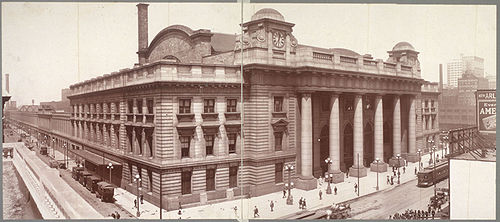 CNW Terminal c. 1912
 -
 C&NW train in July 1964
 -
 Interior in 1981
 -
 Terminal in November 1981

.jpg)
.jpg)
.jpg)
The 1984 station
[edit]In 1984, the head house was razed and replaced with the glass-and-steel 42-story Citicorp Center (now Accenture Tower), which was completed three years later in 1987. Metra service was maintained with only minor interruptions during construction – following the example of the demolition and replacement of New York Penn Station.[citation needed]
1991 rehabilitation
[edit]
In 1991, Metra purchased the train shed from Chicago and North Western and conducted a survey to determine the condition. The examination included necessary repairs to improve its structural integrity and redesign measures to bring the station up to modern mass-commuting standards. After completing a thorough evaluation, Metra, the Urban Mass Transportation Administration, and the Illinois Department of Transportation decided to completely replace the existing structure and in 1992, with the assistance of Federal funding, a contractor and management team were selected to begin the work.
Many engineering challenges had to be addressed and resolved, not only because of the train shed's prominent location but also due to its high traffic volume as it was to remain operational to 45,000 daily commuters during the project. Such challenges included the removal of original lead paint, the complete replacement of all 16 tracks which served 200 trains a day, extensive structural steel repairs (under load), erection of a new steel canopy, complete exterior masonry restoration, new electrical and plumbing systems, and construction of a new pedestrian concourse. During the rehabilitation project, which lasted four years and cost $138 million, over 60 contractors spent more than 800,000 man-hours performing repairs and producing new construction.
The station was renamed the Ogilvie Transportation Center in 1997, two years after the C&NW merged into the Union Pacific Railroad, after Richard B. Ogilvie, a board member of the Milwaukee Road. Many longtime Chicago-area residents still call it "North Western Station", and many longtime employees simply call it "CPT" – short for "Chicago Passenger Terminal".
Platforms and tracks
[edit]_Tower.png)
The station has 16 tracks with eight island platforms, each island platform servicing two tracks. Not all the platforms are the same length; the platforms on the western part of the station (tracks 1–10) are significantly longer than the eastern platforms. In general, West Line trains depart from the western platforms (roughly tracks 1–5), Northwest Line trains depart from the middle tracks (6–10), and North Line trains depart from the eastern tracks (11–15). (Track 16 is seldom used by revenue trains.) This is done so that departing and arriving trains do not have to make large switch movements, which would block the use of other tracks and prevent multiple trains from arriving and departing at the same time. Just north of the station, the number of tracks reduces from 16 to six. Switches allow for trains on any of the 16 station tracks to end up on any of these six tracks, and vice versa. About a third of a mile from the station, the six tracks split into two mainlines of four tracks. One mainline turns west, while the other turns northwest. West Line trains take the west tracks, while Northwest and North Line trains take the northwest tracks. Out-of-service trains use the west mainline to access yards and maintenance facilities.
Services
[edit]
The Chicago and North Western Terminal has served as a terminal for all the commuter and intercity trains of the Chicago and North Western Railway. In addition, on November 9, 1969, the day after Grand Central Station closed, the Baltimore and Ohio Railroad and Pere Marquette Railway, Grand Central's two remaining users, moved their remaining intercity services into the C&NW's terminal. Those trains, which used the C&NW's branch to the St. Charles Air Line west of Western Avenue, last ran on April 30, 1971, the day before Amtrak took over most intercity passenger trains in the U.S. Amtrak services over the lines of those two railroads have run into Union Station.
Metra's three Union Pacific District lines – the Union Pacific North Line, Union Pacific Northwest Line and Union Pacific West Line – now provide regular commuter rail service along three former C&NW lines. In Metra's zone-based fare schedule, Ogilvie is in Zone 1. More than 106,000 people board Metra trains at Ogilvie Transportation Center each day.[1]
Traffic statistics
[edit]| Rank | Route | Daily passengers (weekday) |
|---|---|---|
| 1 | UP-N to Kenosha |
41,000 |
| 2 | UP-NW to Harvard/McHenry |
38,600 |
| 3 | UP-W to Elburn |
27,200 |
Bus and 'L' connections
[edit]Bus connections can be made on Madison Street or Washington Boulevard via the Citigroup Center or through a lower level concourse accessible by the track platforms between Washington Boulevard and Randolph Street with entrances at Canal and Clinton Streets. Connections can also be made at the Union Station bus terminal via an entrance to Union Station's north concourse on Madison Street.
Ogilvie offers two connections to the Chicago Transit Authority's "L" system. It is next door to Clinton station; Ogilvie's platforms directly abut Clinton. Ogilvie is three blocks west of Washington/Wells station.
- J14 Jeffery Jump
- 19 United Center Express
- 56 Milwaukee
- 60 Blue Island/26th (Owl Service)
- 120 Ogilvie/Streeterville Express
- 124 Navy Pier
- 125 Water Tower Express
- 126 Jackson
- 128 Soldier Field Express
- 130 Museum Campus
- 157 Streeterville/Taylor
- 192 University of Chicago Hospitals Express
Major intercity trains before Amtrak
[edit]- Chicago & North Western trains
- North Western Limited
- Twin Cities 400
- Flambeau 400
- Minnesota 400 and its successors the Dakota 400 and Rochester 400
- Kate Shelley 400
- Union Pacific/Chicago and North Western trains
See also
[edit]- List of busiest railway stations in North America
- List of passenger railroads in Chicago for other passenger railroad terminals in downtown Chicago
References
[edit]- ^ a b "Archived copy" (PDF). Archived from the original (PDF) on December 27, 2013. Retrieved March 8, 2014.
{{cite web}}: CS1 maint: archived copy as title (link) - ^ a b c Holland, Kevin J. (2001). Classic American Railroad Terminals. Osceola, WI: MBI. pp. 82–83. ISBN 9780760308325. OCLC 45908903.
- ^ Rodkin, Dennis. "What’s That Building? The Cassidy Tire Building — And Its Unusual Escape From Demolition", WBEZ. June 6, 2019. Retrieved November 30, 2019.
- ^ "Threatened: Cassidy Tire Building Endangered by New High-Rise Tower Proposal", Preservation Chicago. Retrieved November 30, 2019.
- ^ Maiken, Peter T. (1989). Night Trains. Baltimore, MD: Johns Hopkins University Press. p. 166.
- ^ Official Guide of the Railways, National Railway Publication Co, April 1940
- Kevin P. Keefe, City of Six Stations, Trains July 2003, p. 69
External links
[edit]
| Lines |
| ||||
|---|---|---|---|---|---|
| Stations and terminals | |||||
| Rolling stock | |||||
| Incidents | |||||
| See also | |||||


| International | |
|---|---|
| National | |

Ogilvie Transportation Center
View on GrokipediaHistory
Original Station (1911–1984)
The Chicago and North Western Terminal was constructed in 1911 by the Chicago & North Western Railway to replace its earlier Wells Street Station across the North Branch of the Chicago River.[3] Designed by the architectural firm Frost & Granger, the new facility adopted a Renaissance Revival style, characterized by classical ornamentation and grandeur suited to a major transportation hub.[5] The structure included a prominent three-story waiting room adorned with bronze-trimmed marble, a 14-story office tower for railway administration, and a distinctive clock tower that served as a visual landmark along Madison Street between Canal and Clinton Streets on the west side of the Chicago River's South Branch.[6] Multi-level train sheds extended 894 feet to shelter arriving and departing trains, accommodating the railway's growing operations.[3] Key operational features of the terminal encompassed 16 tracks served by eight island platforms, each platform handling two tracks, which facilitated efficient passenger flow for both commuter and intercity services.[3] The design supported high-volume traffic, including interurban lines such as those connecting Chicago to Milwaukee and other regional destinations, with capacity for up to 54 trains daily during peak periods in the early 20th century.[3] Upon its opening in 1911, the station quickly became a vital artery for the Midwest's rail network, processing substantial passenger volumes; for instance, its dining facilities alone served 585,200 meals in its first year of operation.[7] From 1912 to 1984, the terminal functioned as the primary hub for the Chicago & North Western Railway's passenger services, handling both local commuter routes and longer-distance intercity trains that extended across the Upper Midwest to destinations like Omaha, Nebraska, and Rapid City, South Dakota.[3] In the mid-20th century, amid postwar economic expansion, the station managed millions of passengers annually, reflecting Chicago's role as a central rail nexus with daily peaks reaching around 120,000 riders during high-demand eras.[3] The facility's infrastructure, including the elevated platforms and extensive sheds, enabled seamless integration of steam, diesel, and eventually electric-powered services, underscoring its adaptability to evolving rail technologies.[8] By the 1970s, the terminal exhibited significant structural deterioration resulting from years of deferred maintenance, exacerbated by declining national rail passenger volumes due to competition from automobiles and air travel.[3] The aging Renaissance Revival building, once a symbol of railway prominence, faced mounting operational inefficiencies, leading the Chicago & North Western Railway—then under financial strain—to plan its replacement. Full demolition of the original station was completed in 1984 to clear the site for new office development, marking the end of its 73-year service as Chicago's key North Western hub.[6]Reconstruction (1984–1991)
The demolition of the historic Chicago and North Western Terminal, a Renaissance Revival structure completed in 1911, began in early 1984 and was completed by late 1984, clearing the site for a new mixed-use development.[9] Preservationists mounted a campaign to preserve the building, citing its architectural significance, but developer Tishman Realty & Construction Co. prevailed amid debates over urban renewal priorities.[9] The cleared site at 500 West Madison Street paved the way for a 42-story office tower integrated with a modern commuter rail terminal.[10] Construction of the new terminal started in 1984, coinciding with the broader development of the Northwestern Atrium Center (later renamed Citigroup Center and Accenture Tower).[10] Designed by the architecture firm Murphy/Jahn, the project emphasized seamless integration between the below-grade rail facilities and the above-ground office space, providing direct pedestrian access from the tower lobby to the station concourse.[11] The terminal opened in April 1987, featuring eight island platforms serving 16 tracks in an enclosed below-grade concourse to accommodate growing commuter rail demand.[3][12] During the build, commuter rail service experienced only minor interruptions, with operations continuing via temporary arrangements and rerouting to adjacent facilities like Union Station.[9] The initial configuration offered limited capacity for peak-hour traffic, setting the stage for subsequent expansions to handle increased ridership on the Chicago & North Western lines.[3]Rehabilitation and Renaming (1991–2000s)
In the early 1990s, Metra, in partnership with the Union Pacific Railroad, launched a comprehensive rehabilitation of the Chicago and North Western Terminal to address structural deficiencies and enhance functionality. The four-year project, costing $138 million, focused on replacing all 16 tracks that handled approximately 200 daily trains, restoring the aging steel structure, and installing a new steel and glass roof over the train shed, which Metra had purchased from the Chicago and North Western in 1991.[13] The initiative also incorporated enclosed skybridges linking the station to adjacent office towers, an expanded pedestrian concourse for better flow, and upgrades to lighting and ventilation systems, all completed with over 800,000 man-hours contributed by more than 60 contractors. To limit impacts on ongoing commuter operations, work proceeded in phases, allowing continued service throughout the process. These enhancements significantly boosted track capacity and platform accessibility, supporting Metra's growing ridership on Union Pacific lines.[1] The station's major overhaul culminated in its official renaming as the Richard B. Ogilvie Transportation Center on October 16, 1997, during a dedication ceremony that recognized former Illinois Governor Richard B. Ogilvie (1969–1973) for his pivotal role in advancing public transportation, including the creation of the Regional Transportation Authority. Dorothy Ogilvie, the governor's widow, attended as the guest of honor, highlighting his legacy in commuter rail development. The $141 million project—encompassing the rehabilitation efforts—was celebrated as a milestone in modernizing Chicago's rail infrastructure.[14][1][15] During the 2000s, the center received incremental updates to manage escalating commuter volumes, including enhancements to wayfinding and information systems amid ridership surpassing 3,600 weekday trips by the late 1990s. These measures, such as a new control center added in 1997 and subsequent operational tweaks, ensured the facility could accommodate demand without major overhauls.[1]Recent Developments (2010s–2025)
In the 2010s, Metra implemented key upgrades at Ogilvie Transportation Center to enhance passenger experience and connectivity. In December 2015, free Wi-Fi hotspots became available throughout the station's platform-level waiting areas and ground-floor charging zones, extending to all five downtown Metra stations as part of a broader connectivity initiative.[16][17] A multi-floor renovation of approximately 23,000 square feet was also completed that year, modernizing interior layouts and electrical systems.[18] The station maintains seamless integration with the adjacent Accenture Tower (formerly Citigroup Center), where the tower's second level provides direct pedestrian access to the platforms, facilitating efficient transfers for commuters.[19] Metra's 2024 capital improvement program, totaling $332.4 million, focused on system-wide infrastructure enhancements that supported operations at Ogilvie. This included $22 million for track maintenance, such as tie replacements along key lines serving the station, and investments in signal and communications upgrades to improve reliability and safety.[20] Broader station projects across 35 locations emphasized accessibility and platform enhancements, contributing to the overall resilience of downtown terminals like Ogilvie.[20] In 2025, Metra faced financial pressures leading to significant policy announcements affecting Ogilvie riders. On October 10, Metra proposed double-digit fare increases of 13% to 15% for 2026—the first since 2018—to offset a projected $68 million operating shortfall as federal COVID-19 relief funds depleted, with no service cuts planned. Examples included one-way tickets rising from $3.75 to $4.25 for zones 1-2 and monthly passes increasing from $75 to $85 for the same zones. However, on November 13, 2025, Metra's board approved the 2026 budget without the fare increases, utilizing new state funding to close the gap.[21][22] In March, Metra launched a public survey and outreach events at Ogilvie to gather feedback on renaming commuter lines for better clarity and service navigation, aiming to simplify the system for new riders.[23][24] Security challenges at Ogilvie intensified amid broader transit crime trends in the 2020s. During the 2024 Democratic National Convention, pro-Palestinian protests near the adjacent Israeli Consulate prompted temporary closures of the station's Madison Street entrance and a heavy police deployment, resulting in 55 to 60 arrests after demonstrators clashed with officers.[25][26] Rising violent crime across Chicago's public transit, including a near-decade high in 2024 with incidents averaging one every three hours on the CTA system, heightened concerns for stations like Ogilvie, prompting calls for enhanced safety measures.[27][28]Architecture and Design
Renaissance Revival Origins
The Chicago and North Western Terminal, completed in 1911 and designed by the architectural firm Frost and Granger, exemplified a hybrid of Beaux-Arts and Italian Renaissance Revival styles, drawing inspiration from grand European train stations of the era.[7] The exterior featured a detailed Bedford limestone facade with a prominent Doric portico rising 120 feet at the Madison Street entrance, creating an imposing yet elegant presence in downtown Chicago.[7] This architectural approach emphasized symmetry, classical proportions, and monumental scale, reflecting the optimism and industrial ambition of early 20th-century American rail infrastructure.[3] Inside, the station boasted a grand waiting room measuring 201 feet by 202 feet, with marble floors and a barrel-vaulted ceiling reaching 84 feet in height, modeled after the public baths of ancient Rome for a sense of opulent spaciousness. The multi-level design integrated seamlessly with expansive train sheds measuring approximately 894 feet in length, accommodating the flow of passengers through four stories of functional yet ornate spaces.[29] These interior elements prioritized passenger comfort and efficiency, using high-quality materials to convey the prestige of rail travel during Chicago's booming era as a transportation hub. The overall headhouse measured 320 feet by 218 feet.[7] Engineering innovations underscored the terminal's forward-thinking construction, including elevated tracks supported by concrete viaducts that separated rail traffic from street-level congestion, enabling 16 platforms across eight island configurations.[3] The project, costing about $6.4 million for the building and train sheds (equivalent to roughly $205 million in 2025 dollars), represented a significant investment in urban rail architecture.[7][30] Culturally, the terminal embodied Chicago's early 20th-century role as a nexus of rail innovation, offering a scaled-down counterpart to New York City's Grand Central Terminal in its blend of classical grandeur and practical engineering.[31]Modern Integration and Features
The modern integration of the Ogilvie Transportation Center embodies Helmut Jahn's postmodern design philosophy, executed through his firm Murphy/Jahn, which prioritizes verticality and transparency in a 42-story glass curtain wall tower accented with stainless steel elements to evoke a sleek, contemporary presence amid Chicago's skyline.[32][19] This architectural approach links the station directly to the adjacent Accenture Tower (formerly 500 West Madison) via a below-grade concourse, escalators, and skybridges—including a notable 1929-era span connecting to the historic Riverside Plaza—creating a cohesive mixed-use transit hub that blends commuter rail access with office and retail functions spanning over 64,000 square feet on the lower levels. The design retains and rehabilitates the original 1911 train shed, preserving historic elements while integrating modern infrastructure.[19][33][34] Key features enhance user experience and functionality, including an open atrium that promotes natural light infusion, climate-controlled waiting areas on upper levels, and structural reinforcements implemented during 1990s rehabilitations to ensure resilience.[34][35] Sustainability efforts have been integrated post-2010s, with the tower achieving LEED Gold certification through energy-efficient upgrades such as advanced HVAC systems, aligning the complex with Chicago's green building initiatives for reduced environmental impact.[19]Facilities and Infrastructure
Platforms and Tracks
The Ogilvie Transportation Center is equipped with eight island platforms that serve 16 tracks, arranged in an elevated configuration above street level, with passenger access via a below-grade concourse. The tracks are numbered sequentially from 1 to 16, running from east to west across the station's footprint. This layout allows for efficient servicing of multiple Metra lines terminating at the facility.[36] North of the station, the number of tracks narrows from 16 to six as lines diverge.[37] The rail infrastructure is grade-separated from surrounding streets through a series of viaducts and elevated structures, minimizing conflicts with urban traffic and enhancing operational safety. While the station primarily supports diesel-powered Metra services on Union Pacific lines, certain adjacent segments incorporate overhead catenary for freight or legacy electric operations, though no third-rail systems are present at Ogilvie itself.[38] The facility handles up to 300 trains daily across its lines, supporting high-volume commuter flows. In 2025, Metra began signal and crossing equipment upgrades at the north end of the station, including improvements to the Lake Street interlocking, which are enhancing train turnaround times and overall capacity as of November 2025. These enhancements involve replacing switches, signal cables, and related components to boost reliability.[39]Amenities and Accessibility
The Ogilvie Transportation Center provides a range of core amenities to support passenger needs, including ticket vending machines installed throughout the station following the phase-out of agent-based sales in 2024.[40] Vending machines for snacks and beverages are available in concourse areas, while restrooms are accessible on multiple levels. The upper concourse features the Chicago French Market, a dining area with over 20 vendors offering diverse food options, operational during station hours.[41] The lost and found service, located on the lower level, can be contacted at 312-322-1234 and operates in alignment with the station's waiting room hours.[42] Accessibility at the Ogilvie Transportation Center has been fully compliant with the Americans with Disabilities Act (ADA) standards since its major reconstruction completed in 1991, incorporating features such as elevators, ramps, tactile edging on platforms, and accessible restrooms.[43] Signage includes braille elements and audible announcements for visually impaired passengers, with priority areas designated on platforms for wheelchair users and others requiring assistance.[43] Security is maintained by the on-site Metra Police Department, reachable at 312-322-2800 for emergencies or non-emergencies, with officers patrolling the facility.[42] Passenger information is supported by real-time digital displays showing train arrivals and departures, alongside free Wi-Fi coverage that was expanded across all downtown Metra stations, including Ogilvie, in 2015.[17] Secure bike racks are available for cyclists, with prototype racks accommodating multiple bikes installed in late 2023.[44] The station operates with extended hours on the upper concourse—Monday through Saturday from 5 a.m. to 12:40 a.m., and Sunday from 7 a.m. to 12:40 a.m.—while the lower level is open weekdays from 5 a.m. to 6:40 p.m. and closed on weekends.[42]Services and Operations
Current Metra Lines
The Ogilvie Transportation Center serves as the downtown Chicago terminus for three Union Pacific (UP) lines operated by Metra: the Union Pacific North (UP-N), Union Pacific Northwest (UP-NW), and Union Pacific West (UP-W). These lines provide commuter rail service to northern and western suburbs, with all trains departing from and arriving at Ogilvie under a longstanding agreement between Metra and Union Pacific Railroad that originated in 1984 with the Chicago & North Western (predecessor to UP) and has continued post-1995 UP acquisition; Metra assumed direct train operations in May 2025 while UP retains track ownership.[1][45][46] The UP-N line runs north to Kenosha, Wisconsin, approximately 52 miles away, with typical travel times of 1 to 1.5 hours depending on stops and direction. It operates 71 daily weekday trains, serving stations such as Waukegan, North Chicago, and Winthrop Harbor, and averages about 19,300 weekday boardings systemwide (as of 2024). Service patterns feature peak-hour frequencies of every 15 to 30 minutes during morning and evening rush periods to accommodate commuters.[47][48][49] The UP-NW line extends northwest to Harvard and McHenry, Illinois, covering up to 63 miles with travel times around 1.5 to 2 hours; it is a heritage route tracing the historic Chicago & North Western corridor and primarily uses diesel locomotives, including occasional heritage units painted in legacy liveries. With 78 daily weekday trains, it stops at key stations like Palatine, Arlington Heights, and Crystal Lake, recording roughly 20,700 average weekday boardings (as of 2024). Peak-hour service runs every 15 to 30 minutes, with some express options during rush hours.[50][51][52][53] The UP-W line heads west to Elburn, Illinois, spanning 44 miles with end-to-end travel times of about 1 to 1.5 hours, serving communities including Elmhurst, Wheaton, and Geneva. It schedules 58 daily weekday trains and sees approximately 14,800 average weekday boardings (as of 2024). Like the other lines, it offers peak-period frequencies of 15 to 30 minutes to support high-demand commuting.[54][55][56]Ridership Statistics
In 2019, prior to the COVID-19 pandemic, the Ogilvie Transportation Center recorded approximately 26.8 million passenger trips across the three Union Pacific lines it serves (UP-N, UP-NW, and UP-W), representing about 36% of Metra's total system ridership of 74 million that year.[57] This volume established Ogilvie as one of the busiest commuter rail hubs in the United States, with average weekday boardings at Ogilvie exceeding 29,000 in mid-2019.[58] By line, the UP-N saw 8.55 million trips, the UP-NW 10.38 million, and the UP-W 7.88 million annually.[57] The pandemic caused a sharp decline in ridership, with Metra's overall trips dropping to 18.6 million in 2020, and Ogilvie's lines following suit due to reduced commuting. Recovery began in 2022 and accelerated through 2024, with Ogilvie's lines totaling about 12 million trips in 2023 (UP-N: 4.15 million; UP-NW: 4.63 million; UP-W: 3.29 million), or roughly 38% of Metra's 32 million system-wide.[59] By 2024, this rose to approximately 13.7 million trips at Ogilvie (UP-N: 4.83 million; UP-NW: 5.18 million; UP-W: 3.69 million), reflecting a 12-16% year-over-year increase on the UP lines and bringing weekday boardings to an average of about 54,800 across them (as of 2024).[59]| Year | UP-N (million trips) | UP-NW (million trips) | UP-W (million trips) | Ogilvie Total (million trips) |
|---|---|---|---|---|
| 2019 | 8.55 | 10.38 | 7.88 | 26.82 |
| 2023 | 4.15 | 4.63 | 3.29 | 12.07 |
| 2024 | 4.83 | 5.18 | 3.69 | 13.70 |