


Community hub
Recent from talks
Contribute something
Nothing was collected or created yet.
Nostratic languages
View on Wikipedia | This article has multiple issues. Please help improve it or discuss these issues on the talk page. (Learn how and when to remove these messages)
|


| Nostratic | |
|---|---|
| (widely rejected[1]) | |
| Geographic distribution | Europe, Asia except for the southeast, North and Northeast Africa, the Arctic |
| Linguistic classification | Hypothetical macrofamily |
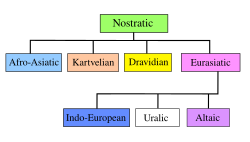
| Subdivisions |
|
| Language codes | |
| Glottolog | None |
| Notes | † indicates a dead language |

Nostratic is a hypothetical language macrofamily including many of the language families of northern Eurasia first proposed in 1903. Though the Nostratic hypothesis once had a measure of support among mainstream linguists, it is now generally considered a fringe theory with very low support. The exact composition of languages families included in Nostrastic varies based on proponent; it typically includes the Kartvelian, Indo-European, and the controversial Ural-Altaic family, as well as the Afroasiatic languages, and the hypothetical Elamo-Dravidian languages.
The Nostratic hypothesis originates with Holger Pedersen in the early 20th century. The name "Nostratic" is due to Pedersen (1903), derived from the Latin nostrates "fellow countrymen". The hypothesis was significantly expanded in the 1960s by Soviet linguists, notably Vladislav Illich-Svitych and Aharon Dolgopolsky.
The hypothesis has fallen out of favour since the latter half of the 20th century and has limited degrees of acceptance, predominantly among a minority of Russian linguists. Linguists worldwide mostly reject Nostratic and many other macrofamily hypotheses with the exception of Dené–Yeniseian languages, which has been met with some degree of acceptance.[2] In Russia, it is endorsed by a minority of linguists, such as Vladimir Dybo, but is not a generally accepted hypothesis.[citation needed] Some linguists take an agnostic view.[3][4][5][6] Eurasiatic, a similar grouping, was proposed by Joseph Greenberg (2000) and endorsed by Merritt Ruhlen.
History of research
[edit]Origin of the Nostratic hypothesis
[edit]The last quarter of the 19th century saw various linguists putting forward proposals linking the Indo-European languages to other language families, such as Finno-Ugric and Altaic.[7]
These proposals were taken much further in 1903 when Holger Pedersen proposed "Nostratic", a common ancestor for the Indo-European, Finno-Ugric, Samoyed, Turkish, Mongolian, Manchu, Yukaghir, Eskimo, Semitic, and Hamitic languages, with the door left open to the eventual inclusion of others.
The name Nostratic derives from the Latin word nostrās, meaning 'our fellow-countryman' (plural: nostrates) and has been defined, since Pedersen, as consisting of those language families that are related to Indo-European.[8] Merritt Ruhlen notes that this definition is not properly taxonomic but amorphous, since there are broader and narrower degrees of relatedness, and moreover, some linguists who broadly accept the concept (such as Greenberg and Ruhlen himself) have criticised the name as reflecting the ethnocentrism frequent among Europeans at the time.[9] Martin Bernal has described the term as distasteful because it implies that speakers of other language families are excluded from academic discussion.[10] However, some people like Pedersen's older contemporary Henry Sweet attributed some of the resistance by Indo-European specialists to hypotheses of wider genetic relationships as "prejudice against dethroning [Indo-European] from its proud isolation and affiliating it to the languages of yellow races".[11] Proposed alternative names such as Mitian, formed from the characteristic Nostratic first- and second-person pronouns mi 'I' and ti 'you' (more accurately 'thee'),[12] have not attained the same currency.
An early supporter was the French linguist Albert Cuny—better known for his role in the development of the laryngeal theory[13]—who published his Recherches sur le vocalisme, le consonantisme et la formation des racines en « nostratique », ancêtre de l'indo-européen et du chamito-sémitique ('Researches on the Vocalism, Consonantism, and Formation of Roots in "Nostratic", Ancestor of Indo-European and Hamito-Semitic') in 1943. Although Cuny enjoyed a high reputation as a linguist, the work was coldly received.
Moscow School of Comparative Linguistics
[edit]
While Pedersen's Nostratic hypothesis did not make much headway in the West, it became quite popular in the Soviet Union. Working independently at first, Vladislav Illich-Svitych and Aharon Dolgopolsky elaborated the first version of the contemporary form of the hypothesis during the 1960s. They expanded it to include additional language families. Illich-Svitych also prepared the first dictionary of the hypothetical language. Dolgopolsky's most recent Nostratic Dictionary was published in 2008, and is considered the most up-to-date attempt at a Nostratic lexicon.[14]
A principal source for the items in Illich-Svitych's dictionary was the earlier work of Alfredo Trombetti (1866–1929), an Italian linguist who had developed a classification scheme for all the world's languages, widely reviled at the time[15] and subsequently ignored by almost all linguists. In Trombetti's time, a widely held view on classifying languages was that similarity in inflections is the surest proof of genetic relationship. In the interim, the view had taken hold that the comparative method—previously used as a means of studying languages already known to be related and without any thought of classification[16]—is the most effective means to establish genetic relationship, eventually hardening into the conviction that it is the only legitimate means to do so. This view was basic to the outlook of the new Nostraticists. Although Illich-Svitych adopted many of Trombetti's etymologies, he sought to validate them by a systematic comparison of the sound systems of the languages concerned.
Constituent language families
[edit]The language families proposed for inclusion in Nostratic vary, but all Nostraticists agree on a common core of language families, with differences of opinion appearing over the inclusion of additional families.
The three groups universally accepted among Nostraticists are Indo-European, Uralic, and Altaic. While the validity of Altaic itself generally rejected by linguists, is taken for granted by Nostraticists. Nearly all also include the Kartvelian and Dravidian language families.[17]
Following Pedersen, Illich-Svitych, and Dolgopolsky, most advocates of the theory have included Afroasiatic, though criticisms by Joseph Greenberg and others from the late 1980s onward suggested a reassessment of this position.
The Sumerian and Etruscan languages, regarded as language isolates by linguists, are thought by some[who?] to be Nostratic languages as well. Others, however, consider one or both to be members of another macrofamily called Dené–Caucasian. Another notional isolate, the Elamite language, also figures in a number of Nostratic classifications.
In 1987 Joseph Greenberg proposed a similar macrofamily which he called Eurasiatic.[18] It included the same "Euraltaic" core (Indo-European, Uralic, and Altaic), but excluded some of the above-listed families, most notably Afroasiatic. At about this time Russian Nostraticists, notably Sergei Starostin, constructed a revised version of Nostratic which was slightly broader than Greenberg's grouping but which similarly left out Afroasiatic.
Beginning in the early 2000s, a consensus emerged among proponents of the Nostratic hypothesis. Greenberg basically agreed with the Nostratic concept, though he stressed a deep internal division between its northern 'tier' (his Eurasiatic) and a southern 'tier' (principally Afroasiatic and Dravidian). Georgiy Starostin (2002) arrives at a tripartite overall grouping: he considers Afroasiatic, Nostratic and Elamite to be roughly equidistant and more closely related to each other than to anything else.[19] Sergei Starostin's school has now re-included Afroasiatic in a broadly defined Nostratic, while reserving the term Eurasiatic to designate the narrower subgrouping which comprises the rest of the macrofamily. Recent proposals thus differ mainly on the precise placement of Kartvelian and Dravidian.
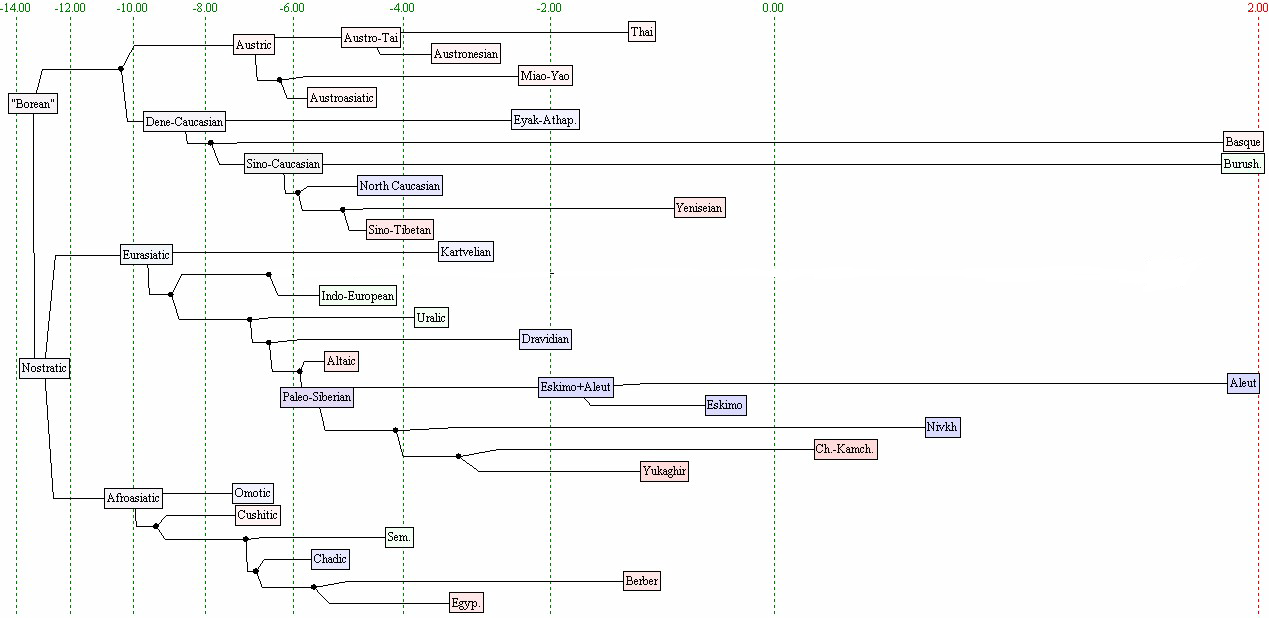
According to Greenberg, Eurasiatic and Amerind form a genetic node, being more closely related to each other than either is to "the other families of the Old World".[20] There are a number of hypotheses incorporating Nostratic into an even broader linguistic 'mega-phylum', sometimes called Borean, which would also include at least the Dené–Caucasian and perhaps the Amerind and Austric superfamilies. The term SCAN has been used for a group that would include Sino-Caucasian, Amerind, and Nostratic.[21] None of these proposed links have found wider acceptance outside of Nostraticists.
The following table summarizes the constituent language families of Nostratic, as described by Holger Pedersen, Vladislav Illich-Svitych, Sergei Starostin, and Aharon Dolgopolsky.
| Linguist | Indo-European | Afroasiatic | Uralic | Altaic | Dravidian | Kartvelian | Eskaleut | Yukaghir | Sumerian | Chukchi-Kamchatkan | Gilyak | Etruscan |
|---|---|---|---|---|---|---|---|---|---|---|---|---|
| Pedersen[22] | 
|
[a]
|
[b]
|
|

|
|
|
|
|
|
|
|
| Illich-Svitych[23] |
|
|
|
|
|
|
|
|
|
|
|
|
| Starostin[24] |
|
|
|
|
|
|
|
|
|
|
|
|
| Dolgopolsky[25] |
|
|
|
|
|
|
|
|
|
|
|
|
Proposed features of Proto-Nostratic
[edit]According to Dolgopolsky, the Proto-Nostratic language had analytic structure, which he argues by diverging of post- and prepositions of auxiliary words in descendant languages. Dolgopolsky states three lexical categories to be in the Proto-Nostratic language:
- Lexical words
- Pronouns
- Auxiliary words
Word order was subject–object–verb when the subject was a noun, and object–verb–subject when it was a pronoun. Attributive (expressed by a lexical word) preceded its head. Pronominal attributive ('my', 'this') might follow the noun. Auxiliary words are considered to be postpositions.
Status within comparative linguistics
[edit]The Nostratic hypothesis is not endorsed by the mainstream of comparative linguistics.
Nostraticists tend to refuse to include in their schema language families for which no proto-language has yet been reconstructed. This approach was criticized by Joseph Greenberg on the ground that genetic classification is necessarily prior to linguistic reconstruction,[26] but this criticism has so far had no effect on Nostraticist theory and practice.
Certain critiques have pointed out that the data from individual, established language families that is cited in Nostratic comparisons often involves a high degree of errors; Campbell (1998) demonstrates this for Uralic data. Defenders of the Nostratic theory argue that were this to be true, it would remain that in classifying languages genetically, positives count for vastly more than negatives (Ruhlen 1994). The reason for this is that, above a certain threshold, resemblances in sound/meaning correspondences are highly improbable mathematically.
Pedersen's original Nostratic proposal synthesized earlier macrofamilies, some of which, including Indo-Uralic, involved extensive comparison of inflections.[27] It is true the Russian Nostraticists initially emphasized lexical comparisons. Critics argue that were one to collect all the words from the various known Indo-European languages and dialects which have at least one of any four meanings, one could easily form a list that would cover any conceivable combination of two consonants and a vowel (of which there are only about 20×20×5 = 2000). Nostraticists respond that they do not compare isolated lexical items but reconstructed proto-languages. To include a word for a proto-language it must be found in a number of languages and the forms must be relatable by regular sound changes. In addition, many languages have restrictions on root structure, reducing the number of possible root-forms far below its mathematical maximum. These languages include, among others, Indo-European, Uralic, and Altaic—all the core languages of the Nostratic hypothesis. For a highly critical assessment of the work of the Moscow School, especially the work of Illich-Svitych, cf. Campbell and Poser 2008:243-264. Campbell and Poser argue that Nostratic, as reconstructed by Illich-Svitych and others, is "typologically flawed". For instance, they point out that, surprisingly, very few Nostratic roots contain two voiceless stops, which are less marked and should therefore occur more frequently, and where such roots do occur, in almost all cases the second stop occurs after a sonorant.[28] In summary, Campbell and Poser reject the Nostratic hypothesis and, as a parting shot, state that they "seriously doubt that further research will result in any significant support for this hypothesized macro-family."[29]
Proto-Indo-European *b[h]ars- seems to be a cultural loanword from Semitic (though several reputable Indo-Europeanists dispute this and consider it to be a native IE word). Much of the IE agricultural lexicon is not shared among all branches and seems to have been borrowed, thus supporting the view that the expansion of IE languages was post-Neolithic rather than a Neolithic one as postulated by Renfrew's theory.
See also
[edit]Notes
[edit]References
[edit]- ^ Campbell, Lyle (1998). Historical Linguistics: An Introduction. The MIT Press. p. 311. ISBN 978-0262518499.
- ^ Campbell, Lyle (2013). Historical linguistics : an introduction (Third ed.). Edinburgh. p. 346. ISBN 978-0-7486-7559-3. OCLC 828792941.
{{cite book}}: CS1 maint: location missing publisher (link) - ^ For instance Philip Baldi: "No particular side on the issue is taken in this book" (Baldi 2002:18).
- ^ Salmons, Joseph C.; Joseph, Brian D. (1998). Nostratic: Sifting the Evidence. John Benjamins Publishing. ISBN 978-90-272-3646-3.
On the other hand, Comrie baldly states, in answer to his own question of the relatedness of Altaic, Uralic and Indo-European pronominal systems, 'I do not know'. Other agnostics represented in this volume, such as Ringe, Vine, Campbell, and even Hamp, demonstrate that the hypothesis is being taken seriously indeed by skeptics specializing in Indo-European and Uralic, at least. While these scholars seek to test the hypothesis, Nostratic has been around long enough and has been discussed widely enough that some regard the genetic affiliations as established.
- ^ Manaster Ramer, Alexis; Michalove, Peter A. "Nostratic hypothesis | proposed language family". Encyclopedia Britannica.
The Nostratic theory is among the most promising of the many currently controversial theories of linguistic classification. It remains the best-argued of all the solutions hitherto presented for the affiliations of the languages of northern Eurasia, a problem that goes back to the German Franz Bopp and the Dane Rasmus Rask, two of the founders of Indo-European studies.
- ^ Kallio, Petri; Koivulehto, Jorma (2017). "Beyond Proto-Indo-European". In Klein, Jared; Joseph, Brian; Fritz, Matthias (eds.). Handbook of Comparative and Historical Indo-European Linguistics. Vol. 3. Walter de Gruyter. pp. 2280–2291. ISBN 978-3-11-054243-1.
In general, Nostratic studies have failed to meet the same methodological standards as Indo-European studies, but then again so have most non-Indo-European studies.
- ^ Sweet 1900: vii, 112–132.
- ^ Pedersen as cited by Ruhlen, 1991: 384.
- ^ Ruhlen 1991: 384-5.
- ^ Bernal (1987). "Nostratic and Euroasiatic". Black Athena. Rutgers University Press. ISBN 0-8135-3655-3.
- ^ Sweet (1900), The History of Language, cit in Ruhlen 1991: 381-2.
- ^ Ruhlen 1991:259.
- ^ Szemerényi 1996:124.
- ^ Dolgopolsky, Aharon (May 7, 2008). Nostratic Dictionary. ISBN 9781902937441 – via www.repository.cam.ac.uk.
- ^ Cf. Trombetti’s defense against his critics in Come si fa la critica di un libro (1907).
- ^ Cf. Greenberg 2005:159. See also Saussure's remarks on Franz Bopp, the founder of comparative linguistics, after Saussure has described the discovery of Indo-European by Cœurdoux and William Jones: "Bopp's originality is great. His merit is not to have discovered the kinship of Sanskrit with other European languages, but to have conceived that there was a subject for study in the precise relations of one related language to another related language." (From course notes by R. Engler, quoted by Tullio De Mauro in his critical edition of Ferdinand de Saussure, Cours de linguistique générale, Paris: Payot, 1972, p. 412; cp. Cours p. 14.)
- ^ Mallory, J.P.; Adams, D.Q. (2006). The Oxford Introduction to Proto-Indo-European & the Proto-Indo-European World (Oxford Linguistics). Oxford University Press. p. 84. ISBN 0199296685. Retrieved 2019-07-23.
- ^ Greenberg, J., "The Indo-European First and Second Person Pronouns in the Perspective of Eurasiatic, Especially Chukotkan", Anthropological Linguistics Vol. 39, No. 2 (Summer, 1997), p. 187.
- ^ Elamite. Starling.
- ^ Greenberg 2002:2.
- ^ Pinker, Steven. The Language Instinct: How the Mind Creates Language. William Morrow and Company: New York, 1994. p. 256
- ^ Nostratic : sifting the evidence. Joe Salmons, Brian D. Joseph, Workshop on Comparative Linguistics. Amsterdam: J. Benjamins. 1998. p. 53. ISBN 978-90-272-7571-4. OCLC 769188796.
{{cite book}}: CS1 maint: others (link) - ^ Nostratic : sifting the evidence. Joe Salmons, Brian D. Joseph, Workshop on Comparative Linguistics. Amsterdam: J. Benjamins. 1998. p. 25. ISBN 978-90-272-7571-4. OCLC 769188796.
{{cite book}}: CS1 maint: others (link) - ^ Shevoroshkin, Vitaly (1989). Explorations in language macrofamilies : Materials from the first International Interdisciplinary Symposium on Language and Prehistory, Ann Arbor 8-12 November 1988. Studienverlag Brockmeyer. p. 44. ISBN 3-88339-751-2. OCLC 475815004.
- ^ Dolgopolsky, A. B. (1998). The Nostratic macrofamily and linguistic palaeontology. Colin Renfrew, McDonald Institute for Archaeological Research. Cambridge: McDonald Institute for Archaeological Research. ISBN 0-9519420-7-7. OCLC 40689120.
- ^ Greenberg 2005:337.
- ^ Cf. Sweet 1900:115–120.
- ^ Campbell, Lyle (2008). Language classification : history and method. William John Poser. Cambridge, UK: Cambridge University Press. p. 250. ISBN 978-0-511-41450-3. OCLC 263493207.
- ^ Campbell 2008, p. 264.
Bibliography
[edit]- Baldi, Philip (2002). The Foundations of Latin. Berlin: Mouton de Gruyter.
- Bengtson, John D. (1998). "The 'Far East' of Nostratic". Mother Tongue Newsletter 31:35–38 (image files)
- Campbell, Lyle (1998). "Nostratic: a personal assessment". In Joseph C. Salmons and Brian D. Joseph (eds.), Nostratic: Sifting the Evidence. Current Issues in Linguistic Theory 142. John Benjamins.
- Campbell, Lyle, and William J. Poser (2008). Language Classification: History and Method. Cambridge: Cambridge University Press.
- Campbell, Lyle (2004). Historical Linguistics: An Introduction (2nd ed.). Cambridge: The MIT Press.
- Cuny, Albert (1924). Etudes prégrammaticales sur le domaine des langues indo-européennes et chamito-sémitiques. Paris: Champion.
- Cuny, Albert (1943). Recherches sur le vocalisme, le consonantisme et la formation des racines en « nostratique », ancêtre de l'indo-européen et du chamito-sémitique. Paris: Adrien Maisonneuve.
- Cuny, Albert (1946). Invitation à l'étude comparative des langues indo-européennes et des langues chamito-sémitiques. Bordeaux: Brière.
- Dolgopolsky, Aharon (1998). The Nostratic Macrofamily and Linguistic Paleontology. McDonald Institute for Archaeological Research. ISBN 978-0-9519420-7-9
- Dolgopolsky, Aharon (2008). Nostratic Dictionary. McDonald Institute for Archaeological Research. [1] Archived 2008-12-15 at the Wayback Machine
- Dybo, Vladimir (2004). "On Illič-Svityč's study ‘Basic Features of the Proto-Language of the Nostratic Language Family'." In Nostratic Centennial Conference: The Pécs Papers, edited by Irén Hegedűs and Paul Sidwell, 115-119. Pécs: Lingua Franca Group.
- Flannery, Kent V. (1969). In: P. J. Ucko and G. W. Dimbleby (eds.), The Domestication and Exploitation of Plants and Animals 73-100. Aldine, Chicago, IL.
- Gamkrelidze, Thomas V., and Vjačeslav V. Ivanov (1995). Indo-European and the Indo-Europeans, translated by Johanna Nichols, 2 volumes. Berlin and New York: Mouton de Gruyter. ISBN 3-11-014728-9
- Greenberg, Joseph (2000, 2002). Indo-European and its Closest Relatives. The Eurasiatic Language Family. (Stanford University), v.1 Grammar, v.2 Lexicon.
- Greenberg, Joseph (2005). Genetic Linguistics: Essays on Theory and Method, edited by William Croft. Oxford: Oxford University Press.
- Illich-Svitych, V. M. В. М. Иллич-Свитыч (1971-1984). Опыт сравнения ностратических языков (семитохамитский, картвельский, индоевропейский, уральский, дравидийский, алтайский). Введение. Сравнительный словарь. 3 vols. Moscow: Наука.
- Kaiser, M.; Shevoroshkin, V. (1988). "Nostratic". Annu. Rev. Anthropol. 17: 309–329. doi:10.1146/annurev.an.17.100188.001521.
- Kaiser, M. (1989). "Remarks on Historical Phonology: From Nostratic to Indo-European" Archived 2012-03-05 at the Wayback Machine. Reconstructing Languages and Cultures BPX 20:51-56.
- Manaster Ramer, Alexis (?). A "Glottalic" Theory of Nostratic Archived 2012-03-05 at the Wayback Machine.
- Norquest, Peter (1998). "Greenberg's Visit to Arizona". Mother Tongue Newsletter 31:25f. (image files)
- Renfrew, Colin (1991). "Before Babel: Speculations on the Origins of Linguistic Diversity". Cambridge Archaeological Journal. 1 (1): 3–23. doi:10.1017/S0959774300000238. S2CID 161811559.
- Renfrew, Colin, and Daniel Nettle, editors (1999). Nostratic: Examining a Linguistic Macrofamily. McDonald Institute for Archaeological Research. ISBN 978-1-902937-00-7
- Ruhlen, Merritt (1991). A Guide to the World's Languages, Volume 1: Classification. Edward Arnold. ISBN 0-340-56186-6
- Ruhlen, Merritt (1994). On the Origin of Languages: Studies in Linguistic Taxonomy. Stanford, California: Stanford University Press.
- Ruhlen, Merritt (1998). "Toutes parentes, toutes différentes". La Recherche 306:69–75. (French translation of a Scientific American article.)
- Ruhlen, Merritt (2001). "Taxonomic Controversies in the Twentieth Century". In: Jürgen Trabant and Sean Ward (eds.), New Essays on the Origin of Language 197–214. Berlin: Mouton de Gruyter.
- Salmons, Joseph C., and Brian D. Joseph, editors (1998). Nostratic: Sifting the Evidence. John Benjamins. ISBN 1-55619-597-4
- Stachowski, Marek, "Teoria nostratyczna i szkoła moskiewska".(pdf) – LingVaria 6/1 (2011): 241-274
- Starostin, Georgiy S. (1998). "Alveolar Consonants in Proto-Dravidian: One or More?". (pdf) Pages 1–14 (?) in Proceedings on South Asian languages
- Starostin, Georgiy S. (2002). "On the Genetic Affiliation of the Elamite Language". (pdf) Mother Tongue 7.
- Starostin, George; Kassian, Alexei; Trofimov, Artem; Zhivlov, Mikhail. 2017. 400-item basic wordlist for potentially "Nostratic" languages. Moscow: Laboratory for Oriental and Comparative Studies of the School of Advanced Studies in the Humanities, Russian Presidential Academy.
- Sweet, Henry (1900, 1995, 2007). The History of Language. ISBN 81-85231-04-4 (1995); ISBN 1-4326-6993-1 (2007)
- Szemerényi, Oswald (1996). Introduction to Indo-European Linguistics. Oxford: Oxford University Press.
- Trask, R. L. (1996). Historical Linguistics. New York: Oxford University Press.
- Yakubovich, I. (1998). Nostratic studies in Russia
Further reading
[edit]- Hage, Per. “On the Reconstruction of the Proto-Nostratic Kinship System”. In: Zeitschrift Für Ethnologie 128, no. 2 (2003): 311–25. http://www.jstor.org/stable/25842921.
- Manaster Ramer, Alexis (1993). “On Illič-Svityč's Nostratic Theory”. In: Studies in Language 17: 205—250
- WITCZAK K.T., KOWALSKI A.P. (2012). "Nostratyka. Wspólnota językowa indoeuropejska". In: Przeszłość społeczna. Próba konceptualizacji, red. S. Tabaczyński i in. (red.), Poznań, pp. 826–837.
÷==External links==
- Stefan Georg, 2013, Review of Salmons & Joseph, eds, Nostratic: Sifting the Evidence, 1997
- "Linguists debating deepest roots of language" – New York Times article on Nostratic (June 27, 1995)
- "What is Nostratic?" by John Bengtson, in Mother Tongue Newsletter 31 (1998), pages 33–38
- "Nostraticist Vladislav Markovich Illich-Svitych" – photograph, Nostratic poem (2002)
- Proposed descent tree for Borean languages, including Nostratic by Sergei Starostin
- Database query to Nostratic etymology on StarLing database (last modified 2006)
- Nostratic Dictionary by Aharon Dolgopolsky (2006): main page at Cambridge University DSpace Archived 2008-12-15 at the Wayback Machine and "Preface" by Colin Renfrew
Long-range comparative linguistics | |
|---|---|
| Concepts | |
| Language families | |
| Linguists |
|
| Journals | |
| Books | |
| Institutions and schools | |


| International | |
|---|---|
| Other | |

Nostratic languages
View on GrokipediaOverview
Definition
The Nostratic hypothesis proposes a hypothetical macrofamily, or superfamily, uniting several major language families of Eurasia and northern Africa through a common ancestral language known as Proto-Nostratic. This includes the Indo-European, Uralic, Altaic (encompassing Turkic, Mongolic, and Tungusic), Kartvelian, and Dravidian families as core components, with Afroasiatic and sometimes Elamo-Dravidian (including Elamite), Gilyak (Nivkh), Chukotko-Kamchatkan, and Eskimo-Aleut also incorporated in broader formulations.[2][3] The term "Nostratic" was coined in 1903 by Danish linguist Holger Pedersen, derived from the Latin nostrates, meaning "fellow countrymen," to evoke a shared prehistoric kinship among these languages.[4] Proto-Nostratic is estimated to have been spoken approximately 10,000 to 20,000 years ago, with proposed homelands situated in the Near East, Central Asia, or adjacent regions of Western Asia and Eastern Europe, based on linguistic and archaeological correlations.[2] At its core, the hypothesis posits genetic relatedness via regular sound correspondences—such as systematic shifts in consonants and vowels across the families—along with shared basic vocabulary (e.g., roots for kinship terms like *#abº- "father" and *#am(m)a "mother") and grammatical elements (e.g., pronouns like *mi "I" and case markers like *-mʌ), setting it apart from typological similarities or borrowings due to areal contact.[2]Constituent families
The Nostratic macrofamily hypothesis encompasses several major language families primarily from Eurasia and neighboring regions, with proposals varying on exact inclusions. Core families generally include Indo-European, Uralic, Altaic (comprising Turkic, Mongolic, and Tungusic branches), Dravidian, Kartvelian, and Afroasiatic (also known as Hamito-Semitic).[5] Occasional proposals incorporate additional families such as Eskimo–Aleut or Chukotko–Kamchatkan, though these are less commonly accepted within the standard Nostratic framework.[6] The inclusion of Altaic remains particularly debated due to questions about its genetic unity as a family, often leading to analysis of its components separately.[7] These families exhibit a broad geographic distribution across Eurasia, extending into South Asia for Dravidian languages and North Africa and the Middle East for Afroasiatic, consistent with hypotheses of ancient migrations from a common Eurasian homeland.[5]| Family | Examples of Modern Languages | Approximate Native Speakers | Primary Regions |
|---|---|---|---|
| Indo-European | English, Hindi, Greek | 3 billion | Europe, South Asia, Americas |
| Uralic | Finnish, Hungarian, Sami | 25 million | Northern Europe, Siberia |
| Altaic (Turkic) | Turkish, Kazakh, Uzbek | 170 million (Turkic alone) | Central Asia, Turkey |
| Altaic (Mongolic) | Mongolian, Buryat | 6 million | Mongolia, Inner Mongolia |
| Altaic (Tungusic) | Evenki, Manchu | 1 million | Siberia, Northeast China |
| Dravidian | Tamil, Telugu, Kannada | 250 million | South India, Sri Lanka |
| Kartvelian | Georgian, Svan, Mingrelian | 5 million | South Caucasus (Georgia) |
| Afroasiatic | Arabic, Hebrew, Amharic | 500 million | North Africa, Middle East, Horn of Africa |