


Community hub
Recent from talks
Contribute something
Nothing was collected or created yet.

Nyau (also: Nyao meaning mask[1] or initiation) is a secret society of the Chewa, an ethnic group of the Bantu peoples from Central and Southern Africa.[2] The Nyau society consists of initiated members of the Chewa people, forming the cosmology or indigenous religion of the people. Initiations are separate for men and for women, with different knowledge learned and with different ritual roles in the society according to gender and seniority. Only initiates are considered to be mature and members of the Nyau.[3][4]
The word Nyau is not only used for the society itself, but also for the indigenous religious beliefs or cosmology of people who form this society, the ritual dance performances, and the masks used for the dances. Nyau societies operate at the village level, but are part of a wide network of Nyau across the central and part of the southern regions of Malawi, eastern Zambia, western Mozambique and areas where Malawians migrated in Zimbabwe.[3][4]
During performances with the masks women and children often rush into the houses when a Nyau performer threatens, as the masks are worn by only male members of the society and represent male knowledge. At that moment in the performance and rituals, Nyau masked dancers are understood to be spirits of the dead. As spirits the masquerades may act with impunity and there have been attacks and deaths during performances in the past.[3][4] Increasing westernization has led to a decrease in Nyau.
History
[edit]A cave painting in Zaire depicts Kasiya Maliro, a type of Nyau mask that may date to 992 CE.[5] The Nyau cosmology continued during the time of the Ngoni invasions in the mid-1800s and during the time of early colonists including Portuguese and British. According to local mythologies Nyau came from Malomba, a place in what is now the DRC.[6] Due to heavy punishment for telling secrets to non-initiates about the Nyau cosmology (e.g. who are the men dancing) the origin of Nyau could not be clarified by the first missionaries and colonialists arriving in Maravi.[7] Penalties went as far as the person revealing secrets being killed by members of the society.[2]
The arrival of missionaries during the 1920s had a growing influence on Nyau at the village level, which produced open conflict.[3] Though Christian missionaries banned Nyau in Chewa communities, the society and its practice survived under British colonial rule through adaptation that included some aspects of Christianity. Presently, it is still practiced with Chewa members belonging both to a Christian church and the Nyau society.[8] Although some other ethnic groups have developed cultural dances, such as the Ngoni, Yao and Mang'anja,[9] the Nyau of the Chewa can be considered the most elaborate of the secret societies and dances in areas around Lake Malawi.[10]
Belief system
[edit]The Chewa believe that life exists within their ancestors and those not yet born, as well as the living.[11] The Nyau beliefs include communication with those who are dead, or their spirits, calling this act pemphero lalikulu ("Great Prayer").[8] Chewa believe in the presence of God in everyday life, and that God is both male (in the sky) and female (in the earth). Words for God include Chiuta, the great bow or rainbow in the sky and Namalango in the earth, like a womb, where seeds germinate and is a source of new life.[12]
The spirit world's symbolism is presented at the Gule Wamkulu ("Big Dance"), which incorporates mwambo ("traditions"), masks, song, dance and rules. Nyau incorporates sophisticated reverse role-playing, proverbs, mimicking and satire in performances. Primarily the Nyau perform their masked dances at funerals, memorial services and initiations (for girls: Chinamwali).[6][13][14][15]
Each dancer represents a special character relating to the mask or animal structure he wears. The zilombo ("wild animals") are large constructions that cover the entire body and mostly represent animals, and the masks worn over the face are primarily ancestral spirits. The secrecy behind Nyau incorporates coded language, riddles, metaphor, myths and signing. Viewed with suspicion by outsiders, Nyau has been misunderstood and misrepresented by others, including the Christian church.[6][13]
Initiation of men into the secret society begins with residing in a wooded grove, the place the dead are buried (cemetery) for a week or much longer in the past. Particularly in Zimbabwe, Nyau members that migrated from Malawi and are now part of the Shona Culture still practice Nyau rituals and hold Nyau religious beliefs. They perform dances in the suburbs of Mabvuku, Highfield and Tafara. They attempt to scare away people who wish to interview them saying "Wavekutamba nemoto unotsva" (you are now playing with fire you will get burnt).[16]
Women and children and also some men may rush into the houses when a Nyau performer appears. Nyau is the presence of the dead, an encounter with a spirit and so associated with fear and ritual dread. However, senior women perform in the Gule Wamkulu with intricate clapping, singing, dancing and chanting, responding to the song of the masquerader and are close to the dancers. During the funeral period, women joke with the Nyau in a practice called kasinja whilst brewing beer and while staying awake the night before a funeral. Men and women both enter the graveyard grove burials at the end of the Nyau funeral performance. Initiated women attend the Nyau performances freely, though they will deny knowledge of the men wearing masks.[3][6]
The men are actual spirits in the ritual, and cannot be spoken of as men even though women will recognize their husbands, fathers, brother and uncles. Identifying the man wearing a mask is disrespectful to the religion, breaking the moment when the masquerade is the spirit of the dead, much as calling Eucharist a biscuit breaks the ritual moment when Christ is near and would be considered disrespectful to Christians. Uninitiated women and children, and uninitiated men, may be chased by Nyau performers and non-members are discouraged from coming near during funerals. In part this is to avoid outsiders from being disrespectful, not understanding the importance of a 'good' burial and the significance of the presence of the dead.[3][6]
In Zambian villages, boys may participate in groups called kalumbu who join a group from as young as five or six.[3] They must pay a joining fee (often around 2 kwacha in 1993) which they raise by hunting and selling birds, or the fee is paid by their parents.[3] Upon joining the novices are often beaten with branches before learning the discipline.[3] The minimum age of boys or girls joining the Nyau itself is usually around ten years of age.[6][17]
Dances
[edit]
Nyau dances involve intricate footwork, flinging dust in the air. Dancers respond to specific drumbeats and songs depending on the mask type or character. The dancers, described as "fleet-footed or nimble-footed", appear in masks representing the dead, human being or animal; the weak-kneed run away from sights of such dances.[16] While it may be considered in many places to be a folk dance, this is certainly not the case; Nyau should rather be considered a religious dance, as its function is to communicate with the ancestral world.
Since 2005, Gule Wamkulu has been classified as one of the 90 Masterpieces of the Oral and Intangible Heritage of Humanity, a program by UNESCO for preservation of intangible cultural heritage. This dance form may date to the great Chewa Empire of the 17th century.[18] Gule Wamkulu, or big dance, is the best-known and longest dance of the Nyau. It is also known as pemphero lathu lalikulu la mizimu ("great prayer to our ancestors") or gulu la anamwaliri ("dance of the ancestors"). Prior to the Gule Wamkulu dance, Nyau dancers observe a series of secret rituals which are associated with their society, a secret brotherhood.[19]
The dance is mainly performed at funerals and memorial services but also at initiations and other celebrations. The masks worn by the dancers on such performances are in the form of animals or "beasts" such as antelopes believed to capture the soul or spirit of the deceased that brings renewed life. The purpose of the dance is said to be a way of communicating messages of the ancestors to the villagers and making possible continued harvests and continued life. Nyau is a protection against evil and an expression of religious beliefs that permeate society.[6][20]
Attire
[edit]The variety of masks resembling ancestors is huge and ever growing, unlike the animal structures. Some mask carvers are professionals while others are occasional artisans.[18] Over 400 masks which are associated with the Nyau society and the Gule wamkulu ritual are exhibited at the Chamare Museum in Dedza District, Malawi.[5]
Masks
[edit].jpg)
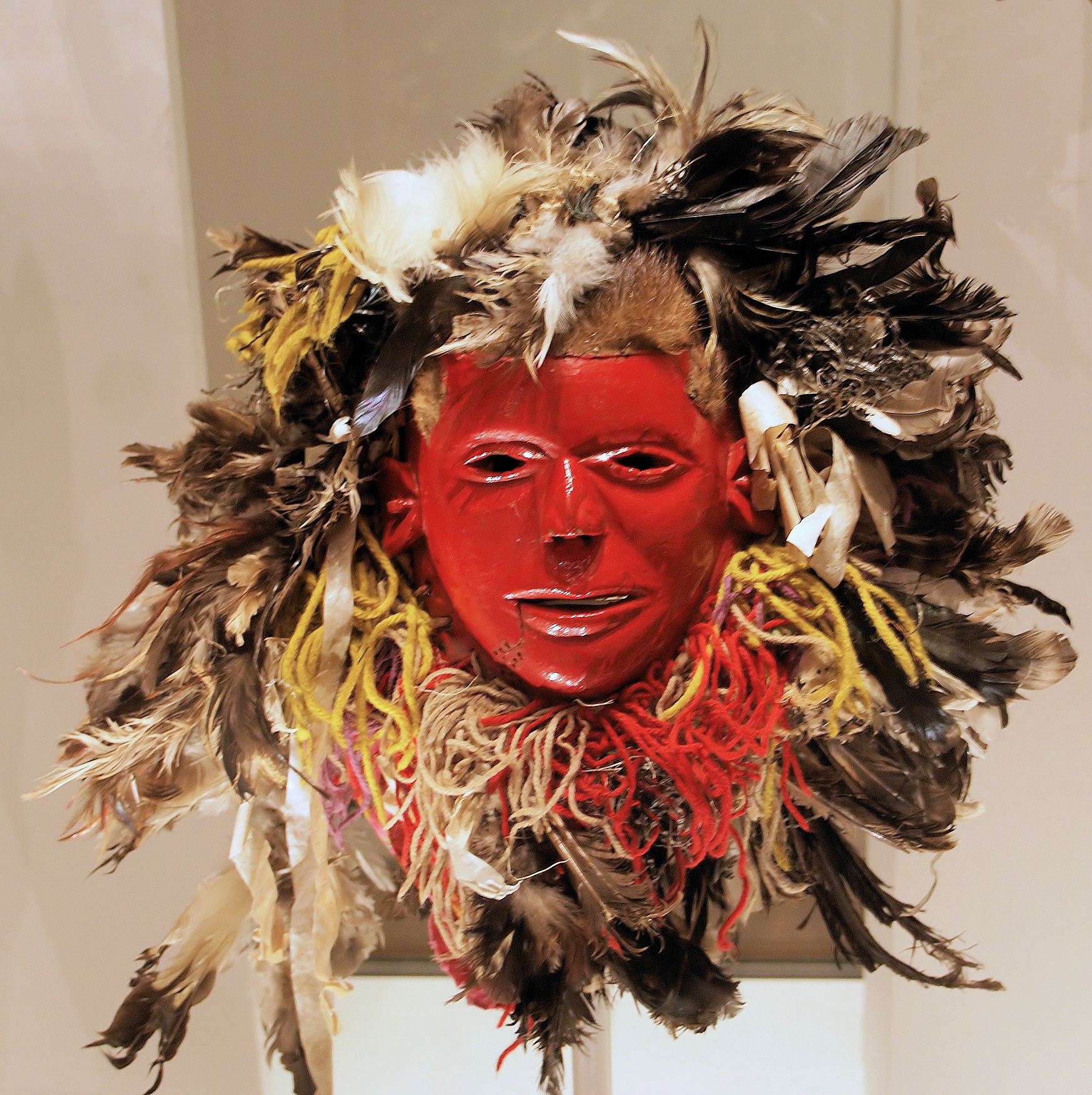
Nyau masks are constructed of wood and straw. and are divided into three types.[21] The first is a feathered net mask, the second is a wooden mask and the third is a large zoomorphic basketry structure that envelops the entire body of the dancer.[6][21] Wearing the latter, dancers tend to turn around and around in a motion known as Nyau yolemba.[21] They are representations of a large variety of characters, including wild animals such as antelope, lions and hyenas.[4]
With names such as Bwindi, Chibano, and Wakana, the masks portray a variety of traits and types such as a philanderer, a helpless epileptic, lust, greed, foolishness, vanity, infertility, sorcery, and ambition.;[13] even a helicopter.[18] As one Nyau member explains, the masks and performance represent all of humanity and all of the spirit world.[6]
There are a variety of mask types, some of which include:[2]
- Bwana wokwera pa ndege/pa galimoto (Mister in a plane/in a car) This mask shows how those who already had money and power in their lifetime will keep this even when they have passed in the ancestral world.
- Chabwera kumanda (the one who came back from the grave) is a character who misreads people and resembles an ancestor who hunts people in their dreams in order to get attention and offerings (e.g. beer, meat, etc.). His dance Chabwera kumanda chases people around which underlines his evil character.
- Kasinja or Kamchacha is the messenger of important ancestors. He sometimes partly plays some kind of moderator and tells which mask or animal is coming next to perform its dance.
- Kondola which originated as Msakambewa ("Mouse Hunter"), then changed into To Ndola (a man in a copper mining town), and then changed again, to Chizonono (someone afflicted with gonorrhea), is an example of a mask that has undergone transformation because of changing pressures and societal influences.
- Maliya (from Mary) represents a kind-hearted female ancestor. This dancer will sing and dance together with the people.
- Mfiti (male witch) wears a very nasty mask and has in general a very demolished and shaggy appearance. The outer shape resembles its evil character, since witches are believed to kill people with their juju.
- Simoni (from Saint Peter) wears a red mask, resembling an Englishman with sunburn; he also wears a suit made of rags. This character might be a caricature of an English colonialist.
Animal structures
[edit]The Nyau members wearing animal structures resemble wild animals or nyama za ku tchire, which appear at the time of death of people and therefore feared. There is some kind of hierarchy between the different animals, with some very respected animals (such as njobvu, the elephant) and some less important. Highly respected animals are also believed to resemble very important ancestors such as chiefs or members of the Nyau cult. Most animal structures usually have a barrel-like shape, with an entry hole at the bottom. Inside the structure, bars are mounted to be able to carry the structure around. All structures completely cover the dancer, and the footprints are brushed away with branches by Nyau members.[6] In the following some structures are explained in order of their importance.[2]
- Njobvu (the elephant) is the most important figure of all. Four Nyau dancers are needed to move this structure. Njobvu resembles an important chief, since the elephant is the most important animal for the Chewa, because of its size. Therefore, this rare structure is only seen at funerals for chiefs.
- Ndondo (the snake) is the second-most important structure and is carried around by up to twelve men. It also resembles an important ancestor and is often seen at funerals for members of the Nyau.
- Mkango (the lion) resembles the evil spirit of an ancestor, which attacks and even kills people. Therefore, some people run away as soon as they see Mkango approaching. The figure Mkango illustrates that ancestors must not be annoyed, just as a lion must not be annoyed, since it might attack people for their disrespect.
The antelope forms are considered the most beautiful and are widely known as Kasiyamaliro (to leave the funeral/burial behind). Standing ten feet tall and often covered in dried woven maize husks, these mask forms are the first to appear in performances to remember the deceased, as a sign that the deceased have now joined the spirits and ancestors. This is a time of remembrance and celebration of life.[6]
See also
[edit]References
[edit]- ^ D.D.Phiri: History of Malawi - From the earliest times to the year 1915. in: CLAIM, pp.31 (2004)
- ^ a b c d Van Breugel, J. W. M. (2001). Chewa Traditional Religion. Christian Literature Association in Malawi. pp. 125–168. ISBN 978-99908-16-34-1.
- ^ a b c d e f g h i Linden, Ian; Linden, Jane (1 January 1974). Catholics, peasants, and Chewa resistance in Nyasaland, 1889–1939. University of California Press. pp. 117–. ISBN 978-0-520-02500-4. Retrieved 19 June 2011.
- ^ a b c d Ottenberg, Simon; Binkley, David Aaron (2006). Playful performers: African children's masquerades. Transaction Publishers. p. 223. ISBN 978-0-7658-0286-6. Retrieved 19 June 2011.
- ^ a b Bell, Deborah (10 September 2010). Mask Makers and Their Craft: An Illustrated Worldwide Study. McFarland. pp. 36–. ISBN 978-0-7864-4399-4. Retrieved 18 June 2011.
- ^ a b c d e f g h i j k Birch de Aguilar, Laurel (1996). Inscribing the Mask: Nyau Ritual and Performance among the Chewa of central Malawi. Anthropos Institute, Sankt Augustin Germany and University of Freiburg Press.
- ^ R.S. Rattray: Some Folk-Lore Stories and Songs in Chinyanja, London: Society for the Promotion of Christian Knowledge (1907), pp. 178–79.
- ^ a b "Gule Wamkulu". Embassy of Malawi. 2007. Retrieved 18 June 2011.
- ^ J.M. Schofeleers: Symbolic and Social Aspects of Spirits Worship among the Mang'anja, Ph.D. Dissertation (1968) Oxford, pp. 307–415.
- ^ Hodgson, AGO (Jan–Jun 1933). "Notes on the Achewa and Angoni of the Dowa District of the Nyasaland Protectorate". Journal of the Royal Anthropological Institute. 63: 146. JSTOR 2843914.
- ^ Sitshwele, Miliswa (June 21, 2010). "The Elephant has Four Hearts: Nyau Masks and Rituals :a book review". The Origins Centre is an initiative of the University of the Witwatersrand. Archived from the original on 25 March 2012. Retrieved 18 June 2011.
- ^ Laurel Birch de Aguilar, Inscribing the Mask 1996
- ^ a b c Curran, Douglas (Autumn 1999). "Nyau Masks and Ritual". African Arts. 68 (3): 68–77. JSTOR 3337711.
- ^ Zubieta, Leslie F. (2006). The rock art of Mwana wa Chentcherere II rock shelter, Malawi : a site-specific study of girls' initiation rock art. African Studies Centre, Leiden.
- ^ Zubieta, Leslie F. (2016). "Animals' Role in Proper Behaviour: Cheŵa Women's Instructions in South-Central Africa". Conservation & Society. 14 (4): 406–415.
- ^ a b "Zimbabwe: Demystifying Intrigue of Nyau Culture". The Herald of the Government of Zimbabwe. 2010. Retrieved 18 June 2011.
- ^ Morris, Brian (14 September 2000). Animals and ancestors: an ethnography. Berg. pp. 135–. ISBN 978-1-85973-491-9. Retrieved 19 June 2011.
- ^ a b c "Gule Wamkulu". UNESCO. 2005. Retrieved 19 June 2011.
- ^ Kalusa, Walima T.; Mtonga, Mapopa (2 January 2010). Kalonga Gawa Undi X: a biography of an African chief and nationalist. African Books Collective. pp. 104–. ISBN 978-9982-9972-5-6. Retrieved 21 June 2011.
- ^ Breugel, J. W. M. van; Ott, Martin (2001). Chewa traditional religion. Christian Literature Association in Malawi. p. 167. ISBN 978-99908-16-34-1. Retrieved 21 June 2011.
- ^ a b c Harding, Frances (2002). The performance arts in Africa: a reader. Routledge. p. 291. ISBN 978-0-415-26198-2. Retrieved 19 June 2011.
Literature
[edit]- Boucher (Chisale), Claude When Animals Sing and Spirits Dance: Gule Wamkulu: the Great Dance of the Chewa People of Malawi. Kungoni Centre of Culture and Art, 2012
- Gerhard Kubik: Makisi nyau mapiko. Maskentradition im bantu-sprachigen Afrika. Trickster Verlag, München 1993
- W.H.J. Rangeley: Nyau in Kotakota District. The Nyasaland Journal No.2, 1949
- Laurel Birch de Aguilar Inscribing the Mask: Nyau Ritual and Performance among the Chewa of central Malawi, Anthropos Institute and University of Freiburg Press, 1996
Nyau is a secret society comprising initiated adult men of the Chewa people in Malawi, Zambia, and Mozambique, central to their indigenous cosmology and religious practices through ritual masked dances known as Gule Wamkulu.[1] The society enforces moral education, ancestor veneration, and social cohesion via performances featuring wooden masks depicting animals, spirits, and satirical human figures, which convey lessons on community values during energetic dances accompanied by drums and songs.[1] Originating in the 17th-century Chewa Empire, Nyau has endured colonial suppression and missionary conversions by adapting elements while maintaining secretive male initiations that transition boys into adulthood, fostering solidarity in the matrilineal Chewa structure.[1] These rituals occur at funerals, weddings, harvests, and chiefly events, where masked performers embody otherworldly beings to critique authority or address contemporary issues like disease prevention through symbolic narratives.[1] Inscribed by UNESCO in 2008 on the Representative List of the Intangible Cultural Heritage of Humanity, Gule Wamkulu highlights Nyau's cultural endurance, though modern commercialization for tourism and politics has diluted some traditional meanings.[1]
Historical Development
Origins and Early Spread
Nyau emerged among the Chewa people during the formative period of their ethnic consolidation, linked to the migrations and settlements of key clans such as the Banda, who roamed and clustered in the savannas of central-southern Africa around 1200 CE. These early Banda groups integrated into proto-Chewa societies across regions now comprising Malawi, Zambia, and Mozambique, where Nyau began as rudimentary communal dances tied to social regulation and ancestral veneration. Oral histories preserved within Chewa traditions attribute the initial development of these performances to ancestral lands like Phokera, emphasizing their role in maintaining order amid clan dispersals and environmental challenges, though archaeological evidence primarily corroborates broader Bantu settlement patterns rather than Nyau-specific artifacts.[2][3] The early spread of Nyau accompanied Chewa expansions southward from northern origins in areas associated with Luba-Lunda influences, embedding the society in village structures by the 14th century as populations adapted to agrarian lifestyles. Banda clan traditions, recorded in oral accounts, describe Nyau evolving into structured male initiations that enforced norms on kinship, labor, and fertility rites, distinct from elite Phiri clan practices and serving as a counterbalance within stratified Chewa communities. This dissemination occurred without centralized authority, relying on kinship networks and inter-village exchanges, prior to the consolidation of Maravi polities around 1480 CE.[4][5] Archaeological findings, including Iron Age sites with evidence of communal gatherings from the 11th-13th centuries, align with oral narratives of Banda arrivals marking pre-Maravi phases, supporting Nyau's establishment as a grassroots institution rather than a derived import. These practices prioritized causal enforcement of social hierarchies through ritual performance, fostering resilience in dispersed settlements without reliance on written records.[6]Colonial Interactions and Resistance
During the late 19th century, Scottish Presbyterian missions, establishing stations such as Livingstonia in 1875 and Blantyre in 1876, encountered Nyau societies among the Chewa in central Nyasaland (modern Malawi), viewing their masked performances and initiations as idolatrous barriers to conversion.[7] Nyau members countered missionary efforts by organizing disruptive Gule Wamkulu dances near mission outposts and during conversion ceremonies, employing animal-masked figures to intimidate potential Christian adherents and mock religious services, thereby preserving village-level adherence to ancestral rituals over imported doctrines.[8] This opposition stemmed from Nyau's role in upholding Chewa cosmological authority, which missions sought to dismantle through education and evangelism, leading to sporadic clashes documented in missionary ethnographies as early as the 1880s.[7] Under British colonial indirect rule formalized after the 1891 declaration of the Nyasaland Protectorate, Nyau societies leveraged their secrecy to evade outright suppression, maintaining exclusive male governance structures that resisted mission-imposed reforms challenging traditional hierarchies, such as prohibitions on polygamy and ritual masking. While colonial administrators tolerated Nyau to stabilize chiefly alliances, the societies subtly undermined mission influence at the grassroots by enforcing participation through nocturnal enforcements and selective revelations of "spirit" knowledge, countering Protestant and later Catholic (from 1901) drives toward cultural uniformity.[8] This adaptation preserved Nyau's autonomy amid fiscal policies like the 1895 hut tax, which spurred labor migration and eroded communal lands without directly targeting the brotherhood.[9] In the early 20th century, particularly around 1910-1930, Nyau activity intensified during funerals amid land pressures from estate expansions and Ngoni displacements, where performances reaffirmed Chewa identity and kin obligations disrupted by dispossession affecting over 20% of central district arable land by 1920.[10] Masked dancers, embodying ancestors, intervened in burial rites to sanction non-participants and ritually reclaim agency from colonial alienation, framing resistance not as overt rebellion but as causal continuity of indigenous social order against exogenous erosion.[8] Such events underscored Nyau's function in village opposition, where secrecy shielded male elders' authority from egalitarian missionary narratives, sustaining the brotherhood through adaptive persistence rather than assimilation.Post-Independence Evolution
Following the independences of Malawi on July 6, 1964, Zambia on October 24, 1964, and Mozambique on June 25, 1975, Nyau societies endured in rural Chewa strongholds across these nations, sustaining their functions in community governance amid national efforts to foster unified identities over ethnic divisions.[11] In rural Malawi and Zambia, Nyau groups maintained strict enforcement of social codes, often clashing with urban migration patterns that diluted traditional authority structures by the 1980s and 1990s.[12] Chewa migration to Zimbabwe, driven by labor opportunities in mines and farms since the mid-20th century, transplanted Nyau practices to peri-urban settlements, where as of the 2020s, migrant communities invoke the society's rituals to assert land claims and ethnic solidarity within Shona-dominated areas.[13] [14] These adaptations highlight Nyau's resilience, with groups in Harare suburbs and mining regions using initiatory networks to navigate disputes over resources, though this has sparked local tensions over perceived occult influences.[15] By the 2020s, Nyau-linked traditions gained overt political traction, exemplified by the August 30, 2025, Kulamba ceremony in Katete, Zambia, attended by Malawi's President Lazarus Chakwera, Zambia's President Hakainde Hichilema, and Mozambique's President Daniel Chapo, which integrated Chewa customs into displays of cross-border solidarity.[16] [17] This event, centered on homage to Chewa royalty, underscored Nyau's utility in nationalist narratives, drawing thousands and state resources to affirm cultural continuity against secular modernization pressures.[18]Societal Organization
Membership and Initiation Processes
Membership in the Nyau society is restricted to males of the Chewa people, with initiation serving as the primary mechanism for entry and conferring lifelong adult status within the community.[19] [1] Boys typically undergo initiation between the ages of 12 and 16, marking the transition from childhood to manhood and integrating them into the society's secretive structure.[19] This process is mandatory for full participation in Chewa male social roles, with membership recognized across villages once attained.[19] The initiation, known as part of the Nyau rites, involves seclusion in the bush for approximately three days under the supervision of elder members, where boys receive instruction in discipline, moral conduct, and societal duties.[19] Physical elements include beatings and tests of endurance to instill resilience and obedience, often framed through interactions with masked figures representing ancestral spirits.[20] Initiates swear oaths of secrecy binding them to conceal the society's knowledge and rituals, reinforced by threats of supernatural retribution for violations.[21] Within Nyau, members progress through informal hierarchical grades based on experience and village roles, starting as novices and advancing to senior positions such as local leaders or guardians responsible for oversight and enforcement.[22] There is no centralized authority; instead, authority disperses across village-based groups, with elders directing initiations and maintaining order.[22] Uninitiated males face exclusion from core societal privileges and are subject to harassment or physical penalties by Nyau members to uphold boundaries, including beatings for intrusions into restricted activities.[21] Breaches of secrecy by initiates trigger disciplinary measures, leveraging both communal pressure and invoked spiritual consequences to ensure compliance and perpetuate the society's control mechanisms.[21]Secrecy and Gender Exclusivity
Nyau enforces secrecy through binding oaths taken by initiates during male-only ceremonies, prohibiting disclosure of ritual knowledge, mask identities, and performance techniques to non-members, with historical enforcement including severe penalties such as physical harm or death for violations.[23][24] This structure positions Nyau as an esoteric fraternity, where revelation undermines the society's internal cohesion and authority.[25] Membership is strictly limited to men, excluding women from initiation and access to core secrets, thereby establishing Nyau as a domain of male-exclusive knowledge that contrasts with the matrilineal inheritance patterns prevalent among the Chewa.[10][25] Women are barred from witnessing unmasked performances or learning the fabrication and symbolism of Nyau artifacts, reinforcing a division where esoteric power resides with initiated males.[26] In practice, men assume central roles by donning masks to impersonate ancestral spirits during Gule Wamkulu dances, while women participate peripherally through singing, drumming, or provisioning, without penetrating the society's veiled operations.[25] This arrangement parallels but counters female initiation rites like Chinamwali, which impart domestic and relational skills to women in secrecy from men, yet Nyau's opacity ensures male ritual dominance amid shared communal functions.[27][28] The resulting exclusivity sustains male authority in social organization, preserving pre-colonial divisions of esoteric labor that balance matrilineal kinship, though it fosters external apprehensions—women often view Nyau performers as unpredictable forces due to withheld knowledge, distinguishing the society from transparent communal structures.[10][25]Cosmological Framework
Ancestral Spirits and Supernatural Beliefs
In Chewa ontology, the mizimu—spirits of deceased ancestors—operate as potent, active forces exerting causal influence over the living, manifesting as a "cold energy" that demands ritual appeasement to uphold moral taboos (mdulo), avert transgressions (kudula), and secure fertility and communal harmony. These spirits, integral to Nyau doctrine, are not passive remnants but dynamic intermediaries requiring libations, dances, and festivals to maintain equilibrium between life's cycles, with failure to engage them risking supernatural retribution observable in dreams or divinations channeled by spirit mediums (obwebweta).[29][30] Nyau dancers achieve temporary possession by these mizimu or hybrid animal-ancestral entities (nyama and mizimu) upon donning masks, transforming into the spirits themselves and gaining impunity to enforce ethical codes through amoral, transgressive demonstrations of sovereignty. This embodiment grants observable supernatural enforcement, as the possessed maskers—beyond human judgment—admonish deviance, promote fertility symbols like the mythical mother Makewana via masks such as Kasiya Maliro, and resolve imbalances like witchcraft threats via rituals (mwavi).[29][30][31] Within broader Chewa cosmology, Nyau doctrinally bridges the animate realms of ancestors, living, and unborn, privileging animistic energies ("hot" or "cold") and cyclical causality over dualistic or monotheistic impositions, thereby preserving indigenous metaphysical primacy where ancestral agency sustains social cohesion absent absolute good-evil binaries.[29][32]Symbolic Interpretations
Nyau masks function as liminal embodiments in the Chewa worldview, representing spirits that mediate between human society and ancestral or natural forces to enforce moral order through impersonation and performance. These symbols causally reinforce ethical conduct by evoking fear of supernatural retribution and humor in exaggeration, as dancers believed to be possessed spirits critique vices and authority without direct human accountability.[11][33] Specific masks satirize human failings, such as the Magwiragwira thief whose elongating nose illustrates the inescapable consequences of deceit, or Matako alingana baboon figures that mock sexual infidelity to underscore social equality and fidelity. Animal depictions often symbolize untamed primal instincts subdued by communal norms, like bull masks portraying unfaithful husbands to advocate abstinence and marital loyalty. Historical or contemporary caricatures, including those of leaders like Malawi's former president Dr. H. Kamuzu Banda, use satirical songs and features to decry abuses of power, drawing from elder accounts that link such representations to resistance against overreach.[34][35] This dual symbolism operates publicly as entertainment that veils private initiatory teachings, where masks like Chadzunda—depicting aged ancestors with wrinkles signifying virility and wisdom—impart lessons on respect for elders and inheritance disputes during funerals. Empirical interpretations from Chewa elders and anthropological analyses reveal masks' role in addressing modern perils, such as edzi figures warning against AIDS through behavioral caution, prioritizing causal efficacy in moral transmission over mere ritual display.[11][34][35]
Ritual Practices
Gule Wamkulu Performances
Gule Wamkulu performances consist of masked dancers executing ritual movements primarily at night, with participants solely comprising initiated adult males from the Nyau society.[1][36] Dancers wear elaborate full-body costumes constructed from straw, fibers, and other natural materials, topped with carved wooden masks representing diverse characters such as wild animals, human professions, and anthropomorphic figures.[1] These performances are synchronized to intense drum rhythms, interspersed with call-and-response songs performed by surrounding singers and onlookers.[37][38] The core mechanics emphasize mimetic imitation, where dancers embody their masked personas through stylized gestures, such as predatory prowls for animal characters or diagnostic motions for healer figures like Sing'anga.[1] Varieties of characters dictate specific movement patterns: animal representations involve aggressive lunges and chases, while human-like types incorporate satirical or instructional pantomimes.[37] Performers respond dynamically to drum cues, shifting between shuffling steps, high kicks, and group formations that simulate hunts or confrontations.[38] Physically demanding elements include acrobatic flips, endurance-sustaining spins, and the repetitive flinging of dust to generate swirling clouds, which heighten the visual and atmospheric intensity.[37][38] These feats require trained agility and stamina, often lasting hours, as dancers maintain anonymity and vigor under heavy regalia weighing up to several kilograms.[39] The overall execution prioritizes precision in timing and spatial control, with performers navigating crowded village spaces while avoiding uninitiated spectators.[36]Ceremonial Contexts and Functions
Nyau rituals, particularly Gule Wamkulu performances, occur primarily during funerals, initiations into manhood, weddings, and the installation or death of chiefs, marking critical transitions in Chewa social life.[1] These events trigger the dances as immediate responses to communal needs for honoring the deceased, welcoming initiates, or affirming authority, with performances often following the July harvest season when agricultural demands subside.[1] In Zambia, Nyau features prominently in the annual Kulamba ceremony, a harvest-related pilgrimage to the Chewa paramount chief near Katete, where dancers gather to symbolize unity and ancestral homage.[40][22] The functions of these ceremonies center on immediate social regulation, where masked performers entertain audiences through spectacle while visibly reinforcing hierarchies and deterring deviance via satirical imitations of improper conduct.[38] At funerals and remembrances, Nyau enacts rituals to appease spirits and guide mourners, channeling grief into structured communal action that upholds patrilineal oversight in matrilineal Chewa society.[41] Initiation contexts similarly use the dances to impose discipline on young men, embedding norms of secrecy and obedience through intimidating displays that condition participants against social infractions.[42] Regional differences influence frequency and form: in rural Malawi, rituals arise more routinely at local funerals and initiations due to dense Chewa populations and traditional authority structures, sustaining near-constant societal oversight.[42] In Zambia, urban adaptations reduce spontaneity, confining major performances to structured events like Kulamba, where migrant workers integrate Nyau into ceremonial calendars amid modernization pressures.[40] This variation reflects causal ties to settlement patterns, with rural density enabling reactive triggers versus urban scheduling for harvest pilgrimages.[22]Material Culture
Mask Fabrication and Types
Nyau masks are fabricated by specialized artisans, known as sing'anga or mask-makers, who are initiated members of the Nyau secret society among the Chewa people. These craftsmen carve masks primarily from local hardwood using adzes and knives in secluded bush locations distant from villages to preserve secrecy.[32] The process involves rough shaping of the wood, followed by detailed facial features, with small holes burned around the edges for ventilation and attachment of raffia or fiber fringes.[43] Surfaces are painted using natural pigments in colors such as red, black, and white, often applied in shiny finishes to evoke otherworldly appearances.[44] Additional elements like feathers, animal skins, straw, or basketry may be incorporated for texture and to represent faunal motifs, though synthetic materials like rubber and plastic have increasingly supplanted traditional ones since the late 20th century.[45] Skills in mask fabrication are transmitted orally and secretly within the Nyau brotherhood, from elder masters to younger initiates during private apprenticeships that emphasize both technical proficiency and spiritual knowledge.[32] This hereditary yet selective transmission has contributed to the craft's endangerment, as fewer young men pursue the labor-intensive traditional methods amid modernization and urbanization; documentation projects in regions like Zomba and Dedza, Malawi, initiated in 2024, aim to record these techniques ethnographically and digitally before further loss.[45] Nyau masks are classified into three main types based on form: anthropomorphic, zoomorphic, and abstract or hybrid designs, each serving as vessels for embodying spirits during rituals. Anthropomorphic masks depict human figures, such as elongated faces representing ancestors (chadzunda) or caricatures of foreigners with exaggerated noses and beards (mandevu).[34] Zoomorphic types portray animals, including baboon-like forms (matako alingana) or bulls (chimbano), carved to mimic natural features with added fur or feathers.[34] Abstract masks feature non-naturalistic elements, like multi-horned structures (chuma cha ana) or flaming heads (mbaula), constructed with layered wood and attachments to symbolize supernatural entities.[34] Variations exist regionally, with masks in Malawi tending toward intricate facial detailing, while those in bordering areas may incorporate larger structural elements.[44]