



Community hub
Recent from talks
Knowledge base stats:
Talk channels stats:
Members stats:
Olive
The olive (botanical name Olea europaea, "European olive") is a species of subtropical evergreen tree in the family Oleaceae. Originating in Asia Minor, it is abundant throughout the Mediterranean Basin, with wild subspecies in Africa and western Asia; modern cultivars are traced primarily to the Near East, Aegean Sea, and Strait of Gibraltar. The olive is the type species for its genus, Olea, and lends its name to the Oleaceae plant family, which includes lilac, jasmine, forsythia, and ash. The olive fruit is classed botanically as a drupe, similar in structure and function to the cherry or peach. The term oil—now used to describe any viscous water-insoluble liquid—was originally synonymous with olive oil, the liquid fat derived from olives.
The olive has deep historical, economic, and cultural significance in the Mediterranean. It is among the oldest fruit trees domesticated by humans, being first cultivated in the Eastern Mediterranean between 8,000 and 6,000 years ago, most likely in the Levant. The olive gradually disseminated throughout the Mediterranean via trade and human migration starting in the 16th century BC; it took root in Crete around 3500 BC and reached Iberia by about 1050 BC. Olive cultivation was vital to the growth and prosperity of various Mediterranean civilizations, from the Minoans and Myceneans of the Bronze Age to the Greeks and Romans of classical antiquity.
The olive has long been prized throughout the Mediterranean for its myriad uses and properties. Aside from its edible fruit, the oil extracted from the fruit has been used in food and for lamp fuel, personal grooming, cosmetics, soap making, lubrication, and medicine, while the wood of olive trees was sometimes used for construction. Owing to its utility, resilience, and longevity—an olive tree can allegedly live for thousands of years—the olive also held symbolic and spiritual importance in various cultures; its branches and leaves were used in religious rituals, funerary processions, and public ceremonies, from the ancient Olympic games to the coronation of Israelite kings. Ancient Greeks regarded the olive tree as sacred and a symbol of peace, prosperity, and wisdom—associations that have persisted. The olive is a core ingredient in traditional Middle Eastern and Mediterranean cuisines, particularly in the form of olive oil, and a defining feature of local landscapes, commerce, and folk traditions.
The olive is cultivated in all countries of the Mediterranean, as well as in Australia, New Zealand, the Americas, and South Africa. Spain, Italy, and Greece lead the world in commercial olive production; other major producers are Turkey, Tunisia, Syria, Morocco, Algeria, and Portugal. There are thousands of cultivars of olive tree, and the fruit of each cultivar may be used primarily for oil, for eating, or both, although some varieties are grown as sterile ornamental shrubs, and are known as Olea europaea Montra, dwarf olive, or little olive. Approximately 80% of all harvested olives are processed into oil, while about 20% are for consumption as fruit, generally referred to as "table olives".
The word olive derives from Latin ŏlīva 'olive fruit; olive tree', possibly through Etruscan 𐌀𐌅𐌉𐌄𐌋𐌄 (eleiva) from the archaic Proto-Greek form *ἐλαίϝα (*elaíwa) (Classic Greek ἐλαία elaía 'olive fruit; olive tree'). The word oil originally meant 'olive oil', from ŏlĕum, ἔλαιον (élaion 'olive oil'). The word for 'oil' in multiple other languages also ultimately derives from the name of this tree and its fruit. The oldest attested forms of the Greek words are Mycenaean 𐀁𐀨𐀷, e-ra-wa, and 𐀁𐀨𐀺, e-ra-wo or 𐀁𐁉𐀺, e-rai-wo, written in the Linear B syllabic script.
The olive tree, Olea europaea, is an evergreen tree or shrub native to Mediterranean Europe, Asia, and Africa. It is short and squat and rarely exceeds 8–15 m (25–50 ft) in height. Pisciottana—a unique variety comprising 40,000 trees found only in the area around Pisciotta in the Campania region of southern Italy—often exceeds this, with correspondingly large trunk diameters. The silvery green leaves are oblong, measuring 4–10 cm (1+1⁄2–4 in) long and 1–3 cm (3⁄8–1+3⁄16 in) wide. The trunk is typically gnarled and twisted.
Small, white flowers are borne generally on the previous year's wood, in racemes springing from leaf axils. Each flower is made of four yellowish white petals fused at the bottom joined to a base of four fused green sepals. The flower buds grow slowly from 4 to 6 weeks before they reach a length of about 2 cm and bloom, they bloom quicker between 5-6 days in hot weather and 2 weeks in colder areas. The flowers also pollinate and fertilize faster in hotter climates.
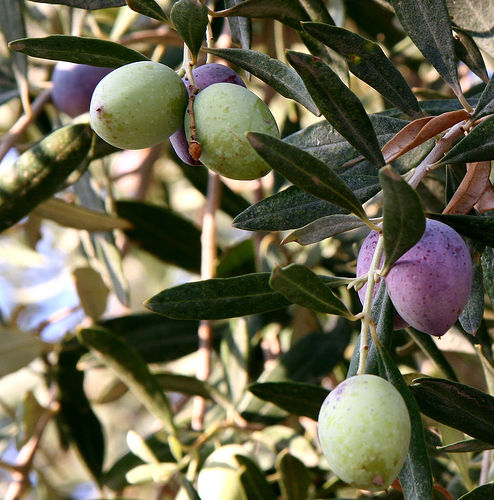
The fruit is a small drupe, 1–2.5 cm (3⁄8–1 in) long when ripe, thinner-fleshed and smaller in wild plants than in orchard cultivars. Olives are harvested in the green to purple stage. O. europaea contains a pyrena commonly referred to in American English as a "pit", and in British English as a "stone".
Hub AI
Olive AI simulator
(@Olive_simulator)
Olive
The olive (botanical name Olea europaea, "European olive") is a species of subtropical evergreen tree in the family Oleaceae. Originating in Asia Minor, it is abundant throughout the Mediterranean Basin, with wild subspecies in Africa and western Asia; modern cultivars are traced primarily to the Near East, Aegean Sea, and Strait of Gibraltar. The olive is the type species for its genus, Olea, and lends its name to the Oleaceae plant family, which includes lilac, jasmine, forsythia, and ash. The olive fruit is classed botanically as a drupe, similar in structure and function to the cherry or peach. The term oil—now used to describe any viscous water-insoluble liquid—was originally synonymous with olive oil, the liquid fat derived from olives.
The olive has deep historical, economic, and cultural significance in the Mediterranean. It is among the oldest fruit trees domesticated by humans, being first cultivated in the Eastern Mediterranean between 8,000 and 6,000 years ago, most likely in the Levant. The olive gradually disseminated throughout the Mediterranean via trade and human migration starting in the 16th century BC; it took root in Crete around 3500 BC and reached Iberia by about 1050 BC. Olive cultivation was vital to the growth and prosperity of various Mediterranean civilizations, from the Minoans and Myceneans of the Bronze Age to the Greeks and Romans of classical antiquity.
The olive has long been prized throughout the Mediterranean for its myriad uses and properties. Aside from its edible fruit, the oil extracted from the fruit has been used in food and for lamp fuel, personal grooming, cosmetics, soap making, lubrication, and medicine, while the wood of olive trees was sometimes used for construction. Owing to its utility, resilience, and longevity—an olive tree can allegedly live for thousands of years—the olive also held symbolic and spiritual importance in various cultures; its branches and leaves were used in religious rituals, funerary processions, and public ceremonies, from the ancient Olympic games to the coronation of Israelite kings. Ancient Greeks regarded the olive tree as sacred and a symbol of peace, prosperity, and wisdom—associations that have persisted. The olive is a core ingredient in traditional Middle Eastern and Mediterranean cuisines, particularly in the form of olive oil, and a defining feature of local landscapes, commerce, and folk traditions.
The olive is cultivated in all countries of the Mediterranean, as well as in Australia, New Zealand, the Americas, and South Africa. Spain, Italy, and Greece lead the world in commercial olive production; other major producers are Turkey, Tunisia, Syria, Morocco, Algeria, and Portugal. There are thousands of cultivars of olive tree, and the fruit of each cultivar may be used primarily for oil, for eating, or both, although some varieties are grown as sterile ornamental shrubs, and are known as Olea europaea Montra, dwarf olive, or little olive. Approximately 80% of all harvested olives are processed into oil, while about 20% are for consumption as fruit, generally referred to as "table olives".
The word olive derives from Latin ŏlīva 'olive fruit; olive tree', possibly through Etruscan 𐌀𐌅𐌉𐌄𐌋𐌄 (eleiva) from the archaic Proto-Greek form *ἐλαίϝα (*elaíwa) (Classic Greek ἐλαία elaía 'olive fruit; olive tree'). The word oil originally meant 'olive oil', from ŏlĕum, ἔλαιον (élaion 'olive oil'). The word for 'oil' in multiple other languages also ultimately derives from the name of this tree and its fruit. The oldest attested forms of the Greek words are Mycenaean 𐀁𐀨𐀷, e-ra-wa, and 𐀁𐀨𐀺, e-ra-wo or 𐀁𐁉𐀺, e-rai-wo, written in the Linear B syllabic script.
The olive tree, Olea europaea, is an evergreen tree or shrub native to Mediterranean Europe, Asia, and Africa. It is short and squat and rarely exceeds 8–15 m (25–50 ft) in height. Pisciottana—a unique variety comprising 40,000 trees found only in the area around Pisciotta in the Campania region of southern Italy—often exceeds this, with correspondingly large trunk diameters. The silvery green leaves are oblong, measuring 4–10 cm (1+1⁄2–4 in) long and 1–3 cm (3⁄8–1+3⁄16 in) wide. The trunk is typically gnarled and twisted.
Small, white flowers are borne generally on the previous year's wood, in racemes springing from leaf axils. Each flower is made of four yellowish white petals fused at the bottom joined to a base of four fused green sepals. The flower buds grow slowly from 4 to 6 weeks before they reach a length of about 2 cm and bloom, they bloom quicker between 5-6 days in hot weather and 2 weeks in colder areas. The flowers also pollinate and fertilize faster in hotter climates.
The fruit is a small drupe, 1–2.5 cm (3⁄8–1 in) long when ripe, thinner-fleshed and smaller in wild plants than in orchard cultivars. Olives are harvested in the green to purple stage. O. europaea contains a pyrena commonly referred to in American English as a "pit", and in British English as a "stone".