


Community hub
Recent from talks
Contribute something
Nothing was collected or created yet.
Onn Jaafar
View on Wikipedia
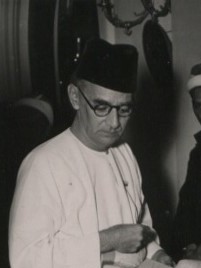
Onn bin Dato' Jaafar (Jawi: عون بن جعفر; 12 February 1895 – 19 January 1962) was a Malayan politician who served as the 7th Menteri Besar of Johor from 1947 to 1950. His organised opposition towards the creation of the Malayan Union (by the returning British colonial power after the end of the Japanese occupation of Malaya) led him to form the United Malays National Organisation (UMNO) in 1946; he was UMNO's founder and its first president until his resignation in 1951. He was famously known as the pioneer of organised anti-imperialism and early Malay nationalism within Malaya, which eventually culminated with the Malayan independence from Britain. He was also responsible for the social and economic welfare of the Malays by setting up the Rural Industrial Development Authority (RIDA).
Key Information


Early years
[edit]Onn's father was Jaafar Muhammad, the former Chief Minister of Johor. His mother was Roquaiya Hanim (also spelled Rogayah Hanim or Rukiye Hanım; 1864–1904), who came from the Caucasus region of the Ottoman Empire, and was either of Circassian or Georgian origin. She was likely presented as a concubine by the Ottoman court to the Sultan of Johor.[1][2] His mother was married three times and the last time was with his father. As Onn Jaafar's family had close relations with the Johor palace, Sultan Ibrahim treated him as an adopted son. He started his education in a Malay school in Johor Bahru. In 1904, he went to England to attend Aldeburgh Lodge School, a private school in Suffolk, with the then Tunku Mahkota of Johor until 1910. He excelled in sports and captained the school's cricket and football teams.[3]
He returned to Malaya and was enrolled at the Malay College Kuala Kangsar (MCKK) where he studied there for two years from 1910 to 1911. According to biographer Ramlah Adam, one of the main reasons for him to enroll at MCKK was the need to improve his Malay language proficiency that had weakened considerably following his time in England.[3]
After graduating from MCKK, he worked as a trainee clerk at the Johor Government Secretary office and was made a permanent clerk a year later. He served in this capacity in several departments before joining the Johor Military Forces in 1917 with the rank of lieutenant. Two years later, he rejoined the civil service. Soon after, he found himself in trouble with the Johor palace after expressing his unhappiness over the sale of his family's ancestral home. The royal palace did not take the issue kindly and terminated his service in June 1920. He rejoined the service again in 1921 as an Assistant Collector of Land Revenue.[3]
Malay nationalism and politics
[edit]Early Malay nationalism took root in Johor during the 1920s, he became a journalist and wrote articles on the welfare of the Malays. Some of Onn's articles were critical of Sultan Ibrahim's policies, which led to strained personal relations with the Sultan. In 1927, Sultan Ibrahim expelled Onn from Johor after he published an article in the Sunday Mirror, a Singapore-based English tabloid, which criticised the Sultan's poor treatment of the Johor Military Forces personnel and the welfare of the Orang Asli. He went into exile in Singapore and became the editor of a Malay paper, Warta Malaya, in 1930. Over the next six years, he edited four other newspapers including the Lembaga Malaya, Warta Ahad and Lembaga. Onn became very popular after he continued to cover issues on Malay grievances, and Sultan Ibrahim invited Onn to return to Johor in 1936.[3]
In 1941, following the Japanese occupation of Malaya, Onn was drafted into the administrative system and served as a food controller in Johor.
Onn, along with his companions, Haji Anwar bin Abdul Malik, Haji Syed Alwi bin Syed Sheikh al-Hadi and Mohamed Noah Omar, founded the United Malays National Organisation (UMNO) as a means to rally the Malays against the Malayan Union, which was perceived as threatening Malay privileges and the position of the Malay rulers. Onn took up the role of UMNO's president on 1 May 1946.
Malayan Union
[edit]The Malayan Union proposal provided that United Kingdom had full administrative powers over the Malay states except in areas pertaining spiritual and moral authority of the Malay rulers, which the Malays held in high esteem. Communal tensions between the Malays and Chinese were high, and the prospect of granting citizenship to non-Malays was deemed unacceptable to the Malays.[4] In particular, politicians in Johor were extremely unhappy with the willingness of Sultan Ibrahim to sign the treaties with Harold MacMichael, and voiced out that the Sultan had violated the terms in the Johor State Constitution which explicitly forbade any foreign powers to assume legitimate control over the state. Prior to February 1946, seven political dissidents led by Awang bin Hassan organised a rally to protest against the Sultan's decision to sign the treaties, and Onn Jaafar, who was then serving as a district officer in Batu Pahat, was invited to attend the rally.[5] The rally was held on 1 February 1946 at the Sultan Abu Bakar State Mosque, and protesters shouted nationalistic slogans and called for the dethronement of Sultan Ibrahim and accused him for committing treason against the Malay race by signing the treaties.
News of the rally reached Sultan Ibrahim on 22 February, who was then residing at Grosvenor House Hotel in London. Sultan Ibrahim approached the colonial office and withdrew his support of the proposal, but this did not appease the political dissidents and Onn continued to organise more rallies in the other Malay states to muster further support for his calls against the Malayan Union, and formed the United Malays National Organisation (UMNO) in May.[6]
To appease the Malays and the UMNO leaders, including Onn himself, Sultan Ibrahim personally donated a lump sum of $5,000 to UMNO and Onn was appointed the Menteri Besar of Johor in 1946.[7]
The establishment of the Federation of Malaya did not go down well with the ethnic Chinese, as favourable conditions for obtaining citizenship for the Chinese and other non-Malays were withdrawn. The Malaysian Chinese Association (MCA) was formed in 1949 under the leadership of a Straits Chinese businessman, Tan Cheng Lock who frequently raised grievances over the citizenship terms that were set when the Federation was established.[8] As a result, communal tensions between the Malays and Chinese surfaced, and Onn kept his distance from Tan. Tan encountered initial difficulties with meeting Sultan Ibrahim, who was not accustomed to working with Chinese businessmen.
Sultan Ibrahim also became increasingly disappointed in Onn's work commitment, whom he saw as neglecting state affairs as a result of his commitments towards UMNO. In early 1950, Sultan Ibrahim approached Onn, who was asked to choose between committing his efforts for UMNO and the state. Onn chose to the former, and resigned as the Menteri Besar of Johor in May.[9]
Leaving UMNO
[edit]Onn became increasingly disillusioned and disgusted with what he considered to be UMNO's race-based communalist policies, and called for party membership to be opened to all Malayans of all races, and for UMNO to be renamed as the United Malayans National Organisation. He left the party on 26 August 1951 after his recommendations went unheeded, and formed the Independence of Malaya Party (IMP). However, the IMP failed to receive sufficient backing from Malayans, and eventually Onn left it to form the Parti Negara, which placed membership restrictions on non-Malays in an attempt to appeal to Malays. He won the Kuala Terengganu Selatan seat in the Malayan parliament in the 1959 elections under his new party.[10]
Neither party gained popular support against Tunku Abdul Rahman's new Alliance coalition and he was eventually eclipsed in Malayan political life.
Election results
[edit]| Year | Constituency | Candidate | Votes | Pct | Opponent(s) | Votes | Pct | Ballots cast | Majority | Turnout | ||
|---|---|---|---|---|---|---|---|---|---|---|---|---|
| 1959 | P027 Kuala Trengganu Selatan | Onn Jaafar (Negara) | 7,986 | 59.78% | Engku Muhsein Abdul Kadir (UMNO) | 5,374 | 40.22% | 13,360 | 2,612 | 70,09% | ||
Death
[edit]
Dato' Onn died at the age of 66, on 19 January 1962 at the Officers' Ward, General Hospital, Johor Bahru.[12] He was buried next to his father Jaafar Muhammad's grave, at the Mahmoodiah Royal Mausoleum in Johor Bahru.
Family
[edit]His son Hussein Onn later became the third prime minister of Malaysia, his grandson, Hishammuddin Hussein is a senior UMNO politician, and his great-grandson Onn Hafiz Ghazi is the Johor State Chairman of UMNO who is serving as a member of the Johor State Legislative Assembly for Layang-Layang and as 19th menteri besar of Johor.
Awards and recognitions
[edit]Places named after him
[edit]- Bandar Dato' Onn, a suburb developed by the Johor Land Berhad in Johor Bahru, Johor
- Bulatan Dato Onn, a small roundabout located next to the Bank Negara Malaysia headquarters
- Jalan Dato Onn, a street in Kuala Lumpur and was previously known as Jalan Brockman or Brockman Road[13]
- Menara Dato' Onn, the UMNO general headquarters in Kuala Lumpur
- Kolej Dato' Onn, a residential college at National University of Malaysia, Bangi, Selangor
- Kolej Dato' Onn Jaafar, a residential college at Universiti Teknologi Malaysia, Skudai, Johor
- Kolej Dato' Onn, a residential college at Universiti Teknologi MARA, Machang, Kelantan
- SK Dato' Onn Jaafar, One of the component schools within the Sekolah Wawasan in Subang Jaya.
- Kampung Dato' Onn, a residential area within the suburb of Larkin, Johor.
Honours
[edit]Honours of Malaysia
[edit] Johor
Johor
 Second Class of the Royal Family Order of Johor (DK II) (1947)[14][15]
 Knight Commander of the Order of the Crown of Johor (DPMJ) – Dato' (1941)[16]
 Perak
Perak
 Knight Grand Commander of the Order of Cura Si Manja Kini (SPCM) – Dato' Seri (2015)[17]


.svg)
Foreign honours
[edit] United Kingdom
 Honorary Knight Commander of the Order of the British Empire (KBE) – Sir (1953)[18]

_Ribbon.png)
In popular culture
[edit]- Portrayed by Zaefrul Nordin in the 2007 film 1957: Hati Malaya directed by Shuhaimi Baba.
References
[edit]- ^ Mehmet Ozay; Ekrem Saltık (June 2015). "The Myth and Reality of Rukiye Hanim in the Context of Turkish Malay Relations (1864–1904)". İnsan & Toplum Dergisi (The Journal of Human & Society). 5 (9): 55–74. doi:10.12658/human.society.5.9.M0116.
- ^ "Taking root, branching out". The Star Online. 1 April 2007. Archived from the original on 4 August 2017.
- ^ a b c d Aristocrat who spoke his mind Archived 4 June 2011 at the Wayback Machine. 18 June 2007. The Star.
- ^ Bayly, Harper, Forgotten wars: Freedom and Revolution in Southeast Asia, pg 133-4
- ^ Bayly, Harper, Forgotten wars: Freedom and Revolution in Southeast Asia, pg 211
- ^ Bayly, Harper, Forgotten wars: Freedom and Revolution in Southeast Asia, pg 211-2
- ^ Bayly, Harper, Forgotten wars: Freedom and Revolution in Southeast Asia, pg 361
- ^ Bayly, Harper, Forgotten wars: Freedom and Revolution in Southeast Asia, pg 502-3
- ^ Ong, One Man's Will: A Portrait of Dato' Sir Onn bin Ja'afar, pg 184
- ^ Wong Chin Huat (17 August 2007). "Splits in Umno and Opposition unity". The Sun. Retrieved 29 September 2021 – via Malaysian Bar.
- ^ "Keputusan Pilihan Raya Umum Parlimen/Dewan Undangan Negeri" (in Malay). Election Commission of Malaysia. Retrieved 4 February 2017. Percentage figures based on total turnout.
- ^ Mohamed Abid (2003). Reflections of pre-independence Malaya. Subang Jaya, Selangor, Malaysia: Pelanduk Publications. p. 42. ISBN 967-978-865-2. OCLC 53896919.
- ^ Santhananaban, M. (16 April 2021). "LETTER | Putrajaya must honour Onn Jaafar". Malaysiakini. Retrieved 12 March 2022.
- ^ "STATE HONOUR FOR LADY IBRAHIM". The Singapore Free Press. 17 September 1947. Retrieved 2 February 2021.
- ^ Pengemudi Bahtera Merdeka Johor (in Malay). Abu Bakar bin Abdul Hamid, Zam Ismail, 1943-, Kamdi Kamil, 1949- (1st ed.). Johor Bahru, Johor: Yayasan Warisan Johor. 2012. p. 73. ISBN 978-983-2440-46-8. OCLC 870691698.
{{cite book}}: CS1 maint: others (link) - ^ Mohamed Abid (2003). Reflections of pre-independence Malaya. Subang Jaya, Selangor, Malaysia: Pelanduk Publications. p. 12. ISBN 967-978-865-2. OCLC 53896919.
- ^ "Perak honours six with posthumous awards". The Star. 28 November 2015. Retrieved 12 November 2019.
- ^ "No. 39863". The London Gazette (Supplement). 1 June 1953. p. 2973.
Further reading
[edit]- Ramlah Adam. (1992). Dato' Onn Ja'afar, pengasas kemerdekaan (1st ed.). Kuala Lumpur: Dewan Bahasa dan Pustaka. ISBN 983-62-2861-6. OCLC 29026780.
- Muhammad Faris Izzuwan, Adam, Ramlah binti, Samuri, Abdul Hakim bin & Fadzil, Muslimin bin (2004). Sejarah Tingkatan 3. Dewan Bahasa dan Pustaka. ISBN 983-62-8285-8.
- Goh, Cheng Teik (1994). Malaysia: Beyond Communal Politics. Pelanduk Publications. ISBN 967-978-475-4.

| International | |
|---|---|
| National | |
| Other | |

Onn Jaafar
View on GrokipediaEarly Life
Birth and Family Background
Onn bin Jaafar was born on 12 February 1895 in Bukit Gambir, Johor Bahru, within the Sultanate of Johor.[3][2] He was the only son of Dato' Jaafar bin Haji Muhammad, who held the position of the first Menteri Besar of Johor from 1886 to 1919 and played a key role in modernizing the state's administration under Sultan Abu Bakar.[2][3] His mother, Roquaiya Hanim (also known as Rogayah Hanim or Rukiye Hanım), originated from the Ottoman Empire and was of Turkish or Circassian descent; she passed away in 1904 when Onn was nine years old.[3][5] The family's proximity to power stemmed from Dato' Jaafar's longstanding service to the Johor court, fostering alliances with the sultanate that positioned Onn within Malay aristocratic circles from an early age.[3] Sultan Ibrahim of Johor, who ascended in 1895, treated Onn as an adopted son, reflecting the intertwined elite networks of the era.[3] This background imbued Onn with a sense of noblesse oblige toward Malay interests, amid Johor's semi-autonomous status under British influence.[2]Education and Formative Influences
Onn Jaafar commenced his formal education at a Malay vernacular school in Johor Bahru, where he received instruction in Malay language and Islamic studies alongside basic English exposure typical of colonial-era schooling for local elites.[2] In 1904, at age nine, he departed for England, enrolling at Aldeburgh Lodge School in Suffolk, a private preparatory institution that provided him with an immersion in British academic and cultural norms. Upon returning to Malaya around 1910, Onn Jaafar attended the Malay College Kuala Kangsar (MCKK), an elite residential institution founded in 1905 to groom promising Malay youths for administrative roles under British colonial oversight; he studied there for approximately two years, gaining proficiency in English-medium subjects and interacting with peers from aristocratic backgrounds.[3] This progression from local vernacular education to elite colonial schooling equipped him with bilingual capabilities and a comparative understanding of governance systems. His formative influences stemmed prominently from his aristocratic lineage as the son of Dato’ Jaafar bin Mohammad, Johor's inaugural Menteri Besar (Chief Minister), whose tenure exposed Onn to the intricacies of sultanate administration and negotiations with British authorities.[2][1] The liberal orientation of his British education, emphasizing individual agency and institutional reform, contrasted with traditional Malay feudal structures and cultivated his early nationalist inclinations, evident in his subsequent advocacy for Malay educational advancement amid colonial demographic shifts favoring immigrant communities.[3] Additionally, enlisting as a cadet officer in the Johor Military Force on July 5, 1917, instilled military discipline and a sense of organized resistance, shaping his approach to collective Malay mobilization.[2]Early Career
Journalism and Media Involvement
Onn Jaafar entered journalism in the early 1930s following a period of exile in Singapore, where he established himself as an editor of Malay-language publications. He became the inaugural editor of Warta Malaya, a daily newspaper launched on 1 January 1930 by Warta Malaya Press Ltd., holding the position until 1933.[6] [7] In this role, he contributed articles advocating Malay nationalism, critiquing colonial influences and communal complacency among Malays.[2] During his tenure and subsequent years, Onn edited additional outlets, including Lembaga Malayu (also known as the Malaya Tribune), over a span that encompassed at least four newspapers between 1930 and 1936.[1] [3] These platforms served as vehicles for his reformist ideas, emphasizing education, economic self-reliance, and resistance to perceived threats to Malay identity under British rule. His editorial stance was marked by direct challenges to traditional elites and calls for modernization, earning him recognition as a pioneering voice in Malay media despite occasional censorship pressures from authorities.[8] Onn's journalistic output extended beyond routine reporting to opinion pieces and columns that influenced early political discourse, laying groundwork for his later activism. He was noted for his incisive prose and oratory-like intensity in print, which resonated amid rising interwar tensions in the Malay Peninsula.[2] By the mid-1930s, his media work had positioned him as a key figure in fostering proto-nationalist sentiment, though it also drew scrutiny from colonial administrators wary of anti-establishment rhetoric.[3]Initial Political Activism and Conflicts
Onn Jaafar's initial political activism emerged in the mid-1920s while employed as a civil servant in the Johor state administration, where he began voicing public criticisms against perceived abuses by the ruling authorities. He targeted Sultan Ibrahim specifically for the inadequate treatment of Johor Military Forces personnel, neglect of Orang Asli welfare, and monopolistic business practices that disadvantaged ordinary Malays. A personal flashpoint involved Onn's condemnation of the Sultan's decision to auction his late father Dato' Jaafar's property to recover debts, which Onn viewed as exploitative given his father's prior service as a state advisor indebted through palace loans.[3][9][10] These outspoken positions, expressed through writings and direct appeals, positioned Onn as an early challenger to absolutist palace politics in Johor, blending personal grievances with broader advocacy for Malay interests against elite overreach. The Sultan regarded such dissent as disloyalty, leading to Onn's formal exile from Johor to Singapore in 1927, a ban that lasted until 1936. This episode underscored a core conflict in his early career: the tension between traditional royal prerogatives and emerging demands for accountable governance, with Onn prioritizing community welfare over deference to authority.[8][3][11] Upon returning to Johor in 1936—invited back by Sultan Ibrahim after gaining widespread Malay support for highlighting communal issues—Onn resumed administrative roles but maintained a reformist stance, critiquing colonial influences alongside local power structures. His pre-World War II activities focused on mobilizing Malay opinion through associations and public speeches, laying groundwork for organized resistance without formal party structures. These efforts, though not yielding immediate institutional changes, established Onn's reputation as a principled agitator, often at personal cost, against both indigenous elites and British oversight in Johor.[3][8]Malay Nationalism
Founding of UMNO
In response to the British-proposed Malayan Union plan, which aimed to centralize colonial administration and extend citizenship rights to non-Malays, thereby diluting traditional Malay privileges in land ownership and political authority, Onn Jaafar initiated efforts to consolidate fragmented Malay associations.[3] Beginning in early 1946, he convened the first Pan-Malayan Malay Congress in Johor Bahru on March 22–23, uniting over 40 Malay organizations to articulate unified opposition.[12] This gathering resolved to form a single national body to safeguard Malay interests, marking the genesis of organized resistance.[2] Subsequent congresses built momentum, with the second held in April and the third culminating on May 11, 1946, at Istana Besar in Johor Bahru.[3] At this assembly, delegates formally established the United Malays National Organisation (UMNO), electing Onn Jaafar as its inaugural president.[12][2] The party's constitution emphasized defending Malay sovereignty, culture, and economic rights against colonial reforms perceived as eroding ethnic primacy.[3] UMNO's rapid formation galvanized Malay elites, including sultans and local leaders, channeling protests into structured petitions and boycotts that pressured British authorities to reconsider the Malayan Union by February 1948.[12] Onn's leadership, drawing from his prior roles in Johor politics and journalism, positioned the organization as the vanguard of Malay nationalism, though internal debates persisted over its exclusively ethnic focus.[2]Opposition to the Malayan Union
Dato' Onn Jaafar led the organized Malay resistance against the Malayan Union, a British colonial proposal unveiled in January 1946 that centralized power under a British governor, reduced the sovereignty of the Malay sultans, and granted automatic citizenship to non-Malays, thereby diluting Malay political privileges.[8] [3] As a prominent Johor aristocrat and editor of the Malay newspaper Warta Malaya, Onn mobilized public sentiment through editorials and speeches decrying the scheme as a betrayal of Malay rights secured under pre-war treaties.[2] Onn initiated the All-Malaya Malay Congresses in February 1946, uniting over 40 Malay associations to coordinate opposition strategies, including petitions to the sultans and protests against the MacMichael Treaties that coerced ruler assent.[13] These efforts peaked with the Third Malay Congress on 11 May 1946, where delegates formally established the United Malays National Organisation (UMNO) under Onn's presidency to serve as the vanguard of Malay nationalism.[12] [14] UMNO, directed by Onn, orchestrated widespread demonstrations across the peninsula, featuring hartals (general strikes), boycotts of British goods and officials, and rallies where participants donned white armbands symbolizing mourning for lost sovereignty.[3] Onn personally advised the sultans to boycott the installation of Governor Sir Harold MacMichael and lobbied for the treaties' repudiation, framing the Union as an existential threat to Malay identity and land rights.[13] His charismatic oratory galvanized tens of thousands, with peak protests in Johor and Selangor drawing over 10,000 participants each.[8] The unrelenting campaign, sustained through UMNO branches in every state, compelled British concessions; by July 1947, the Malayan Union was dissolved, supplanted by the Federation of Malaya in February 1948, which reinstated sultanate powers and imposed stricter citizenship criteria favoring Malays.[2] Onn's leadership in this episode solidified his status as the architect of modern Malay political unity, though it strained relations with some rulers who initially acquiesced to British pressure.[3]Leadership Roles
Tenure as Menteri Besar of Johor
Dato' Onn Jaafar was confirmed as the seventh Menteri Besar of Johor on 1 October 1946, succeeding Dato' Ungku Abdul Aziz bin Ungku Abdul Majid amid the post-World War II reconfiguration of colonial administration.[2] In this position, he acted as the state's chief advisor to Sultan Ibrahim Iskandar and head of the executive council, managing local governance, land administration, and economic recovery efforts in a period marked by Japanese occupation aftermath and emerging Malay nationalist sentiments.[2] His appointment coincided with heightened tensions over British colonial policies, allowing him to bridge state-level duties with broader advocacy for Malay rights. Onn's administration emphasized bolstering rural Malay economic resilience, including initiatives to enhance agricultural output and curb land alienation to non-Malays. He laid groundwork for cooperative societies and industrial training programs tailored to rural communities, reflecting his commitment to self-reliance amid fears of demographic and economic marginalization. These efforts aligned with his parallel national role in UMNO, where he channeled state resources toward organizing Malay unity against centralizing colonial reforms.[15] Onn resigned from the post in early 1950, citing the need to focus exclusively on UMNO's national agenda and independence negotiations, after approximately three and a half years of service.[2] His departure marked a shift from state to federal priorities, though his tenure solidified Johor's administrative modernization and reinforced Malay political influence at the local level.[16]Negotiations for the Federation of Malaya
Following the widespread Malay protests against the Malayan Union, organized under Onn Jaafar's leadership through the newly formed United Malays National Organisation (UMNO) in 1946, the British colonial authorities abandoned the Union plan and initiated negotiations for a revised constitutional framework.[3][17] These discussions, commencing in late 1946, involved consultations with the Malay Rulers and representatives from Malay organizations, with Onn playing a pivotal role in articulating demands to safeguard Malay sovereignty, land rights, and political primacy.[3] As UMNO president, Onn corresponded directly with Governor Sir Edward Gent, critiquing initial federation proposals in a letter dated February 17, 1947, to ensure they did not dilute protections for the Malay community beyond what the protests had secured.[18] In early 1947, Onn participated in key meetings, including one on January 10, 1947, alongside colonial officials and Malay leaders, where he pressed for the retention of the Rulers' authority over Malay states and the exclusion of non-Malays from automatic citizenship to preserve ethnic balances.[3] His influence extended to defining "Malay" identity in constitutional terms, emphasizing cultural, linguistic, and customary criteria to consolidate communal privileges under the emerging federation.[19] The negotiations culminated in the Federation of Malaya Agreement, signed on February 21, 1948, by the nine Malay Rulers and the British Crown, which restructured the territories into a federation of protected states and settlements, restoring pre-war Malay state structures while granting limited citizenship to long-term residents—provisions shaped by Onn's advocacy against broader enfranchisement.[4][20] Onn's strategic engagement ensured the agreement prioritized Malay special rights, including language, religion, and rulers' roles, as a bulwark against perceived threats from Chinese and Indian immigrant populations, setting the stage for self-governance while averting further unrest.[17] This outcome reflected the causal impact of UMNO's mobilization, which compelled British concessions without direct Malay concessions on core demands.[3] The Federation took effect on February 1, 1948, replacing the Malayan Union and establishing a federal structure with a central government in Kuala Lumpur, where Onn continued to influence policy as a prominent figure.[4]Evolution in Politics
Departure from UMNO
Onn Jaafar advocated for broadening UMNO's base amid growing calls for multi-racial cooperation in the prelude to Malayan independence. At the party's biannual General Assembly in March 1951, he warned delegates of the risks posed by racial exclusivity, citing rumors of emerging multi-racial political formations that could sideline UMNO if it remained Malay-centric.[4] He proposed amending the party constitution to allow non-Malay membership, envisioning a rebranding to the United Malayan National Organisation to foster national unity.[3] The proposal encountered fierce resistance from UMNO's conservative faction, which viewed it as a dilution of Malay primacy and a betrayal of the party's founding ethos against non-Malay dominance in colonial-era proposals like the Malayan Union.[3] [4] Party ultras argued that opening membership would undermine efforts to secure Malay political and economic safeguards, prioritizing communal preservation over expansive alliances. Onn's push reflected his evolving view that independence required transcending ethnic silos, but it alienated core supporters wedded to ketuanan Melayu principles.[15] Faced with unyielding opposition, Onn tendered his resignation as UMNO president on 26 August 1951, marking the end of his seven-year leadership tenure.[11] Initial support from some Central Executive Committee members for collective resignation dissipated, solidifying the party's rejection of his vision. This schism highlighted internal tensions between Onn's pragmatic nationalism and the entrenched communalism that would define UMNO's trajectory under his successor, Tunku Abdul Rahman.[4]Formation of Independence of Malaya Party and Parti Negara
Following his resignation from the presidency of UMNO on August 26, 1951, due to the party's rejection of his proposal to open membership to non-Malays and pursue a multi-racial approach to independence, Onn Jaafar established the Independence of Malaya Party (IMP) on September 16, 1951, in Kuala Lumpur.[4][3] The IMP was designed as a non-communal, multi-racial organization drawing from former members of the Communities Liaison Committee, with the explicit goal of uniting Malays, Chinese, Indians, and other communities to achieve Malayan independence within ten years through inter-communal cooperation and a shared "Malayan outlook."[4] Onn positioned the party against UMNO's emphasis on Malay supremacy, advocating for citizenship reforms and economic integration to foster national unity, though it struggled to gain traction among Malay voters wary of diluting ethnic protections.[4] The IMP's electoral debut in the December 1952 Kuala Lumpur municipal elections proved disastrous, securing only two seats out of 12 contested, while the ad hoc UMNO-MCA alliance captured the remaining nine, highlighting the appeal of communal alliances over Onn's vision of non-racial politics.[21] This defeat, coupled with internal challenges and limited Malay support, prompted Onn to dissolve the IMP and pivot toward a new formation. In February 1954, following consultations with IMP leaders and Malay state chief ministers, he founded Parti Negara (National Party) as a successor entity, initially retaining multi-racial aspirations but introducing membership restrictions favoring Malays to recapture ethnic Malay allegiance and counter UMNO's dominance.[4][3] Parti Negara emphasized national unity under Malay leadership, with Onn serving as its second president from December 10, 1955, until 1962, though it too faltered in the 1955 federal elections, winning just 1.5% of the vote and no parliamentary seats.[4]Controversies
Clashes with Johor Royalty
Onn Jaafar's early career involved direct confrontations with Sultan Ibrahim of Johor, stemming from his criticisms of royal policies and personal conduct. In June 1920, while serving in a junior government role, Onn expressed public dissatisfaction with the Sultan's decision to sell what he regarded as his family's ancestral property, leading to his dismissal from service by the palace.[10] He was reinstated in 1922 following intervention by Tunku Ismail, the Sultan's heir, highlighting the personal ties Onn's family had with the palace despite the rift.[10] The most significant clash occurred in 1927, when Onn published an article in the Singapore-based Sunday Mirror condemning Sultan Ibrahim's controversial relationship and marriage to Helen Bartholomew Wilson, a British woman, amid ongoing polygamous royal marriages and perceived favoritism.[9] Onn also criticized broader royal policies, including the mistreatment of Johor Military Forces personnel and neglect of Orang Asli welfare, framing them as injustices against subjects.[9] In response, Sultan Ibrahim banished Onn from Johor, resulting in a nine-year exile in Singapore from 1927 to 1936, during which Onn worked as a journalist and built his political networks.[19] [9] Onn later reflected on the banishment as a consequence of opposing "injustice towards his subjects," underscoring his prioritization of public accountability over deference to authority.[19] Onn was recalled to Johor in 1936 by Sultan Ibrahim, allowing his return to state service and eventual rise.[9] Despite these earlier expulsions, Onn was appointed Menteri Besar of Johor in 1946 under the post-war British administration, navigating residual palace influence while advocating for Malay interests against colonial reforms.[10] No further public dismissals occurred during this tenure, though Onn's history of challenging "inconsiderate palace politics" persisted as a hallmark of his approach to feudal authority.[3] These clashes illustrated Onn's willingness to critique entrenched royal privileges, even at personal cost, in pursuit of accountable governance.[19]Criticisms of Racial Exclusivity and Political Vision
Onn Jaafar's establishment of the United Malays National Organisation (UMNO) on May 11, 1946, emphasized Malay racial exclusivity as a bulwark against the Malayan Union proposal, which would have extended citizenship and land rights to non-Malay immigrants, potentially reducing Malays to a minority in their own domains. Critics, including British colonial officials and some non-Malay leaders, viewed this as fostering unnecessary ethnic antagonism, arguing that UMNO's strict Malay-only membership entrenched communal silos rather than promoting unified anti-colonial resistance.[22][23] By 1950, Onn Jaafar's political vision shifted toward inclusivity, as he proposed amending UMNO's constitution at the 11th General Assembly in Arau, Perlis, to allow non-Malay associate membership, contending that persistent racial exclusivity would doom Malaya to perpetual division and delay independence. This elicited vehement backlash from Malay elites, who criticized the move as a naive betrayal of bumiputera safeguards; figures like Pateh Akhir, Osman, Mahayidden, and Tunku Abdul Rahman deemed it "illogical" and premature, warning that economic and educational gaps left Malays vulnerable to non-Malay dominance in a multi-racial framework. Onn countered by framing exclusivity as a path to "chaos" over "friendship," but the proposal's narrow passage underscored deep rifts.[4] Onn's resignation from UMNO on June 10, 1951, and subsequent founding of the Independence of Malaya Party (IMP) on September 16, 1951, amplified these critiques, with detractors accusing his vision of underestimating communal distrust and over-relying on unproven inter-ethnic alliances. The IMP's poor showing in the 1952 Kuala Lumpur municipal elections, securing only one seat, was attributed by opponents to Malays perceiving Onn's rejection of exclusivity as abandonment of their special position, reinforcing arguments that his idealism ignored causal realities of demographic imbalances and historical grievances.[4][24]Later Life and Death
Post-Political Activities
Following the modest electoral outcomes of Parti Negara in the 1955 Malayan state and federal elections, where the party secured only a handful of seats amid the Alliance Party's sweeping victory, Onn bin Jaafar's influence in national politics diminished significantly.[4] He persisted as president of Parti Negara from December 1955 until his death, yet the organization struggled to expand beyond its core support among certain Malay and urban constituencies, overshadowed by the Alliance's multiracial coalition under Tunku Abdul Rahman.[1] In the 1959 Malayan general election, Onn contested and won the parliamentary seat for Kuala Terengganu, marking Parti Negara's sole federal victory and underscoring the party's marginal status against the Alliance's capture of 74 of 104 seats.[25] His tenure as a backbench Member of Parliament from August 1959 to January 1962 involved limited public visibility, with no major legislative initiatives or speeches attributed to him in available records, reflecting a shift from his earlier prominent roles in independence negotiations and party founding. Parti Negara's inability to form alliances or mount effective opposition further isolated Onn politically, as the Alliance consolidated power post-independence in 1957.[1] Onn spent his final years primarily in Johor Bahru, focusing on personal matters amid declining health, though he maintained nominal oversight of Parti Negara without reversing its trajectory toward irrelevance. The party's dissolution effectively occurred after his passing, as it lacked viable leadership to sustain operations.[3] This period highlighted the limits of Onn's vision for non-communal politics, which failed to resonate broadly in a landscape favoring ethnic-based coalitions.[4]Death and Immediate Aftermath
Dato' Onn Jaafar died on 19 January 1962 in Johor Bahru at the age of 67.[1] He succumbed to a heart attack while under treatment at the Officers' Ward of the General Hospital.[26] His body was subsequently laid to rest at the Mahmoodiah Royal Mausoleum in Johor Bahru, a site reserved for royalty and prominent figures.[26] The immediate aftermath saw tributes from political circles, though his departure from mainstream parties years earlier limited organized national mourning; his son Hussein Onn, then a rising political figure, carried forward aspects of his legacy in public service.[27]Legacy
Role in Malaysian Independence
Onn Jaafar spearheaded the organized Malay opposition to the British Malayan Union proposal in 1946, which sought to consolidate the Malay states and peninsular settlements under a centralized administration while extending citizenship to non-Malays, thereby diminishing the sultans' authority and Malay special rights. In response, he convened a congress of over 40 Malay associations in early 1946, culminating in the establishment of the United Malays National Organisation (UMNO) as a unified front against the scheme.[28][3] This led to widespread protests, including symbolic acts of mourning by Malays, forcing the British to abandon the Malayan Union by July 1947 and replace it with the Federation of Malaya agreement in February 1948, which restored the sultans' sovereignty and preserved Malay land rights, providing a constitutional framework essential for subsequent independence negotiations.[28][3] As UMNO's founding president from 1946 to 1951, Onn Jaafar redirected the organization's focus from defensive communalism to proactive demands for self-governance and full independence from British rule. In a September 2, 1947, speech at the UMNO General Assembly, he called for Malays to collaborate with non-Malays to expedite independence, marking an early shift toward a broader Malayan nationalism.[4] By January 1949, he joined the Sino-Malay Goodwill Committee (renamed Communities Liaison Committee in April 1949) to promote inter-ethnic dialogue on citizenship and governance, and later that year proposed admitting non-Malays as associate members of UMNO, a measure approved at the party's 11th General Assembly in Arau, Perlis.[4] These initiatives aimed to build consensus across communities, countering colonial divide-and-rule tactics and laying the groundwork for unified demands for constitutional reforms.[4] Faced with internal UMNO resistance to further multi-racial integration, Onn Jaafar resigned in June 1951 and founded the Independence of Malaya Party (IMP) on September 16, 1951, explicitly advocating for independence by 1961 through non-communal politics and equal citizenship for all residents.[4][28] The IMP contested the 1952 Kuala Lumpur municipal elections on a platform of merit-based civil service and economic cooperation, but its limited electoral success highlighted the entrenched communal divisions that Onn had sought to transcend.[4] Nonetheless, his emphasis on inter-communal unity influenced later alliances, such as the UMNO-MCA pact in 1952, which evolved into the Alliance Party and negotiated the path to Merdeka on August 31, 1957.[4]Long-Term Impact on Multi-Racial Politics
Onn Jaafar's departure from UMNO in 1951 stemmed from his unsuccessful push to transform the party into a multi-racial entity, proposing at the June 1951 general assembly that membership be opened to non-Malays and the organization renamed the United Malayan National Organisation.[3] Rejected by delegates wary of diluting Malay-centric protections amid post-war communal anxieties, this initiative highlighted early tensions between ethnic exclusivity and broader Malayan nationalism. Onn's subsequent formation of the Independence of Malaya Party (IMP) in September 1951 marked Malaysia's first explicitly non-racial political vehicle, admitting members irrespective of ethnicity to foster unity against colonial rule and internal divisions.[3] Yet, IMP's decisive loss in the December 1952 Kuala Lumpur municipal elections—securing only 6 of 12 seats to the UMNO-Malayan Chinese Association (MCA) alliance's 9—demonstrated the electorate's preference for ethnic alliances over integrated parties, as non-Malays largely backed the MCA while Malays consolidated behind UMNO.[22] Undeterred, Onn reorganized IMP into Parti Negara in 1953, maintaining its multi-racial framework with the aim of contesting federal elections on a platform of inclusive citizenship and economic equity for all communities.[3] The party fielded candidates in the 1955 federal elections but won just 1 of 52 contested seats, further evidencing resistance from voters aligned with communal interests, particularly Malays concerned about losing special rights under the impending independence constitution.[29] Parti Negara's marginalization and eventual dissolution by the late 1950s paved the way for the Alliance Party's dominance—a coalition of UMNO, MCA, and the Malayan Indian Congress (MIC)—which secured 51 of 52 seats in 1955 and shaped the 1957 Federation of Malaya's power-sharing model based on ethnic bargaining rather than non-racial integration.[30] In the decades following independence, Onn's multi-racial experiments exerted negligible structural influence on Malaysian politics, where consociationalism via racial parties endured through Barisan Nasional's 61-year rule until 2018.[29] Subsequent multi-racial ventures, such as Parti Gerakan Rakyat Malaysia in 1968, similarly integrated into ethnic coalitions or faded, reinforcing the resilience of race-based mobilization amid events like the 1969 race riots.[29] While retrospective analyses, including those from reformist outlets, portray Onn's vision as prescient for averting entrenched polarization—citing it as a blueprint for transcending "ethno-centric elite rule"—empirical outcomes show no causal shift, with parties like Pakatan Harapan retaining ethnic components despite multi-racial branding.[24][30] His legacy thus persists more as a cautionary benchmark of failed inclusivity than a transformative force, underscoring Malay political conservatism's role in prioritizing communal safeguards over non-racial unity.[31]Personal Life
Family and Descendants
Dato' Onn Jaafar was married to Datin Halimah binti Husain (1899–1988), the widow of his younger brother Muhammad, with whom he had six children: Tun Hussein Onn (1922–1990), who served as Malaysia's third prime minister from 1976 to 1981; Lieutenant General Datuk Ja'afar Onn (1933–2014), a senior military officer; Gharib Onn; Tahir Onn; Nurziah Onn; and Nel Onn.[32][33][34] Onn Jaafar had a total of 11 children from multiple unions, including daughters from an earlier marriage to Rafeah binti Abdullah, such as Saleha Onn.[32][35] Among his descendants, Tun Hussein Onn's six children continued the family's prominence in public life, with grandchildren and great-grandchildren including politicians like Onn Hafiz Ghazi, who served as Menteri Besar of Johor starting in 2022 and is a great-grandson through Hussein's line. By 2003, Onn Jaafar's lineage encompassed 63 grandchildren.[32][36]Honours and Recognitions
Malaysian Honours
Onn Jaafar was conferred the Dato' Paduka Mahkota Johor (DPMJ) by the Sultan of Johor in 1940, an honour within the Order of the Crown of Johor that carries the title Dato'.[37] This recognition acknowledged his early contributions to public service and administration in the state.[38] Posthumously, on 26 November 2015, Sultan Nazrin Muizzuddin Shah of Perak awarded him the Knight Grand Commander of the Order of Cura Si Manja Kini (SPCM), the state's second-highest honour, which confers the title Dato' Seri.[39] The conferment, received by his grandson Hishammuddin Hussein Onn, highlighted Onn Jaafar's foundational role in Malaysian nationalism and independence efforts.[40] No federal honours from the Malaysian government, such as the Order of the Defender of the Realm, are recorded for Onn Jaafar.| Honour | Date | State | Title |
|---|---|---|---|
| Dato' Paduka Mahkota Johor (DPMJ) | 1940 | Johor | Dato' |
| Knight Grand Commander of the Order of Cura Si Manja Kini (SPCM) | 26 November 2015 (posthumous) | Perak | Dato' Seri |