Hubbry Logo
Overhead valve engineOverhead valve engineMain
Open search
Overhead valve engine
Community hub
Overhead valve engine
logo
8 pages, 0 posts
0 subscribers
Be the first to start a discussion here.
Overhead valve engine
from Wikipedia
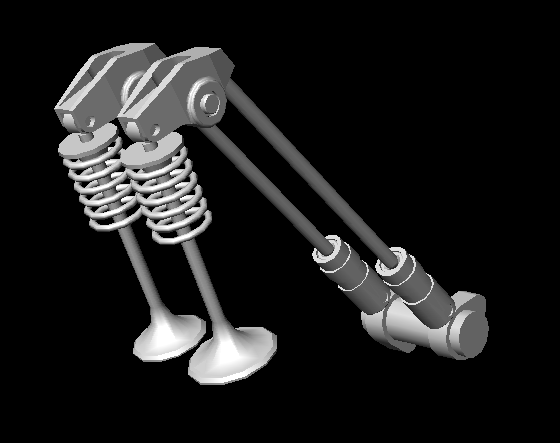
Components of a traditional OHV engine valvetrain

An overhead valve engine, abbreviated (OHV) and sometimes called a pushrod engine, is a piston engine whose valves are located in the cylinder head above the combustion chamber. This contrasts with flathead (or "sidevalve") engines, where the valves were located below the combustion chamber in the engine block.

Although an overhead camshaft (OHC) engine also has overhead valves, the common usage of the term "overhead valve engine" is limited to engines where the camshaft is located in the engine block. In these traditional OHV engines, the motion of the camshaft is transferred using pushrods (hence the term "pushrod engine") and rocker arms to operate the valves at the top of the engine. However, some designs have the camshaft in the cylinder head but still sit below or alongside the valves (the Ford CVH and Opel CIH are good examples), so they can essentially be considered overhead valve designs.

Some early intake-over-exhaust engines used a hybrid design combining elements of both side-valves and overhead valves.[1]

History

[edit]
1894 prototype overhead valve Diesel engine
1904 patent for Buick overhead valve engine

Predecessors

[edit]

The first internal combustion engines were based on steam engines and therefore used slide valves.[2] This was the case for the first Otto engine, which was first successfully run in 1876. As internal combustion engines began to develop separately to steam engines, poppet valves became increasingly common.

Beginning with the 1885 Daimler Reitwagen, several cars and motorcycles used inlet valve(s) located in the cylinder head, however these valves were vacuum-actuated ("atmospheric") rather than driven by a camshaft as with typical OHV engines. The exhaust valve(s) were driven by a camshaft, but were located in the engine block as with side-valve engines.

The 1894 prototype Diesel engine used overhead poppet valves actuated by a camshaft, pushrods and rocker arms,[3][4] therefore becoming the first OHV engines. In 1896, U.S. patent 563,140 was taken out by William F. Davis for an OHV engine with liquid coolant used to cool the cylinder head,[5][6] but no working model was built.

Production OHV engines

[edit]

In 1898, bicycle manufacturer Walter Lorenzo Marr in the United States built a motorised tricycle powered by a single-cylinder OHV engine.[7] Marr was hired by Buick (then named Buick Auto-Vim and Power Company) from 1899–1902, where the overhead valve engine design was further refined.[8] This engine employed pushrod-actuated rocker arms, which in turn opened poppet valves parallel to the pistons. Marr returned to Buick in 1904 (having built a small quantity of the Marr Auto-Car, with one of the first known engines to use an overhead camshaft design), the same year that Buick received a patent for an overhead valve engine design. In 1904, the world's first production OHV engine was released in the Buick Model B. The engine was a flat-twin design with two valves per cylinder. The engine was very successful for Buick, with the company selling 750 such cars in 1905, and the OHV engine has powered almost all Buick automobiles since then.

1918 Buick 242 engine, right side.

Several other manufacturers began to produce OHV engines, such as the 1906–1912 Wright Brothers Vertical 4-Cylinder Engine.[9][10] In 1911, Chevrolet joined Buick in almost exclusive use of OHV engines.[11] However, flathead "side-valve" engines remained commonplace in the U.S. until the mid-to-late 1950s,[12] when they began to be phased out for OHV engines.

Overhead camshaft engines

[edit]

The first overhead camshaft (OHC) engine dates back to 1902, in the Marr;[13] however, use of this design was mostly limited to high-performance cars for many decades. OHC engines slowly became more common from the 1950s to the 1990s, and by the start of the 21st century, the majority of automotive engines (except for some North American V8 engines) used an OHC design.[14]

At the 1994 Indianapolis 500 motor race, Team Penske entered a car powered by the custom-built Mercedes-Benz 500I pushrod engine. Due to a loophole in the rules, the pushrod engine was allowed to use a larger displacement and higher boost pressure, significantly increasing its power output compared to the OHC engines used by other teams. Team Penske qualified in pole position and won the race by a large margin.

In the early 21st century, several pushrod V8 engines from General Motors and Chrysler used cylinder deactivation to reduce fuel consumption and exhaust emissions. In 2008, the first production pushrod engine to use variable valve timing was introduced in the Dodge Viper (fourth generation).[15]

Advantages & disadvantages

[edit]
V8 engine (with intake manifold removed), showing the camshaft, pushrods, and rockers

OHV engines have several advantages compared to OHC engines:

  • Smaller overall packaging: The cam-in-block design of an OHV engine results in a smaller overall size, compared with an equivalent OHC engine, which can have some advantages in center of gravity and hood height in V-engine designs.[16]
  • Simpler camshaft drive system: OHV engines have a less complex drive system for the camshaft than OHC engines.[16] Most OHC engines drive the camshaft or camshafts using a timing belt, a chain, or multiple chains. These systems require the use of tensioners, which add complexity. In contrast, an OHV engine has the camshaft positioned close to the crankshaft, which may be driven by a much shorter chain or even direct gear connection. However, this is somewhat negated by a more complex valvetrain requiring pushrods.
  • Simpler lubrication system: The lubrication requirements for OHV cylinder heads are much lower, as they typically have a single camshaft within the block, where an OHC engine can have two per bank of cylinders, requiring oil passages through the cylinder head. OHV heads only need lubrication for the rocker arms at the pushrod end, trunnion, and rocker tip. This lubrication is typically provided through the hollow pushrods themselves rather than a dedicated lubrication system in the head. The reduced lubrication requirements can also mean that a smaller, lower-capacity oil pump is used.

Compared to OHC engines, OHV engines have the following disadvantages:

  • Limited engine speeds: Although OHV engines have simpler drive systems for the camshaft, there are a greater number of moving parts in the valvetrain (i.e., the lifters, pushrods, and rockers). Inertia from these valvetrain parts makes OHV engines more susceptible to valve float at high engine speeds (RPM).[1]
  • Constraints on valve quantity and location: In OHV engines, the size and shape of the intake ports as well as the position of the valves are limited by the pushrods and the need to accommodate them in the head casting. As a result, it is rare for an OHV engine to have more than two valves per cylinder, while OHC engines often have four, allowing for higher rates of combustion and exhaust.[17]

References

[edit]
Revisions and contributorsEdit on WikipediaRead on Wikipedia
from Grokipedia
An overhead valve engine (OHV), also referred to as a pushrod engine, is a reciprocating design in which the and exhaust valves are mounted in the above the , as opposed to being positioned within the itself. The , located in the or block, drives the opening and closing of these valves indirectly through hydraulic or mechanical lifters, pushrods, and rocker arms, synchronizing with the to manage the four-stroke cycle of , compression, power, and exhaust phases. This configuration enables straighter airflow paths for the and exhaust gases, improving compared to earlier side-valve designs. The OHV engine's development traces back to the early , when and his team at the Manufacturing Company created a pioneering "valve-in-head" in 1903—a 159-cubic-inch inline-two-cylinder engine producing approximately 21 horsepower, which surpassed the output of larger contemporary flathead engines like those in models. This innovation was patented in 1904 by Buick engineer and powered the Buick Model B, contributing significantly to the brand's market leadership and the production of over one million vehicles by 1923. Although adoption was gradual during the flathead era, the design exploded in popularity post-World War II; Oldsmobile's 1949 Rocket V8, a 303-cubic-inch OHV engine with a 7.25:1 delivering 135 horsepower, marked a pivotal shift, enabling higher power from smaller displacements, enhancing fuel efficiency, and spurring the decline of flathead engines across U.S. manufacturers by the mid-1950s. This engine not only propelled Oldsmobile to victories in 1949 and 1950 but also influenced hot rodding and the broader automotive performance landscape. OHV engines offer several notable advantages, including a compact overall package due to the cam-in-block layout, which reduces hood height and simplifies integration into ; lower production and maintenance costs from fewer components; and superior low-end for and in everyday . They also provide enhanced , better economy in moderate-use scenarios, and fewer repair needs owing to their mechanical and ability to support higher compression ratios for improved . However, drawbacks include potential from the pushrod system, limiting safe operation at very high RPMs and restricting advanced features like compared to overhead (OHC) designs. Despite these limitations, OHV configurations persist in modern applications, particularly in high-torque V8 engines for trucks, SUVs, and performance from manufacturers like and Ford, where reliability and cost-effectiveness remain paramount.

Introduction

Definition and Terminology

An overhead valve (OHV) engine is a configuration of in which the intake and exhaust valves are located in the above the , while the is typically positioned in the below. This arrangement allows for the valves to open directly into the from overhead, distinguishing it from earlier designs. OHV engines are commonly referred to by several synonymous terms, including pushrod engine, valve-in-head engine, and I-head engine. The designation "pushrod engine" specifically highlights the use of pushrods as the intermediary components that transfer the camshaft's rotational motion to the rocker arms, which in turn actuate the valves in the . The terminology for OHV engines developed historically in opposition to side-valve engines, also known as flathead or L-head designs, in which the valves are mounted laterally in the adjacent to the cylinders rather than overhead. This contrast emphasized the elevated positioning of valves in OHV configurations as a key evolutionary step in engine architecture. Fundamentally, the anatomy of an OHV engine features a that separately encloses and supports the valves above the pistons and , while the integrates the and in a lower assembly. This separation enables efficient valve operation through intervening mechanisms like lifters and rocker arms.

Basic Operating Principles

In an overhead valve (OHV) engine, the valve opens to admit the air-fuel mixture into the during the , while the exhaust valve opens to expel burned gases during the exhaust , both operating as part of the four- cycle that includes , compression, power, and exhaust phases. These valves must open and close with precise timing relative to position: the valve typically opens before top dead center on the exhaust and closes 50° to 75° after bottom dead center on the compression , allowing efficient filling of the cylinder; the exhaust valve opens 50° to 75° before bottom dead center on the power and closes after top dead center on the , facilitating gas expulsion and scavenging. The overhead positioning of the valves in the , directly above the , provides straighter and shorter paths for the and exhaust gases compared to side-valve designs, reducing flow resistance and enhancing by allowing a larger volume of air-fuel mixture to enter and exit the . This configuration improves overall engine breathing, enabling higher compression ratios and better efficiency without the tortuous required in side-valve engines. Valve operation is synchronized to the engine's via a that rotates at half the speed, ensuring the valves remain closed during the compression and power strokes to contain and prevent backflow of gases. Limited valve overlap occurs only at the transition between exhaust and strokes, typically with the intake opening 10° to 25° before top dead center and the exhaust closing 8° to 20° after top dead center, optimizing gas exchange while avoiding interference during pressure-building phases. The valves undergo , lifting upward to open and returning to seat against the to seal the chamber, with valve springs providing the force to close them rapidly and maintain contact with the timing mechanism. Hardened valve seats, often at 30° or 45° angles, ensure a gas-tight seal during closure, containing pressures up to several thousand psi and preventing leakage that could reduce efficiency.

Historical Development

Early Inventions and Patents

The concept of the overhead valve (OHV) engine emerged in the late 19th century amid the rapid evolution of internal combustion engines, transitioning from inefficient atmospheric designs to more practical four-stroke mechanisms. Early engines, such as Étienne Lenoir's 1860 single-cylinder gas engine, relied on exposed slide valves that suffered from excessive wear, heat damage, and poor sealing due to their direct exposure to combustion gases. By 1876, Nikolaus Otto's four-stroke engine introduced poppet valves mounted on the cylinder block's side, offering better control but still limiting airflow and complicating cylinder head design in primitive castings. Inventors pursued OHV configurations to enhance breathing efficiency, positioning valves directly in the to allow larger sizes, straighter airflow paths, and reduced exposure to hot gases compared to side-mounted or exposed valves in these early designs. This addressed key limitations in power output and reliability during the shift toward automotive applications. One of the earliest experimental implementations appeared in Henry Ford's 1896 Quadricycle, a powered by a twin-cylinder featuring overhead exhaust valves alongside atmospheric (self-opening) side valves, demonstrating initial benefits for exhaust management. More comprehensively, in 1898, American bicycle manufacturer Walter Lorenzo Marr built a equipped with a single-cylinder OHV , weighing 118 pounds with a 3-inch bore and stroke, representing one of the first full OHV prototypes aimed at lightweight personal transport. These pre-production efforts laid conceptual groundwork but lacked formal , with systematic OHV patenting emerging in the early 1900s. A pivotal was filed in 1902 (awarded 1904) by engineer Eugene Richard for the valve-in-head OHV design, which enabled the first production OHV .

First Production Engines

The first production overhead valve (OHV) engine appeared in the 1904 Buick Model B, a touring car featuring a horizontally opposed flat-twin design with two valves per cylinder and an output of 22 horsepower from its 159-cubic-inch displacement. Only 37 units were produced that year, but demand grew rapidly, with 750 sold in 1905, establishing Buick as an innovator in automotive engineering. Among early adopters, the 1914 Chevrolet Series H introduced an OHV inline-four engine, a 171-cubic-inch unit producing 24 horsepower, which represented a key advancement for the Chevrolet brand and contributed to ' expanding portfolio following Chevrolet's integration in 1918. Pioneering models like the Model B employed a water-cooled OHV configuration with valves actuated via pushrods and rocker arms, enabling more efficient breathing than side-valve contemporaries, though early iterations were constrained to low-RPM operation around 1,200 to maintain reliability. These initial OHV engines received positive market reception for delivering smoother operation and superior power delivery relative to prevailing flathead designs, particularly appealing to buyers in the market seeking refined performance. Despite their advantages, production of early OHV engines faced challenges, including the elevated costs associated with precision machining of the overhead cylinder heads, which limited scalability and kept retail prices high at around $950 for the Model B.

Widespread Adoption and Evolution

The widespread adoption of overhead valve (OHV) engines in the United States accelerated during the 1920s and 1930s, as manufacturers sought greater power and efficiency over side-valve designs. Buick had pioneered OHV technology in its early models, but it was Chevrolet's 1929 introduction of an OHV inline-six that influenced broader industry shifts, compelling competitors like Ford to innovate despite their initial reliance on flathead engines. By the early 1950s, OHV configurations became the norm for American passenger cars, with Ford's Y-block V8 debuting in 1954 as a direct replacement for the outdated flathead, marking the near-complete phase-out of side-valve engines in mainstream automobiles by the late 1950s. This transition was driven by the demand for higher performance in post-Depression and wartime recovery markets, where OHV designs offered superior breathing and . Evolutionary improvements further solidified OHV dominance, including the integration of hydraulic lifters to reduce valve train noise and maintenance, first appearing in production engines in 1930 with Cadillac's V16 models featuring this innovation for smoother operation. Pontiac adopted similar advancements in its OHV engines by the mid-1950s, contributing to the rise of multi-cylinder V8s that powered emerging muscle cars in the late 1950s and 1960s, such as Chevrolet's small-block V8 variants. A pivotal key event was the 1949 Oldsmobile Rocket V8, the first high-compression OHV V8 with a 7.25:1 ratio and 135 horsepower, which ignited a post-World War II boom in affordable OHV-powered sedans like the Oldsmobile 88, making high-output engines accessible to middle-class buyers and reshaping American automotive culture. Globally, OHV adoption was more pronounced in the U.S. than in , where overhead (OHC) designs prevailed for compact, high-revving engines suited to smaller displacements and priorities. In contrast, OHV remained dominant in American trucks and vehicles through the mid-20th century, benefiting from simpler and torque-focused applications. tweaks, such as like improved aluminum alloys and for cylinder heads, enabled higher compression ratios—often exceeding 9:1 by the 1960s—allowing OHV V8s to routinely surpass 100 horsepower per liter in tuned configurations, enhancing and output without excessive complexity.

Decline and Modern Persistence

The adoption of overhead camshaft (OHC) engines gained momentum in the 1960s and 1970s as automakers sought to address escalating demands for and reduced emissions amid oil crises and regulatory pressures. The U.S. (CAFE) standards, established under the of 1975, mandated a fleet average of 27.5 miles per gallon for passenger cars by model year 1985, a sharp increase from 12.9 mpg in 1974. OHC configurations provided 2 to 5 percent greater over overhead valve (OHV) designs through superior control, enabling higher engine speeds and better airflow for combustion optimization. This shift accelerated in the 1980s, with OHC engines facilitating multi-valve heads that improved and supported advanced emission control technologies like electronic fuel injection. By the 1990s, OHV engines had become perceived as antiquated in mainstream passenger vehicle development, overshadowed by OHC's advantages in , emissions compliance, and adaptability to . OHV designs endured in American V8 applications, particularly where low-end and manufacturing economy outweighed high-RPM priorities. ' LS-series small-block V8, debuting in 1997, leverages a pushrod layout for compact dimensions, superior low-RPM output, and reduced production costs compared to OHC equivalents. Chrysler's third-generation Hemi V8, introduced in 2003, employs OHV architecture to deliver robust for while maintaining affordability and simplicity in trucks and muscle cars. Ford's 7.3-liter "Godzilla" OHV V8, standard in 2025 Super Duty models, similarly prioritizes these traits for heavy-duty performance. Innovations in the late 20th and early 21st centuries demonstrated OHV's adaptability. The 2008 Dodge Viper's 8.4-liter V10 pushrod engine incorporated through an innovative concentric system, allowing up to 45 degrees of exhaust phasing adjustment to enhance efficiency and power without shifting to OHC. In motorsports, the 1994 500I, a 3.5-liter turbocharged OHV V8 developed by , powered Penske Racing to victory at the —producing over 1,000 horsepower—and represented the final major competitive success for pushrod engines before regulatory changes emphasized OHC configurations. In 2025, OHV engines continue in specialized roles, including heavy-duty trucks like those equipped with ' 6.7-liter inline-six , which uses a 24-valve OHV setup for exceptional durability and low-RPM in Ram 2500/3500 applications. They remain prevalent in motorcycles, such as Harley-Davidson's air-cooled OHV V-twins, and in small engines powering lawnmowers, generators, and outdoor equipment from manufacturers like Kohler and . Emerging hybrid systems are integrating OHV internal combustion engines with electric motors to boost efficiency in off-highway and commercial vehicles, capitalizing on the OHV's characteristics. OHV engines are poised for a niche future in high-torque, low-RPM scenarios, such as hybrid powertrains for and , where their simplicity complements trends by serving as efficient range extenders amid the broader shift to battery-electric .

Technical Design

Core Components

The core components of an (OHV) engine form the system, which enables the precise control of and exhaust valves located in the above the . The itself serves as the primary housing for these valves, providing a sealed for the process while accommodating the valve seats and guides that ensure proper alignment and sealing. Typically constructed from for durability and cost-effectiveness or aluminum for reduced weight and improved heat dissipation, the is bolted to the and integrates ports for and exhaust flow. The , positioned within the and driven by the via a timing or , features eccentric lobes that dictate opening and closing events. It interfaces directly with lifters or tappets, which are hydraulic or solid followers that convert the camshaft's rotational motion into linear movement while absorbing minor irregularities in lobe profiles. These lifters, often made of , sit atop the cam lobes and provide the initial push for the . Pushrods then transmit this linear force from the lifters upward through the engine block and head to the rocker arms, bridging the distance in designs where the camshaft is distant from the valves. Constructed from hardened steel to resist compressive loads, buckling, and flexural stresses—particularly in longer configurations common to V-type engines—pushrods must maintain precise length and straightness for reliable operation. Rocker arms, mounted on pedestal stands or shafts affixed to the cylinder head, act as pivoting levers that amplify and redirect the pushrod motion to depress the valves downward into the combustion chamber. These arms are typically forged from steel for high-strength applications or aluminum for lighter weight, with roller or shaft-mounted variants to minimize friction at contact points. Valve springs encircle the valve stems above the , providing the restorative force necessary to close the valves against pressure and maintain seating during the cycle. Helical coil designs predominate, engineered to deliver consistent tension without excessive that could lead to issues. In assembly, valves are inserted into or cast-iron guides within the head, where they against machined surfaces for gas-tight seals, while rocker arms are secured via adjustable stands to allow for lash settings that accommodate and wear. In typical OHV integrations, the in-block configuration necessitates long pushrods, especially in V-engine layouts where offset requires extended reach, contrasting with rarer single overhead cam variants that deviate from standard pushrod . Maintenance of these components focuses on periodic for , as pushrods and rocker arms can develop flex or pivot binding over time, necessitating lash adjustments to prevent inefficient operation or component failure.

Valve Actuation and Timing

In overhead valve (OHV) engines, valve actuation begins with the , located in the , rotating via a timing or gears synchronized to the . As the camshaft turns, its eccentric lobes contact the valve lifters (also known as tappets), which are cylindrical components that ride directly on the lobes. The lifter's upward motion, driven by the lobe's profile, transmits force through a slender pushrod to the mounted on a fulcrum in the . This pivots the rocker arm, pressing down on the to overcome the valve spring's resistance and open the intake or exhaust , allowing the appropriate gas flow into or out of the . When the cam lobe rotates away, the pre-compressed valve spring forcefully returns the valve to its seat, closing it and resetting the lifter, pushrod, and rocker arm for the next cycle. The timing of valve events is governed by the camshaft's rotation at half the speed of the in four-stroke OHV engines, achieved through a 1:2 gear or ratio that ensures one complete camshaft revolution per two turns, aligning openings with the engine's , compression, power, and exhaust strokes. The precise shape of each cam lobe—its base circle, flank, nose, and ramp—determines the lift (maximum opening distance) and duration ( degrees the remains open), with separate lobes for and exhaust s per to optimize at different engine speeds. Valve lift at the valve stem is calculated as the product of the cam lobe lift and the rocker arm ratio, where the ratio is the mechanical advantage provided by the rocker arm's pivot geometry, commonly 1.5:1 in many OHV designs to amplify the cam's motion for greater valve opening without excessively large lobes. For instance, a cam lobe lift of 0.350 inches with a 1.5:1 rocker ratio yields 0.525 inches of valve lift, enhancing volumetric efficiency while maintaining compact valvetrain dimensions. Intake valve duration in typical OHV engines ranges from 200 to 250 degrees, measured at 0.050 inches of lift, balancing low-speed and high-speed power by keeping the valve open long enough for cylinder filling but not so long as to cause reversion. Exhaust duration is often slightly longer, around 210 to 260 degrees, to facilitate scavenging, while valve overlap—the period when both intake and exhaust valves are open—is minimized in low-RPM-focused OHV designs, typically 10 to 30 degrees, to prevent backflow of exhaust gases into the intake at idle or part-throttle conditions. Valve lash, the small clearance between components to accommodate , is managed differently depending on lifter type: (mechanical) lifters require periodic manual adjustment via shims or screws to maintain precise clearance, ensuring consistent timing but demanding regular , whereas hydraulic lifters use to automatically adjust and eliminate lash, providing quieter operation without adjustments in standard applications. Basic OHV designs lack mechanisms, relying on fixed cam profiles for actuation across all operating conditions.

Layout Variations

The overhead valve (OHV) engine layout typically features a mounted in the engine block, with pushrods extending upward to actuate rocker arms in the , enabling valve operation. This classic pushrod configuration contrasts with rare hybrid variants that incorporate an overhead while retaining pushrod-like elements for compactness or cost efficiency. For instance, Opel's Cam-In-Head (CIH) design positions the within the inclined alongside the valves, using short pushrods and rockers to mimic traditional OHV mechanics while allowing a more compact head profile. Hemispherical and inclined head designs represent key adaptations in OHV layouts to optimize airflow and packaging. The Hemi OHV employs a in the , accommodating larger valves angled for improved intake and exhaust flow without altering the pushrod actuation system. Similarly, the CIH's inclined angles the valves to reduce overall height and enable closer valve spacing in inline-four and six-cylinder configurations. OHV layouts vary significantly between inline and V-engine configurations, primarily due to pushrod geometry. In V8 OHV engines, the V-angle necessitates longer pushrods—often exceeding 8 inches—to reach the rocker arms, increasing mass and requiring stiffer materials for stability at higher RPMs. Inline-four OHV engines, by contrast, use shorter pushrods, typically around 7 inches, for simpler packaging and reduced inertia. Diesel OHV implementations, such as those in heavy-duty trucks, often integrate unit injectors actuated via pushrods or cam lobes directly from the in-block , supporting high-pressure fuel delivery in robust inline-six layouts. Compact adaptations in OHV designs prioritize minimized pushrod length for tight engine bays. The Chevrolet 350 small-block V8 exemplifies this with its low-profile and approximately 7.8-inch pushrods, allowing versatile packaging in passenger vehicles while maintaining the pushrod OHV's inherent advantages. Hybrid traits further refine these layouts, incorporating roller rockers to minimize between the pushrod and rocker contact points, or offset rockers to fine-tune geometry without redesigning the head.

Performance Characteristics

Advantages

Overhead valve (OHV) engines offer significant advantages in packaging due to their cam-in-block design, which results in a shorter and typically narrower overall height from the to the cam cover compared to overhead camshaft configurations. This compactness allows for better integration into vehicle chassis with limited vertical space, such as low-profile sports cars or trucks. Additionally, the simpler with fewer components—relying on pushrods and rocker arms rather than multiple camshafts and belts—leads to lower costs, as it requires less precision and assembly. OHV engines excel in torque delivery, particularly at low engine speeds, thanks to the longer intake runners that enhance air velocity and inertial charging effects. This design promotes strong low-end torque, making OHV engines well-suited for applications requiring pulling power, such as heavy-duty trucks; for instance, the Chevrolet LS3 6.2L V8 produces 425 lb-ft of at 4,600 rpm. The in OHV engines features fewer moving parts than alternatives, reducing potential failure points and enhancing overall durability, with modern designs capable of sustaining high-mileage operation in demanding environments. is simplified as the and valvetrain components draw oil directly from the sump, minimizing the need for complex overhead oiling systems. Maintenance is facilitated by the in-block camshaft location, which provides easier access for timing chain adjustments and valvetrain inspections without removing major components. Hydraulic lifters commonly used in OHV designs further reduce upkeep by eliminating routine valve clearance adjustments. This reliability has been demonstrated in high-mileage applications, where OHV engines sustain operation with minimal valvetrain issues. By positioning the camshaft within the engine block, OHV configurations achieve a lower center of gravity, improving vehicle handling and stability, particularly in performance-oriented designs like sports cars.

Disadvantages

One significant limitation of overhead valve (OHV) engines is their restricted maximum engine speed, primarily due to valve float in the valvetrain. The pushrod and rocker arm mechanism introduces greater reciprocating mass and potential for flex compared to direct cam actuation, causing the valves to lose precise control and "float" at elevated RPMs, typically beyond 6,000 to 7,000 in standard production designs. This can result in reduced power output, inefficient combustion, or severe damage if the valvetrain components collide. The OHV layout also constrains valve configuration, generally limiting engines to two valves per to accommodate the s without excessive complexity or interference. This restriction hampers high-RPM airflow, as fewer valves reduce the effective breathing capacity and compared to alternatives. Additionally, the fixed ratios—often in the 1.5:1 to 1.7:1 range—limit tuning flexibility for valve lift and duration, making performance optimization more challenging without major hardware changes. The valvetrain's reliance on lash adjustments or hydraulic compensators further contributes to noise, vibration, and accelerated wear over time. Efficiency is another area where OHV designs face hurdles, as the elongated and tortuous and exhaust paths increase pumping losses during the process, particularly at part-throttle conditions. Achieving high compression ratios is more difficult due to the geometry required to position valves in the head while maintaining clearance for the pushrods, often leading to a greater propensity for knock and necessitating lower ratios or premium fuels. In terms of emissions, the suboptimal and swirl patterns in OHV cylinders promote incomplete , resulting in elevated levels of unburned hydrocarbons and . The pushrod introduces greater reciprocating mass, exacerbating inertia issues and contributing to dynamic imbalances at high RPMs.

Applications and Examples

Automotive Implementations

Overhead valve (OHV) engines have been extensively implemented in passenger cars, particularly through iconic American V8 designs that emphasized durability, power, and cost-effective manufacturing. The Chevrolet small-block V8, introduced in 1955 as the 265-cubic-inch Turbo-Fire engine, became a cornerstone of ' lineup, powering vehicles from economy sedans to high-performance models like the . A prominent variant, the 350-cubic-inch (5.7L) displacement introduced in 1967, delivered outputs ranging from 250 to over 370 horsepower depending on the application, and was widely used in Corvettes from the late 1960s through the 1990s for its balance of torque and rev capability. Similarly, Ford's Windsor V8 family debuted in 1962 with the 221-cubic-inch (3.6L) version in the Fairlane, evolving into displacements like the 289 (4.7L) and 351 (5.8L) cubic inches, which powered Mustangs, Thunderbirds, and trucks until production ended around 2001, noted for its compact design and adaptability to both street and racing use. In trucks and SUVs, OHV engines provided robust low-end torque for heavy-duty applications, with ' Vortec series exemplifying this role in the lineup starting in 1999. The Vortec 4800 (4.8L), 6000 (6.0L), and 8100 (8.1L) V8s, all based on the architecture with pushrod , offered displacements from 4.8 to 8.1 liters and power outputs up to 340 horsepower and 455 lb-ft of torque in the larger variants, enabling efficient hauling in models like the Silverado 1500HD and 2500HD through the 2000s. For diesel applications, the 5.9L inline-six, an OHV design with a cast-iron block and direct injection, powered Ram 2500 and 3500 pickups from 1989 to 2007, producing 160 to 325 horsepower and up to 610 lb-ft of torque across its 12-valve and 24-valve iterations, renowned for its longevity in towing and off-road scenarios. OHV configurations have also excelled in racing, where their torque delivery suits acceleration-focused disciplines. In 1994, the Mercedes-Benz 500I, a 3.4L pushrod V8 developed by Ilmor for Penske Racing, secured victory at the Indianapolis 500 with Al Unser Jr. behind the wheel, generating over 1,000 horsepower through turbocharging while exploiting rules favoring pushrod designs for its single race appearance. In NHRA drag racing, Top Fuel dragsters employ supercharged, nitromethane-fueled 500-cubic-inch Hemi V8s with OHV valvetrains, delivering peak torque exceeding 8,000 lb-ft to propel vehicles from 0 to 330 mph in under 4 seconds, prioritizing massive low-rpm thrust over high-revving overhead-cam alternatives. Motorcycle applications highlight OHV engines' compact efficiency in air-cooled setups, as seen in Harley-Davidson's V-twin introduced in 1984. This 1,340-cubic-centimeter (80 cubic-inch) OHV engine, with its 45-degree cylinder angle and electric starting, replaced the Shovelhead and powered models like the and Touring lines into the 2000s, producing around 50-70 horsepower while maintaining the brand's characteristic rumble and reliability for long-distance cruising. The automotive adoption of OHV engines has resulted in enormous production scales, underscoring their economic viability and widespread appeal. Chevrolet's small-block V8 family alone has exceeded 113 million units produced since 1955, with the 350 variant accounting for a significant portion due to its versatility across millions of vehicles.

Industrial and Other Uses

Overhead valve (OHV) engines have found extensive use in stationary applications, powering equipment such as generators, pumps, and lawnmowers since the early . Briggs & Stratton introduced its Model F in 1921, recognized as one of the company's first OHV designs, which featured an upright configuration with overhead valves for improved efficiency in general-purpose stationary tasks. These engines, often single-cylinder and air-cooled, provided reliable power for agricultural pumps and early electrical generators, contributing to their widespread adoption in rural and industrial settings by the mid-1900s. Modern OHV engines, such as those in the series, continue this legacy with cast-iron sleeved construction for heavy-duty stationary use in pressure washers, tillers, and portable generators, emphasizing durability and low maintenance. In marine environments, OHV engines excel due to their robustness in harsh conditions like saltwater exposure. MerCruiser V8 inboard engines, derived from Chevrolet small-block designs, incorporate an OHV configuration with 16 valves for reliable performance in recreational and commercial boats. These engines deliver high torque at low RPMs, aiding propulsion through choppy waters while resisting corrosion through specialized marine adaptations. Early aviation applications highlighted OHV engines' potential for lightweight, high-power output in aircraft. The Wright brothers' Engine 17 from 1910 represented an early adoption of OHV technology in , featuring overhead valves in a four-cylinder inline setup to enhance efficiency for powered flight. This design influenced subsequent aircraft engines, prioritizing and reliability in the nascent field of powered aviation. In , OHV diesel engines provide the low-RPM essential for heavy loads in . John Deere's PowerTech series, such as the 4045 and 6068 models, utilize pushrod-operated OHV configurations in their four- and six-cylinder diesels, enabling strong pulling power for plowing and hauling while meeting emissions standards. These engines' overhead layout contributes to compact head design and efficient delivery, as seen in utility like the 5E series. Beyond these sectors, small OHV engines power recreational and tactical vehicles for their simplicity and durability. In all-terrain vehicles (ATVs), manufacturers like employ OHV four-stroke engines, such as the GX series, for reliable low-end torque in off-road conditions. Military generators frequently incorporate OHV engines, exemplified by the 3HP two-cylinder air-cooled units in 28VDC sets, valued for their ruggedness in field operations.

Comparisons with Other Configurations

Versus Side-Valve Engines

The overhead valve (OHV) engine differs fundamentally from the side-valve, or flathead, design in valve placement, with OHV positioning the intake and exhaust valves in the directly above the , while side-valve engines locate them in the adjacent to the walls. This side-valve arrangement creates a T-shaped where the valves open into passages offset from the centerline, resulting in turbulent , longer travel paths, and higher surface-to-volume ratios that increase losses. In contrast, the OHV configuration enables a more compact, - or hemispherical-shaped chamber closer to the axis, promoting efficient swirl, squish, and tumble for faster and reduced unburned emissions. These design differences yield substantial performance advantages for OHV engines, particularly in and compression capability. Side-valve engines suffer from restricted intake and exhaust flow due to their offset valve positions and typically single-valve-per- setup, limiting and overall breathing capacity. OHV engines, by contrast, achieve 75-90% at wide-open through straighter geometries and the potential for multiple valves per , enabling higher speeds and power densities. Additionally, the OHV's superior chamber shape resists better, supporting of 8-12 in spark-ignition applications—roughly double the 4-7 typical of flatheads—translating to gains of about 3% per unit increase. Historically, side-valve engines dominated early automotive production for their manufacturing simplicity, powering vehicles like the Ford Model A (1927-1931) with its 201 cubic-inch side-valve inline-four and the groundbreaking flathead V8 introduced in Ford's Model 18 in 1932, which remained in use through the postwar era. However, by the early 1950s, OHV designs supplanted flatheads in passenger cars due to demands for greater power, efficiency, and high-speed performance; Ford, for instance, discontinued its flathead V8 in 1953 and transitioned to the Y-block OHV V8 in 1954. Maintenance also favored OHV systems, as the removable provides straightforward access to valves, seats, and springs without block disassembly, unlike the side-valve's integrated block-mounted valves that complicate repairs. Despite these upgrades, side-valve engines lingered in small-displacement applications post-World War II, such as lawnmowers and light industrial tools, owing to their low-cost sand-cast block construction and minimal components. This persistence underscored the flathead's legacy as a reliable, economical choice for low-power needs, even as OHV became the benchmark for automotive advancement.

Versus Overhead Camshaft Engines

The overhead valve (OHV) engine and overhead camshaft (OHC) engine differ fundamentally in camshaft placement and valvetrain mechanics. In an OHV design, the camshaft resides in the engine block and actuates the overhead valves through pushrods, rocker arms, and sometimes lifters, creating a longer, more flexible linkage. In contrast, OHC engines position the camshaft (or camshafts, in dual overhead cam or DOHC variants) directly in the cylinder head above the valves, enabling shorter, stiffer connections that minimize flex and energy loss during operation. This valvetrain difference significantly impacts performance potential, particularly at high engine speeds. The reduced mass and inertia in OHC systems allow for superior valve control and stability, supporting rev limits exceeding 8,000 RPM in many applications, whereas OHV engines typically max out around 6,000–7,000 RPM due to the added weight and complexity of pushrods, which can lead to valve float at elevated speeds. OHC configurations also accommodate arrangements more readily, such as four or five valves per cylinder, enhancing airflow and ; OHV engines are generally restricted to two valves per cylinder, though four-valve variants exist with added mechanical intricacy and cost. systems integrate more readily into OHC heads than into OHV designs, which require additional complexity for implementation, optimizing intake and exhaust events across RPM ranges. From a and perspective, OHV engines hold clear advantages in simplicity and economy. With fewer components—lacking the dedicated bearings, timing chains or belts, and additional head castings required for OHC—OHV designs reduce production costs in comparable displacements and are easier to service, as the access remains within the block. However, OHC engines have dominated global automotive production since the , driven by their efficiency gains; improved and reduced pumping losses contribute to better fuel economy in similar vehicle classes, alongside smoother operation and higher specific power outputs. Power delivery characteristics further delineate the two architectures. OHV engines emphasize low- to mid-range , with peaks typically around 4,000 RPM, making them ideal for heavy-duty applications like trucks where immediate and demand prevail over top-end speed. OHC engines, conversely, favor broader power bands with emphasis on high-RPM output, enabling "rev-happy" suited to sporty sedans and imports. This torque bias persists in U.S. V8s, where OHV remains common for its packaging efficiency in longitudinal layouts. The shift toward OHC began accelerating in the 1960s, particularly in , where automakers like and had already employed OHC in performance models, and mass-market adoption grew with designs like Vauxhall's belt-driven SOHC four-cylinder in 1968. Japanese manufacturers followed suit in the same era, incorporating SOHC into compact engines for export-oriented sedans to meet rising demands for efficiency and refinement amid economic expansion. By 2025, OHC variants prevail in most imported vehicles and smaller-displacement powertrains worldwide, while OHV endures in domestic trucks and muscle cars, such as ' 6.2 L LT4 V8 and Ford's 7.3 L V8.

References

Add your contribution
Related Hubs
User Avatar
No comments yet.