Hubbry Logo
OxazinesOxazinesMain
Open search
Oxazines
Community hub
Oxazines
logo
8 pages, 0 posts
0 subscribers
Be the first to start a discussion here.
Oxazines
Oxazines
from Wikipedia
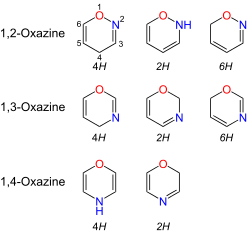
The 8 isomers of oxazine[1]

Oxazines are heterocyclic organic compounds containing one oxygen and one nitrogen atom in a cyclohexa-1,4-diene ring (a doubly unsaturated six-membered ring). Isomers exist depending on the relative position of the heteroatoms and relative position of the double bonds.

By extension, the derivatives are also referred to as oxazines; examples include ifosfamide and morpholine (tetrahydro-1,4-oxazine). A commercially available dihydro-1,3-oxazine is a reagent in the Meyers synthesis of aldehydes. Fluorescent dyes such as Nile red and Nile blue are based on the aromatic compound benzophenoxazine. Cinnabarine and cinnabaric acid are two naturally occurring dioxazines, being derived from biodegradation of tryptophan.[2]

Dioxazines

[edit]

Dioxazines are pentacyclic compounds consisting of two oxazine subunits. A commercially important example is the pigment pigment violet 23.[3]

Synthetic route to dioxazine dyes.[4]

Benzoxazines

[edit]
Benzoxazine resin synthetic pathway, structure and cure mechanism

Benzoxazines are bicyclic compounds formed by the ring fusion of a benzene ring with an oxazine. Polybenzoxazines are a class of polymers formed by the reaction of phenols, formaldehyde, and primary amines which on heating to ~200 °C (~400 °F) polymerise to produce polybenzoxazine networks.[5] The resulting high molecular weight thermoset polymer matrix composites are used where enhanced mechanical performance, flame and fire resistance compared to epoxy and phenolic resins is required.[6]

Physical properties

[edit]

Oxazine dyes exhibit solvatochromism.[7]

Images

[edit]

References

[edit]
[edit]
Revisions and contributorsEdit on WikipediaRead on Wikipedia
from Grokipedia
Oxazines are a class of heterocyclic organic compounds characterized by a six-membered ring containing one oxygen atom and one atom, often featuring varying degrees of unsaturation that confer diverse chemical behaviors. These compounds are formally derived from or its reduced forms by replacing carbon atoms with the heteroatoms, resulting in structures that serve as key subunits in both natural and synthetic molecules. The primary isomeric forms of oxazines include 1,2-oxazines (with adjacent oxygen and , which are less common and often less stable), 1,3-oxazines (oxygen at position 1 and at position 3), and 1,4-oxazines (oxygen at position 1 and at position 4), each exhibiting distinct reactivity and stability profiles. For instance, 1,4-oxazines are particularly stable and commonly encountered in derivatives like (tetrahydro-1,4-oxazine) and phenoxazine (a dibenzo-fused variant), while 1,3-oxazines often appear in pharmaceutical contexts due to their ability to interact with biological receptors. Fused systems, such as benzoxazines, further expand this family, incorporating an aromatic ring to enhance conjugation and functionality. Oxazine derivatives display notable photophysical , including π-conjugation that enables absorption in the spectral region (approximately 600–700 nm) and high resistance to , making them suitable for optical applications. In pharmaceuticals, they exhibit biological activities such as , , antitumor, and effects, with 1,3-oxazines noted for activity and certain derivatives showing efficacy against pathogens like . Additionally, oxazines are utilized in as photochromic dyes for smart textiles and sunglasses, as ligands in asymmetric , and in DNA-binding probes for (e.g., ATTO655 and ATTO680 dyes). Polymers derived from 2-oxazines, known as poly(2-oxazine)s, have gained attention for biomedical uses due to their tunable physical , biocompatibility, and potential in systems.

Introduction

Definition

Oxazines are a class of heterocyclic organic compounds characterized by a six-membered ring containing one oxygen atom and one atom, along with four carbon atoms. This ring system is typically unsaturated, featuring two double bonds that confer a cyclohexa-1,4-diene-like structure to the parent scaffold. The presence of these heteroatoms imparts unique electronic and reactivity properties, making oxazines valuable in synthetic chemistry and . The general molecular formula for the parent oxazine is C₄H₅NO, where the positions of the oxygen and atoms vary across different isomers, leading to distinct subclasses such as 1,2-, 1,3-, and 1,4-oxazines. Unlike related heterocycles, oxazoles feature the same heteroatoms but in a five-membered ring, resulting in different and reactivity profiles. In contrast, diazines incorporate two atoms within a six-membered ring, as seen in compounds like , which exhibit distinct nucleobase-like behaviors. Derivatives of oxazines have been synthesized since the late , with investigations into their structures beginning around that time. Systematic studies accelerated in the mid-20th century, driven by growing pharmaceutical interest in their potential biological activities, such as and effects.

Nomenclature

The nomenclature of oxazines follows the Hantzsch-Widman system, which is the standard IUPAC method for naming simple heterocyclic compounds. In this system, the parent name "oxazine" is used for a six-membered unsaturated ring containing one oxygen and one nitrogen atom, derived from the prefixes "oxa-" for oxygen and "aza-" for nitrogen, combined with the stem "-ine" for a six-membered ring with maximum unsaturation. The specific isomers are distinguished by the positions of the , indicated by in the name: 1,2-oxazine for adjacent oxygen (position 1) and (position 2), 1,3-oxazine for oxygen and separated by one carbon, and 1,4-oxazine for oxygen and in para positions. Numbering begins at the oxygen atom as position 1 due to its higher priority in the heteroatom order (o before a), with the receiving the lowest possible subsequent , and the ring is traversed to give the lowest set of locants to heteroatoms and indicated hydrogens. For partially or fully saturated oxazines, prefixes such as "dihydro-", "tetrahydro-", or others denote the degree and positions of saturation, with the locants specifying hydrogen addition sites to maintain the lowest numbers. Substituents are named using standard IUPAC rules, with positions referenced to the numbered ring starting from oxygen. A common trivial name is , which is the retained IUPAC name for the fully saturated 1,4-oxazine , systematically tetrahydro-1,4-oxazine or 1-oxa-4-azacyclohexane in replacement .

Chemical Structure and Isomers

General Structure

Oxazines consist of a six-membered heterocyclic ring incorporating one oxygen atom and one atom as heteroatoms, along with four carbon atoms. In the parent unsaturated form, the ring features two carbon-carbon double bonds, forming a cyclohexa-1,4-diene-like core that contributes to aromatic-like stability in certain conjugated variants. The general positions the oxygen atom at ring position 1, with the atom at variable positions (such as 2, 3, or 4), resulting in a core framework of alternating single and double bonds. The depicts the oxygen with two s and the with one , influencing the ring's distribution and reactivity. Computational models of saturated oxazine forms yield approximate bond lengths of C-O ~1.43 Å and C-N ~1.47 Å, with typical bond angles around 110–120° reflecting the ring's puckered conformation. Substituted oxazines may exhibit tautomerism, including potential keto-enol interconversions or ring-chain equilibria, particularly in 1,3-oxazine derivatives where the ring can open to acyclic forms under specific conditions.

Isomers

Oxazines exhibit several primary isomeric forms arising from variations in the relative positions of the and heteroatoms within the six-membered ring and differences in the degree of saturation. These include the unsaturated parents 1,2-oxazine, 1,3-oxazine, and 1,4-oxazine, along with their partially saturated counterparts: 3,4-dihydro-2H-1,2-oxazine, 3,4-dihydro-2H-1,3-oxazine, 3,6-dihydro-2H-1,4-oxazine, and 2,3-dihydro-4H-1,4-oxazine, as well as the fully saturated tetrahydrooxazines (oxazinanes). The structural differences among these isomers profoundly affect their stability and reactivity, primarily through the positioning of and the extent of conjugation or saturation. In 1,2-oxazine, the oxygen occupies position 1 and position 2, resulting in adjacent and a direct N-O bond, which introduces significant and electronic repulsion; the ring features double bonds between carbons 3-4 and 5-6, but this configuration renders it highly reactive and prone to ring-opening or reactions. In contrast, 1,3-oxazine places oxygen at position 1 and at position 3, separating the heteroatoms by a carbon atom and allowing for a conjugated system with double bonds at 3-4 and 5-6, which enhances stability relative to the 1,2-isomer. The 1,4-oxazine isomer features oxygen at position 1 and at position 4 in a para-like arrangement, promoting and minimal heteroatom interaction, with double bonds at 2-3 and 5-6 for aromatic-like character. Partially saturated isomers incorporate single bonds that alter conjugation patterns and reduce aromaticity. For instance, 3,4-dihydro-2H-1,2-oxazine retains the adjacent heteroatoms but saturates the 3-4 bond, leading to a non-conjugated enamine-like structure that maintains high reactivity suitable for synthetic intermediates. Similarly, 3,4-dihydro-2H-1,3-oxazine has saturation at the 3-4 bond, creating an enol ether moiety that facilitates hydrolysis; this isomer serves as a key intermediate in the synthesis of aldehydes from N-(1-hydroxyalkyl)amides. The 1,4-oxazine dihydro variants differ in double bond placement: 3,6-dihydro-2H-1,4-oxazine features a double bond at 5-6, yielding an allylic amine system, while 2,3-dihydro-4H-1,4-oxazine has the double bond at 5-6 but with different saturation, resulting in an enamine configuration that influences nucleophilicity. The fully saturated tetrahydro forms eliminate unsaturation entirely, forming oxazinane rings: tetrahydro-1,2-oxazine (1,2-oxazinane), tetrahydro-1,3-oxazine (1,3-oxazinane), and tetrahydro-1,4-oxazine (commonly known as ). These lack conjugation but exhibit chair conformations similar to , with stability enhanced by the absence of double bonds and strain. , the 1,4-oxazinane, is particularly stable and widely used as a solvent and building block due to its basic and oxygen. Relative stability among the isomers correlates with separation and saturation level, with 1,2-oxazine being the least owing to adjacent heteroatoms and observed reactivity in transient species or cycloadditions. The 1,4-oxazine demonstrates greater stability, persisting in solution without rapid decomposition, attributed to its symmetric arrangement that minimizes electronic repulsion. Thermodynamic considerations from computational studies on related heterocycles support this ordering, though specific ΔH_f values for unsubstituted parents vary with method; for example, the 1,2-isomer's strain elevates its energy relative to the 1,4-form by several kcal/mol in analogous systems. Partially and fully saturated isomers generally increase stability by alleviating unsaturation-induced tension, with tetrahydro forms being the most robust.

Derivatives

Dioxazines

Dioxazines represent a class of polycyclic heterocyclic compounds featuring two fused or linked oxazine rings, forming extended conjugated systems that impart vibrant colors and robust stability, particularly in pigment applications. These structures typically adopt an S-shaped conformation, as determined by X-ray crystallographic analysis, distinguishing them from earlier linear models. The core structure of dioxazines is based on the triphenodioxazine skeleton, a pentacyclic system incorporating two atoms and two oxygen atoms within the oxazine moieties. The parent triphenodioxazine has the molecular C18H10N2O2, consisting of three rings fused with two central oxazine rings. Derivatives often feature substitutions on the peripheral rings to enhance , color intensity, or fastness properties, while maintaining the bis-oxazine framework central to their chromophoric nature. Synthesis of dioxazines generally involves reactions between o-phenylenediamines and quinones, leading to the formation of the polycyclic framework through sequential nucleophilic additions and cyclizations. For instance, p-benzoquinones react with o-phenylenediamines under oxidative conditions to yield the core triphenodioxazine structure, often in high-boiling solvents to facilitate ring closure and produce deep violet hues. A prominent industrial route employs chloranil (tetrachloro-1,4-benzoquinone) condensed with substituted anilines, such as 3-amino-N-ethylcarbazole, in , followed by dechlorination and cyclization steps to afford the final . A key representative is (CI 51319, dioxazine violet), a chlorinated derivative with the formula C34H22Cl2N4O2, featuring two units fused to the central dioxazine core. This pigment is synthesized via the chloranil-aniline condensation pathway, yielding a brilliant, reddish-violet shade prized for its purity and intensity. It finds extensive use in printing inks, where its non-migratory nature ensures consistent performance in high-speed lithographic processes. Dioxazines exhibit exceptional thermal stability, enduring processing temperatures up to 250°C without significant decomposition, alongside superior lightfastness rated at 8 on the Blue Wool Scale, enabling long-term color retention in exposed applications. These properties stem from the rigid, planar polycyclic architecture that resists photodegradation and thermal disruption, making dioxazines ideal for demanding industrial formulations despite their limited structural variations.

Benzoxazines

Benzoxazines are a class of bicyclic heterocyclic compounds featuring a ring fused to an oxazine ring, specifically the 3,4-dihydro-2H-1,3-benzoxazine core structure, where the is fused at positions 5 and 6 of the oxazine moiety. The parent compound, 3,4-dihydro-2H-1,3-benzoxazine, has the molecular formula \ceC8H9NO\ce{C8H9NO} and consists of a six-membered oxazine ring with oxygen at position 1 and at position 3, exhibiting a distorted semichair conformation that facilitates ring-opening reactions. Substituents on the nitrogen (typically alkyl or aryl groups) and phenolic ring allow for structural tuning, with the free ortho position on the ring essential for subsequent . Monomeric benzoxazines are synthesized via a involving a phenol, (often as ), and a primary , typically in a one-pot process under solvent-free or mild solvent conditions. For example, the reaction of phenol (\ceArOH\ce{ArOH}), (\ceCH2O\ce{CH2O}), and an (\ceRNH2\ce{RNH2}) yields the corresponding N-substituted 3,4-dihydro-2H-1,3-benzoxazine, as first systematically explored in the for precursor development. This method produces high-purity monomers in good yields (often >80%), with variations in amine or phenol substituents enabling tailored reactivity and properties. Upon heating, benzoxazine monomers undergo thermally induced (ROP) around 200°C to form polybenzoxazines, a process involving cationic initiation via an ion intermediate that leads to chain extension through Mannich base formation and cross-linking via phenolic bridges. The proceeds without catalysts in many cases, though acids or initiators can lower the temperature threshold to 140–180°C, resulting in thermoset networks with molecular weights exceeding 10,000 g/mol and near-zero shrinkage during curing. Polybenzoxazines exhibit unique advantages, including low water absorption (typically <1 wt% after prolonged exposure) due to their hydrogen-bonding network and high char yield (40–60% at 800°C under nitrogen), attributed to the aromatic and phenolic structures that enhance thermal stability during pyrolysis. These properties make them suitable for high-performance applications, such as in polymer composites.

Other Derivatives

Saturated derivatives of oxazines include tetrahydro-1,4-oxazine, commonly known as , which features a six-membered ring with one oxygen and one nitrogen atom in a fully saturated form. acts as a secondary amine with a pKa of approximately 8.3 for its conjugate acid, contributing to its basic properties. It is widely employed as a solvent for resins, waxes, dyes, and casein due to its polarity and miscibility with water and organic solvents. Substituted oxazine derivatives often incorporate functional groups that enhance their reactivity or utility in synthesis. For instance, 2H-1,4-oxazin-3(4H)-one represents a lactam variant with a carbonyl group at the 3-position, forming a cyclic amide structure that can participate in ring transformations and condensation reactions. This compound serves as a building block for more complex heterocycles, demonstrating the versatility of oxazine scaffolds in organic chemistry. Halogenated and alkylated variants of oxazines are valuable synthetic intermediates, particularly in pharmaceutical and agrochemical applications. An example is 6-chloro-1H-benzo[1,3]oxazine-2,4-dione, a benzoxazine derivative that undergoes ring transformations with amines or diamines to yield fused heterocyclic systems like pyrimidobenzimidazoles, useful in medicinal chemistry. Alkyl substitutions, such as methyl groups on the ring, can modulate solubility and biological activity, enabling their use in diverse synthetic routes. Another notable derivative is phenoxazine, a tricyclic compound consisting of two benzene rings fused to a central 1,4-oxazine ring (dibenzo[c,e][1,4]oxazine), with the molecular formula C12H9NO. It exhibits properties and is used in dyes, pharmaceuticals, and as a building block in . A notable unique derivative is ifosfamide, a 1,3,2-oxazaphosphorin-2-amine 2-oxide containing chloroethyl groups, classified as a phosphoramide oxazine analog employed in for its alkylating properties against cancer cells.

Synthesis

General Methods

One of the primary general methods for synthesizing oxazines involves reactions, particularly the [4+2] hetero-Diels-Alder reaction between nitroso compounds as heterodienophiles and conjugated s. This approach is particularly effective for constructing 1,2-oxazine rings, yielding 3,6-dihydro-2H-1,2-oxazines in a stereoselective manner under mild conditions, often without catalysts, due to the high reactivity of the group. For example, reacts with gem-difluoro-1,3-dienes to form 2H-1,2-oxazin-3(6H)-ones, demonstrating the versatility of this method for functionalized derivatives. The reaction proceeds via an endo or exo transition state, influenced by substituents on the diene and nitroso partner, as explored through calculations that highlight the concerted pericyclic mechanism. Ring expansion reactions from five-membered heterocycles represent a key general approach for accessing oxazine scaffolds, particularly through insertion of or imines into oxazoles. For instance, rhodium-catalyzed insertion of carbenoids derived from compounds into isoxazole rings (closely related five-membered O-N systems) effects a ring expansion to 2H-1,3-oxazines, involving N-O bond cleavage and migration under mild conditions. This method allows for the incorporation of CO equivalents via diazoacetate precursors, producing 4H-1,3-oxazines with high efficiency and tolerance, as the metal-stabilized facilitates selective bond reorganization. Catalytic methods using transition metals offer versatile routes for oxazine formation via selective C-N and C-O bond construction, especially for 1,4-oxazines. Palladium-catalyzed cyclizations of unsaturated β-amino alcohols or allylic systems enable the synthesis of tetrahydro-1,4-oxazines through intramolecular allylic substitution or oxidative coupling, proceeding with high enantioselectivity when chiral ligands are employed. Similarly, facilitates tandem N-H insertion and cyclization of α-amino ketones with pyruvates, forming 1,4-oxazines via intermediates that promote C-N bond formation followed by O-cyclization, often in high yields under neutral conditions. These metal-mediated processes are prized for their and ability to handle diverse substituents, establishing them as foundational strategies across oxazine isomers.

Specific Syntheses

, a simple 1,4-oxazine derivative, is synthesized industrially by the acid-catalyzed dehydration of using (20% free SO₃) at 180–235°C for 0.5–1.5 hours, delivering high yields of 90–95%. The process involves intramolecular formation, with the strong acid promoting water elimination while minimizing side products like higher oligomers. Recent advances in oxazine synthesis include microwave-assisted protocols for 1,4-oxazine derivatives, such as the one-pot reaction of 2-aminophenols, benzaldehydes, and phenacyl bromides under Cs₂CO₃ catalysis at 100°C and 150 W, completing in 3–5 minutes with yields of 68–85%. This method exemplifies the efficiency of microwave irradiation in accelerating multicomponent condensations, offering a green alternative to traditional techniques that require 5–9 hours for comparable results.

Physical and Chemical Properties

Physical Properties

Oxazines exhibit a range of physical properties influenced by their structural features, such as the presence of polar heteroatoms and aromatic systems. Polar saturated oxazines, exemplified by (a 1,4-oxazinane), are fully miscible with due to their ability to form hydrogen bonds, displaying infinite solubility in aqueous media. In contrast, aromatic oxazine derivatives like , a phenoxazine dye, show poor solubility in but high solubility in organic solvents such as DMSO and DMF (typically 10-50 mg/mL). Thermally, has a of 129°C and a of -5°C, reflecting its state at room temperature. Solid oxazine pigments, such as pigment violet 23 (a dioxazine), possess high thermal stability, heat resistant up to 280°C in polyolefins, making them suitable for high-temperature applications in certain polymers. Spectroscopic properties provide key insights into the electronic structure of oxazines. In UV-Vis spectroscopy, many oxazine dyes display absorption maxima in the 600-700 nm range, attributed to π-π* or charge-transfer transitions involving the heteroatoms in the ring system. For instance, exhibits an absorption maximum near 520 nm in dioxane, shifting based on the environment. reveals characteristic bands for the C=N stretch in unsaturated oxazines at approximately 1650 cm⁻¹, indicative of the functionality within the heterocyclic ring. Many oxazine dyes demonstrate solvatochromism, where solvent polarity affects their spectral properties. For example, undergoes bathochromic shifts in polar solvents, with emission wavelength changes up to 100 nm, shifting from around 600 nm in nonpolar media to over 650 nm in polar environments due to stabilization of the . This behavior arises from the dye's large dipole moment changes upon excitation.

Chemical Reactivity

Oxazines, particularly 1,3-oxazines, display notable reactivity at the C=N bond, where by organometallic reagents such as Grignard compounds occurs, resulting in ring opening to form intermediates that can be hydrolyzed to β-hydroxy aldehydes or ketones. This reaction exploits the imine-like electrophilicity of the C=N unit in 3,6-dihydro-2H-1,3-oxazines, enabling stereocontrolled carbon-carbon bond formation; for instance, addition of alkylmagnesium halides to chiral auxiliaries derived from these heterocycles proceeds with high diastereoselectivity, yielding products useful in asymmetric synthesis. The stability of certain 2-substituted dihydro-1,3-oxazines toward Grignard reagents prior to directed addition further highlights their utility in selective transformations. Redox reactions provide additional pathways for oxazine modification. Dihydrooxazines undergo dehydrogenation to aromatic oxazines using 2,3-dichloro-5,6-dicyano-1,4-benzoquinone (DDQ), a mild oxidant that abstracts hydrogens from the saturated C-C bonds, often in high yields under ambient conditions. In contrast, complete reduction of oxazines with aluminum hydride (LiAlH4) cleaves the ring and reduces the C=N functionality to a CH-NH unit, producing primary or secondary amines depending on substituents; this process involves stepwise hydride delivery to the and subsequent elimination of the oxygen bridge. Aromatic benzoxazines exhibit primarily on the ring, directed by the oxygen atom to ortho and para positions relative to its attachment point, due to the electron-donating effect of the oxazine moiety. , , or sulfonation thus favors these sites, enhancing reactivity compared to unsubstituted and allowing regioselective functionalization. of 1,3-oxazines, especially dihydro variants, regenerates protected carbonyl compounds under mild acidic or aqueous basic conditions, making them valuable as equivalents in synthesis. For example, 2-alkyl-5,6-dihydro-4H-1,3-oxazines hydrolyze to the corresponding aldehydes via of the C=N bond, ring opening, and tautomerization, with minimal side reactions due to the heterocycle's stability under neutral conditions. This reversible transformation underscores their role in protective group chemistry for multistep .

Applications

Dyes and Pigments

Oxazine compounds serve as versatile colorants in dyes and pigments, prized for their vibrant hues and properties in various industrial applications. These heterocyclic structures enable strong absorption and emission in the , making them suitable for textiles, inks, and imaging agents. Among key oxazine-based dyes, , a phenoxazine (9-diethylamino-5H-benzo[α]phenoxazine-5-one), exhibits intense red specifically in -rich environments, rendering it invaluable for intracellular lipid droplets in biological samples. Similarly, Nile blue, a cationic benzophenoxazine dye, is widely employed in bioimaging due to its excellent mitochondrial permeability and solvatochromic behavior, allowing far-red and near-infrared visualization in live cells. In pigments, dioxazine violet 23 ( violet 23, chemical name 8,18-dichloro-5,15-diethyl-5,15-dihydrodiindolo[3,2-b:3',2'-m]triphenodioxazine) stands out for its shade and exceptional tinting strength, providing superior adhesion and durability in applications. This high-performance is dispersed in resins for formulations. In acrylic painting, Dioxazine Purple serves as an optional convenience color for creating intense, transparent deep violets and shadows, especially useful when painting many such areas; it offers the strength of a single pigment that mixes from quinacridone magenta and ultramarine blue lack. Its lightfastness rating reaches 8/8 on the , ensuring long-term color stability under exposure. The commercial development of oxazine dyes and pigments accelerated in the , with dioxazine violet 23 introduced for coloring textiles and plastics, addressing demands for fade-resistant, high-strength alternatives to earlier synthetic colorants.

Polymers

Polybenzoxazines represent a class of high-performance thermosetting polymers derived from the of benzoxazine monomers, offering superior stability and mechanical integrity compared to traditional phenolics. These materials form crosslinked networks through the process, achieving temperatures (Tg) exceeding 300°C in advanced formulations, such as those incorporating borosiloxane structures, which enable sustained performance under extreme heat. This high Tg, often ranging from 320–370°C in optimized systems, stems from the dense crosslinking density and aromatic backbone, making polybenzoxazines ideal for demanding structural applications. The curing mechanism of polybenzoxazines primarily involves or cationic , where the oxazine ring undergoes electrophilic ring-opening to generate reactive o-hydroxybenzylamine intermediates. These intermediates further react to establish a three-dimensional network characterized by methylene-oxy bridges (–CH₂–O–) alongside Mannich linkages (–CH₂–NR–CH₂–), facilitating low-shrinkage without the release of volatile byproducts typical in phenolic resins. Cationic pathways, often accelerated by Lewis acids or initiators, lower the curing temperature to around 180–220°C, while curing proceeds at 200–250°C, ensuring processability in composite . Key properties of polybenzoxazines include inherent flame retardancy, with limiting oxygen index (LOI) values surpassing 30% in - or silicon-modified variants, attributed to char-forming tendencies that inhibit . Additionally, they exhibit low smoke emission and toxicity during fire exposure, meeting stringent fire-smoke-toxicity (FST) requirements for environments. These attributes, combined with near-zero volumetric shrinkage and excellent dimensional stability, position polybenzoxazines as alternatives to epoxies and bismaleimides in high-temperature settings. In applications, polybenzoxazines serve as matrix resins in fiber-reinforced composites for aircraft structures, where their high Tg and FST performance support out-of-autoclave processing; for instance, has developed debulking processes for carbon fiber/benzoxazine prepregs to achieve void-free laminates in components. They are also employed in structural adhesives, delivering lap shear strengths greater than 20 MPa on metal substrates, as demonstrated in bioinspired catechol-functionalized systems that enhance without compromising thermal resistance. Such versatility extends their use in composites and bonding solutions requiring durability under hydrothermal conditions.

Pharmaceuticals

Oxazine derivatives have emerged as valuable scaffolds in pharmaceutical development due to their diverse biological activities, including anticancer, , and enzyme inhibitory effects. These compounds, often featuring six-membered heterocyclic rings with oxygen and atoms, contribute to the structural diversity of small-molecule drugs, with heterocycles in general comprising over 75% of FDA-approved pharmaceuticals according to reports from the early 2020s. Their incorporation enhances binding affinity to biological targets, facilitating applications in targeted therapies. In anticancer applications, oxazine derivatives demonstrate potent antitumor activity through mechanisms such as arrest and inhibition of proliferative signaling pathways. For instance, oxazine derivatives of γ- and δ-tocotrienols exhibit enhanced efficacy compared to their parent compounds, significantly reducing tumor growth in a syngeneic model of mammary tumors when administered via nanoemulsions. These derivatives lower levels of oncogenic markers like phosphorylated AKT, , COX-2, , and cyclin-dependent kinases 2, 4, and 6, while elevating inhibitors p21 and p27, promoting and halting proliferation. Additionally, certain 1,3-oxazine analogs, such as 7-chloro-2-methylthio-2-ethylcarbazato-2,3-dihydropyrano[3,4-e][1,3]oxazine-4,5-dione, achieve 98-100% killing efficiency against multiple lines, including those from throat, lymph, colon, skin, ovary, , kidney, prostate, and breast origins, highlighting their broad cytotoxic potential. As agents, particularly s, morpholine-based oxazines—saturated 1,4-oxazine derivatives—target fungal integrity by disrupting . , a clinically approved morpholine , inhibits Δ14-reductase and Δ7–Δ8 enzymes, leading to depletion, membrane hyperfluidity, and abnormal deposition; it displays broad-spectrum activity against dermatophytes, yeasts, molds, and dimorphic fungi, functioning as both fungistatic and fungicidal , and is formulated as a 5% nail for treatment. Silicon-incorporated morpholine analogs, such as derivatives of fenpropimorph and , further enhance potency, with compounds like analog 24 outperforming parent molecules in (MIC) and minimum fungicidal concentration (MFC) assays against pathogens including , C. glabrata, C. tropicalis, , and . Beyond these, 1,3-oxazine derivatives serve as inhibitors of enzymes like histone deacetylases (HDACs), modulating epigenetic regulation for therapeutic benefit in cancer. Spiro[2H-(1,3)-benzoxazine-2,4'-piperidine] hydroxamic acid-based compounds act as potent HDAC inhibitors with IC50 values around 100 nM or lower, incorporating a zinc-binding hydroxamic acid group for selective enzyme inhibition. These agents demonstrate robust tumor growth inhibition in HCT116 murine xenograft models, with oral bioavailability of at least 35% and high stability in human and mouse liver microsomes, positioning them as promising candidates for clinical development in oncology.

Natural Occurrence

Examples

Cinnabarine, a phenoxazinone , is produced by the fungus (formerly cinnabarina) through metabolic degradation of . This oxazine compound arises from oxidative condensation processes in fungal pathways, contributing to the characteristic crimson coloration of the fungus's fruiting bodies. Its involves the , where is catabolized to 3-hydroxyanthranilic acid, which undergoes further oxidation and cyclization to form the oxazine core. Cinnabaric acid, another naturally occurring oxazine, was isolated from fungal cultures in the 1950s, with detailed structural elucidation in subsequent studies during the 1960s. This compound shares biosynthetic origins with cinnabarine, stemming from fungal oxidation of intermediates like 3-hydroxyanthranilic acid, often as a degradation product or co-metabolite in species such as Pycnoporus spp. It exhibits greater acidity than cinnabarine due to its functionality, facilitating its role in pigment mixtures within fungal tissues. In insects, oxazines are biosynthesized via the , a major route for that yields phenoxazinone pigments such as xanthommatin for eye coloration. This pathway involves sequential oxidation to form N-formylkynurenine, , and 3-hydroxykynurenine, with subsequent non-enzymatic condensation of 3-hydroxyanthranilic acid derivatives leading to fused oxazine structures such as phenoxazinones in ommochrome . These pigments provide ecological advantages, such as UV and camouflage, in species like and flies. Oxazines also occur in marine environments, particularly in s and their associated or fungi, where they form part of defensive profiles. For instance, peniciadametizine A, featuring a pyrazino[1,2-b][1,2]oxazine skeleton, has been isolated from the marine -derived fungus adametzioides. Such compounds can accumulate at concentrations up to 1% of the host's dry weight, aiding in against predators and competitors in microbiomes. Benzoxazinoids, such as 2,4-dihydroxy-7-methoxy-1,4-benzoxazin-3(4H)-one (DIMBOA), are naturally occurring oxazine derivatives found in like , , and . These compounds serve as allelochemicals and contribute to resistance against , pathogens, and weeds through phytotoxic and activities.

Biological Roles

Oxazines, particularly phenoxazine derivatives, contribute to pigmentation in , serving protective functions against environmental stressors. In and other arthropods, ommochromes— a class of pigments featuring a phenoxazinone core, which is a fused oxazine system— are deposited in the compound eyes and exoskeletons. These pigments absorb (UV) radiation strongly in the 300–400 nm range, thereby shielding sensitive photoreceptor cells from UV-induced damage and . For instance, in species like the fruit fly Drosophila melanogaster, ommochromes facilitate visual screening and contribute to ecological adaptations such as and by modulating light reflection. Cinnabarinic acid, a key phenoxazine in the derived from , exemplifies this role. Produced via enzymes like and vermilion, it is involved in formation that enhances UV resistance in . This pigmentation not only aids in photoprotection but also supports broader physiological by scavenging generated under UV exposure. Studies on locusts and highlight how such oxazine-based pigments correlate with increased survival rates in high-UV environments, underscoring their evolutionary significance in terrestrial adaptation. In microbial ecosystems, phenoxazine derivatives from natural sources may contribute to modulation. Although primarily studied in synthetic contexts, structural analogs suggest potential roles in host-microbe interactions. From an evolutionary perspective, oxazines are integral to in and microbes, forming core scaffolds in diverse natural products that inspire pharmaceutical design. Pathways involving oxazine intermediates, such as those in spirooxindole alkaloids, arise from or precursors and confer defensive against herbivores and pathogens. Many biologically active heterocyclic drugs derive motifs from such natural structures, reflecting the evolutionary conservation of oxazine rings for bioactivity and survival advantages across kingdoms.

References

Add your contribution
Related Hubs
User Avatar
No comments yet.