Hubbry Logo
PakicetidaePakicetidaeMain
Open search
Pakicetidae
Community hub
Pakicetidae
logo
8 pages, 0 posts
0 subscribers
Be the first to start a discussion here.
Pakicetidae
Pakicetidae
from Wikipedia

Pakicetidae
Temporal range: Early Eocene, 50–48 Ma
Pakicetus
Scientific classification Edit this classification
Kingdom: Animalia
Phylum: Chordata
Class: Mammalia
Order: Artiodactyla
Infraorder: Cetacea
Family: Pakicetidae
Thewissen, Madar & Hussain 1996
Genera

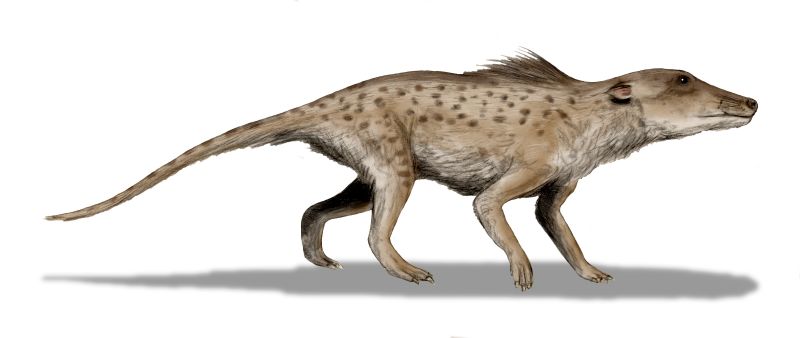
Pakicetidae ("Pakistani whales") is an extinct family of early whales that lived during the Early Eocene in northern South Asia.[1][2] Unlike modern cetaceans, they had well-developed limbs and were capable of walking. The species included were fox to wolf-sized.[3]

Description

[edit]

Dehm & Oettingen-Spielberg 1958 described the first pakicetid, Ichthyolestes, but at the time they did not recognize it as a cetacean, identifying it, instead, it as a fish-eating mesonychid. Robert West was the first to identify pakicetids as cetaceans in 1980 and, after discovering a braincase, Phillip Gingerich and Donald Russell described the genus Pakicetus in 1981. During the following two decades, more research resulted in additional pakicetid cranial material and by 2001 postcranial material for the family had been described. Though all parts of pakicetid postcrania are known, no complete skeleton from a single individual has been recovered.[4] The pakicetid goldmine is the "H-GSP Locality 62" site in the Kala Chitta Hills where fossils from all three genera have been found. However, this site is so littered with bones that identifying bones from a single individual is impossible, and pakicetid skeletons are consequently composites of bones from several individuals.[3]

Pakicetids have been found in or near river deposits in northern Pakistan and northwestern India, a region which was probably arid with only temporary streams when these animals lived there. No pakicetids have been found in marine deposits, and they were apparently terrestrial or freshwater animals. Their long limbs and small hands and feet also indicate they were poor swimmers. Their bones are heavy and compact and were probably used as ballast; they clearly indicate pakicetids were not fast runners in spite of their otherwise cursorial morphology. Most likely, pakicetids lived in or near bodies of freshwater and their diet could have included both land animals and aquatic organisms. During the Eocene, Pakistan was part of the Indian island-continent off the coastal region of the Eurasian land mass and therefore an ideal habitat for the evolution and diversification of the Pakicetids.[4]

Pakicetids have many apomorphic traits (derived traits shared by several taxa) found in artiodactyls, including:[2] Traits linking pakicetids to cetaceans include:[2]
  • a pachyosteosclerotic (thick, heavy bone) auditory bulla with an involucrum and sigmoid process
  • cheek teeth adapted for shearing with reentrant grooves on the anterior surfaces
  • lower molars lacking trigonid and talonid basins and upper molars with very small trigon basins
  • incisors and canines aligned to the cheek teeth
  • narrow elongated postorbital (behind eyes) cranium

Hearing

[edit]

Pakicetid ears had an external auditory meatus and ear ossicles (i.e. incus, malleus, tympanic ring, etcetera) similar to those in living land mammals and most likely used normal land mammal hearing in air. In the pakicetid mandible, the mandibular foramen is small and comparable in size to those of extant land mammals and the acoustic mandibular fat pad characteristic of later whales was obviously not present. The lateral wall of the mandible is also relatively thick in pakicetids, further preventing sound transmission through the jaw. The tympanic bulla in pakicetid ears is similar to those in all cetaceans, with a relatively thin lateral wall and thickened medial part known as the involucrum. However, in contrast to later cetaceans, the tympanic bone makes contact with the periotic bone which is firmly attached to the skull leaving no space for isolating air sinuses, effectively preventing directional hearing in water. Pakicetids most likely used bone conduction for hearing in water.[5]

Locomotion

[edit]
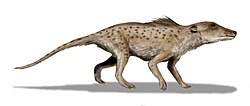
Pakicetus attocki

Interpretations of pakicetid habitat and locomotory behaviour varies considerably. In 2001, it was concluded by Thiwissen et al. that "pakicetids were terrestrial mammals, no more amphibious than a tapir." According to them, none of the aquatic adaptations found in the oldest obligate aquatic cetaceans, basilosaurids and dorudontids, are present in pakicetids. Pakicetid cervical vertebrae are longer than in late Eocene whales, the thoracic vertebrae increase in size from the neck backwards, and the lumbar and caudal vertebrae are longer than in modern cetaceans (but still shorter than in some extinct cetaceans with undulating spines.) Motion in the spine of pakicetids was further reduced by the revolute zygapophyses (processes between the vertebrae) like in stiff-backed runners such as mesonychians. The sacral vertebrae are fused and the sacroiliac joints present like in land mammals and amphibious cetaceans.[6]

Furthermore, according to Thewissen et al. (2001), the pakicetid scapulae have large supraspinous fossae with small acromions, in contrast to other cetaceans. The deltopectoral crests are absent in the long and slender humeri like in cursorial animals but unlike other Eocene cetaceans. Pakicetid elbows are rigid hinge joints like in running mammals and the forearms are not flattened like in truly aquatic cetaceans. In the pakicetid pelvis, the innominates are large and the ischia are longer than the ilia. The pakicetid tibiae are long with a short tibial crest. Hindlimb features that all more reminiscent of running and jumping animals than swimming animals.[6]

Gingerich 2003 disagreed and got support from Madar 2007: postcranial morphology and microstructural features suggest that pakicetids were adapted to an aquatic lifestyle which included bottom wading, paddling, and undulatory swimming, but probably not sustained running. Isotopic evidence indicate Pakicetids spent a considerable part of their life in freshwater and probably ate freshwater prey.[2] This view was further reiterated by Gingerich in a 2017 paper.[7]

Subtaxa

[edit]

See also

[edit]

Notes

[edit]

References

[edit]
Revisions and contributorsEdit on WikipediaRead on Wikipedia
from Grokipedia
Pakicetidae is an extinct family of archaic cetaceans (stem-group whales) that lived during the early Eocene epoch, approximately 55 to 50 million years ago, in the coastal and freshwater environments of what is now and northwestern . These mammals, descendants of terrestrial , represent the earliest known phase of the land-to-sea transition in cetacean evolution, exhibiting a combination of terrestrial and aquatic adaptations such as cursorial limbs for walking on land, a long robust tail possibly aiding in swimming, and increased serving as skeletal ballast for buoyancy control in water. The family comprises three genera—Pakicetus, Ichthyolestes, and Nalacetus—distinguished by variations in size, with Pakicetus being the largest and most wolf-like in overall form. Fossils now attributed to Pakicetidae, primarily from the Kuldana and Subathu Formations in the Punjab region, were first described starting in the 1950s, with their recognition as early cetaceans occurring in the 1980s and 1990s, revealing key cranial features including a nasal opening positioned at the tip of the rostrum (unlike the blowhole of later whales), dorsally oriented eye orbits for surface vision, and a palate retaining primitive incisive foramina. Postcranially, their skeletons show reduced joint mobility in the elbow and ankle, similar to early artiodactyls, indicating they were amphibious predators that foraged in shallow rivers and coastal lagoons but retained the ability to move on land, much like modern hippos. As the basalmost cetaceans, Pakicetidae play a pivotal role in understanding the origins of whales within the order Cetartiodactyla, providing evidence of their artiodactyl ancestry through shared anatomical traits like double-pulley astragali in related forms. Their discovery has illuminated the rapid evolutionary radiation of cetaceans following the Paleocene-Eocene thermal maximum, marking the beginning of a lineage that would diversify into the fully marine whales of today.

Taxonomy and Phylogeny

Classification

Pakicetidae is an extinct family of primitive cetaceans placed within the mammalian order Artiodactyla, the infraorder Cetacea, and the paraphyletic suborder . The family is known from the early Eocene epoch, approximately 50 million years ago. Fossils of Pakicetidae are endemic to northern , specifically the regions of modern-day and , primarily from fluvial deposits in formations such as the Kuldana and Subathu. The family comprises three genera: , Ichthyolestes, and Nalacetus. The genus includes four species: P. attocki, P. calcis, P. chittas, and P. inachus. Ichthyolestes is represented by two species: I. pinfoldi and I. robustus. The placement of Nalacetus within Pakicetidae remains contentious due to its distinct dental morphology, but it is often included based on shared cranial features. Pakicetidae is defined by synapomorphies such as the development of an involucrum on the tympanic bulla and a double-pulley astragalus, which distinguish it from more terrestrial while indicating early adaptations toward aquatic lifestyles. These traits position Pakicetidae as a transitional group leading to later cetacean families such as .

Evolutionary significance

Pakicetidae represent a critical transitional group in cetacean , linking terrestrial even-toed ungulates () to fully aquatic whales through shared morphological and genetic features. The family's ankle bones, or astragali, exhibit a double-pulley morphology indistinguishable from that of early Eocene , providing anatomical evidence of their artiodactyl heritage and indicating retention of terrestrial locomotor capabilities early in whale . Complementing this, molecular analyses using retroposon insertions confirm that cetaceans, including Pakicetidae, form a nested within even-toed ungulates, with hippopotamids as their closest living relatives. Fossils of Pakicetidae, dating to approximately 50 million years ago, provide the earliest direct evidence of cetacean origins on the during its northward drift toward in the early Eocene, documenting the macroevolutionary shift from land to water in a localized Tethyan coastal setting. Within the paraphyletic assemblage , Pakicetidae occupy a basal position, serving as the stem group ancestral to more derived families such as and , which exhibit progressively greater aquatic specializations. Key evolutionary transitions in Pakicetidae include initial auditory modifications and lifestyle shifts from fully terrestrial to semi-aquatic habits, as well as evidence from stable isotope analyses indicating preferences for freshwater habitats over marine settings.

Anatomy and Physiology

General morphology

Pakicetids were small to medium-sized early cetaceans, comparable in scale to foxes or wolves, with estimated body lengths ranging from 1.4 meters in Ichthyolestes pinfoldi to approximately 2.5 meters in Pakicetus attocki. Body masses, derived from cranial metrics such as occipital condyle width, were estimated at 8–18 kg across genera, reflecting their relatively lightweight, terrestrial-oriented build. Nalacetus species were similar in proportions to Pakicetus but slightly smaller, falling within this size range. Their overall was slender and artiodactyl-like, featuring an elongated up to about 50 cm in length and a flexible vertebral column with longer than in later cetaceans. The increased progressively in size from anterior to posterior, supporting a stable trunk, while the region was long and robust, contributing to a posture. The tail was elongated and lacked a fluke, ending in a tapered form without the specialized propulsion structures of advanced cetaceans. The limbs consisted of four well-developed appendages with robust bones suited for , terminating in hooves on the digits as in their relatives. These limbs exhibited adaptations, such as reduced joint mobility in the parasagittal plane at the and ankle, enabling efficient terrestrial movement and potentially aiding in wading. External features, including impressions where preserved, indicate terrestrial adaptations consistent with a lifestyle transitional from land-dwelling ancestors.

Cranial and dental features

The of pakicetids is characterized by an elongated rostrum formed by a long and narrow , which constitutes a significant portion of the total length, approaching 60% in known specimens such as attocki. The orbits are large, dorsally oriented, and closely set, with a deeply incised supraorbital region in , facilitating a wide field of typical of early terrestrial predators. are long, slender, and flat, with the nasal opening positioned at the tip of the rostrum and no evidence of a developing blowhole, reflecting their primitive, land-based ancestry. Dentition in pakicetids is heterodont, featuring distinct tooth morphologies adapted for grasping and shearing prey. Incisors and canines are conical and caniniform, with the upper incisors lacking a cingulum and arranged such that I2 and I3 align on a mesiodistal axis, forming a grasping mechanism similar to that in other early cetaceans. Premolars and molars are double-rooted, with premolars showing inflated posterolingual crown surfaces interpreted as protocone remnants, and molars exhibiting multiple cusps and accessory denticles for shearing flesh, indicative of a carnivorous diet. The is long and robust, with an unfused extending to the level of the third , allowing for a wide gape during feeding. The case is small and triangular, positioned posteriorly in the cranium, with a narrow intertemporal region and overall brain volume comparable to that of terrestrial mammals of similar body size, such as mesonychids.

Postcranial skeleton

The postcranial skeleton of Pakicetidae reveals a predominantly terrestrial , with the featuring elongated that suggest enhanced neck flexibility and an extended region providing spinal stability during movement. The sacral vertebrae are fused, typically numbering four, which contributes to pelvic stability akin to that in early . These vertebral characteristics underscore the family's artiodactyl affinities and adaptation for land-based locomotion.81[176:TPSOEE]2.0.CO;2) The includes robust forelimbs with strong humeri designed for weight-bearing and rigid elbow joints that limit flexion, resembling those of mammals. are comparatively shorter, terminating in feet with a distinctive double-pulley astragalus—a key synapomorphy shared with , featuring two trochleae for ankle articulation that facilitate even-toed stance.81[176:TPSOEE]2.0.CO;2) The pectoral girdle comprises a broad, fan-shaped that supports the for terrestrial support, while the pelvic girdle features a robust ilium elongated along the , anchoring strong muscles without the limb reduction seen in more derived cetaceans.81[176:TPSOEE]2.0.CO;2) Ribs in Pakicetidae are dense and pachyosteosclerotic, with thick cortical and reduced medullary cavities, forming a barrel-shaped thoracic cage that enhances structural integrity and provides comparable to that in forms. The is cartilaginous or poorly ossified in known specimens, contributing minimally to the rigid framework.81[176:TPSOEE]2.0.CO;2) The is supported by numerous caudal vertebrae, often exceeding 20 in count, which are robust but lack chevron facets or other specializations for fluke propulsion, indicating a simple, flexible suited to terrestrial balance rather than aquatic thrust.81[176:TPSOEE]2.0.CO;2)

Auditory adaptations

Pakicetids possessed a configuration resembling that of terrestrial mammals, featuring an ossicular chain composed of the , , and , which transmitted vibrations from a thin to the . The tympanic bulla, a dense bony structure surrounding the cavity ventrally, laterally, and medially, was notably heavy and varied in size across genera, measuring approximately 25–27 mm in and Ichthyolestes specimens. This bulla included an incisure accommodating the , which connected the to the nasopharynx, facilitating pressure equalization similar to land mammals. No specialized impedance-matching mechanisms, such as those seen in later cetaceans, were present, indicating reliance on standard aerial sound conduction pathways. The of pakicetids, housed within the petrosal bone's promontorium, included a and vestibular apparatus adapted for basic , with oval and round windows facilitating fluid movement for and balance signals. Cochlear remains from Ichthyolestes suggest a structure comparable to that of , supporting sensitivity to low-frequency s rather than high-frequency underwater detection. The petrosal contributed to early transmission by articulating with the , allowing vibrations from the to reach the via , a primitive feature bridging terrestrial and aquatic audition. This setup lacked acoustic isolation, limiting efficiency in water compared to modern whales' specialized fat pads and pachyosteosclerotic bones. An external auditory meatus was present, ending in an epitympanic recess, implying the inference of a pinna for directional hearing in air, akin to land-dwelling relatives. Underwater, pakicetids likely depended on through the skull and heavy bulla for perception, with limited directional capabilities due to direct cranial contact. Their hearing was tuned to low frequencies on , potentially around 440 Hz for optimal in semi-aquatic environments, marking an evolutionary step toward cetacean auditory specialization without advanced aquatic adaptations. The involvement of mandibular elements in routing via the petrosal represented a key novelty, foreshadowing the jaw-mediated transmission in derived cetaceans.

Locomotion and Sensory Systems

Locomotor capabilities

Pakicetids were mammals with adaptations for both terrestrial quadrupedal locomotion and aquatic movement, supported by elongated limbs and hoofed digits resembling those of early . Their skeletal proportions, including a relatively straight vertebral column and robust limb bones, indicate a similar to that of modern tapir-like ungulates on land, facilitating movement in forested or riverine environments. Postcranial evidence, including reduced joint mobility in the and ankle, links them to early while showing microstructural specializations for aquatic locomotion. Pakicetids exhibited capabilities for bottom-walking, forelimb-powered paddling, and undulatory in shallow freshwater and coastal habitats, aided by a robust for and partially webbed feet, though they lacked a fully hydrodynamic . This reflects their commitment to a lifestyle, using water for and possibly escape, while retaining terrestrial mobility akin to modern hippopotamuses. Interpretations of pakicetid locomotor capabilities have evolved, with early work by Thewissen et al. (2001) emphasizing terrestrial adaptations and a walking style akin to tapirs, while later studies including Gingerich (2003, 2017), Madar (2007; co-authored by Thewissen), and others highlight semi-aquatic traits such as ankle morphology for wading, skeletal robusticity for water entry, and bone microstructure indicating aquatic specializations. The current consensus supports a habitat. In terms of performance, pakicetids likely achieved walking speeds and agility comparable to small modern like deer on land, based on their limb adaptations, though their swimming was more efficient in shallow waters due to undulatory motions but limited in deeper environments by the absence of advanced aquatic musculature. A key enabler of their dual capabilities was pachyosteosclerosis, a condition of increased throughout the that served as ballast for in water without compromising terrestrial mobility. This dense bone structure, observed in and long bones, reflects an early evolutionary compromise between land and water lifestyles.

Hearing mechanisms

Pakicetids possessed a hearing system that retained terrestrial mammalian characteristics for airborne sound reception while exhibiting early adaptations for underwater audition. In air, sound was transmitted through the external auditory to the , which vibrated the middle ear ossicles (, , and ) to stimulate the , functioning similarly to that of modern land mammals. This mechanism allowed effective detection of airborne sounds, consistent with their semiaquatic lifestyle in shallow freshwater environments. Underwater, pakicetids relied primarily on bone conduction for sound transmission, as water filled the external ear canal, rendering the tympanic membrane ineffective. Sound vibrations passed through the head tissues, , and jaw to reach the , facilitated by the heavy, pachyostotic tympanic bulla and a relatively massive , which enhanced vibration transfer compared to generalized terrestrial mammals. This bone-conduction pathway was suited to the low-frequency vibrations typical of their freshwater riverine habitats, enabling detection of nearby prey movements or predator approaches at short ranges. However, the lack of specialized structures like a mandibular or acoustic isolation of the from the resulted in poor sensitivity and directional hearing capabilities underwater. Overall, pakicetid hearing showed no precursors to echolocation, with underwater audition limited to non-directional vibration sensing rather than precise localization. These physiological traits suggest behavioral adaptations, such as foraging in quieter segments of ephemeral streams to compensate for auditory constraints during hunting.

Paleobiology

Habitat and distribution

Pakicetids primarily inhabited freshwater river systems and coastal floodplains situated within subtropical forested environments, as evidenced by the fluvial and overbank sedimentary deposits preserving their fossils. These settings included abandoned channels and standing water bodies, where pakicetids coexisted with aquatic vertebrates such as catfish (Siluriformes) and soft-shelled turtles (Trionychidae), indicating a predominantly freshwater paleoecology. The geographic distribution of Pakicetidae was highly restricted to the northern Indo-Pakistan region during the Early Eocene, with fossils known exclusively from formations in the Kala Chitta Hills of , as well as adjacent areas in , such as the Subathu Formation. No pakicetid remains have been recovered from marine deposits or more distant parts of , underscoring their localized occurrence without evidence of broad dispersal or migration. Environmental conditions in this region during the Early Eocene were characterized by a warm and humid climate, influenced by emerging seasonal monsoons that supported lush subtropical vegetation and diverse terrestrial faunas, including early and . This paleoecological context reflects the isolation of the as it drifted northward, prior to the full closure of the Tethys Sea, which limited faunal exchange and fostered endemic evolutionary developments among early cetaceans.

Diet and feeding ecology

Pakicetids exhibited a carnivorous diet, primarily consisting of , amphibians, and small tetrapods sourced from riverine habitats. This is supported by dental microwear analysis, which reveals patterns consistent with the consumption of soft-bodied prey such as and small vertebrates, rather than hard or abrasive foods. Stable isotope analysis of further corroborates this, with carbon isotope (δ¹³C) values indicating a reliance on C₃-based freshwater food webs, distinct from terrestrial or marine sources. Their feeding mechanism utilized heterodont dentition for efficient prey capture and processing: conical facilitated grasping and piercing, while the posterior molars featured shearing crests for tearing flesh. Tooth wear patterns, characterized by apical abrasion from food-tooth contact, suggest active mastication of prey items, aligning with a predatory involving whole-ingestion or minimal processing of small animals. Isotopic oxygen (δ¹⁸O) values in pakicetid enamel show low variability (≤0.5‰), reflecting consistent access to freshwater environments during , with no of saline influence. In riverine ecosystems, pakicetids occupied a mid-level predatory niche, preying on aquatic and semi-aquatic vertebrates while potentially competing with contemporaneous crocodylians for overlapping resources. Their , estimated at approximately 1.5 based on isotope data, positions them as secondary consumers within these food webs. There are no isotopic or microwear indications of herbivory or scavenging behaviors, reinforcing their role as active hunters.

Fossil Record

Discovery history

The earliest known pakicetid fossils were described in 1958 as the genus Ichthyolestes by Rainer Dehm and Theresia zu Oettingen-Spielberg, based on fragmentary dental and cranial remains from middle Eocene deposits near Ganda Kas in . These specimens, collected during German-Pakistani expeditions in the 1950s, were initially classified among mesonychians or other archaic ungulates and not recognized as cetaceans. In 1980, Robert M. West became the first to identify pakicetid fossils as early cetaceans, describing a partial from the Kuldana Formation near as Protocetus attocki, later reclassified as Pakicetus attocki. This recognition stemmed from shared dental and auditory features with later archaeocetes. The following year, Philip D. Gingerich and Donald E. Russell formally named the genus based on a partial cranium (P. inachus) from the early-middle Eocene Kuldana Formation in , , solidifying pakicetids as the oldest known cetaceans. Major fossil discoveries occurred during collaborative expeditions by and the Geological Survey of Pakistan (H-GSP) from the 1970s through the 1990s, particularly at H-GSP Locality 62 in the Kala Chitta Hills, which yielded abundant pakicetid remains including multiple partial skeletons and isolated postcrania. These efforts, building on earlier surveys, provided the bulk of known pakicetid material from northern 's Eocene . More recent analyses include S. I. Madar's 2007 study of pakicetid postcranial elements, which detailed limb bones and vertebrae from H-GSP collections to infer locomotor adaptations. In 2017, Gingerich and colleagues examined astragali from pakicetids and other early archaeocetes, offering insights into ankle morphology and early cetacean habitat transitions. Despite these advances, pakicetid fossils remain predominantly fragmentary, with no complete skeletons preserved; researchers rely on composite reconstructions from associated elements to understand overall anatomy.

Known specimens and taxa

The family Pakicetidae is known from a modest number of fossil specimens, primarily cranial and dental elements, with postcranial material less common but sufficient to reconstruct composite skeletons. The holotype of Pakicetus attocki, the type species of the genus, consists of a left dentary (H-GSP 1649) preserving several teeth, including intact crowns of two lower molars and partial crowns of others, collected from the Kuldana Formation in the Kala Chitta Range, Punjab Province, Pakistan. Additional key specimens of P. attocki include a partial skull (H-GSP 96231), a juvenile cranium (H-GSP 96623), and isolated premaxillae and maxillae (e.g., H-GSP 18467 and H-GSP 18470), all from the same locality in the Ganda Kas area. For Ichthyolestes pinfoldi, the smallest pakicetid, the original holotype is a mandible (GSI D 241) from Eocene deposits near Lahore, Pakistan, though subsequent referrals include a well-preserved skull (H-GSP 98134) and basicranium fragments (H-GSP 96431) from H-GSP Locality 62 in the Kuldana Formation. Nalacetus ratimitus, another genus, is represented by a braincase (H-GSP 96386) and basicranium (H-GSP 30432), also from the Kuldana Formation at the same site, with tympanic bullae (e.g., H-GSP 96384) providing diagnostic auditory features. A composite skeleton of Pakicetus has been assembled from multiple disarticulated elements across H-GSP localities in the Kala Chitta Range, incorporating limb bones, vertebrae, and ribs that reveal cursorial and incipient aquatic adaptations. Most pakicetid fossils derive from fluvial (riverine) deposits in the Early to Middle Eocene formations of , primarily the Kuldana Formation, with some from the Kohat Formation, within the Kala Chitta Range, with rare occurrences in (e.g., Himalayacetus subathuensis from the Subathu Formation, though sometimes classified in ). Preservation is generally poor, consisting of disarticulated and weathered bones embedded in red conglomeratic sediments indicative of river channel environments, with rare associated elements like partial skeletons; over 30 isolated tympanic bullae alone have been recovered from Locality 62, highlighting selective taphonomic biases toward robust cranial parts. Taxonomic assignments within Pakicetidae rely on size, dental morphology, and cranial features; for instance, Pakicetus calcis is diagnosed by its larger body (estimated 2 meters long) and broader molars compared to P. attocki, based on referred mandibles and postcrania from the Kuldana Formation. Ichthyolestes pinfoldi is distinguished by smaller dimensions (about 30% smaller than Pakicetus) and narrower tympanic bullae, while Nalacetus shows intermediate traits in braincase proportions. Notable gaps in the fossil record include the absence of complete articulated skeletons, preservation, and most juvenile material beyond a single partial cranium of P. attocki, limiting insights into and full locomotor anatomy.

References

Add your contribution
Related Hubs
User Avatar
No comments yet.