Hubbry Logo
ArchaeocetiArchaeocetiMain
Open search
Archaeoceti
Community hub
Archaeoceti
logo
8 pages, 0 posts
0 subscribers
Be the first to start a discussion here.
Archaeoceti
Archaeoceti
from Wikipedia

Archaeoceti
Temporal range: 54–23 Ma
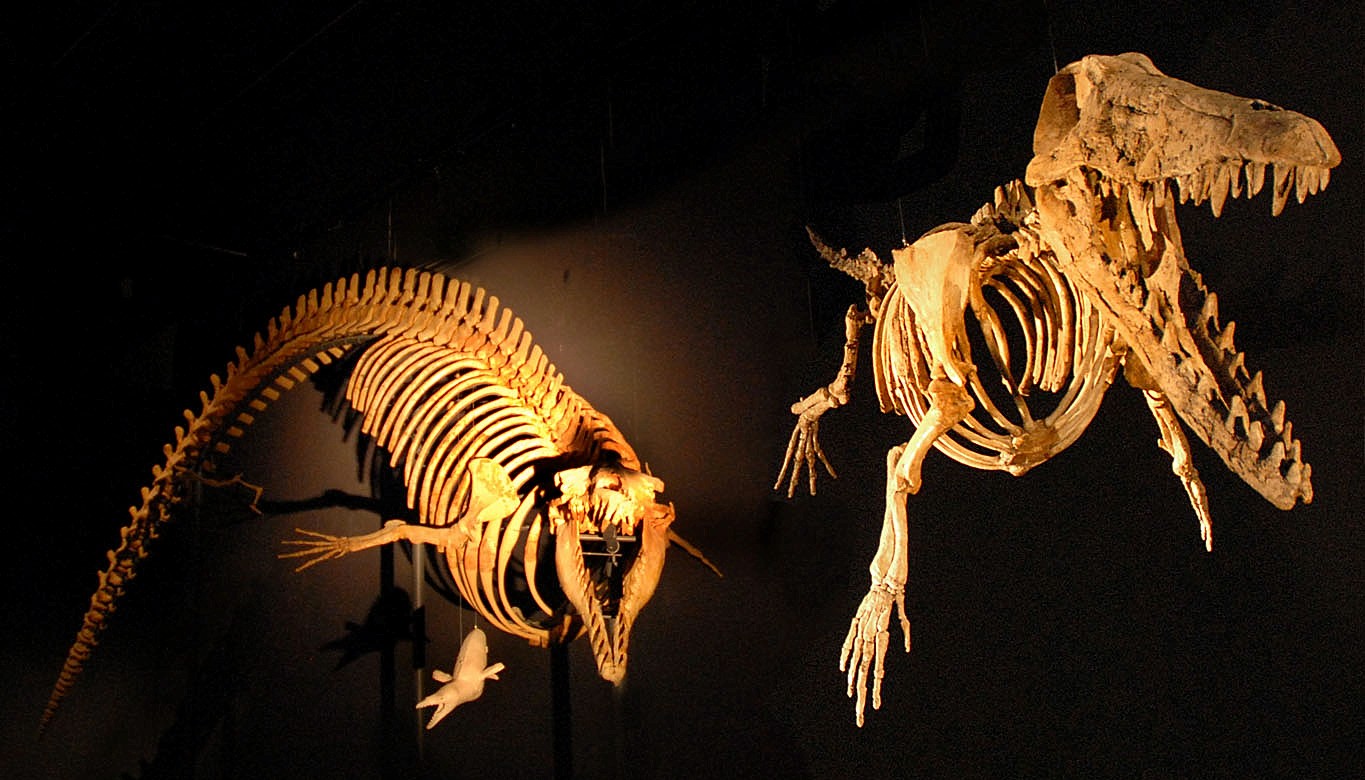
Cynthiacetus and Ambulocetus skeletons
Scientific classification Edit this classification
(obsolete)
Kingdom: Animalia
Phylum: Chordata
Class: Mammalia
Order: Artiodactyla
Infraorder: Cetacea
(unranked): Archaeoceti
Flower, 1883
Families and clades

See text

Archaeoceti ("ancient whales"), or Zeuglodontes in older literature, is an obsolete paraphyletic group of primitive cetaceans that lived from the Early Eocene to the late Oligocene (50 to 23 million years ago).[1] Representing the earliest cetacean radiation, they include the initial amphibious stages in cetacean evolution, thus are the ancestors of both modern cetacean suborders, Mysticeti and Odontoceti.[2] This initial diversification occurred in the shallow waters that separated India and Asia 53 to 45 mya, resulting in some 30 species adapted to a fully oceanic life. Echolocation and filter-feeding evolved during a second radiation 36 to 35 mya.[3]

All archaeocetes from the Ypresian (56–47.8 mya) and most from the Lutetian (47.8–41.3 mya) are known exclusively from Indo-Pakistan, but Bartonian (41.3–38.0 mya) and Priabonian (38.0–33.9 mya) genera are known from across Earth, including North America, Egypt, New Zealand, and Europe. Although no consensus exists regarding the mode of locomotion of which cetaceans were capable during the late Lutetian, they were very unlikely to be nearly as well-adapted to the open ocean as living cetaceans. They probably reached as far as North America along coastal waters, either around Africa and over to South America, or more likely, over the Tethys Sea (between Eurasia and Africa) and along the coasts of Europe, Greenland, and North America.[4]

The archaeocetes are paraphyletic in relation to their extant modern descendants, the Neoceti (neocetes). Neocetes consist of two subgroups, the toothed whales (odontocetes) and the baleen whales (mysticetes).[5][6]

Description

[edit]

Pakicetidae

[edit]
Pakicetus, a pakicetid (drawing showing preserved fossil remains).

First identified as cetaceans by West 1980, the pakicetids, the most archaic of whales, had long, slender legs and a long, narrow tail, and could reach the size of a modern wolf. They have only been found in sediments from freshwater streams in northwestern India and northern Pakistan, and were probably waders rather than swimmers.[7]

Dozens of fossils are known, but only of skulls, teeth, and jaw fragments; no complete skeletons have been found. The dentition varied; the smallest species had teeth like modern fish eaters, and the largest were more like modern hyenas. The pakicetids may have been predators or carrion feeders. Neither the skull nor the dentition of pakicetids resembles those of modern whales, but the sigmoid process, involucrum, pachyostotic (compact) and rotated ossicles of their ears still reveal their cetacean nature.[2]

Ambulocetidae

[edit]
Ambulocetus, an ambulocetid (drawing showing preserved fossil remains).

The next diverging family of whales, the Ambulocetidae, were large, already fully aquatic,[8] and crocodile-like with large feet and a strong tail. Sediments indicate that they lived in coastal areas and their compact bones suggest that they were ambush rather than fast-pursuit predators. Also known exclusively from Pakistan and India, the ambulocetids include the oldest known whale, Himalayacetus, which is believed to be 53.5 million years old, some 4 million years older than the rest of its family.[7]

Of the less than 10 fossils that have been described, one, Ambulocetus natans, is nearly complete and the main source of information concerning early cetacean evolution. The size of a male sea lion, it had a large head with a long snout and robust, strongly worn teeth. The lower jaw shows that Ambulocetus had an unusual soft tissue connecting the back of the jaw to the middle ear — a small equivalent to the large sound-receiving fat pad in modern odontocetes. Its eyes were placed dorsally on the head, but were facing laterally. The musculature of the head, neck, and back was strong and the fluke-less tail was long. The hind limbs were short, but equipped with long feet. The fore limbs were also short and equipped with five short hooves. Ambulocetus probably swam with its hind feet like a modern otter, and was incapable of supporting its own weight on land. It probably was an ambush hunter like modern crocodiles.[2]

Remingtonocetidae

[edit]
Kutchicetus, a remingtonocetid.

The Remingtonocetidae had short limbs, and a strong and powerful tail with flattened vertebrae. Their long snout, tiny eyes, and ear morphology suggest their vision was poor and that hearing was their dominant sense. They, too, have only been found in Pakistan and India, and sediments suggest that they lived in turbid waters in coastal areas. Though they were probably able to live on land, they apparently used their tails to swim.[7]

Dozens of fossils have been described, but most are only skulls and lower jaws with few dental and postcranial remains. Remingtonocetids probably varied in size with the smallest species matching Pakicetus and the largest Ambulocetus. Remingtonocetids had longer snouts than other archaeocetes, except that the cranial morphology also varied considerably, probably reflecting different diets. The eyes were small, but the ears were large and set far apart — probably reflecting an increased emphasis on underwater hearing. The fragmentary remains of remingtonocetid postcrania suggest that they had a long neck and large hind limbs that were probably able to support the body weight on land.[2]

The remaining families and later crown cetaceans form a clade united by six synapomorphies:[9] The anterior margin of external nares is located above or behind the third upper incisor, the rostrum is wide, the supraorbital processes are present but short, the anterior edge of the orbit is located above the second or third upper molar, the postorbital process forms a 90° angle with the sagittal crest, and the cervical vertebrae are short.

Protocetidae

[edit]
Maiacetus, a protocetid.

The Protocetidae, known from both Africa and America, were a diversified family with hind limbs and a strong tail, indicating that they were strong swimmers that colonized shallow and warm oceans, such as reefs. They greatly affected cetacean evolution 47 to 41 million years ago, because they spread across Earth's oceans.[7] They had long snouts, large eyes, and a nasal opening located farther up the head than in earlier archaeocetes — suggesting they could breathe with the head held horizontally, similar to modern cetaceans — a first step towards a blowhole. Their dentition varied, but started to evolve towards the nonmasticating teeth of modern cetaceans, and they were probably active hunters. Their ability to move on land seems to have been variable: in Rodhocetus and Peregocetus possess a sacroiliac joint, indicating they could move on land.[10] In other genera (Georgiacetus and Aegicetus), the pelvis was not connected to the vertebral column, suggesting the hind limbs could not have supported the body weight.[2] Some genera (Rodhocetus) had large hind feet forming large paddles, while Aegicetus seems to have relied more on its tail to propel itself through the water.[11]

Basilosauridae

[edit]
Dorudon, a basilosaurid.

Basilosaurids, which had tiny hind limbs and flipper-shaped fore limbs, were obligatorily aquatic and came to dominate the oceans. They still lacked the echolocation and baleen of modern odontocetes and mysticeti.[7] Basilosaurids and dorudontids are the oldest obligate aquatic cetaceans for which the entire skeleton is known. They display a number of aquatic adaptations not present in earlier archaeocetes:[12] In the vertebral column, the neck vertebrae are short, the thoracic and lumbar vertebrae are of similar length, the sacral vertebrae are unfused, the sacroiliac joints are absent, and the short tail has a ball vertebra (indicating the presence of a fluke). The scapulae are broad and fan-shaped with anterior acromions and small supraspinous fossae. The ulnae are large and have transversely flat olecranons, the wrists and distal forearms are flattened in the plane of the hands, and the hind limbs are tiny.

Taxonomy

[edit]

The Archaeoceti include five well-established families:[13] The status of the Kekenodontidae is still disputed, and the family is placed in either the Archaeoceti, Mysticeti,[14] or even Delphinoidea.[15]

Cetartiodactyla
Archaeoceti
Pakicetidae (Thewissen, Madar & Hussain 1996)
Pakicetus (Gingerich & Russell 1981)
Nalacetus (Thewissen & Hussain 1998)
Ichthyolestes (Dehm & Oettingen-Spielberg 1958)
Ambulocetidae (Thewissen, Madar & Hussain 1996)
Ambulocetus (Thewissen, Madar & Hussain 1996)
Gandakasia (Dehm & Oettingen-Spielberg 1958)
Himalayacetus (Bajpai & Gingerich 1998)
Remingtonocetidae (Kumar & Sahni 1986)
Andrewsiphius (Sahni & Mishra 1975)
Attockicetus (Thewissen & Hussain 2000)
Dalanistes (Gingerich, Arif & Clyde 1995)
Kutchicetus (Bajpai & Thewissen 2000)
Remingtonocetus (Kumar & Sahni 1986)
Rayanistes (Bebej et al., 2016)
Protocetidae (Stromer 1908)
Georgiacetinae (Gingerich et al. 2005)
Aegicetus (Gingerich et.al. 2019)
Babiacetus (Trivedy & Satsangi 1984)
Carolinacetus (Geisler, Sanders & Luo 2005)
Crenatocetus (McLeod & Barnes 2008)
Georgiacetus (Hulbert et al. 1998)
Natchitochia (Uhen 1998)
Pappocetus (Andrews 1919)
Pontobasileus
Makaracetinae (Gingerich et al. 2005)
Makaracetus (Gingerich et al. 2005)
Protocetinae (Gingerich et al. 2005)
Aegyptocetus (Bianucci & Gingerich 2011)
Artiocetus (Gingerich et al. 2001)
Dhedacetus
Gaviacetus (Gingerich, Arif & Clyde 1995)
Indocetus (Sahni & Mishra 1975)
Maiacetus (Gingerich et al. 2009)
Peregocetus
Protocetus (Fraas 1904)
Phiomicetus (Gohar et al., 2021)
Qaisracetus (Gingerich et al. 2001)
Rodhocetus (Gingerich et al. 1994)
Takracetus (Gingerich, Arif & Clyde 1995)
Togocetus (Gingerich & Cappetta 2014)
Basilosauridae
Basilosaurinae
Basilosaurus (Harlan 1834)
Basiloterus (Gingerich et al. 1997)
Eocetus (Fraas 1904)
Dorudontinae
Ancalecetus (Gingerich & Uhen 1996)
Basilotritus (Goldin & Zvonok 2013)
Chrysocetus (Uhen & Gingerich 2001)
Cynthiacetus (Uhen 2005)
Dorudon (Gibbes 1845)
Masracetus (Gingerich 2007)
Ocucajea (Uhen et al. 2011)
Pontogeneus
Saghacetus (Gingerich 1992)
Stromerius (Gingerich 2007)
Supayacetus (Uhen et al. 2011)
Tutcetus (Antar et al. 2023)
Zygorhiza (True 1908)
Pachycetinae
Antaecetus
Pachycetus
Perucetus
Kekenodontidae
Kekenodon (Hector 1881)

Phylogeny

[edit]
Whippomorpha

Notes

[edit]

References

[edit]
[edit]
Revisions and contributorsEdit on WikipediaRead on Wikipedia
from Grokipedia
Archaeoceti, meaning "ancient whales," were a paraphyletic assemblage of primitive cetaceans that flourished during the Eocene epoch, from approximately 55 to 34 million years ago, marking the initial stages of whale evolution from terrestrial ancestors to fully aquatic mammals. These early whales originated from within terrestrial around the –Eocene boundary, about 54 million years ago, and provided the only direct evidence of the land-to-sea transition through progressive adaptations in locomotion, skeletal proportions, and . By the late Eocene, archaeocetes had achieved global distribution across six continents in marginal marine and shallow marine environments, evolving from amphibious forms to obligate swimmers powered initially by hindlimbs and later by tail undulation. The evolutionary progression of archaeoceti is documented across several families, reflecting increasing aquatic specialization. The earliest pakicetids, such as , were small, terrestrial-to-semiaquatic predators around 2 meters long, with diets shifting from omnivory to including aquatic prey like and as early as the early Eocene. Middle Eocene families like ambulocetids (, up to 3 meters), remingtonocetids, and protocetids (e.g., , about 3 meters) were amphibious, using paddling for propulsion in coastal waters, with elongate jaws and reduced hindlimbs indicating a two-phase : first toward life, then full marine commitment. Late Eocene basilosaurids (, up to 20 meters) and dorudontids (, about 5 meters) were fully aquatic, with diminutive hindlimbs, specialized tail flukes for caudal oscillation, and carnivorous diets targeting , marine birds, and mammals; recent discoveries include the diminutive Tutcetus (~2.5 m) and the massive (up to ~17 m) (as of 2023), setting the stage for the diversification of modern odontocetes (toothed whales) and mysticetes ( whales) by the Eocene– boundary. Key adaptations in archaeoceti included dental microwear indicating mixed diets of (cephalopods, crustaceans) and vertebrates, alongside rapid evolutionary rates—about ten times background levels—in trunk and limb proportions to facilitate swimming. Fossils from sites like Wadi Al-Hitan in reveal the youngest archaeocetes in the final stages of hindlimb reduction, underscoring their role as transitional forms. Originating likely in southern (Indo-Pakistan region), they dispersed worldwide by the middle Eocene, with no evidence of post-Eocene survival except through descendant lineages. This group's legacy lies in illuminating cetacean origins, with over 30 genera (dozens of ) known from rare but informative skeletons that bridge artiodactyl terrestrialism and the pelagic lifestyles of today's whales.

Introduction

Definition and Characteristics

Archaeoceti, also known as archaic whales, represent a paraphyletic assemblage of stem-group cetaceans that form the basal lineage leading to the crown-group Cetacea, which includes the extant suborders Odontoceti (toothed whales) and Mysticeti (baleen whales). These early cetaceans first appeared in the early Eocene epoch, approximately 53.5 million years ago, and persisted through the middle to late Eocene until around 33.9 million years ago, primarily documented from fossil-rich deposits in regions like Indo-Pakistan and expanding globally. As a stem group, Archaeoceti excludes the monophyletic Neoceti but encompasses diverse families that bridge terrestrial artiodactyl ancestors to fully aquatic whales, retaining primitive mammalian features while evolving aquatic adaptations. Shared characteristics among archaeocetes include toothed skulls with , featuring incisors, canines, premolars, and molars adapted for grasping and shearing prey, often with double-rooted cheek teeth for enhanced anchorage. They possessed elongated snouts that varied in length across families, facilitating a predatory in aquatic environments, and consistently had seven , a diagnostic cetacean trait that supported mobility despite increasing aquatic specialization. Early archaeocetes, such as those in Pakicetidae, retained functional hind limbs for terrestrial ambulation and wading, though these became reduced and vestigial in later forms, reflecting a transitional phase from land to sea. Archaeocetes exhibited a broad size range, from the small, dog-like forms of Pakicetidae measuring 1–2 meters in length to the elongated, serpentine bodies of reaching up to 18–20 meters, indicating diverse ecological niches from coastal shallows to open oceans. In distinction from Neoceti, archaeocetes lacked specialized features such as plates for filter feeding in mysticetes or advanced echolocation adaptations like the premaxillary sacs and fossae in odontocetes; their cochleae were simpler, without the small basilar gap associated with high-frequency hearing in modern toothed whales.

Evolutionary Significance

Archaeoceti represent the basal stem group of cetaceans, originating from even-toed ungulates (Artiodactyla) during the early Eocene, with molecular and fossil evidence strongly supporting their close phylogenetic relationship to hippopotamids as the nearest living relatives. This linkage is corroborated by shared morphological traits in the ankle bones, such as the double-pulley astragalus, and genetic analyses of SINE insertions in the genome, which cluster cetaceans within Artiodactyla as part of the monophyletic Cetartiodactyla clade. The transition underscores a rapid evolutionary shift from terrestrial herbivores to semi-aquatic predators, driven by adaptations to coastal environments. The earliest known Archaeoceti fossils date to approximately 53.5 million years ago (Ma) from the Subathu Formation in northern , exemplified by Himalayacetus subathuensis, a pakicetid with primitive artiodactyl-like features including functional limbs for . This discovery pushed back the origin of cetaceans by about 3.5 million years, revealing a rapid diversification across multiple families during the Eocene epoch, particularly in the shallow waters of the Tethys Sea, where over a dozen genera emerged within roughly 10 million years. These milestones illustrate a stepwise evolutionary progression: from ambulatory pakicetids that waded in freshwater streams, to paddling ambulocetids and remingtonocetids adapted to nearshore marine habitats, and finally to fully aquatic protocetids and basilosaurids capable of sustained swimming via tail propulsion. Such a sequence directly fulfills Charles Darwin's prediction in On the Origin of Species for intermediate forms documenting macroevolutionary transitions, providing one of the most complete fossil records of adaptation from land to sea among vertebrates. The evolutionary significance of Archaeoceti extends to broader paleoenvironmental insights, as their proliferation correlates with the warm Eocene climate and the expansive, nutrient-rich Tethys Sea, which facilitated the invasion of aquatic niches by offering shallow, estuarine habitats teeming with prey. Archaeoceti persisted until around 34 Ma, near the Eocene-Oligocene boundary, after which they declined amid and ocean restructuring, allowing the radiation of the more derived crown-group cetaceans (Neoceti) that dominate modern oceans with innovations like echolocation and filter-feeding. Ongoing phylogenetic refinements, such as the 2025 analysis of endocranial features in protocetids, continue to provide insights into relationships and sensory within Archaeoceti, highlighting the dynamic of cetacean evolutionary studies and the role of new fossils in resolving paraphyletic groupings.

Anatomy and Adaptations

Skeletal and Muscular Features

The skulls of archaeocetes exhibit a moderate degree of telescoping, less pronounced than in modern cetaceans, with the positioned more anteriorly and the frontals forming a prominent vertex. Large temporal fossae are characteristic, providing extensive attachment areas for temporalis muscles that supported a powerful bite suited to their carnivorous diet. The includes double-rooted premolars and molars, reflecting adaptations for grasping and shearing prey, though less specialized than the conical teeth of later odontocetes. The of archaeocetes features an elongated presacral region, with up to 65 vertebrae in forms like , enabling a flexible, elongated body for both terrestrial and aquatic movement. The sacral region is reduced compared to terrestrial ancestors, consisting of fewer fused vertebrae (typically four in early forms), yet retaining attachments for hind limbs that facilitated weight support on land. In advanced basilosaurids, such as , presacral vertebrae are particularly elongated (length-to-height ratio of 1.72), contributing to a serpentine body form optimized for undulatory propulsion. Forelimbs in archaeocetes represent transitional flipper precursors, with early forms retaining ambulatory capabilities and later species developing hyperphalangy—increased phalangeal counts beyond the primitive five per digit—for enhanced paddling efficiency. Hind limbs are vestigial in advanced archaeocetes but remain functional for steering in early semi-aquatic species, such as ambulocetids, where robust femora and tibiae supported paddling motions. Musculature in archaeocetes shifted from terrestrial adaptations to aquatic ones across the group; pakicetids possessed strong epaxial muscles along the back and neck for postural support during quadrupedal locomotion on land. In later families like protocetids and basilosaurids, these epaxial muscles reoriented to power lateral undulation of the vertebral column, driving tail-based swimming while diminishing reliance on limb propulsion. The overall body plan of archaeocetes was streamlined for semi-aquatic to fully aquatic lifestyles, with elongated trunks and visible external hind limbs in fossils of early and middle forms like natans, but lacking the large tail fluke seen in modern cetaceans. This configuration supported a progression from wading and bottom-walking to open-water cruising, without the full hydrodynamic specialization of later whales.

Sensory and Locomotor Transitions

The transition in hearing among Archaeoceti marked a shift from airborne sound detection in early terrestrial forms to reception in more aquatic lineages, facilitated by modifications to the ear bones. In pakicetids, the ear retained a land-mammal configuration optimized for air conduction, with sound primarily entering via the external auditory meatus, though through the heavy tympanic bulla allowed rudimentary hearing. By remingtonocetids and protocetids, a genuine ear emerged, with sound transmitted through the mandibular fat pad to the tympanic plate and , while the involucrum—a thick, pachyosteosclerotic medial portion of the tympanic bulla—developed early in pakicetids and enhanced vibration isolation for aquatic environments. These adaptations remained primitive compared to later odontocetes, lacking full acoustic isolation of the and the specialized thin or enlarged cochlear canals required for high-frequency echolocation. Recent analyses of protocetid inner ear fossils, including micro-CT scans of specimens like Georgiacetus and Maiacetus, reveal intermediate adaptations such as a narrower laminar gap in the cochlea, enabling sensitivity to higher frequencies (up to several kHz) than in earlier archaeocetes. This configuration, combined with a mandible-tympanic ligament connection, supported efficient sound conduction for detecting prey vibrations in shallow-water habitats, likely aiding active pursuit hunting rather than deep-ocean echolocation. Such features represent a transitional stage, with protocetid hearing bridging low-frequency specialization in pakicetids (for substrate-borne sounds) and the ultra-high-frequency capabilities of crown cetaceans. Vision and olfaction underwent parallel reductions as Archaeoceti adapted to aquatic life, with olfaction diminishing most dramatically in later forms while vision shifted toward underwater acuity. Early pakicetids retained well-developed olfactory bulbs and maxilloturbinates similar to terrestrial , enabling a keen for locating freshwater sources or prey on . In remingtonocetids and protocetids, olfactory bulbs shrank, losing the dorsal domain associated with volatile detection, though a ventral domain persisted for basic chemosensory function in water; this reduction coincided with the loss of functional nasal passages for olfaction. By basilosaurids, olfactory structures were vestigial, reflecting reliance on other senses in fully pelagic environments. For vision, archaeocete eyes transitioned from forward-facing in , suited to terrestrial predation, to more dorsally and laterally positioned orbits in and , improving binocular overlap and light detection from below in shallow waters. Orbit diameters increased progressively, with showing enlarged orbits indicative of larger eyes adapted for low-light underwater conditions, though lacking the extreme spherical lenses of modern cetaceans. Locomotor evolution in Archaeoceti progressed from terrestrial to fully aquatic , driven by modifications in limb and flexibility. Pakicetids employed a sprawling, on land with limited aquatic paddling using short, robust limbs, akin to modern carnivorans. Ambulocetids advanced to foot-powered , undulating the spine to drive webbed hindfeet in an otter-like manner for in shallow coastal waters. Protocetids incorporated greater spinal undulation, with increased mobility allowing dorsoventral flexion to generate thrust from both limbs and body, as evidenced by fossils like Aegicetus gehennae showing transitional vertebral morphology. Basilosaurids achieved tail-dominated , with elongated caudal vertebrae and fluke precursors enabling powerful vertical oscillations for sustained open-water travel, marking the loss of effective terrestrial locomotion. Balance and adaptations in Archaeoceti relied initially on pulmonary air for positive buoyancy and surface-oriented swimming, evolving toward for deeper dives without developing a specialized layer. Early pakicetids and ambulocetids had low (volumetric density ~1.5 g/cm³ in ribs and vertebrae), providing inherent buoyancy from s and allowing brief submergence while favoring surface ambulation. Later protocetids and basilosaurids exhibited increased skeletal density (up to ~1.8 g/cm³), shifting toward to facilitate prolonged submergence and agile maneuvering in mid-water columns, balanced by adjustable volume. Unlike modern cetaceans, archaeocetes lacked thick subcutaneous fat for insulation or buoyancy, instead using air sinuses and pachyosteosclerosis for static control during dives limited to tens of meters.

Families

Pakicetidae

Pakicetidae represents the earliest known family of Archaeoceti, dating to the early Eocene epoch approximately 53.5 to 49 million years ago. Fossils of this family have been primarily discovered in the Indo-Pakistan region, particularly in the Kala Chitta Range of , where sedimentary deposits from riverine and coastal environments preserve their remains. These semi-terrestrial mammals marked the initial stages of cetacean evolution, exhibiting a wolf- or dog-like build adapted for life on land with only tentative aquatic excursions. The family includes three key genera: , Ichthyolestes, and Nalacetus. Individuals ranged in size from about 1 to 2.5 meters in length, with Ichthyolestes being the smallest at roughly fox-sized (around 1 meter), while Pakicetus and Nalacetus approached the dimensions of a large or small deer. Their overall physique resembled that of early , featuring a slender, quadrupedal frame with a long and robust limbs suited for terrestrial locomotion. Distinctive anatomical traits of Pakicetidae highlight their transitional nature. The ankle bones, particularly the astragalus, retained a fully terrestrial artiodactyl-like morphology with a prominent medial and double-pulley structure, enabling efficient weight-bearing on land. However, their limb bones displayed increased density through , providing ballast for wading in shallow waters without compromising terrestrial mobility. consisted of pointed for grasping and shearing in the molars, indicative of a piscivorous diet focused on capturing small prey. Pakicetids inhabited riverine environments in tropical floodplains, where they likely ambushed and other aquatic prey from the shallows. Analysis of stable oxygen isotopes in reveals δ¹⁸O values consistent with ingestion of freshwater or low-salinity (, with intra-tooth variation suggesting movement between riverine and estuarine habitats. Carbon isotopes further support a diet derived from freshwater sources, reinforcing their role as near-shore predators rather than fully marine dwellers. As the oldest cetaceans, Pakicetidae hold critical significance in confirming the origins of whales, with their ankle morphology providing unambiguous evidence of close phylogenetic ties to even-toed ungulates. This illustrates the initial evolutionary forays into aquatic niches, bridging terrestrial mammals to fully marine forms without yet developing specialized swimming adaptations.

Ambulocetidae

Ambulocetidae is a of early archaeocetes that marks the initial transition to a semi-aquatic among cetaceans, characterized by adaptations for predation in shallow coastal environments. Known from the early to middle Eocene, approximately 49–47 million years ago, fossils of this have been recovered primarily from deposits in and northwestern , including nearshore marine and estuarine settings. The includes the genera and Gandakasia, with Ambulocetus natans providing the most complete skeletal evidence of their otter-like , measuring about 2–3 meters in length and weighing roughly 400 kilograms. Key skeletal features of ambulocetids reflect their dual capabilities for terrestrial movement and aquatic . The limbs are robust and short, with elongated feet bearing four toes that functioned as paddles during swimming, supported by flexible joints allowing both walking on land and powerful strokes akin to those of modern otters. Dense, osteosclerotic bones in the limbs—where the marrow cavity occupies only about 57% of the femur's cross-section—provided for control in shallow waters, preventing floating while submerged. The was muscular and robust, with enlarged neural spines on the caudal vertebrae indicating strong via dorsoventral undulation, while the featured a long , high-positioned eyes for periscope-like surface surveillance, and enlarged temporal fossae suggesting powerful jaw muscles for biting prey. Ambulocetids inhabited coastal lagoons, swamps, and river mouths in the Tethys Sea region, where they likely employed ambush tactics to capture prey near the water's surface, similar to crocodilians. Stable isotope analyses of reveal a diet incorporating both terrestrial and , with oxygen isotopes indicating habitation in environments ranging from freshwater-influenced to fully marine settings, supporting a primarily aquatic lifestyle despite retained terrestrial mobility. The skeleton of A. natans, discovered in 1993 near , , exemplifies this amphibious nature—earning the moniker "walking whale"—as it demonstrates weight-bearing hind limbs for land travel, though biomechanical evidence points to as the dominant mode of locomotion. Gandakasia, known from fragmentary remains including teeth, shares similar dental morphology adapted for grasping, further illustrating the family's predatory adaptations in these transitional habitats.

Remingtonocetidae

Remingtonocetidae is a family of early Eocene archaeocetes characterized by their adaptation to shallow marine environments, representing a transitional stage in cetacean evolution with amphibious capabilities. Known from the Middle Eocene, approximately 47–43 million years ago, fossils of this family have been primarily recovered from coastal deposits in the Indo- region, including the Sulaiman Range in and the Kutch region in , with additional occurrences in Egypt's Midawara Formation. The family includes key genera such as Remingtonocetus, Dalanistes, and Attockicetus, with body lengths ranging from about 2.5 to 4 meters, comparable to large crocodilians in build. These cetaceans exhibited a pig-like with a long, low profile, short robust limbs, and likely webbed feet suited for paddling. Their skulls were notably long and narrow, featuring a robust structure with interlocking teeth adapted for a strong bite to grasp slippery prey. Nostrils were positioned high on the , near the , facilitating behavior where only the head needed to surface for while the body remained submerged. The postcranial included a long , fused for stability, and dense bones indicative of pachyosteosclerosis, which aided in control for submersion in shallow waters. Remingtonocetids inhabited estuarine and near-shore shallow seas, where they employed bottom-walking and foot-powered propulsion for locomotion, as evidenced by their robust hind limbs and enhanced lumbar flexibility for extended power strokes underwater. Despite their aquatic specialization, the structure of their limbs suggests they retained the ability to move on land, albeit awkwardly, in a manner similar to modern pinnipeds. Fossil evidence, including multiple associated skeletons from the same localities, implies possible social behavior, such as pack hunting, to pursue fish in these murky, coastal habitats. Adaptations included small eye orbits positioned laterally for some underwater visibility in low-light conditions, but reliance on acute hearing via enlarged middle ear cavities for navigating turbid waters, precursors to more advanced undulatory swimming seen in later cetaceans.

Protocetidae

Protocetidae represents a diverse family of amphibious archaeocete cetaceans that flourished during the middle Eocene, approximately 48 to 37 million years ago, marking a transitional phase in whale evolution toward greater aquatic adaptation. Fossils of protocetids have been recovered from marine and coastal deposits across a wide global distribution, including (particularly Indo-Pakistan and ), (such as , , and ), (with the first confirmed record from ), (New Jersey and ), and (Peru). This broad dispersal, achieved through oceanic routes around the Tethys Sea and emerging connections between landmasses, underscores their enhanced mobility compared to earlier, more regionally confined archaeocetes. Key genera exemplify the family's morphological diversity and size range, typically measuring 2.5 to 5 meters in body length, with a body plan increasingly dolphin-like yet retaining functional hind limbs. For instance, from , approximately 2.5 meters long, featured robust forelimbs with elongated phalanges indicating early hyperphalangy, functioning as proto-flippers for maneuvering in water, while its reduced hind limbs remained mobile for supporting the body on land or beaching. Similarly, , also from and around 2.6 meters in length, possessed a flexible vertebral column enabling lateral undulation for , alongside hind limbs adapted for terrestrial support. Qaisracetus, a medium-sized protocetid from with a about 65 cm long, shared these traits, highlighting the family's overall progression toward aquatic propulsion while preserving terrestrial capabilities. These features reflect protocetids' amphibious lifestyle, bridging land-based ancestry and fully marine descendants. Protocetids inhabited offshore to coastal marine environments, where they pursued a piscivorous diet, as evidenced by their heterodont dentition suited for grasping and shearing . Stomach contents and isotopic analyses from related fossils confirm a reliance on aquatic prey, supporting their role as apex predators in Eocene seas. Reproductive evidence from includes a fossilized female with a near-term positioned head-first, indicating live birth on land, with precocial young capable of following the mother shortly after delivery, akin to modern semi-aquatic mammals. Recent discoveries have further illuminated their , such as from in 2021, a 3-meter-long with robust teeth suggesting durophagous tendencies alongside piscivory, reinforcing protocetids' presence in African waters during the Lutetian . Additionally, phylogenetic analyses have reaffirmed the placement of genera like Gaviacetus within Protocetidae, emphasizing their paraphyletic nature as intermediates in cetacean .

Basilosauridae

Basilosauridae represents the most derived family within Archaeoceti, consisting of fully aquatic cetaceans that inhabited marine environments during the late Eocene epoch, approximately 41.2 to 33.9 million years ago. Fossils of basilosaurids have been discovered across a , including the Tethys Sea, Western North Atlantic, , , , , and even rare occurrences in the North Pacific such as , , indicating their to diverse oceanic basins. This global presence suggests extensive dispersal capabilities, with evidence from Atlantic and Pacific localities supporting long-distance migration patterns typical of pelagic life. Prominent genera within Basilosauridae include Basilosaurus and Dorudon, which exemplify the family's range in body size from about 5 to 18 meters in length, characterized by elongated, serpentine bodies adapted for undulatory swimming. Basilosaurus, reaching up to 18 meters, featured a notably long vertebral column with numerous precaudal vertebrae, contributing to its slender, eel-like form, while Dorudon was smaller, typically around 5 meters, but shared similar proportions. These genera dominated late Eocene marine ecosystems, with Basilosaurus isis from Egyptian deposits exemplifying the family's predatory adaptations. Distinctive morphological traits of basilosaurids include vestigial hind limbs that were small, detached from the , and incapable of supporting body weight, as evidenced by pelvic elements in Basilosaurus isis measuring only about 60 cm in total length. The hind limbs retained phalanges and a rudimentary foot structure but served no locomotor function, likely playing a role in aquatic behaviors such as stabilization during . The was powerfully muscled, with elongated caudal vertebrae suggesting precursors to the fluke seen in modern cetaceans, enabling efficient propulsion through tail-driven swimming that built upon the increased spinal flexibility observed in earlier protocetids. Skulls were markedly elongated, often exceeding 1 meter in Basilosaurus, and equipped with heterodont dentition featuring serrated, triangular cheek teeth suited for grasping and shearing large prey such as , , and smaller cetaceans. Basilosaurids occupied open ocean habitats as apex predators, preying on a variety of marine vertebrates, with bite marks on Dorudon skeletons indicating intraspecific predation by Basilosaurus isis in shallow to bathyal Tethyan waters. Their fully pelagic lifestyle is inferred from the deep-water depositional environments of many fossils, contrasting with the more coastal preferences of earlier archaeocetes, and supported by the absence of terrestrial adaptations. The family declined toward the end of the late Eocene, with no records extending into the , coinciding with the Eocene-Oligocene transition around 33.9 million years ago, potentially driven by global cooling and associated oceanographic changes that disrupted food webs. As the last archaeocetes, basilosaurids are positioned as direct ancestors to the crown-group Neoceti, bridging the transition to modern whales through their advanced aquatic specializations.

Taxonomy and Phylogeny

Taxonomic History

The suborder Archaeoceti was first formally established by William Henry Flower in 1883, who distinguished these primitive, extinct cetaceans from the modern forms (Neoceti) based on differences in vertebral structure and overall , marking the initial separation of whales from living ones. Prior to this, early 19th-century discoveries such as (named in 1834) were often lumped together with extant whales under a single, undifferentiated Cetacea, reflecting limited material and a lack of recognition for their transitional nature. The saw a boom in fossil discoveries, particularly from Eocene deposits in and , which began to refine Archaeoceti's position within mammals. Discoveries of in the early 1980s, such as P. attocki (1980) and P. inachus (1983), from fluvial sediments in and associated with land-mammal faunas, suggested a terrestrial origin for early cetaceans. Postcranial fossils described in revealed shared ankle morphology with terrestrial , providing direct evidence of this link and challenging prior views of whales as isolated marine specialists. In the 1990s, J.G.M. Thewissen and colleagues proposed splitting Archaeoceti into distinct families—such as Pakicetidae, , , and Protocetidae—based on progressive adaptations in locomotion, from ambulatory hindlimbs to more aquatic pelvic structures, as evidenced by skeletal proportions. Cladistic analyses in the early confirmed the of Archaeoceti, revealing it as a grade of stem cetaceans rather than a monophyletic clade, with basilosaurids as the closest relatives to crown-group Cetacea (Neoceti). Recent taxonomic refinements include the 2005 reclassification of genera like Gaviacetus from back to the paraphyletic Protocetidae, based on phylogenetic analyses of cranial and postcranial features. Nomenclature challenges have arisen from homonymy and priority rules, notably for , where the genus name (established 1834) takes precedence over later synonyms like Zeuglodon, ensuring stability in classifications despite initial misinterpretations as reptilian. These resolutions, guided by the , have prevented confusion in assigning new Eocene cetacean fossils to appropriate taxa.

Phylogenetic Relationships

The Archaeoceti represent a assemblage of stem cetaceans that form a linear progression of successive outgroups to the crown-group Cetacea (Neoceti), comprising the families Pakicetidae, , , Protocetidae, and in basal to derived order. This cladistic framework is supported by parsimony analyses of combined morphological and molecular data, which recover Pakicetidae as the most basal , characterized by terrestrial adaptations such as weight-bearing limbs, followed by increasingly aquatic and with elongated snouts and reduced olfaction. Protocetidae exhibit further pelvic reduction and pelvic girdle modifications, while show advanced tail fluke precursors and near-total vestigiality, positioning them as the immediate to Neoceti. The of Archaeoceti underscores their role as transitional forms rather than a cohesive , with no shared apomorphies unique to all members beyond the basal cetacean condition. Key evidence for these inter-family relationships includes shared derived traits that track the progression toward fully aquatic life. The involucrum, a dense pachyosteosclerotic bony casing around the , emerges as a synapomorphy for all Cetacea starting with Pakicetidae, facilitating sound isolation and transmission in water for enhanced underwater hearing. Similarly, hyperphalangy—an increase in phalangeal count within digits beyond the mammalian plesiomorphic state—evolves stepwise from Protocetidae onward, enabling flexible flipper formation for propulsion, as seen in the supernumerary phalanges of basilosaurid forelimbs. estimates, calibrated against the Archaeoceti fossil record, align divergence times with these morphological transitions, placing the origin of Cetacea around 53–50 million years ago in the early Eocene, consistent with the temporal distribution of pakicetid and ambulocetid fossils. Basilosauridae occupy the critical position closest to Neoceti, sharing synapomorphies such as extreme hindlimb reduction and a streamlined , yet the overall Archaeoceti exhibit a paraphyletic "ladder" structure without forming a single monophyletic beyond their stem role. Recent phylogenetic analyses, including Bayesian total-data approaches, reinforce this while supporting the Indo-Pakistani as the evolutionary cradle for early Archaeoceti, with basal pakicetids and remingtonocetids confined to Eocene deposits there. Debates persist on protocetid , with 2021 supermatrix studies finding no support for proposed subfamilies like Protocetinae, suggesting instead a grade of diverse, geographically widespread forms rather than a tight . The transition from Archaeoceti to Neoceti is marked by basilosaurid synapomorphies like pronounced cranial asymmetry, involving rightward rostral torsion and pan-bone thinning, which enhanced directional hearing via mandibular fat pads for locating prey in water. However, basilosaurids lack neocete specializations such as advanced telescoping, ultrasonic echolocation in odontocetes, or low-frequency adaptations in mysticetes, indicating that the full suite of modern cetacean auditory and locomotor traits arose in the .

Biogeographic Patterns

The origins of Archaeoceti trace back to the Indo-Pakistan region during the early Eocene, approximately 53 million years ago (Ma), where the earliest known fossils, such as those of pakicetids, have been discovered in formations like the Kuldana Formation. This area, part of the ancient Tethys Sea margins, served as the cradle for initial cetacean radiation, with primitive archaeocetes evolving from land-dwelling ancestors in fluvial and near-shore environments. The Tethys Sea corridor facilitated early dispersal along the northern margins of the supercontinent , allowing archaeocetes to spread into adjacent shallow marine and coastal habitats. Dispersal patterns expanded significantly by the middle Eocene, with protocetids reaching and the around 43 Ma, likely via westward migration along the proto-Atlantic and Tethys seaways from their Indo-Pakistani origins. Fossils from sites in , such as Wadi Al-Hitan in , document protocetid presence in the late Eocene, including species like Aegicetus gehennae, highlighting their to shallow neritic waters. By the late Eocene, basilosaurids achieved a cosmopolitan distribution, with remains reported from , , , and even , reflecting their fully pelagic lifestyle and ability to traverse open ocean barriers. In , protocetid fossils from , such as Carolinacetus gingerichi from the late middle Eocene, indicate an earlier extension of their range than previously emphasized in some records, predating 40 Ma. Habitat preferences among archaeocetes shifted progressively from freshwater riverine systems in the earliest forms to fully marine environments. Pakicetids inhabited terrestrial and fluvial settings in Indo-Pakistan, relying on river deltas for foraging. Ambulocetids and remingtonocetids transitioned to coastal and estuarine habitats, such as mangrove swamps and near-shore lagoons, as evidenced by their skeletal adaptations for ambush predation in shallow waters. Protocetids and basilosaurids further expanded into open marine realms, with the latter dominating pelagic niches globally by the late Eocene. The Eocene's warm greenhouse climate, characterized by high sea levels and reduced latitudinal temperature gradients, played a pivotal role in enabling trans-equatorial migrations and broad dispersal of archaeocetes across Tethyan and peri-Tethyan seaways. This thermal regime supported ice-free polar regions and facilitated faunal exchanges between hemispheres, contributing to the observed biogeographic expansion.

References

Add your contribution
Related Hubs
User Avatar
No comments yet.