Hubbry Logo
Paper dollPaper dollMain
Open search
Paper doll
Community hub
Paper doll
logo
8 pages, 0 posts
0 subscribers
Be the first to start a discussion here.
Paper doll
Paper doll
from Wikipedia
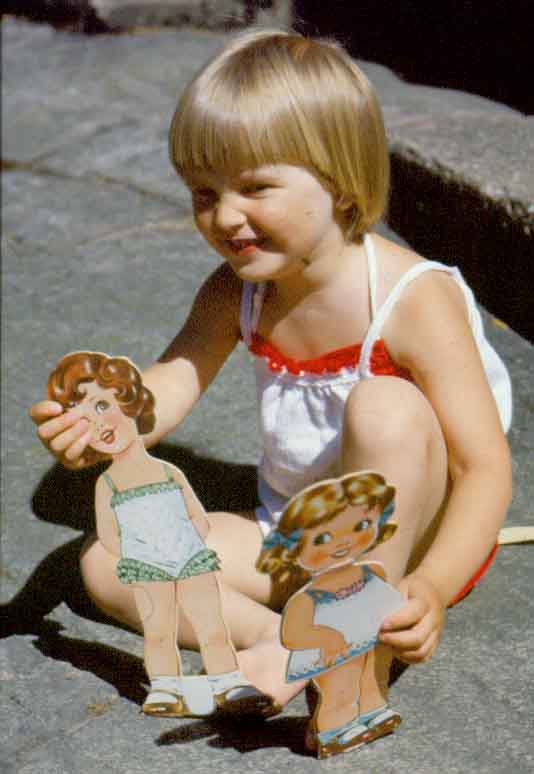
A girl playing with paper dolls

Paper dolls are figures cut out of paper or thin card with separate clothes, also made of paper, that are usually held onto the dolls by paper folding tabs.[1] They may be a figure of a person, animal or inanimate object.[2]

Paper dolls have been used for advertising, appearing in magazines and newspapers, and covering a variety of subjects and time periods. Over the years, they have been used to reinforce cultural beliefs regarding the appearance of ideal women.[3]

Some flat plastic figures are similar to paper dolls, like Colorforms figures and Flatsy dolls, but these are imitations and not considered characteristic of the paper doll art form.[4]

History

[edit]
1919 magazine illustration of actress Norma Talmadge and some of her film costumes in paper doll form

Paper dolls have been around as long as there has been paper, perhaps hundreds or even thousands of years by some estimates. Faces or other objects were applied to the paper and used during religious rituals and ceremonies in Asian cultures many centuries ago.[citation needed] The Japanese used paper for origami, the art of paper folding, and dating back to 800 AD they folded paper figurines in the shape of kimono. Balinese people made paper and leather into puppets since before the Christian Era. Other cultures around the world have had paper formations or paper art, including in Poland, where they were called Wycinanki. [citation needed] These early types of paper figures differ from typical modern paper dolls, as no clothes were made to be used with the dolls.

The first manufactured paper doll was “Little Fanny”, produced by S&J Fuller, London, in 1810.[2] In Europe, particularly France, the first paper dolls were popular since the mid-18th century. The oldest known paper doll card is hosted by Germanisches Nationalmuseum and was printed around 1650 in Southern Germany, showing two female figures with a number of dresses, pieces of headgear, hairstyles and accessories.[5] The paper was jointed and called pantins, meaning dancing or jumping jack puppet. They were intended to entertain adults and spread throughout high society. They were drawn or painted like people with fashions for each doll. These were more similar to contemporary Western paper dolls. Rare hand-painted sets of paper figures dating to the late 1780s can be found in some museums.[6]

"The History and Adventures of Little Henry", by J. Belcher was the first American toy that included paper dolls. Published in 1812, this book prompted children to act out various scenes with the paper dolls that were included.[3]

The biggest American producer of paper dolls, McLoughlin Brothers, were founded in early 1800 and sold to Milton Bradley in the 1920s. Around this time paper dolls became popular in the US and then grew in popularity in the following decades. The rise of paper doll production in the mid-19th century to mid-20th century was partially due to technological advances that made printing significantly less expensive.[3]

Paper doll with clothes

Book publishing companies that followed in the production of paper dolls or cut-outs were Lowe, Whitman, Saalfield and Merrill among others. Movie stars and celebrities became the focus in the early days of paper dolls in the USA. Paper dolls are still produced and Whitman and Golden Co. still publish paper dolls.

Other than movie stars, women of leisure tended to be the ones featured in paper doll form. As more women began to enter the work force in the twentieth-century, paper doll manufacturers began to produce dolls that represented career women. The women's rights movement in mid-20th century was partially responsible for instigating this change. Brides were another common figure often represented in paper doll form.[3]

Convention

[edit]

A paper doll convention has been held every year in the United States since 1979, with two being held in 1980, 1981, and 1982.[7] In 2016, one was held in Phoenix, Arizona.[8]

See also

[edit]

References

[edit]
[edit]
Revisions and contributorsEdit on WikipediaRead on Wikipedia
from Grokipedia
A is a two-dimensional representation of a figure, typically fashioned from or thin cardstock, accompanied by separate garments also made of that attach to the figure using folding tabs, primarily employed as a child's for imaginative and . Originating in mid-18th-century Europe, particularly in fashion hubs like Paris and Vienna, paper dolls initially served practical purposes such as allowing dressmakers to model clothing designs for clients without using live models or costly fabric samples. By the early 19th century, they transitioned into commercial entertainment products, with the first manufactured sets appearing in London around 1810 with Little Fanny and in the United States in 1812 via J. Belcher's The History and Adventures of Little Henry, bundled with children's literature to promote moral tales alongside play. Mass production accelerated their popularity from the mid-19th to mid-20th centuries, especially through lithographic printing techniques that enabled affordable distribution in books, magazines, and standalone kits, often depicting contemporary fashions, historical figures, or celebrities to mirror societal norms and aspirations. Their enduring appeal lies in fostering creativity and dexterity in children, though their prominence waned post-1950s with the rise of plastic dolls like Barbie, which offered greater durability and three-dimensionality.

Definition and Characteristics

Core Design Features

Paper dolls feature a fundamental two-dimensional figure constructed from paper or thin cardstock, cut in a humanoid shape with a static pose that positions limbs away from the torso to facilitate clothing attachment. The base doll is typically illustrated in minimal undergarments, providing a standardized form for overlaying outfits. Central to the design is modularity through interchangeable elements, where separate paper cutouts representing clothing, hats, shoes, and accessories attach via small protruding tabs folded over the doll's contours. These tabs, usually located along the upper and side edges of garments, secure items without permanent adhesion, allowing repeated reconfiguration to alter the doll's appearance or role. Self-standing capability distinguishes functional paper dolls, achieved via foldable base tabs or separate stands that enable upright display and manipulation during play. Design variations include full-body representations for holistic customization versus partial figures emphasizing torsos for focused , with poses selected for compatibility in tab alignment and outfit drape.

Materials and Construction Techniques

Paper dolls are primarily constructed from cardstock or thin , materials selected for their balance of flexibility and structural integrity during repeated handling and dressing. These substrates, typically ranging from 60 to 110 lb (163 to 300 ) in weight, provide resistance to creasing and tearing, with heavier gauges enhancing in play while remaining lightweight for easy manipulation. Thinner variants, closer to standard printer paper at 20-50 lb, may suffice for basic or disposable designs but compromise durability, often leading to deformation or breakage under stress. Printing techniques apply inks or pigments directly to the cardstock surface for coloration and detailing, evolving from manual application to lithographic processes that enable precise, multi-color reproduction on large scales. Die-cutting follows , employing steel-rule dies to punch out doll figures, outfits, and accessories in uniform shapes, ensuring clean edges and scalability for commercial output. This method outperforms hand-cutting by minimizing inconsistencies and accommodating high-volume production without sacrificing outline accuracy. Attachment systems rely on tab-and-slot mechanisms, where protruding tabs on pieces fold over corresponding slits or edges on the body to secure outfits without adhesives. Stands incorporate scored fold lines—pre-creased indentations that facilitate bending without cracking—to form supportive bases, allowing the to remain upright during display or interaction. These elements prioritize accessibility, as they require no tools beyond for user assembly, while paper quality directly influences attachment reliability, with thicker stock preventing tabs from ripping free prematurely.

Historical Development

Origins in 18th-Century

Paper dolls originated as practical tools in the European fashion industry during the mid-18th century, emerging in key hubs including , , , and . These early examples consisted of hand-painted, jointed figures—often flat and articulated with string or paper tabs—created by dressmakers to demonstrate garment designs to prospective clients. In , the epicenter of fashion under Louis XV's reign (1715–1774), such figures replaced bulkier wooden mannequins, allowing for lightweight, portable representations of clothing ensembles that could be shipped across distances without damage. The design's flat profile and modular clothing attachments stemmed from commercial necessities: visualizing layered outfits on a two-dimensional form minimized material costs and enabled precise scaling of patterns for production. French pantins, precursors featuring printed figures with detachable limbs reconnected via string, exemplified this functionality, prioritizing utility in trade communications over aesthetic or playful elements. This innovation reflected the era's expanding textile markets, where visual aids accelerated client approvals and order fulfillment, predating any recreational applications by decades. Verifiable artifacts from European collections, such as those preserved in archives, confirm these origins as adult-oriented prototypes rather than whimsical inventions, underscoring a causal progression from professional prototyping to broader cultural adaptation. The interchangeable wardrobe mechanism, initially engineered for garment trials, inherently lent itself to future extensions, though 18th-century usage remained confined to mercantile contexts amid rising demand for attire in aristocratic circles.

19th-Century Commercial Expansion

The publication of The History of Little Fanny in by S. & J. Fuller of represented the earliest known commercial paper doll product, consisting of a , instructional booklet, seven cut-out figures, a movable head, and four hats designed for assembly and play. This set marked a pivotal shift from handmade or artisanal precursors to industrialized production, enabling reproducible, printed components that reduced manufacturing time and costs compared to manual cutting and painting. By , the product had reached its fifth edition, indicating rapid market acceptance driven by the demand for affordable, narrative-driven toys that could be purchased as complete kits rather than crafted individually. Advancements in technology further accelerated commercialization, with —emerging around 1837—allowing for multi-color reproduction on paper at scale, which drastically lowered per-unit costs and introduced vibrant details previously limited by hand-coloring. This process, involving multiple lithographic stones for layered inks, facilitated of detailed wardrobes and figures, making paper dolls accessible to middle-class households seeking inexpensive entertainment and emulation tools. , production surged by the 1870s as matured, yielding hundreds of sets that capitalized on and rising rates to expand consumer bases beyond elite circles. The transatlantic spread exemplified this expansion, with American periodicals adapting the format for fashion dissemination; , a leading women's magazine, featured its first insertable paper doll in the November 1859 issue, integrating cut-out figures with instructional content to mirror European models while tying into domestic ideals of style and propriety. Such integrations with print media not only broadened distribution through subscriptions and newsstands but also leveraged synergies, as publishers bundled dolls with patterns or stories to drive sales amid industrializing economies. By the late , these mechanisms had globalized the market, with exports and local imitations proliferating in response to and the of childhood .

20th-Century Mass Production and Popularity

The commercialization of paper dolls accelerated in the and through advancements in lithographic printing, enabling publishers like —acquired by in 1920—to produce colorful, die-cut sets at scale for the American market. This era saw tie-ins with magazines offering supplementary outfits, such as those inspired by sewing patterns, which encouraged home customization and appealed to girls' interests in fashion replication. Celebrity endorsements further boosted demand; for instance, Saalfield Publishing released ten paper doll sets between 1934 and 1942, capitalizing on the child's film stardom to sell millions of units amid the Great Depression's emphasis on inexpensive entertainment. During , paper dolls adapted to material shortages by relying exclusively on paper and cardboard, materials exempt from priorities that diverted metals, rubber, and fabrics to needs, thus maintaining production efficiency without resource competition. Publishers shifted designs to include patriotic motifs, such as uniforms for dolls, providing and instilling national pride while circumventing fabric scarcity that halted cloth doll manufacturing. This resource thriftiness extended to home production, where families traced and cut outfits from newsprint, underscoring paper dolls' role as a resilient, low-impact amid wartime constraints. By the and into the , paper dolls achieved peak popularity as dominant low-cost play options in the pre-plastics toy landscape, with sets retailing for five to ten cents and comprising a staple of mass-market offerings from firms like Saalfield and Whitman. Their affordability and portability made them ubiquitous in households, outpacing emerging alternatives until mid-century, as evidenced by extensive archival collections spanning thousands of items from this period. Production volumes exploded, reflecting market dynamics where publishers flooded newsstands and catalogs with themed series, embedding paper dolls deeply in children's daily recreation before durable synthetics reshaped toy preferences.

Late 20th-Century Decline and 21st-Century Revival

The popularity of paper dolls waned significantly from the 1960s through the 1980s, primarily due to the advent of durable three-dimensional plastic dolls like Mattel's Barbie, launched in 1959, which provided more robust play options with expansive, interchangeable wardrobes that outpaced the fragility and flatness of paper figures. This shift aligned with broader toy industry trends favoring mass-produced plastic items, as evidenced by Barbie's rapid market dominance—generating over $1 billion in annual sales by the 1990s—while paper dolls lacked comparable longevity and interactivity. Concurrently, the rise of television viewing among children eroded time allocated to hands-on crafts, with U.S. household TV ownership reaching 90% by 1960 and average daily viewing for youth exceeding 2.5 hours by the 1970s, diverting attention from low-tech activities like paper doll assembly. Despite these pressures, paper dolls maintained a foothold in niche segments, such as vintage collectibles and budget-oriented educational kits, where their affordability—often under $5 per set—preserved appeal in resource-limited households. A resurgence emerged in the 2000s, propelled by nostalgia among millennials revisiting childhood play, alongside a DIY craft movement emphasizing customization over disposability. Online platforms fostered this revival through shared templates and scanned vintage designs, enabling home reproduction that echoed pre-plastic era accessibility without high manufacturing costs. By the 2010s, adult collectors drove demand for reproduction sets of historical figures, with specialty publishers reporting steady sales in limited-edition formats priced at $10–20, reflecting empirical preference for tangible, screen-free engagement amid digital overload. In the 2020s, printable PDF formats on marketplaces like accelerated accessibility, offering instant downloads of customizable dolls and outfits for under $5, which users print and assemble at home—catering to demands for low-barrier, eco-conscious play as paper's recyclability contrasts plastic waste accumulation. Sales of such digital paper doll files surged, with listings exceeding thousands of options by 2023, underscoring market validation through consumer purchases rather than anecdotal trends. Emerging digital-physical hybrids, including apps generating scannable QR-linked printables with overlays for virtual try-ons, further innovated the format by 2024, blending affordability (under $2 per design) with tech-enhanced interactivity to recapture lapsed users seeking versatile, non-committal toys. This revival correlates with stagnant growth in traditional plastic doll segments amid economic pressures, where global doll market expansion to $11.74 billion by 2033 favors niche, customizable alternatives over uniform mass products.

Design Conventions and Functionality

Articulation and Interactive Elements

Articulation in paper dolls primarily relies on pivot-based that enable limited limb movement, contrasting with static cutouts by introducing basic mechanical interactivity. These are formed by aligning pre-cut holes—typically 2-3 mm in —at connection points such as shoulders, elbows, hips, and knees, then fastening segments with metal brads, rivets, or split pins that act as simple hinges. The between the fastener shank and paper edges provides resistance to unintended shifting, allowing controlled ranges of approximately 90 to 180 degrees per , sufficient for posing arms in raised or extended positions and legs in walking or seated configurations. This mechanism draws on elementary and fulcrum principles, where the pivot distributes to minimize paper , though excessive manipulation can lead to tearing if paper thickness falls below 100 . Stand mechanisms ensure self-support for posed dolls, typically involving attached bases cut from cardstock and folded to create a low center of gravity. A standard design traces the doll's lower silhouette onto a 5-10 cm wide strip, scoring and folding it into a curved or Z-shaped brace glued or tabbed to the back, with base width scaled to 1.5 times the doll's foot span for lateral stability against tipping during play. Variations include accordion-folded props for adjustable height or rigid foot tabs for minimalism, where stability derives from material rigidity and contact area; empirical testing shows that 200-300 gsm cardstock reduces wobbling by increasing flexural strength compared to lighter papers. These supports accommodate articulated posing without external fixtures, prioritizing balance through geometric leverage rather than added weight. The shift from rigid to semi-articulated designs incorporates , such as cycle counts of joint flexing (e.g., 50-100 repetitions without failure), to optimize for child handling; joints are engineered with offset holes to prevent binding, enhancing smooth motion akin to basic kinematic chains. Stand integrations evolve similarly, with foldable variants tested for collapse resistance under dynamic poses, ensuring functionality without compromising the doll's lightweight portability.

Clothing and Accessory Integration

Clothing in traditional paper dolls is secured through die-cut tabs extending from the garment's edges, which fold over corresponding areas of the doll's body, such as shoulders and , to ensure stability during handling. These tabs are strategically placed along the upper contours of outfits to prevent slippage, allowing for repeated dressing and undressing without adhesives. Garment designs prioritize alignment with the doll's figure contours, enabling outfits to wrap realistically around the form and support interchangeability across multiple pieces. This contour-matching facilitates layering, where undergarments fit closely to the base silhouette while outerwear layers overlay without misalignment, maximizing utility for combinatorial play. Tabs are scaled and positioned to accommodate such stacking, typically at key structural points like the and hips, to maintain proportion and prevent bulk. Accessories, including hats, shoes, and props, employ analogous tab systems for attachment, with small flaps folding onto the doll's head, feet, or limbs for secure, non-permanent integration. These elements are contoured to match specific body parts, ensuring compatibility and realism in assembly. While functional attachment relies on tabs, illustrative details such as drawn buttons or laces on garments enhance visual authenticity without altering the mechanical design.

Cultural and Social Dimensions

Paper dolls functioned as accessible visual records of evolving silhouettes, capturing empirical shifts in garment construction and cultural aesthetics through printed reproductions. Victorian-era sets, produced from the mid-19th century onward, depicted the structural dominance of crinolines—cage-like undergarments that expanded skirts to widths exceeding 18 feet in circumference for elite gowns—and later bustles that accentuated the posterior from the . These designs, often lithographed in periodicals like , disseminated high-society trends to middle-class consumers via low-cost cutouts, enabling direct replication of period proportions such as fitted bodices over voluminous hoops. Twentieth-century paper dolls integrated with , particularly Hollywood, to mirror and promote cinematic wardrobes as benchmarks. In , sets, first published by Saalfield in 1934, reproduced 16 outfits from her films like Bright Eyes (1934), including polka-dot dresses and tap costumes that echoed the era's youthful, streamlined styles influenced by innovations. This commercial linkage extended trends from screen to consumer play, with over 30 outfits in early editions aligning doll attire to Temple's box-office draw, which grossed $1.6 million for The Little Colonel (1935) alone. Postwar fashion's pivot to femininity appeared in paper doll adaptations of Christian Dior's "New Look," unveiled February 12, 1947, featuring calf-length skirts requiring 20-30 yards of fabric per ensemble—a stark contrast to wartime rationing. Dover Publications' 1990s recreations compiled 25 Dior outfits across two dolls, illustrating nipped waists (as slim as 18 inches) and padded hips that defined 1950s silhouettes in sets sold through hobby retailers. This tradition persists in visualizing trends, from mid-century magazine inserts like Betsy McCall (debuting 1952 in ) to contemporary print-on-demand books and digital templates that adapt indie couture, such as Viktor & Rolf's conceptual layers or sustainable fabric simulations, maintaining paper dolls' role in democratizing style analysis without physical prototyping costs.

Role in Child Development and Play

Paper dolls facilitate imaginative play by allowing children to customize figures and outfits, thereby promoting and narrative construction as users invent scenarios and roles. This process engages , where children sequence events and develop abilities through trial-and-error manipulation of interchangeable elements. Observations in educational settings, such as nursery programs, document children using paper dolls to exchange ideas verbally while creating make-believe situations, enhancing language skills alongside imaginative sequencing. The tactile mechanics of cutting, coloring, and attaching clothing to paper figures build fine motor skills and hand-eye coordination, requiring precise scissoring and alignment that strengthen dexterity in young hands. Unlike rigid high-end , paper dolls' low-cost production from printed sheets enables solo or familial crafting, extending play duration without dependency on manufactured replacements and fostering resourcefulness in customization. Mid-20th-century analyses of toy play efficacy, including simple cutouts like paper dolls, highlighted their role in sustaining extended narrative engagement, contrasting with shorter interactions from complex mechanical . Empirical accounts from play observations underscore paper dolls' efficacy in role-play, where children rehearse sequential actions and social sequences, contributing to causal understanding of event chains in pretend contexts. This aligns with broader play emphasizing open-ended toys for self-directed exploration, as evidenced in 1950s educational reviews linking such activities to sustained developmental gains in problem-solving without external scripting. Accessibility via household paper and democratizes these benefits, enabling consistent practice across socioeconomic contexts.

Representations of Gender and Race

Paper dolls have historically featured predominantly female figures, with outfits emphasizing domesticity, , and moral lessons aligned with 19th-century expectations for girls, such as and evolving social values in attire. These representations reinforced traditional norms by encouraging centered on feminine activities, including tasks and , which mirrored societal ideals of during the mid-19th to early 20th centuries. However, doll wardrobes also incorporated professional attire, such as college student uniforms, movie star gowns, (WAC) outfits from the 1940s, and military roles like those of the Women's Auxiliary Ferrying Squadron, enabling imaginative exploration of careers beyond domestic confines. Male paper doll figures appeared less frequently, as the toy was culturally positioned as a feminine plaything, with parental preferences favoring -typed toys—studies indicate adults rate same- and neutral toys as more desirable for children than cross- ones, potentially limiting boys' engagement despite of cross- use. This typing aligned with broader norms where paper dolls facilitated girls' fantasy defined by clothing, often excluding boys due to associations with "girly" activities, though some 20th-century sets addressed and varied roles. In terms of race, early paper dolls from 18th- and 19th-century and America depicted primarily figures, reflecting the demographic composition of primary markets in those regions, where consumers dominated toy production and distribution. paper dolls, produced from the 1800s to the 1960s, frequently portrayed in subservient stereotypes such as mammies, butlers, and pickaninnies in ragged clothing, serving as mediums for that embedded prevailing racial hierarchies into children's play. Critics contend these images manufactured hegemonic childhoods by characterizing figures as deviant or labor-bound, perpetuating systemic biases. Yet, such depictions causally mirrored contemporaneous societal structures and market realities, including segregated economies and limited demand for diverse representations, rather than originating from isolated industry agendas—post-1950s shifts, like the Saralee doll's positive imagery, responded to civil rights pressures but remained marginal until broader cultural changes.

Modern Applications and Variations

Collectibles, Crafts, and Commercial Products

paper doll sets, particularly those from the and , command collector interest due to their nostalgic appeal and scarcity of uncut examples, with sales occurring on specialized platforms. For instance, a rare uncut 1963 Kissy paper doll set by Saalfield Artcraft lists for $65, reflecting condition-dependent values in a market favoring preserved items over worn play copies. Custom crafting thrives via printable templates, which allow home production of paper dolls and outfits using standard printers and , bypassing high manufacturing costs. This format surged on in the 2020s, with dedicated shops achieving thousands of digital sales for instant downloads that yield physical crafts. Commercial offerings for adults emphasize artistic and thematic lines, such as ' celebrity-inspired sets including paper dolls released in recent years. Similarly, Lynne Perrella's 2006 publication Beyond Paper Dolls promotes advanced techniques for crafting expressive paper figures, influencing ongoing niche products like eeBoo's reusable board sets for creative assembly. Paper dolls' viability stems from minimal entry barriers for indie creators—requiring only design software and —enabling in a segment where production costs remain under $1 per unit for printables, unlike toys demanding injection molding investments exceeding thousands per mold. The global paper toy market, encompassing such items, reached $3.16 billion in 2023 and projects growth to $4.5 billion by the early 2030s, though it trails the broader dolls sector dominated by plastics due to durability preferences.

Digital and Virtual Formats

Digital paper dolls transitioned to online formats in the early through browser-based Flash games that replicated drag-and-drop mechanics on virtual avatars, expanding access without requiring physical cutouts or storage. Platforms like Doll Divine and Rinmaru hosted interactive titles from around 2003, enabling users to layer outfits on pixelated or illustrated figures using simple point-and-click interfaces. , originating as Paperdoll Heaven in 2004 and rebranded by 2005, pioneered by allowing avatar sharing, contests, and community-driven experiments among millions of users. These virtual environments influenced personal style exploration, with participants noting the games' role in fostering early interest in and writing through unrestricted digital prototyping. For instance, early adopters described the non-judgmental space for mixing outfits as a precursor to professional creativity, unhindered by real-world material costs or trends. By the mid-2000s, such sites had evolved into hybrid social networks, where customized dolls represented online identities, predating broader avatar culture in platforms like . In the 2010s and 2020s, the phase-out of Flash in 2020 prompted shifts to , mobile apps, and creator tools like Meiker.io and , launched in December 2018 after a 2017 development phase, which emphasize for experiences. alone garnered 21.4 million visits in July 2025, reflecting sustained engagement through community-shared templates for infinite layering of accessories and attire via browser or app. Digital formats offer expansive wardrobes—often augmented by mods or —surpassing physical constraints, though they sacrifice hands-on manipulation for screen-based interaction. Hybrid innovations include software for designing outfits downloadable as PDFs for virtual or selective , catering to customization trends without fully supplanting tactile play.

Educational and Therapeutic Uses

Paper dolls serve as tactile tools in educational curricula to illustrate historical evolution and societal norms. In a 2025 University of Iowa student project, participants analyzed paper dolls to trace cultural shifts in attire, occupations, and media influences, linking them to broader technological advancements in . Classroom exercises often involve students designing outfits on templates to explore contextual , such as selecting weather-appropriate , which builds practical reasoning without relying on digital aids. These applications enhance for kinesthetic learners by combining visual with hands-on manipulation, though their effectiveness depends on instructor guidance to avoid rote . In therapeutic contexts, paper doll activities promote fine motor development through precise cutting, folding, and attaching elements, as outlined in protocols for eye-hand coordination. For children with developmental delays, including autism, dressing paper figures simulates grooming routines to refine dexterity and sequencing skills, offering low-cost engagement adaptable to individual needs. Empirical reviews of doll-based play indicate gains in relational intelligence and , enabling non-verbal children to externalize experiences via role-play proxies. However, while crafting supports motor milestones—evidenced by activities like paper —claims of profound psychological benefits remain supported more by clinical anecdotes than randomized controlled trials. Critics note that unadapted paper dolls can perpetuate gender-typed roles or racial caricatures, as seen in historical depictions restricting figures to domestic or stereotypical professions, potentially hindering inclusive learning unless curricula incorporate diverse customizations. Adapted versions, such as neutral templates for stereotype-challenging exercises, mitigate this by encouraging critical discussion, aligning with evidence that interventions influence behavioral norms only when actively deconstructed. Overall, these uses excel in skill-building for diverse populations when empirically grounded, but educators must verify adaptations against to ensure causal benefits outweigh reinforcement risks.

References

Add your contribution
Related Hubs
User Avatar
No comments yet.