Hubbry Logo
PapunyaPapunyaMain
Open search
Papunya
Community hub
Papunya
logo
8 pages, 0 posts
0 subscribers
Be the first to start a discussion here.
Papunya
Papunya
from Wikipedia

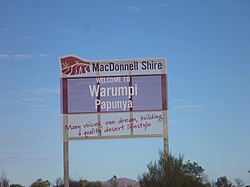
Papunya (Pintupi-Luritja: Warumpi)[4] is a small Indigenous Australian community roughly 240 kilometres (150 mi) northwest of Alice Springs (Mparntwe) in the Northern Territory, Australia. It is known as an important centre for Contemporary Indigenous Australian art, in particular the style created by the Papunya Tula artists in the 1970s, referred to colloquially as dot painting. Its population in 2016 was 404.

Key Information

History

[edit]

Pintupi and Luritja people were forced off their traditional country in the 1930s and moved into Hermannsburg (Ntaria) and Haasts Bluff, where there were government ration depots. There were often tragic confrontations between these people, with their nomadic hunter-gathering lifestyle, and the cattlemen who were moving into the country and over-using the limited water supplies of the region for their cattle.[citation needed]

The Australian Government built a water bore and some basic housing at Papunya in the 1950s to provide room for the increasing populations of people in the already-established Aboriginal communities and reserves. The community grew to over a thousand people in the early 1970s and was plagued by poor living conditions, health problems, and tensions between various tribal and linguistic groups. These festering problems led many people, especially the Pintupi, to move further west closer to their traditional country. After settling in a series of outstations, with little or no support from the government, the new community of Kintore was established about 250 kilometres (160 mi)west of Papunya in the early 1980s.[citation needed]

The term "Finke River Mission" was initially an alternative name for the mission at Hermannsburg, but this name was later often used to include the settlements at Haasts Bluff, Areyonga and, later, Papunya. It now refers to all Lutheran missionary activity in Central Australia since the first mission was established at Hermannsburg in 1877.[5][6][7]

Description and demographics

[edit]

It is now home to a number of displaced Aboriginal people, mainly from the Pintupi and Luritja groups. At the 2016 Australian census, Papunya had a population of 404.[3]

The predominant religion at Papunya is Lutheranism, with 310 members, or 78.7% of the population, based on the 2016 census.[3]

It is the closest town to the Australian continental pole of inaccessibility. Papunya is on restricted Aboriginal land and requires a permit to enter or travel through.[citation needed]

Warumpi Band were an Australian country and Aboriginal rock group which formed in Papunya.[citation needed]

Art

[edit]

Papunya Tula

[edit]

During the 1970s a striking new art style emerged in Papunya, which by the 1980s began to attract national and then international attention as a significant Indigenous art movement, colloquially known as dot painting. Leading exponents of the style, who belonged to the Papunya Tula art cooperative founded in Papunya in 1972, included Clifford Possum Tjapaltjarri, Billy Stockman Tjapaltjarri, Kaapa Tjampitjinpa, Turkey Tolson Tjupurrula, and Pansy Napangardi.[8] The company now operates out of Alice Springs,[9] and covers an enormous area, extending into Western Australia, 700 kilometres (430 mi) west of Alice Springs.[10]

Papunya Tjupi Arts

[edit]

Papunya Tjupi Arts, a community-based, 100% Aboriginal-owned arts organisation, commenced in 2007,[11] and as of March 2021 hosts around 150 artists, many of whose works are featured in exhibitions and galleries around the world.[12] In 2009, Michael Nelson Tjakamarra (Kumantje Jagamara) became the artist leader at the arts centre.[13]

Artists include Doris Bush Nungarrayi, Maureen Poulson, Charlotte Phillipus Napurrula, Tilau Nangala, Mona Nangala, Nellie Nangala, Carbiene McDonald Tjangala, Martha McDonald Napaltjarri, Candy Nelson Nakamarra, Dennis Nelson Tjakamarra, Narlie Nelson Nakamarra, Isobel Major Nampatjimpa, Isobel Gorey, Mary Roberts, Beyula Putungka Napanangka, Watson Corby among others.[14]

See also

[edit]

Notes

[edit]

Further reading

[edit]
[edit]
Revisions and contributorsEdit on WikipediaRead on Wikipedia
from Grokipedia

Papunya is a remote Aboriginal community in Australia's Northern Territory, established in 1959 as a government settlement to house nomadic Pintupi, Luritja, and other Western Desert peoples relocated from ration depots such as Haasts Bluff. Located approximately 240 kilometres west of Alice Springs on the Haasts Bluff Aboriginal Land Trust, it serves as a hub for speakers of Luritja, Warlpiri, and Pintupi languages. As of the 2021 Australian Bureau of Statistics census, Papunya had a population of 438, with 88.8% identifying as Aboriginal and/or Torres Strait Islander.
The settlement was created under policies aimed at concentrating dispersed Indigenous groups for administrative control and assimilation into Western society, resulting in rapid population growth to over 1,400 by 1970 amid cultural clashes and social challenges. Papunya's defining cultural achievement emerged in 1971, when schoolteacher collaborated with senior men to paint murals depicting traditional Dreamtime stories on school walls using acrylic paints, evolving into portable works on boards and canvases that concealed sacred elements with dot patterns. This initiative birthed the artists' collective in 1972, pioneering the Western Desert art movement and enabling economic independence through global sales while revitalizing cultural transmission.
Today, Papunya remains a key center for contemporary Indigenous art production, with continuing as an Aboriginal-owned enterprise, though the community grapples with ongoing issues of remoteness, health, and self-determination in land rights and governance.

Geography and Environment

Location and Physical Features


Papunya lies approximately 240 kilometers northwest of in the of , within the MacDonnell Regional Council area, on land traditionally occupied by and Luritja peoples. This positioning in central 's arid interior underscores the community's remoteness, with vast expanses limiting connectivity and self-sufficiency by complicating supply chains and mobility.
Access to Papunya occurs mainly via unsealed roads branching from the Tanami Highway, rendering travel vulnerable to seasonal flooding that frequently isolates the settlement. Nearby settlements, such as Kintore (Walungurru) to the west along the Kintore Road, share similar isolation, approximately 290 kilometers distant, further emphasizing the sparse human distribution across the region. The absence of major rivers compels reliance on extracted from bores, constraining availability in this water-scarce environment. The terrain features parallel sandhills, ephemeral claypans, and infrequent rock holes, elements integral to and Luritja Tjukurpa () stories that encode knowledge of survival in aridity. These geological formations support minimal vegetation like spinifex and desert oaks but permit little resource extraction or due to pervasive dryness and nutrient-poor soils, reinforcing dependence on external provisioning.

Climate and Ecological Challenges

Papunya lies within a hot regime, marked by extreme and low annual averaging approximately 250 mm, delivered erratically through summer monsoonal influences that often fail or manifest as intense but short-lived storms. This variability exacerbates chronic water deficits, compounded by potential evaporation rates surpassing 3,000 mm per year, which rapidly deplete any surface moisture and . Long-term records indicate a warming trend, with mean temperatures in rising by about 1–1.5 °C over the , intensifying heat stress and evaporation demands. Ecological pressures stem from this marginal , promoting widespread via and episodic flash flooding that strips in sparsely vegetated landscapes. Invasive species, notably buffel grass (), have proliferated across , covering over 60% of the region and outcompeting native flora, thereby accelerating decline and altering dynamics that further degrade habitats essential for traditional food sources like plants. Feral herbivores, including camels, contribute to , which compounds and native species loss in these fragile ecosystems. Dust mobilization from bare, erodible soils poses additional hazards, with arid conditions fostering frequent storms that elevate particulate matter levels, linked to respiratory ailments through of fine silicates and associated pathogens. Erratic wet periods also sporadically boost populations in temporary water bodies, heightening vector-borne disease risks in an environment already strained by thermal extremes. These factors underscore the precarious biophysical limits of the , where empirical records reveal ongoing degradation without inherent equilibrium.

History

Traditional Aboriginal Presence and Dislocation

The and related Anangu groups, including Luritja speakers, have occupied the arid lands west and northwest of modern Papunya—encompassing parts of the Gibson and Great Sandy —for as nomadic hunter-gatherers, relying on knowledge of sparse water sources, seasonal plants, and game regulated by Tjukurpa (ancestral law). Their territories were not rigidly bounded but overlapped through networks, with populations dispersed in small, mobile bands adapted to extreme . Archaeological evidence from central Australian rock shelters and desert sites confirms continuous human presence in these regions dating back at least 20,000–30,000 years, involving sophisticated fire management and tracking techniques for survival. European colonization disrupted this continuity from the late , as pastoral expansion—cattle drives and stations established under leases from the 1870s onward—encroached on central fringes, competing for waterholes and forage while introducing firearms and livestock that altered ecosystems. Many , residing deeper in the remote western deserts, actively avoided outsiders, maintaining isolation until the ; historical accounts document their first widespread contacts via ration depots at Haasts Bluff (established 1942) and sporadic patrols, with some groups unaware of settler presence even later. Introduced epidemics, including outbreaks in the early , decimated isolated bands upon indirect exposure through trade or fleeing groups, while frontier violence—such as the 1928 Coniston reprisals, where Constable George Murray's posse killed at least 31 (likely over 60) Warlpiri, Anmatyerre, and Kaytetye people east of Papunya in response to a scalper's —propagated fear, displacing survivors westward and deterring nomads from eastern fringes. Overall Indigenous population in plummeted over 90% from pre-1788 estimates of 300,000–1,000,000 to around 60,000–93,000 by the , driven primarily by pathogens to which groups had no immunity, compounded by from resource loss and targeted killings exceeding official tallies due to underreporting. These pressures eroded self-sufficiency, as initial ration handouts at stations and outposts—intended for laborers but extended to displaced families—fostered dependency, diminishing proficiency across generations and priming populations for ; ethnographic records note bands increasingly congregating near supply points by the mid-20th century, forsaking vast homelands amid declining game from and . This transition reflected causal chains of ecological disruption and demographic collapse rather than isolated intent, with remote groups like the experiencing delayed but cumulative effects from peripheral contacts.

Government Establishment and Assimilation Era (1950s-1960s)

In 1959, the Administration established Papunya as a settlement under Australia's assimilation policies, which sought to relocate and sedentary nomadic Aboriginal groups to centralized locations for administrative control and cultural integration. The site was selected approximately 240 kilometers west of to consolidate populations from failing reserves, particularly after the closure of Haasts Bluff in 1958 due to chronic water shortages, prompting the relocation of around 400 residents, primarily and Luritja people. development between 1959 and 1962 included basic , a , and facilities, with the explicit aim of providing education, vocational training, and "civilizing" influences to transition wards of the state—governed under the 1953 Welfare Ordinance—toward Western societal norms. The policy's centralized approach quickly encountered implementation failures, as the settlement's design for a smaller population was overwhelmed by rapid inflows, reaching over 700 residents by late 1959 and expanding to nearly 1,000 within years, resulting in acute and inadequate . Relocating disparate and groups from multiple reserves disrupted traditional social structures, fostering interpersonal conflicts and violence that administrators attributed to cultural incompatibilities rather than policy-induced . The paternalistic welfare regime, which vested control in the Director of Welfare and restricted personal initiatives, further entrenched dependency by prohibiting independent economic activities and enforcing regimented living. Health outcomes reflected these systemic strains, with the shift to processed rations and confined conditions introducing or amplifying infectious diseases and nutritional deficiencies, contributing to elevated mortality in Aboriginal communities during the era, where ill-defined causes accounted for a significant portion of deaths in the 1950s and persisted into the 1960s. reports noted deteriorating welfare metrics, including family breakdowns and morale decline, underscoring the assimilation model's inability to deliver sustainable integration amid enforced homogenization of diverse groups.

Initiation of the Art Movement (1971-1972)

In 1971, , a school teacher at the Papunya government settlement, initiated painting activities among Aboriginal men to address widespread and idleness in a community of approximately 1,400 displaced individuals from various groups. Bardon supplied acrylic paints and encouraged the creation of a Honey Ant mural on the exterior school wall, starting in June and involving elders including Tjampitjinpa and Old Bert Tjakamarra. The mural's inclusion of secret-sacred motifs, akin to those on tjuringa boards used in ceremonies, provoked opposition from some elders who viewed the public display as a breach of cultural protocols restricting such designs to initiated men. In August 1971, settlement authorities erased the mural amid fears of broader backlash over the revelation of restricted . Following the mural's removal, Bardon shifted efforts to boards, enabling over 20 senior men from , Luritja, and other groups to produce portable works adapting ground-ochre traditions to acrylics with overlaying dots for partial concealment of esoteric elements. Initial sales of these boards to tourists and other buyers in , facilitated by Bardon, generated around $1,300 in the ensuing months, offering a pragmatic income source amid the settlement's .

Post-Movement Developments and Community Shifts (1980s-Present)

Following the initial challenges faced by the cooperative in the late 1970s, including financial instability and internal disputes, many artists relocated from Papunya to their traditional homelands, such as Kiwirrkurra and Kintore, during the 1980s. This exodus facilitated the decentralization of art production, with artists continuing to paint under the banner from these remote outstations, reflecting a broader return to country enabled by land rights gains. The federal policies of the era, emphasizing Aboriginal control over cultural initiatives, supported the establishment and sustainability of art centers in these dispersed locations, allowing communities to maintain cultural practices amid ongoing assimilation pressures. In the and , the maturation of the provided some resources for community enhancements through artist royalties, though these were primarily directed toward individual and family needs rather than large-scale . The 2022 commemoration of the 50th anniversary of Artists featured major exhibitions, such as "Irrititja Kuwarri Tjungu (Past and Present Together)," which showcased over 50 new paintings commissioned from senior artists, underscoring the movement's enduring legacy in bridging with contemporary expression. This anniversary project extended into 2025 with a touring exhibition across U.S. institutions, including the BYU Museum of Art and Grey Art Museum, marking the first comprehensive U.S. survey of Papunya Tula works and highlighting ongoing global interest. Despite these cultural milestones, Papunya itself has experienced population stagnation and shrinkage, driven by out-migration to urban centers like Alice Springs for services and opportunities, a pattern documented in Central Land Council assessments of remote community demographics. This shift has reinforced reliance on outstations for cultural continuity while underscoring persistent challenges in sustaining the central settlement.

Demographics and Society

Papunya's population is predominantly composed of Aboriginal people from groups, with core affiliations including (historically nomadic groups resettled in the area), Warlpiri, and Luritja speakers, alongside smaller numbers from Anmatyerr, Kukatja, and Western Aranda groups. Influxes from nearby Warlpiri communities such as have contributed to the Warlpiri presence, reflecting patterns of mobility among related linguistic networks. The recorded a total of 438, of which 389 (approximately 88.8%) identified as Aboriginal and/or Islander peoples. This group exhibited a age of 24 years and a imbalance, with 53.4% and 46.6% . Primary languages spoken at home include Luritja and Warlpiri, underscoring the linguistic diversity rooted in traditional affiliations. Population trends indicate instability, with the community recording 404 residents in the 2016 Census before rising slightly to 438 in 2021. High birth rates, evidenced by low median ages and fertility patterns among Aboriginal populations in remote Northern Territory areas, are offset by emigration to urban hubs like Alice Springs and broader mobility dynamics. Historical peaks exceeding 500 in the 1980s reflect earlier concentrations post-settlement, followed by fluctuations tied to relocation patterns. These shifts highlight ongoing demographic volatility in remote Aboriginal settlements.

Social Structure, Health, and Welfare Dependencies

Traditional social organization in Papunya revolves around patrilineal clans and kinship systems inherited from Anangu (Western Desert) Aboriginal groups, where clan membership, traced through male lines, dictates responsibilities for land custodianship, marriage prohibitions, and ceremonial roles. These structures enforce exogamy rules via skin name categories, ensuring alliances between clans while preserving estate-based inheritance of sacred sites and Dreamings. However, contemporary disruptions from relocation, alcohol abuse, and exposure to non-traditional family models have eroded these norms, leading to elevated rates of family fragmentation akin to urban dysfunctions observed elsewhere. Health outcomes in Papunya reflect persistent endemic conditions exacerbated by environmental and behavioral factors. , a preventable eye infection, remains prevalent in remote communities like Papunya due to , poor , and limited access to clean , with national identifying active cases in very remote areas as of 2021. Renal failure is disproportionately high, contributing to 22% of deaths in central Australian Aboriginal populations, linked to rates far exceeding non-Indigenous figures, often tied to , , and inadequate dialysis access. for Indigenous residents in such remote settings hovers around 65-70 years for males—compared to the national average of 83—attributable to diets high in processed foods, sedentary lifestyles post-settlement, and untreated chronic conditions, as documented in Australian Institute of Health and Welfare analyses of remote community burdens. Welfare dependency dominates Papunya's economy, with over 90% of households relying on payments such as JobSeeker and pensions, supplemented historically by Community Development Employment Projects (CDEP) schemes that functioned as subsidized labor but often reinforced idleness. rates exceed 50% in practice for working-age adults, far above the national Indigenous figure of 16.6% in 2022-23, fostering intergenerational patterns where "sit-down money"—passive transfer payments—disincentivizes skill-building or enterprise, perpetuating poverty traps amid limited local opportunities. This reliance, policy-driven since the shift to universal benefits without work requirements tailored to remote realities, has entrenched inertia, as evidenced by stagnant labor participation despite interventions.

Art and Cultural Production

Origins of Papunya Tula and Key Initiators

The art movement originated in 1971 at the Papunya government settlement in Australia's , where school teacher observed widespread idleness among Aboriginal men relocated from traditional lands, prompting him to initiate painting projects as a practical means to foster engagement and purpose. Bardon, arriving in early 1971, first encouraged schoolchildren to depict elements of their cultural world on classroom materials, which evolved into involving their elders in paintings on the school's exterior walls using acrylic paints supplied by the institution. This pragmatic approach addressed immediate social contingencies, including high and cultural disconnection in the settlement, by channeling oral stories into visual form on available surfaces like boards when wall space proved insufficient. Key Aboriginal initiators included senior men such as Johnny Warangkula Tjupurrula and Mick Namarari Tjapaltjarri, who were among the first to translate sacred narratives into the new medium, drawing on their roles as custodians of Water Dreaming and other site-specific lore. Warangkula, a Luritja elder and council member, produced early expressive works emphasizing dynamic landscapes and ceremonial elements, while Namarari, a artist also on the Papunya Council, contributed foundational paintings that shifted toward linear abstractions of country and ancestral tracks. These individuals, alongside figures like Mbitjana, responded to Bardon's facilitation not through abstract inspiration but as an extension of ceremonial ground painting traditions adapted to economic incentives, with initial boards painted for modest payments equivalent to daily wages. By 1972, the group formalized as Artists Pty Ltd, Australia's inaugural Aboriginal-owned art cooperative, to manage production and sales amid persistent funding shortages from government bodies. Early exhibitions, including a 1972-1974 traveling show organized by the Department of the Interior at venues like Sydney's Farmer's Blaxland Gallery, marked initial public exposure, though viability remained precarious due to limited institutional support and reliance on private buyers. A landmark 1974 exhibition in further highlighted works by pioneers like Namarari, underscoring the cooperative's resilience despite operational hurdles.

Techniques, Symbolism, and Artistic Evolution

Papunya Tula artists adapted traditional ephemeral practices of and to Western-supplied acrylic paints on boards starting in 1971, as facilitated by schoolteacher , who provided these materials to enable permanent recording of ancestral stories. This initial technique involved applying paint in layers to surfaces, often beginning with ground-line compositions that outlined journeys and sites before overlaying finer details. By the mid-1970s, the shift to as the standard support allowed for expanded scale and durability, reflecting practical necessities of the medium rather than unbroken continuity with pre-contact methods, which relied on ochres for temporary ceremonies. Symbolism in these works draws from Jukurrpa narratives, employing U-shaped motifs to depict seated people—frequently distinguished by gender-specific implements like spears for men or digging sticks for women—and concentric circles to signify waterholes, campsites, or ceremonial sites linked by lines indicating travel paths. Dotting emerged as a key overlay technique, initially applied by artists like Johnny Warangkula from 1973 to mask explicit sacred elements beneath abstract patterns, thereby adhering to cultural restrictions on revealing restricted while adapting to the opacity and layering possible with acrylics. Artistic evolution progressed from early semi-figurative outlines, which risked exposing secret , to a more abstracted idiom of dense, iconic dot fields by the late 1970s, driven by the exigencies of fixed substrates that demanded concealment strategies absent in transient traditional forms. Tight, meticulous dotting characterized initial Papunya boards, giving way to looser, individualized applications as artists from diverse language groups collaborated under material constraints, yielding a stylized visual code that prioritized pattern density over direct . This transformation underscores adaptation to acrylic's quick-drying properties and portability, converting ceremonial into a codified, reproducible aesthetic without reliance on prior traditions.

Achievements in Global Recognition and Economic Contributions

The Papunya Tula art movement garnered international acclaim starting in the 1980s, as paintings by founding artists entered major auctions at , propelling figures like Clifford Possum Tjapaltjarri to global prominence as one of Australia's most collected Aboriginal painters. Possum, who served as chairman of from the 1970s through the 1980s, produced works that later achieved record auction prices, such as a 2007 sale exceeding A$2.4 million for a single dot painting depicting Dreamings. This visibility extended to prestigious venues like exhibitions, affirming the movement's influence on discourse. Economically, Papunya Tula provided a vital stream through sales and royalties, with annual gross revenues reaching approximately A$5 million by the mid-2000s, enabling artist payments and community royalties that peaked above A$1 million in high years amid broader Indigenous market booms. These proceeds offered a rare mechanism for economic in a remote setting, distinct from welfare dependencies, as sales distributed funds directly to creators via the structure established in 1973. The artworks preserved Tjukurpa—traditional Anangu law and Dreaming stories—by rendering ephemeral sand ceremonies into durable acrylic forms, facilitating transmission to youth amid cultural disruptions from relocation. This visual archiving countered generational knowledge loss, with paintings serving as mnemonic tools for initiating younger community members into ancestral narratives. Recent milestones include Smithsonian Magazine's 2022 feature on the Western Desert movement's 50th anniversary, highlighting Papunya Tula's foundational role, and the 2025 U.S. tour of "Irriṯitja Kuwarri Tjungu," the first comprehensive survey of its artists across venues like the BYU Museum of Art from July to December.

Criticisms: Cultural Dilution, Commercial Exploitation, and Internal Conflicts

In the early 1970s, the initial Papunya paintings often depicted explicit sacred elements from stories, prompting criticism from Aboriginal elders concerned about the public revelation of restricted knowledge; by August 1972, senior men demanded the removal or obscuring of such motifs to prevent unauthorized access by uninitiated viewers, including women and children within the . This led to a stylistic shift toward heavy dotting to sensitive icons, which some anthropologists argue diluted the original narrative depth and ritual specificity of the works, transforming them into more abstract, marketable forms at the expense of cultural protocols. Over time, the pressure to produce for commercial demand exacerbated this, resulting in stylistic homogeneity among later paintings as artists prioritized volume over individual variation in symbolic content. Commercial exploitation emerged prominently due to artists' widespread illiteracy and , enabling dealers to manipulate contracts, underpay for works, and issue fake certificates; a 2006 Australian Senate into the Indigenous sector documented systemic , including cases where Papunya-area artists received minimal payments—sometimes as low as 30-50% of sale values—while intermediaries profited disproportionately. Initially, the movement excluded women artists, as senior men restricted access to painting sites and sacred subjects, delaying female participation until the when a new cohort, including figures like Tjunkiya Napaltjarri, began contributing distinct styles after a roughly 20-year hiatus. Private dealers exploited vulnerabilities such as alcohol dependency among key producers, offering cash advances that fueled rather than sustainable royalties, contrasting with the relative oversight provided by the cooperative. Internal conflicts within the Papunya Tula cooperative included disputes over royalty distribution, where uneven shares among artists and family claims led to tensions, compounded by the influx of funds from art sales that were often spent on alcohol rather than welfare. Several prominent artists, such as Johnny Warangkula Tjupurrula, succumbed to alcohol-related health issues in the and early 2000s, with royalties enabling cycles that undermined long-term cultural transmission. Critics contend this prioritized economic output over spiritual meaning, as the cooperative's focus on high-volume production for global markets eroded traditional mentorship in favor of repetitive motifs tailored to buyer preferences.

Governance, Economy, and Infrastructure

Administrative Structure and Land Rights

Papunya's land is held by the Haasts Bluff Aboriginal Land Trust, established under the Aboriginal Land Rights (Northern Territory) Act 1976, which grants inalienable freehold title to such trusts exclusively for the use and benefit of Aboriginal traditional owners identified through anthropological and traditional evidence. The Act mandates that any proposed leasing, licensing, or other dealings over the land require the of the traditional owners, typically obtained via the representative Aboriginal Land Council (in this case, the Central Land Council), creating a framework of communal control that prioritizes group consensus over individual disposition rights. This structure, while securing collective ownership, imposes barriers to unilateral development or alienation, as individual traditional owners cannot independently subdivide or transfer interests without broader approval, fostering tensions between communal tenure security and personal economic agency. Administratively, Papunya operates under the oversight of the MacDonnell Regional Council as part of reforms, with day-to-day matters managed by the Papunya Local Authority, comprising elected or appointed representatives who advise on bylaws, services, and priorities. The retains ultimate authority, including powers to intervene via administrator appointments under the Local Government Act 2019 in cases of persistent financial irregularities, breakdowns, or failure to meet statutory obligations. Such takeovers have occurred multiple times in Papunya's , including in the amid documented allegations involving fund diversions and , reflecting broader patterns of administrative instability in remote NT where elected councils have struggled with and capacity. These interventions temporarily centralize control to the NT Department of , Racing and Gaming, aiming to restore fiscal compliance before returning functions to local hands.

Economic Realities: Art Sales vs. Persistent

Despite the global acclaim and commercial success of artworks, which have generated significant revenue since the 1970s through initial cash sales exceeding AU$1,300 in early competitions and ongoing auction resales, the economic benefits remain narrowly distributed among a small cadre of senior artists, primarily elders who initiated the movement. Royalties under Australia's 2009 Resale Royalty Scheme, providing 5% of resale values over AU$1,000, have offered sporadic supplemental income to living artists but fail to address broader community needs, as deceased artists' estates receive no payments and distributions favor individuals over collective welfare. This niche prosperity contrasts sharply with persistent , evidenced by the 2021 median weekly of AU$1,031 for Papunya's predominantly Indigenous of 389, far below non-remote Indigenous medians and national averages when adjusted for and remoteness-driven costs. Systemic welfare dependencies exacerbate poverty traps, with remote Indigenous communities exhibiting high reliance on government payments that create "cliffs" disincentivizing due to benefit taper-offs exceeding wage gains from low-skill work. Efforts to diversify beyond , such as Aboriginal-managed enterprises, have repeatedly failed owing to skill deficiencies in commercial operations, management gaps, and cultural mismatches with market demands, leaving communities without sustainable alternatives. In Papunya, these dynamics yield effective per capita economic output well under 10% of Australia's national GDP per capita of approximately AU$, as proxied by and enterprise stagnation, perpetuating cycles where 's cultural value does not translate to broad-based . The 2020s have seen volatility, with Indigenous sales demonstrating resilience amid global scrutiny—total turnover grew in 2023 despite economic pressures—but community-level metrics remain unchanged, underscoring how external demand fluctuations yield minimal trickle-down amid entrenched disincentives. Critics note that while high-profile resales enrich galleries and collectors, artists and residents continue facing insecurity and limited opportunities, highlighting causal barriers like welfare structures over transient market booms.

Infrastructure, Services, and Policy Interventions

Papunya's electricity supply is provided by the Power and Water Corporation through a diesel-powered network, with limited solar augmentation in some facilities, though frequent outages occur due to equipment failures and maintenance challenges in remote conditions. Water and sewerage services are similarly managed by Power and Water, delivering treated , but infrastructure upgrades remain inconsistent, contributing to reliability issues during dry seasons. Road infrastructure centers on the unsealed Tanami Highway connecting Papunya to , approximately 250 kilometers away, with internal community roads consisting of gravel tracks vulnerable to erosion and flooding, limiting year-round access without four-wheel-drive vehicles. Telecommunications rely on satellite services, with intermittent mobile coverage provided by Telstra's remote network, supporting basic connectivity but prone to disruptions. Health services are anchored by the Papunya Health Centre, which offers , vaccinations, and 24/7 on-call response using vehicles like Troops for patient transport, but advanced diagnostics and treatments are unavailable on-site, resulting in routine aeromedical evacuations to regional hospitals in for over 20% of serious cases annually. A 2024 survey by remote health providers documented widespread deterioration in buildings and staff across communities like Papunya, attributing decay to structural failures, , and deferred amid budget constraints. The 2007 Northern Territory Emergency Response (NTER), enacted following the "Little Children are Sacred" report on child sexual abuse, imposed measures in Papunya including mandatory health assessments, alcohol restrictions, and infrastructure investments like housing refurbishments, which correlated with an initial decline in hospital admissions for assault-related injuries from 2007 to 2009. However, a 2020 evaluation found these gains eroded post-intervention, with persistent gaps in and chronic disease rates, underscoring limited sustained impact from top-down mandates without community-led . Ongoing policy efforts include the Anangu Luritjiku , operational since the early and supported by the Central Land Council, which employs local Indigenous rangers for tasks such as feral culls, eradication, and across Papunya's surrounding tracts, covering over 10,000 square kilometers while providing 15-20 jobs. Despite these initiatives, audits of remote highlight annual decay rates exceeding 5% in essential assets due to and deliberate , with ranger efforts focused more on environmental than built upkeep.

References

Add your contribution
Related Hubs
User Avatar
No comments yet.