Hubbry Logo
ParthenocissusParthenocissusMain
Open search
Parthenocissus
Community hub
Parthenocissus
logo
8 pages, 0 posts
0 subscribers
Be the first to start a discussion here.
Parthenocissus
Parthenocissus
from Wikipedia

Parthenocissus
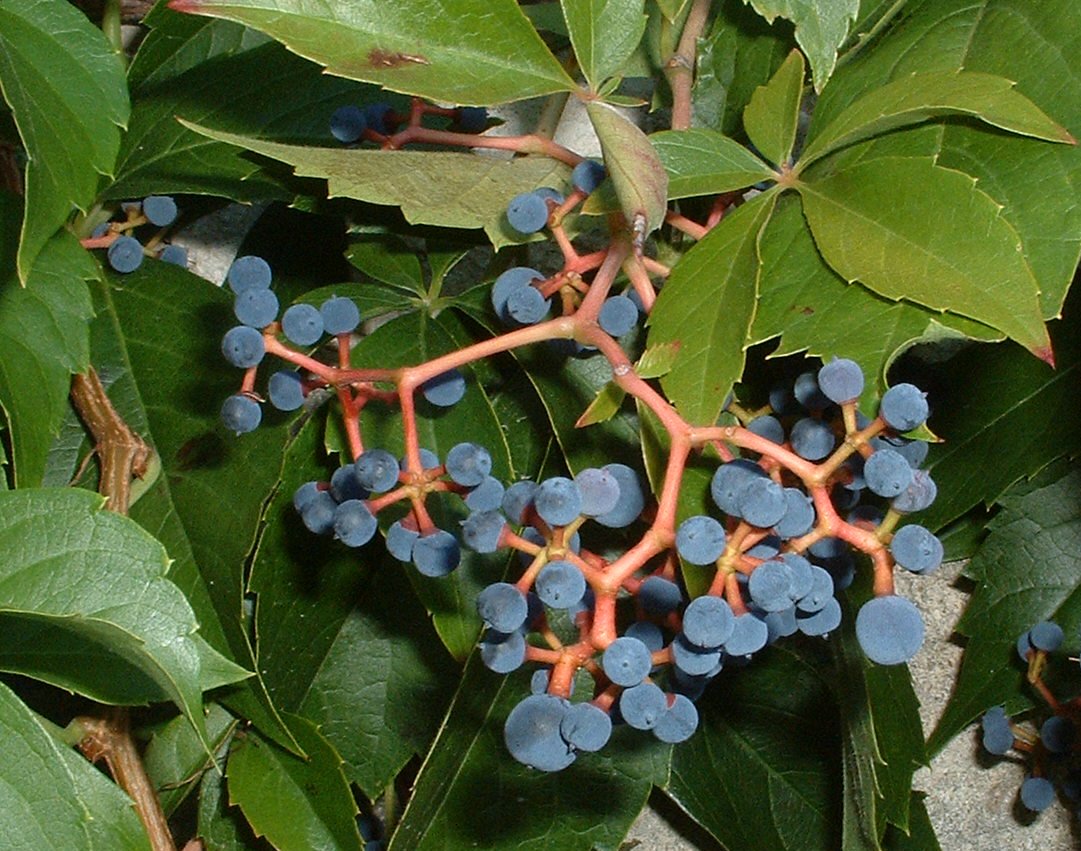
Parthenocissus quinquefolia, foliage and fruit
Scientific classification Edit this classification
Kingdom: Plantae
Clade: Tracheophytes
Clade: Angiosperms
Clade: Eudicots
Clade: Rosids
Order: Vitales
Family: Vitaceae
Subfamily: Vitoideae
Genus: Parthenocissus
Planch.
Creeper stalk transversal cross section.

Parthenocissus /ˌpɑːrθɪnˈsɪsəs/,[1] is a genus of tendril[2] climbing plants in the grape family, Vitaceae. It contains about 12 species native to the Himalaya, eastern Asia and North America.[3] Several are grown for ornamental use, notably P. henryana, P. quinquefolia and P. tricuspidata.[2]

Etymology

[edit]

The name derives from the Greek παρθένος (parthenos) "virgin", and κισσός (kissós) (Latinized as "cissus"), "ivy".[1] The reason is variously given as the ability of these creepers to form seeds without pollination[4] or the English name of P. quinquefolia, Virginia creeper, which has become attached to the whole genus.[5]

Fossil record

[edit]

Among the middle Miocene Sarmatian palynoflora from the Lavanttal Basin, Austrian researchers have recognized Parthenocissus fossil pollen. The sediment containing the Parthenocissus fossil pollen had accumulated in a lowland wetland environment with various vegetation units of mixed evergreen/deciduous broadleaved/conifer forests surrounding the wetland basin. Key relatives of the fossil taxa found with Parthenocissus are presently confined to humid warm temperate environments, suggesting a subtropical climate during the middle Miocene in Austria.[6]

Food plants

[edit]

Parthenocissus species are used as food plants by the larvae of some Lepidoptera species including the brown-tail, Gothic, and the Virginia creeper sphinx.

Species

[edit]

From Asia

[edit]

From North America

[edit]

References

[edit]
Revisions and contributorsEdit on WikipediaRead on Wikipedia
from Grokipedia
Parthenocissus is a of approximately 15 of woody, lianas in the grape family , characterized by their climbing habit via branched tendrils that often end in adhesive discs. These plants feature alternate, palmately compound leaves typically with 3–7 leaflets, small bisexual flowers in cymose panicles, and berries that are dark blue to black containing 1–4 seeds. Native to eastern and , the genus exhibits a disjoint distribution, with the majority of species occurring in Asia and a few in North America extending into . The name Parthenocissus derives from the Greek words parthenos (virgin) and kissos (ivy), equivalent to the French "vigne vierge" for the P. quinquefolia. Several species are notable for their ornamental value, prized in horticulture for vigorous growth, attractive foliage, and brilliant autumn coloration ranging from red to purple. Prominent examples include Parthenocissus quinquefolia (Virginia creeper), a fast-growing vine native to eastern and central North America that reaches up to 20 meters in length and is valued for covering fences and arbors. Another key species, Parthenocissus tricuspidata (Boston ivy), originates from East Asia and is widely planted on buildings for its ability to adhere to masonry without roots, providing seasonal interest with three-lobed leaves. Parthenocissus henryana, from China, stands out for its variegated leaves with silver veins, making it a popular choice for decorative trellises. In cultivation, Parthenocissus species thrive in a variety of soils and light conditions, from full sun to partial shade, and are hardy in temperate climates, though some can become invasive in non-native regions due to their prolific seed production and vegetative spread. Ecologically, they serve as habitat and food sources for , with berries attracting birds and leaves supporting various , contributing to in their native ranges.

Description

Morphology

Parthenocissus species are woody belonging to the family, capable of reaching lengths of up to 20 meters, depending on the supporting structure. These vigorous climbers exhibit a sprawling or ascending habit, with stems that are initially green and glabrous, maturing to woody branches up to several centimeters in diameter. The bark is smooth and grayish-brown when young, becoming fissured and scaly with age as the vine develops. A distinctive feature of Parthenocissus is its -climbing mechanism, where slender, branched s arise opposite the leaves and often terminate in adhesive pads in many species rather than coiling or using for attachment. These pads, formed from expanded, disk-like structures at the tips, secrete a mucilaginous substance that enables firm to various surfaces, including rough bark, stone, or , without damaging the support. The leaves are alternate, usually palmately with 3–5 (occasionally 7) ovate to lanceolate leaflets, but simple (often 3-lobed) in some species, each measuring 5–15 cm in length and 2–6 cm wide, with coarsely serrate margins and a pointed apex. The leaflets are dark green and glabrous or sparsely pubescent above, paler beneath, and emerge with a purplish tint in spring before turning brilliant red or crimson in autumn, providing a striking seasonal display. Flowers are small, inconspicuous, and greenish-white, borne in terminal or axillary cymes (panicles) during to ; they are typically 3–5 mm across, with 5 reflexed petals, 5 stamens, and a superior . Flowers are typically bisexual, though some plants may produce unisexual flowers. The fruits are small, thin-walled berries that are blue-black at maturity, measuring 5–8 mm in diameter, and contain 1–4 embedded in pulpy flesh; these persist on the vine into winter after leaf fall, serving as a food source for .

Growth habits

Parthenocissus are rapid-growing, woody vines that climb vigorously using branched tendrils often tipped with disks, allowing them to ascend trees, walls, or rocks at rates up to 20 feet per year and reach lengths of 30 to 50 feet. These tendrils form holdfasts that adhere firmly to surfaces without penetrating them, enabling the vines to scale vertical structures effectively. If unobstructed by supports, the vines spread horizontally to form dense ground covers approximately one foot high, rooting at nodes where stems contact moist soil. As plants, Parthenocissus shed their leaves in autumn, with new growth emerging vigorously in spring as purplish or foliage that matures to green over summer. They exhibit broad tolerance to environmental conditions, thriving in full sun to full shade and adapting to various types including sandy, loamy, and clay, with a preferred pH range of 5.0 to 7.5. These long-lived perennials can persist for decades in suitable conditions and are propagated readily through requiring stratification, stem cuttings, or layering. In autumn, the foliage undergoes a striking color change to , , or due to increased production of pigments, which provide protective shielding against excess UV radiation and photooxidative damage during leaf . This adaptation helps maintain leaf function as breaks down, facilitating nutrient resorption before .

Taxonomy

Etymology

The genus name Parthenocissus was established by French botanist Jules Émile Planchon in 1887 as part of the Monographiae Phanerogamarum. The name is a compound derived from two Ancient Greek words: parthenos, meaning "virgin" or "maiden," and kissos, referring to "ivy" or an ivy-like climbing plant. This etymology translates directly to "virgin ivy," serving as a botanical Latinization of the French common name vigne vierge (virgin vine), which was applied to the type species P. quinquefolia due to its vigorous climbing nature resembling ivy. The "virgin" element in the name likely alludes to the plant's self-supporting climbing habit via adhesive tendrils, distinguishing it from true ivies (Hedera spp.) that rely on aerial roots for attachment, thus evoking a sense of independence or purity in its growth form. Some interpretations link it to the regional associations of the type species with Virginia, a U.S. state named after Queen Elizabeth I, known as the "Virgin Queen," though the primary linguistic root remains the Greek components adapted from European nomenclature. Common names for species in the further reflect this ivy-like appearance and geographic ties. For instance, P. quinquefolia is widely known as Virginia creeper, highlighting its native eastern North American range and creeping, vine-like spread. Similarly, P. tricuspidata is called Boston ivy, owing to its popularity in ornamental plantings on buildings in and other urban areas, where its foliage mimics traditional English ivy.

Classification

Parthenocissus belongs to the family and is classified within the tribe Parthenocisseae, a monophyletic group comprising approximately 16 across two genera. This tribal placement reflects recent phylogenetic revisions that emphasize morphological traits such as structure and characteristics, distinguishing Parthenocisseae from other Vitaceae tribes like Viteae (including ) and Ampelopsideae (including ). The genus Parthenocissus was formally established by French botanist Jules Émile Planchon in 1887, as part of the monograph on Phanerogams by Alphonse and Casimir de Candolle, where he segregated species previously placed in genera such as Ampelopsis and Cissus based on differences in tendril morphology and fruit structure. Prior to this reclassification in the late 19th century, many Parthenocissus species had been lumped into Cissus due to superficial similarities in climbing habit and leaf arrangement, or into Ampelopsis owing to shared palmate foliage and berry fruits; these transfers marked a key step in refining Vitaceae taxonomy. Comprising 12–16 species, Parthenocissus displays a notable intercontinental disjunction between eastern and eastern , attributed to Tertiary-era migrations via the boreotropical during the Eocene, followed by vicariance due to climatic cooling in the . Recent taxonomic work has reinstated P. subferruginea Merr. & Chun. as a distinct , contributing to ongoing refinements in species delimitation. Molecular phylogenetic analyses, employing nuclear ITS and plastid markers, robustly support the monophyly of Parthenocissus (often including the closely related segregate genus Yua), positioning it as sister to clades containing and within , with divergence estimates aligning with paleogeographic events.

Fossil record

The fossil record of Parthenocissus dates back to the Eocene epoch, with confirmed pollen grains preserved in lake sediments from the Messel Pit in Germany, approximately 47.5 million years ago during the Lutetian stage. These tricolpate, tectate-columellate pollen grains, identified through light microscopy (LM) and scanning electron microscopy (SEM), were found in the digestive tract of a nemestrinid fly (Hirmoneura messelense), alongside pollen from other taxa, indicating that Parthenocissus contributed to paratropical, lake-margin vegetation under warm, humid conditions typical of the early Cenozoic boreotropics. Seed fossils tentatively assigned to Parthenocissus appear in middle Eocene deposits (ca. 47 Ma), characterized by long, straight lateral ribs on the seed surface, though precise generic placement remains challenging due to morphological overlap with related genera like Yua and . Additional early Eocene records from , including , and , such as the London Clay flora in , include seeds and leaf impressions resembling Parthenocissus or its close relatives, suggesting the genus was part of widespread boreotropical floras in warm-temperate to subtropical environments across . By the , European fossils from sites like in feature seed and leaf remains akin to Parthenocissus, Yua, or , reflecting a continued presence in humid, forested settings as global climates began to cool. Miocene records provide clearer evidence of diversification and geographic spread. grains attributable to Parthenocissus have been documented in middle (Sarmatian stage, ca. 13–12 Ma) sediments from the Lavanttal Basin in , part of a diverse palynoflora including over 200 angiosperm taxa, which points to the genus inhabiting subtropical mixed forests with warm, humid summers and mild winters in a lacustrine setting. In , leaves identified as Parthenocissus miocenica n. sp., featuring trilobate blades with serrate margins and basal sinuses, occur in upper (ca. 11–5 Ma) Siwalik sediments from Sarkaghat, , ; these resemble extant East Asian species like P. tricuspidata and imply the genus thrived in humid, deciduous forest ecosystems along ancient riverine habitats. Parthenocissus-like seeds from , , further illustrate the genus's role in temperate woodlands. Overall, the Tertiary fossil distribution of Parthenocissus—spanning and —indicates an origin within Eocene boreotropical vegetation under warm, humid paleoclimates with seasonal deciduous forests, followed by Miocene diversification amid cooling trends that eventually restricted its range to modern disjunct patterns in and .

Distribution and habitat

Native ranges

The genus Parthenocissus is native primarily to eastern , spanning from the Himalaya region through , , Korea, and extending to parts of and the , where approximately nine species occur, alongside eastern and , home to about three species. This intercontinental disjunct distribution reflects the genus's evolutionary history, with the Asian clade showing greater diversity in montane regions such as the Himalayan-Hengduan Mountains, while species are more prevalent in lowland and coastal areas. In their native habitats, Parthenocissus species thrive in temperate forests, woodland edges, riverbanks, and rocky slopes, occurring across elevations from to 3000 meters. These environments typically feature temperate to subtropical climates, with annual rainfall ranging from 800 to 2000 mm and temperature extremes from -20°C in winter to 30°C in summer, allowing adaptation to seasonal variations in moisture and frost. Soil preferences include well-drained loams, though the plants exhibit tolerance for nutrient-poor or rocky substrates; in North America, they are commonly associated with mixed woodlands containing oaks (Quercus spp.), maples (Acer spp.), and pines (Pinus spp.). Endemism patterns underscore regional specialization, with Asian species exhibiting higher diversity in elevated, humid mountain forests and North American ones favoring lowland, deciduous woodlands and floodplains.

Introduced areas

Parthenocissus species have been widely introduced beyond their native ranges to , , , and western , primarily since the as ornamental climbers valued for their foliage and fall color. These introductions occurred through horticultural trade, with plants escaping cultivation and naturalizing in temperate climates suitable for their growth habits. Among the most problematic are Parthenocissus quinquefolia and P. tricuspidata, which have become common invasives in urban and peri-urban environments, outcompeting native via aggressive climbing that allows them to smother trees, walls, and structures. In , P. quinquefolia is invasive in countries such as , , and the , where it is listed under Schedule 9 of the , prohibiting its release into the wild. Similarly, P. tricuspidata is emerging as a concern in , naturalizing in urban areas like , and is considered a potential environmental weed in . In the United States, P. tricuspidata appears on invasive species lists in some northeastern states, including and . The ecological impacts of these introduced vines include alteration of forest light regimes, as they climb into canopies and block , thereby suppressing native plant growth and contributing to breakage from added weight. Dense mats also heighten risk by providing continuous fuel ladders that facilitate crown fires in woodlands. Dispersal primarily occurs through birds that consume and excrete the , enabling rapid establishment in disturbed habitats like roadsides, abandoned lots, and forest edges. Management of invasive Parthenocissus populations typically involves mechanical methods, such as repeated cutting to exhaust reserves, or targeted applications to basal stems or foliage, particularly in early spring or late summer for efficacy. In regions like the and parts of , regulations restrict planting and require control measures to prevent further spread, emphasizing prevention through removal of existing ornamental stands.

Species

Asian species

The genus Parthenocissus includes approximately nine native to , distributed primarily across eastern , the Himalayan region, and parts of , where they exhibit adaptations to diverse habitats ranging from temperate forests to high-altitude montane zones. These are typically deciduous woody climbers with tendrils tipped by adhesive disks, enabling them to ascend trees, rocks, and cliffs, and they play roles in local ecosystems through their fruits and foliage. One prominent example is P. henryana, known as the silvervein creeper, which is endemic to and features palmately compound leaves with five leaflets marked by striking white veins along the midribs, providing a distinctive silvery appearance. This species thrives in moist, shaded forest understories at elevations up to 1,500 meters, showcasing regional adaptation through its ornamental foliage that turns vibrant red in autumn. P. tricuspidata, commonly called Boston ivy, is native to , Korea, and eastern , where it grows on rocky slopes and forest edges; its leaves are typically three- to five-parted, often palmately lobed, allowing for effective climbing in temperate woodlands. In contrast, P. semicordata (syn. P. himalayana) from the Himalayan region, including and northern , has trifoliate leaves suited to high-altitude conditions above 2,000 meters, with tendrils that branch simply and berries that mature to blue-black, aiding by birds in alpine scrub. P. laetevirens is found in southern , displaying variations in tendril branching—often unbranched or bifid—and berry colors ranging from to , which reflect adaptations to subtropical to temperate forests. Similarly, P. dalzellii is found in southern and , extending into Southeast Asian influences, with diverse leaf forms and tendril structures that vary from three- to five-foliolate, contributing to its resilience in humid, lowland habitats. P. sichuanensis is widespread in western 's forests, particularly in the dry valleys of and at 1,300–2,300 meters, featuring three-foliolate leaves and unbranched s, with one-seeded berries that support local wildlife. Several Asian Parthenocissus species face threats from loss due to and , particularly rare montane taxa in the and , where some are assessed as vulnerable on regional red lists.

North American species

North American species of Parthenocissus are primarily adapted to temperate forests, edges, and open areas, where they function as or trailing vines supporting diverse ecosystems. Two main species are recognized as native: P. quinquefolia and P. inserta (syn. P. vitacea in some older treatments). These taxa exhibit variations in leaflet number, structure, and geographic distribution, reflecting regional adaptations to and conditions across the continent. Parthenocissus quinquefolia, commonly known as Virginia creeper, is the most widespread and common species, characterized by palmately leaves with typically five (occasionally three to seven) serrated leaflets, each 4–12 cm long. It climbs using branched tendrils tipped with discs, enabling it to ascend trees, walls, or rocky surfaces up to 15–20 m in height. Native to eastern and central , its range extends from and southeastern southward to and eastern , thriving in moist forests, riverbanks, and disturbed edges where it tolerates partial shade and a variety of soils. This species displays brilliant red fall foliage, aiding in its ecological role within woodland understories. Parthenocissus inserta, known as woodbine or thicket creeper (syn. P. vitacea), features leaves with three to seven leaflets, similar in size to P. quinquefolia but often with fewer (typically three to five, or four to five up to seven in northern populations) and lacking adhesive discs on tendrils, instead climbing by twining around supports in thicker vegetation. It is concentrated in the Midwest and northern regions, ranging from westward to the and northward into , favoring open woodlands, thickets, and margins, as well as coniferous-deciduous mixed forests, river shores, and rocky slopes in cooler climates. This species exhibits good once established and contributes to structure in transitional forest-grassland ecotones, growing vigorously to 10–15 m. Hybridization occurs between P. quinquefolia and P. inserta in overlapping ranges, producing intermediate forms with variable leaflet numbers and characteristics, which can complicate identification in transitional zones. These hybrids are documented in cultivation and occasionally in the wild, potentially enhancing but also blurring boundaries. Regarding conservation, all North American Parthenocissus are generally secure (G5 ranking), being common and resilient, though local populations face declines due to from urban development and , particularly in eastern woodlands.

Ecology

Interactions with wildlife

The berries of Parthenocissus species, such as P. quinquefolia (Virginia creeper), serve as an important food source for various birds, including American robins (Turdus migratorius), cedar waxwings (Bombycilla cedrorum), gray catbirds (Dumetella carolinensis), and brown thrashers (Toxostoma rufum), which consume the small, blue-black drupes in fall and aid in through and subsequent defecation or regurgitation. This ornithochorous dispersal mechanism allows seeds to travel widely, often germinating the following spring, though the berries are highly toxic to humans if ingested in quantity, potentially causing severe , , and even fatality due to content. Several Parthenocissus species act as larval host plants for , particularly sphinx moths in the family ; for instance, P. quinquefolia supports the Virginia creeper sphinx (Darapsa myron), whose caterpillars feed on the foliage, as well as Abbott's sphinx (Sphecodina abbottii) and the Pandora sphinx (), contributing to the moths' life cycles in and brushy habitats. The foliage of Parthenocissus vines is occasionally browsed by white-tailed deer (Odocoileus virginianus) and rabbits, though it is not a preferred food due to its moderate palatability and potential irritants, with deer typically nibbling leaves and stems without causing significant damage to established plants. The plant's climbing tendrils and dense growth form provide essential cover and shelter for small mammals, such as mice and voles, as well as insects including beetles, creating microhabitats within the thick foliage for nesting and protection. The inconspicuous, greenish flowers of Parthenocissus, blooming in late spring to early summer, attract small pollinators like native bees (e.g., sweat bees in the family ) and syrphid flies, which visit for rewards, as the blooms offer minimal but abundant protein-rich to support these ' foraging needs. While beneficial to , Parthenocissus exhibits that affects certain animals; the sap contains ( crystals) that can cause skin irritation or upon handling, and ingestion of berries may lead to mild gastrointestinal upset in pets such as dogs and cats, manifesting as or .

Role in ecosystems

Parthenocissus species, as woody lianas, play a key role in stabilizing on slopes, banks, and riparian zones, where their extensive systems and dense growth help bind soil particles and reduce . In particular, is recognized for its utility in and watershed protection, with optimal planting densities of about 10 plants per square foot providing effective ground cover in shaded or disturbed areas. This function is especially valuable in native forest understories and along watercourses, where the vines' adventitious roots anchor against runoff and loss. In plant succession, Parthenocissus acts as a pioneer in disturbed habitats such as old fields and edges, rapidly colonizing open areas with high availability before contributing to canopy development. Species like P. quinquefolia peak in abundance during mid-succession (around 20–27 years post-disturbance), achieving up to 46% absolute cover as herbaceous declines and young trees emerge, after which they shade out competitors and facilitate transition to later seral stages. Their persistent presence, even as cover decreases to about 5% in mature , allows them to exploit canopy gaps and maintain influence over community dynamics. As mid- to late-seral components of , these lianas help structure layered in temperate woodlands. By climbing trees and forming dense tangles, Parthenocissus enhances canopy complexity, creating microhabitats that support greater through increased structural heterogeneity. These vines provide shelter and nesting sites for small birds and mammals, fostering layered vegetation that diversifies conditions and promotes associated . Parthenocissus contributes to nutrient cycling via its leaf , which decomposes relatively quickly compared to tree , accelerating the return of organic matter and nutrients like to the . As lianas, these species produce a disproportionate amount of relative to their , enriching forest floors and supporting microbial activity in nutrient-limited environments. Additionally, Parthenocissus forms symbiotic associations with arbuscular mycorrhizal fungi, which enhance nutrient uptake—particularly —and improve resilience in varied . Their dense growth further moderates local microclimates by providing shade and reducing temperature fluctuations in layers.

Cultivation and uses

Ornamental value

Parthenocissus species are highly valued in ornamental for their rapid growth, providing lush, evergreen-like foliage coverage during summer and striking architectural interest through their climbing habit on walls, fences, and arbors. These vines are particularly prized for their brilliant red-orange autumn coloration, which transforms landscapes dramatically as temperatures cool. Among the most popular species for landscape use, (Virginia creeper) excels on wooden walls and trellises due to its tendril-climbing mechanism, while P. tricuspidata (Boston ivy) is favored for masonry surfaces thanks to its self-clinging adhesive tendrils that require no additional support. P. henryana (silvervein creeper) stands out for its variegated leaves featuring striking silver veins on dark green foliage, adding textural contrast in shaded gardens. Notable cultivars include P. tricuspidata 'Veitchii', which produces larger, more robust leaves for enhanced coverage and bolder fall displays. Cultivation of Parthenocissus is straightforward in temperate climates, with plants suited to USDA hardiness zones 3 through 9 depending on the species, tolerating a range of soils from clay to sandy as long as drainage is adequate. Space plants 2 to 3 meters (6 to 10 feet) apart to allow for their expansive growth, providing initial support such as wires or trellises until established; self-clinging species like P. tricuspidata adhere firmly thereafter. Prune in late winter to control size and remove dead growth, promoting denser foliage and preventing over-vigorous spread. While generally low-maintenance, Parthenocissus presents challenges including potential invasiveness in non-native regions, where monitoring and are essential to prevent unwanted spread into areas. The plants exhibit moderate deer resistance due to their tough foliage, making them suitable for browsed landscapes, though the sap contains irritating crystals that can cause skin upon contact, necessitating gloves during handling.

Practical applications

Parthenocissus species, particularly P. quinquefolia (Virginia creeper), are employed in due to their vigorous climbing habit and extensive root systems that stabilize soil on embankments and slopes. The vines form dense mats that bind soil particles, reducing runoff and preventing landslides in restoration projects, such as along riverbanks or disturbed sites. This application is supported by their native adaptability to various soils, making them suitable for ecological rehabilitation in North American landscapes. Medicinal applications of Parthenocissus have been documented among Native American groups, with bark and root decoctions used as tonics or expectorants for respiratory issues like colds and coughs. For instance, the prepared infusions of leaves and stems as a liver aid for , while the Houma applied hot decoctions of stems and leaves to treat swellings, akin to dropsy, and used poultices for wounds. The employed compound decoctions of twigs as an antidote for poison sumac and for urinary difficulties, highlighting the plant's role in traditional pharmacopeia. In managed landscapes, Parthenocissus is planted to enhance habitats by attracting birds through its , which serve as a winter source for species like chickadees, , and . The vines also provide essential cover and nesting sites in gardens and parks, supporting in urban and suburban settings. Other practical uses include extracting dyes from the , as practiced historically by Native American tribes such as the , who used fruit for pink paints on skin and feathers, and the Jemez , who mixed berry with clay for purple body paints that could extend to fabric coloring. Flexible stems have been utilized in historical structural applications, with the incorporating vines into ramadas for shade, demonstrating their utility in . Despite these applications, the toxicity of Parthenocissus limits its edible uses, as berries contain that can cause irritation, kidney damage, or fatality if ingested in quantity by humans. Additionally, the plant's aggressive growth necessitates caution, avoiding planting in areas prone to overgrowth where it may outcompete native vegetation.

References

Add your contribution
Related Hubs
User Avatar
No comments yet.