Hubbry Logo
PaschimottanasanaPaschimottanasanaMain
Open search
Paschimottanasana
Community hub
Paschimottanasana
logo
8 pages, 0 posts
0 subscribers
Be the first to start a discussion here.
Contribute something
Paschimottanasana
Paschimottanasana
from Wikipedia
Pashchimottanasana

Pashchimottanasana (Sanskrit: पश्चिमोत्तानासन, romanizedpaścimottānāsana), Seated Forward Bend,[1] or Intense Dorsal Stretch[2] is a seated forward-bending asana in hatha yoga and modern yoga as exercise. Janusirsasana is a variant with one knee bent out to the side; Upavishthakonasana has the legs straight and wide apart.

Etymology and origins

[edit]
Paschimottanasana illustrated in an 1830 manuscript of the Jogapradipika

The name Paschimottanasana comes from three Sanskrit words. Paschima (पश्चिम, paścima) has the surface meaning of "West" or "the back of the body".[3] In terms of the subtle body (as in the Yogabīja), it means the central energy channel, the sushumna nadi, which runs the length of the backbone.[4] Uttana (उत्तान, uttāna) means "intense stretch" or "straight" or "extended".[5] Asana (आसन, āsana) meaning "posture" or "seat".[6] The pose is described in the 15th-century Hatha Yoga Pradipika, chapter 1, verses 28-29.

The name Dandasana (Sanskrit: दण्डासन; IAST: daṇḍāsana) is from Sanskrit दण्ड daṇḍa meaning "stick" or "staff".[7] The pose is not found in the medieval hatha yoga texts. The 19th century Sritattvanidhi uses the name Dandasana for a different pose, the body held straight, supported by a rope. The yoga scholar Norman Sjoman notes, however, that the traditional Indian Vyayama gymnastic exercises include a set of movements called "dands", similar to Surya Namaskar and to the vinyasas used in modern yoga.[8]

The name Janusirsasana (Sanskrit: जानु शीर्षासन; IAST: jānu śīrṣāsana) comes from the Sanskrit जानु (jānu) meaning "knee" and शीर्ष (śīrṣa) meaning "head".[9] The pose is a modern one, first seen in the 20th century. It is described in Krishnamacharya's 1934 Yoga Makaranda,[10] and in the works of his pupils, B. K. S. Iyengar's 1966 Light on Yoga[11] and Pattabhi Jois's Ashtanga Vinyasa Yoga.[12][9]

The name Upavishthakonasana (Sanskrit: उपविष्टकोणासन); IAST: upaviṣṭa koṇāsana) is from the Sanskrit उपविष्ट (upaviṣṭa) meaning "open" and कोण (koṇa) meaning "angle".[13] It is not found in medieval hatha yoga, but is described in Light on Yoga.[14] It is independently described under a different name, Hastapadasana ("Hand-to-Foot Pose"[a]) in Swami Vishnudevananda's 1960 Complete Illustrated Book of Yoga, suggesting an older origin.[15]

Description

[edit]

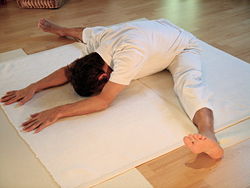
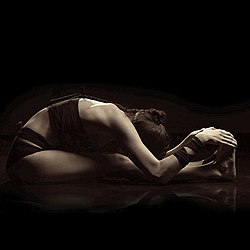
Paschimottanasana is entered from Dandasana (seated Staff pose) by bending forward from the hips without straining and grasping the feet or lower legs. A strap may be placed around the feet and grasped in the hands if the back is stiff. The head may be rested on a folded blanket or bolster, which may be raised on a small stool if necessary.[16][17] People who have difficulty bending their backs should exercise caution when performing this asana.[18]

Variations

[edit]

Dandasana or "Staff pose" has the legs extended along the floor and the body straight upright, with the palms or fingertips on the ground.[19] People who cannot sit on the floor like this can sit on a folded blanket.[20]

Janusirsasana or "Head to knee pose" has one leg extended with toes pointing upward, and the other leg bent with knee pointing away from the straight leg and the sole of the foot in by the groin. The torso folds straight forwards over the extended leg.[11][21]

Urdhva Mukha Paschimottanasana, also called Ubhaya Padangusthasana, is a balancing form of the pose, legs and hands pointing upwards.[22][23]

Parivritta Paschimottanasana is the reversed or twisted form of the pose, the body twisted to one side and the hands reversed, so that if the body is turned to the left, the right hand grasps the left foot, the right elbow is over the left knee, and the left hand grasps the right foot.[24]

Trianga Mukhaikapada Paschimottanasana has one leg bent as in Virasana.[25]

Wide-Legged Forward Bend (Prone Paschimottanasana) Open your legs wider than hip-width apart and fold forward. This variation targets the inner thighs while still stretching the back.[26]

Baddha Padma Paschimottanasana[27] has one leg crossed over the other as in Padmasana.[28]

Upavishthakonasana or "wide-angle seated forward bend"[20] has both legs straight along the ground, as wide apart as possible, with the chin and nose touching the ground.[13][14][29][30] Parsva Upavishthakonasana (to the side) has the body facing one leg, and the hands both grasping the foot of that leg, without raising the opposite hip.[31] Urdhva Upavishthakonasana (upwards) is similar to Navasana but with legs wide. It has the first and second fingers grasping the big toes, the legs wide apart, straight, and raised to around head height; the body is tilted back slightly to balance on the sitting bones. The pose can be practised with a strap around each foot if the legs cannot be straightened fully in the position; a rolled blanked can be placed behind the buttocks to assist with balancing.[32] If you have a back injury, a knee injury, or high blood pressure, avoid this asana.[33]

See also

[edit]

Notes

[edit]

References

[edit]

Sources

[edit]
[edit]
Revisions and contributorsEdit on WikipediaRead on Wikipedia
from Grokipedia
Paschimottanasana, commonly known as the Seated Forward Bend, is a foundational seated forward folding pose in that involves extending the legs forward and folding the over them to stretch the from the heels to the head. The term breaks down to paschima meaning "west" or "back of the body," uttana meaning "intense stretch," and meaning "pose," reflecting its focus on elongating the back side of the body. This is performed seated with the legs extended and straightened, folding forward from the hips to reach toward the feet while keeping the spine long. Documented in classical yoga texts such as the 15th-century (Chapter 1, verses 29-30) and the , Paschimottanasana has been practiced for centuries to promote physical flexibility and mental tranquility, often as part of a balanced sequence to balance (life force) and prepare for . In traditional contexts, it is revered for cleansing the subtle energy channels and fostering inward focus, with the describing it as one of the key asanas for mastering the body. Modern interpretations emphasize its role in contemporary routines, where it serves as an accessible pose for beginners and advanced practitioners alike, often modified with props like straps or blocks to accommodate varying levels of flexibility. The pose offers physiological benefits, including enhanced hamstring and spinal flexibility. It is also associated with stress reduction through activation of the parasympathetic nervous system. Paschimottanasana stimulates abdominal organs, aiding digestion and relieving mild back pain, while promoting overall relaxation and improved posture when practiced regularly. However, it should be approached cautiously by those with lower back injuries, sciatica, or high blood pressure, and modifications such as bending the knees or using supports are recommended for safety. Variations like Ardha Paschimottanasana (half forward bend) or Parivrtta Paschimottanasana (revolved version) extend its therapeutic applications, targeting specific areas like the spine and hips.

Etymology and History

Etymology

Paschimottanasana is a compound word derived from three key components: paschima, meaning "west" or specifically "the back of the body"; uttana, denoting an "intense stretch" or "straight extension"; and asana, referring to a "posture" or "." This etymology highlights the pose's emphasis on elongating the posterior aspect of the body from the head to the heels, with paschima contrasting the front (purva, or "east") to denote the back surface. The literal translation thus becomes "Intense Stretch of the West" or "Intense Back Stretch Pose," underscoring the deep forward fold that targets the back body for profound elongation. In classical texts, the pose appears under this name without further linguistic breakdown, as seen in its early mention in the Gheranda Samhita's second chapter, where it is described simply as a seated forward extension. In modern yoga practice, the Sanskrit term has been widely adopted alongside the English descriptor "Seated Forward Bend," which captures the pose's seated position and forward-bending action, popularized through influential 20th-century texts like B.K.S. Iyengar's Light on Yoga. This dual naming reflects the integration of traditional terminology with accessible Western interpretations, facilitating its inclusion in contemporary yoga sequences.

Historical Development

Paschimottanasana, known as an intense stretch of the back body, receives its earliest documented description in the 15th-century , a foundational text on composed by Svatmarama around 1450 CE. In Chapter 1, Verse 30, the pose is termed Paśchima Tāna and presented as one of the key seated s, involving the practitioner extending both legs straight like a stick on the ground, grasping the toes with the hands, and placing the forehead on the knees or thighs while seated. This text positions the asana among a select group of 15 postures essential for physical stability and yogic preparation, marking its establishment as a core element in medieval Hatha practices. Subsequent classical Hatha yoga texts from the 17th century further elaborate on Paschimottanasana, reinforcing its significance in esoteric yogic processes. The , dated to approximately 1600–1700 CE, includes the pose in its enumeration of 32 asanas in Chapter 2 (verse 26), describing it as a forward fold that aids in directing toward the central channel and awakening energy. Similarly, the Hatha Ratnavali, composed by Srinivāsa around 1650 CE, lists Paschimottanasana among its 84 classical asanas, emphasizing its role in balancing and facilitating the flow of vital energies through the for spiritual advancement. Within pre-20th-century Indian yogic traditions, Paschimottanasana evolved as a staple in Hatha lineages influenced by Tantric practices, though no specific textual evidence predates the . These traditions, rooted in Nath and Shaiva sects, integrated the pose into meditative and purificatory routines to harmonize ida and nadis, preparing practitioners for higher tantric sadhanas such as and , without altering its fundamental form from the description. The pose's transition to modern yoga occurred in the early 20th century through influential teachers like , who documented it in his 1934 text Yoga Makaranda and incorporated it into dynamic vinyasa sequences taught at the . Krishnamacharya's approach emphasized breath-synchronized movements, adapting the traditional static hold into flowing transitions that popularized Paschimottanasana in contemporary postural systems.

Description and Practice

Pose Description

Paschimottanasana, commonly known as Seated Forward Bend, derives its name from the Sanskrit terms paschima meaning "west" or "back," uttana meaning "intense stretch," and asana meaning "pose," referring to the deep extension of the posterior body. The pose originates from the foundational seated position of Dandasana, or Staff Pose, where the practitioner sits with both legs extended straight forward on the floor, the spine held erect and elongated, and the feet actively flexed with heels pressing away from the body. From this base, the forward fold occurs at the hip joints, guiding the torso toward the thighs in a symmetrical alignment, with the hands grasping the feet, outer edges, or alternatively the shins if flexibility limits reach, and the head naturally releasing toward the knees. Alignment in Paschimottanasana emphasizes preserving the natural curvatures of the spine without excessive rounding, achieved by lengthening the front and directing the movement forward from the hips rather than collapsing from the . The muscles engage to support spinal integrity, while the hamstrings activate to maintain , ensuring the knees remain straight and the toes point toward the ceiling for optimal pelvic positioning. This configuration promotes a balanced distribution of effort across the body, with the shoulders relaxing downward and the elbows allowed to bend outward if the hands secure the feet. The pose targets the anatomically, providing an intense stretch to the hamstrings, calves, erector spinae along the spine, and even the shoulders through the forward reach. Concurrently, the folding action compresses the abdominal region, engaging the organs in a contained manner while the and tibialis anterior in the legs remain active to stabilize the foundation.

Step-by-Step Instructions

To practice Paschimottanasana safely, begin in Dandasana (Staff Pose) by sitting on the floor with both legs extended straight in front of you, feet flexed, and heels pressed firmly away from the torso to establish a stable base. Inhale deeply to lengthen the spine, lifting the chest and drawing the shoulders back while maintaining an upright posture. On the exhalation, hinge forward at the hips—rather than rounding the back—extending the arms forward along the floor or toward the feet to initiate the forward fold, keeping the spine as long as possible. As you progress into the pose, walk your hands forward on either side of the legs or grasp the big toes, sides of the feet, or outer edges of the feet if flexibility allows, while continuing to flex the feet and press the thighs down. If the hands cannot reach the feet comfortably, loop a around the soles of the feet and hold the ends to bridge the distance, allowing for a gradual deepening without strain. With each , lift the chest slightly to maintain length in the spine; on each , surrender deeper into the fold by releasing the toward the thighs, aiming to bring the trunk parallel to the floor over time. Use natural, deep breathing to promote relaxation in the back body and facilitate progressive release in the hamstrings and spine. Hold the pose for 5–10 breaths for beginners (approximately 30 seconds to 1 minute) or up to 2 minutes for more advanced practitioners, gradually increasing duration as comfort and flexibility improve. To exit, inhale to slowly lift the , lengthening the spine while supporting the back with the hands if needed, and return to Dandasana with an upright posture.

Variations and Modifications

Core Variations

Janu Sirsasana, also known as Head-to-Knee Pose, is a related seated forward bend that builds on elements of Paschimottanasana by bending one knee and placing the foot against the inner thigh of the extended leg, creating an asymmetric forward fold over the straight leg. In this pose, the practitioner sits with the extended leg active and the heel of the bent leg pressing into the , allowing the torso to hinge forward from the hips while keeping the spine lengthened and the bent knee opened to the side. This adjustment targets a deeper stretch along one side of the , from the ankle to the hip of the extended leg, emphasizing unilateral flexibility. Upavistha Konasana, or Wide-Angled Seated Forward Bend, is another related forward bend that modifies the leg position from the parallel alignment in Paschimottanasana by spreading the legs apart into a wide V-shape, typically at a 90- to 120-degree angle, before folding forward between them. The feet remain flexed and active, with the inner thighs and groins engaged to maintain stability, as the descends toward the floor while the spine extends evenly. This wide-legged configuration shifts the emphasis to the adductor muscles and inner hips, providing a broader stretch across the pelvic region compared to the parallel legs in the base pose. Parivritta Paschimottanasana, or Revolved Seated Forward Bend, adds a spinal twist to the forward fold of Paschimottanasana while keeping both legs extended straight forward. The practitioner folds forward from the hips to grasp the feet, then releases one hand to the outer edge of the opposite foot while placing the other hand on the , rotating the to deepen the twist through the spine. This revolved form enhances spinal mobility and engages the obliques, promoting balanced rotation alongside the posterior stretch. Urdhva Mukha Paschimottanasana, or Upward-Facing Intense West Stretch, is an advanced balancing variation of Paschimottanasana that intensifies the forward fold through lift and engagement. Seated with legs extended, the practitioner folds forward to grasp the feet or big toes, then lifts the upward while maintaining the grip, balancing on the sit bones with the spine concave and gaze toward the toes. This lifted position demands core strength and balance, deepening the stretch to the hamstrings and while fostering spinal awareness and control. In the Ashtanga yoga tradition, additional direct variations include Paschimottanasana B, where the hands grasp the big toes for a more precise fold, and Paschimottanasana C, involving a circling of the arms around the legs to bind behind the back, both enhancing grip and intensity. These core variations and related poses preserve the forward-folding essence of Paschimottanasana but introduce , , or balance to address specific imbalances, such as unilateral tightness or restricted spinal , thereby enhancing overall body awareness and mobility.

Therapeutic Modifications

Therapeutic modifications of Paschimottanasana adapt the pose to accommodate individuals with limited flexibility, injuries, or specific conditions, using props and simplified alignments to reduce strain while preserving the forward fold's essence. These adjustments prioritize safety and accessibility, allowing practitioners to experience the pose's lengthening effects on the posterior body without compromising form. For those with tight s, a strap can be looped around the soles of the feet, held with both hands, and gently pulled to assist the forward reach while keeping the legs extended and spine long. Alternatively, placing a block under the hands elevates the torso, enabling a straighter back and less intense hamstring stretch. The half-forward bend, known as Ardha Paschimottanasana, involves bending one knee and placing the foot in Sukhasana (easy cross-legged position) while extending the other leg, then folding forward over the straight leg to target one side at a time and ease bilateral tension. This unilateral approach suits beginners or those with asymmetrical tightness. For individuals with mobility issues, a chair-supported version positions the practitioner seated on a sturdy with legs extended forward on the floor or another surface, folding the upper body over the legs while using the chair back for stability and support. This adaptation minimizes lower body demands and is particularly beneficial for seniors or those recovering from . During pregnancy, especially in later trimesters, a wide-legged variation with feet separated beyond hip-width reduces abdominal pressure; a placed between the legs or under the forehead provides additional support for a gentle fold without compression. To prepare the , sequence Paschimottanasana after warm-up poses like Adho Mukha Svanasana (Downward-Facing Dog), which activates and lengthens the hamstrings, calves, and spine for safer entry into the forward bend.

Benefits

Physical Benefits

Paschimottanasana, through its forward folding action, significantly enhances flexibility in the hamstrings, calves, and lower back by elongating these muscle groups, thereby reducing tightness and improving overall in the . This effect is particularly beneficial for individuals with sedentary lifestyles, as regular practice promotes greater mobility without straining the joints. The pose also contributes to improved posture by strengthening the spine and core muscles, including the erector spinae, which support spinal alignment and stability during daily activities. By engaging these areas, Paschimottanasana helps counteract the forward slouch often caused by prolonged sitting, fostering a more erect and balanced posture over time. Furthermore, the abdominal compression in Paschimottanasana stimulates digestive organs, massaging the intestines and enhancing , which can provide relief from . This mechanical action increases blood flow to the spine and pelvic organs, nourishing these areas and potentially alleviating menstrual discomfort by reducing cramping in the lower . Overall, the pose supports spinal through decompression of the vertebral column during the forward fold, allowing for gentle elongation of the spinal extensors and discs.

Mental and Physiological Benefits

Paschimottanasana calms the by activating the parasympathetic response, which promotes relaxation and helps reduce stress and anxiety levels. This activation triggers the body's , countering the effects of and fostering a sense of . The forward fold encourages deep breathing, which further soothes the mind and alleviates mild symptoms of anxiety. The pose supports hormonal balance through gentle stimulation of key endocrine glands, including the , which aids in regulating blood sugar, and the , which influences and overall vitality. By massaging abdominal organs and enhancing circulation to these glands, Paschimottanasana contributes to equilibrium in hormone production, potentially easing related imbalances. Paschimottanasana improves mental clarity and focus through its introspective nature, drawing the practitioner's attention inward in a manner akin to meditation. The seated forward fold quiets mental chatter, enhancing concentration and promoting a meditative state that supports sustained attention. In yogic philosophy, this pose targets the Svadhisthana chakra, associated with emotional fluidity, thereby facilitating emotional release and processing suppressed feelings. Additionally, the pose aids in better and reduction via its cooling pranic effect, which balances energy flow and restores vitality. This calming influence on the pranic system helps alleviate exhaustion and prepares the body for restorative rest. The physical stretches in the pose serve as an entry point to these deeper mental and physiological effects.

Contraindications and Precautions

Absolute Contraindications

Paschimottanasana, a seated forward bend pose, involves significant spinal flexion and stretching, which can pose serious risks for individuals with acute back injuries such as herniated discs or , as the forward fold may compress the spine and exacerbate impingement or . Recent tears or strains are absolute contraindications, since the intense stretch on the posterior muscles could worsen the injury and lead to further tissue damage. Those with high or must avoid the pose entirely, as the forward bending action can elevate , potentially aggravating or increasing in the eyes. Pregnant individuals in the third trimester should not practice Paschimottanasana without modifications, but in absolute terms, the full pose is contraindicated to prevent abdominal strain and compression on the . Severe or injuries that compromise seated stability represent another key , as attempting the pose could destabilize the joints and heighten the risk of additional trauma.

General Precautions

Practitioners without absolute contraindications, such as severe spinal injuries or acute tears, should approach Paschimottanasana with caution to ensure safe execution. A key principle is to avoid forcing the forward fold, particularly if the are tight, as this can lead to strain in the lower back or legs; instead, use the breath—inhaling to lengthen the spine and exhaling to gradually deepen the bend—to allow the body to ease into the pose over time. During the pose, it is essential to monitor sensations closely, stopping immediately if sharp pain arises in the lower back or knees, which may indicate improper alignment or excessive pressure. To minimize digestive discomfort from abdominal compression, practice on an empty , ideally waiting at least two to three hours after a . Beginners are advised to hold the pose for shorter durations, such as 30 seconds to one minute, and seek guidance from a qualified to verify proper alignment and use modifications like props if needed. For optimal safety, incorporate Paschimottanasana after warming poses like Dandasana or to prepare the body and prevent strain, followed by counterposes such as Bhujangasana (Cobra Pose) to restore spinal balance.

Scientific Research

Studies on Physical Effects

A 2023 review in the International Journal of Scientific Research synthesized on Paschimottanasana's physical effects, identifying improvements in flexibility after regular practice. These results align with broader intervention data. Research on spinal mobility highlights Paschimottanasana's role in promoting and alleviating lower back discomfort among sedentary adults. A 2015 study on practices, including seated forward bends, found increased spinal flexion and extension in women over 50 after 20 weeks, with significant improvements in thoracic and mobility. Yoga intervention trials provide evidence of Paschimottanasana's influence on circulation. The 2023 review notes enhanced blood flow to the lower limbs and abdominal region from forward bending postures, supported by a 2024 study on asanas that used Doppler to measure improved vascular function in sedentary workers after practice sessions including forward bends. Despite these findings, which test hypotheses from traditional descriptions of enhanced posterior chain flexibility and vitality, research limitations persist. Many studies, including those reviewed in 2023, suffer from small sample sizes (often n<60) and a lack of long-term follow-up, underscoring the need for larger s to robustly confirm physiological benefits.

Clinical Applications

Paschimottanasana has shown potential in the clinical management of through its stimulatory effects on the and enhancement of insulin secretion. A 2018 highlights that the pose activates the and , promoting insulin release from pancreatic beta cells and improving insulin sensitivity via abdominal organ stimulation. In a involving patients with baseline HbA1c levels between 7% and 9%, a 12-week yoga program incorporating Paschimottanasana (practiced for increasing durations up to 1.5 minutes per session) resulted in a mean HbA1c reduction of 0.47% compared to 0.28% in an exercise control group (P < 0.05). The pose is also integrated into stress management protocols, where it contributes to cortisol reduction as part of broader yoga interventions. A 2013 randomized study on familial caregivers of Alzheimer's patients found that an 8-week yoga program including Paschimottanasana (held for 1.5 minutes, three times weekly) significantly lowered morning salivary levels (P < 0.05), measured via on multiple samples. This reduction was linked to the pose's calming effect on the and stress response. In rehabilitation for chronic , Paschimottanasana is employed to enhance spinal flexibility and alleviate discomfort. A 2014 clinical trial with premenopausal women suffering from chronic demonstrated that a 12-week intervention featuring the pose (integrated in weeks 1–4) reduced pain scores by approximately 65% (from 48.7 mm to 16.8 mm, P < 0.001), alongside increases in serum levels. Paschimottanasana is incorporated into therapeutic protocols for (PCOS) to support hormonal balance. A review of interventions for PCOS notes that the pose stretches the pelvic region, stimulates reproductive organs, and reduces stress-related , thereby aiding endocrine regulation and ovulatory function in affected women. Despite these findings, on Paschimottanasana's clinical applications remains limited by small sample sizes, predominantly from Indian cohorts, and a lack of large-scale longitudinal studies to assess long-term and safety across diverse populations.

References

Add your contribution
Related Hubs
Contribute something
User Avatar
No comments yet.