Recent from talks
Nothing was collected or created yet.
Pencoed
View on Wikipedia
Pencoed (also Pen-coed; ⓘ) is a village and community in the county borough of Bridgend, Wales. It straddles the M4 motorway north east of Bridgend and is situated on the Ewenny River. At the 2011 census it had a population of around 9,166.[2]
Key Information
Toponymy and pronunciation
[edit]The name appears as "Penkoyt" in a 1303 deed of Ewenny Priory and as "Pencoyd" in the seventeenth and eighteenth century.[3] The name is likely a contraction of pen-y-coed (head/top/end of the forest/wood) and has historically been given as both Pen-coed and Pencoed. While some local business, roads and signage use the hyphenated version,[4] the Welsh Language Commissioner recommends the spelling in both English and Welsh to be "Pencoed".[5]
The standard pronunciation in modern Welsh is [pɛn ˈkɔid] or [pɛn ˈkɔɨd]. However, the diphthong 'oe' in a monosyllable is generally reduced to a long vowel 'o' [o:] in South Wales, so the local pronunciation is [pɛn ˈkoːd]. This is sometimes spelled as "Pen-côd" in texts written in Gwenhwyseg (the local dialect).[6][better source needed]
History
[edit]The earliest evidence of habitation in the area is the nearby Ogof y Pebyll ("Tents Cave") or Ogof Coed-y-Mwstwr ("Hubbub Wood Cave")), which is a scheduled monument and appears to have been inhabited during Neolithic or Bronze Age periods. Worked flint flakes have been found, along with the teeth of numerous mammals of many different species.[7]
The area remained heavily wooded and sparsely populated until the eighteenth century. A map of 1729 shows "coal pitts" in the area and coal, lime, timbers and stone all contributed to the growth of the village. The development of the industrial villages was heavily influenced by Isambard Kingdom Brunel’s route for the South Wales Railway and the construction of a Railway Station between Pencoed and Penprysg in 1856. The two hamlets became the centre of the village of Pencoed. In just over a century and a half, Pencoed’s population increased from less than 500 to more than 12,000.[8]
Present day
[edit]The village is in the Ewenny Valley and is divided by the M4 motorway near Junction 35, although almost all of the village lies to the north of the M4. About two miles north of the town, the upland relief of the South Wales Valleys starts. To the south are the rolling countryside of the Vale of Glamorgan and the rugged north coast of the Bristol Channel.
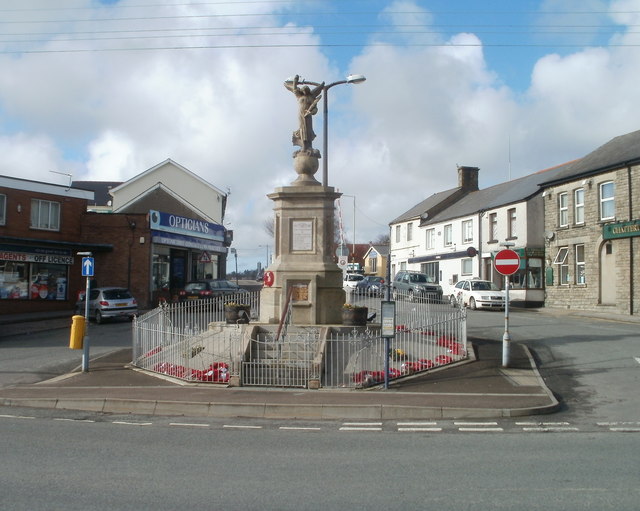
The village consists of three distinct areas, which were once four small hamlets. To the north is Penprysg ("copse end"), which lies at the end of the low ridge (100 m) of Cefn Hirgoed ("long wood ridge"). To the west is Hendre ("lowland winter homestead", literally "old settlement") which rises gently from the railway line in the centre of the village towards the common land at Ystadwaun, on older maps as Ystad y Waun and Gwastadwaun ("level moor"). The central and eastern part of the village, which lies on the valley floor near the railway, consists of Pencoed itself and Felindre ("mill settlement"). There are numerous streams rising and running through the village, and two main rivers, the Ewenni Fawr (Great Ewenny) and the Ewenni Fach (Little Ewenny). At the centre of the village, close to the station, is the war memorial (known locally as the Monument), the shopping centre and the local Community Hall (Pencoed Miners' Welfare Hall). The village is well provided with sports facilities, schools, pubs and clubs. A new development, Earlswood Parc, was announced in 2002 and now has been completed, incorporating various Westbury built homes and Bocam business park.
The current mayor is Councillor Barry Doughty.[9]
Pencoed hosted the National Eisteddfod in 1998.
The Raspberry Pi single-board computer is manufactured at the Sony Technology Centre in Pencoed, which produces 44,000 every week.[10]
Sport
[edit]Pencoed is noted for producing Rugby Union players. Pencoed RFC has produced a number of international players for both Wales and the British and Irish Lions. Most notably, three Pencoed players (Gareth Thomas, Gareth Cooper and Gavin Henson) all took part in the 2005 British & Irish Lions tour to New Zealand with Thomas captaining the Test team.[11]
Twinning
[edit]Pencoed has twinning arrangements with:
- Waldsassen, Germany
- Plouzané, France
References
[edit]- ^ "Town population 2011". Retrieved 7 November 2015.
- ^ "Custom report - Nomis - Official Labour Market Statistics".
- ^ "Official Pencoed Town Guide 2012-2013" (PDF). pencoedtowncouncil.gov.uk. p. 7. Retrieved 21 February 2025.
- ^ "Google Maps". Archived from the original on 14 October 2008. Retrieved 3 October 2019.
- ^ "Standardised Welsh Place-names list". Welsh Language Commissioner. Retrieved 21 February 2025.
- ^ "Huotlach na Herr Hitler" (PDF). Tafod Elái (in Welsh). September 2012. p. 8. Archived from the original (PDF) on 3 October 2019. Retrieved 2 October 2019.
- ^ Coflein.gov.uk NPRN: 307635. Glamorgan-Gwent Archaeological Trust (search for PRN: 00384m). Cadw SAM: GM434: Ogof y Pebyll Cave
- ^ "Official Pencoed Town Guide 2012-2013" (PDF). pencoedtowncouncil.gov.uk. p. 7. Retrieved 21 February 2025.
- ^ Council documentspencoedtowncouncil.gov.uk Archived 29 May 2023 at the Wayback Machine
- ^ "Raspberry Pi production moves to Wales from China". BBC News. 6 September 2012. Retrieved 1 June 2019.
- ^ Orders, Mark (2 May 2020). "The little Welsh rugby club that found the secret to making Wales and Lions stars". Retrieved 21 February 2025.
External links
[edit]Pencoed
View on GrokipediaEtymology and Pronunciation
Name Origin
The name Pencoed derives from the Welsh words "pen" (meaning "head," "top," or "end") and "coed" (meaning "wood" or "forest"), translating to "head of the wood" or "end of the wood."[9][2] This etymology reflects the town's historical position at the edge of forested areas in southern Wales.[9] One of the earliest recorded references to the place appears as "Penkoyt" in a 1303 deed from Ewenny Priory, where Payn de Turberville, Lord of Coity, granted rights to collect firewood in the area.[9][2] By the 17th and 18th centuries, the spelling had evolved to "Pencoyd," as seen on a 1729 map depicting local woods and coal pits, indicating the name's adaptation in English-language documents while retaining its Welsh roots.[9] In modern times, the Welsh Language Commissioner has standardized the spelling as "Pencoed" for official use, ensuring consistency in Welsh orthography across place names in Wales.[10] This standardization aligns with broader efforts to preserve and promote accurate representations of Welsh linguistic heritage.[11]Local Pronunciation
The standard pronunciation of Pencoed in Welsh is [pɛnˈkɔɪd], phonetically rendered as "pen-koyd," where the "oe" diphthong is pronounced as /ɔɪ/ similar to the "oy" in "boy," and the stress falls on the second syllable.[12] In regional dialects, particularly in South Wales where Pencoed is located, some locals may simplify the diphthong to a longer vowel sound like [pɛnˈkoːd] or "pen-code," reflecting variations in spoken Welsh across areas.[13] In English contexts, the name is often adapted to "pen-code," treating it as an anglicized compound, which aligns with common English phonetic patterns but deviates from the authentic Welsh articulation.[12] This adaptation frequently leads to mispronunciations such as "pen-co-ed," mistakenly applying English syllable breaks and vowel sounds, especially among non-Welsh speakers unfamiliar with the language's phonology.[14] The Welsh Language Commissioner provides official guidance on place names, recommending "Pencoed" as the standardized spelling and form for use in both Welsh and English to ensure consistency and preserve linguistic integrity.[10] This standardization supports accurate representation tied to the name's Welsh roots, without altering the phonetic essence.Geography
Location and Boundaries
Pencoed is a town and community located in the eastern part of Bridgend County Borough, Wales, positioned northeast of the county borough's main town of Bridgend. The settlement straddles the M4 motorway and is directly served by Junction 35, providing strategic access to the national road network. It lies in close proximity to the Ewenny River, which flows through the eastern part of the town. Geographically, Pencoed is centred at coordinates 51.5237° N, 3.5002° W. Administratively, it constitutes the Pencoed community within the unitary authority of Bridgend County Borough, sharing its eastern boundary with Rhondda Cynon Taf.Landscape and Hydrology
Pencoed is situated in the Ewenny Valley within Bridgend County Borough, where the landscape features gently undulating lowlands rising from elevations of around 30 to 114 meters above ordnance datum, forming a rural hinterland between the Vale of Glamorgan and upland Wales.[15] The terrain includes rolling hills and ridges, such as the Coed y Pebyll ridge to the east and the Cefn Hirgoed ridge to the north, which provide a backdrop of pastoral slopes and incised valleys shaped by glacial influences and underlying Triassic sandstones and mudstones.[2][15] Forested areas contribute significantly to the natural character, with blocks of broadleaved woodland, including the Coed y Mwstwr Woodland Site of Special Scientific Interest (SSSI) to the west, linking hedgerows and enhancing biodiversity through semi-natural habitats like oak-dominated woods and scrub.[15] These woodlands, alongside neutral grasslands and springs along valleys like Nant-Bryn-glas, support a mosaic of ecological features that maintain the area's tranquil, rural quality despite proximity to infrastructure.[2] The Ewenny River, a 16 km tributary of the River Ogmore, flows southward through the valley near Pencoed, originating from springs north of the town where its main arms, Ewenny Fawr and Ewenny Fach, converge before skirting pastoral landscapes and industrial fringes.[16] Influenced by limestone geology, the river exhibits strong base flow with alkaline chemistry, enabling consistent water levels that support diverse aquatic ecology, including habitats for brown trout, grayling, sea trout, and salmon through pools, riffles, and glides.[16] Local management efforts, such as gravel cleaning and fish passes, address challenges like siltation and invasive plants to preserve spawning grounds and water quality.[16] Environmental aspects include significant prehistoric cave sites, such as Ogof y Pebyll (also known as Pencoed Cave), a scheduled monument located in woodland approximately 2.5 km west-southwest of the town center.[17] This limestone cave contains archaeological deposits dating to the Neolithic and Bronze Age periods, with finds including worked flint flakes and mammal teeth indicating early human occupation and use for shelter or ritual purposes.[17] As a protected site, it highlights the area's rich prehistoric heritage within the broader limestone-influenced landscape.[17]History
Early Settlement
The earliest evidence of human activity in the Pencoed area dates back to prehistoric times, with significant archaeological finds in local caves indicating habitation during the Palaeolithic, Neolithic, and possibly Bronze Age periods. Ogof y Pebyll Cave, a scheduled ancient monument located in woodland north of Coychurch near Pencoed, contains deposits that suggest ritual or funerary use, including flint flakes and faunal remains such as teeth from numerous mammals, recovered during a late 19th-century excavation.[17] These artifacts point to intermittent occupation by early hunter-gatherers and later communities, though the exact dating remains tentative for the Neolithic and Bronze Age phases.[17] Medieval records provide the first documented references to settlement in Pencoed, reflecting a sparse population organized under feudal manorial systems in the lordship of Coity. One of the earliest mentions appears in a 1303 deed from Ewenny Priory, where Payn de Turberville, Lord of Coity, granted permission for land use in the area, indicating limited but structured agrarian activity tied to the priory's estates.[2] The region fell within the broader manorial framework of Glamorgan, where tenants engaged in subsistence farming and owed services to overlords like the Turberville family.[2] Prior to the 19th century, Pencoed remained a quintessential rural agrarian society, characterized by small-scale farming communities scattered across the landscape. With a population of fewer than 500 residents, daily life revolved around agriculture, including crop cultivation and livestock rearing on modest holdings, sustained by the fertile valleys and woodlands of the area.[2] This pre-industrial era saw minimal urbanization, with settlements consisting primarily of farmsteads and hamlets under the influence of local manors and ecclesiastical lands.[2]Industrial and Modern Development
The arrival of the South Wales Railway in 1850 marked a pivotal moment in Pencoed's industrial transformation, as the establishment of a local station connected the previously rural hamlets to broader markets and facilitated the expansion of coal mining and lime production. These industries, already present on a smaller scale in the early 19th century, benefited from improved transportation, enabling the export of coal and lime quarried from the surrounding Ewenny Valley. Unlike more heavily industrialized nearby areas, Pencoed's development remained relatively modest, with limited operations such as an iron foundry and a short-lived brickworks supporting the local economy.[2][2] This railway-driven growth triggered a significant population boom, increasing from fewer than 500 residents in the early 19th century to around 9,000 by the early 21st century, as workers migrated to support the burgeoning extractive sectors.[1] Throughout the early 20th century, Pencoed served as a commuter base for employees in regional coal and steel operations, further bolstering its demographic expansion. However, the latter half of the century saw the decline of these heavy industries, exemplified by the closure of Werntarw Colliery in 1964 due to gas emissions and fire risks, which contributed to the broader contraction of South Wales' coal sector.[2][2][18] In response to these closures, Pencoed underwent post-industrial redevelopment, transitioning from a mining-dependent community to a residential and service-oriented town with new inward investments, such as call centers and light industry. This shift emphasized housing estates and commuter accessibility, aligning with the area's appeal for those working in nearby urban centers. Culturally, the town hosted the National Eisteddfod in 1998 under the Bro Ogwr banner, a major Welsh-language festival that highlighted Pencoed's role in preserving national heritage amid economic change. A key recent milestone was the establishment of Earlswood Parc in 2002, a mixed-use development incorporating residential homes and a business park that supported ongoing regeneration efforts.[2][2][19]Demographics
Population Trends
The population of Pencoed experienced substantial growth beginning in the second half of the 19th century, driven by the industrial influx associated with coal mining and the construction of the South Wales Railway, which facilitated the expansion from small hamlets into a burgeoning town.[2] Prior to this period, the area consisted of scattered settlements with fewer than 500 residents, but the railway's arrival in the 1850s and subsequent mining activities attracted workers and spurred residential development.[2] According to the 2011 United Kingdom Census, Pencoed had 9,166 residents.[20] By the 2021 Census, the community population stood at 9,113, reflecting a slight decline of 0.6% possibly due to definitional changes in geographic boundaries.[1] A 2022 local library report indicated that the facility serves a growing catchment population of over 12,000 people, incorporating broader suburban areas beyond the official community boundaries.[21] This modern growth has been fueled by Pencoed's appeal as a commuter town, owing to its proximity to the M4 motorway and the South Wales Mainline railway, which provide easy access to employment hubs in Cardiff and Bridgend.[4] Between 2001 and 2011, the population rose by approximately 6%, from 8,622 to 9,166, outpacing some regional trends but below the cited 20% estimate in a 2010 report that used a broader study area.[4][22] Population trends in Pencoed are projected to continue steadily upward, aligned with broader regional migration patterns in South Wales, where net in-migration and housing demand contribute to an anticipated 9.4% increase across Bridgend County Borough by 2033.[23] This growth is supported by ongoing infrastructure improvements and the area's role in the Cardiff Capital Region's economic expansion.[24]| Year | Population | Notes/Source |
|---|---|---|
| Mid-19th century | <500 | Pre-industrial estimate[2] |
| 2001 | 8,622 | UK Census (Pencoed community)[22] |
| 2011 | 9,166 | UK Census[20] |
| 2021 | 9,113 | UK Census (Pencoed community)[1] |
