Recent from talks
Nothing was collected or created yet.
Penn Station Access
View on Wikipedia| Penn Station Access | |
|---|---|
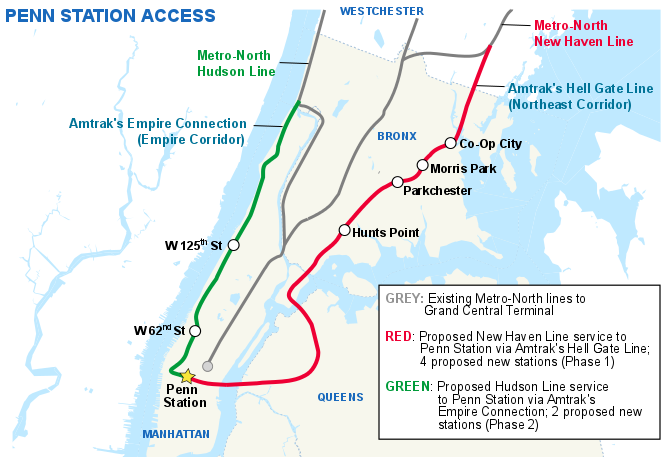
Map of the two proposed routes and six proposed stations of the Penn Station Access project. The red line depicts planned New Haven Line service via Amtrak's Northeast Corridor (Hell Gate Line), and the green line indicates proposed Hudson Line service via Amtrak's Empire Connection. | |
| Overview | |
| Status | Under construction |
| Owner | Amtrak |
| Locale | New York City |
| Termini | |
| Stations | 4 (Phase 1); 2 (Phase 2) |
| Website | Official website |
| Service | |
| Type | Commuter rail |
| System | Metro-North Railroad |
| Services | New Haven Line (via Hell Gate Line) Hudson Line (via Empire Connection) |
| Operator(s) | MTA Metro-North Railroad |
| History | |
| Commenced | December 2022 |
| Planned opening | 2027 (Phase 1) |
| Technical | |
| Character | At-grade, elevated, and underground |
| Track gauge | 4 ft 8+1⁄2 in (1,435 mm) standard gauge |
| Electrification | Third rail, 750 V DC; Overhead catenary |
Penn Station Access (PSA) is a public works project underway by the Metropolitan Transportation Authority in New York City. The goal of the project is to allow Metro-North Railroad commuter trains to access Penn Station on Manhattan's West Side, using existing trackage owned by Amtrak. Metro-North trains currently terminate exclusively at Grand Central in Midtown Manhattan.
The project is scheduled to complement Grand Central Madison, which opened as part of East Side Access in 2023, and will commence in two separate phases. The first phase, which is under construction, will add four new stations along the Hell Gate Line (part of the Northeast Corridor) in the Bronx and route some New Haven Line trains to Penn Station. The second phase, which is unfunded, would add two more stations along the Empire Connection/West Side Line on Manhattan's West Side; this would be served by the Hudson Line. An agreement for the first phase was reached in early 2019, and a groundbreaking ceremony took place in December 2022. New Haven Line trains are tentatively expected to run into Penn Station in 2027. The opening of East Side Access will free up capacity for the expanded services to operate at Moynihan Train Hall, an expansion of Penn Station.
Background
[edit]A 1969 proposal by the North Bronx Transportation Project considered running trains via the Hell Gate Bridge to Penn Station. Some plans for the Second Avenue Subway included integration with the upper portion of the line, providing express service from the East Side of Manhattan to Co-op City and Parkchester. This line was also considered for through-running with the Northeast Corridor in New Jersey, easing travel for residents of Westchester and Connecticut trying to get to New Jersey.[1]: 104, 128, 130
While not proposed officially, in June 1973, two Congressmen and the Mayor of Yonkers proposed having trains run from Stamford, Connecticut, to Penn Station, making stops at Pelham Manor, Co-op City, and Parkchester/Van Nest. They proposed that the line be operated by the MTA pending completion of the Second Avenue Subway, which was under construction at the time and slated to be completed in 1980. Sixty percent of Co-op City residents that responded to a survey said that they would have used the proposed rail service.[2]
The Penn Station Access project was initiated on September 2, 1999, when the Federal Transit Administration (FTA), in conjunction with Metro-North Railroad, issued a Notice of Intent (NOI) to prepare a Major Investment Study/Environmental Impact Statement (EIS). The EIS was intended to consider possible additions to Metro-North using existing rail lines, with the intention of providing flexibility and increased regional access.[3] Rail alternatives originally considered included Hudson and New Haven service, via the Empire Connection and Hell Gate Line, respectively, and a Harlem Line option via wyes at Mott Haven and Spuyten Duyvil.[4]: A-3 [5]

In November 2000, the Final Scoping Document for Penn Station Access was completed, showing 18 alternatives, including a no-build option, a Transportation Systems Management option, various commuter rail options, and alternatives using other modes. Various alternatives considered various ways to run service to Penn Station from the New Haven Line, the Hudson Line, and the Harlem Line, either during all times, or only operating during off-peak hours and weekends. Existing Metro-North riders would have the choice of arriving at either Penn Station or Grand Central on the New Haven Line and the Hudson Line.[6] Service from the New Haven Line would diverge at New Rochelle, using Amtrak's Hell Gate Line to access Penn Station, while service from the Hudson Line would split off at Spuyten Duyvil station via Amtrak's Empire Connection. The alternatives via the Harlem Line would have required the construction of wye tracks. One option would have branched off of the Harlem Line at Mott Haven, using a wye track to go north via the Hudson Line. Using a newly constructed wye track at Spuyten Duyvil, service would turn south via the Empire Connection before reaching Penn Station. Another option considered would have constructed a wye track at Woodlawn, allowing Harlem trains to go east and head down the Hell Gate Line to Penn Station. The final option would have required the reconstruction of the Port Morris Branch and the Hell Gate Line. An additional option would have extended service from Grand Central to Penn Station through the construction of a new tunnel.[7]: 14–16 [8]
In September 2002, a second screening took place narrowing five alternatives to four, and narrowing 20 potential station locations in the Bronx, Queens and Manhattan to five locations. The remaining alternatives considered would have used either the Hudson or New Haven Lines. The Harlem Line options were removed from consideration. The five remaining stations under consideration were at West 125th Street and West 59th Street under the Hudson alternative, and at Co-Op City, Parkchester and Hunts Point under the New Haven alternative.[3] The preferred alternatives would have used 3 miles (4.8 km) of trackage, and would have involved the construction of six new Metro-North stations in the Bronx and Manhattan, allowing riders in these areas to easily access Penn Station, Westchester, Dutchess, and Putnam counties upstate as well as Fairfield and New Haven counties in Connecticut.[9][10] Existing Metro-North riders would have the choice of arriving at either Penn Station or Grand Central on the New Haven Line and the Hudson Line.[6]
Afterwards, in coordination with the current rail operators at Penn Station (Amtrak, LIRR, and New Jersey Transit) it was determined that there were several operational limitations with the Hudson Line service alternative, mainly because the Empire Line's connection into Penn Station consists of only one track. The connection only leads to tracks 1–8 at Penn, which are used primarily by NJ Transit, with some usage by Amtrak. Since the implementation of Penn Station Access via the Hudson Line would have required substantial service reductions to those Penn Station tracks by NJ Transit and Amtrak or a new connection between the Empire Line and the LIRR tracks at Penn, progress did not continue on this alternative. Even though the Hell Gate Line alternative was chosen, this alternative is still being considered by Metro-North as capacity improvements at Penn Stations are underway, such as the Gateway tunnels.[11] Penn Station Access would also provide system resiliency to protect service in the event of natural or other disasters.[12]
By 2011, Metro-North had initiated a federal environmental study for Penn Station Access, to be completed by 2013. The cost of the project was estimated at $350 million with the state of Connecticut funding $100 million and the state of New York funding the remaining $250 million.[13][14]
Phase One
[edit]Penn Station Access - Phase One | ||||||||||||||||||||||||||||||||||||||||||||||||||||||||||||||||||||||||||||||||||||||||||||||||||
|---|---|---|---|---|---|---|---|---|---|---|---|---|---|---|---|---|---|---|---|---|---|---|---|---|---|---|---|---|---|---|---|---|---|---|---|---|---|---|---|---|---|---|---|---|---|---|---|---|---|---|---|---|---|---|---|---|---|---|---|---|---|---|---|---|---|---|---|---|---|---|---|---|---|---|---|---|---|---|---|---|---|---|---|---|---|---|---|---|---|---|---|---|---|---|---|---|---|---|
| ||||||||||||||||||||||||||||||||||||||||||||||||||||||||||||||||||||||||||||||||||||||||||||||||||

The first piece of Penn Station Access would route some New Haven Line trains down Amtrak's Northeast Corridor to Penn Station. The New Haven Line to Grand Central splits off from the Northeast Corridor near New Rochelle. The Northeast Corridor (also known here as the Hell Gate Line) continues south crossing the Pelham Bay Bridge into the Bronx, the Hell Gate Bridge into Queens, and entering Manhattan through the East River Tunnels also used by the Long Island Rail Road. This phase includes the construction of four new Metro-North stations in the Bronx to be served by the New Haven Line, located in Co-op City, Morris Park, Parkchester/Van Nest, and Hunts Point.[10] The stations would provide fast, direct rides to West Midtown and facilitate reverse-commuting trips to Westchester County and Connecticut.[12] The new stations would provide transit access to the transit-deficient East Bronx.[15]
Previously, a station was also considered to be built in Astoria, Queens; however, analysis showed that there would not be enough riders to justify the high cost of constructing a station.[16][17] The construction of a station was projected to cost over $20 million, and the station would only be able to be four cars long. The station would only have a projected annual ridership of 310,367.[17] Since 2014, local residents have pushed to have a Metro-North station built in Queens, either between 41st and 44th Streets in Astoria, or at Northern Boulevard and Broadway in Woodside.[18][16][19]
Planning
[edit]Original announcement
[edit]On January 8, 2014, then-New York Governor Andrew Cuomo voiced support for the project in his 2014 State of the State address.[12] With his support for the project, $695 million was budgeted for the project in the MTA's 2015–2019 Capital Program.[20] In order to accommodate more trains, power and signal systems, and yards at Penn Station and New Rochelle[21] will be upgraded and three railroad bridges will be rehabilitated or replaced.[15] In addition, a third track will be installed between the Parkchester/Van Nest station and north of the Co-Op City station, and additional switches will be added. Metro-North service to Penn Station will begin after the completion of the East Side Access project, which has diverted some Long island Rail Road trains to Grand Central, therefore opening up slots at Penn Station for Metro-North service.[20] During peak hours there will be between six and ten trains to Penn Station. There will be four trains per hour to Connecticut in the reverse peak direction, and there will be two trains per hour to and from Penn Station during off-peak and weekends.[22]
The project would add redundancy to the regional transportation network in case of service interruption. Regional connectivity will be increased with accessible transfers to Amtrak, the Long Island Rail Road and New Jersey Transit at Penn Station. Through-running between the New Haven Line and NJ Transit would be possible, linking business centers in Connecticut and New Jersey while providing access to Newark Liberty Airport.[22] The draft Environmental Assessment was to be made available for public review in late 2018.[11] In September 2017, the proposed alignment for the project only had three tracks through Hunts Point.[23]
Design process
[edit]At the MTA's Metro-North Railroad Committee meeting on January 22, 2019, it was announced that Amtrak and the MTA had reached an agreement regarding track usage rights, and $35 million was approved for initial engineering design work.[24] In addition, HNTB New York Engineering and Architecture received a $35 million contract to consult on the planning of the four new stations.[25][26][27] In exchange for being allowed to use the Hell Gate Line and build the four stations, the MTA agreed to replace the Pelham Bay Bridge across the Hutchinson River, as well as pay access fees for using the Hell Gate Bridge. Amtrak and the MTA also agreed to conduct a joint study on the feasibility of extending Amtrak service to Long Island via the tracks used by the LIRR.[28][29] As part of the project, three track interlockings would be built, one existing interlocking would be rehabilitated, and the line would be widened from three to four tracks between the Hell Gate and Pelham Bay Bridges.[30]: 50 The expanded services will operate at Moynihan Train Hall, an expansion of Penn Station into the neighboring James A. Farley Building.[31]
Design for the project began in February 2019, and construction was expected to begin in late 2020, with an expected opening by 2023.[30]: 53 By February 2020, the MTA had identified three firms that were qualified to bid on the design–build contracts for Penn Station Access. At that point, the project's opening date was announced as 2024.[32][33] Shortly afterward, work was placed on hold due to the COVID-19 pandemic in the United States.[34] The FTA published a draft EIS in May 2021, and the state government commenced a request for proposals for the project's development.[35] The project's completion was then announced for 2025.[36] On September 28, 2021, the FTA issued a Finding of No Significant Impact (FONSI) for the project, allowing the project to move forward.[37] The FRA issued a FONSI for the project on November 16, 2021. In December 2021, it was announced that completion of the line would be delayed until 2027.[38]
Funding
[edit]On December 13, 2021, it was announced that Senate Majority Leader Chuck Schumer had helped broker a deal with the MTA and Amtrak to fund $500 million for the PSA project and $432 million for the rehabilitation of the East River Tunnels using money available due to the passage of the Infrastructure Investment and Jobs Act.[39] On December 15, the MTA Board approved the award of a 63-month design-build contract for the project to a joint venture of Halmar International and RailWork Transit for $1,850,643,000, of which $133,580,000 was for an option to complete improvements in New Rochelle Yard. The MTA Board also approved a cost sharing agreement with Amtrak that set the conditions for the completion of the project on Amtrak's right-of-way. Amtrak agreed to fund $500 million of the project costs as it derived some benefits from the project.[40]
On the same date, the MTA Board approved the awarding of an 86-month contract to WSP USA and Atlas ATC Engineering for project management. The contract was awarded for $116,572,815, with an option for $17,035,237.[41] Furthermore, the MTA Board approved an amendment to the 2020–2024 Capital Program to increase the entire cost of the project to $2.867 billion, and defer $460 million of the project costs, including the option for improvements in New Rochelle Yard and some contingencies and support costs, to a future date. The amendment would increase funding in the 2020–2024 program from $1.131 billion to $2.052 billion, or $920.8 million; $452 million for the project was in the 2015–2019 program. The entire budget for the project went up from $1.561 billion to $2.482 billion. The cost increase was due to bids that were received, increases in the price of construction materials and labor, additional scope required by Amtrak, including expanded power and communication upgrades and a fourth track, and limitations on labor support committed by Amtrak and track outages. Funding for the budget increase would be made using the $500 million in Amtrak funding, and the reallocation of funding from other projects in the Capital Program.[42]
Beginning of construction
[edit]A groundbreaking ceremony for Penn Station Access took place in the Bronx on December 9, 2022,[43][44] marking the official start of construction.[45] Although the project was initially supposed to be completed by March 2027,[46] MTA officials indicated in January 2023 that the first phase of Penn Station Access could be postponed by six to nine months.[47][48] According to MTA Construction and Development president Jamie Torres-Springer, the Hell Gate Line had to be partially closed to allow work on Penn Station Access to proceed, but Amtrak had refused to approve a plan that would have closed the line at night and during the weekend. Torres-Springer said the MTA had proposed closing the line for up to eight months beginning in March 2023 but that Amtrak had not yet approved the proposal.[48] Without a temporary closure of the Hell Gate Line, the project would not be complete until at least October 2027.[46] The federal government provided $1.6 billion for the project in late 2023.[49][50]
In August 2024, the New York City Council voted to rezone 46 city blocks in Parkchester, Van Nest, and Morris Park, around the Metro-North Railroad's Parkchester/Van Nest and Morris Park stations, as part of the Penn Station Access project. The city government also promised to spend $500 million on infrastructure upgrades around these stations. The rezoning was intended to encourage development around these stations.[51][52] As a result, up to 7,000 housing units could be constructed in the three neighborhoods.[53][54]
On January 24, 2025, Metro-North solicited a sole source procurement for up to 16 Siemens Charger locomotives from Siemens to operate service on Penn Station Access. The order would be done as an option order to an existing order.[55][56] In February 2025, the MTA Board was to vote on an option order for 13 dual-mode Charger locomotives, with an option for two additional locomotives for $304.9 million. These locomotives will be powered using both AC Pantographs to operate under catenary and battery power, which is a modification to Siemens' existing design for Tier 4 diesel-electric dual mode locomotives. If the option is approved, the cars would be delivered between January 2029 and July 2030. It will also vote on a proposal to use a request for proposals (RFP) instead of competitive bidding to procure coach cars to be used for PSA to ensure full fleet availability and to replace Metro-North's Center-Door and End-Door coach cars.[57]
In October 2025, MTA officials stated that the completion of Penn Station Access could be postponed to 2030 because Amtrak officials had refused to give MTA workers access to the Hell Gate Line during most weekends. At the time, the MTA said that three of the four stations could still open as early as 2027 if Amtrak agreed to expedite the work, but that the Hunts Point station would still be delayed.[58][59] If Amtrak agreed to expedite the work, temporary platforms could be installed at the three stations until the project was completed.[59] In response, Amtrak officials promised to study the feasibility of allowing a small number of Metro-North trains to use the Penn Station Access routing from 2027 onward.[60][61]
Existing service
[edit]New Haven Line service to Penn Station already existed in a very limited fashion, the Train to the Game, which ran between New Haven and NJ Transit's Secaucus Junction. Connecting service to Meadowlands station brought riders to Sunday 1 PM NFL games played by the New York Jets and New York Giants. This special service, operated using NJ Transit equipment, stopped at Penn Station, but that was only a secondary benefit of the operation.[62]
Phase Two
[edit]Penn Station Access - Phase Two | |||||||||||||||||||||||||||||||||||||||||||||||||||||||||||||||
|---|---|---|---|---|---|---|---|---|---|---|---|---|---|---|---|---|---|---|---|---|---|---|---|---|---|---|---|---|---|---|---|---|---|---|---|---|---|---|---|---|---|---|---|---|---|---|---|---|---|---|---|---|---|---|---|---|---|---|---|---|---|---|---|
| |||||||||||||||||||||||||||||||||||||||||||||||||||||||||||||||

The second part of the project would bring Hudson Line trains into Penn Station using Amtrak's Empire Connection, which runs on Manhattan's West Side via the West Side Line. The Empire Connection branches off from the Hudson Line near Spuyten Duyvil station, just north of the eponymous bridge across Spuyten Duyvil Creek, and is currently used by Amtrak's Empire Corridor trains traveling from Upstate New York, Canada, and other destinations. The majority of the Empire Connection is not electrified, so the M3A and M7A electric railcars in use on the Hudson Line would be unable to travel to Penn Station unless the line is electrified. The former New York Central Railroad lines, including the Hudson Line, use under-running third rail. Tracks in Penn Station and on the LIRR use over-running third rail. Any Metro-North cars traveling from the Hudson Line to Penn Station would have to be specially equipped to operate with both current collection systems. This phase includes a proposal for two new Metro-North stations to be served by the Hudson Line. Both stations would be located in Manhattan along the Empire Connection: one at West 125th Street in Manhattanville and the other near 62nd Street on the Upper West Side.[63]
Project details
[edit]Penn Station Access will add new tracks along the Hell Gate Line right-of-way, relocate, reconfigure, and add new interlockings, realign and install new catenaries, construct four new stations, replace and repair undergrade bridges, upgrade existing AC substations, and construct new AC substations. Since M8 rolling stock cannot operate under Amtrak's 25 Hz traction power system between Gate Interlocking and just east of Harold Interlocking, the project will also install 3 miles (4.8 km) of third rail and two new DC substations at Gate and Woodside. The MTA had considered relocating the existing AC phase break from Gate to Harold. The project would also upgrade New Rochelle Yard and replace the existing wayside signaling with a higher-density signaling system to accommodate the increased level of service on the line. C Yard in Penn Station will be modified minimally with the reenergizing of the third rail on Track 3 in the yard, which had been used to store Long Island Rail Road maintenance-of-way trucks. These changes would allow three train sets to be stored in the yard.[64]
The MTA had the design consultant study the feasibility of building a tunnel connecting the Hunts Point station on PSA with the Hunts Point Avenue station on the IRT Pelham Line. It also had them study whether it made sense to reuse the historic Westchester Avenue station headhouse for the Hunts Point station.[64]: 22
Possible Harlem Line service
[edit]It has been proposed to have Harlem Line access to Penn Station as well by reactivating the abandoned Port Morris Branch in the South Bronx. The reactivated railroad branch would connect the Harlem Line to the Hell Gate Line.[19] However, these plans have been complicated due to the private ownership of the land next to the right-of-way,[65] as well as a new housing development directly on the right-of-way at 156th Street.[66]
References
[edit]- ^ An Assessment of the Transit Service Potential of Inactive Railroad Rights-of-way and Yards Final Report. New York City Department of City Planning. October 1991.
- ^ Hudson, Edward (June 9, 1973). "A NEW RAIL LINK SOUGHT FOR BRONX". The New York Times. ISSN 0362-4331. Archived from the original on February 4, 2018. Retrieved December 25, 2016 – via New York Times Archive.
- ^ a b "Penn Station Access Study". web.mta.info. Metropolitan Transportation Authority. Archived from the original on September 19, 2017. Retrieved September 26, 2017.
- ^ "Final Scoping Document: Major Investment Study/ Draft Environmental Impact Statement for Penn Station Access" (PDF). mta.info. Metropolitan Transportation Authority. November 2000. Archived (PDF) from the original on January 10, 2021. Retrieved September 27, 2017.
- ^ "Penn Station Access Study". Mta.info. Archived from the original on April 12, 2015. Retrieved April 23, 2015.
- ^ a b Smith, Stephen Jacob (February 19, 2013). "West Side vs. East Side (Access): Upper West Side May Get Metro-North Stop". Observer.com. Archived from the original on April 29, 2015. Retrieved April 23, 2015.
- ^ "Final Scoping Document. Major Investment Study / Draft Environmental Impact Statement for Penn Station Access" (PDF). mta.info. Metropolitan Transportation Authority. November 2000. Archived (PDF) from the original on January 10, 2021. Retrieved September 27, 2017.
- ^ "Metro-North PENN STATION ACCESS MIS/DEIS Comparative Screening Results Report (September 2002)" (PDF). mta.info. Parsons Brinckerhoff Quade & Douglas, Inc. September 2002. Archived (PDF) from the original on March 4, 2016. Retrieved February 17, 2016.
- ^ "Penn Station Access Study". Mta.info. Archived from the original on April 12, 2015. Retrieved April 23, 2015.
- ^ a b "Final Scoping Document: Major Investment Study / Draft Environmental Impact Statement for Penn Station Access" (PDF). Web.mta.info. Archived (PDF) from the original on January 10, 2021. Retrieved April 23, 2015.
- ^ a b "Penn Station Access Background". web.mta.info. Metropolitan Transportation Authority. July 2018. Archived from the original on July 3, 2018. Retrieved July 4, 2018.
- ^ a b c "Metro-North Penn Station Access" (PDF). mta.info. Metropolitan Transportation Authority. Archived from the original (PDF) on February 26, 2015. Retrieved February 17, 2016.
- ^ Rocchio, Patrick (November 10, 2011). "MTA may build four new Metro-North stations". Bronx Times Reporter. p. 1. Archived from the original on February 9, 2012. Retrieved November 20, 2011.
- ^ Beekman, Daniel (December 28, 2011). "New passenger rail service for the East Bronx gaining steam with the MTA bigwigs and boro leaders all aboard". New York Daily News. p. 29. Archived from the original on April 21, 2012. Retrieved December 29, 2011.
- ^ a b "MTACC Quarterly Progress Report to CPOC Penn Station Access Project Overview December 12, 2016" (PDF). mta.info. Metropolitan Transportation Authority. December 12, 2016. Archived (PDF) from the original on February 2, 2017. Retrieved January 27, 2017.
- ^ a b Trapasso, Clare (October 2, 2012). "Petition for Metro-North station in Queens". NY Daily News. Archived from the original on March 3, 2016. Retrieved February 17, 2016.
- ^ a b "Metro-North PENN STATION ACCESS MIS/DEIS Comparative Screening Results Report (September 2002)" (PDF). mta.info. Parsons Brinckerhoff Quade & Douglas, Inc. September 2002. Archived (PDF) from the original on March 4, 2016. Retrieved February 17, 2016.
- ^ Honan, Katie (October 8, 2014). "Locals Pushing for Metro-North Stations in Queens". DNAinfo New York. Archived from the original on March 6, 2016. Retrieved February 17, 2016.
- ^ a b "Metro-North PENN STATION ACCESS MIS/DEIS Final Scoping Document" (PDF). mta.info. Parsons Brinckerhoff Quade & Douglas, Inc. Edwards and Kelcey, Inc. Archived (PDF) from the original on January 10, 2021. Retrieved February 17, 2016.
- ^ a b "MTA 2015-2019 Capital Program, pages 152 and 225" (PDF). Archived (PDF) from the original on November 17, 2015. Retrieved January 11, 2016.
- ^ "PSA: Shops & Yards". mta.info. Metropolitan Transportation Authority. Archived from the original on July 4, 2018. Retrieved February 1, 2017.
- ^ a b "Connecticut Presentation (2013)" (PDF). mta.info. Metropolitan Transportation Authority. March 2013. Archived (PDF) from the original on March 29, 2017. Retrieved January 27, 2017.
- ^ "Capital Program Oversight Committee Meeting 9/25/2017" (PDF). mta.info. Metropolitan Transportation Authority. September 25, 2017. Archived (PDF) from the original on April 19, 2020. Retrieved December 16, 2021.
- ^ "MTA | news | Project to Build Bronx Metro-North Stations Advances". www.mta.info. Archived from the original on January 23, 2019. Retrieved January 22, 2019.
- ^ Castillo, Alfonso A. (January 22, 2019). "Metro-North riders will finally get Penn Station access". am New York. Archived from the original on January 23, 2019. Retrieved January 23, 2019.
- ^ Spivack, Caroline (January 22, 2019). "MTA to build new Metro-North stations linking Bronx to Penn Station". Curbed NY. Archived from the original on January 23, 2019. Retrieved January 23, 2019.
- ^ "Metro-North Railroad Committee Meeting" (PDF). Metropolitan Transportation Authority. January 2019. p. 79. Archived from the original (PDF) on January 21, 2019. Retrieved January 18, 2019.
- ^ Nessen, Stephen (January 22, 2019). "Amtrak, Metro-North Reach Deal on Bronx Expansion Plans". WNYC. Archived from the original on February 4, 2019. Retrieved January 23, 2019.
- ^ Zambito, Thomas C. (January 22, 2019). "Penn Station Access Project gets green light, will open West Side to Westchester commuters for first time". The Journal News. Archived from the original on January 24, 2019. Retrieved January 23, 2019.
- ^ a b "Capital Program Oversight Committee Meeting" (PDF). Metropolitan Transportation Authority. April 2019. Archived (PDF) from the original on May 24, 2019. Retrieved January 18, 2019.
- ^ Goldman, Harry (December 28, 2020). "NYC's Penn Station Expansion Remakes a Depot People Love to Hate". Bloomberg.com. Archived from the original on December 30, 2020. Retrieved April 14, 2021.
- ^ "MTA selects qualified bidders for Penn Station access project. For Railroad Career Professionals". Progressive Railroading. Archived from the original on February 18, 2020. Retrieved February 12, 2020.
- ^ "MTA identifies firms qualified to bid to design and build Metro-North Penn Station Access Project". Mass Transit. February 12, 2020. Archived from the original on February 18, 2020. Retrieved February 12, 2020.
- ^ "4 New Metro-North Stations Coming to the Bronx as Part of Penn Station Access Project". NBC New York. May 13, 2021. Archived from the original on May 13, 2021. Retrieved May 13, 2021.
- ^ Campbell, Jon (May 13, 2021). "MTA moving ahead with Metro-North access to Penn Station, which could cut commute times". lohud.com. Archived from the original on May 13, 2021. Retrieved May 13, 2021.
- ^ Cruz, David (May 15, 2021). "After Yearlong Pause, NY Approved To Start Long-Awaited Metro-North Expansion Project In The Bronx". Gothamist. Archived from the original on May 16, 2021. Retrieved May 16, 2021.
- ^ "Metro-North Penn Station Access Project Completes Environmental Review". CBS New York. September 28, 2021. Archived from the original on September 29, 2021. Retrieved September 29, 2021.
- ^ "Penn Station Access". mta.info. Metropolitan Transportation Authority. Archived from the original on December 16, 2021. Retrieved December 16, 2021.
- ^ Goldiner, Dave (December 13, 2021). "Schumer cuts deal to 'surcharge' transit with 4 new Bronx stations and repaired LIRR tunnels". New York Daily News. Archived from the original on December 16, 2021. Retrieved December 16, 2021.
- ^ "Penn Station Access Design Build Staff Summary". mta.info. Metropolitan Transportation Authority. December 15, 2021. Archived from the original on December 16, 2021. Retrieved December 16, 2021.
- ^ "Penn Station Access Consultant Svcs. Staff Summary". mta.info. Metropolitan Transportation Authority. December 15, 2021. Archived from the original on December 16, 2021. Retrieved December 16, 2021.
- ^ "MTA 2020-2024 Capital Program Amendment". mta.info. Metropolitan Transportation Authority. December 15, 2021. Archived from the original on December 15, 2021. Retrieved December 16, 2021.
- ^ "4 New Metro-North Stations Break Ground in NYC. Here's When They'll Take You to Penn". NBC New York. December 9, 2022. Archived from the original on December 9, 2022. Retrieved December 9, 2022.
- ^ Kramer, Marcia (December 9, 2022). "Metro-North Penn Station Access project breaks ground in the Bronx". CBS News. Archived from the original on December 9, 2022. Retrieved December 9, 2022.
- ^ "Governor Hochul Announces Groundbreaking for Metro-North Penn Station Access Project to Bring Four New Stations to the Bronx | Governor Kathy Hochul". www.governor.ny.gov. December 9, 2022. Archived from the original on December 9, 2022. Retrieved December 9, 2022.
- ^ a b Kaske, Michelle (January 30, 2023). "New Metro-North Rail Service to Penn Station Postponed by Seven Months". Bloomberg. Archived from the original on March 26, 2023. Retrieved January 31, 2023.
- ^ Castillo, Alfonso A. (January 30, 2023). "MTA's next megaproject, $2.8 billion Penn Station Access, delayed". Newsday. Archived from the original on January 30, 2023. Retrieved January 31, 2023.
- ^ a b Brachfeld, Ben (January 30, 2023). "Dispute between MTA, Amtrak could delay Penn Access megaproject bringing Metro-North to west side". amNewYork. Archived from the original on January 30, 2023. Retrieved January 31, 2023.
- ^ "$1.6 billion secured for Penn Station Access Project". Mid Hudson News. November 6, 2023. Retrieved November 9, 2023.
- ^ LaRocca, Lisa (November 6, 2023). "Federal funding for Penn Station Access Project excites Westchester commuters". News 12 - Westchester. Retrieved November 9, 2023.
- ^ Sommerfeldt, Chris; Kvetenadze, Téa (August 6, 2024). "Revised East Bronx rezoning plan includes thousands of apartments, $500 million in improvements". New York Daily News. Retrieved August 8, 2024.
- ^ Nehring, Abigail (August 6, 2024). "NYC to Invest $500M in East Bronx for Proposed Metro-North Rezoning". Commercial Observer. Retrieved August 8, 2024.
- ^ Durso, Isabelle (August 15, 2024). "NYC Approves Metro-North Rezoning Set to Bring 7,000 Homes to Bronx". Commercial Observer. Retrieved August 15, 2024.
- ^ Haag, Matthew (August 15, 2024). "Plan to Build Thousands of Apartments Will Transform the East Bronx". The New York Times. Retrieved August 15, 2024.
- ^ "Metro-North Railroad Procurements". mta.info. Metropolitan Transportation Authority. June 21, 2023. Retrieved January 27, 2025.
- ^ "Metro-North Railroad current procurement opportunities". mta.info. Metropolitan Transportation Authority. January 24, 2025. Archived from the original on January 27, 2025. Retrieved January 27, 2025.
- ^ "Metro-North Railroad Procurements". mta.info. Metropolitan Transportation Authority. February 21, 2025. Retrieved February 23, 2025.
- ^ Martinez, Jose (October 27, 2025). "MTA Rails Against Amtrak for Delays to Metro-North Penn Station Connection". THE CITY - NYC News. Retrieved October 28, 2025.
- ^ a b Chen, Stefanos (October 27, 2025). "Metro-North Expansion in the Bronx Is Likely to Be Delayed by 3 Years". The New York Times. Retrieved October 28, 2025.
- ^ Kaske, Michelle (November 13, 2025). "Amtrak Tells NY MTA It Would Be Open to Some Metro-North Lines". Bloomberg.com. Retrieved November 15, 2025.
- ^ "Amtrak to study limited Metro-North service into Penn Station". Crain's New York Business. October 31, 2025. Retrieved November 15, 2025.
- ^ "MNR Schedules". Archived from the original on September 7, 2017. Retrieved December 10, 2018.
- ^ "Penn Station Access Proposed "Build" Alternative" (PDF). mta.info. Metropolitan Transportation Authority. Archived (PDF) from the original on March 22, 2016. Retrieved February 17, 2016.
- ^ a b "Contract No. PS864: General Engineering Consultant Professional Design Services for Metro-North Railroad Penn Station Access Project Scope of Services" (PDF). pennstationaccess.info. Metropolitan Transportation Authority. January 2018. Archived (PDF) from the original on December 16, 2021. Retrieved December 16, 2021.
- ^ "Deck over the railway" (PDF). Archived from the original (PDF) on March 4, 2016. Retrieved November 5, 2015.
- ^ Anuta, Joe (November 2, 2015). "Green space or mass transit? A forgotten South Bronx rail line is suddenly the center of attention". Crain's New York Business. Archived from the original on March 28, 2017. Retrieved November 4, 2015.
External links
[edit]- Project website
- Penn Station Access Infrastructure Project | Amtrak
- Penn Station Access Study at the Wayback Machine (archived May 22, 2018)
Penn Station Access
View on GrokipediaBackground and Historical Development
Origins and Early Proposals
The concept of extending Metro-North Railroad commuter service directly to Pennsylvania Station via the Hell Gate Line corridor has been under discussion for decades, aimed at providing redundancy to Grand Central Terminal and better serving West Side destinations in Manhattan.[8] The Hell Gate Line, part of Amtrak's Northeast Corridor, was originally built by the Pennsylvania Railroad to enable through-service from New England points to Penn Station, with passenger trains utilizing the route until the late 1960s when financial difficulties prompted widespread cutbacks under Penn Central.[9] Following the creation of Metro-North in 1983 to operate commuter rail in the New York region, the underutilized Hell Gate tracks—primarily handling freight and limited Amtrak intercity runs—presented an opportunity for expanded local service, though early ideas remained conceptual amid competing priorities like electrification of existing lines.[10] By the early 2010s, the proposal gained traction within the MTA's planning framework, with Metro-North incorporating Penn Station Access into its capital program in February 2013. This outlined an initial phase focusing on New Haven Line trains routing through the Bronx via the Hell Gate Bridge, adding intermediate stations and upgrading tracks for commuter volumes, alongside a prospective second phase for Hudson Line integration over the Spuyten Duyvil Bridge.[11] Governor Andrew Cuomo elevated the project in state priorities starting in 2011, framing it as a means to optimize existing infrastructure without new tunneling, and it featured prominently in the 2014-2015 executive budget as a bypass for bottlenecks at major terminals.[12] The MTA board approved the core elements of phase one in September 2014, committing $743 million for track realignments, signaling enhancements, and four new Bronx stations to enable peak-hour service from Westchester and Connecticut directly to Penn Station, with projected travel times of 35-45 minutes from stations like New Rochelle.[13] These early plans emphasized state-of-good-repair upgrades to Amtrak's aging infrastructure, including catenary rehabilitation and interlocking expansions, to accommodate up to 8-10 daily round trips initially.[11]Key Announcements and Planning Milestones
The Penn Station Access project was conceived in 1996 as part of New York Governor George E. Pataki's "Master Links" initiative aimed at improving regional transportation connectivity.[14] In 1999, Metro-North Railroad initiated a Major Investment Study and Draft Environmental Impact Statement, with the Federal Transit Administration issuing a Notice of Intent to prepare an Environmental Impact Statement.[14] By 2002, screening studies recommended extending New Haven Line service to Penn Station via Amtrak's Hell Gate Line, initially proposing three new stations in the Bronx.[14] Community engagement in 2012 resulted in the addition of a fourth station at Morris Park, expanding service to underserved areas.[14] A Planning Phase Agreement was executed in 2015 among Amtrak, the Metropolitan Transportation Authority, Metro-North, and the Long Island Rail Road to advance feasibility and design work.[14] Progress accelerated in 2019 with the signing of a Memorandum of Understanding on February 11 for design and construction coordination, followed by a Preliminary Design Phase Agreement on August 14.[14] The project encountered delays amid the COVID-19 pandemic but resumed momentum in 2021. An Environmental Assessment and Draft Section 4(f) Evaluation were released on May 18, initiating a public comment period that concluded on July 3, accompanied by a virtual public meeting on June 15.[14][1] The Federal Transit Administration issued a Finding of No Significant Impact in September 2021, clearing the path for construction.[1] On December 15, Governor Kathy Hochul announced the MTA's intent to award a design-build contract valued at $2.87 billion, which was granted to Halmar International, LLC/RailWorks, J.V. later that month, with notice to proceed issued in January 2022.[15][16][1] Site surveys and advanced design commenced in February 2022.[1] Groundbreaking occurred on December 9, 2022, as announced by Governor Hochul, marking the start of physical construction for the four new ADA-accessible stations and infrastructure upgrades.[17][1] Subsequent milestones included advancements on the CSX-E Switch installation in 2023.[18] As of October 2025, preparatory work such as tree removal began on October 27, with overall completion projected for 2027.[19][1]Engineering and Feasibility Studies
The initial engineering evaluations for the Penn Station Access (PSA) project, conducted by the Metropolitan Transportation Authority (MTA) in coordination with Amtrak, assessed the technical viability of routing Metro-North Railroad's New Haven Line trains through the existing Hell Gate Line corridor to reach Penn Station, avoiding new tunneling while leveraging underutilized Amtrak infrastructure. These preliminary studies, initiated around 2011 as part of broader regional rail planning, identified key constraints including limited track capacity on the Hell Gate Line (shared with Amtrak's Northeast Corridor services), aging bridges such as the Bronx Kill and Harlem River spans, and signaling limitations under the legacy Absolute Block system. Engineers determined that feasibility hinged on targeted upgrades to achieve up to 12 additional peak-hour trains without disrupting Amtrak's high-speed operations, projecting initial travel time savings of 15-30 minutes for Bronx-to-Manhattan commutes based on modeling of existing right-of-way alignments.[14][3] By 2015, more detailed Phase 1A engineering analyses refined these findings, incorporating hydraulic modeling for bridge scour risks at the Bronx Kill and Pelham Bay spans—structures dating to 1918-1927—and geotechnical surveys confirming stable soil conditions for station platforms without extensive excavation. The studies quantified infrastructure needs, including catenary realignments for third-rail-to-overhead transition compatibility and interlocking reconfigurations at Oak Point Yard to handle diverging New Haven Line routes, estimating a minimum viable capacity increase to 22 daily round trips. Cost-benefit modeling in these reports prioritized the "no new tunnel" alternative over costlier options like deep-bore tunneling under the East River, citing empirical data from similar retrofits on the Northeast Corridor showing 20-40% capacity gains from signaling alone. However, Amtrak coordination challenges were noted, as PSA trains would occupy 10-15% of Penn Station's throat capacity during peaks, potentially constraining intercity services absent parallel Gateway Program expansions.[14][20] The project's cornerstone feasibility document, the Environmental Assessment (EA) prepared by MTA and released for public review in May 2021, integrated comprehensive engineering simulations using rail operations software to evaluate four alternatives against a no-build baseline. It confirmed the preferred alignment's engineering soundness, with finite element analysis of bridge rehabilitations projecting seismic resilience upgrades compliant with AASHTO standards and minimal flood risk elevation via existing embankments. Ridership forecasts from the EA's Appendix B, derived from four-step travel demand models calibrated to 2019 Census data, anticipated 26,000 daily boardings by 2040, driven by causal links to denser Bronx land uses and reduced transfers at Grand Central. Noise and vibration modeling per FTA guidelines predicted construction peaks of 85-95 dBA but operational levels below impact thresholds post-mitigation, such as resilient wheelsets on new track sections. The Federal Transit Administration issued a Finding of No Significant Impact in September 2021, validating the studies' conclusions despite critiques from some stakeholders on understated Amtrak interface costs.[21][22][23] Subsequent 2022-2024 engineering updates, led by prime designer Jacobs, incorporated value engineering to optimize station footprints—e.g., elevated platforms at Hunts Point averaging 600 feet long with ADA-compliant ramps—and dynamic envelope analyses ensuring clearance for Acela trainsets sharing the corridor. A joint Amtrak-MTA-NJ Transit feasibility study released in October 2024 extended PSA-specific modeling to Penn Station's internal capacity, simulating throat movements to affirm that Hell Gate Line inflows could double throughput to 48 trains per hour via platform-end extensions and dynamic routing, though it highlighted causal dependencies on $16 billion in concurrent Penn Station renovations for full realization. These analyses, grounded in as-built surveys and LiDAR mapping, underscore the project's reliance on incremental, evidence-based retrofits rather than greenfield construction, with total engineering costs for studies and preliminary design totaling approximately $50 million by 2023.[24][25]Project Phases and Construction Timeline
Phase One: New Haven Line Implementation
Phase One of the Penn Station Access project implements direct service for Metro-North Railroad's New Haven Line to Penn Station in Manhattan by constructing four new ADA-accessible stations in the eastern Bronx and upgrading the Hell Gate Line corridor.[1] The stations are situated at Hunts Point, Parkchester/Van Nest, Morris Park, and Co-op City, providing one-seat rides from these locations to Midtown Manhattan's West Side and facilitating reverse commutes to Westchester County and Connecticut.[1] This phase leverages capacity freed by the Long Island Rail Road's East Side Access project, which opened in January 2023, allowing New Haven Line trains to bypass the constrained approaches to Grand Central Terminal.[2] Construction commenced with a groundbreaking ceremony on December 9, 2022, encompassing approximately 19 miles of new and rehabilitated trackwork to expand segments of the two-track Hell Gate Line to four tracks where feasible.[1] Key infrastructure elements include the addition of a third track along much of the corridor, rehabilitation of the Bronx Kill and Pelham Bay bridges, and a new span over the Bronx River to support increased service frequencies.[26] In May 2025, a 350-ton bridge segment was installed over the Bronx River as part of track duplication efforts.[27] The original timeline projected initial revenue service in 2027, enabling up to 18 additional daily peak-hour trains into Penn Station.[1] However, in July 2025, MTA officials disclosed delays during a public hearing, pushing station completions to at least 2028 due to supply chain issues, labor shortages, and complex urban construction challenges in the Bronx.[5] Despite these setbacks, ongoing work includes foundation pouring for station platforms and utility relocations, with full implementation expected to enhance regional connectivity without requiring tunneling under Manhattan.[2] The phase prioritizes integration with Amtrak's Northeast Corridor operations, incorporating positive train control signaling upgrades for safety and reliability.[26]Phase Two: Full Penn Station Connectivity
Phase Two of the Penn Station Access project proposes extending direct service to Penn Station for Metro-North's Hudson Line trains via Amtrak's Empire Connection, a tunnel and trackage running under Manhattan's West Side from Spuyten Duyvil to Penn Station.[26] This would provide one-seat rides for Hudson Line commuters from Westchester County and beyond, reducing reliance on transfers at Grand Central Terminal and enhancing system redundancy during disruptions at either Manhattan terminal.[28] The extension aims to leverage existing Amtrak infrastructure while adding capacity for commuter operations, potentially serving underserved areas with improved access to Midtown West employment centers. Key elements include the construction of two new infill stations along the Empire Connection in Manhattan to serve Hudson Line passengers, located on the West Side to fill gaps in current service.[26] These stations would require new platforms, vertical circulation for accessibility, and integration with local transit, similar to Phase One's Bronx stations. Track and signaling upgrades would be necessary to accommodate mixed Amtrak intercity and Metro-North commuter traffic, including potential double-tracking or reconfiguration to minimize conflicts with Empire Corridor services to Albany and beyond.[29] As of 2024, Phase Two remains in preliminary planning without dedicated funding in the MTA's capital program, distinguishing it from the funded Phase One New Haven Line implementation.[30] Advocacy from local governments, such as Westchester County, has pushed for feasibility studies emphasizing economic benefits like reduced travel times and increased ridership from Hudson Valley communities.[31] However, challenges include limited track capacity on the Empire Connection, which currently handles Amtrak's daily Empire Service trains, and coordination with Amtrak and New Jersey Transit to avoid service reductions or delays. Ridership projections for Hudson Line extensions are lower than for the New Haven Line due to existing Grand Central access and geographic factors, potentially impacting cost-benefit justifications.[32] Implementation would require environmental reviews, federal approvals for Amtrak-owned tracks, and substantial investment estimated in the billions, contingent on broader Penn Station redevelopment efforts to expand platform capacity.[26] Proponents argue it would achieve "full connectivity" by linking both major Metro-North branches west of the Harlem Line to Penn, fostering balanced terminal usage and resilience against events like the 2022-2023 Penn Station rehabilitation disruptions. Critics note potential operational complexities, as Hudson Line trains would share constrained West Side trackage, possibly necessitating service trade-offs during peak hours. No construction timeline has been set, with progress dependent on MTA board approval and federal grants.[28]Delays, Setbacks, and Progress Updates
The Penn Station Access project, which broke ground in December 2022 with an initial completion target of 2027, has encountered multiple delays primarily attributed to challenges in securing track access from Amtrak for construction along the Hell Gate Line.[1] In January 2023, MTA officials reported setbacks in the first phase, including a seven-month delay due to insufficient access windows for infrastructure upgrades.[33] These issues stem from Amtrak's operational priorities on the Northeast Corridor, which have limited the scheduled outages needed for MTA crews to perform bridge rehabilitations, signaling improvements, and track realignments.[34] By July 2025, the MTA announced another postponement, pushing the opening of the four new Bronx stations—Hunts Point, Parkchester-Van Nest, St. Mary's, and Morris Park—to at least 2028, marking the third delay since groundbreaking.[5][35] MTA Chair Janno Lieber publicly criticized Amtrak's management decisions for causing repeated disruptions, arguing that contractual promises for track closures have not been fulfilled adequately.[6] Amtrak countered that it has provided over 400 days of continuous outages since 2023—exceeding original plans—but MTA contends these have been inconsistent and insufficient for the project's scope.[34] Progress has continued amid setbacks, with ongoing station foundation work and utility relocations in the Bronx, including temporary parking removals near Van Nest Avenue to accommodate construction staging.[22] Track and bridge upgrades in Queens and along the Hell Gate corridor have advanced during available access periods, supported by Amtrak-coordinated outages in 2024 that included three months of service adjustments between New York and Boston.[2] As of October 2025, MTA estimates suggest potential completion slippage to 2029 or early 2030 without improved coordination, though no formal update beyond 2028 has been confirmed.[33] Local officials, including U.S. Rep. Mondaire Jones, have urged Amtrak to prioritize access to mitigate further community impacts like prolonged disruptions and lost parking.[35]Infrastructure and Technical Specifications
New Stations in the Bronx
The Penn Station Access project incorporates four new Metro-North Railroad stations in the Bronx along the Hell Gate Line segment of the Northeast Corridor: Hunts Point, Parkchester/Van Nest, Morris Park, and Co-op City. These stations feature fully ADA-accessible platforms, elevators, and entrances to accommodate passengers with disabilities, providing direct one-seat rides to New York Penn Station and alleviating reliance on transfers at Grand Central Madison.[1][17] Construction on the Bronx stations commenced with a groundbreaking ceremony on December 9, 2022, attended by state officials including Governor Kathy Hochul. The stations aim to serve underserved East Bronx communities, with projected daily ridership exceeding 27,000 by 2041, based on regional planning models. Site preparations include utility relocations, foundation work, and integration with existing rail infrastructure, coordinated between the MTA and Amtrak.[17][1]- Hunts Point station: Positioned in the industrial Hunts Point neighborhood near the freight yards and markets, it will connect to local bus routes and support logistics workers with peak-hour service.[1]
- Parkchester/Van Nest station: Located adjacent to the Parkchester housing complex and Van Nest residential area, offering proximity to over 40,000 residents and enhancing access to Manhattan's west side.[1]
- Morris Park station: Situated near Morris Park Avenue in a densely populated area close to medical facilities, it targets commuters from the northeast Bronx.[1]
- Co-op City station: Built beneath Interstate 95 along the southern boundary of the Co-op City cooperative housing development, serving approximately 50,000 residents with elevated platforms for efficient boarding.[1]
