


Community hub
Recent from talks
Contribute something
Nothing was collected or created yet.
Secaucus Junction
View on Wikipedia
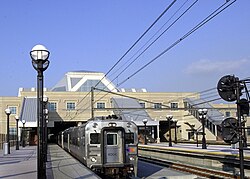
Secaucus Junction (signed as Secaucus) is an intermodal transit hub served by New Jersey Transit (NJ Transit) and Metro-North Railroad in Secaucus, New Jersey. It is one of the busiest railway stations in North America.
Key Information


The $450 million, 321,000-square-foot (29,800 m2) station opened on December 15, 2003. It was known as Secaucus Transfer during planning stages and was dedicated as the Frank R. Lautenberg Rail Station at Secaucus Junction. U.S. Senator Frank Lautenberg, who died in 2013, was a transit advocate who had worked to allocate federal funds for the project.[6]
The station is on the Northeast Corridor (NEC) five miles west of New York Penn Station and five miles east of Newark Penn Station. At Secaucus, the NEC crosses above the Main Line, which originates/terminates at Hoboken Terminal; the station allows passengers to transfer between the two lines. The station is served by all NJ Transit rail lines except for the Atlantic City Line and the Princeton Branch. Amtrak trains run through Secaucus but do not stop.
A bus terminal was built at the station in 2016.[citation needed]
Purpose and history
[edit]
NJ Transit's rail operations are split between two divisions, a legacy of their roots in separate railroads. The Hoboken Division consists of lines formerly part of the Erie Lackawanna Railway and its predecessors, while the Newark Division lines had once been part of the Pennsylvania Railroad and Central Railroad of New Jersey. Conrail ran both networks under contract to the New Jersey Department of Transportation from 1976 until handing them to NJ Transit in 1983. While the opening of the Kearny Connection and Waterfront Connection in 1996 allowed for the implementation of some interdivisional trains, including the "Midtown Direct" service to New York Penn Station on the Hoboken Division's Morris & Essex Lines, direct passenger transfers between the divisions were still not possible. Secaucus Junction was built to integrate the two systems and allow for transfers between trains on each division.[citation needed]
The two-track Northeast Corridor embankment was expanded to three tracks for a mile on each side of the station and to four tracks through the station itself, allowing Amtrak and nonstop NJT trains to pass stopped trains. The two-track Bergen County Line was re-aligned southwestward to join the two-track Main Line to pass through the station on the four-track lower level. The construction required the bodies from the Hudson County Burial Grounds to be disinterred and moved to another cemetery.[7]
The station was built with little public parking, as NJT believed few passenger trips would originate there. In 2005, exit 15X on the adjacent New Jersey Turnpike opened to provide easier access to the station; two years later, it was the least-used interchange on the turnpike, possibly due in part to the lack of parking at the station.[8] Despite NJT's prediction that the station would be used primarily for transfers, in 2008 an upscale "transit-oriented" housing development called Xchange at Secaucus Junction opened nearby with 799 units marketed toward Manhattan commuters, and is expected to expand to 1,538 total units by 2024.[9][10] On June 1, 2009, Edison Parkfast, a private company, opened the first parking lot near the station,[11] with space for 1,094 cars. Bicycle parking is also available.[12]
On July 26, 2009, NJ Transit began rail service to the Meadowlands station at the Meadowlands Sports Complex, with Secaucus Junction being a transfer point for passengers.[13] From 2009 to 2014, Secaucus Junction served trains coming from Metro-North's New Haven Line for New York Giants and New York Jets football games at the Meadowlands with 1:00 p.m. kickoffs on Sundays.[14][15] In anticipation of increased ridership for Super Bowl XLVIII in February 2014, NJT extended the lower-level platforms at Secaucus Junction by 120 ft (37 m) to accommodate multi-level 10-car train sets which could handle about 1,400 to 1,800 passengers per trip.[16] The capacity to handle crowds, a plan dubbed the Mass Transit Super Bowl, was seen as unsuccessful.
On June 5, 2013, two days after his death, a special Amtrak train stopped at the station to carry the coffin of U.S. Senator Frank Lautenberg to Washington, D.C. for his burial.[17] On February 2, 2014, a limited number of Amtrak trains made stops at Secaucus for passengers going to Super Bowl XLVIII.[18] Local officials have indicated a desire to have regular Amtrak service stop at Secaucus Junction after American Dream Meadowlands opened in October 2019,[19] however, as of 2024, this has not been implemented.

In March 2016, a new bus station with 14 bus berths opened; it is used for intermodal connections and was intended to add redundancy to the transportation network.[20] In 2021 NJ Transit authorized studies for alternative options between the Meadowlands Sports Complex and Secaucus Junction including a bus "transitway".[21][22][23] Further funding for design was approved in 2023 for an exclusive bus transitway planned to go into service for the 2026 FIFA World Cup.[24]
Station layout
[edit]
Despite its name, Secaucus Junction is not a true junction, in which trains can switch between lines; there is no rail connection between the upper and lower levels. The station has two platform levels connected by a third level on top.[25] Such a loop, however, is proposed as part of the Gateway Project to improve commuter access to Manhattan.
- The lower platform level lacks electrification and has four tracks and two island platforms serving the Bergen County Line, Main Line, Pascack Valley Line, Port Jervis Line, and Meadowlands Line trains, which originate and terminate at Hoboken Terminal.[25]
- The upper platform level tracks are electrified and carry trains to and from New York Penn Station (usually the Northeast Corridor, North Jersey Coast, Montclair-Boonton, and Morristown Lines) with four tracks and three platforms: two side platforms serving Tracks 2 and 3 (where nonstop trains usually bypass) and one island platform between Tracks A and B.[25] Amtrak trains pass through the upper-level tracks without stopping.
- The upper concourse level has a New Jersey Transit customer service office, a convenience store and food court. To transfer between trains on different levels, passengers ascend to the upper concourse, pass through faregates, and descend to their destination platforms. At the center of this level is a 30-foot-high (9.1 m) steel, glass, and titanium sculpture of a cattail (abundant in the surrounding New Jersey Meadowlands) by San Francisco artist Cork Marcheschi. The tops of the cattails are lit from within in the purple, blue, and orange colors of NJ Transit.[25]
Proposed New York City Subway extension
[edit] | This section needs to be updated. (October 2025) |
On November 16, 2010, The New York Times reported that New York City Mayor Michael Bloomberg's administration was working on a plan to bring the 7 and <7> trains of the New York City Subway under the Hudson River to Secaucus Junction.[26][27] An extension of that service from Times Square – 42nd Street to a new terminus at Eleventh Avenue and 34th Street, has already been built.[28][29]
The extension would take the subway outside the city's and New York's borders and under the Hudson River for the first time. The plan would alleviate pressure on the NJ Transit/Amtrak route under the Hudson, after the cancellation of the Access to the Region's Core tunnel project by New Jersey Governor Chris Christie in October 2010. It would offer a direct route to Grand Central Terminal on the east side of Manhattan, while connecting with most other subway routes. New York City spent $250,000 for a consultant to conduct feasibility studies for the project. However, no design work commenced nor were financing arrangements made.[30] On October 26, 2011, Bloomberg reiterated his support for the project, while Christie also expressed general concurrence.[31][32] In April 2013, the Metropolitan Transportation Authority rejected the proposed extension, citing lack of funding.[33] However, it was reconsidered again in 2018.[34][35]
Gateway Project
[edit]The Gateway Project, a series of infrastructure improvements along the NEC between Newark Penn Station and New York Penn Station, includes a proposal to build the so-called Secaucus Loop or Bergen Loop, tracks connecting the Main Line and the NEC at Secaucus, thus creating a true junction station. As part of the second phase of the Gateway Project, the loop is projected to be constructed between 2024 and 2030.[36]

See also
[edit]- Jamaica station – station on the nearby Long Island Rail Road that serves a similar purpose to Secaucus Junction
References
[edit]- ^ NJ Transit (2005). NJ Transit Rail Operations: Physical Characteristics. pp. 117–119, 142b, 173–182.
- ^ "EZ Ride Routes". Archived from the original on April 20, 2017. Retrieved March 5, 2017.
- ^ "Megabus begins a route between Lautenburg Station in Secaucus and Boston". The Jersey Journal. March 30, 2011. Retrieved July 22, 2023.
- ^ "Secaucus Junction Station". New Jersey Transit. Retrieved July 11, 2023.
- ^ Average Weekday Rail Station Passenger Boardings History, FY 2019–2025 (Report). Newark, New Jersey: NJ Transit. 2025. Retrieved June 1, 2025 – via Internet Archive.
- ^ Frassinelli, Mike (June 5, 2013). "U.S. Sen. Frank Lautenberg gets one last ride at the Secaucus station that bears his name". The Star-Ledger. Retrieved June 5, 2013.
- ^ "Potter's Field to be Moved for Turnpike-Railroad Interchange". The New York Times. August 29, 2001. Retrieved July 8, 2022.
- ^ "Ramp to nowhere – 15X is the loneliest exit in Jersey". The Record. October 18, 2007. p. L08.
- ^ Brody, Beth (October 7, 2014). "Xchange at Secaucus Junction Takes Luxury Living to NEXT Level in New Jersey, Setting New Lifestyle Standard". Hoboken Patch.
- ^ Young, Michael; Pruznick, Matt (October 3, 2023). "Waterside At Xchange's Curtain Wall Nears Completion in Secaucus, New Jersey". New York YIMBY.
- ^ "First parking lot opens at Secaucus Junction". The Jersey Journal. June 2, 2009. Archived from the original on June 5, 2011. Retrieved August 15, 2009.
- ^ "New Jersey Transit". njtransit.com. Archived from the original on October 9, 2014. Retrieved February 16, 2010.
- ^ Clunn, Nick (July 26, 2009). "Thousands hop on board new Meadowlands rail service". The Record. Archived from the original on July 29, 2009. Retrieved August 15, 2009.
- ^ Saeed, Khurram (June 29, 2009). "Metro-North to run trains to 10 Jets, Giants games in the 2009 season". Journal News. p. A.1.
- ^ "Take The Train To The Game" (PDF). Metropolitan Transportation Authority. Retrieved December 24, 2012.
- ^ Frassinelli, Mike (March 10, 2013). "To make it Super, Meadowlands train needs longer platform, says NJ Transit". The Star-Ledger. Retrieved March 10, 2013.
- ^ Frassinelli, Mike (June 6, 2013). "U.S. Sen. Frank Lautenberg gets one last ride at the Secaucus station that bears his name". The Star-Ledger. Retrieved July 22, 2023.
- ^ Rouse, Karen (December 9, 2013). "NY-NJ transit agencies outline Super Bowl plans". NorthJersey.com. Retrieved December 27, 2013.
- ^ Higgs, Larry (December 8, 2018). "Next stop for Amtrak: Secaucus? That could be an American Dream for the Meadowlands". NJ Advance Media. Retrieved December 10, 2018.
- ^ Higgs, Larry (March 29, 2016). "How new Secaucus bus plaza could change your commute". NJ.com. Retrieved March 29, 2016.
- ^ Higss, Larry (August 26, 2021). "Amid questions, NJ Transit takes first steps to new Transitway to American Dream, MetLife stadium". NJ Advance Media for nj.com. Retrieved June 3, 2023.
- ^ Wilson, Colleen; Katzban, Nicolas (August 25, 2021). "New Jersey Transit Board approves $3.5 million contract for new bus line to Meadowlands". North Jersey Media Group. Retrieved June 3, 2023.
- ^ "PROJECT SHEET SECAUCUS TO MEADOWLANDS (BOONTON) TRANSITWAY" (PDF). NJ Transit.
- ^ Higgs, Larry (July 20, 2023). "NJ Transit racing to build Transitway in time for World Cup 2026". NJ.com. NJ Advance Media. Retrieved July 22, 2023.
- ^ a b c d "New Jersey Transit". njtransit.com. Archived from the original on December 13, 2013. Retrieved February 24, 2014.
- ^ "NJ Commuters Like 7 Train Extension Plan". WCBS. November 17, 2010. Retrieved November 17, 2010.
- ^ "Tunnel to Nowhere Might Become 7 to Secaucus". WNBC. November 17, 2010. Retrieved November 17, 2010.
- ^ Fitzsimmons, Emma G. (September 10, 2015). "Subway Station for 7 Line Opens on Far West Side". The New York Times. Retrieved September 13, 2015.
- ^ Tangel, Andrew (September 13, 2015). "New Subway Station Opens on NYC's Far West Side". WSJ. Retrieved September 13, 2015.
- ^ Bagli, Charles V.; Confessore, Nicholas (November 16, 2010). "New York Studies Extending Subway Line to New Jersey". The New York Times. Retrieved November 16, 2010.
- ^ Lipof, Phil (October 26, 2011). "Mayor Bloomberg wants to extend 7 line to New Jersey". ABC7 New York. Archived from the original on July 7, 2012. Retrieved October 27, 2011.
- ^ Young, Elise (October 27, 2011). "Christie Praises New York City Subway Extension to New Jersey". Bloomberg Businessweek. Archived from the original on July 29, 2012.
- ^ Donohue, Pete (April 10, 2013). "Mayor Bloomberg push to extend 7 train to Jersey is promptly derailed by the MTA". Daily News. New York.
- ^ Walker, Ameena (February 28, 2018). "Port Authority study will consider 7 train extension to New Jersey". Curbed NY. Retrieved April 16, 2018.
- ^ Barone, Vincent (February 27, 2018). "Cross-Hudson study options include 7 line extension into NJ". am New York. Retrieved April 16, 2018.
- ^ Chernetz, Janna (February 1, 2016). "Gateway Project Timeline Released, But Cross-Hudson Capacity Relief Still a Long Way Off". Tri-State Transportation Campaign. Retrieved March 30, 2016.
External links
[edit]
| Google Maps Street View | |
|---|---|
 Upper Concourse Level Upper Concourse Level | |
| South Lower Level Concourse | |
| Platform A/B, 2, & 3 (Upper Level) | |
| Platforms E/F & G/H (Lower Level) | |
| Bus Terminal/Plaza | |
| Station from New Jersey Turnpike |
- NJT rail station information page for Secaucus Junction
- DepartureVision real time train information for Secaucus Junction upper level
- DepartureVision real time train information for Secaucus Junction lower level
- Station Directory Archived June 22, 2017, at the Wayback Machine
| Hoboken Division |  | |
|---|---|---|
| Newark Division | ||
| Connections | ||
| Current rolling stock | ||
| Bridges and tunnels |
| |
| Stations and yards | ||
| Proposed lines | ||
| Other topics | ||
Secaucus Junction
View on GrokipediaHistory
Planning and Proposal
The planning for what would become Secaucus Junction, initially termed Secaucus Transfer during its development phase, emerged in the late 1980s amid New Jersey's push to unify its fragmented commuter rail network. NJ Transit's lines were operationally divided, with northern routes (Main, Bergen, and Pascack Valley) terminating at Hoboken Terminal and southern routes converging at Newark Penn Station, necessitating inefficient transfers either at Hoboken or in New York City for cross-system travel.[5] In 1989, then-Governor Thomas H. Kean outlined a "circle of mobility" concept to bolster transit infrastructure in the Hackensack Meadowlands, emphasizing interconnections between rail lines, light rail proposals, and regional development to handle growing commuter volumes.[6] By January 1992, the Allied Junction Corporation, under president William E. McCann, formalized a detailed proposal for a $1 billion mixed-use complex on a 60-acre site near the historic intersection of north-south (former Delaware, Lackawanna & Western and Erie Railroad) and east-west (Pennsylvania Railroad) tracks. The plan centered on a 200,000-square-foot rail transfer station topped by five office towers totaling 3 million square feet, a 600-room hotel, and retail areas, projecting service for nearly 70,000 daily commuters and creation of 15,000 jobs while integrating with Amtrak's Northeast Corridor.[6] Key proponents included U.S. Representative Robert A. Roe and Hudson County Executive Robert C. Janiszewski, who advocated for federal backing; the proposal aligned with the Intermodal Surface Transportation Efficiency Act (ISTEA) of 1991, which authorized up to $5.6 billion nationwide for surface transportation over six years, including $400 million earmarked for Amtrak track expansions to support interline transfers.[6] NJ Transit assumed leadership of the rail-specific elements as a public-private partnership, prioritizing the station's role in enabling direct cross-platform transfers to cut Manhattan-bound travel times by over 15 minutes for thousands of riders and boost system ridership by an estimated 20,700 daily passengers.[7] Approvals hinged on Hackensack Meadowlands Development Commission reviews and a new interchange on the New Jersey Turnpike, delaying groundbreaking until the mid-1990s, with construction advancing through federal appropriations secured by U.S. Senator Frank R. Lautenberg, who later saw the facility dedicated in his name.[6][8] The initiative addressed longstanding capacity constraints at Hoboken Terminal and anticipated economic growth in Hudson County, though the full office development was scaled back in favor of transit-focused infrastructure.Construction and Opening
Construction of the Secaucus Transfer Station, later renamed the Frank R. Lautenberg Rail Station at Secaucus Junction, involved significant engineering to create a multi-level transfer hub straddling the Northeast Corridor and NJ Transit Main Line tracks in Secaucus, New Jersey. Engineering and design work commenced in 1989, with major construction contracts awarded by the mid-1990s, including an $80 million agreement in April 1996 for ongoing site development and infrastructure.[9][10] The project, costing approximately $450 million, encompassed building elevated platforms, a 312,000-square-foot facility, and new track connections such as the Main/Bergen connector to reroute Bergen County and Pascack Valley Line trains directly to the station without detouring through New York Penn Station.[3][11] Key phases included utility relocations, bridge constructions over Routes 1&9, and phased track work to minimize disruptions to existing service. The Main/Bergen connector opened on August 4, 2003, enabling initial transfers for select lines.[12] Full station dedication occurred on September 6, 2003, honoring U.S. Senator Frank R. Lautenberg for his advocacy in securing federal funding.[8] Initial operations began shortly thereafter on September 5, with limited service integration. The station officially opened to the public on December 15, 2003, linking 10 of NJ Transit's 11 rail lines and facilitating cross-honoring with PATH service to improve commuter access to Manhattan.[2] Governor James McGreevey presided over the opening, highlighting the facility's role in enhancing regional connectivity amid growing ridership demands.[11] The project was completed on schedule despite challenges like swampy terrain in the Meadowlands and coordination with Amtrak operations on shared corridors.[13]Early Operations and Initial Impact
The Frank R. Lautenberg Secaucus Junction station commenced operations on December 15, 2003, marking the first integration of NJ Transit's previously separate Hoboken Division and New York Division rail networks.[3] This allowed passengers from the Main Line, Bergen County Line, and Pascack Valley Line to transfer directly to trains bound for New York Penn Station or the Meadowlands, bypassing the need for time-consuming changes at Hoboken Terminal.[5] Initial service was phased in to align with the restoration of PATH service to Lower Manhattan, with weekday peak-hour transfers prioritized to maximize capacity on inbound trains.[11] Early operations focused on cross-platform transfers via an elevated walkway connecting the two rail divisions, reducing average connection times from 10-15 minutes at Hoboken to under 5 minutes at Secaucus.[14] The station handled approximately 10 of NJ Transit's 11 commuter rail lines, excluding the Atlantic City Line, and featured automated fare collection and real-time signage to facilitate efficient passenger flow.[3] NJ Transit reported that the hub immediately alleviated overcrowding on select lines by redistributing riders, though full utilization depended on schedule adjustments and rider familiarity with the new routing.[5] The station's opening contributed to a broader rebound in NJ Transit rail ridership, with passenger trips rising 5.2 percent to nearly 64 million in fiscal year 2004 compared to 2003, partly attributed to enhanced connectivity for northern New Jersey commuters.[15] It enabled more direct access to Manhattan for riders from underserved suburbs, potentially shortening end-to-end commutes by up to 20 minutes for some routes.[16] However, initial adoption faced hurdles, including commuter confusion over revised timetables that required precise timing for transfers, leading to missed connections in the station's first months.[17] Reports from September 2004 highlighted underutilization, with the $609 million facility often seeing sparse crowds during off-peak hours as riders adjusted to the system and service patterns stabilized.[18]Design and Infrastructure
Architectural Features and Layout
The Frank R. Lautenberg Rail Station at Secaucus Junction is a four-level, 300,000-square-foot structure designed by Brennan Beer Gorman Architects, elevated above the Main Line and Northeast Corridor tracks on a 28-acre site in the Hackensack Meadowlands.[8][11] The station employs durable materials such as stone and steel, with precast concrete panels textured to resemble stone on the exterior, and incorporates decorative light fixtures, 12-inch sill projections on windows, and multiple expansion and seismic joints to accommodate structural demands.[8][19] Its cruciform floor plan spans approximately 900 feet in length, facilitating efficient passenger flow across connected rail lines.[19] At the concourse level, a central 75-foot-high rotunda serves as the primary public space, capped by a 50-foot-wide skylight and flanked by clerestory windows to maximize natural light.[8] This level houses ticketing facilities, management offices, mechanical spaces, and provisions for future retail areas, with air-conditioned waiting rooms adjacent to the five island platforms below.[8] The platforms, equipped with canopies and designed for high-volume transfers, support connections among ten New Jersey Transit rail lines, enabling cross-platform interchanges without street-level exposure.[8][11] The overall layout prioritizes functionality for intermodal transfers, with the station's elevated design allowing for potential vertical expansion, including up to 3.5 million square feet of overlying commercial development and high-rise towers.[8] Accessibility features integrate escalators, elevators, and wide corridors from the concourse to platforms, while the structure's positioning above active rail corridors minimizes disruption to ongoing operations during construction.[8] This configuration reflects an intent to create a monumental transit hub amid an otherwise isolated industrial landscape.[19]Facilities and Accessibility
Secaucus Junction station includes a central atrium serving as a primary waiting area, with ticketing facilities located on the south mezzanine level. Ticket vending machines number 15 in total, distributed across the unpaid zone in the rotunda, the paid zone inside fare gates, and four portable units. No ticket agents are stationed at the facility.[1] Amenities at the station encompass restrooms, which are reported as clean and wheelchair-accessible, along with limited concessions such as a newsstand offering snacks and beverages and a Dunkin' Donuts outlet. Vending machines provide additional options for passengers. The station's intermodal design incorporates a bus plaza for NJ Transit bus connections, facilitating transfers between rail and bus services.[20][21] The station complies with ADA standards, featuring elevators and escalators providing access to upper and lower platform levels, including ADA-accessible elevators at platform ends. Detectable warning edges are present on platforms, and bridge plates assist boarding at high-level platforms. General NJ Transit rail features like priority seating and on-board announcements further support accessibility.[22][23] Parking is available in a lot with 1,080 standard spaces and 14 accessible spaces, managed by Edison Properties at 675 New County Road, offering daily parking and monthly permits at $430. Bicycle racks and lockers are provided for cyclists. No on-street parking is permitted near the station.[1]Surrounding Developments
The area immediately surrounding Secaucus Junction has undergone targeted redevelopment as part of the Secaucus Transit Village, a designated zone established to promote transit-oriented development leveraging the station's connectivity. Initiated through collaboration between the New Jersey Meadowlands Commission, NJ Transit, and the Town of Secaucus, the plan emphasizes mixed-use projects including residential, retail, office, and hotel components on former industrial and warehousing lands adjacent to the station.[24][25] The inaugural project within the transit village, the Xchange at Secaucus Junction, opened in 2008 as a mixed-use residential community featuring apartment buildings with integrated amenities and direct pedestrian access to the station.[26] This development marked the shift toward higher-density housing proximate to transit infrastructure, with subsequent phases expanding the complex. In December 2019, developers proposed a 25-story tower addition to the Xchange site, comprising 403 market-rate residential units atop retail space, pending zoning variances to exceed height limits in the Meadowlands district.[27] Broader infrastructure enhancements include NJ Transit's Secaucus to Meadowlands Transitway project, advanced in planning stages as of July 2023, which aims to provide bus rapid transit and improved pedestrian links between the station and the American Dream entertainment complex and MetLife Stadium, reducing reliance on highways and fostering regional accessibility.[28] The Secaucus Transit Village Redevelopment Plan was amended in 2023 to refine circulation, access points, and open space integration, supporting ongoing private-sector proposals for commercial and residential growth while preserving environmental standards in the Meadowlands.[29]Operations and Ridership
Served Rail Lines and Services
Secaucus Junction functions as a key transfer point for New Jersey Transit (NJT) commuter rail passengers, enabling seamless connections between lines bound for New York Penn Station and those terminating at Hoboken Terminal, thereby reducing travel times and avoiding congestion at Newark Penn Station.[1] The station accommodates bidirectional service on six NJT rail lines, which utilize the Waterfront Connection—a dedicated track linkage completed in 1991—to access New York Penn Station directly from northern and western New Jersey routes.[1] The served lines include:- Main-Bergen County Line: Provides service from Suffern, New York, and intermediate stops through Bergen County to Hoboken or New York Penn Station, with transfers at Secaucus for cross-line connectivity.[1]
- Montclair-Boonton Line: Operates from Montclair Heights or Hackettstown to Hoboken or New York Penn Station, offering peak-hour express options that converge at Secaucus.[1]
- Morris & Essex Line: Runs from Gladstone or Hackettstown through Morristown to New York Penn Station, with Secaucus serving as the junction for transfers to other northern lines.[1]
- Northeast Corridor Line: Connects Trenton and intermediate Princeton-area stops to New York Penn Station, handling high-frequency service with Secaucus as a transfer hub for non-Corridor lines.[1]
- North Jersey Coast Line: Travels from Bay Head or Long Branch along the Jersey Shore to New York Penn Station, using Secaucus for efficient interline movements.[1]
- Pascack Valley Line: Extends from Spring Valley, New York, to Hoboken or New York Penn Station under joint NJT-Metro-North operation, with Secaucus facilitating transfers to southern and eastern routes.[1][30]