


Community hub
Recent from talks
Contribute something
Nothing was collected or created yet.
Penn Yan, New York
View on Wikipedia
Penn Yan is an incorporated village and the county seat of Yates County, New York, United States. The population was 5,159 at the 2010 census.[2] It lies at the north end of the east branch of Keuka Lake, one of the Finger Lakes.
Key Information


As tourism has grown in the Finger Lakes, Penn Yan has become a summertime hub for visitors to local vineyards, breweries, and Mennonite craft markets. Since the 1970s, farmland in Yates County has been increasingly purchased by Mennonite families from Lancaster County, Pennsylvania. Today, Penn Yan is the center of the largest Old Order Mennonite community in New York State, and horse-drawn buggies are a common sight in the village.[3]
The village is home to The Birkett Mills, founded in 1797, one of the oldest mills in the United States and among the largest buckwheat manufacturers, earning Penn Yan the title of the "Buckwheat Capital of America." During the 1987 Annual Buckwheat Harvest Festival, a 28-foot griddle was used to cook what was then the world's largest pancake.[4][5]
The Village of Penn Yan is primarily in the Town of Milo, but a small section is in the Town of Benton. A smaller section is in the Town of Jerusalem. The Penn Yan Airport is south of the village. The name "Penn Yan" is a syllabic abbreviation of "Pennsylvania Yankee".[6] It houses the Penn Yan Central School District.
History
[edit]
The Penn Yan area was home to several Seneca villages until their destruction in the 1779 Sullivan Expedition, after which most of the Seneca population fled westward. The Seneca leader Red Jacket grew up on Keuka Lake. The first white settlers in Western New York were the followers of the Public Universal Friend, a religious enthusiast born in Cumberland, Providence County, Rhode Island, who obtained a large tract for a settlement (called Jerusalem in 1789) in the present Yates County, and founded the village of Hopeton on the outlet of Keuka Lake, approximately one mile from Seneca Lake. Many followers settled there, and lived there after 1790, but the community gradually broke up.[7]
The first frame dwelling at Penn Yan was built in 1799. The village became the county seat in 1823, when Yates County was created. It was incorporated in 1833.[7]
Penn Yan, the name of the village, is said to have been contrived from the first syllables of "Pennsylvania" and "Yankee", as most of the early settlers were from Pennsylvania and New England; the latter were known as Yankees.[7][8] It became a trading center for the agricultural county, with mills for lumber, buckwheat and other grains. The village was the western terminus of the former Crooked Lake Canal.
 |
 |
In 1921, the Penn Yan Boat Company was founded by German immigrant Charles A. Herrman. It produced wooden and glass-fiber boats until 2001.
During the late 1800s and through the mid-to-late 1900s, Penn Yan and surrounding Yates County areas were home to a large number of dairy farms, many settled by Danish immigrants and their descendants. Even today, names such as Christensen and Jensen are common. Since the late 20th century, Old Order Mennonite and Amish families have settled and taken over farms in the region. Beginning in 1974, many families of the Groffdale Conference Mennonite Church moved to Yates County from Lancaster County, Pennsylvania, seeking cheaper farmland. The Yates County Old Order Mennonites settlement is the largest horse-and-buggy community in the state of New York.[9] There are also several Old Order Amish settlements in adjacent Steuben and Seneca counties, which were founded starting in 1979.[10]
On May 13, 2014, heavy downpours caused severe flash flooding in the area, which ripped out roads as well as destroying at least one commercial building downtown[11] as about five inches of rain fell over a few hours, considered to be at least a 100-year flood.[12]
Historic properties
[edit]The Roderick M. Morrison House, Lake View Cemetery, Crooked Lake Outlet Historic District, Yates County Courthouse Park District, Sampson Theatre, United States Post Office, Charles Wagener House, and Penn Yan Historic District are listed on the National Register of Historic Places.[13]
Demographics
[edit]| Census | Pop. | Note | %± |
|---|---|---|---|
| 1860 | 2,388 | — | |
| 1870 | 3,488 | 46.1% | |
| 1880 | 3,475 | −0.4% | |
| 1890 | 4,254 | 22.4% | |
| 1900 | 4,650 | 9.3% | |
| 1910 | 4,597 | −1.1% | |
| 1920 | 4,517 | −1.7% | |
| 1930 | 5,329 | 18.0% | |
| 1940 | 5,308 | −0.4% | |
| 1950 | 5,481 | 3.3% | |
| 1960 | 5,770 | 5.3% | |
| 1970 | 5,293 | −8.3% | |
| 1980 | 5,242 | −1.0% | |
| 1990 | 5,248 | 0.1% | |
| 2000 | 5,219 | −0.6% | |
| 2010 | 5,159 | −1.1% | |
| 2020 | 5,056 | −2.0% | |
| U.S. Decennial Census[14] | |||
As of the census[15] of 2000, there were 5,219 people, 2,141 households, and 1,261 families residing in the village. The population density was 2,299.7 inhabitants per square mile (887.9/km2). There were 2,299 housing units at an average density of 1,013.1 units per square mile (391.2 units/km2). The racial makeup of the village was 97.15% White, 0.67% African American, 0.27% Native American, 0.31% Asian, 0.06% Pacific Islander, 0.33% from other races, and 1.23% from two or more races. Hispanic or Latino of any race were 0.94% of the population.
There were 2,141 households, out of which 29.2% had children under the age of 18 living with them, 41.2% were married couples living together, 12.8% had a female householder with no husband present, and 41.1% were non-families. 35.1% of all households were made up of individuals, and 18.5% had someone living alone who was 65 years of age or older. The average household size was 2.28 and the average family size was 2.90.
In the village, the population was spread out, with 23.9% under the age of 18, 7.6% from 18 to 24, 26.4% from 25 to 44, 20.4% from 45 to 64, and 21.7% who were 65 years of age or older. The median age was 40 years. For every 100 females, there were 87.2 males. For every 100 females age 18 and over, there were 81.2 males.
The median income for a household in the village was $29,278, and the median income for a family was $39,087. Males had a median income of $30,692 versus $19,263 for females. The per capita income for the village was $15,848. About 9.7% of families and 13.8% of the population were below the poverty line, including 17.8% of those under age 18 and 11.7% of those age 65 or over.
Climate
[edit]| Climate data for Penn Yan Airport, New York (1991–2020 normals, extremes 1998–present) | |||||||||||||
|---|---|---|---|---|---|---|---|---|---|---|---|---|---|
| Month | Jan | Feb | Mar | Apr | May | Jun | Jul | Aug | Sep | Oct | Nov | Dec | Year |
| Record high °F (°C) | 66 (19) |
74 (23) |
81 (27) |
92 (33) |
93 (34) |
97 (36) |
101 (38) |
97 (36) |
94 (34) |
90 (32) |
79 (26) |
69 (21) |
101 (38) |
| Mean daily maximum °F (°C) | 32.7 (0.4) |
34.8 (1.6) |
43.2 (6.2) |
56.2 (13.4) |
68.8 (20.4) |
76.6 (24.8) |
81.4 (27.4) |
79.7 (26.5) |
73.0 (22.8) |
60.6 (15.9) |
48.4 (9.1) |
37.9 (3.3) |
57.8 (14.3) |
| Daily mean °F (°C) | 25.1 (−3.8) |
26.6 (−3.0) |
34.3 (1.3) |
45.8 (7.7) |
57.9 (14.4) |
66.8 (19.3) |
71.6 (22.0) |
69.8 (21.0) |
62.8 (17.1) |
51.6 (10.9) |
40.5 (4.7) |
31.3 (−0.4) |
48.7 (9.3) |
| Mean daily minimum °F (°C) | 17.5 (−8.1) |
18.5 (−7.5) |
25.4 (−3.7) |
35.5 (1.9) |
47.0 (8.3) |
57.0 (13.9) |
61.8 (16.6) |
59.9 (15.5) |
52.6 (11.4) |
42.6 (5.9) |
32.7 (0.4) |
24.7 (−4.1) |
39.6 (4.2) |
| Record low °F (°C) | −18 (−28) |
−12 (−24) |
−3 (−19) |
2 (−17) |
27 (−3) |
38 (3) |
44 (7) |
43 (6) |
30 (−1) |
22 (−6) |
2 (−17) |
−4 (−20) |
−18 (−28) |
| Average precipitation inches (mm) | 1.49 (38) |
1.26 (32) |
2.06 (52) |
2.81 (71) |
2.88 (73) |
2.77 (70) |
3.39 (86) |
2.84 (72) |
3.89 (99) |
2.88 (73) |
2.14 (54) |
1.83 (46) |
30.24 (768) |
| Average precipitation days (≥ 0.01 in) | 10.0 | 9.9 | 11.3 | 12.6 | 13.4 | 13.2 | 11.5 | 13.1 | 12.0 | 14.0 | 10.2 | 9.8 | 141.0 |
| Source: NOAA[16][17] | |||||||||||||
Media
[edit]WYLF-AM 850 "Your Lifetime Favorites" broadcasts from studios in Penn Yan.
The Chronicle-Express is Penn Yan's weekly newspaper that provides information regarding a variety of current events and updates of local news.[18]
Notable people
[edit] | This section needs additional citations for verification. (January 2014) |
- William Babcock, former US Congressman
- David Bordwell, prominent American film theorist, film critic, and author, grew up on a farm near Penn Yan.
- Dana H. Born, Brigadier General, former Penn Yan Resident - past Dean of Faculty at the United States Air Force Academy
- Dan Beach Bradley, born July 18, 1804, studied here c. 1830 before serving as a highly regarded medical missionary to Siam, from 1835 until his death in Bangkok June 23, 1873.
- Stimson Joseph Brown, Commodore and astronomer, born in Penn Yan
- Sophia Cacciola, filmmaker, musician, and artist[19]
- Tony Collins, NFL running back who played for the New England Patriots, grew up in Penn Yan.
- Cris Crissy, NFL Cornerback played for the Washington Redskins, born, raised and grew up in Penn Yan.
- Sylvester J. Conklin, former Wisconsin State Assemblyman, was born in Penn Yan.
- Susan Miller Dorsey, former superintendent of Los Angeles schools, was born in Penn Yan.
- Duane Eddy, Guitarist/Composer, a member of The Rock and Roll Hall of Fame graduated from High School in Penn Yan
- Samuel S. Ellsworth, former US Congressman
- Jonathan J. Hazard, Rhode Island Antifederalist and Country Party founder; moved to Penn Yan with his wife and children in 1805 and died here in 1812.
- Thomas Augustine Hendrick, American Roman Catholic bishop, was born in Penn Yan.
- Dutch Hoag, racing driver
- John Imbrie, paleoceanographer and MacArthur Fellow, known for proving the theory of the Earth's ice ages, was born in Penn Yan.
- Maria Brace Kimball (1852–1933), educator, elocutionist, writer
- William M. Oliver, former US Congressman[20]
- John Roche (1893–1952), actor
- Henry Parker Sartwell, physician and botanist, settled in Penn Yan about 1830 and died there in 1867.
- Walter H. Stevens, Confederate Brigadier General
See also
[edit]References
[edit]- ^ "ArcGIS REST Services Directory". United States Census Bureau. Retrieved September 20, 2022.
- ^ "Find a County". National Association of Counties. Retrieved June 7, 2011.
- ^ Reid, Judson. "Old Order Mennonites in New York: Cultural and Agricultural Growth". The Journal of Amish and Plain Anabaptist Studies.
- ^ "History". The Birkett Mills.
- ^ Clemens, Chris. "Largest Pancake Griddle In The World". Exploring Upstate.
- ^ Temple, Robert D. Edge Effects: The Border-Name Places, (2nd edition, 2009), iUniverse, ISBN 978-0-595-47758-6, page 148.
- ^ a b c Chisholm 1911, p. 116.
- ^ Scriba, Jay (October 15, 1970). "From Sleepy Eye to Chicken Bristle, USA". The Milwaukee Journal. Archived from the original on September 25, 2015. Retrieved April 22, 2015.
- ^ Reid, Judson (November 16, 2019). "Old Order Mennonites in New York: Cultural and Agricultural Growth". Journal of Amish and Plain Anabaptist Studies. 3 (2): 212–221. doi:10.18061/1811/75350. hdl:1811/75350. ISSN 2471-6383.
- ^ Donnermeyer, Joe; Luthy, David (October 21, 2019). "Amish Settlements across America: 2013". Journal of Amish and Plain Anabaptist Studies. 1 (2): 107–129. doi:10.18061/1811/57700. hdl:1811/57700. ISSN 2471-6383.
- ^ Mike Hibbard (May 14, 2014). "HARD TO BELIEVE: Flood waters cause heavy damage in Penn Yan, parts of Yates". Finger Lakes Times. Retrieved February 19, 2018.
- ^ Gwen Chamberlain (May 8, 2015). "Bad floods, major lessons: Penn Yan, one year later". The Chronicle-Express. Retrieved April 9, 2018.
- ^ "National Register Information System". National Register of Historic Places. National Park Service. March 13, 2009.
- ^ "Census of Population and Housing". Census.gov. Retrieved June 4, 2015.
- ^ "U.S. Census website". United States Census Bureau. Retrieved January 31, 2008.
- ^ "NowData – NOAA Online Weather Data". National Oceanic and Atmospheric Administration. Retrieved February 6, 2024.
- ^ "Station: Penn Yan AP, NY". U.S. Climate Normals 2020: U.S. Monthly Climate Normals (1991–2020). National Oceanic and Atmospheric Administration. Retrieved February 6, 2024.
- ^ "Chronicle Express".
- ^ "The Observer, 4 July 2001". NYS Historic Newspapers.
- ^ "OLIVER, William Morrison, (1792 - 1863)". Biographical Directory of the United States Congress. Retrieved January 14, 2014.
Attribution
- This article incorporates text from a publication now in the public domain: Chisholm, Hugh, ed. (1911). "Penn Yan". Encyclopædia Britannica. Vol. 21 (11th ed.). Cambridge University Press. p. 116.

External links
[edit]
Municipalities and communities of Yates County, New York, United States | ||
|---|---|---|
| Towns |  | |
| Villages | ||
| CDP | ||
| Hamlets | ||
| Footnotes | ‡This populated place also has portions in an adjacent county or counties | |
| International | |
|---|---|
| National | |
| Geographic | |
| Other | |

Penn Yan, New York
View on GrokipediaGeography and Environment
Location and Topography
Penn Yan is an incorporated village serving as the county seat of Yates County in the Finger Lakes region of west-central New York State. It is situated at the northern end of the east branch of Keuka Lake, one of the eleven elongated glacial lakes that define the region's distinctive landscape. The village lies approximately 45 miles southeast of Rochester and 50 miles southwest of Syracuse, within a broader area midway between Pennsylvania and Lake Ontario. Its geographic coordinates are approximately 42°39′36″N 77°3′20″W.[6][7] The topography surrounding Penn Yan is characterized by relatively flat terrain in the northern townships of Yates County, contrasting with the steeper hills and valleys found in the county's western sections and the gently rolling hills in the eastern and central areas. Keuka Lake, with its Y-shaped form, bisects the mid- and southern portions of the county, influencing local drainage and providing a natural boundary that shapes the village's waterfront setting. Elevations in the immediate vicinity average around 222 meters (728 feet) above sea level, with subtle variations that support agriculture and residential development along the lakeshore.[6][8][9] The broader topographic features of the Penn Yan area stem from Pleistocene glaciation, where massive ice sheets carved U-shaped valleys that now hold the Finger Lakes, including Keuka. This glacial activity deposited drumlins, moraines, and till plains, creating a landscape of linear lakes oriented north-south and fertile soils overlying sedimentary bedrock from the Devonian period. These elements contribute to the region's scenic beauty and ecological diversity, with the flat northern lands facilitating early settlement and modern infrastructure.[10][11]Climate
Penn Yan experiences a humid continental climate classified as Dfb under the Köppen system, characterized by cold, snowy winters and warm, humid summers with precipitation distributed fairly evenly throughout the year.[12] The village's location in the Finger Lakes region influences its weather patterns, with moderating effects from nearby lakes contributing to relatively mild temperatures compared to inland areas farther north. Annual average temperatures hover around 47°F (8°C), with extremes ranging from lows near 18°F (-8°C) in winter to highs up to 81°F (27°C) in summer.[13] Precipitation totals approximately 32.34 inches (82 cm) annually, supplemented by about 68.3 inches (173 cm) of snowfall, primarily from November through March.[14] Winters are long and harsh, lasting from early December to mid-March, with average highs below 42°F (6°C) and frequent lake-effect snow from Lake Keuka and Seneca Lake. January is typically the coldest month, with average highs of 31°F (-1°C) and lows of 16°F (-9°C). Summers are short and comfortable, spanning late May to early September, when highs exceed 71°F (22°C); July marks the warmest period, averaging 82°F (28°C) highs and 61°F (16°C) lows. Spring and fall serve as transitional seasons with increasing variability, including occasional frost risks into late May.[13] The following table summarizes monthly climate normals (1991–2020) for temperature, precipitation, and snowfall in Penn Yan:| Month | Avg. High (°F) | Avg. Low (°F) | Precipitation (in.) | Snowfall (in.) |
|---|---|---|---|---|
| January | 31 | 16 | 2.01 | 19.2 |
| February | 34 | 17 | 1.81 | 15.6 |
| March | 43 | 25 | 2.34 | 10.1 |
| April | 57 | 36 | 2.89 | 2.3 |
| May | 70 | 47 | 3.12 | 0.0 |
| June | 78 | 56 | 3.45 | 0.0 |
| July | 82 | 61 | 3.56 | 0.0 |
| August | 80 | 59 | 3.23 | 0.0 |
| September | 73 | 52 | 3.12 | 0.0 |
| October | 60 | 42 | 3.01 | 0.2 |
| November | 47 | 32 | 2.67 | 5.1 |
| December | 36 | 22 | 2.13 | 15.8 |
| Annual | 58 | 37 | 32.34 | 68.3 |
History
Pre-Colonial and Early Settlement
The region encompassing present-day Penn Yan, located at the northern end of Keuka Lake in Yates County, was originally inhabited by the Seneca Nation, one of the six nations of the Iroquois Confederacy. The Seneca utilized the area's fertile lands for agriculture, including the cultivation of corn, beans, and squash, while also engaging in hunting and fishing along the lake and its tributaries. Notable Seneca villages in the vicinity included Kanandesaga (near Geneva, with approximately 60 houses) and Kashong (a trading post and settlement in what is now Benton Township), both of which featured longhouses, gardens, and orchards.[15] These communities were connected by trails, such as the one linking Ganundagwa (Canandaigua) and Kanandesaga along Seneca Lake, facilitating trade and travel by canoe on Lake Keuka, known to the Seneca as Ogoyago.[15] Archaeological evidence, including ancient earthworks at Bluff Point in Jerusalem Township and fortifications at Bare Hill, suggests possible pre-Iroquoian influences from groups like the Adena culture or earlier Algonquian and Huron peoples, though the Seneca dominated the territory by the time of European contact.[15] The Seneca presence was severely disrupted during the American Revolutionary War, particularly by General John Sullivan's expedition in 1779, which aimed to neutralize Iroquois support for the British. Sullivan's forces destroyed Kanandesaga, Kashong, and other nearby villages, burning crops and homes in a scorched-earth campaign that devastated the region's Native American infrastructure and led to significant displacement.[15] Following the war, the 1784 Treaty of Fort Stanwix and subsequent agreements ceded much of western New York, including the Phelps and Gorham Purchase of 1788, in which Oliver Phelps and Nathaniel Gorham acquired approximately 2.6 million acres from the Seneca for $100,000 in goods and cash, opening the area to white settlement.[16] This transaction marked the formal transition of land ownership, though sporadic Native American activity persisted into the early 19th century.[17] Early white settlement in the broader Yates County began in 1788 with the arrival of about 60 families, many from New England and the Susquehanna Valley, who established the first permanent outpost west of Seneca Lake. A significant group consisted of followers of Jemima Wilkinson, known as the Public Universal Friend, a religious leader who founded the utopian community of New Jerusalem in Jerusalem Township near the outlet of Keuka Lake; by 1790, this settlement had grown to about 60 families (around 260 residents), becoming the largest in western New York at that time.[16] In the specific area of Penn Yan, within Milo and Benton townships, initial legal white inhabitants arrived in the early 1790s, including James Scofield and Robert Chissom in 1792, who divided and settled Lot 37; the first white child born there, Catharine Chissom, arrived in 1793.[18] Lewis Birdsall constructed a sawmill on the lake outlet in 1794, boosting economic activity, while David Wagener built a gristmill in the late 1790s, operational until 1913.[18] Abraham Wagener, often called the "Father of Penn Yan," purchased 275 acres in 1796 and played a pivotal role in development, surveying highways, establishing a post office (initially named Jerusalem) in 1801, and erecting the first frame building in 1799.[15] By 1802, the site was selected for public buildings due to its strategic location at the lake's head, and the village—spanning Milo and Benton—emerged as a hub for milling, tanning (with Morris F. Sheppard's tannery in 1801), and trade.[15] The name "Penn Yan," a blend of "Pennsylvanians" and "Yankees" reflecting its settlers' origins, was first recorded around 1809 and formalized at a community meeting under a pine tree in the early 1810s.[18] In 1823, with the creation of Yates County from Ontario County, Penn Yan was designated the county seat, solidifying its early prominence.[15]19th and 20th Century Development
During the 19th century, Penn Yan transitioned from a frontier settlement to a burgeoning village economy anchored in agriculture and transportation infrastructure. Incorporated on April 29, 1833, the village benefited from the Crooked Lake Canal, constructed between 1830 and 1833, which linked Keuka Lake to the Erie Canal and spurred commerce in lumber, grain, and early agricultural products until its obsolescence around 1873.[19] [16] Railroads further accelerated growth, with the Canandaigua and Elmira Railway arriving in the early 1850s and the Fall Brook branch extending service by 1885, enabling efficient shipment of goods to broader markets.[19] Grape cultivation emerged as a cornerstone industry starting in 1836, with significant expansion by 1850 that supported local wineries and exporters, while general farming, including dairies and orchards, dominated the rural economy.[19] [16] Socially, the period marked Penn Yan as a center for reformist ideals amid its designation as Yates County seat in 1823. Early religious influences from Jemima Wilkinson's community evolved into established institutions like the first Presbyterian church, organized on February 18, 1823, while the village became a hub for freethought, abolitionism, temperance, and women's rights movements influenced by figures such as Abner Kneeland.[19] [20] [18] Education advanced with the founding of the Yates County Agricultural Society in 1840 and the Penn Yan Academy in 1859, fostering community intellectual life.[19] The Civil War mobilized local support, as the Keuka Rifles formed in 1861 as Company I of the 33rd New York Infantry, drawing from over 2,100 enlistees countywide.[19] Architectural progress reflected prosperity, with cobblestone buildings like the Roderick N. Morrison House (ca. 1825) exemplifying durable, regional styles used in homes and farms through the 1840s.[21] In the early 20th century, infrastructural modernization solidified Penn Yan's role as a regional hub. A municipal water plant was constructed in 1894 for $66,000, followed by a sewer system in 1903 costing $80,319.80 and an electric light plant in 1905 at $39,872.83, which powered 82 arc lights by 1910.[19] Street paving began in 1906 on Jacob Street for $12,500, extending to Main Street by 1915 at $46,225.32, while the Penn Yan Lake Shore Railway connected to Branchport in 1897 and the Federal Building opened in 1914 for $50,000.[19] Economically, the grape sector peaked, shipping 40 million pounds annually, complemented by emerging industries like the Walker Bin Company (relocated 1909, employing 100 with $60,000 yearly payroll), tobacco wholesaling, and cider production reaching 4,000 barrels in 1914.[19] Social reforms advanced with Yates County becoming New York's first "dry" county in 1909, and the Penn Yan Academy rebuilding in 1905 for $24,000 to accommodate growing enrollment.[19] By mid- to late century, agricultural continuity intertwined with demographic shifts, as Mennonite and Amish settlements expanded in the region from the 1970s onward, drawn by affordable farmland and revitalizing rural economies through traditional farming practices.[22] These communities contributed to sustained vineyard and dairy operations, while the historic downtown evolved as a focal point for commerce and preservation efforts.[23]Historic Sites and Landmarks
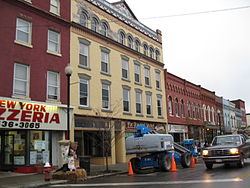
Penn Yan features a rich collection of historic sites and landmarks that reflect its development from a 19th-century milling village to a cultural hub in the Finger Lakes region. The Penn Yan Historic District, encompassing 65 acres in the village core, includes 281 structures dating primarily from the 1800s, with 210 contributing buildings showcasing Federal, Greek Revival, and Italianate architectural styles. These structures, concentrated along Main Street and adjacent areas, highlight the village's early commercial and residential growth tied to milling, agriculture, and lake transportation. The district was listed on the National Register of Historic Places in 1985, preserving examples of period architecture such as cast-iron storefronts and brick residences.[24] Central to the town's historical preservation efforts is the Yates County History Center, comprising three adjacent museums on Main and Chapel Streets. The anchor is the Oliver House Museum, an 18-room Italianate brick mansion built in 1852 by Dr. Andrew Oliver as a wedding gift for his son William, a physician. Restored to reflect mid-19th-century life, it houses period furnishings, agricultural exhibits, and artifacts illustrating local pioneer history. Adjacent, the L. Caroline Underwood Museum displays 20th-century domestic and industrial items, including over 6,000 indexed photographs and historic newspapers in its Spencer Research Center. The Scherer Carriage House Museum focuses on 19th-century transportation, featuring horse-drawn vehicles and tools. Together, these sites, operated since the 1940s, offer insights into Yates County's social and economic evolution.[25][26][27] A notable exhibit within the History Center is the Public Universal Friend collection, dedicated to Jemima Wilkinson (1752–1819), who adopted the genderless persona of the Public Universal Friend after a near-death illness in 1776. Between 1788 and 1790, the Friend led about 260 followers to establish the utopian Society of Universal Friends near Penn Yan, promoting gender equality, celibacy, and communal living on land purchased in the area. The exhibit includes the Friend's portrait, Bible, carriage, saddle, hat, and documents, underscoring early American religious experimentation and LGBTQ+ history in the region.[28][29] Beyond the museums, the Crooked Lake Outlet Historic District extends along the 8.5-mile Keuka Lake Outlet Trail, tracing the path of the 1833 Crooked Lake Canal that connected Keuka Lake to Seneca Lake for freight transport until 1877. This National Register-listed district (added in 1996) features remnants of 27 canal locks, stone abutments, and early industrial sites in Penn Yan, such as mills powered by the outlet's flow, which fueled the village's 19th-century prosperity. The trail, now a rail-trail on the former Fall Brook Railroad bed, provides access to these engineering landmarks.[30][31] Other key landmarks include the Sampson Theatre at 112 Main Street, a poured-concrete vaudeville house opened on October 12, 1910, designed by Dr. Frank Sampson and architect Frank Harrison. Seating over 900, it hosted live performances, silent films, and comedies until closing around 1929 amid the Great Depression; restoration efforts since the 2010s aim to revive it as a performing arts venue. As of 2025, restoration efforts have advanced significantly, with major demolition and site preparation completed in 2024, and the theater is set for a grand reopening as a performing arts venue.[32][33][34][35][36]Government and Economy
Local Government and Administration
The Village of Penn Yan operates under a mayor-council form of government, with an elected Board of Trustees serving as the primary legislative and policy-making body. The Board consists of the Mayor and six Trustees, all elected to two-year terms by village residents during annual elections typically held in March. The Mayor, who serves as the chief executive officer, presides over Board meetings, enforces village laws, and oversees administrative operations, including the appointment of key department heads subject to Board approval. Current Mayor Dan Condella was elected in March 2022 and continues to lead as of 2025.[37][38][39] The Board of Trustees holds regular meetings on the third Tuesday of each month at 6:00 PM in Village Hall at 111 Elm Street, where it addresses budgets, ordinances, public services, and community issues. Administration meetings occur the preceding Friday at 8:30 AM to prepare agendas and discuss operational matters. The Board also appoints a Deputy Mayor from among the Trustees to assist the Mayor and assume duties in their absence; Kevin McLoud was reappointed to this role in April 2025. Supporting the Board is the Village Clerk/Treasurer, an appointed position serving as the chief financial officer responsible for budgeting, record-keeping, billing, and financial reporting.[40][41] Key administrative departments include Public Works, which manages infrastructure maintenance, water utilities, and streets; Police, handling law enforcement; and Code Enforcement, enforcing building codes and issuing permits under the oversight of an appointed officer certified by New York State. The Village Court, presided over by an elected or appointed judge, adjudicates local violations and small claims. Planning and Zoning Boards, composed of appointed residents, advise on development and land use to ensure compliance with village codes.[37][42] As the county seat of Yates County, Penn Yan's local administration intersects with county government through shared services and facilities. The Yates County Legislature, established in 1972, comprises 14 members elected from four districts covering the county's nine towns, including Penn Yan, with four-year terms. The Legislature, chaired by Leslie Church as of 2025, meets in Penn Yan at 417 Liberty Street and oversees county-wide policies on public works, health, and emergency services, often collaborating with village officials on joint initiatives like infrastructure projects.[43][44][45]Economy and Industry
Penn Yan serves as a central business and recreational hub in the Finger Lakes region of New York, surrounded by productive farmland that supports its agricultural economy. The village's economy is diverse, with major sectors including manufacturing, healthcare and social assistance, construction, agriculture, and tourism.[46][4] Manufacturing stands out as a leader in job growth within the Finger Lakes, contributing to Yates County's overall economic expansion.[4][47] The manufacturing industry has driven significant employment gains, with Yates County facilitating over 1,600 new jobs and $300 million in company investments since 2000. Over the past decade through 2025, the Finger Lakes Economic Development Center has facilitated 78 new business attractions and 680 projected new jobs.[47][48] Notable examples include Birkett Mills, a global producer of buckwheat products based in Penn Yan, and Abtex Corporation in nearby Dresden, which has expanded to over 35 employees with international shipping capabilities. Healthcare and social assistance employ the largest number of workers, reflecting the village's role in regional services, while construction supports ongoing infrastructure and residential development.[47][46] Agriculture remains a cornerstone, with Yates County leading New York State in organic production and featuring strong sectors in dairy, fruits, and cash crops. The craft beverage industry, including winemaking and viticulture tied to the Finger Lakes' renowned wine trail, has emerged as a key growth area, bolstered by local farmland and tourism. Tourism spending in the county has risen 68% since 2000, drawing visitors to Keuka Lake and related recreational activities.[47][46] Economic indicators as of 2023 show a median household income of $51,466, an unemployment rate of 3.3%, and a poverty rate of 13.5%, underscoring relative stability amid regional challenges.[49] In 2017, Penn Yan received a $10 million Downtown Revitalization Initiative grant to enhance its craft food and beverage sector, promote local arts as an economic driver, and address housing shortages to support workforce growth. The Finger Lakes Economic Development Center continues to promote business expansions, including innovative ventures like Staving Artist, a Penn Yan retail shop utilizing recycled wine barrels.[4][47]Demographics and Society
Population Trends
The population of Penn Yan, a village in Yates County, New York, has experienced a gradual decline since the late 20th century, reflecting broader rural depopulation patterns in upstate New York. According to U.S. Census Bureau data, the village's population peaked at 5,248 in 1990 before beginning a consistent downward trajectory.[50] Decennial census figures illustrate this trend:| Year | Population | Change from Previous Census |
|---|---|---|
| 2000 | 5,219 | -0.6% (from 1990) |
| 2010 | 5,159 | -1.1% |
| 2020 | 5,056 | -2.0% |
Community Composition
Penn Yan's community is predominantly White, reflecting the broader demographics of rural upstate New York. According to the 2023 American Community Survey estimates analyzed by Data USA, 89.4% of residents identify as White Non-Hispanic, making it the largest racial group. Hispanic or Latino residents, who may be of any race, comprise 6.71% of the population, with the majority identifying as Other Hispanic (3.15%) or White Hispanic (2.02%). Multiracial individuals account for 2.58% Non-Hispanic and an additional 1.54% Hispanic, while Black or African American, Asian, Native American, and Pacific Islander groups each represent less than 1% of the total.[49] The village has a low level of immigration, with only 3.38% of residents foreign-born, primarily from Latin America and Europe, and 99.6% holding U.S. citizenship. This composition underscores a largely native-born community with limited ethnic diversity compared to urban areas in New York State. Ancestry data from the American Community Survey indicates strong European roots, with common self-reported heritages including German (23.6%), English (15.5%), and Irish (15.2%) in Yates County, though specific village-level figures align closely with county trends due to Penn Yan's role as the county seat.[49][55][56] Religiously, the community reflects a mix of Protestant, Catholic, and emerging Anabaptist influences, as detailed in the 2020 U.S. Religion Census for Yates County. Catholicism is the largest affiliation at 34.7% of adherents (2,896 individuals countywide), followed by mainline Protestant denominations such as the United Methodist Church (19.5%, 1,627 adherents) and non-denominational Christian churches (13.8%, 1,150 adherents). Baptist groups represent 7.7%, while the Church of Jesus Christ of Latter-day Saints holds 6.1%. Notably, Anabaptist communities, including Mennonite conferences (collectively around 7%) and Amish settlements, have grown in the surrounding area, contributing to the cultural fabric; the largest Old Order Mennonite settlement in New York State is nearby, emphasizing plain living and horse-and-buggy traditions. Overall, religious adherents make up about 50-60% of the county population, with the remainder unaffiliated.[57][46] Household structures emphasize families and older residents, with a median age of 44.6 years and 40% of households being family units with children under 18. Single-person households, often retirees, comprise about 35%, highlighting an aging community supported by intergenerational ties.[49]| Racial/Ethnic Group | Percentage (2023 ACS) |
|---|---|
| White (Non-Hispanic) | 89.4% |
| Hispanic or Latino (any race) | 6.71% |
| Two or More Races (Non-Hispanic) | 2.58% |
| Black or African American | <1% |
| Asian | <1% |
| Other groups | <1% |