


Community hub
Recent from talks
Contribute something
Nothing was collected or created yet.
Periodic function
View on Wikipedia

A periodic function is a function that repeats its values at regular intervals. For example, the trigonometric functions, which are used to describe waves and other repeating phenomena, are periodic. Many aspects of the natural world have periodic behavior, such as the phases of the Moon, the swinging of a pendulum, and the beating of a heart.
The length of the interval over which a periodic function repeats is called its period. Any function that is not periodic is called aperiodic.
Definition
[edit]

A function is defined as periodic if its values repeat at regular intervals. For example, the positions of the hands on a clock display periodic behavior as they cycle through the same positions every 12 hours. This repeating interval is known as the period.
More formally, a function is periodic if there exists a constant such that



for all values of in the domain. A nonzero constant for which this condition holds is called a period of the function.[1]

If a period exists, any integer multiple (for a positive integer ) is also a period. If there is a least positive period, it is called the fundamental period (also primitive period or basic period).[2] Often, "the" period of a function is used to refer to its fundamental period.


Geometrically, a periodic function's graph exhibits translational symmetry. Its graph is invariant under translation in the -direction by a distance of . This implies that the entire graph can be formed from copies of one particular portion, repeated at regular intervals.
Examples
[edit]Periodic behavior can be illustrated through both common, everyday examples and more formal mathematical functions.
Real-valued functions
[edit]Functions that map real numbers to real numbers can display periodicity, which is often visualized on a graph.
Sawtooth wave
[edit]An example is the function that represents the "fractional part" of its argument. Its period is 1. For instance,

The graph of the function is a sawtooth wave.
Trigonometric functions
[edit]
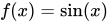
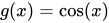
The trigonometric functions are common examples of periodic functions. The sine function and cosine function are periodic with a fundamental period of , as illustrated in the figure to the right. For the sine function, this is expressed as:

for all values of .
The field of Fourier series investigates the concept that an arbitrary periodic function can be expressed as a sum of trigonometric functions with matching periods.
Exotic functions
[edit]Some functions are periodic but possess properties that make them less intuitive. The Dirichlet function, for example, is periodic, with any nonzero rational number serving as a period. However, it does not possess a fundamental period.
Complex-valued functions
[edit]Functions with a domain in the complex numbers can exhibit more complex periodic properties.
Complex exponential
[edit]The complex exponential function is a periodic function with a purely imaginary period:

Given that the cosine and sine functions are both periodic with period , Euler's formula demonstrates that the complex exponential function has a period such that

- .

Double-periodic functions
[edit]A function on the complex plane can have two distinct, incommensurate periods without being a constant function. The elliptic functions are a primary example of such functions. ("Incommensurate" in this context refers to periods that are not real multiples of each other.)
Properties
[edit]Periodic functions can take on values many times. More specifically, if a function is periodic with period , then for all in the domain of and all positive integers ,[3]

A significant property related to integration is that if is an integrable periodic function with period , then its definite integral over any interval of length is the same.[3] That is, for any real number :


This property is crucial in areas such as Fourier series, where the coefficients are determined by integrals over one period.
If is a function with period , then , where is a non-zero real number such that is within the domain of , is periodic with period . For example, has period and, therefore, will have period .


A key property of many periodic functions is that they can be described by a Fourier series. This series represents a periodic function as a sum of simpler periodic functions, namely sines and cosines. For example, a sound wave from a musical instrument can be broken down into the fundamental note and various overtones. This decomposition is a powerful tool in fields like physics and signal processing. While most "well-behaved" periodic functions can be represented this way,[4] Fourier series can only be used for periodic functions or for functions defined on a finite length. If is a periodic function with period that can be described by a Fourier series, the coefficients of the series can be described by an integral over an interval of length .
Any function that is a combination of periodic functions with the same period is also periodic (though its fundamental period may be smaller). This includes:
- addition, subtraction, multiplication and division of periodic functions,[1] and
- taking a power or a root of a periodic function (provided it is defined for all )
Generalizations
[edit]The concept of periodicity can be generalized beyond functions on the real number line. For example, the idea of a repeating pattern can be applied to shapes in multiple dimensions, such as a periodic tessellation of the plane. A sequence can also be viewed as a function defined on the natural numbers, and the concept of a periodic sequence is defined accordingly.
Antiperiodic functions
[edit]One subset of periodic functions is that of antiperiodic functions. This is a function such that for all . For example, the sine and cosine functions are -antiperiodic and -periodic. While a -antiperiodic function is a -periodic function, the converse is not necessarily true.[5]



Bloch-periodic functions
[edit]A further generalization appears in the context of Bloch's theorems and Floquet theory, which govern the solution of various periodic differential equations. In this context, the solution (in one dimension) is typically a function of the form

where is a real or complex number (the Bloch wavevector or Floquet exponent). Functions of this form are sometimes called Bloch-periodic in this context. A periodic function is the special case , and an antiperiodic function is the special case . Whenever is rational, the function is also periodic.


Quotient spaces as domain
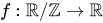
[edit]In signal processing you encounter the problem, that Fourier series represent periodic functions and that Fourier series satisfy convolution theorems (i.e. convolution of Fourier series corresponds to multiplication of represented periodic function and vice versa), but periodic functions cannot be convolved with the usual definition, since the involved integrals diverge. A possible way out is to define a periodic function on a bounded but periodic domain. To this end you can use the notion of a quotient space:
- .

That is, each element in is an equivalence class of real numbers that share the same fractional part. Thus a function like is a representation of a 1-periodic function.

Calculating period
[edit]Consider a real waveform consisting of superimposed frequencies, expressed in a set as ratios to a fundamental frequency, f: F = 1⁄f [f1 f2 f3 ... fN] where all non-zero elements ≥1 and at least one of the elements of the set is 1. To find the period, T, first find the least common denominator of all the elements in the set. Period can be found as T = LCD⁄f. Consider that for a simple sinusoid, T = 1⁄f. Therefore, the LCD can be seen as a periodicity multiplier.
- For set representing all notes of Western major scale: [1 9⁄8 5⁄4 4⁄3 3⁄2 5⁄3 15⁄8] the LCD is 24 therefore T = 24⁄f.
- For set representing all notes of a major triad: [1 5⁄4 3⁄2] the LCD is 4 therefore T = 4⁄f.
- For set representing all notes of a minor triad: [1 6⁄5 3⁄2] the LCD is 10 therefore T = 10⁄f.
If no least common denominator exists, for instance if one of the above elements were irrational, then the wave would not be periodic.[6]
See also
[edit]- Almost periodic function
- Amplitude
- Continuous wave
- Definite pitch
- Double Fourier sphere method
- Doubly periodic function
- Fourier transform for computing periodicity in evenly spaced data
- Frequency
- Frequency spectrum
- Hill differential equation
- Least-squares spectral analysis for computing periodicity in unevenly spaced data
- Periodic sequence
- Periodic summation
- Periodic travelling wave
- Quasiperiodic function
- Seasonality
- Secular variation
- Wavelength
- List of periodic functions
References
[edit]- ^ a b Tolstov, Georgij Pavlovič; Tolstov, Georgij Pavlovič (2009). Fourier series. Dover books on mathematics (Nachdr. ed.). New York: Dover Publ. p. 1. ISBN 978-0-486-63317-6.
- ^ For some functions, like a constant function or the Dirichlet function (the indicator function of the rational numbers), a least positive period may not exist (the infimum of all positive periods being zero).
- ^ a b Tolstov, Georgij Pavlovič (2009). Fourier series. Dover books on mathematics (Nachdr. ed.). New York: Dover Publ. p. 2. ISBN 978-0-486-63317-6.
- ^ For instance, for L2 functions, Carleson's theorem states that they have a pointwise (Lebesgue) almost everywhere convergent Fourier series.
- ^ Weisstein, Eric W. "Antiperiodic Function". mathworld.wolfram.com. Retrieved 2024-06-06.
- ^ Summerson, Samantha R. (5 October 2009). "Periodicity, Real Fourier Series, and Fourier Transforms" (PDF). Archived from the original (PDF) on 2019-08-25. Retrieved 2018-03-24.
- Ekeland, Ivar (1990). "One". Convexity methods in Hamiltonian mechanics. Ergebnisse der Mathematik und ihrer Grenzgebiete (3) [Results in Mathematics and Related Areas (3)]. Vol. 19. Berlin: Springer-Verlag. pp. x+247. ISBN 3-540-50613-6. MR 1051888.
External links
[edit]- "Periodic function". Encyclopedia of Mathematics. EMS Press. 2001 [1994].
- Weisstein, Eric W. "Periodic Function". MathWorld.
| International | |
|---|---|
| National | |
| Other | |

Periodic function
View on GrokipediaCore Concepts
Definition
In mathematics, a function (or ) is said to be periodic with period if for all , where is a subset of (or ) belonging to the additive group of the domain.[12][13] For this condition to hold, the domain must be closed under addition by , meaning that if , then as well, allowing the periodicity to extend across the entire domain.[13] This ensures that the function repeats its values at regular intervals determined by shifts of . Classic examples of such functions include the trigonometric functions.[14] A period need not be unique; any integer multiple (for , ) is also a period of . The fundamental period, or primitive period, is defined as the smallest positive such .[12] Constant functions are periodic with every nonzero , but lack a fundamental period.[12] The concept of periodic functions traces its origins to Leonhard Euler's 18th-century investigations into trigonometric series, where he systematically explored the repetitive nature of these functions in the context of infinite series expansions.[15]Fundamental Period
The fundamental period of a periodic function is defined as the infimum of the set of all its positive periods, provided this infimum is positive and attained as a period itself.[16] This value, denoted , is the smallest positive real number satisfying for all in the domain of .[6] In cases where the infimum is not attained—such as when the periods form a dense subset of —no fundamental period exists, though the function remains periodic. For instance, functions with periods that are rational multiples of an irrational number may exhibit such density, leading to an infimum of zero without a minimal repetition length.[17] The existence of a fundamental period depends on the structure of the set of all periods of , which forms an additive subgroup of , including zero and negative periods.[17] This subgroup is discrete if and only if it is nontrivial and generated by a single positive element , i.e., , in which case is the fundamental period.[17] Constant functions provide a key example where no fundamental period exists: every real number serves as a period, making , which is dense and has infimum zero for positive elements.[7] In contrast, nonconstant continuous periodic functions typically have a discrete period subgroup, ensuring the existence of a fundamental period.[7] When a fundamental period exists, all periods of are precisely the integer multiples for , as these exhaust the discrete subgroup .[7] This structure implies uniqueness for the positive fundamental period, though is also a period; the choice of the positive value standardizes the definition.[6] In degenerate cases like constant functions, the absence of a minimal positive period means no unique can be identified.[7] Fundamentally, the period captures the minimal repetition interval, reflecting the intrinsic symmetry of the function's behavior under translation by multiples of .[17]Examples
Real-Valued Periodic Functions
Real-valued periodic functions are mappings from the real numbers to the real numbers that repeat their output values over fixed intervals, providing foundational models in analysis and applications. Among the most fundamental examples are the sine and cosine functions, which exhibit smooth, oscillatory behavior. The sine function has fundamental period , oscillating between -1 and 1 with a graph that forms a symmetric wave.[18] Similarly, the cosine function shares the same period , starting at its maximum value of 1 and decreasing symmetrically.[19] These functions are essential for modeling periodic phenomena, such as acoustic waves and electromagnetic oscillations.[8] The square wave is a discontinuous, piecewise constant function that alternates abruptly between -1 and 1. For a period of , it can be defined as for and for , extended periodically.[20] This waveform motivates the study of Fourier series, as its representation requires an infinite sum of harmonics to approximate the sharp transitions.[21] The sawtooth wave consists of a linear ramp followed by an instantaneous drop. With period 1, it rises from 0 to 1 over , given by the equation , the fractional part of .[20] The triangular wave features linear increases and decreases, forming symmetric peaks and troughs. For period 2, it can be defined as for , extended periodically to range between 0 and 1.[21] These examples are bounded, with sine and cosine continuous everywhere, while the square and sawtooth waves exhibit discontinuities at transition points. They play a central role in signal processing for synthesizing and decomposing complex signals into basic components.[22]Complex-Valued Periodic Functions
In the complex domain, periodic functions exhibit behaviors distinct from their real-valued counterparts, such as holomorphicity and potential multi-periodicity over lattices in the plane. A fundamental example is the complex exponential function , which satisfies for any complex , with period along the real axis, and is an entire function without singularities.[23] This periodicity arises from the property that for complex , scaled appropriately for the period . Real trigonometric functions, such as sine and cosine, emerge as the real and imaginary parts of this exponential.[23] Double-periodic functions in the complex plane are meromorphic functions invariant under translations by two linearly independent complex numbers and , forming a lattice . A canonical example is the Weierstrass -function, defined by the series which is doubly periodic with periods and , converging uniformly on compact sets away from the lattice points.[24] This lattice periodicity ensures the function repeats its values over the entire plane according to the fundamental parallelogram spanned by the periods. Elliptic functions form the general class of non-constant, doubly periodic meromorphic functions in , satisfying for and periods . The Weierstrass -function exemplifies this, with its derivative also elliptic and serving as a building block for more general constructions via addition theorems.[24] Liouville's theorem implies that non-constant elliptic functions must have poles, as entire doubly periodic functions are constant. The periodicity of elliptic functions implies that their poles and zeros repeat periodically across the lattice, with the number of zeros equaling the number of poles (counted with multiplicity) in each fundamental domain, ensuring a balanced distribution.[25] For instance, the Weierstrass -function has double poles at every lattice point. These functions are instrumental in solving inversion problems for elliptic integrals, such as inverting to express in terms of Jacobi elliptic functions like , which arise in applications like pendulum motion and arc lengths.[26] The modern theory of elliptic functions was developed by Karl Weierstrass in the mid-19th century, particularly through his 1863 lectures where he introduced the -function to address inversion problems in elliptic integrals, building on earlier work by Abel and Jacobi.[27] This framework unified the study of such functions and their geometric interpretations via elliptic curves.Properties
Algebraic and Analytic Properties
Periodic functions exhibit several key algebraic properties, particularly when considering specific classes such as trigonometric functions, which serve as prototypical examples. For instance, the sine function satisfies the addition formula , allowing the decomposition of arguments into sums that preserve the periodic nature of the function.[28] This identity generalizes to periodic shifts, where for a periodic function with period , holds identically, enabling algebraic manipulations of shifted arguments without altering the function's value. Similar formulas apply to cosine, , facilitating the analysis of compositions and products within the class of periodic functions.[28] Analytically, non-constant continuous periodic functions defined on are bounded. To see this, consider a function with period ; the image is compact because is compact and is continuous, hence bounded by the extreme value theorem, and this bound extends to all of due to periodicity.[29] Furthermore, such functions are uniformly continuous on , as uniform continuity on the compact interval implies it globally via periodic repetition. Regarding integrability, a periodic function with period is Riemann integrable over any finite interval if it is bounded and continuous almost everywhere on , with the integral over each period being equal: .[30] Periodic functions can also display symmetry properties analogous to even and odd functions, adjusted for the period. A periodic function is even if for all , implying symmetry about the y-axis, while it is odd if , implying rotational symmetry about the origin; these hold provided the period satisfies compatibility, such as being a point of symmetry.[31] For example, cosine is even and periodic, while sine is odd and periodic. Finally, periodic functions may exhibit discontinuities, including jump discontinuities, yet remain Riemann integrable over each period if the discontinuities are finite in number and the function is bounded. Jump discontinuities do not prevent integrability on the compact interval , as the set of discontinuities has measure zero, satisfying Lebesgue's criterion for Riemann integrability.[30]Representation and Decomposition
A fundamental property of periodic functions is their representation as a Fourier series, which decomposes them into a sum of orthogonal trigonometric functions. For a function with period that is integrable over and satisfies suitable conditions (such as being piecewise continuous), the Fourier series is where the coefficients are for .[3] This representation is enabled by the orthogonality of the basis functions over . Specifically, with analogous relations for sines (zero for ) and cross terms .[2] These properties allow the coefficients to be computed independently, facilitating the analysis, approximation, and synthesis of periodic signals in various applications.Generalizations
Antiperiodic Functions
An antiperiodic function satisfies the condition for all in the domain, where is termed the antiperiod. This relation implies that , establishing that the function is periodic with period . Unlike strictly periodic functions, which repeat positively without phase shift, antiperiodic functions incorporate a sign inversion over the antiperiod, representing a generalization that captures certain symmetries in mathematical and physical systems.[32] A representative example is the sine function , which is antiperiodic with antiperiod because , while its full period is . More generally, serves as an antiperiodic function with antiperiod and period , illustrating how trigonometric functions naturally exhibit this behavior through their inherent odd symmetry properties.[32] Antiperiodic functions display odd symmetry around points offset by half the antiperiod, such that for appropriate . In terms of series representation, over the interval of length , their Fourier series expansion includes only odd harmonics of the fundamental frequency , often manifesting as sine terms when the function aligns with odd parity conditions. This half-wave symmetry—where —eliminates even harmonics, simplifying the decomposition compared to general periodic functions.[33][34] In applications, antiperiodic functions arise in quantum mechanics, particularly for Bloch waves exhibiting odd parity, where wavefunctions transform under sign inversion across the lattice period, as seen in models of unconventional superconductors. For instance, in certain spinor representations, antiperiodic boundary conditions ensure consistency with odd-parity solutions in periodic potentials. Additionally, the square of an antiperiodic function is periodic with period , since , providing a direct link to standard periodic structures.[35]Almost Periodic Functions
Almost periodic functions generalize the concept of periodic functions to cases where exact repetition does not occur but approximate repetitions happen with arbitrary accuracy over dense intervals. Introduced by Harald Bohr in the 1920s, a continuous function is almost periodic if, for every , the set of -periods is relatively dense in , meaning that there exists such that every interval of length contains at least one such . This definition captures functions that exhibit "almost" periodicity uniformly across the real line, distinguishing Bohr's uniform almost periodicity from weaker notions like mean almost periodicity, which involve approximations in an sense rather than uniform norms; for continuous functions, the uniform version is the primary focus, as it aligns with Bohr's original framework and ensures well-behaved properties like boundedness. Representative examples include finite sums of periodic functions with incommensurate periods, such as , which is almost periodic but not periodic due to the irrational ratio of periods. Another classic example involves quadratic phases, like the infinite sum , which converges uniformly and is almost periodic because its frequencies form a discrete set allowing dense approximate translations, though the function lacks a true period. Strict periodic functions form a subclass of almost periodic functions, where the set of exact periods (for ) is itself relatively dense. Almost periodic functions possess several key properties that extend those of periodic functions. They are bounded on , with , and uniformly continuous, meaning for every , there exists such that implies for all . Moreover, every continuous almost periodic function can be uniformly approximated by trigonometric polynomials of the form , where the are real frequencies forming a countable discrete set; this approximation theorem, due to Bohr, underscores the closure of the span of such exponentials under the uniform norm. The spectrum of an almost periodic function consists of discrete frequencies, generalizing the Fourier series representation. Specifically, every almost periodic function admits a Bohr-Fourier series , where is a countable set of real numbers (the spectrum) and the coefficients are given by mean values , which exist due to the uniform almost periodicity; the series converges uniformly to on when restricted to finite partial sums over subsets of . This representation highlights how almost periodic functions behave like superpositions of periodic components with incommensurate frequencies, enabling applications in areas such as differential equations and harmonic analysis.Period Determination
Computational Methods
Computational methods for identifying periods in discrete or sampled data rely on numerical algorithms that analyze time series to detect repeating patterns, particularly when analytical solutions are unavailable or data is noisy. These approaches process finite observations, such as sensor readings or experimental measurements, using techniques from signal processing to estimate dominant periods without assuming a specific functional form. The autocorrelation function (ACF) is a primary tool for periodicity detection, quantifying the correlation between a signal and its time-shifted version to reveal lags where the signal repeats. For a continuous periodic function , the ACF is defined as where significant peaks in at nonzero lags indicate the periods of the underlying function, as these lags align repeating cycles.[36] In discrete time series with samples for , the ACF is approximated via normalized by the signal variance, and peaks are sought beyond the central lag to avoid trivial autocorrelation. This method excels in time-domain analysis for evenly spaced data, such as evenly sampled physiological signals, where computational cost is but can be reduced to using fast Fourier transform (FFT) convolution.[37] A complementary frequency-domain method is the periodogram, which estimates the power spectral density to identify dominant frequencies corresponding to periods . For a discrete signal , the periodogram is the squared magnitude of its discrete Fourier transform (DFT): evaluated at Fourier frequencies for , with the FFT enabling efficient computation. Peaks in highlight frequencies where the signal has high energy, allowing period estimation as the reciprocal; this is particularly useful for stationary series with multiple harmonics.[38] For unevenly sampled data, common in astronomy or environmental monitoring, the Lomb-Scargle periodogram adapts this by performing weighted least-squares fits of sinusoids to the data points, avoiding interpolation artifacts and handling irregular gaps effectively. Originally proposed by Lomb (1976) and refined by Scargle (1982), it computes power as where is a time shift, yielding peaks at periodic frequencies even for sparse or gapped observations.[39][40] Practical implementation often involves software libraries for efficiency and accuracy. In Python's SciPy, the ACF can be computed viascipy.signal.correlate, followed by scipy.signal.find_peaks to locate significant lags in the result, using parameters like height for minimum peak amplitude and distance to enforce minimum spacing between candidates, thus automating period extraction from noisy ACF outputs.[41] For noise handling, which can obscure true peaks, preprocessing steps such as smoothing with a low-pass filter or robust ACF variants (e.g., using median instead of mean) enhance detection; signal-to-noise ratio influences peak significance, with thresholds set via bootstrapping to reject spurious correlations.[42] Detecting multiple periods in complex series, like those with superimposed cycles, employs clustering on candidate peaks from ACF or periodogram outputs—e.g., density-based clustering groups hints within a radius (where is series length and the frequency index)—followed by filtering and detrending to isolate harmonics, achieving high precision (e.g., 91%) on synthetic multi-periodic data.[43]