Hubbry Logo
Peripheral drift illusionPeripheral drift illusionMain
Open search
Peripheral drift illusion
Community hub
Peripheral drift illusion
logo
8 pages, 0 posts
0 subscribers
Be the first to start a discussion here.
Contribute something
Peripheral drift illusion
from Wikipedia
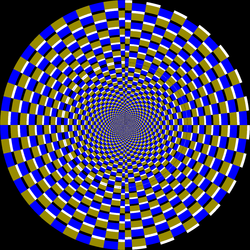
Two images that exhibit peripheral drift illusion. The different pattern of light and dark causes the two circles to appear to rotate in opposite directions.

The peripheral drift illusion (PDI) refers to a motion illusion generated by the presentation of a sawtooth luminance grating in the visual periphery. This illusion was first described by Faubert and Herbert (1999), although a similar effect called the "escalator illusion" was reported by Fraser and Wilcox (1979). A variant of the PDI was created by Kitaoka Akiyoshi and Ashida (2003) who took the continuous sawtooth luminance change, and reversed the intermediate greys. Kitaoka has created numerous variants of the PDI, and one called "rotating snakes" has become very popular. The latter demonstration has kindled great interest in the PDI.

The illusion is easily seen when fixating off to the side of it, and then blinking as fast as possible. Most observers can see the illusion easily when reading text with the illusion figure in the periphery. The motion of such illusions is consistently perceived in a dark-to-light direction.

Two papers have been published examining the neural mechanisms involved in seeing the PDI (Backus & Oruç, 2005; Conway et al., 2005). Faubert and Herbert (1999) suggested the illusion was based on temporal differences in luminance processing producing a signal that tricks the motion system. Both of the articles from 2005 are broadly consistent with those ideas, although contrast appears to be an important factor (Backus & Oruç, 2005).

Rotating snakes

[edit]
Illusion similar to Rotating Snakes

Rotating snakes is an optical illusion developed by Professor Akiyoshi Kitaoka in 2003.[1] A type of peripheral drift illusion, the "snakes" consist of several bands of color which resemble coiled serpents. Although the image is static, the snakes appear to be moving in circles. The speed of perceived motion depends on the frequency of microsaccadic eye movements (Alexander & Martinez-Conde, 2019).

[edit]

References

[edit]
[edit]
Revisions and contributorsEdit on WikipediaRead on Wikipedia
from Grokipedia
The peripheral drift illusion (PDI) is an in which stationary visual patterns featuring repeated asymmetrical gradients, such as sawtooth profiles, appear to exhibit episodic rotational or drifting motion specifically in the peripheral , while remaining motionless under central fixation. This illusion is triggered by transient events like eye blinks, saccades, or pattern onsets, which introduce temporal modulations via reflexive dilation, lasting approximately 1–7 seconds per episode. First formally described in the scientific literature around 1999 by vision researchers Jocelyn Faubert and Andrew Herbert, the PDI builds on earlier observations of anomalous motion in dating back to at least the , though systematic study began with high-resolution displays in the . The requires specific stimulus properties, including at least four to five cycles arranged in a circular or serpentine pattern with a dark-to-light , and is most pronounced with contrasts rather than absolute levels, as neural processing in early visual areas like V1 and MT favors contrast signals for direction selectivity. A landmark example is Akiyoshi Kitaoka's Rotating Snakes , introduced in 2003, which depicts interlocking circular patterns that seem to rotate continuously in opposite directions when viewed peripherally, captivating viewers and inspiring numerous variants. Mechanistically, the PDI arises from interactions between peripheral visual limitations, such as larger receptive fields and slower spatiotemporal integration, and transient neural responses to changes, leading to false motion signals in direction-selective cells without actual stimulus movement. Recent research has pinpointed pupil dynamics as a key driver: post-trigger dilation reduces retinal illumination transiently, mimicking moving edges and eliciting illusory drift, an effect diminished by factors like aging-related pupil or pinhole viewing that stabilizes . The illusion's strength varies individually, influenced by factors such as and , and it has been used in studies to probe pathways, revealing activation in areas like MT even for static inputs. Overall, the PDI exemplifies how the visual system's adaptations for efficient central can generate compelling errors in the periphery, contributing to broader understandings of and perceptual robustness.

Definition and Characteristics

Definition

The peripheral drift illusion is an optical motion illusion in which static visual patterns, typically featuring repeating sawtooth gratings or asymmetric distributions, induce a percept of episodic drifting or rotational movement specifically in the visual periphery. These patterns consist of abrupt transitions between levels, such as from dark to light in a stepwise or serrated manner, which under peripheral viewing conditions generate an apparent motion following the asymmetry. Unlike genuine motion stimuli, the illusion persists without physical displacement of elements in the image, relying instead on the brain's interpretation of static contrasts. This illusion manifests prominently when the observer fixates on a point adjacent to the pattern, causing the surrounding peripheral regions to appear to shift or rotate slowly, often in a circular trajectory, in episodes lasting 1–7 seconds triggered by eye blinks, saccades, or other transients. The perceived motion direction aligns with the luminance asymmetry, reversing if the contrast polarity is inverted (e.g., light-to-dark instead of dark-to-light). In contrast to central vision, where such patterns remain perceptually static due to high spatial acuity, the peripheral drift effect highlights the differential processing across the visual field. A well-known example is the "Rotating Snakes" pattern, where interlocking circular segments create illusory serpentine rotations. The phenomenon occurs primarily in peripheral vision because this region exhibits lower spatial resolution, resulting from larger receptive fields in retinal ganglion cells and cortical neurons, which blur fine luminance edges and promote spatiotemporal integration of signals. Additionally, peripheral vision demonstrates heightened sensitivity to motion cues, particularly at low spatial frequencies, making it more prone to misinterpreting static asymmetries as dynamic changes compared to the fovea, where precise detail resolution dominates. This contrast underscores the specialized roles of central and peripheral visual processing in the human visual system.

Visual Properties

The peripheral drift illusion is characterized by asymmetric luminance patterns, typically consisting of stepwise gradients such as black, dark-gray, white, and light-gray regions arranged in repeating cycles along curved or circular paths like spirals or rings. These patterns induce a strong sense of directionality in the apparent motion, where the illusion typically propagates from black to dark-gray and from white to light-gray regions, creating a coherent rotational or drifting effect. Stepwise profiles are more effective than smooth sawtooth gradients in eliciting the illusion, as they enhance the perceptual asymmetry that drives the motion percept. The strength of the illusion varies significantly with pattern density, luminance contrast, and viewing distance. Higher contrast between luminance levels amplifies the effect, while denser patterns or closer viewing distances can modulate the intensity by altering the perceived in the periphery. The illusion weakens substantially in central vision but intensifies in the visual periphery, with peak strength occurring at eccentricities of 10-14 degrees from the fovea. Perceptually, the illusion manifests as a slow drift, often perceived as rotation at approximately 1 degree per second in optimal luminance configurations. The direction of this motion can vary across patterns and observers, and may reverse with shifts in attention or fixation.

Historical Development

Early Discoveries

The motion aftereffect, a foundational visual illusion involving perceived movement in stationary objects following prolonged exposure to actual motion, was first systematically documented in the 19th century. In 1834, Robert Addams observed this effect while viewing the Falls of Foyers in Scotland, noting that after fixating on the descending water, the adjacent rocks appeared to drift upwards. This phenomenon, later termed the waterfall illusion, represented an early recognition of how adaptation in the visual system could generate illusory motion, with subsequent studies by figures like Jan Purkinje in the 1820s providing additional insights into its perceptual basis. By the late , research shifted toward illusions arising from static patterns without requiring prior , marking a transition to more specific forms of peripheral . The Fraser-Wilcox , reported in , provided the earliest documented observations of what would later be recognized as the peripheral drift (PDI), involving continuous apparent motion in stationary images viewed in the visual periphery. A. Fraser and K.J. Wilcox described patterns such as spiral arrangements of alternating black and white segments, which induced a sense of rotational or escalator-like drift in observers. Initial experiments by Fraser and Wilcox demonstrated that the illusion was predominantly tied to peripheral viewing, occurring reliably beyond 5 degrees from the fixation point but not in central vision, with approximately 75% of observers reporting motion perceptions categorized into directional drifts or expansions. These findings, based on static gratings with asymmetric sawtooth profiles, highlighted the illusion's dependence on off-axis processing and laid the groundwork for distinguishing it from classical motion aftereffects. Reports in the and further corroborated these peripheral-specific drifts in similar static stimuli, establishing the phenomenon's core characteristics before its formal naming in the .

Key Researchers and Publications

The peripheral drift illusion (PDI) builds on early observations by Alex Fraser and K. J. Wilcox, who described a similar "escalator illusion" in 1979 involving apparent motion in static patterns viewed peripherally. Jocelyn Faubert and A. M. Herbert advanced the understanding of PDI in their seminal 1999 paper, where they formally described the illusion as arising from sawtooth luminance gradients in the visual periphery, emphasizing the role of eye movements and blinks in generating perceived motion. Their work, published in Perception, provided the first detailed psychophysical analysis and coined the term "peripheral drift illusion" to distinguish it from central vision effects. Benjamin T. Backus and Ipek Oruç contributed further in 2005 by investigating the neural basis of illusory motion in PDI-like stimuli, demonstrating how temporal changes in contrast and luminance responses produce spurious motion signals, particularly in . Their study in the Journal of Vision highlighted the illusion's dependence on slow adaptation processes in . Akiyoshi Kitaoka played a pivotal role in popularizing PDI during the early 2000s through his creation of digital patterns, such as variants of the Rotating Snakes illusion, which amplified the effect for broader audiences. In his 2003 collaboration with Hiroyuki Ashida, published in Vision (the journal of the Vision Society of ), Kitaoka detailed the phenomenal characteristics of PDI, including its sensitivity to fixation and peripheral viewing, solidifying its recognition in optical illusion research. Subsequent neuroscientific insights came from Jorge Otero-Millan, Stephen L. Macknik, and Susana Martinez-Conde in their 2012 Journal of Neuroscience paper, which linked microsaccades and blinks to triggering illusory rotation in Kitaoka's Rotating Snakes pattern, using high-resolution eye-tracking to quantify episodes. A recent advancement appears in the 2025 study by George Mather and Patrick Cavanagh, published in Journal of Vision and available via PMC, which established a between dilation episodes and PDI duration, suggesting transitory changes as a key mechanism updating prior models.

Underlying Mechanisms

Eye Movements and Transients

The peripheral drift illusion arises primarily from involuntary eye movements that introduce transient changes, which the misinterprets as motion signals within asymmetric patterns. Microsaccades—small, rapid fixational movements typically spanning 0.2 to 1 degree—and blinks generate these transients by abruptly shifting the image across pattern edges, triggering perceived drift in the direction of gradients. This mechanism relies on the visual system's sensitivity to sudden changes, where the asymmetric structure of the patterns amplifies the illusory effect during peripheral viewing. Microsaccades and blinks produce temporal asynchronies in the processing of light and dark transitions, leading to a net apparent velocity as the integrates mismatched signals from adjacent pattern elements. The resulting is unidirectional, aligning with the pattern's inherent asymmetry, and is most pronounced when the is not perfectly stabilized. Experimental studies using eye-tracking have demonstrated a strong between the onset of microsaccades or blinks and the of . Stabilizing the through oculomotor control techniques significantly reduces the , underscoring the causal role of these eye movements, while slow drifts appear to have minimal impact. dilation may serve as a modulator of visual sensitivity during these events.

Pupil Dilation and Neural Factors

Recent research has demonstrated that pupil dilation plays a crucial role in modulating the peripheral drift illusion by altering illumination levels. Specifically, dilation increases by an average of over 15%, which enhances the transient sensitivity of static patterns, thereby strengthening the . This effect is particularly pronounced during blinks or states of , where reflexive pupil dilation lasting 2–5 seconds correlates directly with the duration and amplitude of the illusion. The neural basis of the peripheral drift illusion involves motion-sensitive areas such as MT/V5 (also known as MT+), where direction-selective occurs in the visual periphery, contributing to the perception of continuous motion from static images. Adaptation asymmetries arise from differing processing latencies for increments and decrements in sawtooth gradients, leading to temporal-order effects that bias motion detectors toward a unidirectional percept. These asymmetries are processed through layered neural units, including Reichardt-type detectors that integrate changes, with larger receptive fields in peripheral pathways amplifying the effect. Factors such as and contrast sensitivity further sustain the illusion through incomplete in peripheral visual pathways. Even as contrast levels vary, the illusion persists because repeated transients—such as those initiated by brief eye movements—prevent full , maintaining unbalanced motion signals in higher-order areas like MT/V5. This incomplete adaptation ensures that peripheral processing continues to generate perceived continuity despite the static nature of the stimulus. Recent findings emphasize pupil dilation as a primary driver, integrating with ocular transients to elicit the effect.

Notable Examples

Rotating Snakes

The "Rotating Snakes" pattern, developed by in 2003, consists of concentric rings formed by repeating arcs in black, white, dark gray, and light gray, arranged to produce an apparent clockwise or counterclockwise rotation in static images. Adjacent rings typically rotate in opposite directions, creating a dynamic, serpentine effect that is most compelling when viewed in the visual periphery while fixating near the center. The perceptual strength of the drift peaks in , where the rings appear to rotate slowly at approximately 1° per second, with the motion direction following luminance transitions from black to dark gray or white to light gray. Shifting to different peripheral areas or performing quick head tilts can reverse the perceived direction of rotation, altering the illusory flow. Kitaoka's creation process relied on asymmetric luminance gradients with abrupt stepwise changes rather than smooth transitions, combined with curved and fragmented edges, to exploit misinterpretations of visual transients and induce the drift. This design maximizes the illusion's potency by emphasizing directional biases in ordering, making "Rotating Snakes" a seminal demonstration of peripheral drift effects.

Other Patterns

Beyond the benchmark Rotating Snakes pattern, peripheral drift illusions encompass a diverse array of designs that induce through variations in and arrangement. The Fraser–Wilcox illusion, first reported in , involves repeating angular sectors composed of asymmetric gradients, such as stripes shaded from dark to light, that appear to rotate slowly in the peripheral , with motion direction depending on the transition from dark to light or vice versa. This sectoral configuration highlights the role of angular arrangements in generating rotational drift without circular elements. Linear grating variants, such as those inspired by the barber pole illusion, utilize striped columns or gratings confined within vertical apertures to produce horizontal or oblique drift in the periphery, where the appears to move unidirectionally despite its static nature. For instance, the peripheral escalator illusion employs three striped columns that appear to drift obliquely in , mimicking the directional bias seen in barber pole configurations. Digital patterns further diversify the illusion, as seen in Akiyoshi Kitaoka's explorations of optimized designs with asymmetric gradients and high-contrast elements, where stepwise profiles elicit stronger effects than traditional sawtooth patterns. Color-based variations can incorporate chromatic asymmetries to induce , though the effect primarily depends on gradients. Non-circular forms, like wavy line arrays, induce lateral drift rather than rotation, with vertical rows appearing to undulate horizontally in peripheral view. High-contrast patterns in these variants often yield stronger than traditional circular rings, establishing their comparative potency in peripheral perception.

Comparisons to Similar Illusions

The peripheral drift illusion (PDI) differs from central motion illusions such as the waterfall effect, also known as the , in its perceptual mechanism and stimulus requirements. The waterfall illusion arises from adaptation to prolonged real motion in one direction, causing a subsequent stationary scene to appear to move in the opposite direction due to neural fatigue in motion-sensitive areas of the . In contrast, PDI induces a continuous, slow drift from a completely static image without any prior exposure to motion, relying instead on asymmetric luminance gradients that exploit peripheral processing latencies. PDI also exhibits distinctions from the Fraser-Wilcox illusion, which it extends but from which it diverges in pattern geometry. The original Fraser-Wilcox illusion, described in 1979, typically produces linear through stationary patterns with repeating light-dark asymmetries, often perceived inconsistently in direction across observers and stronger in the periphery. PDI, as formalized by Faubert and Herbert in 1999, emphasizes rotational drift in circular or serpentine arrangements, such as sawtooth gratings arranged in loops, leading to more consistent clockwise or counterclockwise perceptions when viewed peripherally. Similarly, compared to the Ouchi illusion, PDI involves unidirectional drift from luminance gradients rather than relative motion between orthogonal textures like checkerboards, where static elements appear to jitter or expand due to shifts in fixation. While PDI shares traits with other illusions involving static stimuli and peripheral sensitivity, its is uniquely tied to transient neural responses without or sequential elements. Unlike the , which creates apparent motion through discrete, timed flashes of stationary lights exploiting temporal integration in the , PDI generates sustained drift from inherent pattern asymmetry without any dynamic presentation. In distinction from ambiguous figures, such as the , which prompt perceptual reversals in figure-ground organization through spatial ambiguity visible centrally, PDI's effect is motion-specific, diminishing under direct foveal gaze and absent in non-peripheral bistable patterns.

Applications in Research and Design

In , the peripheral drift illusion (PDI) serves as a tool for probing motion processing mechanisms in the visual periphery through (fMRI). Researchers have applied patterns like the Rotating Snakes illusion to elicit and measure direction-specific adaptations in cortical activity, identifying key areas such as the middle temporal area (MT) and medial superior temporal area (MST) involved in perceiving static stimuli as dynamic. For example, event-related fMRI studies have demonstrated enhanced BOLD signals in motion-sensitive regions during exposure to PDI variants, correlating illusory direction with neural responses and providing insights into how the constructs motion from gradients. These applications extend to investigations of perceptual stabilization, where PDI reveals how involuntary eye movements influence the robustness of processing. Beyond , PDI contributes to clinical vision by facilitating assessments of peripheral visual function. Studies have used PDI variants to evaluate variations in , for instance in autism spectrum disorder, where reduced strength correlates with contrast discrimination deficits. dilation responses to PDI patterns have been quantified to explore autonomic influences on . Recent as of 2024 has also examined PDI in non-human animals, finding that do not perceive it as motion, indicating species-specific differences in illusion susceptibility. Artistically, PDI has inspired works by psychologist , whose illusions, including the iconic Rotating Snakes, blend scientific precision with aesthetic appeal and have been featured in international s. For instance, Kitaoka's geometric and color-based PDI designs were displayed at the Sensory Illusion special event during the 2019 International Display Workshop (IDW), highlighting their role in bridging perception research and visual art. Similar pieces appeared in the Uchiwa Science in in 2024, where over a dozen PDI-inspired designs explored cultural and perceptual themes through static yet dynamic patterns. These exhibitions underscore PDI's value in illusion art, drawing crowds to experience the disorienting yet captivating effects of peripheral motion. In , PDI enhances user engagement by simulating motion without , commonly integrated into screensavers and looping videos for hypnotic . (VR) environments incorporate PDI elements to amplify immersion, as seen in studies where illusions modulate perceived motion in action contexts, informing for realistic perceptual experiences. For design applications, PDI informs (UI) principles by highlighting risks of unintended in static elements, guiding creators to adjust gradients and patterns in warning signage or digital graphics to prevent perceptual distractions. In the , op-art trends have revived PDI motifs in digital and print media, with artists and designers drawing on Kitaoka's influence to create interactive wallpapers and installations that exploit peripheral drift for dynamic .

References

Add your contribution
Related Hubs
Contribute something
User Avatar
No comments yet.