Hubbry Logo
PernachPernachMain
Open search
Pernach
Community hub
Pernach
logo
8 pages, 0 posts
0 subscribers
Be the first to start a discussion here.
Pernach
Pernach
from Wikipedia
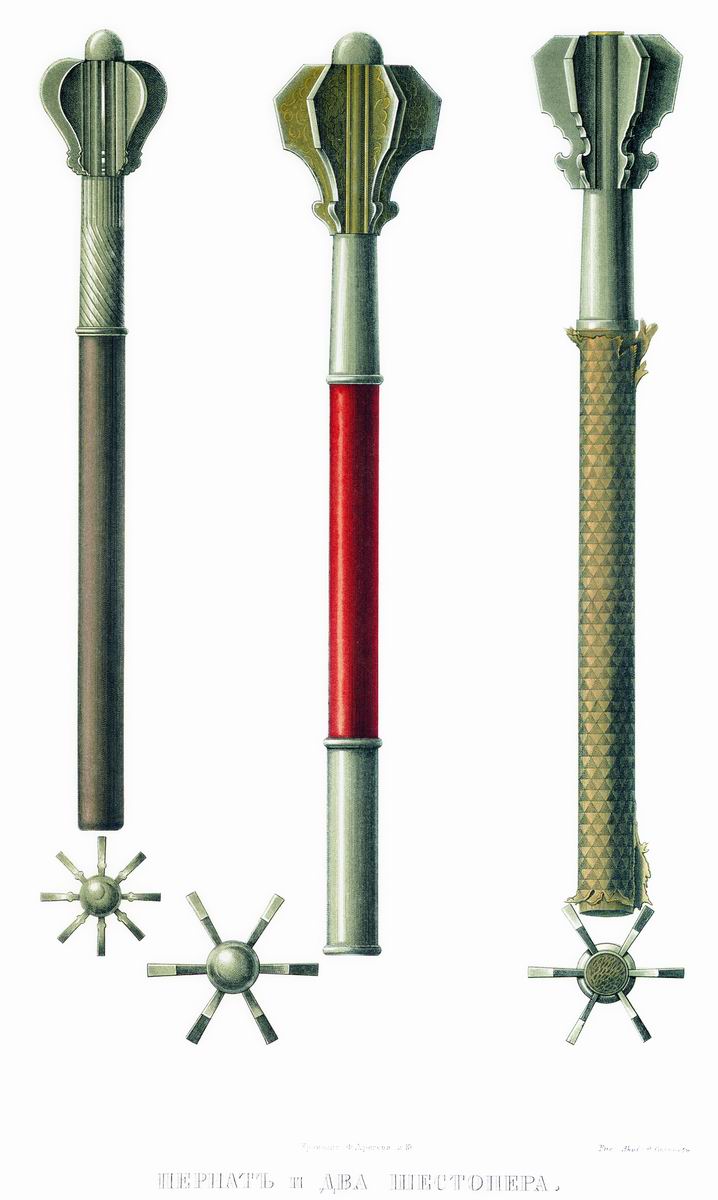
Pernachs, two of which are shestopyors (right)

A pernach (Russian: перна́ч, Ukrainian: перна́ч or пірна́ч, pirnach, Polish: piernacz) is a type of flanged mace originating in the 12th century in the region of Kievan Rus' and later widely used throughout Europe. The name comes from the Slavic word перо (pero) meaning feather, referring to a type of mace resembling an arrow with feathering.

Uses against armour and mail

[edit]

Among a variety of similar weapons developed in 12th-century Persian- and Turkic-dominated areas, the pernach became pre-eminent,[1] being capable of penetrating plate armour and plate mail.

Ceremonial uses

[edit]

A pernach or shestoper (Russian: шестопeр, "six-feathered") was often carried as a ceremonial mace of rank by certain Eastern European military commanders, including Polish magnates, Ukrainian Cossack colonels and sotniks (cf. centurion).

Symbolic uses

[edit]

In Ukraine, it symbolized the authority of polkovnyks (regional leaders or military officers)[2] unlike another mace, the bulawa, which was associated with the Hetman.

References

[edit]
Revisions and contributorsEdit on WikipediaRead on Wikipedia
from Grokipedia
The pernach (also known as shestopyor in Russian, meaning "six-feathered") is a type of flanged mace characterized by a metal head featuring multiple protruding flanges or knobs designed for penetrating armor, mounted on a wooden shaft typically 50–80 cm long. Originating in the 12th century in the Kievan Rus' region of , it evolved from earlier maces introduced by nomadic such as the in the 7th–8th centuries, becoming a staple for and against plate armor. By the 13th–14th centuries, the pernach had spread widely across , , , , and the , where it was favored by knights and commanders for its balance of weight and impact force, often cast in or iron with heads shaped like stars or pyramids (e.g., Type IV with three rows of knobs). Archaeological finds, such as a 12th–14th-century mace head discovered in eastern in 2023, illustrate its intensive combat use, with damaged flanges suggesting both battlefield application and possible repurposing as tools like hammers. Variants included numbered types like the shestoper (six-flanged) or dvadtsatpyor (twenty-flanged), reflecting increasing complexity in design to enhance penetration. In addition to its practical role, the pernach transitioned into a symbol of by the 15th–17th centuries, carried ceremonially by Eastern European and Cossack colonels, sometimes or adorned with misericordes (short blades) for dual functionality. Examples include a 17th-century Turkish-forged colonel's pernach with and , now in Ukrainian collections, and a pure gold version gifted to Russian Alexei Mikhailovich in 1658 by Persian Abbas II. Its decline as a primary coincided with the rise of firearms in the , though it persisted in ceremonial contexts into the early .

History and Origins

Origins in Kievan Rus'

The term pernach derives from the Slavic word pero, meaning "feather," alluding to the weapon's flanged head that resembled the of an arrowhead. The pernach emerged as a type of flanged mace in the region of Kievan Rus' during the , marking an early development in Eastern Slavic weaponry. This innovation coincided with broader influences from Persian and Turkic designs prevalent in the northern Islamic world, where flanged mace heads had become common by the , likely transmitted through nomadic interactions. Archaeological evidence indicates that production of these maces, often cast in bronze with star-shaped or multi-flanged forms, began in the 12th–13th centuries, reflecting both military utility and symbolic status among warriors. Rus' warriors adopted the pernach amid the rising prevalence of and early plate armor in , valuing its design for penetrating such defenses. Key artifacts from this period include bronze mace heads unearthed in , as documented in excavations analyzed by M.K. Karger, dating to the 13th century and housed in the National Museum of the , and similar finds from Novgorod sites reported by A.R. Artemev, dating to the 12th–13th centuries. These early examples highlight the pernach's foundational role in Kievan Rus' martial culture before its wider dissemination.

Spread Across Eastern Europe

The pernach, evolving from its initial development in Kievan Rus' during the , began its wider dissemination across in the 13th century, facilitated by the Mongol invasions that introduced warfare elements to the region. These invasions, occurring between 1237 and 1242, exposed Rus' principalities and neighboring territories to nomadic weaponry, including flanged maces, which were integrated into local arsenals through captured arms, tribute exchanges, and military adaptations. By the 14th and 15th centuries, trade routes along the and Baltic corridors further propelled its spread to the Polish-Lithuanian Commonwealth and Ukrainian lands, where it became a staple in and equipment amid ongoing conflicts with the and Muscovy. Adoption of the pernach extended to elite military groups in the expanding Polish-Lithuanian Commonwealth, including the Lithuanian armies under Vytautas, who incorporated it into formations during campaigns against the remnants. In , it gained prominence among the winged hussars by the late 15th century, serving both as a battlefield weapon for close-quarters combat and a symbol of command for officers. Early Cossack forces in Ukrainian territories, emerging in the 16th century along the River, similarly embraced the pernach as a mark of authority for atamans and colonels, reflecting its dual role in against Tatar raiders. Interactions with Ottoman and Crimean Tatar forces during the 15th and 16th centuries influenced regional variations, as Eastern European smiths adapted designs encountered in border skirmishes and alliances. Tatar raids into Polish-Lithuanian and Ukrainian territories introduced models with increased flange counts—often six to eight for greater piercing power—while Ottoman trade introduced longer hafts suited to mounted use, enhancing reach in charges. These modifications were evident in artifacts from the Polish-Muscovite Wars (1492–1667), where pernachs equipped troops in engagements like the (1514), underscoring their tactical value against armored foes.

Design and Construction

Physical Characteristics

The pernach is characterized by a straight wooden haft measuring approximately 50 to 80 cm in length, optimized for one-handed use and facilitating powerful swinging strikes. A historical example from the late 17th to early , preserved in the Honchar , has a total length of 54.5 cm, illustrating the compact design suitable for close-quarters combat. The haft's cylindrical form provides a secure grip, often enhanced by a wrist strap or cord wrapping near the head for retention during momentum-driven blows, as seen in a late 15th-century flanged mace with cord elements. Atop the haft sits a metal head, typically weighing 0.8 to 1 kg for the entire , with the head itself contributing the majority of the mass to maximize impact. The head adopts a pear-shaped or elongated cylindrical form, from which 4 to 12 protruding flanges extend radially in a symmetrical arrangement, often numbering 6 to 8 in common variants. These flanges, sharpened along their outer edges, measure around 5 to 7 cm in height and are spaced to concentrate force, with one archaeological specimen featuring a head approximately 5.8 cm long and 6.8 cm wide. In a comparable late 15th-century example, the head spans 14 cm in length and 6.5 cm in width. This flanged configuration imparts a distinctive "feathered" or star-like profile to the pernach, setting it apart from earlier non-flanged maces that relied on blunt, rounded, or polyhedral heads for crushing effects. The radial flanges enhance the weapon's balance by distributing weight evenly around the axis, promoting rotational while allowing the user to target vulnerabilities with precision.

Materials and Manufacturing

The pernach head was typically forged from or cast in or iron, a material chosen for its malleability and availability in Eastern European forges during the medieval period. Later examples from the 14th to 16th centuries often incorporated for enhanced hardness and durability. Hafls were commonly crafted from dense hardwoods such as or , selected for their strength and resistance to splintering under impact; metal reinforcements, like iron bands, were sometimes added near the head to prevent cracking. Manufacturing began with heating or billets in a , followed by hammering on an to shape the central body and form the protruding flanges, often using swages or dies for precision. For examples, clay molds were employed. The flanges were then tempered by controlled reheating and to balance and , preventing during combat. Simpler iron pernachs were produced using basic iron in various regional forges. Assembly involved fitting the haft into a socket on the head, secured with rivets, pins, or wedges to ensure a firm connection capable of withstanding repeated strikes. Some variants used tangs driven into the wood and peened over for added stability. Maintenance required regular polishing of the iron or surfaces with oils or animal fats to inhibit formation, particularly in humid climates, and occasional sharpening of edges using whetstones to maintain penetrating efficacy.

Variants and Evolution

Shestoper and Other Types

The shestoper represents a distinctive variant of the pernach characterized by its six-flanged head, designed for both combat and ceremonial purposes. This type gained prominence in 16th- to 18th-century Ukraine and Poland, where it served as a symbol of rank among Cossack colonels, sotniks, and military commanders, often carried in processions or official capacities rather than active battle. Unlike simpler maces, the shestoper's flanges were forged to concentrate impact force, making it effective against armored foes while its ornate construction emphasized status. Surviving examples, such as those in the National Museum of the History of Ukraine, date to the early modern era (1700–1800) and feature iron or steel heads mounted on wooden hafts, highlighting their dual role in warfare and symbolism. Other variants of the pernach varied primarily by the number of flanges, adapting to different tactical needs. The four-flanged version formed the basic combat model, offering a balance of weight and maneuverability for standard infantry use, with flanges typically pear-shaped and arranged symmetrically around the head. Heavier penetrating types incorporated eight or twelve flanges, increasing destructive potential against plate armor by allowing deeper penetration through concentrated strikes, though at the cost of added weight and reduced speed. Higher-flanged variants, such as the dvadtsatpyor with twenty flanges, further exemplified this trend toward greater penetration capability. These multi-flanged designs evolved from earlier Eastern European traditions, with archaeological evidence including a 14th- to 15th-century shestoper recovered from Balkan sites, demonstrating widespread regional adoption. Regional subtypes further diversified the pernach, reflecting local craftsmanship and influences. In Polish contexts, variants like the buzdygan shared the six-flanged form but often featured spurred terminals on the flanges for enhanced lethality, as seen in 17th-century examples used by . Such adaptations underscore the weapon's versatility across , where haft lengths typically ranged from 50 to 70 cm to suit both mounted and foot soldiers.

Evolution from Earlier Maces

The pernach evolved from earlier plain-headed maces prevalent in the 10th and 11th centuries across , including the Kievan Rus' region, where simple spherical or cubical iron and heads were mounted on wooden hafts for blunt force impact against lightly armored foes. These predecessors, often weighing 0.5 to 1 kg, were effective against unarmored or chainmail-clad opponents but proved inadequate as armor technology advanced with widespread adoption of reinforced mail hauberks and early plate elements around 1100–1200 CE. By the early , the pernach emerged as a specialized flanged variant in Kievan Rus', featuring protruding blades or knobs on the head to concentrate force and penetrate hardened defenses, marking a direct adaptation to these defensive innovations. Key innovations in the pernach included the addition of 4 to 6 flanges—pyramidal or wedge-shaped projections—cast in or forged in iron, which allowed the weapon to dent, crack, or pierce links and thin plate without embedding like a plain head might. This design drew from pre-Kievan influences, blending Byzantine mace forms (such as the vardoukion, a knobbed striking weapon) with Central Asian traditions introduced by nomadic groups like the and , who migrated into the region during the 10th–11th centuries and facilitated cultural exchange via and conflict. Archaeological evidence from Kievan sites, including hollow-cast heads, confirms this synthesis, with early pernach examples showing ornamental flanges that enhanced both utility and status. Over the 12th–14th centuries, the pernach underwent refinement in Kievan Rus' and adjacent areas, transitioning from socketless knobbed heads (Type I, with 4 protrusions for basic penetration) to socket-mounted designs (Type II) that integrated more securely with longer hafts, improving reach and leverage against mounted knights in . Flange counts increased for better armor-crushing capability, with cast examples from the 13th century exhibiting pear-shaped heads up to 10 cm long. By the 15th–17th centuries, the weapon evolved further through longer-hafted variants adapted for use against effectively. The pernach's combat role declined in the with the rise of firearms, including muskets and early , though it persisted in ceremonial forms among Cossack and noble regiments for parades and symbols of authority.

Military Uses

Effectiveness Against Armor

The pernach's design provided significant mechanical advantages in countering armored opponents through its flanged head, which concentrated the impact force of a swing onto narrow points, enabling it to dent plate armor, fracture underlying bone, or rupture links without requiring full penetration. This often caused concussive injuries, internal hemorrhaging, or incapacitation by deforming helmets and breastplates, even if the armor remained intact. The weapon's effective range was limited to 1-2 meters, relying on the user's momentum in close-quarters swings rather than thrusting or ranged attacks. In comparison to edged weapons like swords or axes, the pernach offered superior performance against curved or sloped armor surfaces, as its flanges reduced the likelihood of glancing blows and maximized energy transfer to induce shock through the armor. Swords, designed primarily for slashing or thrusting, often failed to deliver comparable force against hardened plate, while axes could split lighter but risked deflection on reinforced surfaces. This made the pernach particularly valued in and engagements where opponents wore transitional armors combining and plate. Historical evidence from late medieval Eastern European contexts underscores the pernach's role against armored foes, with archaeological finds and combat manuals illustrating its deployment from the 14th century onward. For instance, flanged mace heads akin to the pernach appear in Transylvanian collections dated to the late 14th-15th centuries, coinciding with the spread of plate armor and reflecting adaptations to counter it. Depictions in Hans Talhoffer's Fechtbuch illustrate the use of flanged maces in close combat, including scenarios involving armored opponents and shields. Despite these strengths, the pernach had notable limitations against fully enclosed plate harnesses of the late , where thick, tempered often absorbed impacts without yielding gaps for follow-up strikes, reducing its penetrating power to primarily concussive effects. Against unarmored or lightly protected enemies, it proved inferior to swords, which excelled at inflicting deep cuts over blunt crushing.

Deployment in Battles and Armies

The pernach, known in Polish contexts as the buzdygan, served as a key secondary weapon for officers and commanders in Polish and Lithuanian armies from the 15th to 17th centuries, particularly among elite heavy units such as the winged s after their emergence in the late . These forces, which formed the backbone of Polish-Lithuanian military power following the of 1386, equipped hussar rotmistrze (captains) and other leaders with the flanged mace for close-quarters engagement after primary lances were expended or broken during charges. units, including and lighter pancerni , also employed variants of the pernach as a versatile bludgeon, often paired with shields for defensive combat against armored foes. In Russian and Hungarian armies, the pernach was similarly used by from the onward. In tactical deployments, the pernach excelled in the chaotic aftermath of charges, where hussars transitioned from thrusts to crushing overhead blows capable of penetrating plate armor and helmets, disrupting enemy formations and morale. For Cossack irregulars and foot soldiers, it functioned as a reliable sidearm in skirmishes and sieges, allowing wielders to maintain mobility while delivering high-impact strikes in dense clashes. This adaptability made it a staple in Eastern European warfare, where prolonged engagements demanded weapons effective at short range beyond sabers or pistols. The weapon saw prominent use in the Polish-Ottoman Wars, including decisive engagements like the in 1605, where officers wielding buzdygan maces contributed to the rout of a larger Swedish force by breaking through lines during the final assault. Similarly, in the 1514 against troops, leaders depicted with pernach variants led charges that shattered enemy cohesion, highlighting its role in shattering dense formations. Although primary accounts emphasize lances at the 1683 , commanders likely resorted to pernachs in the melee following the Ottoman center's collapse, aiding the Polish-led relief army's victory. Cossack units, integral to these campaigns, integrated the pernach into their hybrid tactics of raid and assault, using it to counter Ottoman cavalry in frontier skirmishes. By the , the pernach had become standard issue for mid- to high-ranking officers in Polish-Lithuanian forces, distributed through royal armories and noble estates to ensure uniformity in command signaling and . regimens for hussars and emphasized proficiency with the weapon via mounted drills and foot exercises, integrating it into broader curricula that prioritized lance work and saberplay, with variants scaled by rank—simpler iron models for line officers and more ornate steel ones for rotmistrze. This structured issuance reflected the reliance on noble levies, where the pernach not only but also denoted on the .

Ceremonial and Symbolic Roles

Ceremonial Applications

The pernach functioned as a key insignia of rank within the military hierarchies of Eastern Europe from the 16th to 18th centuries, particularly among Cossack forces under the Polish-Lithuanian Commonwealth. High-ranking officers, such as colonels (polkovnyks), carried the pernach as a badge of office to denote their command authority over regiments, distinguishing them from lower ranks like sotnyks who held subordinate positions. In Cossack traditions, this flanged mace symbolized the transfer of power and was integral to maintaining order within the semi-autonomous host structure. Beyond combat roles, the pernach featured prominently in rituals and processions, often elaborately decorated with , jewels, or engravings to emphasize its ceremonial prestige. During Cossack inaugurations, such as those for atamans or colonels, the pernach was formally conferred in public ceremonies to legitimize leadership and affirm loyalty to the broader political order, as seen in 19th-century examples that echoed earlier practices. These events, including gatherings in the Polish Sejm where military symbols were displayed, underscored the mace's role in official displays of authority, with ornate variants crafted from , turquoise, and engraved wood for visual impact. Surviving examples from the 17th and 18th centuries highlight the pernach's enduring ceremonial legacy, preserved in Ukrainian institutions like the Ivan Honchar Museum in Kyiv, where a colonel's pernach dating to the late 17th or early 18th century features floral engravings and inlays of gold and turquoise. After the 1700s, as battlefield use declined, the pernach transitioned to purely parade functions in the uniforms of imperial Russian officers, particularly among Cossack units, where it continued as a symbol of rank in formal reviews and processions into the 19th century.

Symbolic Significance in Society

In Ukrainian Cossack society, the pernach functioned as a primary symbol of authority, specifically denoting the rank of polkovnyk (colonel), in contrast to the larger bulawa reserved for hetmans. This distinction highlighted the structured hierarchy within the Cossack Host, where the pernach embodied martial prowess, leadership, and administrative command among regimental officers. The pernach appeared prominently in 17th- and 18th-century Cossack , including historical paintings and depictions, as an emblem of and the warrior ethos central to Cossack identity. It represented the autonomy of the and resistance to external powers, reinforcing narratives of self-governance in and . Today, the pernach's symbolism endures in Ukrainian military , such as the crossed maces on the General Staff chevron, which draw directly from Cossack to signify enduring traditions of power and command. It also features in historical reenactments that revive Cossack heritage, distinguishing Eastern Slavic martial emblems from Western European mace symbols, which more commonly denote ceremonial or parliamentary authority. Reserved exclusively for the Cossack starshyna—the officer elite that developed into a hereditary —the pernach reinforced social hierarchies and class distinctions in Eastern Slavic communities, marking bearers as members of a privileged stratum with both military and landowning rights.

References

Add your contribution
Related Hubs
User Avatar
No comments yet.