Hubbry Logo
Persistent truncus arteriosusPersistent truncus arteriosusMain
Open search
Persistent truncus arteriosus
Community hub
Persistent truncus arteriosus
logo
8 pages, 0 posts
0 subscribers
Be the first to start a discussion here.
Persistent truncus arteriosus
from Wikipedia
Persistent truncus arteriosus
Other namesTruncus Arteriosus, Truncus Arteriosus Communis, Patent truncus arteriosus, or Common arterial trunk
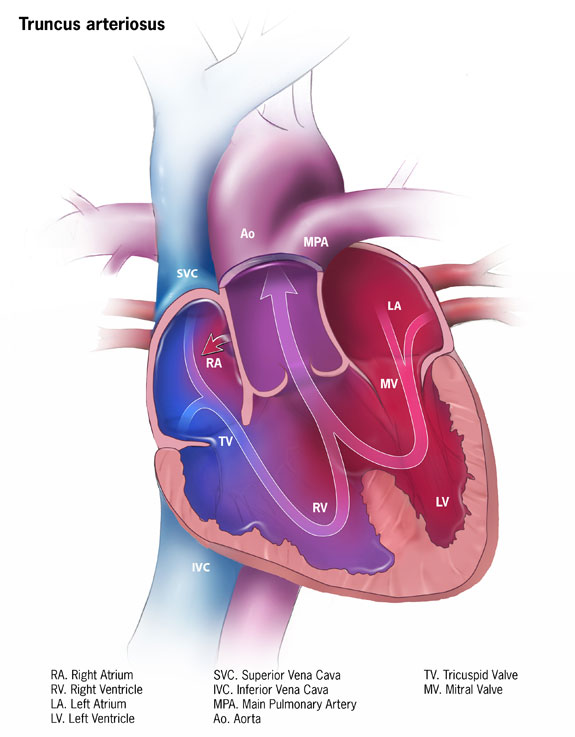
Illustration of truncus arteriosus
SpecialtyMedical genetics Edit this on Wikidata

Persistent truncus arteriosus (PTA),[1] often referred to simply as truncus arteriosus,[2] is a rare form of congenital heart disease that presents at birth. In this condition, the embryological structure known as the truncus arteriosus fails to properly divide into the pulmonary trunk and aorta. This results in one arterial trunk arising from the heart and providing mixed blood to the coronary arteries, pulmonary arteries, and systemic circulation.[3] For the International Classification of Diseases (ICD-11), the International Paediatric and Congenital Cardiac Code (IPCCC) was developed to standardize the nomenclature of congenital heart disease. Under this system, English is now the official language, and persistent truncus arteriosus should properly be termed common arterial trunk.[2]

Causes

[edit]

Most of the time, this defect occurs spontaneously. Genetic disorders and teratogens (viruses, metabolic imbalance, and industrial or pharmacological agents) have been associated as possible causes. Up to 50% (varies in studies) of cases are associated with chromosome 22q11 deletions (DiGeorge Syndrome). The neural crest, specifically a population known as the cardiac neural crest, directly contributes to the aorticopulmonary septum.[4][5]

Microablation of the cardiac neural crest in developing chick embryos and genetic anomalies affecting this population of cells in rodents results in persistent truncus arteriosus.[6][7][8]

Numerous perturbations affecting the cardiac neural crest have been associated with persistent truncus arteriosus, some of which include growth factors (fibroblast growth factor 8 and bone morphogenetic protein), transcription factors (T-box, Pax, Nkx2-5, GATA-6, and Forkhead), and gap junction proteins (Connexin). The cardiac neural crest also contributes the smooth muscle of the great arteries.[citation needed]

Pathophysiology

[edit]

Anatomical changes associated with this disorder includes:[citation needed]

Diagnosis

[edit]

The diagnosis is based on:[citation needed]

Classification

[edit]

A well-known classification is the fourfold system developed by Collett and Edwards in 1949.[9] Collett/Edwards Types I, II, and III are distinguished by the branching pattern of the pulmonary arteries:[10][11]

  • Type I: The branch pulmonary arteries arise from a single "main pulmonary artery" arising from the lateral surface of the common trunk
  • Type II: The branch pulmonary arteries arises separately, but near each other posteriorly off the common trunk
  • Type III: The branch pulmonary arteries arise separately and far apart off the common trunk
  • Type IV: The branch pulmonary arteries arise distally off the aorta, or the lungs are supplied by multiple aortopulmonary collaterals. Type IV is now considered a form of Tetralogy of Fallot and not Common Arterial Trunk.[11]

Another well-known classification was defined by Stella and Richard Van Praagh in 1965.[11][12] In this classification scheme, the preceding letter ("A" or "B") refers to the presence or absence, respectively, of a ventricular septal defect. Type B common arterial trunk is extremely rare; so below, only Type A is considered:[citation needed]

  • Type A1: The branch pulmonary arteries arise from a single "main pulmonary artery" arising from the lateral surface of the common trunk (Collett & Edwards Type I)
  • Type A2: The branch pulmonary arteries arise separately off the common trunk (includes both Collett & Edwards Types II and III).
  • Type A3: One branch pulmonary artery arises off the common trunk, and one branch pulmonary artery is isolated, arising from a patent ductus arteriosus.
  • Type A4: Common arterial trunk in association with interrupted aortic arch.

As both of the above schemes involve four numerals, they can be easily confused. For this reason, the Collette & Edwards scheme usually uses roman numerals while the Van Praagh system uses arabic numerals and the preceding "A". Ambiguity as to the system being used can lead to misunderstanding.

The classification in the International Paediatric and Congenital Cardiac Code (IPCCC) attempts to eliminate this source of confusion with the following nomenclature scheme, which removes the use of numbered types:[2]

  • Common arterial trunk with aortic dominance and both pulmonary arteries arising from trunk (includes Collette & Edwards Types I, II, and III and Van Praagh types 1 and 2).
  • Common arterial trunk with aortic dominance and one pulmonary artery absent from trunk, isolated pulmonary artery (Van Praagh type 3).
  • Common arterial trunk with pulmonary dominance and aortic arch obstruction (Van Praagh type 4)

Treatment

[edit]

Treatment is with neonatal surgical repair, with the objective of restoring a normal pattern of blood flow.[13] The surgery is open heart, and the patient will be placed on cardiopulmonary bypass to allow the surgeon to work on a still heart. The heart is opened and the ventricular septal defect is closed with a patch. The pulmonary arteries are then detached from the common artery (truncus arteriosus) and connected to the right ventricle using a tube (a conduit or tunnel). The common artery, now separated from the pulmonary circulation, functions as the aorta with the truncal valve operating as the aortic valve. Most babies survive this surgical repair, but may require further surgery as they grow up. For example, the conduit does not grow with the child and may need to be replaced as the child grows. Furthermore, the truncal valve is often abnormal and may require future surgery to improve its function. There have been cases where the condition has been diagnosed at birth and surgical intervention is an option. A number of these cases have survived well into adulthood.[14]

Epidemiology

[edit]

Persistent truncus arteriosus is a rare cardiac abnormality that has a prevalence of less than 1%.[3][15]

Additional images

[edit]

See also

[edit]

References

[edit]
[edit]
Revisions and contributorsEdit on WikipediaRead on Wikipedia
from Grokipedia
Persistent truncus arteriosus is a rare in which the fails to divide during fetal development, resulting in a single large arterial trunk arising from the heart that supplies both the systemic and pulmonary circulations, often accompanied by a (VSD) and an abnormal semilunar valve. This leads to mixing of oxygenated and deoxygenated blood, causing and excessive blood flow to the lungs. The condition accounts for less than 1% of all and approximately 4% of critical . In typical , the divides into the and , but in persistent truncus arteriosus, this septation does not occur due to abnormal cell migration, leading to a single vessel overriding a large VSD. The single trunk usually gives rise to the , , and , with the often being insufficient or stenotic. This pathophysiology results in pulmonary overcirculation, which can progress to and if untreated. Approximately 12% to 35% of cases are associated with 22q11.2 deletion syndrome (), highlighting a genetic etiology in a subset of patients. The defect occurs in about 1 in 10,000 to 15,000 live births worldwide, with an incidence of roughly 7 per 100,000 live births, and affects males and females equally. Risk factors include maternal , viral infections during , and genetic predispositions, though the exact cause remains multifactorial and not fully understood in most cases. Prenatal is possible via fetal , but many cases are identified postnatally through or when symptoms appear in the first few days of life. Symptoms typically manifest early as cyanosis (bluish skin discoloration), rapid breathing, poor feeding, lethargy, and heart failure signs such as tachycardia and weak pulses. Diagnosis is confirmed with echocardiography, which visualizes the single trunk, VSD, and associated anomalies, often supplemented by electrocardiogram, chest X-ray, or cardiac MRI. Complications without intervention include irreversible pulmonary vascular disease and high mortality, with fewer than 20% surviving the first year. Treatment involves surgical repair in the first few weeks to months of life, typically using a patch to close the VSD, separating the pulmonary arteries from the trunk, and inserting a conduit (e.g., ) to direct blood to the lungs. Initial medical management includes prostaglandins to maintain ductal patency and diuretics for . Long-term outcomes have improved, with over 80% survival at 20 years post-repair, though patients often require reoperations for conduit replacement, valve issues, or arrhythmias, necessitating lifelong follow-up.

Overview and Epidemiology

Definition and Anatomy

Persistent truncus arteriosus is a rare cyanotic characterized by the failure of the embryologic to divide into separate aortic and pulmonary outflows, resulting in a single arterial trunk that arises from both ventricles through a common semilunar truncal valve and supplies the systemic, pulmonary, and coronary circulations. This single trunk typically overrides a large (VSD), allowing communication between the ventricles. The condition is frequently associated with due to 22q11.2 microdeletion. In normal embryonic , the undergoes septation between weeks 5 and 7 of gestation, when paired conotruncal ridges—formed from and contributions from cardiac cells—fuse to create the aorticopulmonary septum, dividing the outflow tract into the and pulmonary trunk. This process establishes distinct pathways for systemic and pulmonary blood flow, with the ridges spiraling to align the great arteries properly with their respective ventricles. In persistent truncus arteriosus, septation fails, leading to a persistent common trunk that originates proximal to the VSD and gives rise to the , , and pulmonary arteries in variable configurations. The pulmonary arteries may arise as a short main pulmonary trunk that bifurcates, or separately from the posterolateral aspects of the trunk, or even from a in some cases. The truncal valve is often dysplastic, with thickened or deformed leaflets; it is most commonly tricuspid but can be quadricuspid or bicuspid, potentially leading to or regurgitation.

Incidence and Prevalence

Persistent truncus arteriosus is a rare with an estimated incidence of approximately 6 to 10 per 100,000 live births. It accounts for less than 1% of all congenital heart defects and approximately 4% of critical congenital heart defects that require intervention in the neonatal period. There are no significant differences in incidence based on sex, race, or geographic location, with studies showing a near-equal distribution between males and females. The birth prevalence of persistent truncus arteriosus has remained stable over time, typically reported as consistent with historical data from the late , while overall detection of congenital heart defects has improved due to advances in screening. Prenatal diagnosis rates have increased to around 20% to 30% in recent years, facilitated by enhanced fetal techniques, though the condition remains challenging to detect antenatally compared to other defects. Approximately 12% to 35% of cases are associated with 22q11.2 deletion syndrome, though detailed genetic aspects are covered elsewhere.

Etiology

Genetic Factors

Persistent truncus arteriosus (PTA) exhibits a strong genetic association with 22q11.2 microdeletion syndrome, also known as , occurring in 12% to 35% of cases. This chromosomal deletion encompasses multiple genes, with TBX1 being a primary contributor due to its role in cardiac outflow tract development; haploinsufficiency of TBX1 disrupts cell migration essential for septation of the . Patients with this syndrome often present with additional features such as thymic hypoplasia, , and palatal abnormalities, highlighting the multisystemic impact of the deletion. Beyond 22q11.2 deletions, rare mutations in genes such as NKX2.5, GATA4, and FLT4 have been implicated in PTA pathogenesis, typically in sporadic or non-syndromic cases. These transcription factors and signaling molecules regulate cardiogenesis, and their variants can lead to conotruncal defects like PTA by altering myocardial differentiation or vascular remodeling. Familial recurrence risk for PTA or related congenital heart defects is estimated at 1-3%, underscoring a heritable component even in isolated cases. Other chromosomal anomalies, such as trisomies 13, 18, or 21, infrequently co-occur with PTA, while elevates risk by increasing homozygosity for recessive variants in populations with high rates. Given these genetic underpinnings, screening for chromosomal analysis and targeted testing, particularly for 22q11.2 deletions, is recommended in all diagnosed PTA cases to identify syndromic associations and inform family counseling. Environmental factors, such as maternal pregestational diabetes, may interact with genetic predispositions to exacerbate PTA risk by inducing hyperglycemia-related disruptions in embryonic cardiac .

Embryological Development

During embryonic development, the conotruncus undergoes septation between approximately weeks 4 and 7 of gestation to divide the single outflow tract into separate aortic and pulmonary arteries. This process involves the formation and spiraling fusion of paired truncal ridges, which are endocardial cushions derived from mesenchymal cells within the cardiac jelly of the outflow tract. These ridges, augmented by contributions from the second heart field (SHF)—a population of progenitor cells adding myocardium to the outflow tract—elongate and twist helically, eventually partitioning the truncus arteriosus while aligning the aorta with the left ventricle and the pulmonary artery with the right ventricle. Cardiac neural crest cells (CNCCs), originating from the dorsal between the mid-otic placode and third around weeks 3 to 5, play a critical role in this septation by migrating ventrally through the pharyngeal arches to populate the truncal cushions. These cells proliferate, differentiate into mesenchymal components, and facilitate the fusion and spiraling of the ridges, ensuring proper outflow tract division; disruptions in their migration or proliferation during weeks 4 to 8 lead to conotruncal anomalies. (RA) signaling pathways regulate CNCC migration and SHF contribution, with appropriate RA levels promoting cushion maturation and septation while excess or deficiency impairs these interactions. In persistent truncus arteriosus, abnormal CNCC migration fails to adequately populate the truncal cushions, resulting in absent or incomplete aorticopulmonary formation and a persistent single outflow vessel overriding the ventricular . This contrasts with normal development, where coordinated CNCC-SHF-endocardial cushion interactions ensure complete separation into distinct great arteries; such failures often intersect with genetic factors like 22q11.2 deletion, which further disrupts CNCC function.

Pathophysiology

Hemodynamic Alterations

In persistent truncus arteriosus, systemic and pulmonary venous blood mix completely at the level of the large and single arterial trunk, resulting in ejection of desaturated blood into both circulations and causing mild to moderate with systemic oxygen saturations typically ranging from 85% to 95%. This admixture leads to variable arterial saturation influenced by the relative pulmonary and systemic s, with neonates often exhibiting saturations in the low 90s as pulmonary vascular resistance falls postnatally. Pulmonary blood flow becomes excessive due to the low pulmonary vascular resistance in early infancy, often exceeding systemic flow by 2 to 3 times, which promotes overcirculation through the pulmonary arteries arising from the common trunk. This hypercirculation imposes significant volume overload on the truncal valve and the single systemic ventricle, increasing myocardial workload and precipitating early congestive heart failure. As pulmonary overcirculation intensifies, systemic hypoperfusion may occur due to diversion of blood away from the systemic circuit, particularly if pulmonary flow dominates. Without intervention, prolonged exposure to high flow leads to progressive , potentially culminating in irreversible pulmonary vascular obstructive disease. Truncal valve regurgitation, present in approximately 50% of cases, further exacerbates hemodynamic strain by allowing diastolic runoff of blood back into the ventricle, amplifying left ventricular and diastolic dysfunction.

Associated Cardiac Defects

Persistent truncus arteriosus is nearly universally associated with a large subaortic ventricular septal defect (VSD), present in 100% of cases, which permits output from both ventricles into the common arterial trunk.00227-2) This defect is typically malalignment type and contributes to the mixing of systemic and pulmonary blood flows, with implications for overall hemodynamics. Abnormalities of the truncal valve are common, occurring in 50-80% of patients and often involving dysplasia, stenosis, or regurgitation; for instance, truncal valve regurgitation is reported in 69% of cases, while stenosis affects 56%.00227-2) The valve is frequently quadricuspid, with an overall incidence of approximately 30%, rising to 57% among those requiring concomitant valve surgery and 79% in cases with moderate to severe regurgitation. Coronary artery anomalies, including intramural courses or anomalous origins, are identified in 5-32% of cases depending on the cohort and definition, with examples such as single coronary or potentially complicating surgical repair.00227-2) Interrupted aortic arch occurs in 10-15% of patients, most commonly type B (between the left carotid and subclavian arteries), which necessitates specific surgical considerations during repair.00227-2) A right aortic arch is present in about 30% of cases.00227-2) Atrial septal defects or patent foramen ovale are noted in 62% of patients, while accompanies the lesion in approximately 18%.00227-2)

Diagnosis

Prenatal and Postnatal Evaluation

Prenatal evaluation of persistent truncus arteriosus (TA) typically begins with routine fetal ultrasound screening, where increased nuchal translucency thickness in the first trimester may raise suspicion for conotruncal anomalies, including TA, prompting further assessment. , performed between 18 and 22 weeks of gestation, serves as the primary diagnostic tool, visualizing key features such as a single great artery arising from the heart, a large (VSD), and the origin of pulmonary arteries from the common trunk. Upon suspicion, such as chromosomal microarray or (FISH) for 22q11.2 deletion is recommended due to the condition's association with genetic syndromes. This modality enables early detection in approximately 20-30% of cases as of recent studies, allowing for prenatal counseling and planning, though challenges in visualization can lead to underdiagnosis in some centers. Postnatal evaluation often starts with newborn screening using pulse oximetry to detect hypoxemia, followed by clinical suspicion based on neonatal symptoms, including mild cyanosis, tachypnea, or signs of congestive heart failure shortly after birth due to mixing of systemic and pulmonary circulations. Transthoracic echocardiography remains the gold standard for confirming the diagnosis, demonstrating the overriding arterial trunk, perimembranous VSD, and pulmonary artery branches arising from the trunk, while also assessing truncal valve function and associated defects. Genetic testing is recommended for all patients to evaluate for 22q11.2 deletion and other syndromes. Complementary tests include electrocardiography (ECG), which typically reveals biventricular hypertrophy and right axis deviation, and chest X-ray, showing cardiomegaly with increased pulmonary vascular markings indicative of pulmonary overcirculation. Advanced imaging such as cardiac (MRI) or computed tomography (CT) angiography is employed when is inconclusive, providing detailed evaluation of coronary artery origins, anatomy, and configuration, particularly in complex cases. is rarely required for initial diagnosis but may be used selectively to assess pulmonary or prior to surgical intervention. These evaluations collectively guide timely management, with prenatal diagnosis improving outcomes through planned delivery at specialized centers.

Classification Systems

The classification of persistent truncus arteriosus (PTA) primarily focuses on the origin and configuration of the pulmonary arteries relative to the common arterial trunk, as these features influence surgical planning and outcomes. The seminal system proposed by Collett and Edwards in divides PTA into four types based on autopsy findings. Type I features a main pulmonary artery arising from the truncal root that then bifurcates into right and left pulmonary arteries, representing the most straightforward for reconstruction. Types II and III involve separate origins of the right and left pulmonary arteries directly from the posterior or lateral aspects of the trunk, respectively, with type II having origins closer together than in type III. Type IV, characterized by absent true pulmonary arteries with pulmonary blood flow supplied by major aortopulmonary collateral arteries, is now often reclassified as pseudotruncus or a variant of with due to its distinct embryology and poorer natural history. The Van Praagh classification, introduced in , refines this approach by incorporating the presence of a and additional anatomical variations, emphasizing embryologic correlations. Type A, the most common form, includes a and is subdivided: A1 mirrors Collett and Edwards type I with a main from the trunk; A2 and A3 feature separate origins without (A2) or with (A3) an incomplete aorticopulmonary septum; and A4 involves supply via collaterals often with interrupted . Type B, a rare subtype without a , includes truncal valve leading to hypoplastic ventricles. This system better accounts for associated defects like arch anomalies, which occur in up to 30% of cases, guiding preoperative strategies. A simplified classification proposed in 2011 by Russell et al., based on and surgical observations, reduces complexity by categorizing PTA into two major subtypes according to dominance: pulmonary-dominant (with a well-developed main and branch pulmonary arteries, akin to type I) or aortic-dominant (with separate or collateral pulmonary supply, resembling types II-IV). This framework prioritizes features most relevant to and surgical feasibility, such as the relative size of pulmonary versus systemic outflows, and has been adopted in guidelines for its prognostic utility. Type I anatomy remains the most prevalent, accounting for 50-70% of cases, while types II and III together comprise about 30%. Prognostically, type I configurations are associated with superior surgical outcomes due to the proximity of pulmonary arteries, facilitating easier detachment and reconnection to the right ventricle with lower reintervention rates compared to types II and III, where distant origins increase conduit complications. Cardiac (MRI) is emphasized for precise typing, particularly in delineating collateral vessels and arch interruptions not always clear on , improving risk stratification and long-term survival rates exceeding 85% at 20 years post-repair in specialized centers.

Treatment

Preoperative Stabilization

Neonates diagnosed with persistent truncus arteriosus often present with symptoms of due to excessive pulmonary blood flow and mixing of systemic and pulmonary circulations, necessitating immediate supportive care in a neonatal or cardiac to optimize prior to surgical intervention. Initial management focuses on correcting metabolic derangements such as , , and , while closely monitoring via noninvasive and invasive methods including arterial lines and . Prostaglandin E1 infusion is administered intravenously in cases of associated interruption or coarctation (Van Praagh type A4) to maintain and ensure systemic perfusion through right-to-left shunting. For symptoms, diuretics such as are used to alleviate fluid overload and pulmonary congestion, often combined with inotropic agents like to support cardiac output and afterload reduction. and angiotensin-converting enzyme inhibitors may also be employed to enhance myocardial contractility and reduce preload, respectively. Respiratory distress from pulmonary overcirculation is managed with or , while avoiding excessive supplemental oxygen to prevent further increases in pulmonary blood flow. Feeding difficulties secondary to are addressed through nasogastric tube supplementation to provide adequate and prevent growth , with enteral feeds resumed once hemodynamic stability is achieved. Vigilant monitoring for signs mimicking , such as poor or fever, is essential due to the elevated risk of in these vulnerable infants; prompt evaluation and antibiotics are initiated if is suspected. Anticoagulation may be considered in select cases with high risk from indwelling catheters or low states, guided by consultation. Surgical repair is typically timed within the first 2 to 4 weeks of life to avert irreversible pulmonary from prolonged overcirculation. A multidisciplinary team, comprising pediatric cardiologists, intensivists, surgeons, and geneticists, coordinates care; genetic screening for 22q11.2 deletion syndrome is recommended given its association in 12% to 35% of cases, informing potential immunological and developmental needs.

Surgical Repair

The definitive surgical repair for persistent truncus arteriosus is a single-stage complete correction, ideally performed in neonates between 1 and 4 weeks of age to minimize the risks of prolonged pulmonary overcirculation and . This approach involves closure of the (VSD) using a synthetic or xenopericardial patch, reconstruction of the (RVOT) with a valved or non-valved conduit to establish continuity to the pulmonary arteries, and detachment of the pulmonary arteries from the common arterial trunk. If the truncal valve is dysplastic or regurgitant, it is repaired concurrently through techniques such as leaflet resection, commissural plication, or annular reduction to preserve native valve function and avoid early replacement. The procedure begins with a , excision of the , and opening of the to expose the heart and great vessels. The pulmonary arteries are meticulously dissected and mobilized from their origin on the posterior aspect of the truncal root, often extending into the hila to ensure adequate length for reconstruction. The VSD is identified transatrial or transventricular and closed with a patch sutured to the margins, directing left ventricular output to the truncus while separating the circulations. The RVOT is then reconstructed by placing a conduit—typically a pulmonary homograft, aortic homograft, or (PTFE) graft—between the right ventricle and the pulmonary bifurcation, positioned anterior to the truncus () to optimize geometry. In cases of interrupted , which occurs in approximately 10-15% of patients, direct end-to-side or patch augmentation is performed during the same operation to restore arch continuity. The Collett and Edwards may influence the surgical approach, particularly for types involving separate pulmonary artery origins, by guiding the extent of mobilization required. Historically, initial management often involved palliative pulmonary artery banding to restrict excessive pulmonary blood flow, followed by delayed complete repair; however, this two-stage strategy is now rarely employed except in select high-risk cases (e.g., ≤2.5 kg, interrupted aortic arch, or hemodynamic instability), where it may offer improved survival, though primary repair remains standard with generally better long-term outcomes and lower reintervention rates in low-risk patients. Contemporary single-stage repairs have demonstrated substantial improvements, with in-hospital survival rates reaching 90-95% in experienced centers during the and beyond, attributed to advances in neonatal , myocardial protection, and perioperative care. Despite these successes, reoperations are common owing to somatic growth and conduit degeneration, with approximately 50% of patients requiring intervention by 5 years postoperatively, primarily for RVOT conduit or regurgitation. As of 2025, interventions have emerged as a key revision strategy, particularly the transcatheter pulmonary valve implantation for dysfunctional conduits, offering a less invasive alternative to surgical replacement with favorable mid-term durability in congenital heart disease patients, including those post-truncus repair.

Prognosis and Complications

Short-term Outcomes

Hospital survival following surgical repair of persistent truncus arteriosus has improved significantly in contemporary practice, with rates reaching 90% in high-volume centers performing over 10 cases annually. Early mortality, typically around 10%, is influenced by factors such as (<2.5 kg), significant truncal valve dysfunction, and coronary artery anomalies. These risks contribute to an overall of approximately 10% in recent large database analyses as of 2025. Common early complications include low syndrome, often requiring inotropic support or mechanical assist devices like ECMO in about 8% of cases, and arrhythmias such as , occurring in up to 20% of patients postoperatively. Renal failure affects around 4% of patients, while infections, including , are reported in up to 4-28% depending on the cohort. The stay is typically several days to weeks in recent experiences. Discharge generally occurs after achieving stable , of 95-100%, adequate feeding, and absence of moderate-to-severe truncal valve regurgitation. Early prenatal or postnatal facilitates timely intervention, further enhancing these short-term outcomes by mitigating preoperative deterioration.

Long-term Management

Following surgical repair, patients with persistent truncus arteriosus require lifelong multidisciplinary focused on monitoring and addressing progressive complications such as truncal dysfunction, right ventricle-to-pulmonary (RV-PA) conduit , arrhythmias, and ventricular dysfunction. Regular follow-up with an adult congenital heart disease (ACHD) specialist is essential, with evaluation frequency tailored to the patient's physiological stage: annually for stable (Stage A/B) individuals, every 6-12 months for moderate complexity (Stage C), and every 3-6 months for advanced cases (Stage D) involving symptoms like or . Routine assessments include to detect arrhythmias, transthoracic to evaluate truncal regurgitation or and RV-PA conduit patency, exercise to gauge cardiopulmonary capacity, and advanced such as cardiac magnetic or computed for conduit obstruction or myocardial when indicated. These interventions aim to optimize , as long-term survivors often achieve functional status comparable to the general population despite multiple procedures. Reinterventions are a cornerstone of , with 60-70% of patients undergoing RV-PA conduit replacement or catheter-based interventions (e.g., balloon angioplasty or stenting) due to somatic outgrowth, , or regurgitation, typically within 4-10 years post-repair; smaller initial conduits (≤11 mm) increase this risk ( 1.96). Truncal valve reoperation occurs in 20-25% of cases over 20 years, driven by preoperative moderate-to-severe insufficiency ( 4.77) or single coronary ( 6.94), often involving repair (e.g., tricuspidization) or replacement to prevent progression to moderate regurgitation in 25% of patients. Arch-related reoperations are increased in those with interrupted , while arrhythmias (13%) or (8%) may necessitate pacemaker implantation or ablation. Overall, 83% of patients require at least one reintervention, with freedom from reoperation at 15 years around 36%. Pharmacologic support includes diuretics and inotropic agents for symptoms, beta-blockers or antiarrhythmics for rhythm control, and vasodilators if develops, particularly in cases with residual shunts. prophylaxis with antibiotics is recommended prior to high-risk procedures (e.g., dental work) for patients with prosthetic material, residual defects, or prior endocarditis. Physical activity should be individualized based on exercise tolerance, with moderate encouraged for most but competitive or isometric sports restricted if significant valve insufficiency or ventricular dysfunction is present (peak oxygen uptake often 70% of predicted in long-term survivors). requires preconception counseling, as it poses elevated risks of or arrhythmias, especially with or severe ; mechanical support or transplant may be needed in advanced cases. Long-term survival is favorable, with 10-year rates around 74% in single-center experiences as of 2023, though 30-year survival is approximately 69% in other cohorts, influenced by truncal valve regurgitation and conduit issues. and family screening are advised given associations with (22q11 deletion).

References

Add your contribution
Related Hubs
User Avatar
No comments yet.