


Community hub
Recent from talks
Contribute something
Nothing was collected or created yet.
Peter Halley
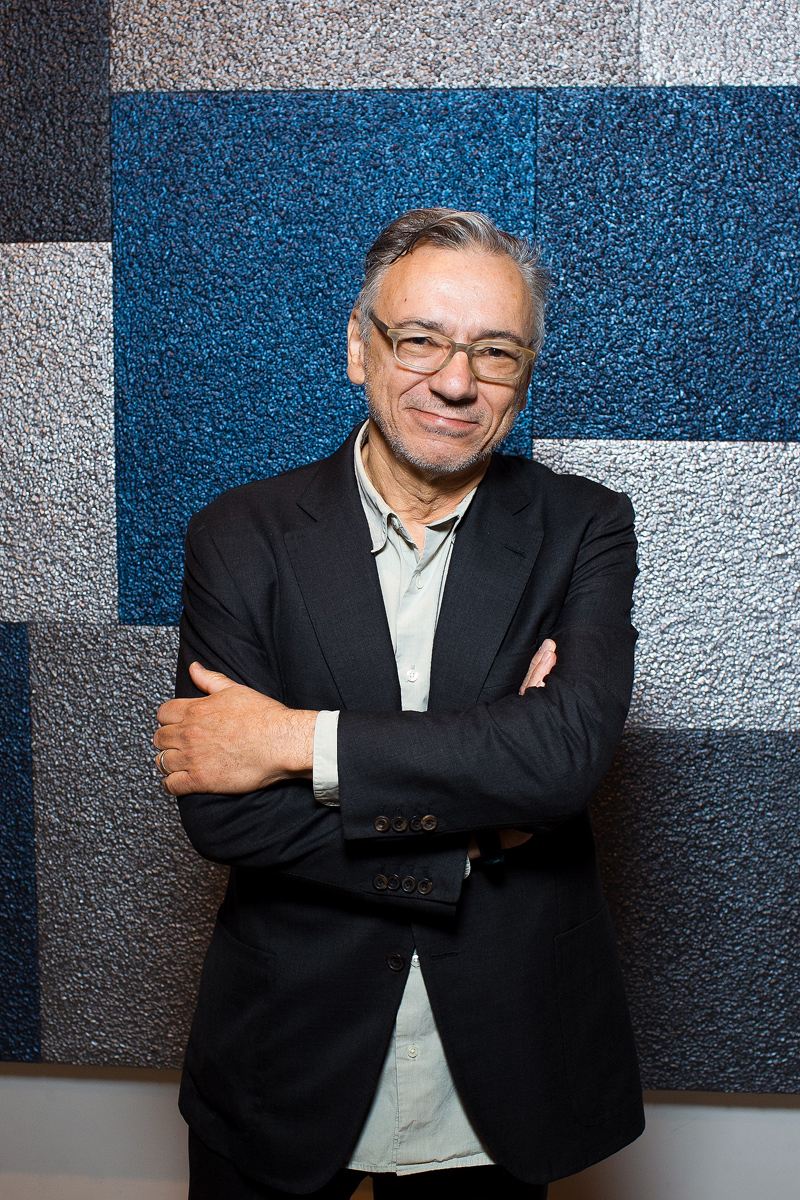
View on WikipediaPeter Halley (born 1953[3]) is an American artist and a central figure in the Neo-Conceptualist movement of the 1980s. Known for his Day-Glo geometric paintings, Halley is also a writer, the former publisher of index Magazine, and a teacher; he served as director of graduate studies in painting and printmaking at the Yale University School of Art from 2002 to 2011. Halley lives and works in New York City.
Key Information


Introduction
[edit]Halley came to prominence as an artist in the mid-1980s, as part of the generation of Neo-Conceptualist artists that first exhibited in New York's East Village, including Jeff Koons, Haim Steinbach, Sarah Charlesworth, Annette Lemieux, Steven Parrino, Phillip Taaffe, and Gretchen Bender.
Halley's paintings explore both the physical and psychological structures of social space; he connects the hermetic language of geometric abstraction—as practiced by artists such as Barnett Newman and Ellsworth Kelly—to the actualities of urban space and the digital landscape. In the 1990s, he expanded his practice to include public installations based around the technology of large-scale digital prints.
Halley is also known for his critical writings, which, beginning in the 1980s, linked the ideas of French Post-Structuralist theorists including Michel Foucault and Jean Baudrillard to the digital revolution and the visual arts. From 1996 to 2005, Halley published Index Magazine, which featured in-depth interviews with emergent and established figures in fashion, music, film, and other creative fields. Having also taught art in several graduate programs, Halley became the director of graduate studies in painting and printmaking at the Yale University School of Art, serving from 2002 to 2011.
Early life and education
[edit]Halley was born and raised in New York City. He is the son of Janice Halley, a registered nurse of Polish ancestry, and Rudolph Halley, an attorney and politician of German-Austrian Jewish descent. In 1951, Rudolph "became an instant celebrity," as Halley has said, while serving as chief prosecutor for the United States Senate Special Committee to Investigate Crime in Interstate Commerce, also known as the Kefauver Committee (after Senator Estes Kefauver). "This series of hearings with various colorful mobsters was broadcast on television all over the country," Halley notes.[4] Rudolph was also assistant counsel to the wartime Truman Committee, investigating fraud and waste in defense contracting. He served as president of the New York City Council from 1951 to 1953, and unsuccessfully ran for New York City Mayor in 1953. He died soon after at the age of forty-three, when Halley was three years old.[5][6]
Other notable family members include Rudolph's first cousin Carl Solomon (1928–1993), to whom Allen Ginsberg dedicated his epic poem "Howl (for Carl Solomon)" in 1955. Halley is also related to Samuel Shipman (1884–1937), a well-known and colorful writer of Broadway comedies in the 1920s. Halley's great aunt and uncle, Rose and A.A. Wyn, published Ace Comics from 1940 to 1956 and Ace Books from 1952 to 1973. Ace Books was an American publisher of science fiction that published William Burroughs's first novel, Junkie, in 1953, as well as the first novels by several prominent science-fiction writers including Philip K. Dick, Samuel R. Delany, and Ursula K. Le Guin.[4]
A precocious child, Peter started first grade at Manhattan's Hunter College Elementary School at the age of 5. He later attended Phillips Academy in Andover, Massachusetts, a prep school known for its art museum and, at the time, innovative art program. While at Andover, Halley took an interest in various forms of media and became the programming director for the school's low-wattage radio station. It was also during this time that he began painting, making his first works in his great uncle Aaron's art studio.[6]
He received college acceptances with full scholarships from Brown, Harvard, and Yale, but chose to study at Yale because of their renowned art program.[5] But, after his sophomore year, Halley was denied entry into the art major and decided to move to New Orleans, where he lived for one year. He returned to Yale the following year to study art history, and wrote his senior thesis on Henri Matisse before graduating in 1975. After graduation, Halley returned to New Orleans and, in 1976, enrolled in the University of New Orleans MFA program. He received his MFA in 1978 and lived in New Orleans until 1980 (also traveling to Mexico, Central America, Europe, and North Africa during this time).[7][8]
Career
[edit]
Early career and New York City
[edit]In 1980, Halley returned to New York City and moved into a loft on East 7th Street in the East Village, Manhattan; there, Talking Heads frontman David Byrne was his upstairs neighbor. New York City had a lasting influence on Halley's distinct painting style. He became enamored with the city's intensity, scale, and three-dimensional urban grid—the "geometricization of space that pervaded the 20th century." Likewise interested in abstract painting, Halley "set out to connect the language of geometric abstraction to the actual space that he saw all around him, transforming the square—borrowed from Malevich, Albers, and others—into architectural icons he called 'prisons' and 'cells,' and connecting them by straight lines called 'conduits.'"[9]
These particular geometric icons, which he developed in the early 1980s in the midst of a global technology boom, became the basis of Halley's painting for the decades to come. Halley derived his language not just from the urban grid but from the gridded networks permeating all facets of the contemporary "media-controlled, post-industrial world." With this background, the "cells" could be seen as "images of confinement and as cellular units in the scientific sense," according to Calvin Tomkins.[10] The "conduits"—the lines connect various "cells" and other geometric patterns in a given work—represent the supports of "underlying informational and structural components of contemporary society," Amy Brandt writes.[11] "Halley wished to incite public awareness of the confining, underlying structures of industrialized society and commodity capitalism."[11]
In addition to urban structures such as modernist buildings and subways, Halley drew influence from the pop themes and social issues associated with new wave music.[6][12] He took the modernist grid of previous abstract painting—namely, according to Brandt, the work of Frank Stella—and amplified its colors and impact in accordance with the postmodern times. During this early period, Halley employed new colors and materials with specific connotations. He began to use fluorescent Day-Glo paint, which has an uncanny glow that recalls the artificial lights of postmodern society and the bright government-issued signs that mark streets and workers' clothing. Halley also uses Day-Glo colors in response to developments in modernist painting—a "hyperrealization" of art-historical motifs, in Halley terms (following Jean Baudrillard)—and as a means of delineating space on his canvases.[13]
Halley also began to employ Roll-a-Tex, a textural additive that gives his "cells" and "prisons" a tactile, architectural quality, as Roll-a-Tex is most often used as surfacing in buildings such as suburban homes and motels.[14] The postmodern, commodity-like color and texture, not to mention the thickness, of Halley's canvases entered them into the art-historical conversation surrounding painting and objecthood. The mixture of harsh colors and textures at once "seduce[s] and repel[s] viewers with assaults on their senses of sight and touch."[15][16]
In the 1980s, Halley's practice and career developed amid the artistic and intellectual discourse that arose in East Village artist-run galleries like International with Monument, Cash/Newhouse, and Nature Morte. These spaces were a community for artists such as Halley, Jeff Koons, Haim Steinbach, Sherrie Levine, Ashley Bickerton, and Richard Prince, who "shared a focus on the role of technology in postmodern society and rejected nature as a touchstone of meaning." (Bob Nickas, Dan Cameron, and the curatorial team Tricia Collins and Richard Milazzo were curators and critics associated with this scene.)[8][17] These artists used irony and pastiche to subvert and comment upon structural issues of the time; they drew from Conceptual Art to create "paintings and sculptures that operated as a set of pictorial signs referencing artists and moments in postwar art history," expanding their boundaries as artists to also encompass the theoretical discourse around the art objects themselves.[18]
Halley staged solo projects at PS122 Gallery in 1980 and at the East Village bar Beulah Land in 1984. In 1983 he organized a show at the John Weber Gallery, Science Fiction, which included, among others, Jeff Koons as well as Ross Bleckner, Richard Prince, Taro Suzuki, Robert Smithson, and Donald Judd, the latter of whom had been an influence on Halley. Alison Pearlman described the relevance and influence of the show, writing:
The gallery presentation dramatized a pop-futuristic sensibility. To begin, the space was painted entirely black. Because many of the works incorporated geometric shapes, Plexiglas and lights, some flashing or rotating, the total effect was crystalline like a Star Trek idea of Peter Halley, Jeff Koons, and the Art at Marketing ... This high-tech sensibility has been common in popular science fiction as well as fashion, music, and other consumer products made to look geometricizing, streamlined, synthetic, or otherwise ultra-urban. The aesthetic coincides with actual fashions of the early 1980s.[19]
Halley's first larger one-person exhibition came in 1985 at International with Monument, a gallery at the heart of the East Village scene run by Meyer Vaisman, Kent Klamen, and Elizabeth Koury, who had all met at the Parsons School of Design.[20] Around this time, Halley introduced Jeff Koons to Vaisman, and Koons subsequently exhibited at International with Monument as well.
In October 1986, Vaisman organized a group show at New York's more established Sonnabend Gallery that featured work by Halley, Ashley Bickerton, Jeff Koons, and Vaisman himself. Embodying the intellectual style that had been established by International with Monument, the show marked a departure from the painterly style of Neo-Expressionism, the dominant style in New York's art scene of the earlier 1980s.[14][21] The exhibition at Sonnabend received popular and critical attention, and the four artists became identified on a wider scale with the labels "Neo-Geo" and "Neo-Conceptualism."[22] In New York magazine Kay Larson called the artists "Masters of Hype," while in the same magazine a month earlier, Paul Taylor had dubbed them "The Hot Four" and called Halley the "intellectual of the group."[21][22] Roberta Smith wrote in the New York Times that "Halley's geometric abstractions suggest diagrams of battery cells with conduits or prison cells with barred windows (that is, electrical or social systems), while their powerful fluorescent colors come from somewhere beyond art."[23]
Writing
[edit]As he began his art career, Halley became interested in the French Post-Structuralist writers, including Michel Foucault, Roland Barthes, Paul Virilio, and Jean Baudrillard, many of whose works were translated into English in the late 1970s and early 1980s and were being discussed among New York intellectuals.[24][25] The ideas of the French writers informed Halley's use of synthetic colors and materials in his painting, and also the writing that he began to produce around the same time.[26] "The modernism I grew up with was that it was spiritual," Halley said, "it was about a kind of purity and Emersonian transcendentalism ... Feeling less and less comfortable with that, I decided that for me modernism was really about skepticism, doubt, and questioning. Things that we now say are part of a postmodern sensibility."[27]
Halley put forth such ideas on modernism, postmodernism, culture, and the digital revolution—derived in part from Foucault, Baudrillard, and others, and with a neo-Marxist slant—in his numerous writings.[28] He published his first essay "Beat, Minimalism, New Wave, and Robert Smithson" in 1981 in Arts Magazine, a New York-based publication that published seven more of his essays throughout that decade.[29] In his essays, published from the 1980s to early 2000s, Halley makes reference to the shifting relationship between the individual and larger social structures, and how artists of his generation responded to the emerging social, economic, and cultural conditions of the 1980s and 1990s. Halley highlighted the various roles of new wave music, Cold War cultural politics, and the increased digitization of experience brought about by computers and video games. Additionally, he provided a critical overview of contemporary art during this period through examining a range of sources including the social theories of José Ortega y Gasset, Norbert Elias, and Richard Sennett.[30][31]
Bibliography
[edit]- Peter Halley, "Selected Essays 1981-2001", Edgewise Press, N.Y, 2013. ISBN 9781893207264 [32]
- Peter Halley, "Collected Essays, 1981-87", Bruno Bischofberger, 1988. ISBN 0-932499-68-6[33]
- Peter Halley, "Recent Essays 1990-1996", Edgewise Press, N.Y, 1997. ISBN 0-9646466-1-7[34]
Artwork from the 1990s to the present
[edit]Following the 1986 exhibition at Sonnabend Gallery, Halley had many more exhibitions in Europe and the United States, including his first museum survey, Peter Halley: Recent Paintings, at the Museum Haus Esters in Krefeld, Germany, in 1989. In 1991–1992, CAPC Musee d'Art Contemporain, Bordeaux, staged an extensive retrospective of Halley's work that traveled to FAE Musee d'art Contemporain, Lausanne, Switzerland; the Museo Nacional Centro de Arte Reina Sofia, Madrid; and the Stedelijk Museum, Amsterdam.[8][35][36]
In the 1990s, in response to the changes in communications and media caused by the digital revolution, Halley adapted his visual language to the effects of the digital revolution in the 1990s.[37] The "conduits" that marked his painting began to multiply and increase in complexity, and he began to add pearlescent and metallic paints to his Day-Glo color palette of the 1980s. "My earlier paintings were rational, diagrammatic, and logical," he said in a 1995 interview with Flash Art, explaining the difference between his '80s and subsequent outputs. "Then I made a break around 1990, and since then they've become really exaggerated, almost parodic; and they aren't analytical at all. In any case, I don't see a great formal break in the '90s, although there is a psychological break."[38] Around 1990 Halley began producing bas-reliefs, many of them hollow and constructed from fiberglass.[39] Soon after, he began experimenting with digital printing and web-based art.[40]
In 1993, Halley created Superdream Mutation, a digital print available for viewing and downloading on the web bulletin board-style platform The Thing. The piece, a monochrome image, was distributed as a GIF—and is considered to be the first artwork exclusively available for online viewing and sale (for twenty dollars).[41] Regarding this work, Halley highlighted his thought process and the way in which the digital work related to his painting: "I set up the matrix and the person has certain choices within it. It's also based on a Jasper Johns print edition from the mid-sixties, in which there was a line drawing of a target, and a little box of water colors. It was a kit. Another factor for the Web project was my skepticism about the notion of 'interactivity' on the computer. Most decisions are choices between two paths; binary decisions are the only possible ones with computers. So I wanted to do something in which the choices were very mechanistic."[42] Halley did another online project called Exploding Cell with the Museum of Modern Art, New York, on the occasion of his 1997 exhibition New Concepts in Printmaking 1: Peter Halley, a one-person show that highlighted Halley's print and installation practices. Exploding Cell was published online at the time and is still available to the public.[43] Glenn Lowry, director of the museum, has stated that this was MoMA's first digital acquisition.[44]
Throughout the twenty-first century, Halley has continued to employ his iconic "cells," "prisons" and "conduits" in his painting, as his primary subject remains the organization of social space. But, Halley explained in 2011, "the nature of the social space we live in has changed immensely in the last thirty years since my project began. When I started my work in the '80s, the limits of communications technology were the telephone, the fax machine, and cable television. In a very short time, we've gone from the era of limited, linear communications to the epoch of the web, Google, and Facebook."[45]
Digital prints and installations
[edit]In the mid-1990s, Halley started to produce site-specific installations for museums, galleries, and public spaces that would interact with the surrounding architecture. Halley began using Adobe Illustrator as a means of developing his compositions. He also began to explore printmaking, using a variety of techniques including silkscreen, digital, and inkjet printing. In his prints, Halley often includes comic book imagery as well as a new motif of explosions and exploding cells, often made through printing images from the computer.[38][46]
His installations mix imagery and media such as painting, fiberglass relief sculpture, wall-size flowcharts, and digitally generated wallpaper. Halley created his first site-specific installation at the Dallas Museum of Art; this installation included paintings, silkscreen prints, wallpaper, and murals of flow charts and other images.
Other notable installations include at Museum Folkwang, Essen, in 1999, and Disjecta, Portland, in 2012, as well as "Judgment Day," an installation of digital prints for the exhibition, Personal Structures, at the 54th Venice Biennale in 2011.[35][47] In 2016, he exhibited The Schirn Ring, a large, multi-part installation at Schirn Kunsthalle, Frankfurt, Germany.[48]
Halley has created several permanent works in public spaces. In 2002, Halley was commissioned by architects Abalos and Herreros for their recently completed public library in a working-class neighborhood populated by university students in the district of Usera, in Madrid. The architects wanted to cover the interior walls with text imagery and invited Halley to undertake the project. Halley designed wall murals using the text from Jorge Luis Borges’ story, La Biblioteca de Babel. He digitally mutated the text until it achieved a look he describes as ‘futuristic Arabic typography.’ Halley was fascinated by how Borges’ text, though written in European letters, gained the aspect of Arab calligraphy, referencing the Moorish rule in Spain that ended four hundred and fifty years ago. In 2005, he was commissioned to make a 17-by-40-foot painting consisting of a grid of eight individual panels, for the Dallas/Fort Worth International Airport, Texas.[49][50] Three years later, in 2008, he completed a permanent installation of digital prints extending over five floors for the Gallatin School of Individualized Study at New York University.[51] In 2018, Halley had a show of paintings at the Lever House on Park Avenue in New York City. The show included paintings with fluorescent geometric forms, in canvases that were not square, but which had rectilinear outlines. The show also included an installation of Halley's "exploding cells". Halley created an installation for the show in the exterior-facing windows of the Lever House, in which the light exuding from the windows was tinted fluorescent chartreuse.[52] The installation included a dance piece by Jessie Gold of Movement Research, in which dancers in the exterior-facing windows performed for an audience below.[53]
Halley's longstanding interest in design has led to collaborative installations with international designers, creating a compelling dialogue between fine art and design. In 2007 he collaborated with French designer Matali Crasset on an installation at Galerie Thaddaeus Ropac, Paris, France; and with Italian architect Alessandro Mendini at Galleria Massimo Minini, Brescia, Italy, and at Mary Boone Gallery, New York.[54]
Index Magazine
[edit]In 1996, Halley and Bob Nickas, a curator and writer, co-founded index, a magazine inspired by Andy Warhol's Interview that featured interviews with people in various creative fields. Halley ran index from his New York studio. The magazine often employed rising photographers like Juergen Teller, Terry Richardson, Wolfgang Tillmans, and Ryan McGinley, and ran interviews with artists of diverse media like Björk, Brian Eno, Marc Jacobs, Agnes b., Diamanda Galas, Harmony Korine, and Scarlett Johansson. Halley stopped production of index in 2005. In 2014, Rizzoli published Index A to Z: Art, Design, Fashion, Film, and Music in the Indie Era, which documents the magazine's run as well as that era's cultural movements.[55]
Teaching
[edit]Halley has taught and lectured at universities continuously throughout his career, both in the United States and abroad, including the Ludwig Maximilian University in Munich, Ecole Nationale Superieure des Beaux-Arts in Paris, Akademie der Bildenden Kunst in Vienna, Harvard University, and Hunter College of Art. In the late 1990s Halley taught in the graduate art programs at Columbia University, UCLA, and Yale University. From 2002 to 2011, he served as director of graduate studies for painting and printmaking at the Yale School of Art. Three of Halley's former students, Njideka Akunyili Crosby, Titus Kaphar, and Mary Reid Kelly, have received MacArthur Fellowships.
From 2010 to 2011, he was appointed as an endowed chair, the Leffingwell Professor of Painting, at the Yale University School of Art.[56]
Personal life
[edit]Halley has been married twice. Both of which have ended in divorce.[57] He has two children, Isabel Halley, a ceramicist, and Thomas Halley, a pre-school teacher.[58]
References
[edit]- ^ a b c Halley, Peter (2010). "BIOGRAPHICAL SUMMARY". Peter Halley. Retrieved 11 October 2010.
- ^ "Awards". The College Art Association. Retrieved 11 October 2010.
- ^ Sim, Stuart (2013-08-21). Fifty Key Postmodern Thinkers. Routledge. p. 124. ISBN 978-1-135-05290-4.
- ^ a b Interview with Katherine Hixson, "Peter Halley: Oeuvres de 1982 à 1991" exhibition catalogue, Bordeaux: CAPC, Musee d'Art Contemporain, 1991, 9.
- ^ a b Interview with Katherine Hixson, "Peter Halley: Oeuvres de 1982 à 1991" exhibition catalogue, Bordeaux: CAPC, Musee d'Art Contemporain, 1991, 10.
- ^ a b c Calvin Tomkins, "Between Neo- and Post-," The New Yorker, 24 Nov 1986, 106.
- ^ "Peter Halley: Oeuvres de 1982 à 1991" exhibition catalogue, Bordeaux: CAPC, Musee d'Art Contemporain, 1991, 12.
- ^ a b c "Peter Halley" exhibition catalogue, Galerie Thomas Munich, 2011, 8.
- ^ This Will Have Been: Art, Love & Politics in the 1980s, exhibition catalogue (Chicago: Museum of Contemporary Art Chicago, 2012).
- ^ Calvin Tomkins, "Between Neo- and Post-," The New Yorker, 24 Nov 1986, 109.
- ^ a b Amy Brandt, Interplay: Neoconceptual Art of the 1980s (Cambridge: MIT Press, 2014), 145.
- ^ Jeanne Siegel, "The Artist/Critic of the Eighties: Peter Halley and Stephen Westfall," Arts Magazine (Sep 1985): 72.
- ^ Amy Brandt, Interplay: Neoconceptual Art of the 1980s (Cambridge: MIT Press, 2014), 155, 163.
- ^ a b "Peter Halley" exhibition catalogue, Galerie Thomas Munich, 2011, 12.
- ^ Amy Brandt, Interplay: Neoconceptual Art of the 1980s (Cambridge: MIT Press, 2014), 151, 153.
- ^ Interview with Katherine Hixson, "Peter Halley: Oeuvres de 1982 à 1991" exhibition catalogue, Bordeaux: CAPC, Musee d'Art Contemporain, 1991, 15-16.
- ^ David Carrier, "Baudrillard as Philosopher, or, The End of Abstract Painting," Arts Magazine (Sep 1988): 52–53.
- ^ Amy Brandt, Interplay: Neoconceptual Art of the 1980s (Cambridge: MIT Press, 2014), 164.
- ^ Alison Pearlman, Unpackaging Art of the 1980s (Chicago:University of Chicago Press, 2003), 112-114.
- ^ Cara Jordan, Peter Halley, "Introduction," Stuart Shave Modern Art, 2017.
- ^ a b Paul Taylor, "The Hot Four," New York Magazine, 27 Oct 1986, 50–56.
- ^ a b Kay Larson, "Masters of Hype," New York Magazine, 10 Nov 1986, 100–103.
- ^ Roberta Smith, "Four Young East Villagers at Sonnabend Gallery," The New York Times, 28 Oct 1986, C30.
- ^ Richard Milazzo, Selected Essays: 1982-2001, "Introduction," Edgewise Press: New York, 2013. 7.]
- ^ Siegel, 1985; Stuart Sim, Fifty Key Postmodern Thinkers (New York: Routledge, 2013), 124–129.
- ^ Amy Brandt, Interplay: Neoconceptual Art of the 1980s (Cambridge: MIT Press, 2014), 151, 159.
- ^ Mark Rosenthal, Abstraction in the Twentieth Century, Guggenheim Museum: New York, 1996. 96.
- ^ Jeremy Gilbert-Rolfe, "Non-representation in 1988: Meaning Production Beyond the Scope of the Pious," Arts Magazine (May 1988): 30–39.
- ^ Richard Milazzo, Selected Essays: 1982-2001, "Introduction," Edgewise Press: New York, 2013. 3.
- ^ Richard Milazzo, Selected Essays: 1982-2001, "Introduction," Edgewise Press: New York, 2013. 10.
- ^ Alison Pearlman, Unpackaging Art of the 1980s (Chicago:University of Chicago Press, 2003), 106.
- ^ Ammirati, Domenick (2015). "The Invisible Giant: Postmodernism Redux, Part 1| Domenick Ammirati". DIS Magazine. Retrieved 2021-05-09.
- ^ Gilbert-Rolfe, Jeremy (November 1998). "Jeremy Gilbert-Rolfe on Peter Halley: Collected Essays 1981–87". www.artforum.com. Retrieved 2021-05-09.
- ^ Carrier, David (1998). "Review of Recent Essays: 1990-1996". The Journal of Aesthetics and Art Criticism. 56 (3): 320–321. doi:10.2307/432380. ISSN 0021-8529. JSTOR 432380.
- ^ a b Peter Halley: Recent Paintings, exhibition catalogue, Krefelder Kunstmuseen, Museum Haus Esters, Krefeld, Germany.
- ^ Peter Halley: Works from 1982–1991, exhibition catalogue, CAPC Musée d'art contemporain, Bordeaux, France.
- ^ Pariss Sloan, "Pleasure and Alienation," Tirade Magazine, Issue 3, (Apr 2014): 10–20.
- ^ a b Jeff Rian, "Peter Halley Makes a Move," Flash Art (Oct 1995): 89–92,128.
- ^ Alison Pearlman, Unpackaging Art of the 1980s (Chicago:University of Chicago Press, 2003), 131-132.
- ^ "Peter Halley | Artist Profile, Exhibitions & Artworks". ocula.com. 2021-05-09. Retrieved 2021-05-09.
- ^ David Platzker and Elizabeth Wyckoff, Hard Pressed: 600 Years of Prints and Process, Hudson Hills: New York, 2000. 32.
- ^ "Mark Tribe, "Peter Halley, On Line______ Rhizome, 4 May 1998".[permanent dead link]
- ^ "MoMA.org - Interactives - Projects - 1997 - Peter Halley, Exploding Cell - Index". www.moma.org.
- ^ "Glenn Lowry with Joachim Pissarro, Gaby Collins-Fernandez, and David Carrier," The Brooklyn Rail, 6 May 2015.
- ^ "Peter Halley" exhibition catalogue, Galerie Thomas Munich, 2011, 20.
- ^ Nancy Princenthal, "Peter Halley at the Museum of Modern Art," Art in America (May 1998): 121.
- ^ "Peter Halley "Judgment Day": An Installation in Personal Structures at the Venice Biennale". artdaily.com.
- ^ Danny Lewis, "Wander About an Art Installation Inspired by the Large Hadron Collider," Smithsonian (Online edition), www.smithsonian.com, 16 May 2016.
- ^ "Archived copy". Archived from the original on 2017-03-08. Retrieved 2017-03-07.
{{cite web}}: CS1 maint: archived copy as title (link) - ^ Spencer Michlin, "The Art of Flying," American Way, Fort Worth, TX, 15 Jul 2005, 32.
- ^ "The Guggenheim Museums and Foundation". The Guggenheim Museums and Foundation. Retrieved 2021-05-09.
- ^ McGrath, Katherine (24 September 2018). "Midtown Manhattan Is Bathed in Yellow Light Thanks to This Artist's Installation". Architectural Digest. Retrieved 2021-05-09.
- ^ "Jessie Gold | Pratt Institute". www.pratt.edu. Retrieved 2021-05-09.
- ^ Anna Bates, "Matali Crasset," Icon Eye (Nov 2007).
- ^ Alison Pearlman, Unpackaging Art of the 1980s (Chicago:University of Chicago Press, 2003), 128.
- ^ "Peter Halley Appointed the Leffingwell Professor". YaleNews. 2010-01-15. Retrieved 2019-11-15.
- ^ McMahon, Katherine (31 July 2019). "Habitat: The Art of the Dinner Party, With New York Art Types Who Use Food to Foster Community". ARTnews. Retrieved 18 November 2019.
- ^ "Peter Halley's New Gallery in Germany". Observer.com. 24 August 2011. Retrieved 18 November 2019.
Further reading
[edit]- Baumgärtel, Tilman (2001). net.art 2.0 - New Materials towards Net art. Nürnberg: Verlag für Moderne Kunst Nürnberg. pp. 78–87. ISBN 3-933096-66-9.
External links
[edit] Media related to Peter Halley at Wikimedia Commons
- Official website
- Index Magazine Published by Peter Halley from 1996 to 2005
- Peter Halley Artist Page at Sommer Contemporary Art Gallery Website
- In the collection of MoMA
- Greene Naftali Gallery, New York
- Stuart Shave Modern Art, London

Peter Halley
View on GrokipediaEarly Life and Education
Childhood in New York
Peter Halley was born on September 24, 1953, in New York City to parents Janice Halley, a registered nurse, and Rudolph Halley. His birth occurred by cesarean section at 11:54 p.m. at Flower and Fifth Avenue Hospital. In 1956, Halley's family relocated to a 1940s-era apartment building at 48th Street and Third Avenue in midtown Manhattan, a sixteen-story structure in what was then a low-rise residential neighborhood before subsequent zoning changes spurred high-rise development.[6][7][8] He resided there throughout his childhood, fostering a deep personal identification with the city's urban fabric and evolving skyline.[9] Halley's early years in Manhattan exposed him to the intellectual and artistic currents of the New York School, including the geometric abstractions and heroic scale of postwar painters such as Mark Rothko, Barnett Newman, and Ad Reinhardt, whose works permeated the local cultural environment.[6] His family background, characterized by tolerant values and connections to a wealthy, old-line Jewish lineage through maternal relatives like Irving Schachtel, further shaped his formative experiences amid the city's mid-20th-century dynamism.Yale and New Orleans Studies
Peter Halley received a Bachelor of Arts degree in art history from Yale University in 1975.[10][11] At Yale, he immersed himself in the undergraduate art history curriculum while beginning to produce early abstract geometric paintings, which he continued to refine during his studies.[12] A key aspect of his Yale experience involved associating with graduate students connected to the New York art scene, exposing him to emerging trends in the early 1970s, a period marked by dynamic shifts in American art toward conceptual and minimal approaches.[12] After graduating from Yale, Halley relocated to New Orleans and enrolled in 1976 in the newly launched Master of Fine Arts program in painting at the University of New Orleans, earning the degree in 1978.[6][11] The program lasted approximately two and a half years, during which Halley worked under the supervision of professor Howard Jones, who was assigned to guide him.[13] In New Orleans, Halley rented a studio and drew from the city's distinctive visual and cultural milieu—including its commercial vibrancy and urban textures—which prompted his initial experiments with non-traditional materials like Day-Glo paints and rollers in painting.[10][13] He resided in the city continuously until 1980, using the period to consolidate the geometric motifs and fluorescent color palette that would define his mature style.[14][10] This Southern interlude contrasted with Yale's more formalist academic environment, fostering a pragmatic, site-responsive evolution in his practice grounded in local industrial and architectural observations.[6]Artistic Beginnings
Influences from Minimalism and Geometry
Peter Halley's artistic development in the late 1970s drew from the geometric austerity and industrial materials of Minimalism, particularly the hard-edged abstractions of Frank Stella and Donald Judd, whose works emphasized non-referential forms and rejected illusionistic depth.[6] [15] Halley adapted these influences by incorporating Day-Glo fluorescent pigments and roller-applied textures, transforming minimalist neutrality into vibrant, diagrammatic symbols that evoked technological confinement rather than pure opticality.[16] [17] This shift subverted the supposed detachment of Minimalist geometry, infusing it with references to urban infrastructure and digital networks, as seen in his early "cells" and "conduits" motifs that parallel but critique Judd's box-like units and Stella's shaped canvases.[18] [19] Geometry served as a foundational lexicon for Halley, rooted in the precise, modular forms of 1960s Minimalism, yet he positioned his practice against the "geometric mysticism" of earlier modernists like Piet Mondrian and Kazimir Malevich, favoring instead a secular, information-age reinterpretation.[20] In essays such as "The Crisis in Geometry" (1981), Halley argued that traditional geometric forms had lost transcendental authority amid postmodern fragmentation, prompting him to deploy squared "cells" with stucco-like surfaces and linear "conduits" to diagram flows of energy and isolation in contemporary society.[21] These elements, often rendered on canvas with synthetic rollers for uniformity, echoed Minimalist seriality—Judd's galvanized iron repetitions or Stella's metallic powders—but loaded them with connotative weight, such as prisons or circuit boards, to reflect 1980s techno-culture's seductive yet restrictive geometries.[21] [3] Halley's neo-geometric approach, sometimes termed "neo-constructivist," built on Minimalism's rejection of expressionism by prioritizing fabricated icons over gestural marks, yet he explicitly diverged by assigning signifieds to signifiers, countering Judd's insistence on referent-free objects.[22] [18] This synthesis emerged during his time in New York and New Orleans, where exposure to industrial environments reinforced geometry's role as a tool for mapping alienation, evident in paintings like Two Cells with Conduit (1980), which deploy interlocking rectangles and lines to evoke enclosed spaces connected by restrictive pathways.[16] By the early 1980s, these influences coalesced into a signature vocabulary that has persisted, using geometry not for formalist purity but for causal analysis of modernity's spatial and social constraints.[23][24]Shift to Cells and Conduits in the 1970s
In the late 1970s, following his graduation from Yale University in 1978 with a BA in art history and painting, Peter Halley began developing geometric abstractions that prefigured his iconic cells and conduits, departing from earlier landscape and representational influences.[3] These works emphasized rigid, modular forms evoking confinement and connectivity, drawing on post-structuralist theory, including Michel Foucault's examinations of prisons as mechanisms of social control and surveillance.[3] Halley's interest in Foucault, alongside thinkers like Roland Barthes and Jean Baudrillard, informed a critique of modernity's isolating structures, where enclosed geometric units—proto-cells—symbolized hermetic isolation amid networked flows.[10] Halley's experimentation during this period incorporated commercial materials like Day-Glo fluorescent acrylics and textured additives such as Roll-a-Tex, techniques he first explored in New Orleans between 1973 and 1974 while pursuing independent studies.[10] These elements created luminous, artificial surfaces that underscored the commodified, electric quality of urban and technological environments, contrasting the subdued palettes of Minimalism and Color Field precedents like those of Frank Stella or Barnett Newman.[6] By late 1979, as Halley relocated toward New York—permanently settling there in 1980—his canvases featured angular grids and linear extensions hinting at conduits, reflecting the city's orthogonal infrastructure as a diagram of power distribution and alienation.[3] This transitional phase, though not yet fully codified until 1981 with paintings like Freudian Painting, represented a deliberate rejection of organic abstraction in favor of diagrammatic iconography addressing late-20th-century information systems and spatial regimentation.[25] Halley's writings from the era, such as early essays on geometry's social implications, reveal a first-principles analysis of how abstract forms encode causal relations between isolation (cells as bounded prisons) and circulation (conduits as energy vectors), grounded in empirical observations of urban wiring and architectural modularity rather than purely formal concerns.[16] The shift prioritized synthetic vibrancy over naturalism, yielding paintings that, by 1980, employed up to four Day-Glo hues per composition to amplify perceptual intensity and critique consumerist spectacle.[26]Career in New York
East Village Scene and 1980s Breakthrough
In 1980, Peter Halley returned to New York City after studies in New Orleans and established a studio loft at 128 East 7th Street in the East Village, a neighborhood then emerging as an epicenter for affordable artist spaces and experimental galleries amid economic recession and the dominance of neo-expressionism in SoHo.[27][28] The East Village scene, fueled by artist-run venues like White Columns and Civilian Warfare, emphasized DIY aesthetics, graffiti-influenced works, and conceptual challenges to commodified art, providing Halley a platform to refine his geometric paintings amid peers such as Jeff Koons and Ashley Bickerton.[29][30] Halley debuted locally with a solo exhibition at PS122 Gallery in December 1980, followed by another at Beulah Land Gallery in 1981, where he presented early iterations of his "cells and conduits" motifs—rectilinear forms in Day-Glo colors evoking digital networks and confinement, contrasting the era's figurative excess.[27] These shows positioned him within the scene's neo-conceptual undercurrent, which critiqued modernism through abstracted geometries rather than embracing the raw expressionism of artists like Jean-Michel Basquiat or Keith Haring.[8] His breakthrough accelerated in 1985 with a solo exhibition at International with Monument, an East Village gallery space that amplified his visibility and underscored the neighborhood's role in launching neo-geometric artists against prevailing trends.[31] This exposure culminated in a 1986 group show at Ileana Sonnabend's SoHo gallery alongside Koons and Bickerton, marking Halley's transition from fringe experimentation to institutional acclaim and solidifying his reputation for paintings that interrogated electric-age isolation through vibrant, prison-like grids.[32] By decade's end, Halley's East Village roots had propelled over 50 paintings produced in the 1980s, many now cataloged as foundational to his oeuvre.[27]Expansion into Installations and Digital Media
In the mid-1990s, Halley began incorporating digital processes into his practice, as seen in Exploding Cell (1994), a silkscreen print conceived as a digital project that required generating new iterations for each installation, thereby extending traditional printmaking through computational variability.[26] This marked an early pivot from canvas-bound paintings to media leveraging algorithms and digital files, allowing for scalable, site-responsive outputs that echoed his motifs of cells and conduits in virtual and physical spaces.[33] By the 2000s, Halley expanded into large-scale installations, executing permanent commissions such as those at Dallas/Fort Worth International Airport and integrating digital elements like computer-generated wallpaper and flowcharts derived from disk files.[10] These works employed digital tools to produce patterns critiquing technological rationalization, aligning with his theoretical interests in modernity's geometries.[31] A notable progression occurred in 2017 with a permanent installation of digital mural prints at New York University's Gallatin School of Individualized Study, where algorithmic designs translated his Day-Glo abstractions into architectural interventions.[34] Halley's installations gained immersive dimensions in the late 2010s, exemplified by Heterotopia I (2019) at the Venice Academy of Fine Arts, a multimedia environment blending painting, sculpture, and digital projections to evoke Foucauldian "transgressive spaces" amid urban isolation.[9] That year, his debut at Greene Naftali Gallery featured a multipart setup combining paintings, wall-sized digital prints, and sculptural elements, demonstrating how digital reproduction enabled hybrid forms that interrogated digital connectivity's isolating effects.[31] Subsequent commissions, like New York, New York (undated site-specific at Lever House), utilized digitally generated stencils for hand-painted murals, merging analog execution with computational precision to scale his iconography across building facades.[35] Recent projects underscore this evolution's persistence, including The Mirror Stage (2024–2025) at NSU Art Museum Fort Lauderdale, an immersive site-specific installation reflecting on specular digital interfaces through geometric interventions.[36] Halley's use of digital media thus facilitates critiques of control and flow in contemporary networks, expanding his neo-conceptual framework beyond static paintings into dynamic, environment-altering experiences.[37]Painting Style and Techniques
Iconography of Confinement and Flow
Peter Halley's iconography employs a limited set of geometric motifs—prisons, cells, and conduits—to depict the dual dynamics of confinement and circulation in modern urban and technological environments. Prisons and cells appear as bounded squares, frequently rendered with simulated stucco textures using Roll-a-Tex, evoking the isolating enclosures of apartments, hospital rooms, or institutional structures.[38] These forms subvert the modernist square's purported neutrality, transforming it into a symbol of restriction, as Halley articulated in his writings: "the idealist square becomes the prison. Geometry is revealed as confinement."[39] Conduits, by contrast, manifest as radiating lines or tubes that connect or emanate from cells, signifying flows of electricity, data, or capital through networked systems.[21] In Halley's formulation, these elements populate a "digital field" where confinement intersects with flux, reflecting the postmodern erosion of geometry's traditional stability into "shifting signifiers and images of confinement and flow."[21] This binary draws partial inspiration from Michel Foucault's examinations of geometric spatial organization in industrial society, particularly mechanisms of surveillance and enclosure, though Halley adapts it to critique abstract art's complicity in ideological containment.[16] Early examples, such as Red Cell with Conduit (1982), partition the canvas into an upper cell-like enclosure and a lower conduit section, using Day-Glo pigments to heighten their luminous, electric quality against darker grounds.[40] By the mid-1980s, compositions like Two Cells with Conduit (1987) expanded to diptychs or multi-panel formats, with paired cells linked by conduits to underscore relational isolation amid connectivity, measuring up to 6 feet 6 inches by 12 feet 10 inches.[16] Halley's consistent restriction to these icons across series maintains a diagrammatic precision, prioritizing conceptual clarity over illusionistic depth.[41]