Hubbry Logo
search
logo
2228285

Phosphorescence

logo
Community Hub0 Subscribers
Read side by side
from Wikipedia
Phosphorescent bird figure
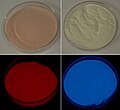
Phosphorescent, europium-doped, strontium silicate-aluminate oxide powder under visible light, fluorescing/phosphorescing under long-wave UV light, and persistently phosphorescing in total darkness

Phosphorescence is a type of photoluminescence related to fluorescence. When exposed to light (radiation) of a shorter wavelength, a phosphorescent substance will glow, absorbing the light and reemitting it at a longer wavelength. Unlike fluorescence, a phosphorescent material does not immediately reemit the radiation it absorbs. Instead, a phosphorescent material absorbs some of the radiation energy and reemits it for a much longer time after the radiation source is removed.

In a general sense, there is no distinct boundary between the emission times of fluorescence and phosphorescence (i.e.: if a substance glows under a black light it is generally considered fluorescent, and if it glows in the dark it is often simply called phosphorescent).[1] In a modern, scientific sense, the phenomena can usually be classified by the three different mechanisms that produce the light and the typical timescales at which they emit light: fluorescence, triplet phosphorescence, and persistent phosphorescence. Whereas fluorescent materials stop emitting light within nanoseconds (billionths of a second) after the excitation radiation is removed, phosphorescent materials may continue to emit an afterglow ranging from a few microseconds to many hours after the excitation is removed.[2]

There are two separate mechanisms that may produce phosphorescence, called triplet phosphorescence (or simply phosphorescence) and persistent phosphorescence (or persistent luminescence):

  • Triplet phosphorescence occurs when an atom absorbs a high-energy photon, and the energy becomes locked in the spin multiplicity of the electrons, generally changing from a fluorescent singlet state to a slower emitting triplet state. The slower timescales of the reemission are associated with "forbidden" energy state transitions in quantum mechanics. As these transitions occur relatively slowly in certain materials, absorbed radiation is reemitted at a lower intensity, ranging from a few microseconds to as much as one second after the excitation is removed.[3]
  • Persistent phosphorescence occurs when a high-energy photon is absorbed by an atom and its electron becomes trapped in a defect in the lattice of the crystalline or amorphous material. A defect such as a missing atom (vacancy defect) can trap an electron like a pitfall, storing that electron's energy until released by a random spike of thermal (vibrational) energy. Such a substance will then emit light of gradually decreasing intensity, ranging from a few seconds to up to several hours after the original excitation.[4]

Everyday examples of phosphorescent materials are the glow-in-the-dark toys, stickers, paint, and clock dials that glow after being charged with a bright light such as in any normal reading or room light. Typically, the glow slowly fades out, sometimes within a few minutes or up to a few hours in a dark room.[further explanation needed][5]

The study of phosphorescent materials led to the discovery of radioactive decay.

Etymology

[edit]

The term phosphorescence comes from the Ancient Greek word φῶς (phos), meaning "light", and the Greek suffix -φόρος (-phoros), meaning "to bear", combined with the Latin suffix -escentem, meaning "becoming of", "having a tendency towards", or "with the essence of".[6] Thus, phosphorescence literally means "having a tendency to bear light". It was first recorded in 1766.[7]

The term phosphor had been used since the Middle Ages to describe minerals that glowed in the dark. One of the most famous, but not the first, was Bolognian phosphor. Around 1604, Vincenzo Casciarolo discovered a "lapis solaris" near Bologna, Italy. Once heated in an oxygen-rich furnace, it thereafter absorbed sunlight and glowed in the dark. In 1677, Hennig Brand isolated a new element that glowed due to a chemiluminescent reaction when exposed to air, and named it "phosphorus".[8]

In contrast, the term luminescence (from the Latin lumen for "light"), was coined by Eilhardt Wiedemann in 1888 as a term to refer to "light without heat", while "fluorescence" by Sir George Stokes in 1852, when he noticed that, when exposing a solution of quinine sulfate to light refracted through a prism, the solution glowed when exposed to the mysterious invisible-light (now known to be UV light) beyond the violet end of the spectrum. Stokes formed the term from a combination of fluorspar and opalescence (preferring to use a mineral instead of a solution), albeit it was later discovered that fluorspar glows due to phosphorescence.[9]

There was much confusion between the meanings of these terms throughout the late nineteenth to mid-twentieth centuries. Whereas the term "fluorescence" tended to refer to luminescence that ceased immediately (by human-eye standards) when removed from excitation, "phosphorescence" referred to virtually any substance that glowed for appreciable periods in darkness, sometimes to include even chemiluminescence (which occasionally produced substantial amounts of heat). Only after the 1950s and 1960s did advances in quantum electronics, spectroscopy, and lasers provide a measure to distinguish between the various processes that emit the light, although in common speech the distinctions are still often rather vague.[10]

Introduction

[edit]
Jablonski diagram of an energy scheme used to explain the difference between fluorescence and phosphorescence. The excitation of molecule A to its singlet excited state (1A*) may, after a short time between absorption and emission (fluorescence lifetime), return immediately to ground state, giving off a photon via fluorescence (decay time). However, sustained excitation is followed by intersystem crossing to the triplet state (3A) that relaxes to the ground state by phosphorescence with much longer decay times.

In simple terms, phosphorescence is a process in which energy absorbed by a substance is released relatively slowly in the form of light. This is in some cases the mechanism used for glow-in-the-dark materials which are "charged" by exposure to light. Unlike the relatively swift reactions in fluorescence, such as those seen in laser mediums like the common ruby, phosphorescent materials "store" absorbed energy for a longer time, as the processes required to reemit energy occur less often. However, timescale is still only a general distinction, as there are slow-emitting fluorescent materials, for example uranyl salts, and, likewise, some phosphorescent materials like zinc sulfide (in violet) are very fast. Scientifically, the phenomena are classified by the different mechanisms that produce the light, as materials that phosphoresce may be suitable for some purposes such as lighting, but may be completely unsuitable for others that require fluorescence, like lasers. Further blurring the lines, a substance may emit light by one, two, or all three mechanisms depending on the material and excitation conditions.[further explanation needed][11]

When the stored energy becomes locked in by the spin of the atomic electrons, a triplet state can occur, slowing the emission of light, sometimes by several orders of magnitude. Because the atoms usually begin in a singlet state of spin, favoring fluorescence, these types of phosphors typically produce both types of emission during illumination, and then a dimmer afterglow of strictly phosphorescent light typically lasting less than a second after the illumination is switched off.

Conversely, when the stored energy is due to persistent phosphorescence, an entirely different process occurs without a fluorescence precursor. When electrons become trapped within a defect in the atomic or molecular lattice, light is prevented from reemitting until the electron can escape. To escape, the electron needs a boost of thermal energy to help spring it out of the trap and back into orbit around the atom. Only then can the atom emit a photon. Thus, persistent phosphorescence is highly dependent on the temperature of the material.[12]

Triplet phosphorescence

[edit]
After an electron absorbs a photon of high energy, it may undergo vibrational relaxations and intersystem crossing to another spin state. Again the system relaxes vibrationally in the new spin state and eventually emits light by phosphorescence.

Most photoluminescent events, in which a chemical substrate absorbs and then re-emits a photon of light, are fast, in the order of 10 nanoseconds. Light is absorbed and emitted at these fast time scales in cases where the energy of the photons involved matches the available energy states and allowed transitions of the substrate. In the special case of phosphorescence, the electron which absorbed the photon (energy) undergoes an unusual intersystem crossing into an energy state of different (usually higher) spin multiplicity (see term symbol), usually a triplet state. As a result, the excited electron can become trapped in the triplet state with only "forbidden" transitions available to return to the lower energy singlet state. These transitions, although "forbidden", will still occur in quantum mechanics but are kinetically unfavored and thus progress at significantly slower time scales. Most phosphorescent compounds are still relatively fast emitters, with triplet decay-times in the order of milliseconds.

Common examples include the phosphor coatings used in fluorescent lamps, where phosphorescence on the order of milliseconds or longer is useful for filling in the "off-time" between AC current cycles, helping to reduce "flicker". Phosphors with faster decay times are used in applications like the pixels excited by free electrons (cathodoluminescence) in cathode-ray tube television-sets, which are slow enough to allow the formation of a picture as the electron beam scans the screen, but fast enough to prevent the frames from blurring together.[13][14] Even substances commonly associated with fluorescence may in fact be prone to phosphorescence, such as the liquid dyes found in highlighter pens, which is a common problem in liquid dye lasers. The onset of phosphorescence in this case can sometimes be reduced or delayed significantly by the use of triplet-quenching agents.[15]

Equation

[edit]

where S is a singlet and T a triplet whose subscripts denote states (0 is the ground state, and 1 the excited state). Transitions can also occur to higher energy levels, but the first excited state is denoted for simplicity.

Persistent phosphorescence

[edit]
An extremely intense pulse of short-wave UV light in a flashtube produced this blue persistent-phosphorescence in the amorphous, fused silica envelope, lasting as long as 20 minutes after the 3.5 microsecond flash.
An electron microscope reveals vacancy defects in a crystalline lattice of molybdenum disulfide. The missing sulfur atoms leave dangling bonds between the molybdenum atoms, creating traps in the empty spaces.

Solid materials typically come in two main types: crystalline and amorphous. In either case, a lattice or network of atoms and molecules form. In crystals, the lattice is a very neat, uniform assembly. However, nearly all crystals have defects in the stacking sequence of these molecules and atoms. A vacancy defect, where an atom is simply missing from its place, leaving an empty "hole", is one type of defect. Sometimes atoms can move from place to place within the lattice, creating Schottky defects or Frenkel defects. Other defects can occur from impurities in the lattice. For example, when a normal atom is substituted by a different atom of much larger or smaller size, a substitutional defect occurs, while an interstitial defect occurs when a much smaller atom gets trapped in the "interstices", or the spaces between atoms. In contrast, amorphous materials have no "long-range order" (beyond the space of a few atoms in any direction), thus by definition are filled with defects.

When a defect occurs, depending on the type and material, it can create a hole, or a "trap". For example, a missing oxygen atom from a zinc oxide compound creates a hole in the lattice, surrounded by unbound zinc-atoms. This creates a net force or attraction that can be measured in electron-volts.[further explanation needed] When a high-energy photon strikes one of the zinc atoms, its electron absorbs the photon and is thrown out into a higher orbit. The electron may then enter the trap and be held in place (out of its normal orbit) by the attraction. To trigger the release of the energy, a random spike in thermal energy of sufficient magnitude is needed to boost the electron out of the trap and back into its normal orbit. Once in orbit, the electron's energy can drop back to normal (ground state) resulting in the release of a photon.[16]

The release of energy in this way is a completely random process, governed mostly by the average temperature of the material versus the "depth" of the trap, or how many electron-volts it exerts.[citation needed] A trap that has a depth of 2.0 electron-volts would require a great amount of thermal energy (very high temperature) to overcome the attraction, while at a depth of 0.1 electron-volts very little heat (very cold temperature) is needed for the trap to even hold an electron. Generally, higher temperatures cause a faster release of energy, resulting in a brighter yet short-lived emission, while lower temperatures produce a dimmer but longer-lasting glow. Temperatures that are too hot or cold, depending on the substance, may not allow the accumulation or release of energy at all. The ideal depth of trap for persistent phosphorescence at room temperature is typically between 0.6 and 0.7 electron-volts.[17] If the phosphorescent quantum yield is high, that is, if the substance has a large number of traps of the correct depth, this substance will release a significant amount of light over a long period of time, creating a so-called "glow in the dark" material.

Chemiluminescence

[edit]

Some examples of glow-in-the-dark materials do not glow by phosphorescence. For example, glow sticks glow due to a chemiluminescent process which is commonly mistaken for phosphorescence. In chemiluminescence, an excited state is created via a chemical reaction. The light emission tracks the kinetic progress of the underlying chemical reaction. The excited state will then transfer to a dye molecule, also known as a sensitizer or fluorophor, and subsequently fluoresce back to the ground state.

Materials

[edit]

Common pigments used in phosphorescent materials include zinc sulfide and strontium aluminate. Use of zinc sulfide for safety related products dates back to the 1930s.

The development of strontium aluminate pigments in 1993 was spurred on by the need to find a substitute for glow-in-the-dark materials with high luminance and long phosphorescence, especially those that used promethium.[18][19] This led to the discovery by Yasumitsu Aoki (Nemoto & Co.) of materials with luminance approximately 10 times greater than zinc sulfide and phosphorescence approximately 10 times longer.[20][21] This has relegated most zinc sulfide based products to the novelty category. Strontium aluminate based pigments are now used in exit signs, pathway marking, and other safety related signage.[22]

Since both phosphorescence (transition from T1 to S0) and the generation of T1 from an excited singlet state (e.g., S1) via intersystem crossing (ISC) are spin-forbidden processes, most organic materials exhibit insignificant phosphorescence as they mostly fail to populate the excited triplet state, and, even if T1 is formed, phosphorescence is most frequently outcompeted by non-radiative pathways. One strategy to enhance the ISC and phosphorescence is the incorporation of heavy atoms, which increase spin-orbit coupling (SOC).[23] Additionally, the SOC (and therefore the ISC) can be promoted by coupling n-π* and π-π* transitions with different angular momenta, also known as Mostafa El-Sayed's rule. Such transitions are typically exhibited by carbonyl or triazine derivatives, and most organic room-temperature phosphorescent (ORTP) materials incorporate such moieties.[24][25] In turn, to inhibit competitive non-radiative deactivation pathways, including vibrational relaxation and oxygen quenching and triplet-triplet annihilations, organic phosphors have to be embedded in rigid matrices such as polymers, and molecular solids (crystals,[26] covalent organic frameworks,[27] and others).

Uses

[edit]
Phosphorescent elements of a wrist watch that had been exposed to bright (ultraviolet) light

In 1974 Becky Schroeder was given a US patent for her invention of the "Glow Sheet" which used phosphorescent lines under writing paper to help people write in low-light conditions.[28]

Glow in the dark material is added to the plastic blend used in injection molds to make some disc golf discs, which allow the game to be played at night.

Often clock faces of watches are painted with phosphorescent colours. Therefore, they can be used in absolute dark environments for several hours after having been exposed to bright light.

A common use of phosphorescence is decoration. Stars made of glow-in-the-dark plastic are placed on walls, ceilings, or hanging from strings make a room look like the night sky.[29] Other objects like figurines, cups, posters,[30] lamp fixtures, toys[31] and bracelet beads may also glow.[32] Using blacklights makes these things glow brightly, common at raves, bedrooms, theme parks, and festivals.

Shadow wall

[edit]

A shadow wall is created when a light flashes upon a person or object in front of a phosphorescent screen which temporarily captures the shadow. The screen or wall is painted with a glow-in-the-dark product that contains phosphorescent compounds.[33] Publicly, these shadow walls can be found at certain science museums.[34][35]

See also

[edit]

References

[edit]
[edit]
Revisions and contributorsEdit on WikipediaRead on Wikipedia
from Grokipedia
Phosphorescence is a type of photoluminescence in which a substance absorbs electromagnetic radiation, typically ultraviolet light, and re-emits it as visible light over an extended period, often lasting from seconds to days after the excitation source is removed.[1] This delayed emission distinguishes phosphorescence from fluorescence, where light is released almost immediately upon excitation, and arises from a forbidden quantum transition involving a change in electron spin multiplicity, usually from a triplet excited state to the singlet ground state.[2] The mechanism of phosphorescence involves the promotion of an electron to a higher energy state upon photon absorption, followed by intersystem crossing to a triplet state where the spin is flipped, prohibiting rapid decay and leading to prolonged emission lifetimes on the order of milliseconds to minutes.[3] This process is quantum mechanically "forbidden" due to spin conservation rules, but occurs with lower probability, enabling the characteristic afterglow observed in phosphorescent materials.[4] Common examples include strontium aluminate-based compounds used in glow-in-the-dark toys and zinc sulfide in traditional phosphors, where the emitted light is typically at longer wavelengths than the absorbed radiation.[5] The phenomenon has been known since ancient times, with scientific study beginning in the early 17th century. The modern understanding of its spin-forbidden nature was established by Francis Perrin in 1926.[6] Phosphorescence finds diverse applications in science and industry, including safety signage and exit markers that remain visible in the dark without power, as seen in persistent phosphors like SrAl₂O₄:Eu²⁺,Dy³⁺ developed in the 1990s.[7] In analytical chemistry, phosphorescence spectroscopy enables sensitive detection in environmental monitoring and biomedical imaging, such as oxygen sensing via lifetime measurements.[8] Emerging uses include organic room-temperature phosphorescent polymers for flexible displays, anti-counterfeiting technologies, bioimaging, and circularly polarized materials for advanced optoelectronics, leveraging their tunable emission properties (as of 2025).[9][10][11]

History and Terminology

Etymology

The term "phosphorescence" originates from the Ancient Greek words φῶς (phōs), meaning "light," and φόρος (phoros), meaning "bearer" or "carrier," literally translating to "light-bearer." This etymological root reflects the phenomenon's association with self-sustained or induced light emission without heat or combustion. The word entered English in the late 18th century, with its first recorded use around 1796, derived from the French "phosphorescence" (attested in 1788), building on the adjective "phosphorescent" coined in 1766 from Latin phosphorus and the suffix -escent, denoting a faint, persistent glow resembling that of phosphorus.[12] The precursor term "phosphor" emerged in alchemical contexts during the early 17th century, initially applied broadly to any material or natural process emitting light in the dark without apparent cause, such as bioluminescent organisms (e.g., fireflies) or decaying wood. This usage stemmed from the Greek Phosphoros, the name for the morning star (Venus), symbolizing a bringer of light, and was adapted by alchemists to describe elusive, glowing substances sought for their mystical properties. A pivotal early application occurred in 1603 when Italian alchemist Vincenzo Casciarolo (also known as Vincenzo Cascariolo) heated barytes (barium sulfate) with charcoal, creating "Bologna stone" or "lapis solaris," which absorbed sunlight and emitted a greenish glow at night; he and contemporaries dubbed this "lapis phosphoros," marking the first scientific-like naming of a persistent luminescent material.[13] By the mid-17th century, the term "phosphor" evolved with the isolation of the element phosphorus in 1669 by Hennig Brand, a glowing substance derived from urine that spontaneously oxidized and luminesced, further entrenching the word in chemical nomenclature while shifting its connotation from alchemical wonder to observable natural property. In the 18th and 19th centuries, as optical physics advanced, "phosphorescence" narrowed to specifically denote delayed light emission persisting after the removal of excitation, distinguishing it from instantaneous glows and aligning with empirical studies of excited states in materials. This refinement solidified its modern scientific usage, separate from broader luminous phenomena.[13]

Discovery and Early Observations

The phenomenon of phosphorescence was first documented in the early 17th century when Italian alchemist and shoemaker Vincenzo Casciarolo discovered a material known as "Bologna stone" near Bologna in 1603. This substance, an impure form of barium sulfate (barite) treated with heat and reducing agents, absorbed sunlight during the day and emitted a faint glow in the dark for several hours afterward, captivating scholars and alchemists who initially attributed it to mystical properties.[14] In the 18th century, French chemist Charles François de Cisternay du Fay advanced the understanding of phosphorescence through systematic experiments on various minerals and substances, distinguishing "true phosphorescence"—a persistent glow excited by light exposure—from the self-sustained combustion glow of elemental phosphorus and similar chemiluminescent effects. Du Fay's observations, presented to the Académie Royale des Sciences, emphasized that genuine phosphorescence required prior excitation and did not involve ongoing chemical reactions like slow oxidation, thereby clarifying the phenomenon's photoluminescent nature.[15] The 19th century saw more rigorous investigations, particularly by physicist Edmond Becquerel, who in 1842 demonstrated that phosphorescent materials like calcium sulfide emit light at longer wavelengths than the exciting radiation when exposed to ultraviolet light, laying groundwork for understanding energy transfer. Becquerel further innovated in 1858 by inventing the phosphoroscope, a device using rapidly rotating disks to measure phosphorescence decay times as short as 0.1 milliseconds, revealing variations in persistence across materials and excitation sources such as sunlight, heat, or friction. Other contemporaries, including Eilhard Mitscherlich, contributed by identifying excitation dependencies in sulfides and phosphates.[16] By the early 20th century, up to the 1920s, the advent of quantum mechanics provided the initial theoretical framework for phosphorescence, with physicists like Albert Einstein applying quantum concepts to luminescence processes, explaining delayed emission through quantized energy levels and transitions. This period marked the shift from empirical observations to atomic-scale interpretations, though full elucidation of spin-related mechanisms awaited further developments.[17]

Fundamental Principles

Definition and Basic Mechanism

Phosphorescence is a form of photoluminescence in which a material absorbs electromagnetic radiation, typically in the ultraviolet or visible range, and subsequently emits light at longer wavelengths after the excitation source has been removed, with the emission persisting for a duration ranging from milliseconds to hours./Spectroscopy/Electronic_Spectroscopy/Fluorescence_and_Phosphorescence) This delayed emission distinguishes it from instantaneous luminescent processes and arises from the involvement of electronically excited states with extended lifetimes.[18] The basic mechanism begins with photoexcitation, where an electron in the ground singlet state (S₀) absorbs a photon and transitions to an excited singlet state (S₁). From S₁, the electron undergoes intersystem crossing—a spin-forbidden process facilitated by spin-orbit coupling—to populate the lower-energy triplet excited state (T₁). Finally, the electron returns to the ground state (S₀) via radiative decay, releasing a photon in the process known as phosphorescence; this step is also spin-forbidden, resulting in a slow emission rate.[18][3] Key characteristics of phosphorescence include a significant Stokes shift, where the emitted light is red-shifted relative to the absorbed radiation due to energy losses during the excited-state processes, often by tens to hundreds of nanometers. The phenomenon exhibits strong temperature dependence, with emission intensity and lifetime decreasing at higher temperatures owing to increased non-radiative decay pathways, such as thermal vibrational relaxation. Additionally, phosphorescence is highly susceptible to quenching by molecular oxygen, a paramagnetic triplet-ground-state molecule that efficiently deactivates the T₁ state through energy transfer or electron exchange, often requiring deoxygenated or low-temperature conditions for observation.[19] Unlike incandescence, which involves thermal emission from hot materials producing a continuous spectrum, phosphorescence is a non-thermal process driven solely by absorbed radiation without significant heat generation. It also differs from bioluminescence, which relies on chemical reactions to supply excitation energy rather than photonic absorption.[16]

Comparison to Fluorescence

Both fluorescence and phosphorescence belong to the family of photoluminescence phenomena, where molecules absorb photons to reach excited electronic states and subsequently emit lower-energy light upon relaxation to the ground state.[2] In fluorescence, this involves a spin-allowed transition from the lowest excited singlet state (S1) to the ground singlet state (S0), occurring almost instantaneously with lifetimes typically on the order of 1–10 nanoseconds.[2] The process is depicted in the Jablonski diagram as a straight vertical arrow from S1 to S0, following rapid vibrational relaxation and without change in electron spin multiplicity.[20] Phosphorescence, by contrast, proceeds via a spin-forbidden transition from the triplet excited state (T1) to the ground singlet state (S0), after intersystem crossing from S1 to T1, resulting in delayed emission with lifetimes ranging from milliseconds to several seconds.[2] This forbidden nature slows the radiative decay rate, as illustrated in the Jablonski diagram by a curved or dashed arrow from T1 to S0, emphasizing the role of non-radiative processes like internal conversion in the overall energy dissipation.[20] Efficiency differs markedly between the two: fluorescence often achieves high quantum yields close to 1 in fluid solutions due to minimal competition from non-radiative pathways, whereas phosphorescence yields are typically lower (often <0.1) because of the slow transition rate and susceptibility to quenching, necessitating low-temperature or rigid media to enhance observability.[21] These characteristics lead to practical distinctions, with fluorescence favored for fast-response probes like organic dyes in real-time bioimaging, and phosphorescence employed in lifetime-based sensing for analytes such as oxygen, where the extended decay enables time-gated detection to reduce autofluorescence interference.

Triplet State and Spin-Forbidden Transitions

Phosphorescence arises from the radiative decay of a molecule from its lowest triplet excited state (T₁) to the singlet ground state (S₀), a process that is inherently slow due to quantum mechanical selection rules governing spin conservation. In the Jablonski diagram representing electronic energy levels, the ground state S₀ is a singlet with paired electron spins, while absorption of light promotes an electron to the first excited singlet state S₁, also with total spin zero. The triplet state T₁, characterized by two unpaired electrons with parallel spins (total spin one), lies slightly lower in energy than S₁ due to Hund's rule, making it metastable. The transition from S₁ to T₁ occurs via intersystem crossing (ISC), a non-radiative process that violates spin angular momentum conservation but is enabled by spin-orbit coupling, which mixes singlet and triplet character through relativistic interactions between electron spin and orbital motion. The spin-forbidden nature of both ISC (S₁ → T₁) and phosphorescence (T₁ → S₀) results in transition rates that are orders of magnitude slower than allowed singlet-singlet processes like fluorescence, typically on the order of milliseconds to seconds for phosphorescence lifetimes. Spin-orbit coupling provides the primary mechanism to relax the spin selection rule, with its strength proportional to the fourth power of the atomic number of the atoms involved, as derived from relativistic quantum mechanics. This leads to the heavy atom effect, where incorporation of heavy elements (e.g., bromine or iodine) into the molecule or its environment dramatically enhances spin-orbit coupling, accelerating ISC rates by factors of 10² to 10⁴ and thus increasing phosphorescence quantum yields at the expense of fluorescence. For instance, in halogenated aromatics, the external heavy atom perturbation from solvent molecules like ethyl iodide similarly boosts ISC efficiency. The lifetime of the T₁ state, which determines the duration of phosphorescence, is influenced by several environmental and structural factors that modulate non-radiative decay pathways. In rigid matrices, such as frozen solutions or polymer hosts, vibrational relaxation and internal conversion from T₁ are suppressed, extending lifetimes by restricting molecular motions that facilitate energy dissipation as heat; for example, phosphorescence in rigid media at low temperatures can persist for seconds, compared to microseconds in fluid solutions. Temperature plays a critical role, as higher thermal energy populates vibrational modes that enhance non-radiative quenching, shortening T₁ lifetimes exponentially according to the energy gap law. Additionally, paramagnetic species like molecular oxygen act as efficient quenchers by inducing spin-allowed energy transfer from T₁ to the triplet ground state of O₂, reducing phosphorescence intensity in aerated environments.[22][23]

Mechanisms and Types

Molecular Triplet Phosphorescence

Molecular triplet phosphorescence in organic molecules occurs through a sequence of photophysical processes depicted in the Jablonski diagram. Upon absorption of a photon, the molecule is excited from the ground singlet state (S₀) to an excited singlet state (S₁ or higher). Rapid vibrational relaxation within the excited singlet manifold is followed by competing pathways: fluorescence (radiative decay to S₀ with rate constant k_f), internal conversion (non-radiative decay to S₀ with rate constant k_ic), or intersystem crossing (ISC, non-radiative transition to the triplet state T₁ with rate constant k_isc). The ISC step involves a spin-forbidden transition, which is weakly allowed by spin-orbit coupling.[20] From the lowest triplet state (T₁), the molecule can return to S₀ either radiatively via phosphorescence (with rate constant k_p) or non-radiatively (with rate constant k_n, often involving thermal activation). The phosphorescence rate is thus k_p [T₁], where [T₁] is the triplet population, and the triplet lifetime is defined as τ_p = 1 / (k_p + k_n). Typical values for k_p in organic molecules range from 10^{-3} to 10^{-1} s^{-1}, leading to lifetimes on the order of milliseconds to seconds under favorable conditions.[24] The efficiency of phosphorescence is quantified by its quantum yield, Φ_p, which accounts for the population of the triplet state and its subsequent decay. Specifically, Φ_p = Φ_isc × (k_p / (k_p + k_n)), where Φ_isc = k_isc / (k_f + k_ic + k_isc) represents the branching ratio for triplet formation from the excited singlet state. In many organic systems, Φ_isc is moderate (0.1–0.5) due to the spin-forbidden nature of ISC, while the triplet decay term (k_p / (k_p + k_n)) is often low at room temperature because k_n dominates, quenching emission.[25] A classic example is observed in aromatic hydrocarbons such as naphthalene, where phosphorescence is prominent when dissolved in rigid media (e.g., EPA solvent glass) at low temperatures (around 77 K). At these conditions, molecular motions are restricted, suppressing k_n and allowing τ_p to reach ~2.5 s with measurable Φ_p up to 0.6. In contrast, at ambient temperatures in fluid media, rapid non-radiative decay shortens τ_p to microseconds. However, recent developments in organic room-temperature phosphorescence (RTP) materials, such as those embedded in rigid polymer matrices or crystalline structures, enable detectable phosphorescence at room temperature by minimizing non-radiative decay pathways through host-guest interactions or π-π stacking, achieving lifetimes up to several seconds and quantum yields approaching 0.5 as of 2025.[26][27][28] Room-temperature phosphorescence in organics is facilitated by molecular designs that enhance ISC (e.g., via heavy atom substitution or n-π* transitions) while rigidifying the environment to suppress vibrational quenching and oxygen quenching, as seen in materials like pure organic phosphors based on benzophenone or metal-free systems in amorphous matrices.

Persistent and Long-Lived Phosphorescence

Persistent and long-lived phosphorescence refers to the emission of light that continues for minutes to hours after the cessation of excitation, primarily observed in solid-state inorganic materials where charge carriers are temporarily stored in defect traps within the band gap.[29] In these systems, excitation promotes electrons to the conduction band or creates holes in the valence band, which are then captured by trap sites—localized energy levels introduced by impurities or lattice defects—preventing immediate recombination and enabling prolonged release.[30] Upon thermal stimulation at room temperature, the trapped charges are gradually released to luminescent centers, such as activator ions, where they recombine radiatively, producing the extended afterglow.[30] The trap-depth model governs this persistence, with the depth of the traps (the energy difference between the trap level and the conduction or valence band) determining the release rate and thus the duration of emission.[30] Deeper traps store charges longer but may require higher temperatures for release, while shallower traps enable emission at ambient conditions. The lifetime τ\tau of the afterglow relates to the trap depth through the Arrhenius-like equation τ=τ0exp(Ea/kT)\tau = \tau_0 \exp(E_a / kT), where τ0\tau_0 is a pre-exponential factor (often the inverse of the attempt-to-escape frequency), EaE_a is the activation energy corresponding to the trap depth, kk is the Boltzmann constant, and TT is the temperature.[31] This exponential dependence highlights how small increases in trap depth can exponentially extend persistence, making trap engineering crucial for practical applications.[30] A representative example is strontium aluminate doped with europium and dysprosium (SrAl₂O₄:Eu,Dy), which exhibits green afterglow lasting over 10 hours, attributed to Eu²⁺ acting as the luminescent center and Dy³⁺ creating suitable electron traps near the conduction band.[32] First reported in 1996, this material revolutionized persistent phosphors by providing brightness and duration far superior to earlier systems.[32] Modern synthesis of such persistent phosphors employs co-doping strategies to optimize trap depths and densities without relying on radioactive activators, as used in older zinc sulfide (ZnS)-based materials up to the 1960s, which posed health risks due to continuous irradiation.[29] Techniques like solid-state reactions or sol-gel methods incorporate rare-earth ions (e.g., Eu²⁺ as activator and Dy³⁺ or Nd³⁺ as co-dopants) to enhance charge trapping and thermal stability, yielding non-toxic, environmentally friendly materials with tunable persistence.[29] Chemiluminescence is the emission of light resulting from an exothermic chemical reaction that directly produces electronically excited species, without requiring prior photoexcitation, in contrast to phosphorescence which involves light absorption followed by delayed re-emission.[33] A classic example is the oxidation of luminol in the presence of hydrogen peroxide and a catalyst, producing a blue glow used in forensic applications to detect blood traces.[33] Bioluminescence represents a specialized form of chemiluminescence occurring in living organisms, mediated by enzymes such as luciferases that facilitate the oxidation of substrates like luciferin, generating light for functions including communication and predation.[34] In fireflies, for instance, the reaction between luciferin, oxygen, and luciferase in the presence of ATP produces a yellow-green flash, distinct from phosphorescence as it relies on biochemical energy rather than photonic excitation.[34] Triboluminescence involves the emission of light triggered by mechanical stress, such as friction or fracture, often due to the separation of charges across newly created surfaces, and can exhibit delayed emission resembling phosphorescence in certain materials like quartz crystals.[35] This phenomenon differs fundamentally from phosphorescence, as the excitation arises from mechanical energy rather than light absorption, though some triboluminescent materials may incorporate phosphorescent dopants to enhance persistence.[35] Recent research in the 2020s has explored hybrid systems combining photoexcitation with chemiluminescent reactions, such as photo-chemiluminescence platforms using photocatalysts like sulfur-doped graphitic carbon nitride to amplify signal detection in bioassays; however, these do not constitute true phosphorescence, which is defined by triplet-state photoluminescence without chemical reaction involvement.

Materials and Synthesis

Organic Phosphorescent Compounds

Organic phosphorescent compounds encompass a diverse class of materials that emit light from triplet excited states at room temperature, primarily through heavy atom-induced spin-orbit coupling or structural rigidity to suppress non-radiative decay. These materials are pivotal in advancing optoelectronic technologies due to their ability to harvest both singlet and triplet excitons, achieving near-unity internal quantum efficiencies. Key examples include transition metal complexes and purely organic systems, each offering unique synthetic routes and photophysical properties. Iridium(III) complexes, such as fac-tris(2-phenylpyridinato-N,C2')iridium(III) (Ir(ppy)3), represent benchmark green emitters renowned for their high phosphorescence quantum yields approaching 100% in solution, attributed to the strong spin-orbit coupling (SOC) facilitated by the heavy iridium atom, which promotes efficient intersystem crossing and radiative decay from the triplet state. Similarly, platinum(II) complexes, like Pt(ppy)Cl or tetradentate Pt(II) emitters, exhibit efficient red to orange phosphorescence with quantum yields up to 0.25 and lifetimes in the microsecond range, leveraging analogous SOC enhancement for robust triplet emission.[36] These metal-organic compounds enable triplet harvesting in devices, maximizing exciton utilization beyond traditional fluorescent limits. Purely organic phosphorescent compounds avoid heavy metals, relying instead on molecular design to induce ISC via n-π* transitions or rigid environments to rigidify triplets. Carbazole derivatives, such as 3,6-di-tert-butylcarbazole-based systems, demonstrate room-temperature phosphorescence (RTP) with lifetimes up to milliseconds and quantum yields around 22%, though they face challenges like concentration quenching due to π-π stacking in aggregated states.[37] Phosphorescent polymers, including those with embedded carbazole or benzophenone units, extend these properties into flexible matrices, but suffer from similar quenching issues and reduced efficiency in high-dopant concentrations, necessitating careful molecular weight control and copolymerization strategies.[38] Synthesis of these compounds typically involves cyclometalation for metal-organic variants, where iridium or platinum precursors react with cyclometalating ligands like 2-phenylpyridine in the presence of solvents such as 2-ethoxyethanol, yielding homoleptic or heteroleptic complexes with high purity after purification.[39] For enhanced stability, particularly in pure organic systems, host-guest doping integrates phosphorescent guests into rigid polymer or crystalline hosts, mitigating quenching and oxygen sensitivity while preserving emission integrity.[40] These materials exhibit tunable emission colors from blue to red by varying ligand substituents or core structures, with typical phosphorescence lifetimes of 1-10 μs for metal complexes and longer for RTP organics, enabling spectral matching for specific applications. Recent advancements in the 2020s have introduced TADF-phosphorescence hybrids, combining thermally activated delayed fluorescence mechanisms with phosphorescent triplets in single molecules or blends, achieving balanced prompt and delayed emission for improved color purity and efficiency.[41]

Inorganic Phosphors and Doping

Inorganic phosphors are crystalline materials, typically oxides, sulfides, or nitrides, that exhibit phosphorescence through dopant-induced emission centers within a wide-bandgap host lattice. Common host lattices include sulfides such as zinc sulfide (ZnS), which provides a bandgap of approximately 3.6 eV suitable for visible emission, and aluminates like strontium aluminate (SrAl₂O₄), known for its spinel structure and bandgap around 6.9 eV that enables efficient trapping for long persistence.[42][43] Silicates, such as those in the Lu₂CaMg₂(Si,Ge)₃O₁₂ family, offer tunable bandgaps through compositional engineering, allowing optimization of excitation and emission wavelengths for applications requiring specific spectral output.[44] Band gap engineering in these hosts, achieved by substituting anions or cations (e.g., Ge for Si in silicates), modulates the conduction band minimum and defect levels to enhance charge carrier mobility and reduce non-radiative recombination.[44][45] Doping introduces activators, sensitizers, and co-dopants to control emission and persistence. Activators like Eu²⁺ ions substitute host cations and emit broadband light via 4f⁶5d¹ → 4f⁷ transitions, as seen in SrAl₂O₄:Eu²⁺ where green emission peaks at 520 nm.[46] Sensitizers such as Ce³⁺ facilitate energy transfer to activators, broadening excitation ranges; for instance, in Ba₃Si₆O₉N₄:Ce³⁺,Eu²⁺, Ce³⁺ absorbs UV light and transfers energy to Eu²⁺, enhancing overall luminescence efficiency by up to 6.9 times compared to singly doped variants.[47] Co-dopants like Dy³⁺ create electron traps by introducing deep levels in the bandgap, promoting long-lived phosphorescence through thermal release of trapped carriers, as demonstrated in SrAl₂O₄:Eu²⁺,Dy³⁺ where Dy³⁺ increases trap density and depth for afterglow durations exceeding 10 hours.[48] These traps, often at 0.6–1.0 eV below the conduction band, enable persistent emission by storing excitation energy and releasing it gradually via conduction band retrapping.[49] Synthesis of inorganic phosphors has evolved from early radium-doped formulations, which relied on radioactive self-excitation but posed health risks, to safer rare-earth-doped systems developed in the mid-20th century.[50] Modern methods include solid-state reactions, where precursors like metal oxides and carbonates are sintered at high temperatures (1200–1600°C) under reducing atmospheres to form crystalline phases, yielding high-purity materials with uniform particle sizes but requiring long reaction times.[51] Sol-gel processes offer an alternative, involving hydrolysis of metal alkoxides or nitrates to form gels that are dried and calcined at lower temperatures (800–1000°C), resulting in finer particles and better dopant homogeneity, as applied to SrMgAl₂SiO₇:Eu²⁺ for improved phase purity.[52] This shift to rare-earth dopants, initiated in the 1940s with lanthanide activations in sulfides and expanded in the 1990s to aluminates, has prioritized non-radioactive, stable compositions with tunable properties.[50] Inorganic phosphors exhibit high chemical and thermal stability due to their robust ionic lattices, maintaining emission efficiency above 80% at 150°C, far surpassing organic counterparts.[53] Long persistence, often lasting hours to days, arises from efficient trap mechanisms, with SrAl₂O₄:Eu²⁺,Dy³⁺ achieving afterglow visible for over 20 hours under daylight excitation.[54] Recent advances include perovskite-structured phosphors, such as double perovskites like Cs₂AgInCl₆ doped with Bi³⁺ or Mn⁴⁺, which offer narrow-band emissions and high quantum yields (>90%) for LED applications; in 2024–2025 developments, post-perovskite MgGe₀.₉Si₀.₁O₃:Cr³⁺ has demonstrated broadband near-infrared phosphorescence with persistence up to 30 minutes, enabling efficient pc-LEDs through bandgap tuning via Si substitution.[55][56] These materials leverage the flexible perovskite framework for dopant integration, enhancing stability under operational stresses.[57]

Applications and Uses

Safety and Visibility Applications

Phosphorescence plays a critical role in safety applications by providing sustained visibility in low-light or power-failure scenarios without relying on electricity or radioactive materials. Early implementations included radium-based paints on watch dials and instrument panels, which emitted light through radioluminescence but posed severe health risks due to radioactivity, leading to worker illnesses documented in the 1920s Radium Girls cases. By the post-World War II era, particularly after the 1940s, regulatory pressures and safety reforms prompted the gradual phasing out of radium, with its use largely discontinued by the 1960s in favor of non-radioactive alternatives.[58] Modern phosphorescent materials, such as strontium aluminate-based phosphors, offer non-toxic, environmentally stable options that charge under ambient light and provide afterglow for hours, replacing radium in safety contexts.[59] Glow-in-the-dark paints and signs utilizing persistent phosphors are widely employed for emergency signage, such as exit markers in buildings, where they ensure clear guidance during blackouts. These materials must meet international standards like ISO 17398, which classifies photoluminescent products based on afterglow duration and luminance; for safety signs, a common requirement is maintaining luminance above 0.3 mcd/ for at least 10 minutes post-excitation to guarantee visibility.[60] Strontium aluminate phosphors excel here due to their high efficiency and long persistence, often glowing brightly for the first hour and remaining visible up to 8-10 hours, far surpassing earlier materials.[61] Beyond indoor signage, phosphorescence enhances outdoor safety through applications like road markings, where photoluminescent paints improve nighttime delineation of lanes and hazards in poorly lit areas.[62] In underwater environments, phosphorescent elements integrated into diver gear, such as watch bezels and instrument dials, provide reliable low-light readability without external illumination, aiding navigation and buddy tracking during night dives.[63] Recent advancements from 2023 to 2025 have focused on integrating phosphorescent materials into textiles for personal protective equipment (PPE), enhancing worker visibility in industrial and emergency settings. For instance, phosphorescent threads and coatings in high-visibility clothing, like those developed by Coats Group, offer durable afterglow lasting over 8 hours and up to 20 years of performance, combining with retroreflective elements for comprehensive day-and-night safety without added power sources.[64]

Display and Optoelectronic Devices

Phosphorescent organic light-emitting diodes (PHOLEDs) represent a pivotal advancement in display technology, leveraging phosphorescent emitters to achieve near-100% internal quantum efficiency through the harvesting of both singlet and triplet excitons. In conventional fluorescent OLEDs, only singlet excitons contribute to light emission, limiting efficiency to about 25%, whereas PHOLEDs enable triplet excitons—formed in approximately 75% of recombination events—to transfer energy to the emitter, resulting in radiative decay from the triplet state. This mechanism, first demonstrated in 1998 using iridium-based complexes, has enabled external quantum efficiencies exceeding 30% in green and red PHOLEDs. Commercialization of PHOLEDs accelerated in the 2010s through Universal Display Corporation (UDC), which licensed phosphorescent materials for integration into OLED displays, starting with red emitters in 2003 and expanding to green for broader adoption in televisions and monitors. By the mid-2010s, PHOLEDs were incorporated into products from manufacturers like LG Display and Samsung, enhancing power efficiency and color purity in consumer electronics. In white lighting applications, hybrid fluorescent-phosphorescent OLEDs combine blue fluorescent emitters with red and green phosphors to balance efficiency and stability, achieving luminous efficacies over 50 lm/W while reducing energy consumption compared to traditional fluorescent lamps.[65][66] Despite these successes, challenges persist with blue phosphors, which suffer from lower stability and shorter operational lifetimes due to molecular degradation under electrical stress, limiting their use to fluorescent blue in most commercial devices. Recent advances, such as hyperfluorescence architectures introduced in the 2020s, employ thermally activated delayed fluorescence (TADF) sensitizers to transfer triplet energy to stable fluorescent blue emitters, yielding external quantum efficiencies approaching 30% with improved longevity exceeding 100,000 hours at practical luminance levels.[67][68][69]

Biological and Medical Uses

Phosphorescent probes based on iridium(III) complexes have emerged as valuable tools for intracellular oxygen sensing due to their long-lived emission lifetimes, which are sensitive to quenching by molecular oxygen through dynamic collision mechanisms.[70] These complexes exhibit phosphorescence in the red to near-infrared range, enabling non-invasive monitoring of hypoxia in biological environments, such as tumor tissues where oxygen levels are critically low.[71] For instance, cyclometalated iridium(III) probes demonstrate lifetime quenching that correlates linearly with oxygen concentration, allowing quantitative mapping of oxygen gradients in live cells and tissues.[72] Time-gated phosphorescence lifetime imaging microscopy (PLIM) leverages the microsecond-scale lifetimes of these probes to effectively separate phosphorescent signals from short-lived autofluorescence, providing high-contrast images in complex biological samples.[70] This technique has been applied in cancer detection, where PLIM with iridium-based probes reveals heterogeneous oxygen distribution in xenograft tumor models, identifying hypoxic regions associated with aggressive tumor growth and poor prognosis.[73] In melanoma spheroids, PLIM enables real-time, non-invasive oxygen profiling, distinguishing viable from necrotic cores and aiding in the evaluation of therapeutic responses.[74] In photodynamic therapy (PDT), phosphorescent materials serve as photosensitizers by populating long-lived triplet states that facilitate energy transfer to ground-state triplet oxygen, generating cytotoxic singlet oxygen for targeted cell destruction.[75] The phosphorescence lifetime of these triplets is a key determinant of PDT efficacy, as longer lifetimes enhance the probability of oxygen interaction and singlet oxygen production, particularly in hypoxic environments.[76] Platinum(II) porphyrins and iridium complexes, for example, exhibit strong phosphorescence that correlates with their singlet oxygen quantum yields, enabling both imaging-guided and therapeutic applications in cancer treatment.[77] Recent advances in the 2020s have focused on nanoparticle-encapsulated phosphorescent probes to overcome tissue penetration limitations, enabling deep-tissue bioimaging and PDT. Organic phosphorescent nanoscintillators, such as those based on purely organic triplets, support low-dose X-ray excitation for generating singlet oxygen in deep-seated tumors while minimizing radiation damage.[78] Metal halide nanoclusters with tunable phosphorescence have also been developed for PDT, offering enhanced stability and deeper light penetration through near-infrared emission.[79] These nanoparticle systems improve probe delivery to hypoxic regions, as demonstrated in in vivo models, and hold promise for clinical translation in oxygen-sensitive diagnostics and therapies.[80]

Demonstrations and Effects

Shadow Wall Phenomenon

The Shadow Wall Phenomenon is a captivating demonstration of phosphorescence in which a surface coated with phosphorescent material is exposed to ultraviolet (UV) light, and the shadow cast by an object—such as a hand—prevents the light from exciting the material in that region. This results in a glowing outline of the object appearing on the surface, with the shadowed area remaining dark against the luminous background. The setup typically involves a large wall or screen treated with phosphorescent paint or film, positioned under a UV spotlight or black light source, allowing participants to pose and cast shadows in real time.[81][82] The underlying physics relies on the selective excitation and subsequent emission from the phosphorescent material. UV light excites electrons in the material from their ground state to higher-energy triplet states, where they become trapped and slowly relax, emitting visible light over time—a process known as phosphorescence due to the forbidden spin transition that prolongs the lifetime. In the continuously illuminated areas, steady-state emission maintains a constant glow as excitation replenishes the excited states at a rate balancing radiative decay. However, in the shadowed region, the absence of re-excitation allows the existing excited states to deplete through natural decay without replenishment, creating a localized dark area that contrasts sharply with the surrounding glow and reveals the object's outline.[83] This phenomenon has been featured in educational demonstrations since the mid-20th century, notably in the Exploratorium's Shadow Box exhibit, which opened in 1969 and uses periodic strobe flashes on a phosphorescent wall to capture shadows, making it a staple in science lectures to engage audiences with light-matter interactions. Modern variants often employ compact LED-based UV sources for portability and safety, as seen in museum installations like the Liberty Science Center's Shadow Wall introduced in 2020, which uses a UV spotlight to enable interactive shadow imprinting.[82][81] Educationally, the Shadow Wall Phenomenon effectively illustrates the key properties of phosphorescence, including its dependence on external excitation for sustained emission and the persistence of the glow after excitation ceases, helping learners distinguish it from instantaneous fluorescence while highlighting concepts like electron state transitions and energy storage in materials.[82][84]

Experimental Observations

Phosphorimetry, a technique for measuring phosphorescence, typically requires low temperatures, such as those achieved in liquid nitrogen or ethanol-methanol mixtures at 77 K, to minimize non-radiative deactivation and enhance emission intensity from aromatic and heterocyclic compounds.[85] At these conditions, excitation and emission spectra, along with relative intensities or quantum yields, are recorded to identify and quantify phosphors, as room-temperature liquid solutions often quench the signal due to molecular collisions.[86] Historical experiments by Edmond Becquerel in the mid-19th century utilized a phosphoroscope device to study the persistence of phosphorescence, measuring afterglow durations as short as microseconds in uranium salts and other minerals, laying foundational observations for delayed emission phenomena.[87] Lifetime measurements of phosphorescence, spanning microseconds to seconds, are commonly performed using time-correlated single photon counting (TCSPC), which provides high signal-to-noise ratios for mapping decay times in the micro- and millisecond regimes.[88] This method involves exciting the sample with a pulsed laser and detecting individual photons with time-resolved detectors, enabling precise determination of triplet-state lifetimes in materials like oxygen-sensitive phosphors.[89] Key experimental observations include temperature quenching curves, where phosphorescence intensity decreases with rising temperature due to enhanced vibrational relaxation and non-radiative decay pathways, often plotted to reveal activation energies for quenching processes in organic phosphors.[90] Stern-Volmer plots, derived from varying quencher concentrations such as oxygen, yield linear relationships that quantify quenching constants, illustrating collisional deactivation of the triplet state in solutions or matrices.[91] Modern ultrafast techniques, such as femtosecond pump-probe transient absorption spectroscopy, probe intersystem crossing (ISC) dynamics, revealing rapid triplet population times on the order of picoseconds in carbazole-based phosphorescent compounds.[92] Recent 2025 studies using these methods highlight polymorphism-induced enhancements in ISC efficiency through ionic clustering, providing insights into charge-transfer states that boost room-temperature phosphorescence yields.[93] Laboratory studies of phosphorescence necessitate precautions against UV exposure risks, as excitation sources in the 200-400 nm range can cause acute effects like erythema and photokeratitis, alongside long-term hazards including skin cancer from cumulative doses.[94]

References

User Avatar
No comments yet.