Hubbry Logo
PiccoloPiccoloMain
Open search
Piccolo
Community hub
Piccolo
logo
8 pages, 0 posts
0 subscribers
Be the first to start a discussion here.
Piccolo
Piccolo
from Wikipedia
Piccolo
Piccolo
Woodwind instrument
Classification
Hornbostel–Sachs classification421.121.12-71
(Flute-like aerophone with keys)
Playing range

    {
      \new Staff \with { \remove "Time_signature_engraver" }
      \clef treble \key c \major \cadenzaOn
      \tweak font-size #-2 c'1 ^ \markup "written"
      d'1 \glissando \ottava #+1 c''''1 \ottava #0
      \hide r1
      \tweak font-size #-2 c''1 ^ \markup "sounds"
      d''1 \glissando \ottava #+2 c'''''1
    }
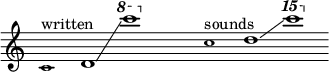
Tessitura of the piccolo is D5–C8. Some have a key for low C5.
Related instruments
Flutes:

The piccolo (/ˈpɪkəl/ PIK-ə-loh; Italian for 'small')[1][2] is a smaller version of the western concert flute[a] and a member of the woodwind family of musical instruments. Sometimes referred to as a "baby flute" or piccolo flute, the modern piccolo has the same type of fingering as the standard transverse flute,[3] but the sound it produces is an octave higher. This has given rise to the name ottavino[b] (Italian pronunciation: [ottaˈviːno]), by which the instrument is called in Italian[4] and thus also in scores of Italian composers.

Early 19th-century French piccolo in D.

Piccolos are often orchestrated to double the violins or the flutes, adding sparkle and brilliance to the overall sound because of the aforementioned one-octave transposition upwards. The piccolo is a standard member in orchestras, marching bands, and wind ensembles.

History

[edit]

Since the Middle Ages, evidence indicates the use of octave transverse flutes as military instruments, as their penetrating sound was audible above battles. In cultured music, however, the first piccolos were used in some of Jean Philippe Rameau's works in the first half of the 18th century. Still, the instrument began to spread, and therefore to have a stable place in the orchestra, only at the beginning of 1800 A.D. During the Baroque period, the indication "flautino" or also "flauto piccolo" usually denoted a recorder of small size (soprano or sopranino). In particular, this is the case of the concertos that Antonio Vivaldi wrote for flautino.[c]

Until the end of the 19th century, the piccolo maintained the same construction. Historically, the piccolo had the same keys of the baroque flute (one key) and then of the classical and romantic simple system flute. At the end of the century, the piccolo began to be built with the Boehm mechanism, which would become the standard during the 1900s. However, it cannot wholly transition to the Boehm system since the bore has remained conical, as in the old system flute, and the first bottom note is D, like in the baroque flute. The piccolo should not be confused with the fife, which is traditionally one-piece, has a smaller, cylindrical bore, and produces a more strident sound.

Traditional use

[edit]

It is a myth that one of the earliest pieces to use the piccolo was Ludwig van Beethoven's Symphony No. 5 in C Minor, which premiered in December 1808. Although neither Joseph Haydn nor Wolfgang Amadeus Mozart used it in their symphonies, some of their contemporaries did, including Franz Anton Hoffmeister, Franz Xaver Süssmayr, and Michael Haydn.[5] Also, Mozart used the piccolo in his opera Idomeneo. Gioachino Rossini later featured the instrument prominently in the overture to his opera Semiramide. Opera orchestras in Paris sometimes included small transverse flutes at the octave as early as 1735 as existing scores by Jean-Philippe Rameau show.[5]

Piccolos are now mainly manufactured in the key of C or D. In the early 20th century, piccolos were manufactured in D as they were an earlier model of the modern piccolo.[6] For this D piccolo, John Philip Sousa wrote the solo in the final repeat of the closing section (trio) of his march "The Stars and Stripes Forever".[citation needed]

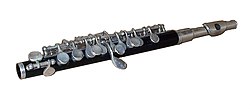
A piccolo being played

Although once made of wood, glass, or ivory, piccolos today are made from plastic, resin, brass, nickel silver, silver, and a variety of hardwoods, most commonly grenadilla. Finely made piccolos are often available with a variety of options similar to the flute, such as the split-E mechanism. Most piccolos have a conical body with a cylindrical head, like the Baroque flute and later flutes before the popularization of the Boehm bore used in modern flutes. Unlike other woodwind instruments, in most wooden piccolos, the tenon joint that connects the head to the body has two interference fit points surrounding the cork and metal side of the piccolo body joint.[citation needed]

The piccolo is used alongside marching drums in traditional formations at the Carnival of Basel, Switzerland.

In 2014, a festival was born entirely dedicated to the piccolo, the International Piccolo Festival, which takes place annually in July in Grado, Italy.[7][8]

Repertoire

[edit]

There are a number of pieces for piccolo alone by such composers as Samuel Adler, Miguel del Aguila, Robert Dick, Michael Isaacson, David Loeb, Amanda Harberg, Stephen Hough, Polly Moller, Vincent Persichetti, Karlheinz Stockhausen, and Brian Ferneyhough.

Repertoire for piccolo and piano, many of which are sonatas, has been composed by Miguel del Águila, Robert Baksa, Robert Beaser, Rob du Bois, Howard J. Buss, Eugène Damaré [fr], Pierre Max Dubois, Raymond Guiot, Lowell Liebermann, Peter Schickele, Michael Daugherty, and Gary Schocker.

Concertos have been composed for piccolo, including those by Lowell Liebermann, Sir Peter Maxwell Davies, Todd Goodman,[9] Martin Amlin,[10] Will Gay Bottje,[11] Bruce Broughton, Valentino Bucchi, Avner Dorman,[12] Jean Doué, Michael Easton,[13] Robert Groslot,[14] Egil Hovland, Guus Janssen, Daniel Pinkham, Jeff Manookian and Levente Gyöngyösi. The Piccolo Concerto by Amanda Harberg is one of the best known-examples.

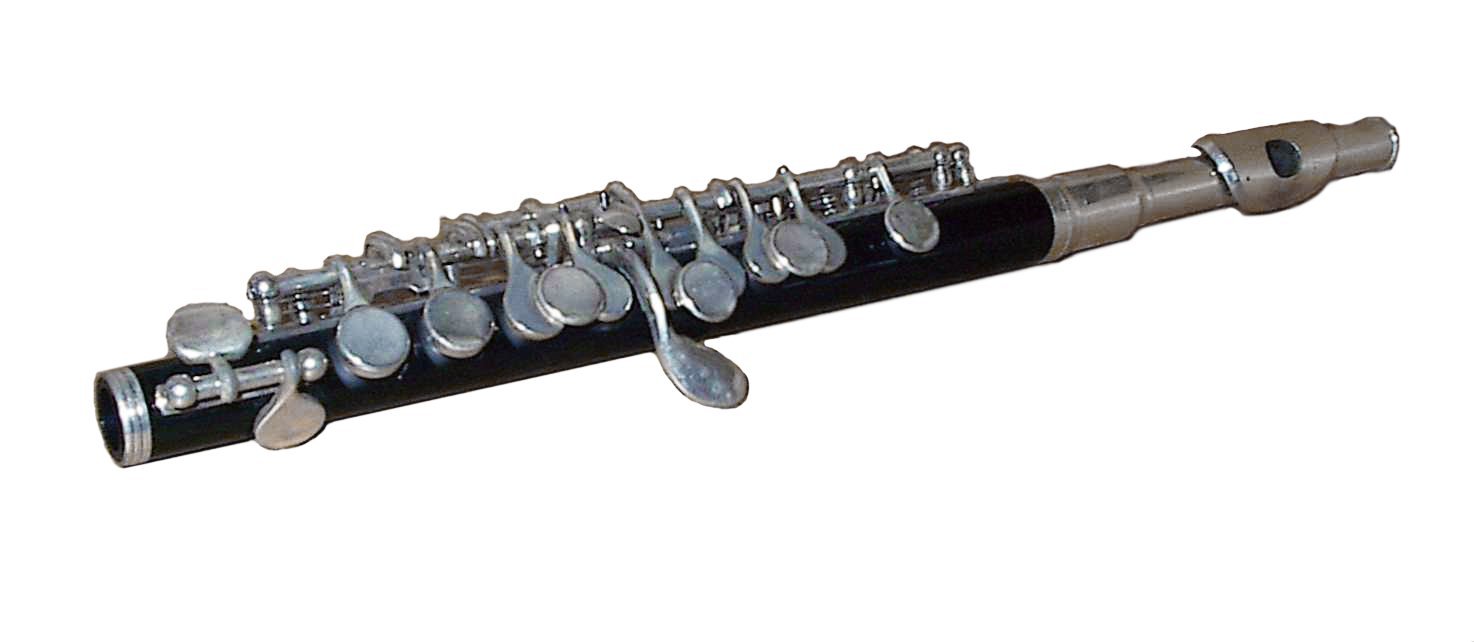
A concert piccolo with a grenadilla body and wave head joint and silver-plated keys

Additionally, there is now a selection of chamber music that uses the piccolo. One example is Stockhausen's Zungenspitzentanz, for piccolo and two euphoniums (or one synthesizer), with an optional percussionist and dancer. Another is George Crumb's Madrigals, Book II for soprano, flute (doubling piccolo/alto flute), and percussion. Other examples include a trio for piccolo, contrabassoon, and piano, 'Was mit den Tränen geschieht' by Stephen Hough, the Quintet for Piccolo and String Quartet by Graham Waterhouse, and Malambo for piccolo, double bass, and piano by Miguel del Aguila. Currently published trios for three piccolos include Quelque Chose canadienne (Something Canadian) by Nancy Nourse and Bird Tango by Crt Sojar Voglar for three piccolos with piano. Petrushka's Ghost for eight piccolos by Melvin Lauf, Jr. and Una piccolo sinfonia for nine piccolos by Matthew King are two more examples.

Notes

[edit]

References

[edit]

Bibliography

[edit]
[edit]
Revisions and contributorsEdit on WikipediaRead on Wikipedia
from Grokipedia
The piccolo is a small transverse , essentially half the size of a standard concert and pitched an higher, typically ranging from D5 to C8 across nearly three octaves. It functions as a side-blown edge with a cylindrical head bore and a tapering conical body bore, often featuring Boehm-system keys for chromatic playability. Constructed from materials such as grenadilla wood, , or , it produces a bright, piercing tone that is shrill in its upper register above G7 and weaker below G5, making its optimal range G5 to G7. Originating in during the Baroque period as an evolution from earlier military fifes and small flutes, the piccolo was first documented in orchestral use in George Frideric Handel's opera Rinaldo in 1711. By the Classical era, it became more prominent, appearing in works like Beethoven's Symphony No. 5 (1807), and transitioned from one- or six-keyed designs to the modern introduced in 1835, which improved intonation; the range was further extended downward to written C4 in the 20th century. Initially viewed as an auxiliary instrument in military bands and orchestras, it gained integral status in the 19th century, particularly in American amateur bands with the D-flat piccolo variant. In , the piccolo serves essential roles in orchestras for adding high-register color and , as in Mahler's Symphony No. 2 (1894) or Tchaikovsky's Symphony No. 4, and remains a staple in military and marching bands, exemplified by John Philip Sousa's (1897). Its use has expanded to solo recitals, chamber ensembles, and consortia, though its limited dedicated and pedagogical challenges—such as intonation issues—often require flutists to double on the instrument through practical rather than specialized training. Modern innovations, including quarter-tone variants and enhanced mechanisms like the C-sharp trill key, continue to refine its expressive capabilities.

Instrument Design

Physical Features

The piccolo, the smallest member of the family, measures approximately 32–33 cm (12.5–13 inches) in overall length, roughly half the size of the standard concert flute, which spans about 67 cm. This compact dimension allows for agile handling while maintaining proportional scaling of its structural elements relative to larger flutes in the family. The instrument typically comprises two primary sections: a head and a body, omitting the dedicated foot present in concert due to its limited lower register. The hole, positioned on the head near the cork assembly, is oval-shaped and smaller than that of the concert , facilitating the high-pitched airflow required for its range. Boehm-system piccolos, the modern standard, incorporate 11–13 keys, including essential tone hole covers, roller keys for , and optional trill mechanisms, all scaled down for the instrument's proportions. Variations in head joint design distinguish piccolo models, with bore shapes ranging from cylindrical—offering brighter tone and quicker response—to conical, which provides warmer and improved low-note stability, particularly in wooden constructions. Tone holes are positioned closer together than on larger flutes, with diameters around 6 , ensuring even finger spacing despite the reduced scale.

Materials and Construction

Piccolos are typically constructed from a variety of materials, including hardwoods such as grenadilla and for professional models, which provide a warm, resonant tone due to their and acoustic properties. Metals like , silver-plated , or are common for the body and mechanisms in orchestral and band instruments, offering brighter projection and greater durability against wear. Student models often use high-impact plastics or composites like , which mimic wood's tone while resisting moisture and reducing costs for beginners. Construction methods vary between handcrafting for custom instruments and production for mass-market options, with handmade piccolos involving precise boring and tuning to achieve optimal intonation. Wooden piccolos feature a conical bore—narrower at the foot and widening toward the head—for enhanced and blending in ensembles, while metal models typically employ a cylindrical bore for consistent projection in outdoor settings. Key mechanisms utilize a rod-and-post assembly with options for closed-hole or open-hole systems; closed holes are standard for beginners to simplify fingerings, whereas open-hole designs, often with split-E and adjustable screws, improve airflow and high-note stability in professional play. Material choices significantly influence playability and durability: wooden piccolos are lighter, aiding extended performances, but require careful to prevent cracking, whereas metal constructions add weight yet offer superior and resistance to environmental changes. is warmer and more blended with wood, contrasting metal's brighter, cutting that enhances visibility in large ensembles. Costs reflect these factors, with basic plastic or nickel-plated models under $500, escalating to over $5,000 for custom grenadilla or gold-plated versions due to labor-intensive crafting and premium materials.

Acoustics and Sound

Pitch Range and Notation

The piccolo, tuned in C, possesses a standard sounding range spanning two octaves and a third, from D5 to C8. This range is achieved through its compact bore and headjoint design, which facilitate higher fundamental frequencies compared to larger flutes. In written notation, the instrument's music is transcribed an octave below the sounding pitch to minimize the use of excessive ledger lines and align more closely with standard treble clef readability; thus, the written range extends from D4 to C7. Unlike transposing flutes such as the (which sounds a lower than written), the piccolo is a non-transposing instrument in terms of key—it is and requires no pitch adjustment beyond the displacement for notation purposes. Scores typically place piccolo parts in the treble clef, often above the concert flute line in orchestral layouts, with frequent reliance on three or more lines for the upper register to accommodate notes up to written C7. This convention ensures that performers read the part directly, producing the intended high without additional mental transposition. The register of the piccolo, corresponding to its third (approximately from C7 sounding to C8 and beyond), demands precise control over and air stream, as notes in this range can become shrill or unstable without specialized techniques. Skilled players may extend the practical range slightly beyond C8, reaching D8 or higher using alternate fingerings and overblowing, though such extensions are not standard and are limited by the instrument's acoustics. In comparison to the concert flute, whose standard range covers three octaves from C4 to C7, the piccolo's sounding pitches begin at the outset of the concert flute's upper octave (around D5), effectively doubling the flute family's high-end capabilities in ensemble settings.

Tone Production

The piccolo produces sound through an edge-tone mechanism, where the player's directed airstream strikes the sharp edge of the embouchure hole, causing the air jet to split and form alternating vortices that oscillate the airstream from side to side. This oscillation creates pressure waves that travel down the instrument's bore, exciting the air column to vibrate at its resonant frequencies, while feedback from the bore sustains the initial edge-tone instability. The process relies on the precise interaction between the airstream velocity and the geometry of the embouchure hole, with the edge acting as a fixed boundary that amplifies the periodic shedding of vortices. The piccolo's pitches are generated via the harmonic series of the air column, with overblowing to access higher harmonics by increasing speed, starting from a of approximately 587 Hz for its lowest note, D5. The small bore length—about half that of a concert —raises the fundamental and all harmonics by an , allowing the instrument to produce notes up to around 4,186 Hz, but requiring careful control to maintain stability across the series. The piccolo's timbre is characterized by a dominance of high harmonics, which imparts a piercing, brilliant quality particularly in the upper register, distinguishing it from the flute's more mellow tone. The bore shape significantly influences tonal evenness: conical bores taper gradually, promoting a more balanced response across registers by enhancing lower harmonic contributions, while cylindrical bores yield a brighter but less uniform sound with greater variability in timbre evenness. Due to its compact size and elevated pitch range, the piccolo exhibits inherent and superior projection, as high-frequency sounds propagate more directionally and are perceived as louder by the human ear, enabling it to cut through dense ensembles despite modest physical volume. This acoustic property stems from the inverse relationship between instrument scale and , concentrating energy in higher partials for enhanced audibility.

Historical Development

Origins in the Flute Family

The piccolo traces its origins to the transverse of the period and earlier military traditions, which emphasized portability and piercing tone for signaling in battle. Emerging from primitive bone flutes dating back over 40,000 years and evolving through medieval transverse flutes used by foot soldiers alongside drums, the instrument's design prioritized a narrow bore to project sound over noise, as seen in the ' Schweitzerpfeife documented at the in 1515. These early forms, often keyless and cylindrical, laid the foundation for the piccolo's compact structure, similar in basic layout to larger concert flutes but scaled down for higher pitch. Distinct references to the piccolo as a specialized transverse instrument first appeared in European courts during the early , distinguishing it from related duct flutes like the . In 1711, George Frideric Handel's Rinaldo included parts marked "flauto piccolo," initially interpreted as possibly a high recorder or but later associated with the small . Debates persist over early nomenclature, such as whether Antonio Vivaldi's "flautino" in works like Il gardellino (1729) indicates a small or a recorder. By 1730, composer Michel Corrette explicitly mentioned "small transverse octave flutes" in his writings, signaling the piccolo's emergence as a courtly and theatrical instrument capable of chromatic extension beyond simple diatonic scales. Early piccolo models drew heavily from the one-key design popularized in the late 17th and early 18th centuries, which allowed for basic chromatic playing without complex mechanisms. Credited in part to French instrument maker Jacques-Martin Hotteterre around 1711, these one-key flutes featured a single saltspill key for the left-hand pinky, enabling a two-and-a-half range but limiting versatility in remote keys due to cross-fingering techniques. Most pre-1800 piccolos retained this simplicity, lacking full keywork and relying on open holes or minimal additions (one to four keys by mid-century), which restricted their intonation and ease compared to later developments. Theobald Boehm's innovations in flute construction during the 1830s and 1840s exerted an indirect but foundational influence on the piccolo, standardizing key systems that eventually enhanced its playability. As a Bavarian inventor and flutist, Boehm developed his ring-key mechanism in 1832 for the concert flute, addressing acoustic and ergonomic issues through a cylindrical bore and open-hole keys; this system began appearing on piccolos by 1835, though full adoption lagged until the 1850s due to the instrument's niche status. Boehm's work, refined in his 1847 metal flute patent, provided a template for conical-bore piccolos, improving tone evenness without altering the core transverse design inherited from earlier traditions.

Evolution Through the 19th and 20th Centuries

In the , the piccolo underwent significant advancements in keywork and mechanism design, building on its roots in the flute family. By the 1820s, six-keyed models emerged, enabling greater chromatic flexibility, as seen in instruments like Johan Joseph Ziegler's DCM 413 piccolo from 1820-1821. During the Romantic era, eight-key configurations became common, using hardwoods such as grenadilla for enhanced structural integrity and playability across the . Theobald Boehm's innovative system, initially applied to the piccolo around 1835 using his 1832 design principles, was refined and standardized with the 1847 cylindrical bore mechanism, revolutionizing intonation and ease of execution. Boehm & Mendler further advanced this in 1862 by producing cylindrical Boehm-system piccolos in combinations of silver, wood, and German silver, marking a shift toward more precise . The 20th century brought further evolution driven by material innovations and recovery. After , makers like Haynes and Powell temporarily discontinued wooden piccolo production. recovery saw a surge in silver-plated models, with conical bore designs in wood and silver becoming the professional norm by 1950, replacing earlier cylindrical variants for improved tonal balance and intonation. efforts culminated in the for 's adoption of A=440 Hz as the global tuning pitch in 1955, requiring piccolo makers to recalibrate scales and bores to align with ensemble standards and mitigate sharpness in higher registers. This era also witnessed the rise of conical bore wooden piccolos in the , favored for their warmer and even response across the instrument's range. Japanese manufacturers like Muramatsu and drove key innovations in precision machining during the mid- to late , elevating piccolo craftsmanship. Founded in , Muramatsu integrated advanced headjoint designs and meticulous key alignment, emphasizing customizable materials like grenadilla wood for superior resonance and control. , established in 1968 by craftsmen Kikuo Hisakura, Hideo Takei, and Taichi Oki, pioneered handmade mechanisms with soldered tone holes and offset G keys, leveraging precision tools to enhance durability and responsiveness in professional models. These developments solidified the piccolo's status as a versatile orchestral tool, with both companies producing instruments featuring extended ranges and trill keys for demanding .

Playing Technique

Basic Embouchure and Fingerings

The embouchure for the piccolo requires a smaller than that used on the , typically about half the size, to accommodate the instrument's diminutive embouchure hole and produce its characteristic high-pitched tone. This setup demands a more focused and centered airstream directed across the edge of the hole, with the lips forming a tighter seal to maintain control over the rapid air vibrations necessary for the piccolo's range. Flutists transitioning to piccolo often place the headjoint higher on the lower lip—closer to the —compared to the flute's position lower on the chin, which helps achieve a clear tone without excessive tension. Fingerings on the piccolo follow the , identical to those of the concert for basic scales and patterns, allowing flutists to apply familiar techniques with minimal relearning. However, the instrument's shorter key spacing—approximately half the length of the —brings the hands closer together, which can feel cramped and requires adjustments to avoid tension, particularly for players with larger hands. Trill keys function similarly but demand precise, light finger action due to the piccolo's sensitivity; alternate fingerings are commonly used for certain notes to improve intonation and responsiveness in the high register, such as venting specific keys for better stability. Breath control on the piccolo emphasizes faster air speed and greater diaphragmatic support than on the , as the smaller bore necessitates less overall volume of air but more directed pressure to sustain pitch and tone across its range. Players must engage the abdominal muscles more firmly to provide steady support, preventing the airstream from becoming too diffuse, which could lead to unstable high notes. This technique builds on flute fundamentals but adapts to the piccolo's demand for quick, efficient breaths to handle rapid passages without fatigue. Assembly of the piccolo mirrors that of the concert flute, involving a gentle twist to connect the headjoint to the body while aligning the hole parallel to the keys, though its compact size (about half the flute's length) reduces leverage and calls for careful handling to avoid damage. Posture remains upright and relaxed, similar to flute playing, with feet shoulder-width apart and shoulders down to promote free breathing; the smaller instrument allows a more central holding position across the body, but players should curve fingers naturally over the closer keys to prevent strain in the wrists and hands.

Performance Challenges

Piccolo players face significant intonation challenges due to the instrument's small size and high register, which amplify environmental sensitivities. The piccolo is particularly responsive to temperature variations, becoming flat in cold conditions and sharp in warm ones, necessitating adjustments such as pulling the headjoint out slightly in cooler environments or using a cloth to insulate the instrument. fluctuations further exacerbate these issues, altering the wood or metal's response and requiring frequent recalibration to maintain pitch stability. For sharp high notes, players must adjust by increasing support to lower the pitch or lessening it to raise it, often combined with subtle headjoint repositioning up to a quarter inch outward in demanding passages. Endurance demands pose another hurdle, as the piccolo's higher air resistance from its compact bore leads to rapid fatigue during extended play. The faster, more focused airstream required—especially in the upper register—demands greater lip strength, causing physical exhaustion if sessions exceed 15-45 minutes without breaks, particularly for beginners. To mitigate this, performers employ strategies like limiting initial practice to lower ranges (e.g., up to E6) and gradually expanding by thirds, while incorporating alternate fingerings—such as using the first trill key for high B—to reduce resistance and preserve stamina without altering basic embouchure techniques. Articulation on the piccolo requires precise to achieve crisp effects in rapid passages, differing from the due to the instrument's sensitivity to airstream disruptions. Players position the tip higher, toward the upper gum, to ensure clean attacks while keeping the upper lip relaxed, avoiding a heavy that could muddy the sound in the smaller airstream. This technique supports light, responsive articulation essential for fast tempos, though over-emphasis can lead to fatigue. Ergonomic considerations arise from the piccolo's diminutive scale, including tighter key spacing that challenges hand positioning for players with larger fingers, potentially causing tension during prolonged use. Additionally, the risk of overblowing in high notes—where excessive air pressure forces unintended harmonics—demands vigilant control of size and breath support to prevent pitch instability or strained tone.

Traditional Applications

Role in Orchestras

In the symphony orchestra, the piccolo functions primarily as a supportive and coloristic instrument within the woodwind section, enhancing the ensemble's upper register and adding timbral variety to the overall texture. It is typically orchestrated to double existing flute lines at the octave above, thereby extending the woodwinds' pitch range and providing reinforcement in high passages without dominating the melodic foreground. This doubling role is particularly effective in tutti sections, where the piccolo's bright timbre helps to clarify and elevate melodic lines amid denser orchestration. Composers often employ it for specialized effects, such as simulating bird calls through rapid, fluttering articulations or contributing to fanfares with its incisive attacks, drawing on its suitability for the upper end of the flute family's range. Historically, the piccolo's integration into orchestral scoring evolved from sporadic appearances in the early 19th century to a more standardized presence by the late 19th century, as composers like and expanded the woodwind palette for greater expressive depth. was among the early adopters in symphonic contexts, incorporating the piccolo in his overture Calm Sea and Prosperous Voyage (1828) to evoke natural phenomena like wind and waves through brief, atmospheric passages. By the Romantic era, its use had become conventional in full orchestras, transitioning from an auxiliary tool to an essential element for heightening dramatic intensity. In terms of ensemble placement, the piccolo is usually performed by the principal flutist, who switches instruments as dictated by the score, ensuring seamless integration with the flute section's responsibilities. This doubling arrangement is standard in major orchestras, such as the New York Philharmonic and Chicago Symphony, where the same musician handles both roles to maintain tonal consistency across the section. The instrument's seating aligns with the flutes, typically on the left side of the woodwinds, facilitating quick transitions during performances. The piccolo's dynamic contributions are versatile, leveraging its inherent piercing quality to cut through fortissimo climaxes and create a sense of urgency or exhilaration in orchestral peaks. In quieter passages, it blends subtly by employing delicate dynamics, offering a sweet, ethereal contrast that supports harmonic shading without overpowering other voices. This dual capability—shrill and commanding at high volumes, yet capable of nuanced softness—makes it invaluable for building tension and release in symphonic works.

Use in Bands and Ensembles

In military bands, the piccolo traces its prominence to the 18th and 19th centuries, where it evolved from the simple, keyless used for signaling on battlefields due to its piercing tone capable of cutting through noise. By the mid-19th century, keyed piccolos in C or D♭ became standard in European and American military ensembles, allowing greater chromatic flexibility and integration into more complex marches and fanfares, as seen in works by composers like . This transition from the diatonic to the fully keyed instrument enhanced its role in formal band settings, where it provided high-register accents and calls. In concert bands and wind ensembles, the piccolo typically handles exposed high melodic lines and , adding brilliance and cutting through dense textures without overpowering other winds. Its agile upper register often doubles or ornaments principal themes, contributing to contrapuntal layers in pieces like Gustav Holst's Second Suite in F for Military Band, where it weaves intricate lines against and reed sections. Wooden models are favored here for their warmer, blending tone, contrasting with the instrument's more strident orchestral applications. For marching bands, lightweight plastic or composite piccolos are preferred for their durability against weather and ease of carry during long processions, ensuring reliable projection over loud brass sections in outdoor environments. Models like the Yamaha YPC-32 exemplify this design, offering a bright, focused sound that maintains clarity in fanfares and field shows, such as those in competitive drum corps repertoires. Metal variants further amplify cut-through in these settings, prioritizing volume over subtlety. In chamber ensembles, the piccolo appears in flute quartets and duets to provide timbral contrast and extended range, often featuring in modern works that exploit its ethereal highs alongside flutes. Historical use remains sparse, but 20th-century compositions increasingly incorporate it for coloristic effects in mixed flute ensembles.

Repertoire and Notable Works

Orchestral and Band Literature

The piccolo's integration into orchestral literature began gaining prominence in the early , with Ludwig van Beethoven's Symphony No. 9 in , Op. 125 (1824), marking a significant milestone as one of the first major symphonic works to feature the instrument. In the fourth movement, the piccolo enters during the choral sections to provide high-register support and brilliance, doubling the upper woodwinds and strings to enhance the texture amid the vocal forces. This usage, which includes exposed passages in measures 343–431, demonstrated the piccolo's ability to cut through dense orchestration, influencing subsequent composers in the Romantic era. By the early 20th century, Igor Stravinsky's (1913) exemplified the piccolo's role in evoking dramatic intensity within orchestral settings. The score calls for two piccolos among the woodwinds, employing them for piercing, ritualistic shrieks in sections like "The Augurs of Spring," where rapid, high-altitude figurations contribute to the work's primal energy and textural chaos. This innovative application highlighted the instrument's capacity for coloristic effects in modernist ensembles, expanding its traditional doubling role. Twentieth-century orchestral expansions further embedded the piccolo in standard repertoire, as seen in Carl Nielsen's symphonies, where it frequently appears for timbral heightening. For instance, Symphony No. 5, Op. 50 (1922), incorporates the piccolo (doubled by the third flute) in dynamic contrasts during the first movement's tense passages, contributing to the work's emotional breadth. Similarly, Gustav Holst's , Op. 32 (1914–1916), an orchestral suite, utilizes piccolos (doubled by third and fourth flutes) in its "Mars, the Bringer of War" movement for aggressive, stratospheric lines that amplify the martial rhythm and dissonance; band arrangements have popularized these effects in wind ensembles. In film scores, employed the piccolo for ethereal and emphatic effects, such as in the Star Wars saga (1977 onward), where it underscores heroic themes with sparkling upper harmonics in the main title sequence. These examples illustrate the piccolo's evolution from supportive to integral in large ensembles. In band literature, the piccolo has long served as a melodic and decorative element, particularly in marches by . Notable examples include "The Stars and Stripes Forever" (1897), where the famous countermelody solo in the trio section—originally conceived for D-flat piccolo—showcases virtuosic trills and runs that add patriotic flair and lightness to the ensemble.

Solo and Chamber Pieces

One of the earliest dedicated solo works associated with the piccolo is Antonio Vivaldi's Concerto in C Major, RV 443, composed around 1728–1729 (Op. 44 No. 11). Originally scored for flautino (sopranino recorder), this three-movement piece—frequently performed on piccolo today—features energetic allegros that demand rapid scalar passages and trills, contrasted by a serene Largo, allowing the instrument to display its lyrical capabilities in a chamber-orchestral setting. The 20th-century solo repertoire for piccolo expanded with original compositions that highlight its unique , such as Jacques Ibert's Pièce (1936), a concise unaccompanied work originally for but frequently adapted and performed on piccolo to emphasize its ethereal high register and rhythmic vitality. Another landmark is Lowell Liebermann's Concerto for Piccolo and , Op. 50 (1996), commissioned by the National Flute Association and premiered by piccoloist Jan Gippo with the Aspen Chamber Symphony; this piece explores the instrument's full range through virtuosic cadenzas and flourishes in its three movements. More recent works continue to develop the solo repertoire, including Amanda Harberg's Hall of Ghosts (2020) for unaccompanied piccolo, which evokes haunting atmospheres through extended techniques and passages. Chamber compositions for piccolo often feature adaptations that leverage its piercing projection in intimate ensembles, including Sergei Prokofiev's Flute Sonata, Op. 94 (1943), transposed and performed on piccolo with to accentuate the work's neoclassical wit and demanding intervallic leaps across three movements. Examples of contemporary include Eugène Bozza's Quartet for Four Piccolos (1964), a lively work that exploits the homogeneous of multiple piccolos in contrapuntal textures, blending technical precision with playful synchronization. These pieces frequently impose virtuosic challenges, particularly in the range above high C, as evidenced in commissions for flutist , such as Liebermann's concerto, which requires agile articulation and dynamic control to navigate its stratospheric lines. Influential recordings include Jean-Pierre Rampal's renditions of Vivaldi's piccolo concertos, such as RV 443, with I Solisti Veneti under Scimone, praised for their elegant phrasing and tonal purity that have shaped interpretive standards since the .

Modern Variants

Contemporary Designs

Since the late , piccolo designs have incorporated hybrid materials like to provide lightweight durability and reduced maintenance needs, with flute makers first introducing such instruments in the . These materials offer enhanced resistance to environmental factors compared to traditional woods, though their distinct tonal qualities have sparked debate among performers seeking the classic piccolo . Custom features in contemporary piccolos cater to demands for precision and comfort, including adjustable head joints and ergonomic key extensions. Systems like Tobias Mancke's patented interchangeable adapter allow head joints to fit various piccolo bodies with fine-tuned adjustments for optimal alignment and intonation. Ergonomic key extensions, pioneered by makers such as Brannen Brothers, reposition keys to accommodate hand sizes and reduce strain during , benefiting orchestral and solo professionals. Brand-specific advancements highlight these trends, with Yamaha adapting offset G keys in models like the YPC-62 to improve left-hand reach and on the compact instrument. Gemeinhardt has advanced eco-friendly options through composite materials in piccolos such as the 4P and 1P, which use synthetic bodies as sustainable alternatives to rare woods, delivering warm tones while minimizing . Market trends since 2000 reflect a surge in student-oriented piccolo models, driven by expanded programs in schools that emphasize accessible entry-level instruments for ensembles. Affordable and composite designs from brands like Yamaha (YPC-32) and Gemeinhardt have dominated this growth, enabling broader participation among young learners while maintaining reliable intonation and playability.

Electronic and Experimental Forms

In the realm of electronic and experimental forms, the piccolo has been adapted for integration with digital technologies, particularly through MIDI-equipped systems that emerged in the . These setups allow performers to interface the instrument with synthesizers and virtual sound modules, extending its piercing into synthesized realms with real-time processing for effects like , spatialization, and harmonic layering. For instance, wind MIDI controllers configured for flute fingerings enable piccolo players to trigger software synthesizers, producing hybrid sounds that blend acoustic input with electronic manipulation, as seen in live performances where breath control modulates oscillator banks for ethereal, extended timbres. Prepared techniques represent a of experimental piccolo practice, involving the insertion of foreign objects into the instrument's bore to alter acoustics and generate microtonal effects. Common preparations include corks, which lower pitches by nearly an and disrupt the series to yield quarter-tones; cigarette paper under keys for buzzing, oboe-like resonances; or beads in the head joint to create wavering interference tones and pitch jumps exceeding an . These methods, drawn from extended techniques , enable microtonal trills, bisbigliandi (timbral trills with subtle pitch variations), and glissandi through adjustments or air stream disruption, with stability varying from reliable (e.g., cork-induced quarter-tones) to precarious (e.g., bead-induced wavering). Representative works include Zwaanenburg's Solo for Prepared (1984), where cork insertion in the foot joint produces alterations for microtonal exploration, and Brockshus's Greytudes I (2016), employing beads for beating effects in the air column. Digital emulations of the piccolo have proliferated in digital audio workstations (DAWs), with software plugins employing physical modeling to replicate its bright, agile and responsive dynamics. These virtual instruments, such as Audio Modeling's SWAM Piccolo (introduced in the SWAM Flutes bundle in and updated to version 3.10 in 2025), use synthesis algorithms to simulate , breath pressure, and key articulations, allowing MIDI controllers to produce realistic piccolo phrases with nuances like and overblowing. Similarly, sampled libraries like Acousticsamples' VWinds Piccolo and Vienna Symphonic Library's Piccolo provide high-fidelity models for orchestral integration, capturing the instrument's extended range (C5 to C7) and transient attacks for film scoring and experimental composition in DAWs like or . These tools facilitate experimentation by layering piccolo emulations with effects processors, bypassing physical limitations while preserving conceptual fidelity to the acoustic source. In September 2025, Audio Modeling released SWAM VariFlute, enabling users to design variable flute instruments from recorder to styles, including piccolo configurations, for innovative . Experimental composers have incorporated piccolo variants in works that push sonic boundaries, often combining acoustic performance with electronic or prepared elements. Karlheinz Stockhausen's PICCOLO (1977, extracted from SIRIUS), scored for solo piccolo (or with geisha bell), features scalar runs and large intervals in a minimalist framework that influenced later electro-acoustic explorations, emphasizing the instrument's piercing clarity in spatial contexts. Kaija Saariaho's Dolce Tormento (2004), a five-to-six-minute solo for piccolo, evokes "sweet torment" through lyrical, tormented lines that integrate microtonal inflections and timbral shifts, premiered by Camilla Hoitenga and reflecting Saariaho's spectralist approach to woodwind color. These pieces exemplify how the piccolo's high register serves as a vector for experimental innovation, bridging traditional with modernist .

References

Add your contribution
Related Hubs
User Avatar
No comments yet.