Hubbry Logo
Jazz fluteJazz fluteMain
Open search
Jazz flute
Community hub
Jazz flute
logo
8 pages, 0 posts
0 subscribers
Be the first to start a discussion here.
Jazz flute
Jazz flute
from Wikipedia

Jazz flute is the use of the flute in jazz music. While flutes were sometimes played in ragtime and early jazz ensembles, the flute became established as a jazz instrument in the 1950s.[1] It is now widely used in ensembles and by soloists.[2] The modern Boehm system transverse concert flute is commonly used in jazz playing; other members of the same family are used, such as the alto flute in G. Ethnic and other flutes, such as bamboo flutes, have also been used in jazz.

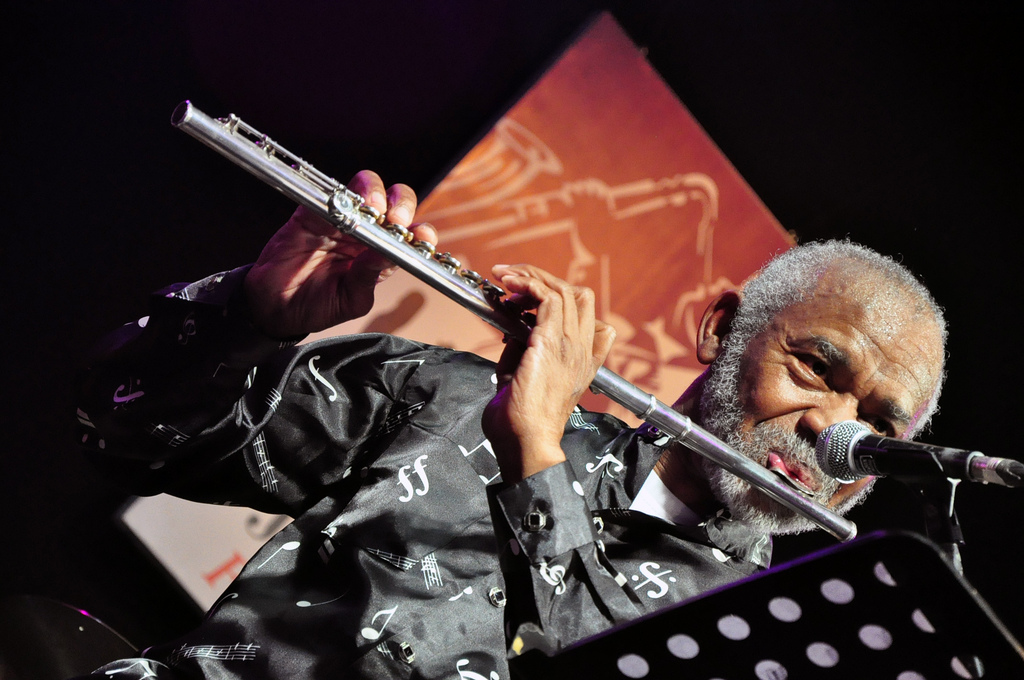
Hubert Laws at the Jakarta International Java Jazz Festival in 2010
Herbie Mann at the Eastman Theatre, Rochester, NY, in 1975

History

[edit]

The flute was not widely used in early jazz, although some ragtime arrangements call for it. The timbre and the limited dynamic range of the instrument and its associations with classical music caused it to be perceived as unsuitable to big band ensembles and unable to swing convincingly.[1] Before the use of amplification became common practice in the 1930s, jazz flute players were restricted to the upper range of the instrument to be audible.[2]

Among the earliest jazz flute recordings is "Shootin' the Pistol," performed by the Cuban clarinettist and bandleader Alberto Socarras with the Clarence Williams band in 1927.[2] The first jazzman to make extensive use of the flute was Wayman Carver, a saxophone player who from 1932 specialised in flute. He recorded flute solos with Benny Carter and with Spike Hughes in 1933, and played and recorded with the Chick Webb band for several years, soloing on flute on tracks such as "Sweet Sue", "Down Home Rag" and "I Got Rhythm".[1][3]: 43 

Flute became more common in jazz during the 1950s. Sam Most, Herbie Mann, Eric Dolphy and Bobby Jasper were early important jazz flutists, with Hubert Laws and Roland Kirk achieving prominence in the '60s.

Instruments

[edit]

Flutes of many kinds have been used in jazz music.

Transverse flute

[edit]

The modern Boehm system transverse concert flute is commonly used in jazz playing; other members of the same family are also heard. The piccolo is not common in jazz, but has been used by players such as Anthony Braxton and Hubert Laws, and by Marshall Allen, who recorded piccolo solos with Sun Ra. The alto flute in G is more often heard, and has been used in recordings by Bobby Jaspar, Túpac Amarulloa, Herbie Mann, Bud Shank and Paul Horn among others. Jimmy Giuffre soloed on bass flute in C on his album River Chant, recorded in 1975.[1]

Recorder

[edit]

The recorder is often perceived as unsuitable for jazz as its technique does not facilitate chromatic playing.[4] Jazz recorder performers include Benoit Sauvé[4] and Pete Rose, who also composes "written-out" jazz for performance by soloists or by groups such as the Amsterdam Loeki Stardust Quartet.[5]

Other flutes

[edit]

A wide variety of ethnic and other flutes have been used in jazz at times. Roland Kirk played bamboo flutes and nose flute,[2] and Yusef Lateef used wooden and bamboo instruments.[1] Theodosii Spassov plays jazz kaval. Shakuhachi was used in Tony Scott's Music for Zen Meditation in 1964. A single track on Live at the Blue Note by Dave Valentin lists instruments including concert flute, bamboo flutes, pan pipes, Peruvian bamboo bass flute, porcelain flute, Romanian pan flute and assorted whistles.[6]

Performers

[edit]

References

[edit]
Revisions and contributorsEdit on WikipediaRead on Wikipedia
from Grokipedia
Jazz flute is the application of the within music, characterized by improvisational solos, airy and relaxed tones, and techniques adapted to blend the instrument's inherently soft volume with the energetic demands of jazz ensembles. Emerging in the late , it overcame early challenges related to projection and range, evolving from sporadic use in and early to a prominent role in , , and fusion styles by the mid-20th century. The style has continued to evolve, with ongoing innovations in the 2020s through contemporary artists like Kim Scott, who blend , , and fusion elements.

History

Early Development (1920s–1940s)

The made sporadic appearances in early , particularly in arrangements and New Orleans ensembles of the late 1910s and early , where it served primarily as a novelty instrument to add melodic color rather than a core solo voice. These influences stemmed from the brass-heavy bands of the era, which occasionally incorporated woodwinds for variety in marches and dance pieces, though the 's role remained marginal due to the dominance of clarinets and saxophones. A milestone arrived in 1927 with the first notable jazz flute recording: Cuban flutist Alberto Socarras's solo on "Shootin' the Pistol," featured with Clarence Williams' Blue Five. This track marked the instrument's debut as a viable improvisational tool in recorded jazz, blending flute lines with the group's rhythmic drive. In the following decade, Wayman Carver advanced the flute's profile through his pioneering work, including collaborations with Benny Carter's orchestra in 1933 and his tenure with Chick Webb's band from 1934 to 1939, where he integrated flute solos into swing-era arrangements like "I Got Rhythm." Despite these innovations, the flute encountered significant challenges in big band settings, as its soft timbre and narrow dynamic range struggled to project against the volume of saxophones, trumpets, and trombones in unamplified environments. Players like Carver often doubled on saxophone to compensate, limiting the flute to higher registers or quieter sections for audibility. This foundational period of experimentation set the stage for post-war advancements, including the bebop-era contributions of innovators like Sam Most.

Rise and Popularization (1950s–1970s)

In the 1950s, the jazz flute gained prominence through pioneering and recordings, with Sam Most leading breakthroughs by incorporating humming and singing into the instrument for a distinctive vocal-like , as heard in his collaborations like the 1955 session with . pushed avant-garde boundaries on flute, notably in his 1958 performances with the Quintet at the , where he explored extended techniques inspired by contemporary classical composers like . European contributions came from Bobby Jaspar, a Belgian flutist whose style shone in the 1957 album Flute Soufflé alongside Mann, bridging transatlantic jazz scenes. This era's innovations built on precursors like Wayman Carver's swing-era work, but the 1950s marked the flute's shift toward agility and melodic prominence. The 1960s saw a surge in the flute's popularity, exemplified by Canadian Moe Koffman's 1958 hit "Swingin' Shepherd Blues," which reached number one on Canadian pop charts and number 23 in the UK, introducing jazz flute to mainstream audiences through its infectious, blues-inflected melody. further popularized the flute by fusing it with rhythms, establishing it as a versatile solo voice in jazz ensembles. advanced classical-jazz crossovers, drawing on his Juilliard training to blend and modern classical elements with in mid-1960s recordings, such as his work with the Jazz Crusaders and early Atlantic sessions. innovated multi-instrumentally, playing flute alongside and unconventional tools like the manzello, using and vocal effects through the flute—as in his 1961 album We Free Kings—to create layered, theatrical performances that expanded the instrument's expressive range. Advancements in microphones and amplification during the late 1960s and fusion era enabled the flute's integration into larger, electrically driven ensembles, overcoming its inherent low volume to compete with amplified guitars, basses, and drums in bands like those led by and . This technological shift facilitated the flute's role in high-energy fusion contexts, where players like Mann and Laws achieved commercial success through Latin-tinged and rock-infused tracks. However, by the late , the flute's prominence waned as trends increasingly favored electric instruments and synthesizers, prioritizing denser, electronically textured sounds over acoustic subtlety in the evolving fusion landscape.

Modern Revival (1980s–Present)

In the 1980s and 1990s, jazz flute underwent expansions led by figures such as James Newton, who drew on African rhythmic and melodic structures to push the instrument's expressive boundaries beyond traditional frameworks. Newton's 1985 album The African Flower, interpreting works by and , integrated African influences through intricate lines that evoked bird calls and communal improvisation, establishing him as a pioneer in world-jazz synthesis. Similarly, advanced during this period by fusing Afro-Cuban rhythms, Brazilian , and grooves, as heard in his 1983 release Flute Juice, which blended percolating percussion with melodic solos to create accessible yet innovative crossover sounds. These developments revived interest in the by emphasizing its timbral versatility in multicultural contexts, building on mid-20th-century foundations like Herbie Mann's explorations. The 2000s and 2020s marked a renaissance for jazz flute, propelled by artists affiliated with the Association for the Advancement of Creative Musicians (AACM), such as Nicole Mitchell, whose compositions fused with ecological and Afrofuturist themes drawn from global soundscapes. Mitchell's work, including her leadership of the Black Earth Ensemble, incorporated elements like non-Western scales and improvisational forms to address themes of community and nature, expanding the flute's role in experimental ensembles. In the 2020s, furthered this genre-blending trajectory by transitioning from saxophone to diverse flutes—including the , , and svirel—infusing jazz with African folk, calypso, hip-hop, and electronic textures on his 2024 album Perceive Its Beauty, Acknowledge Its Grace. Hutchings' approach highlighted the flute's portability and intimacy in live and recorded settings, attracting younger audiences through rhythmic hybrids that transcended jazz conventions. Globalization enriched the revival through integrations of ethnic flutes into , exemplified by Bulgarian musician Theodosii Spassov, who pioneered —a end-blown wooden flute—in jazz contexts by merging Balkan folk modalities with improvisational swing and classical phrasing since the 1990s. Spassov's ensembles, such as his , layer the kaval's reedy timbre over to evoke Eastern European traditions within Western structures. Likewise, Israeli flutist Itai Kriss has woven Middle Eastern and influences into jazz via his group Telavana, combining Israeli scales with Afro-Cuban , North African rhythms, and Brazilian to craft a pan-global sound on albums like 2025's Daybreak. Kriss's virtuosic phrasing bridges cultural divides, positioning the as a conduit for narratives in contemporary . As of 2025, jazz flute thrives in the streaming era, where its ethereal tones enhance genre fusions with hip-hop and electronic music, as seen in collaborative tracks blending flute loops with beat-driven production on platforms like and . Artists like Hutchings and Kriss leverage to reach global listeners, fostering improvisational remixes that incorporate electronic effects and hip-hop sampling, thereby sustaining the instrument's relevance amid broader trends in hybrid . This evolution underscores the flute's adaptability, reflecting a vibrant, cross-pollinated scene.

Instruments

Western Concert Flutes

The Boehm-system transverse concert , pitched in C and commonly referred to as the C , serves as the standard instrument for jazz performance due to its cylindrical bore, open-hole keywork, and ergonomic design that facilitates rapid fingerings essential for improvisation. This system, developed by Theobald Boehm in the 19th century, allows for even intonation across its three-and-a-half-octave range, making it adaptable to the rhythmic and melodic demands of . Jazz flutists often favor models with silver or gold plating on the body and keys, as silver provides a brighter, more focused tone that enhances projection in ensemble settings, while gold offers a warmer for nuanced solos. Variants of the concert flute expand the timbral palette available to jazz musicians. The piccolo, a smaller Boehm-system flute pitched an octave higher, enables high-range solos with piercing clarity, as exemplified by flutist in his recordings like "Piccolo Boogie," where it cuts through dense arrangements. The alto flute in G, with its curved headjoint and larger bore, produces a warmer, more velvety ideal for lyrical passages and ballads, a choice frequently employed by to evoke a mellow, introspective quality in tracks such as "Sir ." For deeper extensions, the bass flute—pitched an octave below the concert flute—adds a resonant, earthy depth, notably explored by in his 1975 album River Chant, where it contributes to experimental textures in pieces like "Tree People." Key acoustic properties of these Western flutes make them well-suited to jazz expression. Their wide becomes fully realized post-amplification, allowing soft whispers to swell into bold statements within amplified jazz ensembles. The inherent breathy attack, resulting from the edge-tone mechanism without a reed, imparts a airy, intimate onset that contrasts with more percussive winds, enabling subtle phrasing variations. Additionally, the shared Boehm with saxophones facilitates phrasing that mimics the saxophone's idiomatic bends and slides, allowing flutists to double on both instruments seamlessly and integrate flute lines into horn sections. The recorder, while occasionally referenced in niche jazz contexts for its simpler duct-flute design, remains rare compared to these variants.

Ethnic and Alternative Flutes

In jazz, ethnic and alternative flutes introduce non-Western timbres and scales that foster cross-cultural integrations, expanding the genre's improvisational palette with sounds drawn from global traditions. These instruments, often featuring irregular bore shapes and unconventional embouchures, enable musicians to blend folk modalities with , creating hybrid textures that challenge conventional Western intonation. For instance, utilized flutes and nose flutes to evoke African-inspired textures, employing the nose flute's nasal —produced by directing air through the nostrils while —to layer ethereal, percussive effects over ensemble grooves. The flute's warm, woody overtones further contributed to Kirk's polyrhythmic explorations, mimicking the earthy qualities of sub-Saharan wind instruments in his multi-instrumental jazz contexts. The Japanese , a , entered jazz through Tony Scott's 1964 recordings on Music for Zen Meditation, where clarinetist Scott collaborated with shakuhachi master Hōzan Yamamoto to fuse meditative drones with improvisational phrasing. Similarly, the Bulgarian , an reedless flute, has been adapted for by Theodosii Spassov, who synthesizes Balkan folk scales with jazz swing to produce fluid, ornamented lines that evoke Eastern European mysticism. In Latin jazz, incorporated pan pipes—such as Bolivian siku variants— to integrate Andean pentatonic melodies into rhythmic ensembles, using the instrument's clustered tubes for harmonic drones that underpin syncopated solos. The recorder, typically associated with , appears in rare applications, as seen in Benoît Sauvé's transcriptions and improvisations with big bands, and Pete Rose's compositions that merge jazz phrasing with experimental . Acoustically, these flutes differ from Western concert models through variable intonation, breathy overtones, and microtonal capabilities; the , for example, allows pitch sharpening via cross-fingerings and meri/kari head positions, yielding subtle glissandi and inharmonic spectra ideal for expressive jazz bends. The and pan pipes produce rich, uneven overtones from their open bores and lip-directed airflow, facilitating microtonal slides that enhance modal improvisation, while the recorder's narrow bore supports precise quarter-tones in avant-garde settings. Such traits allow for dynamic timbral shifts, enriching jazz's emphasis on personal expression and cultural dialogue. These ethnic flutes complement concert flutes in ensembles, adding layered ethnic fusions without overshadowing core jazz structures.

Modifications and Accessories

To address the inherent volume limitations of the flute in jazz ensemble settings, where louder instruments like drums and dominate, flutists commonly employ clip-on and amplification systems. These setups, such as the DPA 4099 supercardioid microphone mounted on the headjoint with a belt-clip transmitter, allow for wireless mobility while capturing the full and of the instrument. Similarly, the K&K clip-on condenser microphone provides an affordable, phantom-powered option that clips directly to the flute body, enabling the player to compete acoustically with a band without feedback issues when paired with a PA system like the Powerwerks PW100 mixer and speakers. Effects pedals further expand the jazz flute's sonic palette, particularly in fusion styles, by mimicking textures through reverb, delay, and wah-wah effects. For instance, the TC Helicon Voicelive series offers XLR-input reverb as a preamp alternative, adding spatial depth to improvisational lines, while the Line 6 delay pedal with tap tempo supports rhythmic layering in live performances. The Joyo , favored for its compact design over bulkier models like the Dunlop , enables expressive filtering to emulate guitar-like cries, enhancing the flute's role in jazz-rock contexts when integrated into a pedalboard chain after amplification. These tools are typically used with standard Western concert flutes to broaden timbral possibilities without altering the instrument's core mechanics. Instrument modifications tailored for jazz include specialized headjoints and custom keywork to facilitate rapid articulation and access to the register, essential for and modal improvisation. A flat-walled embouchure hole design in headjoints promotes lip flexibility and quicker response, allowing smoother and note bends compared to traditional rounded styles, as seen in custom options from makers like Altus. For keywork, additions such as the split E mechanism improve high-note stability and evenness in the third , while offset G keys with enhanced reduce hand strain during extended solos; these are common upgrades on models from Yamaha and Miyazawa to support jazz's technical demands. For stage mobility during improvisational gigs, lightweight cases and stands are indispensable accessories. The Vangoa 600D oxford carrying bag combines padded protection with an integrated foldable stand, facilitating quick setup and transport for flutists navigating club venues or outdoor sessions. Similarly, Gator's ATA-style molded cases for flutes offer rugged durability with wheels for easy movement, often including compartments for mics and pedals to streamline on-stage transitions.

Techniques

Improvisation Styles

In jazz flute improvisation, foundational approaches emphasize navigation through scales, chord progressions, and rhythmic phrasing tailored to the instrument's agile, linear tone. These methods enable flutists to create melodic solos that align with while leveraging the flute's breathy sustain and rapid scalar passages. Key elements include adapting standard jazz scales to the flute's range and practicing arpeggios to outline chord changes, fostering a fluid response to ensemble cues. Jazz scales and modes form the core vocabulary for flute improvisation, with the often used over minor ii chords for its melancholic yet raised sixth degree, providing a brighter sound suitable for the flute's expressive timbre. The , with its flattened seventh, is essential for dominant V chords, allowing flutists to emphasize the bluesy tension-release typical in jazz turnarounds. The , incorporating the flat third, fifth, and seventh with chromatic passing tones, adapts well to the flute's smooth glissandi, enabling soulful bends and fills; practice involves playing these scales in all keys alongside arpeggios from chord changes to build harmonic fluency. Tonguing effects, such as light , articulate these lines for rhythmic clarity without disrupting airflow. The ii-V-I progression, a cornerstone of , is navigated on through targeted patterns that highlight chord tones and chromatic embellishments. Common approaches include 20 standard patterns derived from arpeggiating the ii (Dorian-based), V (Mixolydian or altered dominant), and I (major) chords, with emphasis on —approaching target notes from above and below—and chromatic approaches to add tension. For instance, flutists practice ascending or descending lines that outline the root, third, fifth, and seventh of each chord, transposing them across keys to internalize the progression's cycle-of-fifths motion; this builds precision in the 's upper register while maintaining even tone. Bebop improvisation on flute incorporates scalic runs derived from bebop-dominant and Dorian scales, featuring chromatic passing notes for dense, eighth-note lines that fit the style's fast tempos. Rhythmic displacement—shifting phrases off the beat or anticipatory —adds swing and unpredictability, while call-response phrasing exploits the flute's clear projection to mimic dialogue with , often using short motifs repeated with variations. In modal improvisation, flutists sustain longer tones over static harmonies, employing pentatonic or modal scales for expansive, lyrical solos that prioritize color over rapid changes, with scalic runs sparingly used to evoke modal ambiguity. These techniques suit the flute's breath control, promoting sustained phrases with subtle dynamic swells. For beginners, a step-by-step method builds skills progressively: first, develop by singing and identifying intervals (e.g., major third, ) within major scales, then transcribe simple solos from recordings to internalize phrasing. Next, practice major scales and basic arpeggios in one key, gradually incorporating Dorian and Mixolydian modes; advance to full ii-V-I progressions by playing root-position chords followed by improvised fills using learned patterns. Daily routines include looping progressions with a to refine time feel, ensuring the flute's intonation remains centered through consistent scale work. This structured approach transitions from rote exercises to intuitive soloing over chord changes.

Extended Effects and Phrasing

In jazz flute performance, techniques play a crucial role in achieving precise articulation and rhythmic vitality. Double tonguing enables the execution of fast passages by alternating "tu-ku" syllables with the tongue, allowing flutists to maintain clarity and speed in bebop-style runs and improvisational lines without relying solely on single tonguing. , produced by rolling the tongue as in a prolonged "r" sound, creates a percussive, tremolo-like effect that adds texture and intensity to jazz phrases, often used to evoke a fluttering or buzzing quality in ensemble or solo contexts. Tongue stops provide a sharp articulation by momentarily halting the air stream with the tongue against the , resulting in crisp, abbreviated notes ideal for punchy rhythmic figures in swing or fusion settings. Pitch manipulations such as glissandi, slides, falls, and scoops expand the flute's expressive palette, emulating the vocal inflections and brass-like bends common in . These effects are primarily achieved through lip control, where subtle adjustments to the alter the airstream angle to bend pitches smoothly, or via key slurs that rapidly open or close tone holes for discrete chromatic glides. Falls involve a quick downward pitch descent, often starting on the target note and dropping via lip relaxation, while scoops ascend to the note with an initial bend from below, both enhancing melodic contour and emotional delivery in . Vocalizing and introduce timbral grit and complexity, with the air reed technique— or into the while blowing—producing overlaid harmonics for a raspy, vocal-like quality that infuses lines with raw, human expressivity. This method, executed by vocalizing the same or a different pitch as the played note, yields gritty timbres reminiscent of shouting or R&B inflections. Multiphonics, achieved through special fingerings that split the airstream to sound multiple partials simultaneously, alongside jet whistles—high-pitched bursts of directed air without full tone—contribute textures, layering dissonance or ethereal overtones in experimental contexts. Jazz phrasing on flute emphasizes rhythmic and dynamic nuance to convey idiomatic swing and emotion. Swing rhythm is applied by unevenly interpreting eighth notes, with the upbeat roughly half the duration of the downbeat, fostering the propulsive "long-short" feel essential to the genre; this is often practiced via scat singing or slur-tongue patterns to internalize the groove. Delayed attacks, where the note onset is slightly postponed after the beat, create syncopation and tension, heightening bluesy anticipation in phrases. Vibrato variations, typically wider and more relaxed than in classical playing, undulate pitch and volume to infuse lines with soulful, emotive depth, adjustable in speed and intensity to match the phrase's mood. These elements collectively shape the flute's role in ii-V-I solos, adding idiomatic flair without altering core harmonic structures.

Notable Performers

Pioneers

Wayman Carver is widely recognized as the first full-time flutist, emerging in the 1930s as a key innovator who integrated the into settings. From 1934 to 1939, he performed with Chick Webb's orchestra, primarily on but prominently featuring flute solos that showcased its lyrical potential in jazz ensembles, including arrangements he composed for the band. His pioneering work demonstrated the 's viability beyond classical contexts, influencing its adoption in swing orchestras during that decade. Sam Most, often called the "father of modern jazz flute," emerged in the 1950s as a innovator who established the as a solo voice in small-group settings. Recording extensively for Prestige and other labels, including the album Flute Flight (1957), Most developed techniques like humming through the for added harmonic depth, influencing generations of jazz flutists with his virtuosic improvisations over standards and originals. His work helped legitimize the in post-swing , bridging swing-era lyricism with 's rhythmic complexity. Frank Wess advanced the flute's role in the 1950s as a with the , where he served as lead alto saxophonist and pioneering flutist from 1953 to 1964. Featured on Basie recordings like April in Paris (1955) and his own The Flute Mastery of Frank Wess (1957), Wess employed classical training to deliver swinging, melodic solos that expanded the instrument's presence in big bands, earning him multiple poll wins as top jazz flutist. His contributions solidified the flute's integration into mainstream jazz ensembles. Herbie Mann advanced jazz flute in the 1950s and 1960s by pioneering and fusion styles, blending Latin rhythms, pop, and elements to broaden the instrument's appeal. In 1961, he recorded a seminal in with Antonio Carlos Jobim and , marking one of the earliest international fusions of jazz flute with Brazilian music. Over his career, Mann released more than 80 , establishing the flute as a lead voice in crossover jazz and popularizing its energetic, groove-oriented phrasing. Eric Dolphy, a multi-instrumentalist active in the 1960s, pushed jazz flute into avant-garde territories through expressive, boundary-breaking solos on Blue Note recordings. His work on flute, alongside alto saxophone and bass clarinet, emphasized free jazz improvisation, incorporating unconventional timbres and emotional depth, as heard in sessions like the 1964 album Out to Lunch!. Dolphy's innovations expanded the flute's role in experimental ensembles, challenging traditional harmonic structures and inspiring abstract explorations in the genre. Hubert Laws bridged classical and jazz realms in the 1960s, leveraging his conservatory training to introduce sophisticated crossover techniques on flute. As a member of the early Jazz Crusaders and through solo albums like The Laws of Jazz (1964), he incorporated classical phrasing and precision into settings, enhancing the instrument's versatility in both small groups and larger arrangements. Laws's contributions elevated the flute's ensemble presence, demonstrating its capacity for intricate interplay in contexts. Rahsaan Roland Kirk, another 1960s , experimented with extended techniques, including multi-phonics and vocalization through the instrument, to create polyphonic textures in . His innovative approaches, such as simultaneous horn playing and , integrated into dense, improvisational soundscapes, as explored in sessions from 1962 to 1964. Kirk's work broadened the 's expressive range, emphasizing its potential for theatrical and multifaceted roles within performance.

Contemporary Artists

Nicole Mitchell has emerged as a leading figure in contemporary jazz flute, serving as former president of the for the Advancement of Creative Musicians (AACM) and pioneering and Afrofuturist compositions that blend traditional flute techniques with electronics since the early 2000s. Her work often explores utopian themes through electro-acoustic ensembles, drawing inspiration from AACM pioneers like Roland Kirk while pushing boundaries with processed flute sounds and improvisational narratives. Ali Ryerson has been a prominent contemporary jazz flutist since the 1980s, known for her straight-ahead style, educational contributions, and collaborations with jazz luminaries. She authored the influential Jazz Flute Practice Method (2009) and continues to lead ensembles like the Jazz Flute Big Band, releasing albums such as Game Changer (2017) while conducting masterclasses worldwide as of 2025. Ryerson's precise technique and commitment to pedagogy have helped sustain and expand jazz flute's presence in education and performance. In the 2010s and 2020s, flutists Elena Pinderhughes and Itai Kriss have infused with themes and global rhythms, reflecting through collaborative performances and culturally diverse . Pinderhughes, a versatile flutist and vocalist, contributes to projects addressing incarceration and resistance, blending with hip-hop and R&B influences in works like her brother's The Transformations Suite. Kriss, meanwhile, fuses Afro-Caribbean, Middle Eastern, and Latin rhythms with in his Telavana , creating vibrant, cross-cultural improvisations that highlight Mediterranean and American soul elements. Alexa Tarantino and Kim Scott exemplify woodwind doublers who have elevated in straight-ahead and contexts during the 2020s, with Tarantino excelling on and in settings that emphasize melodic and rhythmic drive. Scott, a prominent flutist, delivers soulful, accessible performances that incorporate straight-ahead elements, achieving multiple chart-topping releases while showcasing the instrument's lyrical potential in live and studio environments. Emerging artists in the 2020s, such as Ashley Crawford and Hadar Noiberg, are advancing expressive, genre-blending approaches to jazz flute through live and recorded works that merge classical foundations with soul, hip-hop, funk, Brazilian choro, and Middle Eastern flavors. Crawford, known as FluteBae, fuses these styles in unorthodox performances that promote education and creativity, while Noiberg's trio explorations emphasize flowing compositions and improvisational finesse across diverse cultural influences.

Notable Recordings

Classic Albums

Herbie Mann's Memphis Underground (1969, Atlantic Records) stands as a landmark fusion album that seamlessly blended jazz improvisation with soul, R&B, and pop elements, propelled by Mann's soaring flute solos over expansive arrangements featuring organ, vibraphone, and wah-wah guitar. The title track, a seven-minute groove, exemplifies this hybrid style, drawing from Memphis's Stax and Hi Records sound to create one of the best-selling jazz albums of its era. Mann's flute phrasing cuts through the ensemble with blues-inflected ease, marking a commercial and stylistic peak for jazz flute in the late 1960s. Rahsaan Roland Kirk's I Talk with the Spirits (1965, ) is an innovative all-flute album that delves into themes, utilizing Kirk's mastery of multiple s simultaneously to produce unprecedented textures and multi-phonic effects. Recorded with a small ensemble including on , the album explores ethereal, meditative compositions that evoke a shamanistic quality, blending structures with experimentation. Kirk's banter and exclamations add a personal, lighthearted dimension, while his work pushes the instrument's expressive boundaries in a purely wind-focused setting. James Newton's Axum (1982, ECM Records) represents an avant-garde milestone in solo jazz flute, inspired by the ancient Ethiopian kingdom of Axum and incorporating extended techniques such as multiphonics, , and microtonal inflections across nine original compositions. Performed entirely on , , and bass flute, the album creates a sonic that merges intimacy with evocations, highlighting Newton's profound control and timbral variety. Its sparse, resonant production underscores the flute's capacity for narrative depth, establishing Newton as a specialist in expanding the instrument's avant-garde potential. Hubert Laws's debut The Laws of Jazz (1964, ) showcases early flute through Laws's classically trained precision, integrating phrasing with subtle nods to European concert traditions in a setting featuring on . Tracks like "Miss Thing" and "Bessie's Blues" demonstrate Laws's agile articulation and tonal purity, bridging with classical technique to elevate the flute in contexts. The album's energetic swing and harmonic sophistication reflect Laws's versatility, setting a foundation for his role as a flute in .

Influential Tracks

One of the earliest tracks to bring jazz flute into mainstream awareness was 's "Comin' Home Baby," recorded live in 1961 (released 1962) on the album Herbie Mann at the Village Gate. Featuring a infectious bossa nova rhythm and Mann's prominent flute riff, the piece blended Latin influences with , achieving crossover success by reaching the top 30 on the pop charts. Eric Dolphy's "Gazzelloni" from the 1964 album Out to Lunch! stands as a landmark in flute performance, showcasing Dolphy's innovative use of register and unconventional phrasing over shifting rhythms. Named after Italian flutist Severino Gazzelloni, the track features Dolphy's darting with birdlike agility amid the ensemble's abstract interplay, pushing the instrument's expressive boundaries in contexts. Yusef Lateef's renditions of "African Flower," first recorded in 1957 on The Sounds of Yusef Lateef and later in the 1960s including flute work drawing from global sonorities on albums like Eastern Sounds (1961), incorporated modal structures and Eastern traditions to evoke contemplative, otherworldly atmospheres. The piece's haunting flute lines, often layered with exotic scales, influenced subsequent world-jazz fusions and inspired numerous covers by artists across genres. In the 2000s, Nicole Mitchell's "Black Unstoppable" from her album of the same name exemplifies flute leadership, with Mitchell's multifaceted solos—ranging from tender to incisive tones—driving themes of empowerment and collective liberation rooted in African American cultural resilience. The track's flute-centric structure merges , , and ritualistic elements to address social unity and transformation, marking a modern evolution in the instrument's narrative role.

Cultural Impact

Influence on Jazz and Fusion

The jazz flute gained prominence in cool jazz during the 1950s through performers like , who featured the instrument on albums such as Moods (1954) alongside , emphasizing its airy, melodic qualities in a relaxed, introspective style. Mann's explorations extended into in the early 1960s, inspired by the soundtrack to (1959), leading to recordings like Do the Bossa Nova with Herbie Mann (1963), which incorporated Brazilian rhythms and musicians such as and Sergio Mendes, thereby bridging cool jazz with Latin influences. These fusions contributed to the developments of the 1960s by integrating global scales and rhythms, as seen in Mann's Impressions of the Middle East (1966), which drew on non-Western modalities to expand possibilities in jazz. In the fusion era of the 1970s, the jazz flute adapted to electric instrumentation and synthesizers, enhancing its role in genre-blending ensembles. Joe Farrell's flute work on Chick Corea's Return to Forever (1972) exemplified this shift, combining acoustic flute lines with electric piano, Fender Rhodes, and ARP synthesizers to create a hybrid sound that merged jazz improvisation with rock energy and Latin percussion. This integration allowed the flute to cut through dense electric textures, as in tracks like "Return to Forever," where Farrell's phrasing interacted dynamically with Stanley Clarke's electric bass and Airto Moreira's percussion. Similar adaptations appeared in broader fusion contexts, where the flute's timbre complemented synthesizer layers, influencing the evolution of jazz toward more electrified, cross-genre expressions. The avant-garde jazz scene, particularly through the Association for the Advancement of Creative Musicians (AACM), utilized the jazz flute for experimental purposes starting in the 1960s and expanding globally post-1980s. Henry Threadgill, an early AACM member since the 1960s, employed flute in innovative ensembles like Air (formed 1972), pushing boundaries with multiphonic techniques and unconventional timbres to challenge traditional jazz structures. Post-1980s, Threadgill's work in groups such as Zooid incorporated world music modalities from African and Asian traditions, using flute to explore microtonal scales and polyrhythms, as heard in albums like Up Popped the Two Lips (2001), which broadened jazz's modal palette through global influences. The educational legacy of jazz flute solidified in the 1990s with its inclusion in university curricula and the publication of dedicated method books for . Institutions like integrated jazz flute into programs emphasizing articulation, phrasing, and historical players, fostering technical adaptation for improvisational contexts. Ali Ryerson's Jazz Flute Practice Method (2009) built on this foundation, providing structured exercises in scales, arpeggios, and patterns tailored for flutists, drawing from earlier 1990s developments in jazz to train ear, mind, and technique for and solo . These resources, alongside events like the National Flute Association's Jazz Flute Big Band, have ensured the instrument's ongoing pedagogical presence in jazz studies. In the 1970s, jazz flute became stereotyped as a "smooth" or "cheesy" sound, often featured in adult films and commercials to evoke a sensual or relaxed atmosphere, which later inspired parodies in media. This association stemmed from the instrument's prominence in easy-listening fusion tracks and blaxploitation soundtracks, where its airy tones complemented funky grooves, as heard in War's "Flyin’ Machine (The Chase)" from the 1978 film Youngblood, blending spicy flute with Latin rhythms. The trope persisted into parodies like the iconic jazz flute scene in the 2004 film Anchorman: The Legend of Ron Burgundy, which lampooned the era's perceived excess. Jazz flute crossed into mainstream pop early on, exemplified by Moe Koffman's "Swingin' Shepherd Blues," an instrumental that reached number 23 on the pop chart in 1958, surprising audiences with its chart success beyond jazz circles. This crossover appeal continued into the , influencing hip-hop artist André 3000's 2023 album , an 87-minute instrumental exploration of flutes drawing from ambient and spiritual traditions, which debuted at number one on the Top Jazz Albums chart and sparked renewed interest in the instrument. Beyond films, jazz flute appeared in television and during the , featured in jazz playlists on platforms like Spotify's "The Sound of Jazz Flute," which curates tracks emphasizing the instrument's improvisational role. In the , a meme-driven revival emerged on , with viral covers and tributes reclaiming the flute from its clichés, boosted by artists like transitioning to flute and André 3000's project, leading to increased online engagement and performances that highlight its versatility.

References

Add your contribution
Related Hubs
User Avatar
No comments yet.