Hubbry Logo
search
logo
1978450

Pipecutter

logo
Community Hub0 Subscribers
Read side by side
from Wikipedia
Pipecutter
Cutting copper pipe with a close quarters tubing cutter

A pipecutter is a type of tool used to cut pipe. Depending on the metal of the pipe, a pipecutter can often provide a faster, cleaner and more convenient way of cutting pipe than using a hacksaw.

There are two types of pipe cutters. Plastic tubing cutters, which resemble a pair of pruning shears, may be used for thinner pipes and tubes, such as sprinkler pipe. For use on thicker pipes, there is a pipecutter with a sharp wheel and adjustable jaw grips. These are used by rotating it around the pipe and repeatedly tightening it until it cuts all of the way through.[1] They are also used to quietly remove the catalytic converters off of cars and trucks of any kind, because of their precious metals.

Pipecutters vs. hacksaws

[edit]

Hacksaws will cut nearly any size pipe made out of metals and plastics. Pipecutters, on the other hand, are more limited. In the situations where they work, they are generally accepted to leave cleaner cuts on the outer surface of the tube. The cut can leave a burr around the inside of the tube. This burr should be cleaned or reamed when cutting electrical conduit to prevent stripping of the insulating coating from the wires. In fluid handling applications, the burr should also be removed, as it can restrict the flow and cause turbulence.

References

[edit]
Revisions and contributorsEdit on WikipediaRead on Wikipedia
from Grokipedia
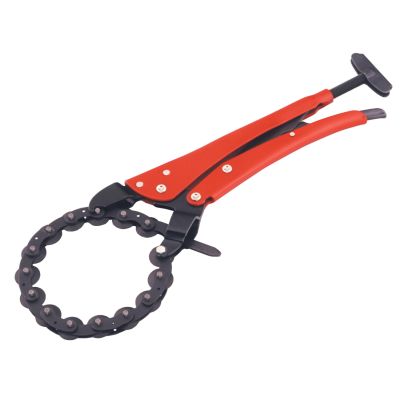
A pipe cutter is a specialized hand tool used for precisely cutting pipes and tubing, typically featuring a clamping mechanism with one or more sharp cutting wheels that score the material as the tool rotates around the pipe, resulting in a clean, burr-free cut.[1] Commonly employed by plumbers, HVAC technicians, and construction workers, it excels at slicing through materials like copper, brass, aluminum, PVC, and steel tubing with diameters ranging from 1/8 inch to several inches, offering superior accuracy and efficiency compared to hacksaws or rotary tools.[2][3] Pipe cutters come in various types tailored to specific applications and materials, including standard wheel cutters for thin-walled metal tubes, ratcheting models for PVC and plastic pipes that allow incremental advancement without full rotation, and chain-style cutters for larger or rigid pipes like cast iron.[4][5] Mini or close-quarters cutters are designed for tight spaces, while soil pipe cutters use chains to handle brittle materials without shattering.[5] These tools prioritize safety and portability, often incorporating features like replaceable blades and adjustable jaws to accommodate different pipe thicknesses, making them essential for both professional and DIY installations.[6][7] Beyond manual variants, powered pipe cutters—such as orbital or hydraulic models—are available for high-volume or heavy-duty tasks in industrial settings, though hand tools remain the most widespread due to their simplicity and cost-effectiveness.[8] The evolution of pipe cutters dates back to the late 19th century, with modern designs emphasizing durability and ergonomic handles from leading manufacturers like RIDGID and KNIPEX.[9][10][11]

Overview

Definition and Purpose

A pipecutter is a handheld tool designed to score and cut pipes and tubes by rotating a cutting wheel around the pipe's circumference, producing a clean, square cut without requiring excessive force.[1][2] This mechanism allows for precise slicing through materials such as copper, steel, PVC, and other metals or plastics commonly used in plumbing and construction.[12] Various types, including manual and ratchet models, adapt the basic design to different pipe sizes and materials.[2] The primary purpose of a pipecutter is to enable quick, burr-free cuts on pipes, which facilitates easier fitting and joining while reducing the need for additional deburring tools and minimizing material waste during installation.[1][13] In professional applications like plumbing and pipefitting, it streamlines workflows by providing reliable cuts that maintain pipe integrity, outperforming traditional methods in speed and accuracy for tasks such as water line installations or HVAC systems.[14]

Key Advantages

Pipe cutters produce clean, square cuts with minimal burrs, resulting in smooth edges that facilitate tight seals when connecting fittings, unlike hacksaws which often leave rough surfaces requiring additional deburring.[15][16] This precision is particularly beneficial in plumbing applications where even minor imperfections can lead to leaks.[17] Compared to traditional sawing methods, pipe cutters offer greater speed and ease for small to medium-diameter pipes, demanding less physical effort while eliminating sparks that could ignite flammable materials in sensitive environments.[15][18] Their compact design enhances portability for on-site use, and they prove cost-effective over time through durable cutting wheels that reduce the need for frequent replacements, unlike hacksaw blades that wear quickly.[19] Safety is further improved with pipe cutters, as they generate no flying debris or heat, minimizing injury risks in workshop settings and providing better user control to prevent accidents.[17][15]

History

Invention and Early Development

The origins of the pipecutter trace back to the 19th century, when precursors such as simple scoring tools and hacksaws were commonly used to cut pipes, often resulting in imprecise and time-consuming work for plumbers and industrial workers. These early methods relied on manual abrasion or sawing, lacking the precision and efficiency of later designs. The invention of the basic wheeled pipecutter mechanism is credited to Elbridge F. Barnes of New Haven, Connecticut, in the United States, who received US Patent 282,435 on July 31, 1883, for a three-wheel cutter designed to replace hacksaws in plumbing applications.[20] Barnes' design featured a cast or malleable frame with a movable jaw adjusted by a screw, allowing the cutting wheels to score the pipe through a rocking motion even when full rotation around the pipe was impractical.[20] This innovation marked a significant advancement, enabling cleaner and faster cuts on metal pipes compared to prior techniques. Early development built on these foundations, with 19th-century patents like US 176,815 (1876) by Andrew Saunders introducing basic pipe-cutting concepts, evolving into the first commercial models of wheeled cutters in the 1920s targeted at copper and steel pipes for industrial and plumbing use.[21] These models, such as those refined in US Patent 1,428,712 (1922) by Walter J. Sanders, incorporated chain-linked cutting wheels for better encircling of pipes, improving versatility in tight spaces.[22] A key milestone occurred in the 1930s with the introduction of adjustable models capable of handling varying pipe diameters. Companies like Reed Manufacturing, established in 1896 as a producer of pipe tools, contributed to this era through ongoing innovations in cutter designs and related patents, solidifying the tool's role in professional trades.[23]

Modern Evolution

Following World War II, pipecutter technology advanced significantly in the post-1950s period, with manufacturers focusing on specialized designs for plumbing applications. In 1955, Monument Tools began in-house design and production of the first dedicated copper pipe cutters, shifting from general-purpose tools to precision instruments optimized for softer metals like copper and plastic tubing.[24] Cutter wheels evolved to incorporate high-carbon tool steel for superior durability and shock resistance, enabling cleaner cuts and extended tool life compared to earlier carbon steel variants.[25] By the 1970s, plastic-handled models emerged, providing enhanced grip and reduced slippage during use, aligning with broader industry trends toward user-friendly tool construction.[26] A pivotal innovation occurred in the 1980s with the Pipeslice, a single-size cutter invented by Stephen D. Garton and patented in 1989 (US Patent 4,831,732). This design popularized quick-release mechanisms, allowing users to snap the tool onto pipes for faster, one-handed operation without readjusting, which streamlined workflows in tight spaces.[27] Monument Tools distributed the Pipeslice until its patent expired in 2005, after which the company launched the similar Autocut model, spurring widespread production of generic versions and democratizing access to efficient cutting tools.[28] These developments contributed to the integration of pipecutters into global plumbing standards by the 1990s, as ergonomic features like quick-release and ratcheting reduced the physical effort required for repetitive tasks. Following the 2005 patent expiration, numerous manufacturers produced affordable generic quick-release cutters, further increasing their adoption in professional and DIY applications as of 2025.[28]

Design and Mechanism

Basic Components

A standard pipecutter, also known as a tube cutter, consists of several core physical components designed for precise and controlled pipe sectioning. The cutting wheel, often a sharp, rotatable blade made of hardened steel, serves as the primary element responsible for scoring and penetrating the pipe's surface during use.[4][1] This wheel is typically with a sharp, pointed edge to ensure even contact and clean cuts on materials like copper, brass, or PVC, with replaceable designs allowing for maintenance when dullness occurs.[1] The frame or body forms the structural backbone of the tool, comprising an adjustable metal chassis—usually steel or aluminum—that securely cradles the pipe to prevent slippage.[4] Integrated rollers on the frame facilitate smooth rotation of the pipe or tool around the circumference, enabling uniform scoring without excessive force.[4][1] Standard models accommodate pipe diameters ranging from 1/8 inch (3 mm) to 2 inches (50 mm), with the frame's design ensuring stability across these sizes.[4][1] The adjustment mechanism, commonly a threaded screw or knob, allows precise positioning of the cutting wheel against the pipe, tightening to apply consistent pressure as the cut progresses.[4][1] Crafted from durable metal, this component enables adaptation to varying pipe thicknesses and diameters, typically within the 1/8- to 2-inch range for general-purpose cutters.[1] Finally, the handle provides an ergonomic interface for user control, featuring a contoured grip—often plastic-coated steel—for applying rotational force and downward pressure.[4][1] In basic models, it integrates with the frame to support one-handed operation, while heavier-duty versions may include extended handles for enhanced leverage.[1] These components collectively enable the tool's efficient function by maintaining alignment and controlled depth during pipe scoring.[29]

Cutting Process

The cutting process of a pipecutter begins with proper preparation to ensure stability and accuracy. Hold the pipe steady to prevent movement during operation. Position the cutter perpendicular to the pipe at the desired cutting point, aligning the rollers against the pipe's surface and adjusting the feed screw or knob to bring the cutting wheel into light contact with the material, without applying excessive pressure initially.[1][30] Next, initiate scoring by rotating the cutter fully around the pipe one to two times to establish an initial groove with the cutting wheel. Continue the process by incrementally tightening the feed knob or screw—typically a quarter to half turn—after each full rotation, deepening the groove gradually while maintaining even pressure to avoid slipping or uneven cuts. Repeat these rotations and tightenings until the groove penetrates fully, causing the pipe to snap or separate cleanly, which may require several cycles depending on the pipe's dimensions. The rollers and cutting wheel, as core components, facilitate this controlled scoring action.[1][30] For finishing, the scoring method typically produces a clean cut with minimal burrs, requiring only light deburring using the tool's built-in reamer or a separate deburring tool to smooth any minor edges. Technique variations include fewer rotations and lighter tightening for thin-walled pipes to prevent distortion or collapse, while thicker walls demand more deliberate, incremental advances to maintain wheel integrity and achieve a straight severance.[1][30] Safety during the cutting process involves wearing protective gloves to handle potential sharp edges on the pipe ends and avoiding over-tightening the feed mechanism, which can damage the cutting wheel or cause binding. Always use eye protection to guard against flying debris.[1][30]

Types

Manual Tube Cutters

Manual tube cutters are fundamental hand tools featuring a basic rotating wheel mechanism designed for cleanly severing metal tubes such as copper, brass, and steel, with capacities typically extending up to 1-1/8 inches (28 mm) in outer diameter. These devices employ a single cutting wheel mounted on a frame that clamps around the tube, allowing the user to rotate the tool progressively while tightening the wheel to score and separate the material with minimal burr formation. The single-wheel configuration promotes precision by focusing the cutting force on a narrow point, resulting in square, even cuts suitable for applications requiring tight tolerances.[31][26] Standard specifications for these cutters include a cutting range of 3 to 28 mm, accommodating small-diameter tubing commonly encountered in plumbing and mechanical systems. Key features enhance usability and durability, such as quick-change mechanisms for replaceable cutting wheels made from hardened steel, which can be swapped out to maintain sharpness and adapt to different material hardness levels. The lightweight construction, often from zinc alloy or aluminum, facilitates portability and ease of handling in confined spaces.[32][33] Despite their effectiveness on softer metals, manual tube cutters have notable limitations, including reduced performance on very hard materials like cast iron, where the wheel may fail to penetrate adequately without excessive force or damage to the tool. The manual rotation process, which demands repeated full or partial turns to complete the cut, can become physically tiring, particularly for larger tubes near the upper end of the capacity range. For more demanding tasks, users may turn to advanced ratchet variants that incorporate leverage mechanisms for reduced effort.[34][35] Prominent examples of these tools include the Ridgid Model 150 constant-swing cutter and Reed Manufacturing's TC series tubing cutters, both of which are staples in HVAC installations for preparing refrigerant lines and ductwork tubing with reliable precision.[36]

Ratchet and Specialized Cutters

Ratchet cutters represent an advanced category of manual pipecutters designed for enhanced ergonomics and efficiency, particularly in handling non-metallic pipes. These tools employ a lever-action ratchet mechanism that incrementally advances the cutting blade with each squeeze of the handles, allowing users to apply sustained pressure without continuous manual rotation of the tool. This design is especially suited for cutting PVC and PPR pipes with outer diameters up to 42 mm, where the ratcheting action distributes force evenly to minimize user exertion.[37][38] Specialized variants within this category include snap cutters, which operate on a guillotine-style principle for quick, shearing cuts on thin-wall plastic pipes such as polyethylene (PE). These cutters feature a sliding blade that snaps closed in a single motion, producing clean edges without burrs on materials like low-density PE tubing used in irrigation or drainage systems. Complementing these are mini cutters tailored for small-diameter tubing, such as those in refrigeration lines, where compact designs with adjustable jaws enable precise cuts on copper, aluminum, or thin plastic lines ranging from 3 mm to 28 mm in outer diameter. These mini tools often incorporate a swivel head or close-quarter access to navigate tight spaces in HVAC installations.[39][40][41] Key features of ratchet and specialized cutters enhance their practicality, including quick-adjust dials for rapid sizing changes and provisions for spare, replaceable blades made from hardened steel or stainless steel to maintain sharpness over multiple uses. For instance, the Monument Autocut series offers models optimized for multi-size PVC cutting, with interchangeable blades that accommodate plumbing pipes from 10 mm to 50 mm, ensuring versatility in professional plumbing tasks. These elements contribute to the tools' durability and ease of maintenance in demanding environments.[38][42] Compared to basic manual tube cutters, which rely on direct wheel rotation for metals as described in the Manual Tube Cutters section, ratchet and specialized models excel in repetitive applications by accelerating the cutting process through mechanical advantage, thereby reducing hand fatigue during extended use. Additionally, their mechanisms are optimized for non-metallic materials, delivering deformation-free cuts that preserve pipe integrity for seamless jointing in plastic piping systems.[38][43]

Chain and Soil Pipe Cutters

Chain-style cutters are specialized tools designed for cutting large-diameter or rigid pipes, such as cast iron soil pipes, clay, and small concrete pipes, typically ranging from 1.5 to 6 inches (38 to 152 mm) in diameter. These cutters use a chain with multiple cutting links that wraps around the pipe, tightened by a ratchet or lever mechanism to apply even pressure until the pipe snaps cleanly without shattering. This method is ideal for brittle materials in plumbing and drainage systems, providing a square cut in confined spaces where rotary tools cannot operate.[44][45] Features include replaceable chain segments made from hardened steel for durability and quick-release mechanisms for easy setup. Models like the Reed SC49 series offer ratcheting action for close-quarter work, while single-stroke variants like the SC59 enable faster cuts on service-weight soil pipes. These tools prioritize safety by containing fragments during the snapping process and are essential for gray water and sewer line installations.[5][44]

Applications

Suitable Materials

Pipecutters are primarily designed for cutting softer metals such as copper, brass, thin-wall steel, and aluminum, where the cutting wheels can effectively score the material without encountering excessive resistance due to its malleability.[4][46][47] These metals allow for precise scoring and clean severance, with softer variants like copper and aluminum particularly yielding smooth edges that minimize post-cut finishing.[47] In the realm of plastics, pipecutters accommodate materials including PVC, CPVC, PEX, and PPR, though these necessitate sharper blades to mitigate risks of cracking or localized melting from friction.[46][47] Applying steady, even pressure during the process helps prevent jagged or irregular edges on plastic pipes, preserving structural integrity.[47] Limitations arise with very thick or hardened materials, such as schedule 80 steel or cast iron, where manual pipecutters lack the force to score effectively and may result in tool damage or incomplete cuts, often necessitating powered alternatives.[46][4]

Common Uses

Pipecutters are extensively employed in plumbing tasks for cutting water supply lines and drain pipes during both installations and repairs, ensuring precise fits without burrs that could impede flow.[3] In HVAC applications, technicians rely on them to section refrigerant lines and copper tubing, facilitating efficient system modifications and maintenance.[48] In construction and fabrication settings, pipecutters enable on-site adjustments to pipes used in framing structures or irrigation systems, allowing workers to achieve clean cuts in confined spaces.[49] For DIY home projects, such as installing sinks or updating plumbing fixtures, these tools provide accessible precision for hobbyists handling materials like PVC or copper.[50] Industrial applications of pipecutters include routine maintenance in manufacturing plants, where they are used to trim pipes in conveyor systems or fluid transfer setups, minimizing downtime during repairs.[49][51] Pipecutters are particularly suited for scenarios involving multiple sequential cuts, offering speed and portability over alternatives in non-automated environments, though they are less prevalent in high-volume mass production lines.[52]

Comparisons

Versus Hacksaws

Pipecutters produce square, burr-free cuts that are ideal for ensuring proper fittings and minimizing leaks in plumbing applications, particularly with materials like copper and PVC.[18] In contrast, hacksaws typically result in rough, jagged edges that require additional filing or deburring to achieve a clean finish, which can compromise seal integrity if overlooked.[53] This difference in cut quality makes pipecutters preferable for precision work where smooth edges are essential.[18] Regarding effort and speed, pipecutters offer rotational cutting that demands minimal physical exertion and allows for quicker completion on round pipes under 2 inches in diameter, often finishing in seconds per cut.[53] Hacksaws, however, involve linear sawing motions that are more laborious and time-intensive, especially for repetitive tasks, though they may prove faster for irregular or non-round shapes where rotation is impractical.[18] The ease of pipecutters in confined spaces further reduces user fatigue compared to the steady-hand requirement of hacksaws.[53] In terms of versatility, hacksaws excel at handling a broader range of materials, including metals, plastics, and wood, as well as cutting at various angles or on larger diameters beyond the typical 1.5- to 2-inch limit of manual pipecutters.[18] Pipecutters are optimized solely for straight, circumferential cuts on cylindrical pipes, limiting their use in scenarios requiring angled or non-standard profiles.[53] This makes hacksaws a more adaptable choice for general workshop or emergency repairs.[18] For cost and maintenance, pipecutters involve a higher initial investment due to their specialized design but feature durable cutting wheels that primarily require periodic sharpening for longevity.[53] Hacksaw frames are generally less expensive and widely available, with replacement blades being affordable; however, blades wear out faster under heavy use and necessitate frequent changes.[18] Overall, pipecutters offer better long-term value for frequent pipe-specific tasks, while hacksaws provide economical versatility for occasional or multi-purpose cutting.[53]

Versus Other Cutting Tools

Pipecutters offer distinct advantages over powered cutting tools such as reciprocating saws and bandsaws, particularly in scenarios requiring precision and safety in constrained environments. Reciprocating saws provide rapid cutting for high-volume tasks on larger pipes, but they produce significant noise, vibration, and rough edges that often necessitate additional deburring, while pipecutters deliver clean, burr-free cuts without these issues, making them preferable for fieldwork in tight spaces like plumbing installations in walls or ceilings.[54][55] Similarly, powered pipe saws like bandsaws excel in industrial settings for processing multiple pipes simultaneously with minimal heat buildup, yet they generate sparks and require substantial setup, contrasting with the spark-free, heat-free operation of pipecutters that reduces fire risks near flammable materials.[54][56] Among other manual alternatives, guillotine shears are effective for plastics like PVC, providing quick, square cuts without electricity, but they lack the precision for metals where pipecutters prevent distortion and ensure smooth ends suitable for threading or soldering.[57] Tube benders with integrated cutters serve dual purposes in shaping and trimming soft metals, yet pipecutters surpass them in standalone accuracy for straight cuts on rigid pipes, avoiding the bending-induced irregularities that can compromise joint integrity.[54] Alternatives like powered tools are typically chosen for pipes exceeding 4 inches in diameter or in high-volume production, where their speed outweighs the need for portability, whereas pipecutters are ideal for low-noise, handheld operations in remote or on-site fieldwork without access to electricity.[54][56] In environmental terms, pipecutters eliminate dust, fumes, and sparks entirely, rendering them superior for indoor applications or sensitive locations such as hospitals, where powered tools' emissions could pose health or contamination risks.[55][56]

References

User Avatar
No comments yet.