Hubbry Logo
PolytrichaceaePolytrichaceaeMain
Open search
Polytrichaceae
Community hub
Polytrichaceae
logo
8 pages, 0 posts
0 subscribers
Be the first to start a discussion here.
Polytrichaceae
Polytrichaceae
from Wikipedia

Polytrichaceae
Temporal range: Valanginian–Recent
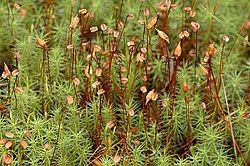
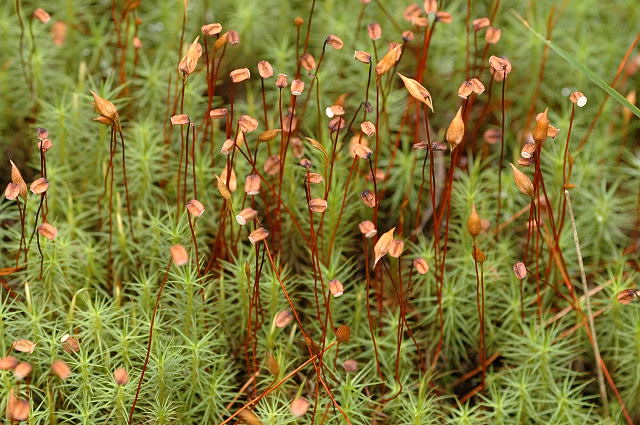
Polytrichum commune
Scientific classification Edit this classification
Kingdom: Plantae
Division: Bryophyta
Class: Polytrichopsida
Doweld
Order: Polytrichales
M. Fleisch.
Family: Polytrichaceae
Schwägr.
Genera

See text.

Polytrichaceae is a common family of mosses. Members of this family tend to be larger than other mosses, with the larger species occurring in particularly moist habitats. The leaves have specialized sheaths at the base and a midrib that bears photosynthetic lamellae on the upper surface. These mosses are capable of sustaining high rates of photosynthesis in the presence of ample light and moisture. Unlike all other mosses, the hydroid-based vascular system of these mosses is continuous from stem to leaf and can extract water from the soil through transpiration.[1] Species in this group are dioicous, though some are monoicous.[2] In most species, the sporophytes are relatively large, the setae are rigid, and the calyptrae are hairy.[1] Most species have nematodontous peristomes with 32–64 teeth in their sporangium;[2] some early-diverging genera instead have a stopper mechanism, which consists of the apical section of the columella, that seals the mouth of the capsule shut prior to dehiscence.[1]

Classification

[edit]
class Polytrichopsida
order Polytrichales
family Polytrichaceae
multiple genera
The phylogenetic position of the Polytrichaceae among the eight classes of mosses, based on inferences from DNA sequence data.[3][4]

Genera

[edit]
Atrichum undulatum

Extinct genera

[edit]

References

[edit]
Revisions and contributorsEdit on WikipediaRead on Wikipedia
from Grokipedia
Polytrichaceae is a family of acrocarpous mosses in the class Polytrichopsida, distinguished by their erect stems up to several centimeters tall, leaves with a sheathing base and photosynthetic lamellae along the costa, and sporophytes featuring (2–)4(–6)-angled or terete capsules topped by a hairy calyptra, earning them the common name "haircap mosses." This family, described by Christian Friedrich Schwägrichen in 1830, comprises approximately 17 genera and around 200 species worldwide, with 9 genera and 38 species native to North America north of Mexico. The most species-rich genus is Polytrichum, which includes robust, tuft-forming species like Polytrichum commune, often reaching heights of 5–15 cm and serving as pioneers in disturbed habitats. Other notable genera include Atrichum, Pogonatum, and Polytrichastrum, which exhibit similar polytrichoid leaf architecture with a narrow marginal lamina and nematodontous peristomes consisting of 16–64 unjointed teeth. Polytrichaceae mosses are widely distributed across all climatic zones except the lowland , occurring from arctic tundras to temperate forests and montane regions, often forming caespitose tufts or scattered colonies in moist, shaded, or disturbed soils. They prefer habitats with moderate to high and cover, such as river valleys and forested areas, where they contribute to and formation in some ecosystems. Most species are dioicous, with separate , though rare monoicous forms exist; reproduction involves persistent protonemata in genera like Pogonatum and wind-dispersed spores from erect capsules. Evolutionarily, Polytrichaceae represent an ancient lineage with a disjunctive record dating back to the , including the genus Eopolytrichum from amber deposits in Georgia, , highlighting their morphological isolation from other groups. These es play key ecological roles as primary colonizers, enhancing nutrient cycling and providing microhabitats, while species like Polytrichum commune have cultural uses in peat production and traditional crafts.

Description

Morphology

Polytrichaceae mosses are distinguished by their relatively large body size compared to most bryophytes, with erect, unbranched or sparsely branched stems that can reach heights of (2–)5–10(–70) cm in species such as Polytrichum commune. The gametophyte is the dominant life stage, featuring stiff stems arising from a central rhizome and anchored by rhizoids, forming dense tufts or cushions that give the plants a distinctive, grass-like appearance. Leaves are arranged spirally along the stem, narrow and lanceolate in shape, with sharply pointed apices and a broad basal sheath that clasps the stem; the margins are often toothed, and the upper leaf surface bears vertical photosynthetic lamellae—multilayered plates of cells along the midrib—that enhance light capture and photosynthetic efficiency. In Polytrichum species, these lamellae are numerous, typically 5-9 cells high and densely covered with small teeth on their margins, while in genera like Pogonatum, the lamellae are fewer and span the full width of the leaf, obscuring the underlying costa. The generation is prominent and elevated above the on a rigid , which can measure 5–9 cm in length in P. commune, providing stature for dispersal. Capsules are topped by a hairy calyptra—a cucullate hood densely covered in matted hairs that protects the developing spores—and vary in form across the family, often being four-angled or terete with a constricted or tapering hypophysis. For example, Pogonatum species exhibit urn-shaped capsules that are ovoid to short-cylindric, erect to inclined, and lack differentiated stomata on the exothecium. These external features collectively contribute to the family's for upright growth and efficient reproduction in diverse environments.

Anatomy

The stems of Polytrichaceae exhibit a central cylinder that forms a proto-vascular system unique among bryophytes, consisting of a hydrome and surrounding leptome. The hydrome comprises elongated, thin-walled hydroids that function in water conduction; these cells are dead at maturity, lack and secondary thickenings, and feature slanted end walls without perforations, providing resistance to while allowing axial flow from base to apex. Enveloping the hydroids are leptoids, living cells with oblique end walls, axial , and polarized connected via plasmodesmata, which conduct photosynthates and hormones in a manner analogous to sieve cells. This organization, absent in most other mosses, supports the upright growth and larger stature typical of the family. Leaf anatomy centers on a prominent costa, or midrib, that extends the full length of the leaf and incorporates stereids—thick-walled, supportive cells that provide mechanical strength. Adaxial to the costa are 5–10 layers of lamellae, vertical plates of narrow, chloroplast-containing cells that enhance and water retention by increasing surface area. These lamellae are multistratose and cover much of the lamina in genera like , forming a distinctive photosynthetic tissue. The capsule features a multi-layered wall, including a smooth to scabrous exothecium, with a central —a column of sterile tissue that persists after operculum dehiscence and facilitates air circulation within the capsule to aid maturation. The is guarded by a nematodontous of 32–64 rigid, unjointed teeth formed from whole cells, which exhibit hygroscopic movements to regulate release. The apex of the expands into an , a that partially covers the orifice and anchors the teeth. Anatomical variation occurs across genera; for instance, Dawsonia possesses simpler lamellae typically 4–6 cells high and a dawsonioid central strand with hydroids interspersed among sclerenchyma, contrasting with the more complex lamellae (up to 10 layers) and solid polytrichoid hydrome cylinder in Polytrichum, while Dawsonia also features notably longer setae supporting the capsule.

Habitat and Distribution

Global Distribution

Polytrichaceae exhibit a , occurring across temperate, boreal, and regions worldwide, but are notably absent from lowland tropical zones. They are present in high-altitude tropical areas, such as the and , where cooler conditions prevail. This family comprises approximately 22 genera and 260 globally, with a broad presence in moist, non-tropical environments. The highest species diversity is concentrated in the , exemplified by 38 species across 9 genera in . Southern extensions of the family occur in , where the genus Dawsonia—endemic to the region and extending to and parts of —represents a notable disjunct. In southern Africa, species like Polytrichum commune and members of Atrichopsis are recorded, highlighting limited but significant presence in subtropical to temperate zones of the continent. Specific genera illustrate varied ranges within the family: achieves a near-pantropical distribution at high elevations, spanning from the temperate zones to montane sites in , , , and Pacific islands. Atrichum , such as A. undulatum, are widespread in and , favoring temperate forests and grasslands. Pogonatum shows strong representation in (including the and Far East ) and the , with arctic-montane to subtropical distributions. Recent discoveries include a range extension of Pogonatum tahitense to , , marking its first mainland record and expanding from previous Pacific locales like and , as well as three additional new records for the family in Tibet reported in 2024, contributing to 12 known across five genera in the region.

Habitat Preferences

Species of the Polytrichaceae family generally prefer moist, acidic soils in open or semi-shaded areas, where they are commonly found in bogs, forests, disturbed sites, and rocky outcrops. These mosses thrive in environments with full sun to partial shade and mesic to moist conditions, often on sandy, gravelly, or peaty substrates with pH levels ranging from 3.4 to 4.6. Polytrichaceae exhibit adaptations to a variety of conditions, allowing some species to colonize challenging microhabitats. For instance, Polytrichum piliferum tolerates dry, sandy soils as a on well-drained, exposed sites such as rocky outcrops and disturbed ground. In contrast, species like Polytrichum strictum (bog haircap moss) favor wet , peatlands, and banks, where high moisture supports their growth. These adaptations, including specialized structures for conduction, enable the family to occupy both pioneer and stable niches. The family occupies a broad altitudinal range, from to alpine zones exceeding 4000 m, particularly in regions like where elevations reach up to 3966 m. Optimal falls between 4 and 6, with moderate temperatures of 5–20°C supporting growth, as indicated by bioclimatic variables such as annual mean temperatures of 3.2–18.4°C in suitable habitats. Regionally, Polytrichaceae in associate with warm, densely vegetated, and humid sites, often along river valleys with high precipitation (623–2050 mm annually). In , they are frequent in coniferous forests, including habitats in and spruce stands, as well as post-disturbance areas like burned sites.

Ecology

Ecological Roles

Polytrichaceae species, particularly those in the genus , function as pioneer organisms in , rapidly colonizing disturbed substrates such as bare soil, exposed , or burned areas. For example, Polytrichum strictum establishes dense mats on milled peatlands, where it covers up to 93% of sampled points, stabilizing loose substrates against from wind, overland flow, and . This soil-binding role creates a protective layer that reduces leaching and maintains higher (e.g., 95–165% in August versus 31% on bare ), thereby facilitating the recruitment and health of vascular plants like fir seedlings, which show improved health (Moss Health Index of 3.4 versus 2.0 after 16 months) under moss cover. In nutrient cycling, Polytrichaceae play a key role by intercepting and accumulating and from atmospheric deposition, especially in nutrient-poor early successional habitats. In Polytrichum-dominated , bulk precipitation provides the majority (58%) of annual nitrogen inputs, totaling around 10.5 kg ha⁻¹ yr⁻¹ including unmeasured sources, leading to net accumulation over time. Their subsequently releases these nutrients, enriching the layer in boreal forests and supporting microbial activity and higher plant productivity. Polytrichaceae contribute to through substantial accumulation in and boreal environments, where they form part of the that builds layers. In northern ecosystems, mosses like influence carbon cycling by storing fixed carbon in persistent , with their tolerance to —allowing survival at 5–10% —enhancing resilience to and variability. This physiological enables sustained productivity even under fluctuating moisture regimes, aiding long-term carbon retention in peat-forming systems. Recent studies highlight their sensitivity to declining under , potentially limiting distribution in warming regions. As indicator species, Polytrichaceae signal acidic, moist conditions in temperate and boreal habitats, with their presence reflecting low environments (e.g., as a robust indicator of soils). They are employed in to assess integrity, such as tracking restoration success in disturbed peatlands or evaluating acidification trends in forest ecosystems. Additionally, they are increasingly used in ecological restoration of areas for and recovery.

Interactions with Other Organisms

Polytrichaceae species, particularly those in the genus , provide essential and resources for soil on floors, serving as microhabitats that and sustain communities of nematodes, mites, and springtails. The dense, upright growth form of these mosses creates a bryosphere—a complex matrix of living and decaying tissues—that traps moisture and , offering refuge from and predators while supplying food sources such as spores, fragments, and decomposing tissues. For instance, oribatid mites and collembolans (springtails) thrive within carpets, where they graze on fungal hyphae and moss , contributing to in boreal and temperate ecosystems. Associations with fungi play a key role in the ecology of Polytrichaceae, including mycorrhizal-like and endophytic interactions that influence nutrient acquisition and defense. While true mycorrhizal symbioses are rare in mosses, some Polytrichum species form associations with basidiomycete fungi such as Pholiota carbonaria, which colonize gametophyte tissues in a manner resembling endophytism, potentially enhancing phosphorus uptake from nutrient-poor substrates like post-fire soils. Endophytic fungi within Polytrichum commune and related taxa may also confer protection against environmental stresses, such as extreme pH levels in acidic peatlands. These fungal partnerships are particularly evident in disturbed habitats, where they aid moss establishment and indirectly benefit associated microfauna through improved host vigor. Polytrichaceae engage in both competitive and facilitative interactions with vascular plants, shaping community dynamics during . In early successional stages on bare or disturbed substrates, species like P. piliferum and P. strictum compete with vascular plants for light and space due to their tall, dense growth, which can suppress seedling emergence in shaded conditions. However, they also act as nurse plants by retaining and providing microclimatic refugia, promoting the and initial establishment of vascular seedlings such as those of and ericaceous shrubs in and mine tailings. For example, in peatland restoration, P. strictum carpets improve vascular plant seedling health compared to bare , through moisture retention and reduced , though this facilitation diminishes as vascular competitors mature. Dispersal of Polytrichaceae propagules is facilitated by animals through bryo-zoophily, involving both external attachment and internal . Spores of species adhere to the fur of small mammals, such as red-backed voles (Myodes gapperi) and red squirrels (Tamiasciurus hudsonicus), enabling epizoochorous dispersal across boreal forest landscapes; viable spores have been recovered from mammal fur, germinating successfully after transport distances of several meters. Additionally, endozoochory occurs when spores are ingested and excreted in feces, as demonstrated by P. strictum propagules surviving passage through the guts of upland geese ( picta) and ashy-headed geese (C. poliocephala), with regeneration rates in fecal samples comparable to controls in substrates. These animal-mediated mechanisms enhance long-distance dispersal beyond wind limitations, particularly in fragmented habitats.

Reproduction

Life Cycle

The Polytrichaceae exhibit a diplohaplontic life cycle typical of bryophytes, characterized by an alternation of generations between a dominant, haploid gametophyte phase and a dependent, diploid sporophyte phase. The gametophyte is the prominent, green, photosynthetic stage, consisting of upright, branched stems that can persist for several years and serve as the primary life form of the plant. This haploid phase produces gametes through mitosis, enabling sexual reproduction, while the sporophyte arises from fertilization and remains nutritionally reliant on the gametophyte throughout its development. Sexual reproduction in Polytrichaceae is predominantly dioicous, with separate gametophytes, though monoicous forms occur rarely in some . Male plants bear antheridia clustered in perigonia at the stem apices, forming rosette-like heads surrounded by specialized leaves, where biflagellate, motile (antherozoids) are produced. Female plants develop archegonia in terminal perichaetia, with flask-shaped structures containing a single at the base of a long neck. Fertilization requires external , such as or dew, to enable the to swim toward the archegonia via , fusing with the to form a diploid . This develops into the while embedded in the of the female . The consists of a foot embedded in the for nutrient absorption, an elongated that elevates the capsule, and the capsule itself, which features a central for structural support and an annulus that aids in (operculum) removal. The capsule is typically 4- to 6-angled or terete, maturing to release spores through a unique nematodontous of [16–]32 to 64 rigid, unjointed teeth fused in pairs. These teeth exhibit hygroscopic movements, bending inward in moist conditions to protect spores and outward in drier air to facilitate release, often enhanced by rain splash or wind, with each capsule containing up to approximately 10^6 minute, echinulate spores produced via . occurs within the capsule, yielding haploid spores that germinate into protonemata, which develop into new s to complete the cycle. Variations in the life cycle occur across genera; for instance, species are typically dioicous and feature notably long setae (up to 6-9 cm) that position capsules high for effective dispersal. In contrast, Dawsonia exhibits capsules that are initially erect but become inclined or horizontal at maturity, with a distinctive 2-angled, dorsally flattened form and a fibrous adapted to similar hygroscopic regulation.

Asexual Reproduction

In Polytrichaceae, occurs primarily through vegetative means on the generation, enabling clonal propagation without the need for sexual processes. Multicellular propagules known as gemmae are produced in certain genera, such as Atrichum, where rhizoidal gemmae form on rhizoids and serve as dispersal units for rapid colonization of new sites. These gemmae, often clustered and capable of developing into new upon detachment, are particularly noted in species like Atrichum tenellum and A. crispum, enhancing establishment in moist, shaded environments. Fragmentation represents another key strategy, especially in genera like , where portions of stems, leaves, or rhizomes break off and regenerate into independent under favorable moist conditions. This process is common in disturbed habitats and contributes to local population expansion, as observed in Polytrichum formosum, where gametophyte fragments disperse short distances and establish clones via rhizome branching. Vegetative regeneration from such fragments is efficient for maintaining populations in stable microhabitats, often outpacing in dioicous species. Additionally, persistent protonemata serve as a vegetative reproductive mechanism in genera such as Pogonatum, where the filamentous stage forms extensive, long-lived mats that facilitate clonal expansion and colonization without immediate development. These protonemal mats can persist for years, producing new shoots asexually and aiding in persistence. These asexual mechanisms provide ecological advantages by allowing swift spread independent of water for fertilization, promoting genetic uniformity within populations while facilitating persistence in heterogeneous environments. In species, clonal growth via fragmentation supports habitat colonization without relying on dispersal, reducing vulnerability to or limitations.

Taxonomy

Phylogenetic Position

Polytrichaceae is classified within the division Bryophyta (es), specifically in the class Polytrichopsida, and constitutes the sole family in the order Polytrichales. This class represents an early-diverging lineage among mosses, positioned basally relative to other classes such as , Tetraphidopsida, and Buxbaumiopsida, based on molecular phylogenetic analyses. Studies utilizing genes like rps4 and rbcL, along with the trnL-F region, have consistently recovered Polytrichopsida as sister to the remaining moss classes, highlighting its isolated evolutionary trajectory within bryophytes. Key synapomorphies defining Polytrichopsida, and thus Polytrichaceae, include the nematodontous —composed of intact cell walls forming solid teeth—and well-developed conducting tissues resembling those in , with hydroids for and leptoids for photosynthate conduction. These traits distinguish Polytrichaceae from the arthrodontous peristomes and simpler internal structures of more derived mosses like . estimates, calibrated with fossil data, indicate that Polytrichopsida diverged from other moss lineages approximately 400 million years ago during the period, aligning with the early radiation of land . Within Polytrichaceae, phylogenetic structure reveals early-branching lineages akin to those in Tetraphidopsida, such as genera lacking peristomes (e.g., Alophosia as sister to the core group), contrasting with the more derived Polytrichoideae that encompasses most genera and features fully developed nematodontous peristomes. Recent molecular phylogenies have further refined relationships, splitting the large Polytrichum into distinct subgenera based on sporophyte morphology and . A 2010 reassessment using nuclear ITS regions and chloroplast trnL-F markers strongly supports the monophyly of Polytrichaceae, resolving incongruences among trees and confirming robust generic circumscriptions across chloroplast, mitochondrial, and nuclear datasets.

Genera

The Polytrichaceae family encompasses approximately 18–22 extant genera and 200–260 species worldwide, with the highest diversity concentrated in Asia, particularly in regions like Southeast Asia and the Sino-Himalayan area. Recent taxonomic revisions, including molecular phylogenies, have refined genus boundaries within the family, such as the separation of Polytrichastrum from Polytrichum based on sporophyte morphology and genetic data. Recent surveys in Tibet (as of 2024) have documented 12 species across 5 genera, contributing to broader Asian patterns. Among the core genera, is the largest, comprising over 70 species with a across temperate, boreal, and montane habitats; its leaves feature prominent lamellae on the upper surface, aiding in . Atrichum includes about 20 species primarily in temperate zones, distinguished by transversely undulate leaves with distinct borders and capsules that lack prominent ornamentation on the exothecial cells. Pogonatum, with more than 50 species showing diverse habits from lax to robust tufts, is characterized by urn-shaped capsules and occurs widely in disturbed soils across northern and southern hemispheres. Other notable genera include Dawsonia, which is distributed from to New Guinea, Malesia, and the Solomon Islands, with 7–9 species known for exceptionally tall stems reaching up to 60 cm, the tallest among mosses due to specialized hydroid conduction tissues. Psilopilum consists of 2 species adapted to and pioneer sites on non-calcareous soils, featuring reduced lamellae confined near the leaf apex and wiry, slender habits. Oligotrichum encompasses around 24 species in boreal and alpine environments, particularly diverse in the Sino-Himalaya, with variable leaf forms and abaxial lamellae often restricted to the costa. Lyellia is a small genus of 3–4 rare species with disjunct distributions in the , eastern Asia, and , noted for its erect tufts and toothed calyptrae in harsh, exposed habitats. The full list of extant genera also encompasses Alophosia, Atrichopsis, Bartramiopsis, Dendroligotrichum, Hebantia, Itatiella, Meiotrichum, Notoligotrichum, Polytrichadelphus, and Polytrichastrum (ca. 20 species, mainly in temperate and boreal forests with leiodont peristomes), among others; these smaller genera often exhibit regional and specialized traits like reduced peristomes or epiphytic growth.

Fossil Record

Extinct Genera

The fossil record of Polytrichaceae includes several extinct genera that provide insights into the family's early diversification, primarily from Mesozoic and Cenozoic deposits. These fossils, often preserved as permineralized gametophytes or amber inclusions, reveal morphological features such as lamellate leaves and specialized reproductive structures that align with but predate extant taxa. Meantoinea alophosioides, described from permineralized gametophytes in Early Cretaceous (Valanginian) deposits on Vancouver Island, Canada, dated to approximately 136 million years ago, represents the oldest unequivocal record of the family. This species features alophosioid leaves with marginal lamellae and terminal gemma cups containing stalked gemmae, marking the first fossil evidence of asexual reproduction via gemmae in mosses; the central strand includes both hydroids and leptoids, a diagnostic polytrichaceous trait, while the absence of advanced sporophytic features suggests a basal position. These characteristics indicate an early divergence within the family, extending its minimum age significantly beyond previous estimates. Eopolytrichum antiquum, known from associated sporophytes and s in () sediments in Georgia, , approximately 80 million years old, exhibits a with ventral lamellae on the leaves and a primitive, elongate lacking a fully developed . The capsules are borne on short setae, and the overall morphology combines derived polytrichaceous elements like lamellate leaves with simpler sporophytic structures, positioning it closer to crown-group genera such as . This highlights the presence of relatively advanced features in the , supporting a origin for the family. Polytrichites, a based on isolated fragments from deposits, is characterized by stiff leaves with basal sheaths and marginal lamellae, features typical of polytrichaceous mosses, though full gametophytes or sporophytes remain unknown. These fragments, often assigned to species like P. spokanensis from later contexts but rooted in material, suggest widespread distribution of sheath-bearing forms during the . In Eocene Baltic amber, approximately 44-38 million years old, three extinct species of Atrichum have been described: A. groehnii, A. succineum, and A. undulatifolium, based on well-preserved gametophytes with leaves featuring a crispulum (undulate margins) and reduced lamellae. These fossils, the earliest records for the genus, show close similarity to modern Atrichum in leaf architecture but differ in sporophyte absence and slight lamella counts, indicating early Cenozoic specialization within the family. Phylogenetic analyses incorporating these fossils, including a 2018 study of stem-group Polytrichaceae, place Meantoinea and Eopolytrichum as successive outgroups to the crown group, demonstrating early divergence of basal lineages by the Early Cretaceous and supporting the family's isolation from other bryophytes.

Evolutionary History

The evolutionary origins of Polytrichaceae are estimated through molecular clock analyses to date back to the Jurassic, with a crown age for the class Polytrichopsida of approximately 150 million years ago (Ma). This timing aligns with the early diversification of the family within the moss lineage, though direct fossil evidence remains elusive prior to the Cretaceous. The oldest unequivocal fossils, such as Meantoinea alophosioides from the Valanginian stage of the Early Cretaceous (ca. 136 Ma) on Vancouver Island, Canada, confirm the presence of the full family by this period, featuring permineralized gametophytes with gemma cups and conducting tissues indicative of advanced morphology. These early records suggest an initial radiation during the Mesozoic, potentially accelerated by the family's key adaptations for terrestrial environments. A defining in Polytrichaceae is the development of specialized conducting tissues in the stem, comprising hydroids for water transport and leptoids for conduction, which are unique to this family among mosses and enhance . These structures are evident in fossils like Meantoinea, indicating their establishment by at least 136 Ma, though phylogenetic inferences place their emergence earlier in the stem lineage. complexity, particularly the nematodontous teeth that regulate dispersal, also evolved during the , as seen in transitional forms like Eopolytrichum antiquum from the (ca. 80 Ma), which lacks fully developed teeth but shows fibrous capsule features precursor to modern designs. Post- events around 66 Ma appear to have spurred further diversification, with Eocene deposits from Baltic and other sites preserving multiple genera and demonstrating a radiation to around 19–23 extant genera by the . The fossil record of Polytrichaceae is notably sparse before the , with no confirmed pre- specimens despite molecular estimates suggesting deeper antiquity; this gap likely reflects taphonomic biases and limited exploration of deposits rather than absence. Eocene amber inclusions, including species of Atrichum and other polytrichaceous mosses, reveal morphologies nearly identical to modern forms, underscoring the family's evolutionary conservatism over 50 million years. In contemporary lineages, ancient events have contributed to , as evidenced by allopolyploid origins in species like Polytrichastrum pallidisetum and formosum, where patterns indicate from diploid progenitors dating back millions of years. Fossil distributions further imply resilience to climate shifts, with and records showing broad latitudinal ranges that mirror the family's current global presence in varied habitats.

References

Add your contribution
Related Hubs
User Avatar
No comments yet.