


Community hub
Recent from talks
Contribute something
Nothing was collected or created yet.
Port of Busan
View on Wikipedia
Key Information


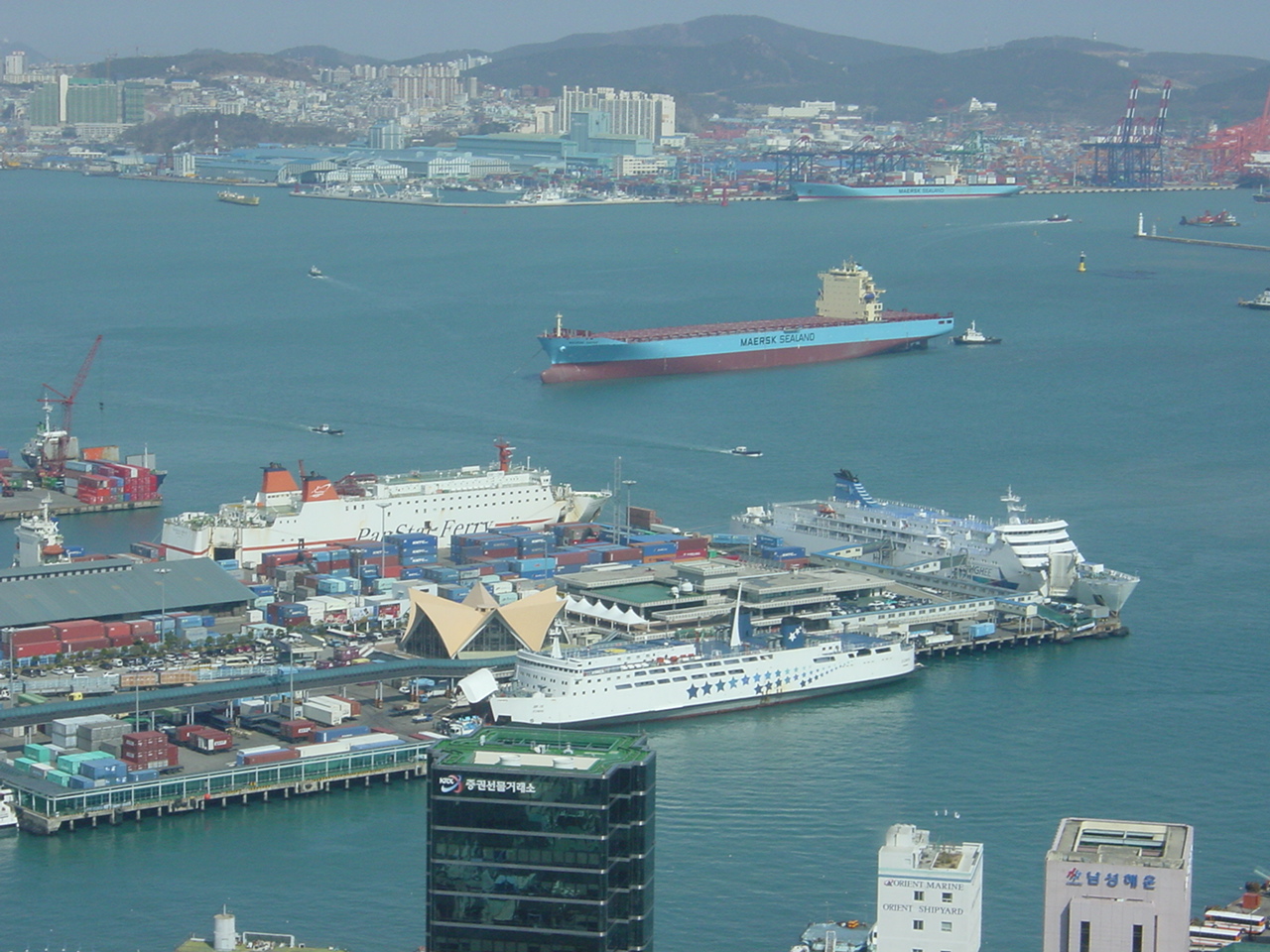
The port of Busan is the largest port in South Korea, located in the city of Busan, South Korea. Its location is known as Busan Harbour.[a]
The port is ranked sixth in the world's container throughput and is the largest seaport in South Korea. The port is operated by the Busan Port Authority, which was founded in 2004 as a public company. In 2019, around 22 million TEU were handled at 10 container terminals in Busan.[3]
History
[edit]The port of Busan was established in 1876 as a small port with strict trading between Korea, China and Japan.[4] It is situated at the mouth of the Nakdong River (낙동강) facing the Tsushima Island of Japan. During the Korean War (1950-1953), Busan was among the few places North Korea did not invade, causing war refugees to flee to the city of Busan. At that time Busan's port was crucial to receive war materials and aid, such as fabrics and processed foods to keep the economy stable. In the 1970s, a rise in the footwear and veneer industries caused factory workers to migrate to Busan, bringing Busan's population from 1.8 million to 3 million.
The port of Busan continued to grow and by 2003 the port was the fourth largest container port in the world.[5] South Korea accounted for 0.7% of global trade in 1970, but by 2003 it went up to 2.5%. 50% of the Busan's manufacturing jobs are related to exports, and 83% of the country's exports are containerised, making Busan the country's largest container and general cargo port. Compared to the port of Busan, Inchon port handles only 7% of containers. Easy access to the port of Busan between Japan, Singapore, and Hong Kong contribute to its vast growth.
Currently the port of Busan is the fifth busiest container port in the world and the tenth busiest port in North-east Asia.[6] It is developed, managed, and operated by the Busan Port Authority (BPA) established in 2004. Today the port of Busan consists of four ports- North Port, South Port, Gamcheon Port, and Dadaepo Port, an International Passenger Terminal and the Gamman container terminal. The North Port provides passenger handling facilities and cargo, and with Gamcheon Port's help more cargo volumes can be handled (Ship Technology). The South Port is home to the Busan Cooperative Fish Market which is the largest fishing base in Korea, and it handles 30% of the total marine volume. The Dadaepo Port located west of the Busan Port, mainly handles coastal catches.
In 2007 the Busan Port handled cargo containing fertilisers, meat, scrap metal, petroleum and other gases, crude petroleum, coal, leather, fats and oils, iron ore, rough wood, natural sand, milling industry products, grains and sugar. In 2016, South Korea exported a total of $515B and imported $398B. Top exports of South Korea are integrated circuits, cars, refined petroleum, passenger and cargo ships, and vehicle parts. South Korea exports the most to China, the United States, Vietnam, Hong Kong, and Japan. Imports to South Korea mainly come from China, Japan, the United States, Germany, and other Asian countries.[7] In 2017 Busan processed more than 20 million TEU, twenty-foot equivalents (a measure used to estimate the capacity of container ships).[8]
The port is part of the Maritime Silk Road that runs from the Chinese coast towards the southern tip of India to Mombasa, from there through the Suez Canal to the Mediterranean and there to the Upper Adriatic region of Trieste with its rail connections to Central and Eastern Europe.[9][10][11][12]
The current traffic volumes and urban population categorise Busan as a Large-Port Metropolis, using the Southampton system of port-city classification.[13]
Port Statistics
[edit]| Year | Container Throughput (TEU) |
|---|---|
| 2010 | |
| 2011 | |
| 2012 | |
| 2013 | |
| 2014 | |
| 2015 | |
| 2016 | |
| 2017 | |
| 2018 | |
| 2019 | |
| 2020 | |
| 2021 |
Incidents
[edit]In 2021, a big cargo ship hit a number of cranes as it was parking. There were no injuries or deaths.[14]
Sister ports
[edit]The Port of Busan also has 6 sister ports (listed in order of dates).[15]
 – Port of Southampton, United Kingdom (1978)
 – Port of Seattle, United States (1981)
 – Port of Osaka, Japan (1985)[16]
 – Port of Rotterdam, Netherlands (1985)
- – Port of New York & New Jersey, USA (1988)
 – Port of Shanghai, China (1994)
 - Bandar Abbas, Iran


References
[edit]- ^ "UNLOCODE (KR) - KOREA, REPUBLIC OF". service.unece.org. Retrieved 28 April 2020.
- ^ EB (1878), p. 390.
- ^ 김상춘; 최봉호 (December 2015). "Economic Impacts of Container Freight Activities in Busan Port on the Regional Economy of Busan, South Korea". The Journal of International Trade & Commerce. 11 (6): 271–295. doi:10.16980/jitc.11.6.201512.271. ISSN 1738-8112.
- ^ Seo, Jeong Kyung; Cho, Mihye; Skelton, Tracey (2015-08-01). ""Dynamic Busan": Envisioning a global hub city in Korea". Cities. 46: 26–34. doi:10.1016/j.cities.2015.03.012. ISSN 0264-2751.
- ^ FREMONT, ANTOINE; DUCRUET, CESAR (September 2005). "The Emergence of a Mega-Port - from the Global to the Local, the Case of Busan". Tijdschrift voor Economische en Sociale Geografie. 96 (4): 421–432. CiteSeerX 10.1.1.593.8315. doi:10.1111/j.1467-9663.2005.00473.x. ISSN 0040-747X.
- ^ "Port of Busan". Ship Technology. Retrieved 2018-12-10.
- ^ "OEC - South Korea (KOR) Exports, Imports, and Trade Partners". atlas.media.mit.edu. Retrieved 2018-12-10.
- ^ "Decades of Growth at Port of Busan". earthobservatory.nasa.gov. 2018-09-05. Retrieved 2018-12-10.
- ^ Marcus Hernig: Die Renaissance der Seidenstraße (2018) pp 112.
- ^ Can the New Silk Road Compete with the Maritime Silk Road?
- ^ China’s 21st Century Maritime Silk Road
- ^ China’s Maritime Silk Road and the Middle East: Tacking Against the Wind
- ^ Roberts, Toby; Williams, Ian; Preston, John (2021). "The Southampton system: A new universal standard approach for port-city classification". Maritime Policy & Management. 48 (4): 530–542. doi:10.1080/03088839.2020.1802785. S2CID 225502755.
- ^ "Big Ship Crashes into new Gantry cranes. DISASTER!". YouTube.
- ^ Port of Busan, Sister Ports, Busan
- ^ "Port & Harbor Bureau, City of Osaka". Archived from the original on 2007-03-13. Retrieved 2006-09-15.
- , Encyclopædia Britannica, 9th ed., Vol. VI, New York: Charles Scribner's Sons, 1878, pp. 390–394.
Notes
[edit]External links
[edit] Media related to Busan Port at Wikimedia Commons


Port of Busan
View on GrokipediaGeography and Location
Site and Access
The Port of Busan is situated at the southeastern tip of the Korean Peninsula, at the mouth of the Nakdong River, with geographic coordinates of 35°04′42″N 129°01′01″E.[3][5] This location provides natural advantages as a deep-water harbor, with channel depths reaching 17 to 18 meters, enabling berthing for large vessels up to 19,000 TEU capacity without extensive dredging requirements.[12] The harbor is well-sheltered by surrounding mountains, islets, and Geoje Island to the south, along with a narrow tidal range of approximately 1.3 meters, which minimizes navigational challenges and supports year-round operations.[3][12][5] The port's position adjacent to key East Asian sea lanes via the Korea Strait offers efficient maritime access, with sailing distances to major hubs like Shanghai measuring about 450 nautical miles and typical transit times of 20 to 24 hours for container vessels.[13][3] Domestically, it integrates seamlessly with the national transport network through the Gyeongbu Line railway, which connects Busan to Seoul and other inland regions, and major highways including the Gyeongbu Expressway, ensuring rapid distribution of cargo across South Korea.[14][15] Designated under UN/LOCODE as KRPUS, the Port of Busan serves as South Korea's principal maritime gateway, facilitating the majority of the country's exports and imports while acting as a critical transshipment hub linking the Pacific Ocean to the Eurasian continent.[16][3]Harbor Layout
The Port of Busan is divided into several distinct zones, including the older North Port located in the central area of the city, the Gamcheon Port, the Dadaepo Port, and the modern New Port situated on Gadeokdo Island, which has been under development since 2006.[3] The North Port serves primarily as a hub for bulk and general cargo handling, along with passenger services, while the New Port is specialized for container operations, accommodating mega-container ships through its advanced infrastructure.[17][18] Gamman Pier, integrated within the North Port, supports additional container and logistics activities, contributing to the port's versatile zoning. The harbor features a total quay wall length of 40.1 kilometers, enabling simultaneous berthing for up to 135 vessels across its zones.[3] Water depths vary by area, ranging from 11 meters in shallower sections like Uam to 18 meters in the New Port's deeper berths, allowing access for large vessels including those up to 20,000 TEU capacity.[3][19] The New Port incorporates automated systems, such as remote-controlled ship-to-shore cranes and high-bay storage, marking South Korea's first fully automated container terminal operational since 2024.[20] The overall port area encompasses approximately 1,200 hectares, with the New Port alone covering around 11 square kilometers dedicated to container yards and support facilities.[21][22] Navigation into the harbor is facilitated by protective breakwaters, including natural formations from nearby islands like Yeongdo and Jodo, which shelter the entrance, along with designated approach channels maintaining depths of 15 to 17 meters in key areas.[23][24] Pilotage is compulsory for all vessels, with pilots boarding outside the breakwaters to guide safe entry, ensuring efficient traffic flow in this high-volume facility that processed 24.4 million TEU in recent years.[25][26]History
Origins and Early Development
The Port of Busan traces its origins to the 15th century during the Joseon Dynasty (1392–1910), when it functioned as a vital trading hub for coastal and regional exchange, particularly facilitating commerce and diplomacy with Japan due to its strategic southeastern location on the Korean Peninsula.[5] As the closest major port to Japan, Busan hosted Japanese trading posts known as Waegwan, established as early as 1407 under the name Busanpo, where goods like rice and textiles were exchanged in limited volumes through rudimentary facilities.[6] This pre-modern role positioned Busan as a gateway for Joseon's interactions with East Asian neighbors, emphasizing regional maritime trade over large-scale international operations.[27] The port's transformation into a modern international facility began with its official opening on 27 February 1876, marking it as Korea's first such port under the provisions of the Japan–Korea Treaty of 1876 (also called the Treaty of Ganghwa), an unequal agreement that ended Joseon's isolationist policies and initially restricted trade to Japan alone.[28][29] The treaty, signed amid Japanese naval pressure, designated Busan as one of three open ports (alongside future openings at Wonsan in 1880 and Incheon in 1883), allowing Japanese merchants extraterritorial rights and focusing early activities on exporting Korean rice and importing Japanese manufactured goods like textiles.[30] Initial infrastructure was modest, comprising small-scale wharves and piers capable of handling shallow-draft vessels for bulk commodities, with trade volumes remaining limited to support local and bilateral exchanges rather than global commerce.[31] Under Japanese occupation from 1910 to 1945, following Korea's annexation, the port underwent significant expansion to serve colonial economic interests, including the development of additional piers and facilities for exporting raw materials like rice and minerals to Japan.[32] Major infrastructure projects initiated in 1911 modernized the harbor, increasing capacity for cargo handling and integrating Busan into Japan's imperial supply chains, though operations prioritized colonial exports over Korean domestic needs.[33] By the 1940s, general cargo piers had been constructed, enhancing efficiency for wartime logistics.[34] In the early 20th century, amid regional conflicts such as the Russo-Japanese War (1904–1905), Busan emerged as a critical supply and logistical point for Japanese forces, handling military shipments and reinforcements that underscored its growing strategic value and foreshadowed its role in larger-scale wartime operations.[32] This period solidified the port's infrastructure for handling increased traffic, transitioning it from a modest trade outpost to a key node in East Asian geopolitics.Post-War Growth and Modernization
During the Korean War (1950–1953), the Port of Busan served as the primary supply base for United Nations forces, functioning as the main gateway for military personnel, equipment, and humanitarian aid entering South Korea.[35] Pier 1, in particular, handled the arrival of U.N. soldiers, displaced Koreans, and the majority of war assistance supplies, supporting the defense of the Pusan Perimeter and sustaining the provisional government's operations.[7] This influx of refugees and economic activity spurred rapid population growth in Busan, transforming it from a regional hub into a bustling wartime capital with lasting demographic impacts.[36] Following the armistice in 1953, Busan gained greater autonomy when it was designated a directly governed city in 1963, separating from South Gyeongsang Province and enabling focused local governance over port and urban development.[37] This status facilitated rapid industrialization in the 1970s, as the city attracted heavy industries including shipbuilding and manufacturing, driven by national economic plans that positioned Busan as a key industrial center.[38] Shipyards and factories proliferated, leveraging the port's strategic location to export goods and import raw materials, which further integrated the port into South Korea's export-oriented economy.[39] The 1980s marked a containerization boom at the port, with expansions in feeder networks to Japanese and Chinese ports enabling Busan to capture transshipment cargo and handle increasing volumes of standardized containers.[40] Institutional reforms continued with the formation of the Busan Port Authority (BPA) in January 2004, a public corporation tasked with unified management, development, and operation of port facilities to enhance efficiency and competitiveness.[41] The groundbreaking for Busan New Port in 2006 initiated a major expansion, with the first phase completing 23 berths by the early 2020s and accommodating larger vessels with depths up to 18 meters in some areas; by 2024, 26 berths were operational.[42][43] In the 2010s, the port pursued automation initiatives, including smart technologies for terminal operations and logistics integration, to streamline handling and reduce costs.[44] These upgrades, combined with strategic investments, solidified Busan's role as a leading transshipment hub in Northeast Asia, connecting major trunk routes with extensive feeder services to regional ports.[45] In December 2024, the South Korean government announced a 14 trillion won ($10 billion) investment plan through 2045 to further upgrade Busan Port, including the completion of remaining New Port phases and the development of Jinhae New Port with nine initial berths, aiming to position it as the world's third-largest container port by container handling capacity.[1]Facilities and Operations
Container and Cargo Terminals
The Port of Busan features a network of specialized container and cargo terminals primarily divided into the North Port, Gamman area, and the expansive New Port, designed to handle high-volume freight operations with a focus on efficiency and scalability.[3] The North Port is undergoing redevelopment as of 2025, with key container operations, including those previously at Jaseongdae Pier, relocating to the New Gamman Terminal; it supports berthing for vessels up to 50,000 tons across multiple berths.[46][47] In the Gamman area, the Busan Newport Container Terminal (BNCT) operates as a major hub with a capacity of 2.5 million TEUs annually, featuring four berths capable of accommodating 50,000-ton vessels and a quay length of 1,400 meters at a water depth of 17 meters.[48] BNCT emphasizes advanced automation, including vertical automated stacking systems that enhance throughput for transshipment cargo.[18] Adjacent facilities support additional capacity, focusing on regional feeder services.[3] The New Port represents the port's most modern infrastructure, boasting a total quay length of 21 kilometers designed for ultra-large vessels up to 24,000 TEUs, with ongoing expansions to include additional berths, including plans for 15 more to reach 15.8 million TEUs capacity.[3][49] Key operators here include the Pusan Newport International Terminal (PNIT), managed by a consortium including DP World, with a 1.2 km quay, three berths, and a capacity of 2.6 million TEUs, supported by 12 quay cranes and automated guided vehicles (AGVs) for yard transport.[50] The HMM PSA New-Port Terminal (HPNT), a joint venture between HMM and PSA International, features a 1.15 km quay, 12 quay cranes, and a designed capacity of 3.5 million TEUs, incorporating remote-controlled unmanned yard cranes and tandem lifting capabilities for 40-foot containers.[51] Other New Port facilities, such as the Pusan Newport Corporation (PNC) terminal with 5.25 million TEU capacity across six berths, further bolster operations with state-of-the-art equipment like electric-powered stacking cranes.[52] Recent additions include the fully automated West Container Terminal (operational March 2024) and Busan Container Terminal (BCT, since 2022). Plans for the adjacent Jinhae New Port aim to add 66 berths by 2045.[53][54] Overall, the port's 43 berths across these terminals are equipped with over 100 quay cranes, including automated and tandem models, alongside AGVs and rail-mounted gantry cranes in the New Port for seamless container movement. Cargo handling prioritizes containers, which constitute about 91% of throughput, alongside bulk commodities such as coal and grain, and roll-on/roll-off (Ro-Ro) vehicles, with a combined annual capacity exceeding 300 million tons.[55][3] This setup enables efficient processing of diverse freight, from standard dry containers to specialized bulk and vehicular loads, while integrating automated systems to minimize turnaround times.[51]Passenger and Support Facilities
The Busan Port International Passenger Terminal, located in the North Port area, opened on August 31, 2015, as Asia's largest dedicated facility of its kind, spanning 93,932 square meters across six floors.[56] Designed with an emphasis on user convenience and sustainability, the terminal incorporates eco-friendly elements such as natural lighting optimization and energy-efficient systems to minimize environmental impact, while providing modern amenities including baggage check-in counters, arrival and departure gates, duty-free shops, conference spaces, and dining options.[57] In 2024-2025, the terminal supported recovery in passenger traffic, with over 200,000 cruise visitors expected in 2025 across 165 voyages, and facilities capable of accommodating up to five large cruise ships or combinations of smaller vessels simultaneously.[58] Ferry services from the terminal connect Busan to key destinations in Japan, including the island of Tsushima, facilitating short-haul travel for tourism and commerce. Operators such as Panstar Line and Dae-A Express Shipping run daily routes using high-speed catamaran vessels with capacities exceeding 400 passengers each, such as the Tsushima Link (425 passengers) and Nina (440 passengers), which have resumed full operations post-COVID-19 restrictions; the Tsushima route handled 329,094 passengers as of August 2025, projecting approximately 400,000-500,000 annually.[59][60][61] Support infrastructure at Busan Port includes inland container depots (ICDs) in the hinterland areas, such as those integrated with the Busan New Port, which facilitate efficient storage and transfer of goods away from the waterfront to reduce congestion.[48] Cold storage facilities, vital for perishable imports and exports, are prominent in areas like Gamcheon Port, with operators like Dongwon Cold Storage providing facilities for rapid processing of seafood and frozen goods within minutes of vessel arrival.[62] Rail connections via the Busan New Port Railway enhance multimodal transport, linking the port directly to national networks and supporting container movements as part of the overall terminal operations that handle millions of TEUs annually. These elements complement cargo terminals by enabling seamless passenger and freight integration at shared access points.[3] North Port redevelopment Phase 1 includes a 26,000 m² cultural park opened in December 2024, enhancing support amenities.[47] Logistics hubs within the port ecosystem feature free trade zones, notably the Busan-Jinhae Free Economic Zone, which spans multiple districts and offers tax incentives, streamlined customs, and integrated distribution centers to attract international manufacturing and logistics firms.[63] These zones, located near key terminals, include multimodal centers for warehousing and value-added services, positioning Busan as a Northeast Asian logistics gateway with direct ties to the port's passenger and cargo flows.[64]Economic and Statistical Overview
Throughput and Performance Metrics
In 2024, the Port of Busan achieved a record container throughput of 24.4 million twenty-foot equivalent units (TEU), reflecting a 5.4% year-on-year increase and securing its position as the seventh-busiest container port globally.[2][65] Transshipment activity, a core strength of the port, reached 13.5 million TEU during the same period, marking an 8.7% rise and underscoring its role as a vital relay point for regional trade.[10] Historical trends illustrate steady expansion, with container volumes growing from 14.2 million TEU in 2010 to 22.7 million TEU in 2021, driven by infrastructure upgrades and rising Northeast Asian demand.[66][67] The port has a capacity to handle over 300 million tons of total cargo annually, encompassing containers, bulk, and general goods, which highlights its multifaceted operational scale.[3] Key performance metrics include servicing approximately 130 vessels per day, maintaining an average vessel turnaround time under 24 hours to enhance efficiency, and utilizing 45 operational berths across its terminals.[68][17] As South Korea's dominant container facility, Busan accounts for about 77% of the nation's total container traffic, positioning it as a preeminent hub in Northeast Asia for global shipping networks.[69]Economic Contributions
The Port of Busan plays a pivotal role in South Korea's economy, serving as the primary gateway for international trade and significantly influencing national growth. As the country's largest port, it handles a substantial portion of the nation's container traffic, contributing to approximately 4.56% of South Korea's GDP through the broader Busan metropolitan economy, where port-related activities form a core driver.[70] The port supports hundreds of thousands of jobs directly and indirectly in logistics, shipbuilding, and related sectors, bolstering employment in an industrial hub that accounts for 90% of the country's shipbuilding and parts production.[71][72] It facilitated approximately $179.5 billion in import and export value in 2023, underscoring its status as a critical engine for South Korea's export-oriented economy.[73] On a regional level, the Port of Busan drives the economic expansion of the Busan metropolitan area, which has a population of over 7.6 million and relies heavily on port-induced activities for urban development. The ongoing North Port redevelopment project, spanning 2020 to 2030, transforms former industrial zones into integrated port-city spaces that enhance tourism, commercial complexes, and cultural facilities, fostering a symbiotic relationship between maritime operations and urban vitality.[72][74] This initiative, covering 2.28 million square meters around key districts like Jung-gu and Dong-gu, aims to recreate the area as a vibrant downtown hub, stimulating local economic diversification beyond traditional logistics.[74] Looking ahead, the South Korean government has outlined ambitious expansion plans for the port, including a 14 trillion KRW (approximately $10 billion) investment by 2045 to double its container handling capacity to 50 million TEU annually and elevate it to the world's third-largest port.[75][54] This strategy encompasses the construction of Jinhae New Port as a major addition to the Busan complex, with the full investment securing advanced infrastructure to accommodate growing global trade demands.[69] Eco-initiatives are integral to these plans, promoting the adoption of electric and zero-emission ships to align with sustainable maritime practices.[76] Preliminary data for 2025 indicates continued growth in container throughput, building on the 2024 record.[2] In parallel, the port's sustainability efforts emphasize green port development to mitigate environmental impacts, with projects targeting reductions in greenhouse gas emissions in line with national goals of 40% by 2030 through emission-free technologies and infrastructure upgrades.[77] These include the deployment of hybrid and electric vehicles within port facilities, alternative marine power systems, and air pollution monitoring enhancements to support carbon-neutral goals.[78][79] Such measures not only address emissions—aiming for a 30% overall cut in port-related pollutants by 2030—but also position Busan as a leader in eco-friendly global logistics.[79]Safety and Incidents
Notable Accidents
One of the most significant incidents at the Port of Busan occurred on April 6, 2020, when the 13,900 TEU containership Milano Bridge, operated by Ocean Network Express, collided with multiple gantry cranes at the Busan New Port container terminal during berthing maneuvers.[80] The vessel, approaching berth 8B at excessive speed due to maneuvering difficulties exacerbated by its light ballast condition, struck and demolished one crane (No. 85), derailed two others (Nos. 81 and 84), and also contacted the nearby containership Seaspan Ganges.[81] The crane operator on the collapsed structure sustained minor injuries but was able to escape; no other casualties were reported.[82] The accident caused substantial damage to port infrastructure, halting operations at the affected berth and requiring extensive repairs estimated in the tens of millions of dollars.[83] On July 28, 2024, the 1,900 TEU containership Sky Challenge, operated by CK Line, collided with the entrance breakwater at Busan Port while attempting to berth, leading to the vessel grounding near the Gamman Wharf.[84] The accident occurred around 2:05 a.m. local time amid routine docking procedures, with no reported injuries to crew or port personnel.[85] The ship was subsequently refloated and anchored in the port for inspection; environmental assessments confirmed no oil spill or pollution, though salvage operations and berth restrictions followed to ensure safe recovery. In 2025, the port experienced a containership fire incident when ZIM Integrated Shipping's MV Colorado, a 5,500 TEU vessel, reported an onboard blaze on September 24 while en route in the Pacific, prompting its diversion to Busan for firefighting and inspection.[86] The fire, believed to originate from a container, was contained by the crew without escalation, and the ship arrived at Busan on September 27 with no injuries reported.[87] Operations at the port were briefly affected as emergency response teams assisted in unloading and assessing potential hazards.[88] Also in 2025, a fatal accident involving commercial divers occurred during hull cleaning operations at Busan New Port, highlighting risks in underwater maintenance. On July 20, three divers in their 30s lost consciousness simultaneously while removing marine growth from a large vessel's underside at a container pier, using surface-supplied air; two died from cardiac arrest en route to the hospital, and the third remained in critical condition.[89] Investigations by the Korea Coast Guard and Ministry of Employment and Labor pointed to possible oxygen supply issues, leading to joint raids on involved companies HMM and KCC in October 2025 for safety violations related to equipment and procedures in underwater operations.[90][91]Safety Protocols
The safety protocols at the Port of Busan are primarily overseen by the Busan Port Authority (BPA), which manages port operations and infrastructure safety, and the Korea Coast Guard, responsible for vessel traffic services, port access control, and overall maritime safety enforcement. These entities ensure compliance with national and international standards to mitigate risks associated with high-volume container handling and vessel movements.[92][93] Pilotage is compulsory for all vessels entering the port, with pilots available around the clock and boarding outside the outer harbor breakwaters; this requirement applies to vessels exceeding 300 gross tons, as well as those carrying dangerous cargoes or involved in towing operations. Additionally, all vessels over 300 gross tons on international voyages must operate Automatic Identification System (AIS) transponders for real-time tracking and collision avoidance, integrated into the port's vessel traffic service framework. To further reduce navigation hazards, speed limits are enforced within the harbor and approach areas, capping speeds at 10 knots for most vessel types, including bulk carriers and tankers, while container ships and car carriers are limited to 12 knots.[25][94][95][96] In response to past incidents, including pier contact accidents analyzed in the early 2020s, the BPA introduced a unified strategy for safety, health, and resilience, incorporating smart technologies like a KRW 12.1 billion crane wire rope monitoring system (operational from 2023 to 2025) to prevent equipment failures and structural collapses.[97][98][92] Following the July 2025 diver incident at Busan New Port, where two commercial divers died and a third was critically injured during hull cleaning, the Ministry of Employment and Labor and the Korea Coast Guard launched joint raids and safety audits on involved operators, focusing on enhanced protocols for underwater operations and personal protective equipment.[99] Environmental safeguards emphasize pollution prevention and rapid response, with the Korea Coast Guard leading oil spill contingencies in coordination with the Korea Marine Environment Management Corporation (KOEM). Under the Korean Marine Pollution Prevention Act, spillers are legally obligated to initiate clean-up, supported by national plans prioritizing containment booms, skimmer recovery, sorbent deployment, and dispersants for larger incidents; these measures extend to the full port area to minimize ecological impact from vessel traffic and cargo operations. Hazardous cargo handling follows stringent International Maritime Dangerous Goods Code standards, enforced by port authorities to ensure secure stowage, labeling, and emergency preparedness without tolerance for procedural lapses.[100][101][102][103]International Partnerships
Sister Ports
The Port of Busan has established formal sister port agreements with at least eight major international ports since 1978, aimed at promoting exchanges in trade, logistics, and operational best practices. These bilateral partnerships enable collaborative initiatives such as joint training programs, executive port visits, and knowledge sharing on port management, contributing to enhanced global connectivity and efficiency for the Busan Port Authority (BPA).[104] Key among these is the longstanding agreement with the Port of Southampton in the United Kingdom, signed in 1978, which has facilitated ongoing maritime technology sharing and operational cooperation. Similarly, the partnership with the Port of Seattle in the United States, originally established in June 1981 and renewed on November 28, 2023, emphasizes decarbonization efforts, including a feasibility study for a green cargo corridor announced at COP27 in 2022, alongside exchanges in digitization and safety protocols.[105] The recent sister port agreement with the Port of New York and New Jersey, signed in March 2024 following discussions initiated in late 2023, focuses on technology transfer and supply chain resilience to address global logistics challenges.[106] Other notable agreements include the Port of Osaka in Japan (established August 6, 1985), which supports regional trade facilitation; the Port of Rotterdam in the Netherlands (1985), centered on automation and infrastructure advancements; the Port of Shanghai in China (1990s), promoting transshipment and container handling synergies; the Port of Los Angeles in the United States (October 2006), aimed at boosting trade development and commercial facility improvements; and the Port of Kaohsiung in Taiwan (August 2023), enhancing regional connectivity and logistics cooperation in Northeast Asia.[107][108][109][110] These relationships underscore Busan's role in international port networks, with benefits including reciprocal training sessions and site visits that enhance operational expertise—for instance, the Seattle renewal specifically highlights joint efforts toward sustainable shipping practices.[105]| Sister Port | Country | Establishment Year | Primary Focus Areas |
|---|---|---|---|
| Port of Southampton | United Kingdom | 1978 | Maritime technology sharing |
| Port of Seattle | United States | 1981 (renewed 2023) | Green shipping and decarbonization |
| Port of Osaka | Japan | 1985 | Regional trade facilitation |
| Port of Rotterdam | Netherlands | 1985 | Automation and infrastructure |
| Port of Shanghai | China | 1990s | Transshipment and container handling |
| Port of New York/New Jersey | United States | 2024 (discussions from 2023) | Supply chain resilience and tech transfer |
| Port of Los Angeles | United States | 2006 | Trade development and facilities |
| Port of Kaohsiung | Taiwan | 2023 | Regional trade facilitation and logistics cooperation |