Hubbry Logo
PrashastiPrashastiMain
Open search
Prashasti
Community hub
Prashasti
logo
8 pages, 0 posts
0 subscribers
Be the first to start a discussion here.
Prashasti
Prashasti
from Wikipedia

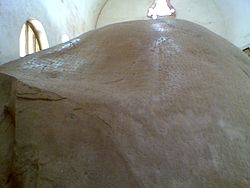
The Junagadh rock inscription of Rudradaman contains an early Prashasti, by Western Satrap ruler Rudradaman I, circa 150 CE.

Prashasti (IAST: Praśasti, Sanskrit for "praise") is an Indian genre of inscriptions composed by poets in praise of their rulers. Most date from the 6th century CE onwards. Written in the form of poetry or ornate prose, the prashastis stereotypically constructed a genealogy, the ruler's attributes, eulogize victories, piety and typically ended with one or more announcements of generous gifts and rewards he has given.[1][2] They differ from the so-called "Cultic" genre of Indian inscriptions which praise a deity, religious founder (Buddha, Tirthankara, sub-tradition of Hinduism), guru, or sages then typically announces gifts or donations to a monastery, school, temple or a generous cause.[3] In some epigraphic literature, a prashasti is considered synonymous with a kirti or purva, and is related to the word kirtana which implies "songs and praises of" someone or a deity.[4]

He is the King of Peace, the King of Prosperity,
the King of Monks (bhikshus), the King of Religion (Dharma),
who has been seeing, hearing and realising blessings (kalyanas),
(... lost ...) accomplished in extraordinary virtues,
respector of every sect, the repairer of all temples,
one whose chariot and army are irresistible,
one whose empire is protected by the chief of the empire (himself),
descended from the family of the Royal Sage Vasu,
the Great conqueror, the King, the illustrious Kharavela.

— Lines 16–17, c. 1st-century BCE Hathigumpha inscription[5]

The prashastis generally contained ornate titles, links to mythical legends or comparisons to deities, and often fabricated stories about wars, victories, loot and attributes.[2][6] For example, they would create genealogies of the rulers linked to solar or lunar dynasties, and in their praise allude to legendary heroes from Indian myths and legends such as those found in Epics and the Puranas.[1]

The earliest well known example of an extensive prashasti is the Hathigumpha inscription of Kharavela inscribed in or about the 1st-century BCE in Prakrit language and Brahmi script.[7] The earliest prashastic inscription in classical Sanskrit language is the Junagadh rock inscription of Rudradaman (circa 150 CE), which became a prototype for Gupta era poetic prashastis in Sanskrit. According to Richard G. Salomon – a scholar of South Asian inscriptions, the inscription is the first extensive panegyric record in the poetic style. The style of Rudradaman's inscription is seen in later prashasti inscriptions.[8][9]

The Tamil meykeerthi inscriptions are similar to the prashastis, but feature far more standardized formats.[6]

Examples

[edit]

References

[edit]

Sources

[edit]
  • Salomon, Richard (1998). Indian Epigraphy: A Guide to the Study of Inscriptions in Sanskrit, Prakrit, and the Other Indo-Aryan Languages. Oxford: Oxford University Press. ISBN 0-19-509984-2.
Revisions and contributorsEdit on WikipediaRead on Wikipedia
from Grokipedia
Prashasti (Sanskrit: praśasti, meaning "praise" or "eulogy") refers to a genre of ancient Indian inscriptions that function as poetic encomiums, extolling the virtues, conquests, genealogies, and divine origins of rulers and dynasties. These compositions, typically crafted by court poets or brahmanas, were engraved on durable surfaces such as stone pillars, rocks, temple walls, or copper plates to commemorate royal achievements and legitimize authority. Emerging prominently from the post-Mauryan period onward, prashastis became a staple of epigraphy during the Gupta Empire (c. 4th–6th centuries CE), though earlier examples exist, serving as invaluable primary sources for reconstructing political, social, and cultural histories. The historical significance of prashastis lies in their dual role as propaganda and historical documentation, often blending factual accounts with hyperbolic praise to elevate the patron's status. Composed primarily in Sanskrit verse and prose, they detail military victories, administrative reforms, religious endowments, and familial lineages tracing back to mythical or divine ancestors, thereby reinforcing the concept of kshatriya dharma and royal legitimacy. As noted by historian R.C. Majumdar, such inscriptions hold precedence over literary sources due to their contemporaneity and relative authenticity, providing datable evidence absent in puranic texts. Romila Thapar further emphasizes their function in invoking ancient rishis and deities to connect rulers to sacred origins, thus embedding political narratives within a broader cosmological framework. Notable examples illustrate the genre's evolution and diversity. The Prayaga Prashasti (also known as the Inscription), composed by the poet around 380 CE, praises emperor Samudragupta's extensive conquests across , portraying him as a warrior-poet and universal sovereign. Earlier, the Junagadh Inscription of Shaka ruler (c. 150 CE) not only eulogizes his repairs to a but also praises his personal virtues, military prowess, and mastery of and literature. Similarly, the Hathigumpha Inscription of Kalinga king (c. BCE) details his military campaigns and patronage of , offering insights into regional power dynamics. These texts, deciphered through , reveal the interplay of language, religion, and power in ancient , from the Deccan to the Gangetic plains. Beyond royal eulogies, prashastis extended to commemorate grants, temple constructions, and even non-royal figures, evolving into a broader literary form in medieval . Their study today aids in verifying chronologies, understanding administrative practices, and tracing cultural exchanges, such as the adoption of as a court language under patronage. While often idealized, cross-referencing with archaeological and numismatic evidence mitigates biases, underscoring prashastis' enduring value in South Asian .

Definition and Etymology

Meaning and Origins

Prashasti, derived from the Sanskrit word praśasti meaning "praise" or "eulogy," refers to a genre of inscriptional literature composed in poetry or ornate prose that glorifies rulers, deities, or patrons by extolling their virtues, achievements, and lineages. This form emerged as a formalized means of commemoration in ancient India, distinct from mere records by its hyperbolic and laudatory style aimed at elevating the subject's status. The conceptual roots of prashasti trace back to ancient Indian literary traditions, particularly the Vedic hymns of the , where dana-stuti sections praised generous chiefs and patrons through ritualistic commendations. These evolved alongside the epic narratives of the and , which incorporated genealogical praises and heroic eulogies to affirm dynastic legitimacy and moral authority, drawing from the broader itihasa-purana tradition of oral storytelling. Oral precursors, such as bardic praises in epic traditions, further influenced this development. As a distinct inscriptional genre, prashasti crystallized around the 1st century BCE, marking the transition from ephemeral oral forms to durable stone or metal engravings that preserved praise for posterity. Initially composed in Prakrit, reflecting the vernacular languages of early inscriptions, it gradually shifted to Sanskrit by the early centuries CE, aligning with the resurgence of classical literary norms and elite patronage. Fundamentally, prashasti functioned dually as a historical record—detailing conquests, alliances, and administrative feats—and as a propagandistic instrument to legitimize rule by invoking divine origins, mythical ancestries, or connections to ancient heroic lineages, thereby reinforcing the patron's authority in both secular and sacred realms. This interplay of fact and flattery underscored its role in shaping perceptions of power within early Indian polities. The standard term for prashasti derives from the root pra-śaṃs, where pra- indicates forth or intensively, and śaṃs means to , thus connoting a forthright or elaborate laudation, often performed in royal courts to proclaim a ruler's virtues and deeds. This etymological emphasis on public proclamation underscores its role as a performative genre in and literature. In Indian , prashasti elements are frequently embedded within broader document types, such as śāsana (royal edict or charter), which records administrative orders, or tāmrapatra (copper plate grants), used to document land donations and privileges, where the eulogistic portion glorifies the issuing sovereign before detailing the grant. These variants integrate as a formal , distinguishing them from standalone prashasti inscriptions while sharing the core function of legitimizing royal authority. Prashasti inscriptions differ from cultic inscriptions, which primarily honor deities, gurus, or religious figures through dedications like temple endowments, focusing on devotional or sectarian themes rather than the ruler-centric , conquests, and virtues central to prashasti. A regional parallel appears in and as meykkīrti (self-glorification or praise poem), particularly in Chola inscriptions, where it serves a similar eulogistic purpose but employs a conventional format with formulaic openings and lists of achievements to extol the king's exploits and lineage. Such praise motifs in prashasti echo broader epic traditions in the , where divine and royal laudations reinforce cosmological and political hierarchies.

Historical Development

Early Inscriptions

The early inscriptions that served as prototypes for prashasti emerged during the post-Mauryan period, a time of political fragmentation following the decline of the around the 2nd century BCE. Unlike Ashoka's edicts, which primarily propagated moral and dharmic precepts in across diverse regions, these later inscriptions shifted focus toward the personal glorification of rulers, their conquests, and administrative feats to bolster dynastic legitimacy amid rival power centers. One of the earliest known examples is the of the Jaina king of the , dated to the mid-1st century BCE and located in the near , . Composed in using the , this seventeen-line epigraph details Kharavela's military campaigns against neighboring kingdoms, including the Satavahanas and rulers in the north, as well as his efforts in infrastructure like reservoir construction and promotion of Jain piety. It emulates the format of Ashokan rock edicts in its placement and declarative style but pivots to celebrate royal prowess and religious patronage. A pivotal transition to occurred with the I, the Western Kshatrapa ruler, composed around 150 CE at hill in . This prose epigraph, the first extensive one in chaste classical and , extols Rudradaman's restoration of the Sudarshana lake—a vital irrigation project originally built by the Mauryas—as well as his victories over the Satavahanas and other foes, while highlighting his patronage of Brahmanical traditions. By employing ornate, kavya-style language, it established prashasti as a tool for cultural and political assertion in a multilingual, contested landscape. In this era, prashastis played a crucial role in the Satavahana and Western Kshatrapa dynasties, where inscriptions helped claim authority over fragmented territories. The prashasti, issued by Gautami Balashri (mother of Satavahana king ) in the late 1st or early 2nd century CE at the Pandavleni caves in , is inscribed in and lauds his reconquests from the Western Kshatrapas, including the defeat of , thereby reinforcing Satavahana resurgence and maternal lineage ties to legitimacy. These early forms trace conceptual roots to Vedic praise traditions, such as stutis in the that honored kings alongside deities for their valor and generosity.

Medieval and Later Evolution

The Gupta era (4th–6th century CE) represented a golden age for prashasti, elevating the form through sophisticated compositions that intertwined poetic grandeur with factual historical accounts. The Allahabad Pillar inscription of Samudragupta, dated around 380 CE and authored by his court poet Harisena, exemplifies this pinnacle, praising the ruler's extensive military campaigns across northern and southern India while outlining his administrative prowess and dynastic lineage. This blend of kavya-style poetry and narrative prose not only glorified the emperor but also served as a primary epigraphic record of Gupta imperial expansion. From the 7th to 13th centuries, prashastis proliferated in under dynasties like the Chalukyas, Rashtrakutas, and Cholas, appearing frequently in royal grants and dedicatory texts. These inscriptions increasingly wove in mythical elements, such as assertions of solar (Suryavamsha) or lunar (Chandravamsha) dynasty origins, to bolster royal legitimacy and connect rulers to epic and divine ancestries—for example, Rashtrakuta inscriptions linking to the Yaduvamsha line, or Chola copper plates tracing Rajaraja I's genealogy to forebears. This period saw prashastis evolve into tools for socio-political integration, documenting land endowments to Brahmins and temples while promoting bhakti-influenced patronage. In the 16th to 19th centuries, prashastis adapted within Mughal and spheres, incorporating Persian linguistic and stylistic elements amid Islamic imperial dominance. Mughal emperor , for instance, appended a Persian inscription to the in 1607 CE, layering contemporary claims over the ancient prashasti to assert his own lineage and authority. rulers similarly sustained the tradition, as seen in Maharana Raj Singh of Mewar's Raj Prashasti (1676 CE), a eulogy inscribed on 25 marble slabs at , which celebrated irrigation projects and dynastic resilience under Mughal overlordship. The form gradually declined during the colonial period, as British epigraphic efforts—spearheaded by the from 1861—prioritized systematic documentation and historical analysis over royal eulogies, favoring printed gazetteers and archaeological reports instead. A defining evolution across these phases was the shift from monumental rock edicts, as in early prototypes like Rudradaman's inscription, to copper plates for portable administrative grants and temple wall carvings for enduring religious dedications, thereby embedding prashastis within both governance and devotional practices.

Literary Characteristics

Poetic Structure and Style

Prashastis typically follow a standardized compositional format designed to elevate the patron's status through ritualistic and narrative progression. They commence with an opening invocation to deities such as Viṣṇu, Śiva, or the , often incorporating auspicious phrases like siddham or svasti to invoke divine blessings and legitimacy. This is succeeded by a detailed genealogy tracing the ruler's lineage back to mythical or solar-lunar ancestors, establishing hereditary prestige and divine descent. The core section enumerates the patron's virtues, military conquests, and administrative achievements, framing them as heroic feats worthy of epic commemoration. The composition concludes with specifications of donations or grants, such as land endowments or temple constructions, authenticating the act and ensuring its perpetuity. In terms of poetic form, prashastis are composed in classical Sanskrit verse, employing a variety of meters to achieve rhythmic praise and mnemonic resonance. The most common is the anuṣṭubh (śloka), a quatrain of 32 syllables per line that provides a straightforward, narrative flow suitable for historical recounting. More elaborate chandas such as vāṃśasthavīla, śārdūlavikrīḍita, sragdhara, and vasantatilaka are used for heightened ornamentation, particularly in medieval examples, allowing for complex syllable patterns that enhance the eulogistic tone. Some prashastis adopt a campū style, blending prose and verse for dynamic variation, reflecting broader kāvya traditions. Stylistic elements emphasize grandeur and rhetorical flourish to immortalize the patron. is prevalent, as seen in descriptions of rulers as "conquerors of the world" or subduers of vast empires, exaggerating territorial claims to underscore unparalleled power. and create sonic harmony, while metaphors frequently liken kings to divine avatars like Rāma or Kṛṣṇa, or natural forces such as the or mountains, intertwining royal authority with cosmic order. These devices draw from epic narratives, infusing the text with literary depth without deviating from its epigraphic purpose. Length and elaboration vary significantly across periods, reflecting evolving patronage and scribal sophistication. Early prashastis, such as those from the , are often concise, spanning 10-20 lines or verses to suit rock or pillar media. By the medieval period, they expand into elaborate compositions exceeding 100 verses, as in copper-plate grants, incorporating intricate praise to affirm dynastic continuity and generosity. This progression mirrors the genre's adaptation from succinct memorials to comprehensive literary artifacts.

Language and Rhetorical Devices

Prashastis initially employed as the primary language in early post-Mauryan inscriptions, such as the of (c. BCE), reflecting the vernacular forms prevalent in commemorative records of the time. By the post-second century CE, particularly from the fourth century onward, classical became the dominant medium, marking a shift driven by the resurgence of Brahmanical traditions and the need for a refined, to exalt royal patrons. This evolution is evident in Gupta-era eulogies, where Sanskrit's precision allowed for intricate expressions of lineage and virtue, though regional grants occasionally incorporated hybrid forms blending Sanskrit with local dialects to accommodate diverse audiences. The rhetorical devices in prashastis drew heavily from Sanskrit poetics, elevating prosaic praise into poetic artistry through techniques like anuprasa (alliteration), which created rhythmic resonance in descriptions of royal feats, and yamaka (repetition of words with varied meanings), adding layers of interpretive depth to laudatory passages. Similes via upama were particularly favored, comparing rulers to divine or epic figures—such as likening a king's valor to Indra's thunderbolt—to amplify their superhuman qualities and invoke aesthetic relish. These alankaras (figures of speech) not only embellished the text but also served propagandistic ends, blending emotional evocation with historical narrative to ensure the prashasti's memorability and impact. Under the influence of kavya traditions, prashasti composers—often court poets versed in mahakavya—integrated alankara to fuse factual genealogy with literary flourish, transforming inscriptions into enduring works of art that mirrored the ornate style of poets like Kalidasa. This kavya-inspired approach emphasized rasa (aesthetic emotion), particularly veera (heroic sentiment), through metaphorical imagery and rhythmic prose-verse hybrids like champu. Scripts for prashastis evolved from the Brahmi of early records, used in Ashokan edicts for its clarity in stone carving, to the more angular Brahmi by the fourth century CE, accommodating Sanskrit's phonetic nuances. By the medieval period, from the seventh century onward, the Nagari script emerged as a refined descendant, featuring a horizontal top bar and symmetrical forms that enhanced legibility in eulogistic texts. Later inscriptions often incorporated ornate , with elongated strokes and decorative flourishes, to visually complement the rhetorical grandeur and underscore the prashasti's ceremonial prestige.

Regional Variations

Northern Indian Forms

In northern India, prashastis evolved within Indo-Aryan cultural and political frameworks, prominently featuring in the , Pala, and dynasties to underscore rulers' Vedic-Brahmanical heritage and demonstrations of martial valor. These compositions often began with elaborate genealogies tracing dynastic origins to ancient Vedic figures, followed by poetic accounts of conquests that positioned the patron as a dharmic warrior upholding cosmic order. For instance, the dynasty's Prayaga Prashasti, inscribed on the around 380 CE and authored by the court poet Harishena, meticulously outlines Samudragupta's lineage from the founder Shri Gupta while celebrating his subjugation of northern kingdoms like the Aryavarta rulers and frontier tribes such as the and Yaudheyas, thereby reinforcing imperial legitimacy through heroic and ritualistic prowess. Pala inscriptions extended this tradition into eastern and northern domains, blending Brahmanical elements with Buddhist patronage; the Khalimpur copper plate of (c. 810 CE) praises his victories at and genealogical ties to prior rulers, emphasizing protective roles over sacred sites while granting lands to Brahmins, thus highlighting martial achievements alongside religious endowments. prashastis, emerging prominently from the onward, amplified themes of Vedic descent and battlefield exploits, as in the Gwalior Prashasti of (c. 875 CE), which glorifies the Pratihara emperor's campaigns against rivals and his role as a defender of Hindu realms during the tripartite struggles for . Copper plates, or tamrasasanas, served as the predominant medium for these northern prashastis, typically engraved in with the preceding the legal stipulations of land grants (agrahara) to Brahmins, temples, or officials, ensuring the document's authenticity via royal seals and providing enduring records of socio-political hierarchies. These grants, often tax-exempt, were embedded in broader administrative contexts, with the prashasti portion invoking divine sanction to immortalize the ruler's generosity and authority. A distinctive trait of northern prashastis was their incorporation of Puranic myths to fabricate pedigrees, portraying rulers as descendants of solar () or lunar (Chandravanshi) lineages from epics like the and , thereby elevating regional chieftains to pan-Indian heroic status amid post-Gupta fragmentation. Between the 8th and 12th centuries, prashastis flourished in and surrounding areas under Pratihara hegemony, as evidenced by inscriptions detailing dynastic expansions and resistances to invasions, while transitioning into the era (c. 1206 onward), where surviving Hindu polities adapted these forms under mixed patronage, occasionally toning down overt martial rhetoric to navigate Islamic overlordship without fully abandoning traditional Vedic-Puranic motifs.

Southern Indian Adaptations

In southern , prashasti traditions adapted into the Tamil form known as meykkeerthi (meaning "true praise" or heroic self-eulogy), which served as the opening section of inscriptions issued by Chola and Pandya kings from the 9th to 13th centuries CE. These compositions functioned as poetic self-praise, extolling the ruler's personal valor, military conquests, and pious acts in a formulaic manner, often preceding details of land grants or temple donations. Unlike the more genealogical northern variants, meykkeerthi emphasized an autobiographical tone, highlighting the king's individual triumphs and devotion, such as Rajaraja I's conquests over the Chera, Pandya, and Chalukya realms as recorded in his temple inscriptions. Key features of meykkeerthi included a focus on the ruler's achievements in warfare and of religious institutions, particularly temple endowments like perpetual lamps, allocations, and provisions for Shaiva shrines. Composed in Tamil verse with rhythmic and alliterative styles, they frequently incorporated phrases for royal epithets and divine invocations, blending Dravidian literary conventions with Indo-Aryan elements. These texts were inscribed in the , a southern variant adapted from the Pallava period for rendering alongside Tamil, as seen in Chola copper plates and stone epigraphs at sites like Thanjavur's Brihadishvara Temple. For instance, Rajendra I's meykkeerthi in inscriptions details his naval expeditions to and riverine victories, underscoring his role as a divine protector of . The evolution of meykkeerthi traced back to 7th-century Pallava cave inscriptions at sites like Mahabalipuram, where early prashasti-like eulogies praised kings' temple constructions and conquests in a proto-form, setting the template for later elaboration under the Cholas. By the imperial Chola era (9th-11th centuries), the format became more standardized, with detailed enumerations of victories and endowments reflecting administrative precision. This tradition extended into the Pandya realm (11th-13th centuries), as in the meykkeerthi of Jatavarman Sundara Pandya, which celebrated restorations of Pandya sovereignty and Vaishnava temple gifts. Under the (14th-16th centuries), these adaptations further integrated devotionalism, incorporating Shaiva and Vaishnava poetic motifs to portray rulers as humble devotees rather than mere conquerors, evident in multilingual inscriptions at temples that fused Tamil, , and styles. This southern variant's devotional emphasis distinguished it from northern genealogical emphases, aligning with the bhakti movement's influence in Tamil literature and epigraphy, where kings positioned themselves as servants of Shiva or Vishnu to legitimize rule through piety rather than solely dynastic lineage.

Notable Examples

Hathigumpha Inscription

The Hathigumpha inscription is situated on the ceiling of a natural cavern known as Hathigumpha (Elephant Cave) in the Udayagiri hills near Bhubaneswar, Odisha, India. It dates to approximately the 1st century BCE, during the reign of King Kharavela, a ruler of the Mahameghavahana dynasty who governed the ancient kingdom of Kalinga, tracing his lineage to the ancient Chedis. The text is engraved in 17 lines using Prakrit language and Brahmi script, marking it as one of the earliest extensive royal inscriptions in post-Mauryan India. The inscription was first noticed in 1820 by British administrator Andrew Stirling during a survey of the Udayagiri-Khandagiri cave complex, though local traditions had long associated the site with Jain heritage. It was copied in 1825 by , the first Surveyor General of , but initial decipherment efforts were incomplete due to the weathered and damaged state of the text—several lines are partially illegible. Significant progress came in 1837 when , secretary of , provided an early reading based on impressions; however, the first comprehensive and reliable interpretation was achieved by scholar Bhagwanlal Indraji in the , who identified the ruler as and clarified much of the narrative. Further refinements were made by epigraphists like Georg Bühler and, notably, and in their 1929–30 edition in Epigraphia Indica, which established the inscription's chronological structure and historical context, shedding light on post-Mauryan political dynamics in eastern . The content offers a year-by-year of Kharavela's accomplishments from his first to thirteenth , blending with administrative records. It details campaigns, such as expeditions against the Satavahanas in the west (defeating King Satakarni), incursions into where he sacked Gorathagiri and forced an Indo-Greek ruler named to retreat, and southern advances reclaiming territories like Pithunda from the Cholas. A prominent feat includes the capture of a prized war elephant named Dhavalagaj from the Magadhan , symbolizing Kalinga's resurgence. The text also highlights and Jain revival efforts, including the repatriation of a sacred Jina image from (stolen centuries earlier by the Nandas), endowments to Jain monks, and the convening of a council to compile and propagate Jain scriptures like the Angas. Additionally, it praises famine relief measures, such as cyclone recovery works in Kalinganagara involving embankments and gardens, and cultural patronage through the construction of palaces, organization of festivals, and remission of taxes for public welfare. As a for the , the stands out for its innovative use of praise to glorify a ruler's personal and administrative deeds, moving beyond mere donative records to a format that emphasizes heroism, , and benevolence—elements that would influence later royal eulogies. This focus on Kharavela's individual achievements, including his early training in statecraft and , relief during natural calamities, and support for arts and , establishes it as a foundational example of epigraphic self-glorification in ancient .

Junagadh Rock Inscription

The Junagadh Rock Inscription, engraved on a large boulder at the base of hill near in , , dates to the 72nd year of the era, corresponding to approximately 150 CE. It was issued by , the Mahakshatrapa (great satrap) of the Western Kshatrapas, an Indo-Scythian dynasty ruling parts of western and central . Composed in classical using the , the inscription consists of 29 lines of prose, making it one of the earliest extensive examples of this form in the language. The content serves as a prashasti, or , extolling Rudradaman's royal lineage from the Kshaharata and Western Kshatrapa rulers, his physical prowess, intellectual accomplishments, and moral virtues, while claiming divine favor from gods like Siva and the Sun. It details his military conquests, including victories over the tribes, the , and the Satavahana king Satakarni, whom he defeated twice in battle but spared out of respect for their shared heritage and to avoid unnecessary destruction. A central focus is the restoration of the Sudarshana Lake's dam, an engineering feat originally constructed by the Mauryan Pushyagupta under and later augmented with an inlet by the Yavana architect Tushasphi during Ashoka's reign; the dam had been breached by a severe hurricane, and Rudradaman commissioned its repair through his Pahlava minister Suvisakha at his own expense, without burdening his subjects through taxes. The text also highlights Rudradaman's patronage of scholarship, noting his proficiency in composing and his command of , as well as his benevolence in providing refuge to allies and maintaining public welfare. Linguistically, the inscription represents a milestone as the first major public document in classical , transitioning from the used in earlier Ashokan edicts on the same rock to a more refined, grammatically complex form influenced by Paninian rules. It features long compound words (samasa), intricate sentence structures, and poetic with rhetorical flourishes, such as metaphors comparing Rudradaman's glory to the sun, though it avoids strict verse meters. This sophistication underscores the of by foreign-origin rulers like the Sakas for official and propagandistic purposes. Historically, the inscription illuminates the extent of Indo-Scythian political control over regions like Saurashtra, , and , as well as their diplomatic and military interactions with indigenous dynasties such as the Satavahanas. It provides evidence of advanced in ancient , emphasizing the continuity of Mauryan infrastructure projects and the environmental challenges faced by rulers in maintaining irrigation systems vital for . The text also reflects a cultural synthesis, with Rudradaman, a non-Indian ruler, adopting Brahmanical ideals and to legitimize his authority, influencing subsequent prashastis in the period.

Significance and Legacy

Historical and Epigraphic Value

Prashastis function as crucial historical records for reconstructing ancient and medieval Indian history, offering detailed chronologies, dynastic successions, and specific event dates that are frequently absent or unreliable in contemporary literary texts. These inscriptions often enumerate royal genealogies, military campaigns, and administrative achievements, providing a framework for understanding political developments across regions and periods. For instance, details of conquests recorded in prashastis can be cross-verified with foreign accounts, such as Chinese annals that corroborate Indian military expansions and diplomatic interactions during the . In epigraphic studies, prashastis contribute significantly to the corpus of over 100,000 inscriptions cataloged by the , serving as key artifacts for dating historical events through paleography—the analysis of script evolution—and references to regnal years or established eras like the Vikrama or calendars. This methodological precision allows scholars to anchor otherwise undated narratives, facilitating the sequencing of rulers and events with greater accuracy than possible from oral traditions or later chronicles. Paleographic examination, for example, helps place undated prashastis within specific centuries by comparing letter forms to known dated specimens. Despite their value, prashastis have inherent limitations as historical sources due to their eulogistic nature, which emphasizes royal glorification and may exaggerate achievements or omit defeats, necessitating cross-verification with complementary evidence such as numismatic finds or accounts from Persian and travelers. This requires historians to approach the texts critically, distinguishing hyperbolic praise from verifiable facts. Nonetheless, such inscriptions have been instrumental in illuminating the "dark ages" following the Empire's decline around the sixth century CE, enabling the reconstruction of fragmented political landscapes and the tracing of emerging lineages, including the origins of through references to early feudal grants and alliances. Samudragupta's Prashasti exemplifies this utility by detailing imperial expansions that align with broader epigraphic and archaeological patterns.

Cultural and Scholarly Impact

Prashastis have profoundly shaped royal in and art, serving as templates for eulogistic portrayals of rulers that emphasized divine kingship, martial prowess, and . This tradition influenced later courtly poetry and visual representations, where kings were depicted in heroic poses echoing the hyperbolic language of inscriptions, thereby reinforcing ideals of across medieval and early modern periods. In modern , prashastis were instrumental in constructing narratives of ancient Indian glory, with scholars drawing on them to highlight imperial achievements and cultural continuity against colonial depictions of stagnation. For instance, the Allahabad Pillar Inscription of was celebrated as evidence of a golden age, fueling anti-colonial sentiments and the reclamation of indigenous historical agency. Scholarly advancements in prashasti studies owe much to epigraphists like D.C. Sircar, whose seminal work Indian Epigraphy (1965) systematized the analysis of these inscriptions, elucidating their linguistic, historical, and administrative value while establishing methodologies for deciphering eulogistic texts. Complementing this, Kumkum Roy's explorations in The Power of Gender and the Gender of Power (2010) apply feminist lenses to prashastis, revealing how they constructed gendered identities through references to royal women, often portraying them as patrons or symbols of legitimacy rather than autonomous agents. Digital archives such as Epigraphia Indica, maintained by the and accessible via the Indira Gandhi National Centre for the Arts, have democratized access to these sources, enabling interdisciplinary research on socio-cultural dynamics. Contemporary interpretations extend to postcolonial critiques, which view prashastis as constructed power narratives that naturalized hierarchical rule and Brahmanical dominance, often marginalizing subaltern voices in the process of state legitimation. Feminist readings further unpack mentions of in these texts, interpreting them as sites of negotiated agency amid patriarchal frameworks, as seen in analyses of Gupta-era inscriptions where royal women appear as donors or regents. In , the analysis of an 11th-century prashasti inscription has provided new insights into the narrative, further enriching interpretations of ancient literary and historical connections.

References

Add your contribution
Related Hubs
User Avatar
No comments yet.