Hubbry Logo
Preiddeu AnnwfnPreiddeu AnnwfnMain
Open search
Preiddeu Annwfn
Community hub
Preiddeu Annwfn
logo
8 pages, 0 posts
0 subscribers
Be the first to start a discussion here.
Preiddeu Annwfn
Preiddeu Annwfn
from Wikipedia

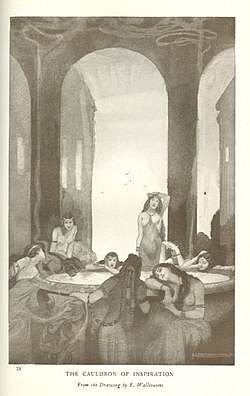
Image by E. Wallcousins, 1912. "In Caer Pedryvan, four its revolutions; In the first word from the cauldron when spoken, From the breath of nine maidens it was gently warmed".

Preiddeu Annwfn or Preiddeu Annwn (English: The Spoils of Annwfn) is a cryptic poem of sixty lines in Middle Welsh, found in the Book of Taliesin. The text recounts an expedition with King Arthur to Annwfn or Annwn, the Otherworld in Welsh.

Preiddeu Annwfn is one of the best known medieval British poems. English translations, in whole or in part, have been published by R. Williams (in William Forbes Skene's Four Ancient Books of Wales), by Robert Graves in The White Goddess and by Roger Sherman Loomis, Herbert Pilch, John T. Koch, Marged Haycock, John K. Bollard, Sarah Higley. At points it requires individual interpretation on the part of its translators owing to its terse style, the ambiguities of its vocabulary, its survival in a single copy of doubtful reliability, the lack of exact analogues[clarification needed] of the tale it tells and the host of real or fancied resonances with other poems and tales.

A number of scholars (in particular, Marshall H. James, who points out the remarkable similarity in Line 1, of Verse 2 in "Mic Dinbych", from the Black Book of Carmarthen) have pointed out analogues in other medieval Welsh literature: some[which?] suggest that it represents a tradition that evolved into the grail of Arthurian literature. Haycock (in The Figure of Taliesin) says that the poem is "about Taliesin and his vaunting of knowledge", and Higley calls the poem "a metaphor of its own making—a poem about the material 'spoils' of poetic composition".[1]

Manuscript and date

[edit]

The poem is uniquely preserved in the Book of Taliesin (Aberystwyth, NLW, MS Peniarth 2), which has been dated to the first quarter of the 14th century.[2] The text of the poem itself has proved immensely difficult to date. Estimates range from the time of the bard Taliesin in the late 6th century to that of the completion of the manuscript. On the basis of linguistic criteria Norris J. Lacy suggests that the poem took its present form around AD 900.[3] Marged Haycock notes that the poem shares a formal peculiarity with a number of pre-Gogynfeirdd poems found in the Book of Taliesin, that is, the caesura usually divides the lines into a longer and shorter section.[4] She contends, however, that there is no firm linguistic evidence that the poem predates the time of the Gogynfeirdd.[5]

Text

[edit]

The poem may be divided into eight stanzas, each for the most part united by a single rhyme but with irregular numbers of lines. The first stanza begins and the last ends with two lines of praise to the Lord, generally taken to be Christian. In the last couplet of each stanza except the last the speaker mentions a dangerous journey into Annwfn with Arthur and three boat-loads of men, of whom only seven returned, presumably with the "spoils" from Annwfn. Annwfn is apparently referred to by several names, including "Mound or Fairy Fortress," "Four Peaked or Cornered Fortress," and "Glass Fortress", though it is possible these are intended to be distinct. Whatever tragedy occurred is not clearly explained.

Each stanza except the last two begins in the first person; the first begins "I praise the Lord", the second and third "I am honoured in praise", the next three declare "I do not merit little men" who rely on books and lack understanding. The last two refer to crowds of monks who again rely upon the words and the knowledge of authorities and lack the type of experience the poem claims.

Between these beginnings and ends the first six stanzas offer brief allusions to the journey. In the first Gweir is encountered imprisoned in the fort's walls, a character whom Rachel Bromwich associates with Gwair, one of "Three Exalted Prisoners of Britain" known from the Welsh Triads.[6] He is imprisoned in chains, apparently until Judgment Day, singing before the spoils of Annwfn. The second stanza describes the cauldron of the Chief of Annwn, finished with pearl, and how it was taken, presumably being itself the "spoils". The third and fourth allude to difficulties with the forces of Annwfn while the fifth and sixth describe a great ox, also richly decorated, that may also form part of Arthur's spoils.

The first stanza has already mentioned Pwyll, the legendary prince of Dyfed who in the first branch of the Mabinogi becomes the Chief of Annwfn after helping its king, Arawn, and was credited with ownership of a cauldron.

The speaker may be intended to be Taliesin himself, for the second stanza says "my poetry, from the cauldron it was uttered, from the breath of nine maidens it was kindled, the cauldron of the chief of Annwfyn" and Taliesin's name is connected to a similar story in the legend of his birth.[7] Song is heard in the fourfold fort, which therefore seems also to be Annwfn: Gweir was imprisoned in perpetual song before a cauldron that first gave out poetry when breathed upon by nine maidens, reminiscent of the nine muses of classical thought. Just as, we are told, the cauldron "does not boil the food of a coward", so the song it is inspires is "honoured in praise", too good for petty men of ordinary mentality.

Analogues and interpretations

[edit]

Two works in particular, the tale of Bran the Blessed in the Second Branch of the Mabinogi and a tale included in Culhwch and Olwen in which Arthur's retinue sail to Ireland aboard Prydwen (the ship used in Preiddeu) to obtain the Cauldron of Diwrnach, are frequently cited as narratives resembling that of the present poem.

Bran and Branwen

[edit]

In the Second Branch Bran gives his magic life-restoring cauldron to his new brother-in-law Matholwch of Ireland when he marries Bran's sister Branwen. Matholwch mistreats his new wife and Bran's men cross the Irish Sea to rescue her. This attack involves the destruction of the cauldron, which Matholwch uses to resuscitate his soldiers. There is a battle between the hosts and in the end only seven of Bran's men escape alive, including Taliesin and Pryderi.

Arthur and Diwrnach

[edit]

In Culhwch and Olwen Arthur's retinue also sail to Ireland (aboard his ship Prydwen, the ship used in Preiddeu) to obtain the cauldron which, like that in Preiddeu Annwfn, would never boil meat for a coward whereas it would boil quickly if meat for a brave man were put in it. Arthur's warrior Llenlleawc the Irishman seizes Caledfwlch (Excalibur) and swings it around, killing Diwrnach's entire retinue. Taliesin is mentioned in Culhwch among Arthur's retinue, as are several Gweirs.

Preiddeu Annwfn is usually understood to say that a sword described either as "bright" or else "of Lleawch" was raised to the cauldron, leaving it in the hands of "Lleminawc" (cledyf lluch lleawc idaw rydyrchit/ Ac yn llaw leminawc yd edewit). Some scholars have found the similarity to this Llenlleawc compelling, but the evidence is not conclusive. Higley suggests a common story has influenced these various Welsh and Irish accounts.[7]

Annwfn

[edit]

Sir John Rhys was quick to connect these campaigns in Ireland with the symbolic "western isles" of the Celtic otherworld and, in this general sense, Preiddeu Annfwn may be associated with the maritime adventure genres of Immram and Echtra. Rhys also noted that the Isle of Lundy was once known as Ynys Wair, and suggested that it was once accounted the place of Gweir's imprisonment.[8]

Culhwch also recounts Arthur's nearby rescue of another of the three famous prisoners, Mabon ap Modron, a god of poetry after whom the Mabinogi are named, and gives details of another ruler of Annwfn, Gwynn ap Nudd, king of the Tylwyth Teg - the fairies in Welsh lore - "whom God has placed over the brood of devils in Annwn lest they should destroy the present race". Gwynn is also made part of Arthur's retinue, though he is the son of a god, after Arthur intervenes in his dispute over Creiddylad.

In the First Branch of the Mabinogi Pwyll marries Rhiannon and their son Pryderi receives a gift of pigs from Arawn. He later follows a white boar to a mysterious tower where he is trapped by a beautiful golden bowl in an enchanted "blanket of mist" and temporarily vanishes with Rhiannon and the tower itself. This motif has also been compared with that of Gweir/Gwair's imprisonment.[8]

Roger Sherman Loomis pointed out the similarities between Preiddeu's description of the "Glass Fortress" and a story from Irish mythology recorded in both the Book of Invasions and the 9th-century Historia Britonum, in which the Milesians, the ancestors to the Irish people, encounter a glass tower in the middle of the ocean whose inhabitants do not speak with them, just as, in Preiddeu, the Glass Fortress is defended by 6,000 men and Arthur's crew finds it difficult to speak with their sentinel. The Milesians attack and most of their force perishes.

Another fortress, "Caer Sidi", is often linked through its name with the Irish fairyland, where live the Tuatha Dé Danann, whom the Milesians eventually conquer.[9] it appears again in the same collection, in "Kerd Veib am Llyr", ("The Song of the Sons of Llyr"), in language that closely follows that of Preiddeu; Complete is my chair in Caer Siddi/ No one will be afflicted with disease or old age that may be in it./ Manawyddan and Pryderi know it./ Three (musical?) instruments by the fire, will sing before it/ and around its borders are the streams of the ocean/ and the fruitful fountain is above it.... The poet, this time definitely speaking as Taliesin, also claims to have been with Bran in Ireland, Bran and Manawyddan being the sons of Llŷr.

Higley affirms that Annwfn is "popularly associated with the land of the old gods who can bestow gifts, including the gift of poetry (awen)". She cites another poem in the same collection, called "Angar Kyfyndawt", which states that Annwfn is in the deeps below the earth, and that "It is Awen I sing, / from the deep I bring it". The great ox has "seven score links on his collar" while in "Angar Kyfyndawt" awen has "seven score ogyruen“. Though this latter is not a well-understood term, it can be interpreted as - possibly - personification, attribute, characteristic or symbol.

In a third poem, "Kadeir Teyrnon", three "awens" come from the ogyruen, just as in the birth legend Taliesin receives inspiration in three drops from the cauldron of Ceridwen, the enchantress who gives a second birth to the legendary Taliesin, and who is also mentioned other poems from the collection, "Kerd Veib am Llyr" and "Kadeir Kerrituen", and by another poet, Cuhelyn, in connection with ogyruen.[10]

These poems draw freely upon a wide variety of otherworldly tales, representing the fateful voyage, the battle, imprisonment and the cauldron as allegories of a mystical poetic knowledge beyond the ordinary. Robert Graves aligned himself personally with the poets' standpoint, commenting that literary scholars are psychologically incapable of interpreting myth[11]

The Grail

[edit]

Early translators suggested a link between Preiddeu Annwfn (taken together with the Bran story) and the later Grail narratives, with varying degrees of success. Similarities are sometimes peripheral, such as that both Bran the Blessed and the Grail keeper the Fisher King receive wounds in their legs and both dwell in a castle of delights where no time seems to pass. The graal portrayed in Chrétien de Troyes' Perceval, the Story of the Grail is taken to be reminiscent of Bran's cauldron, and, as in Preiddeu, the Grail romances always result in initial tragedy and frequently in huge loss of life.

Earlier scholars were quicker to read Celtic origins in the Holy Grail stories than their modern counterparts. Whereas early 20th-century Celtic enthusiast Jessie Weston unequivocally declared that an earlier form of the Grail narrative could be found in Preiddeu Annwfn, modern researcher Richard Barber denies Celtic myth had much influence on the legend's development at all.[12][page needed] R. S. Loomis, however, argued that it was more logical to search for recurrent themes and imagery found in both the Grail stories and Celtic material rather than exact ancestors; many or most modern scholars share this opinion.

References

[edit]

Sources

[edit]
[edit]
Revisions and contributorsEdit on WikipediaRead on Wikipedia
from Grokipedia
Preiddeu Annwfn (also spelled Preiddeu Annwn), meaning "The Spoils of ," is a cryptic poem consisting of sixty lines, preserved in the fourteenth-century manuscript held by the . The poem narrates an expedition led by to the realm of to seize a magical , during which most of the participants fail to return, with the refrain emphasizing that "except seven, none rose up from ." The work is traditionally attributed to the legendary sixth-century bard , who is said to have served at the courts of kings like Urien of , though modern scholarship considers it a product of the "pseudo-Taliesin" tradition, likely composed in the tenth or eleventh century by an anonymous poet imitating the earlier bard's style. This dating is supported by linguistic analysis and the poem's metrical form, which aligns with early medieval Welsh poetic conventions. Structurally, Preiddeu Annwfn is divided into eight stanzas employing the awdl metre, featuring couplets and triplets with internal rhymes and alliteration typical of Welsh . The narrative opens with a Christian invocation praising God as sovereign over the world, before shifting to the Arthurian raid, which encounters supernatural obstacles such as a that refuses to boil for the "unfortunate" and a fortified citadel. The poem then transitions into the speaker's boastful declaration of poetic superiority, decrying the ignorance of monks, cowards, and those lacking true bardic inspiration (), thus blending heroic quest motifs with themes of knowledge and artistic mastery. Interpretations of the poem have evolved significantly. Early scholars like Roger Sherman Loomis viewed it as a genuine early Arthurian tale, possibly drawing on Celtic myths of voyages akin to those in Irish lore, such as the pursuit of magical treasures. More recent analysis by Marged Haycock posits that the Arthurian elements serve as a for Taliesin's own poetic achievements, with the "spoils" symbolizing the fruits of inspired bardic creation rather than a literal raid. This reading highlights the poem's self-referential quality, positioning the poet as a figure of profound transcending worldly failures. As an early surviving reference to in Welsh , Preiddeu Annwfn holds significant place in the development of Arthurian legend, influencing later medieval romances and providing insight into the interplay of pagan mythology, Christian elements, and bardic tradition in medieval . Its enigmatic language and multilayered symbolism continue to inspire scholarly debate on the origins of Arthurian motifs and the role of poetry in preserving cultural memory.

Manuscript and Composition

The Book of Taliesin

The , designated NLW MS Peniarth 2, is a 14th-century consisting of 38 surviving folios that compile 56 poems, along with a partial 57th, all pseudepigraphically attributed to the legendary 6th-century bard . The manuscript was penned in predominantly by a single during the first quarter of the 14th century, with minor later additions by other hands. Its provenance traces to the 17th-century antiquarian Robert Vaughan, who acquired it for his Hengwrt library in ; the volume subsequently entered the Peniarth collection in the 19th century before being purchased by the in 1911, where it is preserved in . Within this , Preiddeu Annwfn occupies folios 25v–26r and is enumerated as poem 30 (or 31 in some schemes). The artifact exhibits typical medieval wear, including damaged folios from lost covers and the initial lines of the opening poem, areas of faded ink that obscure legibility, and orthographic inconsistencies inherent to paleography, complicating modern transcriptions and scholarly editions.

Dating and Authorship

The poem Preiddeu Annwfn exhibits linguistic features characteristic of , including vocabulary such as annwn for the and morphological elements like the intensifying prefix an-, which collectively point to a composition date between the ninth and twelfth centuries. Some scholars, analyzing lexical criteria, propose an earlier terminus around AD 900 for its current form. Metrical analysis further supports this timeline, with the use of awdl stanzas featuring internal caesurae and occasional triplets that align with pre-Gogynfeirdd poetic styles, predating the more rigid schemes of eleventh- and twelfth-century bards. Although attributed to the legendary bard , the poem's authorship is pseudepigraphic, as the historical flourished in the sixth century—a period antedating by several centuries—and thus could not have composed it. Instead, it forms part of a broader medieval Welsh tradition of invoking 's persona to lend authority to later works, often blending mythic and bardic elements to assert poetic knowledge and inspiration (). Scholarly consensus holds that the poem likely originated in an oral milieu before its transcription, with rhythmic structures and allusive phrasing suited to performance rather than initial written composition, though debates persist on the precise balance between oral transmission and literate adaptation. Marged Haycock, in particular, emphasizes its roots in an archaic bardic idiom while cautioning against over-dating based solely on form. Regarding influences, some analyses suggest a possible Christian monastic , evidenced by the poem's of pagan motifs with critiques of clerical ignorance (e.g., references to uncomprehending monks), though no agreement exists on the exact author or institutional context. The text survives solely in the fourteenth-century .

The Poem

Structure and Form

Preiddeu Annwfn is a compact poem comprising 60 lines, organized into eight s or awdlau, each characterized by irregular line lengths typically ranging from seven to twelve syllables and unified by end-rhymes within the stanza. This structure reflects the flexible yet rhythmic conventions of early verse, where stanzas often pair longer and shorter lines divided by a , creating a dynamic flow that emphasizes oral performance. The poem employs a range of rooted in Welsh bardic tradition, including incipient —an early form of consonantal harmony involving internal sound patterns—as well as and repetition for sonic emphasis. For instance, appears in phrases like "" and "Caer Pedryvan," reinforcing the exotic locales, while caesurae provide natural pauses that heighten dramatic tension. Repetition is prominent in the recurring motif of only seven survivors returning from the expedition, phrased variably as "nam seith ny dyrreith" across multiple stanzas, and in iterations of "" (or orthographic variants like "Annwn"), which underscore the journey's perilous centrality. These elements contribute to the poem's musicality and mnemonic quality, suited to recitation. Linguistic features pose significant interpretive challenges, with cryptic diction and archaic vocabulary demanding scholarly glosses for modern understanding. The 14th-century manuscript exhibits orthographic inconsistencies, such as fluctuating spellings of key terms like "Annwfn," which reflect evolving conventions and scribal practices, complicating textual reconstruction. These obscurities enhance the poem's riddling aura, requiring readers to unpack layered meanings. The stanzaic progression builds thematically: the opening awdl invokes divine praise, transitioning into first-person descriptions of the voyage and encounters in successive stanzas that highlight successive failures, before culminating in a closing that shifts tone toward . This arc mirrors the narrative frame of expedition and loss without resolving into triumph. In comparison to other poems attributed to Taliesin in the Book of Taliesin, such as Cad Goddeu or Armes Prydein, Preiddeu Annwfn shares a prophetic, boastful, and enigmatic style that blends myth with riddles, yet distinguishes itself through its sustained narrative focus on a collective heroic voyage rather than isolated prophecies or battles.

Narrative Summary

The poem opens with the narrator, Taliesin, praising the "sovereign, supreme king of the land" who has extended his dominion over the world's shore, establishing a boastful tone for the expedition led by Arthur to Annwfn. It describes the complete prison of Gweir in Caer Sidi, attributed to the spite of Pwyll and Pryderi, where no one had entered before; a heavy blue chain holds the faithful youth, who sings woefully before the spoils of Annwfn and remains a bard of prayer until doom. The voyage involves three full loads of Prydwen entering the fortress, but except for seven, none return from Caer Sidi. In the second stanza, Taliesin asserts his candidacy for fame through song, recounting the four-peaked Caer Pedryvan and the cauldron's activation with the first word spoken from it. The cauldron is kindled by the breath of nine maidens and serves as the chief vessel of Annwfn, its rim adorned with pearls while rejecting the food of cowards; again, three full loads of Prydwen enter, but only seven return. The third stanza shifts to Caer Rigor, a place of complete watchfulness where is measured from the , and bright wine is mixed at noon and night in the same vessel, with its strong door ever open against a host of warriors. A great wind assails the crew, and false images undo the brave; three full loads of go there, but except seven, none return from the struggle. Subsequent stanzas detail further encounters in other fortresses. In Wydr, Arthur penetrates beyond the fort where three-score standing men guard the wall, and the van leads with song; three full loads enter, but only seven survive. The pursuit involves a brindled with the trappings of a man, tied to the birth of Cwy, deep in the fortress of the cliff; again, only seven return from Vandwy. Similarly, in Ochren, the tale questions the birth of the chief and an animal with a silver head and a sparkling wine-red , amid a that assails without mercy; three full loads go, but except seven, none rise from Lochry. The narrative closes with Taliesin denouncing "little men" who know not the perilous journey nor the speckled ox's pursuit, contrasting his wisdom with their ignorance, and praising the wonders of the hall where songs are heard in the . It ends by likening monks to yelping dogs, questioning phenomena like the division of midnight and morning, and offering a to the who made and .

Mythological Context

Annwfn as Otherworld

In the poem Preiddeu Annwfn, Annwfn is portrayed as the Welsh , a distinct from the earthly domain yet accessible through perilous voyages. The term "Annwfn" (variants include Annwn and Annwfyn) derives from roots, with "an-" as a negating or intensifying prefix combined with "dwfyn" meaning "deep," yielding interpretations such as "un-world," "very deep," or "the great deep," emphasizing its profound, inaccessible nature. This etymology underscores Annwfn's role as an inverted or submerged counterpart to the human world, often depicted as an island-fortress surrounded by tidal waters, blending abundance with inherent dangers. The realm's characteristics in the poem highlight a fortified paradise laced with peril, featuring multiple caers (fortresses) such as Kaer Sidi and Caer Pedryfan, the latter described as four-peaked to evoke quartered divisions. Defensive magics abound, including radiant or iron doors that resist intruders, and a "glass fortress" possibly implying crystalline transparency or illusory defenses, where six thousand men stand upon its walls. Central to its abundance is the of rebirth, kindled by nine maidens and refusing to boil the food of cowards, bordered by pearls and a dark ridge; this vessel symbolizes plenty and poetic inspiration (), guarded by a brindled tethered with seven score links. Yet peril permeates the , with chains descending from above and the need for esoteric knowledge to navigate its sparkling wines and mingled elements. Unique elements further define Annwfn's and atmosphere, such as the mixing of fresh, flowing (echwyd) with jet-blackness (muchyd) in a twilight-like , and songs resounding through its four quarters, evoking a harmonious yet fortified domain. The brief voyage to this realm serves as the poem's entry point, underscoring Annwfn's separation from earthly accessibility. In broader Welsh lore, Annwfn evolves from its pagan Celtic origins as an of old gods—coexistent with regions like , subaqueous or underground, and a source of gifts like —to later Christian-influenced depictions as a paradise of or a hellish abyss, such as the frigid Kaer Rigor. This shift reflects contrasts with the mortal world in both bounty and inaccessibility, transitioning from a realm of delights free of to one infused with .

Celtic Voyage Motifs

The poem Preiddeu Annwfn employs several archetypal motifs characteristic of Celtic Otherworld voyages, including heroic raids aimed at acquiring supernatural treasures such as cauldrons and magical animals. These expeditions often involve a band of warriors venturing into a fortified otherworldly realm to seize items of immense power, as seen in the narrative's focus on the cauldron of Annwfn, which is described as a vessel that does not cook for a coward. Perilous sea crossings form another core element, with the expedition undertaken aboard Arthur's ship Prydwen, navigating treacherous waters to reach distant, enchanted fortresses across three fraught journeys. Shape-shifting obstacles and deceptive illusions further complicate these quests, exemplified by the poem's references to a "white witch" and a "cauldron tempered by the streams of the ocean," evoking transformative barriers that test the intruders' resolve. A recurring theme of survivor scarcity underscores the high stakes, as only seven warriors return from each attempt, symbolizing the devastating toll of challenging the Otherworld's boundaries. Irish analogues to these motifs appear prominently in the immram genre of voyage tales, such as Immram Brain (The Voyage of Bran), where Bran mac Febail leads a sea journey to the Otherworld island of Emain Ablach, encountering similar perils including enchanted islands, shape-shifting entities, and a return marked by few survivors amid themes of otherworldly temptation. Cauldron parallels are evident in the Ulster Cycle, particularly the ever-full cauldron that revives slain warriors, akin to the regenerative and selective properties of Annwfn's cauldron, highlighting shared Celtic beliefs in vessels as conduits to immortality or judgment. In Welsh tradition, echoes of these voyage motifs resonate in the Mabinogion, such as the Second Branch's quest involving the of rebirth and voyages to for magical treasures like pigs, but Preiddeu Annwfn distinctly emphasizes the expedition's ultimate failure and the of the intruders, with the remaining unobtained due to their unworthiness. Unlike more triumphant narratives in the Mabinogion, the poem portrays Annwfn—depicted briefly as a of deep halls, , and unyielding defenses—as an impregnable destination that punishes overreach. Thematically, these motifs in Preiddeu Annwfn reflect a transitional phase in Celtic literature from pagan conceptions of the as a of abundance and to Christian-influenced views positioning it as a perilous testing ground for human mortality and spiritual failing. This shift is evident in the poem's integration of monastic critiques and the selective nature of the , suggesting over mere heroic prowess.

Interpretations

Literal and Historical Readings

Literal readings of Preiddeu Annwfn interpret the poem as a straightforward account of an Arthurian military expedition to seize treasures, particularly a magical , from a fortified stronghold, emphasizing the expedition's dramatic failure and heavy losses. In this view, the poem recounts leading warriors aboard his ship Prydwen on a perilous voyage, where only seven return from the assault on the "Fort of Glass" or similar bastions, highlighting themes of heroism amid defeat. The quest, central to the plot, serves as the expedition's objective, akin to a raid for valuable spoils in a heroic tale. Scholars like Loomis have proposed that the poem may preserve elements reflecting Celtic roots in Irish voyage tales, potentially connected to post-Roman Britain's . Diwrnach, the Irish figure guarding a in related Welsh traditions like Culhwch ac Olwen, is often seen as representing a historical Irish chieftain or , whose defeat symbolizes British resistance to Irish expansion in regions like . This interpretation aligns the poem's narrative with post-Roman Britain's defensive struggles, portraying as a dux bellorum coordinating amphibious operations against external threats. The poem's realism is underscored by its depiction of military setbacks, attributed in the text to both tactical errors—such as inadequate forces penetrating the fortress—and otherworldly defenses that thwart the raid, resulting in catastrophic casualties. The motif of seven survivors lends a layer of historical plausibility to the account. Loomis supported such readings by tracing the poem's Celtic roots to pre-Christian Irish voyage tales, arguing that it fictionalizes oral traditions of Arthurian exploits rooted in 6th-century British against invaders. Loomis connected the narrative to broader Arthurian origins in post-Roman defenses, viewing the raid as a euhemerized memory of real conflicts rather than pure fantasy. Debates persist among scholars on whether Preiddeu Annwfn records echoes of an actual voyage—possibly a failed incursion into Irish territories—or merely dramatizes longstanding oral legends without direct historical basis. While some emphasize verifiable parallels to Irish chieftains like Diwrnach, others caution that the poem's composition in the 9th to 12th centuries likely embellishes earlier traditions for poetic effect.

Symbolic and Allegorical Analyses

Scholars interpret Preiddeu Annwfn as an for poetic inspiration, with Taliesin's narration functioning as a for , the divine frenzy of creativity in Welsh bardic tradition. Marged Haycock posits that the journey to Annwfn symbolizes the bard's immersion in a realm of profound wisdom, where the serves as a metaphorical for acquiring bardic and spiritual insight essential to . In this view, the poem's cryptic imagery and enumeration of otherworldly wonders reflect the ecstatic process of composition, elevating the poet above mere warriors through access to transcendent truths. Christian allegorical readings frame the raid on Annwfn as the soul's perilous journey toward redemption or a subtle critique of pre-Christian persisting in Celtic lore. The , central to the quest, is often symbolized as a representing purification and rebirth, or as an Eucharistic vessel signifying divine sustenance and grace. Carole M. Cusack highlights how this pre-Christian evolves into the in later Arthurian narratives, transforming motifs of abundance and into emblems of Christian . The recurring motif of failure in the expedition—only seven men returning from the three cargoes that departed—symbolizes the of endeavors contrasted with the poet's enduring , underscoring themes of loss, mortality, and the futility of incomplete quests for the sacred. This narrative tension illustrates how physical conquest yields to intellectual and spiritual discernment, with Taliesin's survival affirming poetry's role in transcending human limitations. In modern scholarship, S. L. Higley reads the poem as an for the composition process itself, where the "spoils of Annwfn" represent the rewards and challenges of poetic creation, including the integration of mythic fragments into coherent verse. Higley's emphasizes the self-referential quality of the text, viewing its obscurity as a deliberate reflection of the bard's labor in forging inspiration from chaos.

Arthurian Connections

Welsh Tradition Parallels

The poem Preiddeu Annwfn exhibits notable parallels with narratives in the Mabinogion, particularly in the motif of a heroic raid to obtain a magical cauldron, as seen in the Second Branch, Branwen ferch Llŷr. In Branwen, the cauldron of rebirth, brought from the Otherworld by Llasar Llaesgyfnewid and his wife, revives slain warriors and is central to the conflict with Ireland, echoing the cauldron seized in Preiddeu Annwfn that serves a similar regenerative purpose. This shared element suggests a common root-tale of an otherworldly incursion for a potent artifact, with Branwen's cauldron developing the raid motif into a tale of international warfare and survival. Additionally, the seven survivors who return from the Irish expedition in Branwen, led by Manawydan, parallel the limited success of Arthur's venture in Preiddeu Annwfn, where except seven none rose up from Caer Sidi, underscoring themes of partial triumph amid catastrophe. Further connections appear in the pursuit of elusive, magical creatures, a recurring quest pattern akin to . In Preiddeu Annwfn, the expedition involves confronting otherworldly guardians and retrieving treasures like the , much like the anoethau tasks in that demand hunting supernatural beasts, such as the swine , associated with Annwfn in . These quests blend martial prowess with mythic pursuit, reflecting a shared Welsh narrative tradition where aids in capturing otherworldly prizes that evade ordinary means. A direct echo of the Annwfn raid occurs in the Diwrnach episode of Culhwch ac Olwen, where dispatches Llenlleawg to to seize the of the Irish chieftain Diwrnach Wyddel through a violent , mirroring the martial acquisition of the peir Pen Annwfn by Lleminawg in the poem. This episode, positioned among Culhwch's impossible tasks, euhemerizes the supernatural elements of Preiddeu Annwfn, transforming the Otherworld incursion into a transmarine raid while retaining the core dynamic of as quest-leader. Scholars identify this as an adaptation of the same heroic biography, with cultural streams from and converging in Welsh prose traditions. Within the Taliesin cycle, Preiddeu Annwfn integrates seamlessly with other poems in the , sharing diction, prophetic tone, and motifs that survey Welsh history from mythic past to anticipated revival. As one of the legendary 's attributed works, it aligns with poems like Armes Prydein Fawr, employing visionary journeys to Annwfn as a framework for broader prophecies of cultural endurance and conflict. This corpus positions as a prophetic bard-witness to Arthurian exploits, embedding the raid in a cycle that blends historical allusion with eschatological themes up to the thirteenth century. In broader early Welsh Arthuriana, Preiddeu Annwfn portrays as a flawed raider whose ambitious venture ends in near-disaster, with most of his warband lost, contrasting the more idealized, chivalric king of later medieval romances. This depiction, rooted in ninth- to twelfth-century poetic traditions, emphasizes 's role as a martial leader in regional lore, such as the violent quests in Culhwch ac , rather than a flawless sovereign, highlighting an autochthonous Welsh memory of him as an ethnic defender amid supernatural perils. The cauldron featured in Preiddeu Annwfn, described as a vessel of abundance that provides endless sustenance, has been interpreted by early scholars as a prototype for the Holy 's regenerative and nourishing powers. Alfred Nutt argued that Celtic magical cauldrons, such as the one in the poem, represent pagan talismans of rejuvenation and plenty, which evolved into the Christianized as a symbol of spiritual and physical renewal, drawing parallels with the revivifying cauldron in the Mabinogi tale of Daughter of Llyr as an intermediate step. Similarly, Jessie L. Weston explored how such vessels in Celtic , including those tied to otherworld abundance, underpin the 's role in fertility and healing rituals, transitioning from pagan abundance motifs to Christian Eucharistic symbolism. The perilous quest narrative in Preiddeu Annwfn, involving Arthur's expedition to the otherworld where only a few warriors survive amid supernatural trials, exhibits striking parallels to the Grail quest's themes of hazardous journeys, selective survival, and encounters with a guarded magical vessel often associated with female figures. Roger Sherman Loomis highlighted these motifs, noting the poem's depiction of a cauldron protected in a fortified otherworld realm as echoing the Grail castle defended by women in later romances, with Arthur's leadership role serving as an indirect catalyst for the adventure rather than the central hero. This structure prefigures the collective knightly quests emanating from Arthur's court in Grail literature, where survival depends on worthiness and esoteric knowledge. Scholarly debates on these connections center on the Celtic origins of the legend, with Loomis positing that motifs from Preiddeu Annwfn influenced ' Perceval, or the Story of the (c. 1180–1190) through oral transmission of Welsh and Breton tales, transforming the poem's pagan into the enigmatic vessel. However, modern expresses skepticism, emphasizing the absence of explicit in the poem and questioning direct lineage due to the later of the in French romances, which overlays Eucharistic elements not present in the original Celtic material. Recent views often downplay a straightforward , attributing shared motifs to broader Indo-European or archetypes rather than specific textual descent.

References

Add your contribution
Related Hubs
User Avatar
No comments yet.