Hubbry Logo
PryderiPryderiMain
Open search
Pryderi
Community hub
Pryderi
logo
8 pages, 0 posts
0 subscribers
Be the first to start a discussion here.
Pryderi
Pryderi
from Wikipedia
Pryderi
Mabinogi character
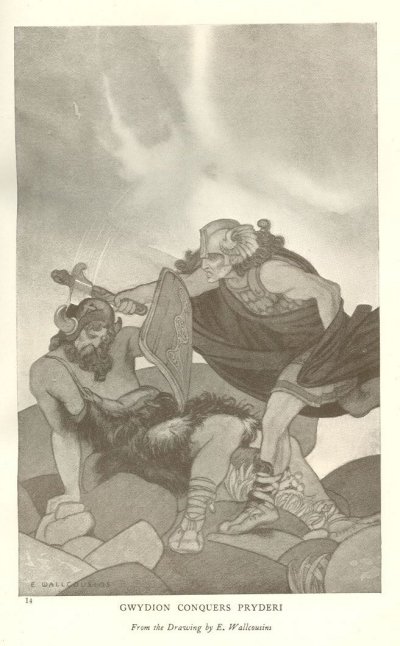
Pryderi's death in single combat. Image by E. Wallcousins.
In-universe information
SpeciesHuman
GenderMale
Spouse(s)Cigfa ferch Gwyn Glohoyw
ParentsPwyll (father), Rhiannon (mother)
FamilyManawydan (step-father), Hefeydd (maternal grandfather)
Welsh mythology character
Found inPwyll Pendefig Dyfed, Branwen ferch Llŷr, Manawydan fab Llŷr, Math fab Mathonwy
NationalityBritish (Demetian)

Pryderi fab Pwyll is a prominent figure in Welsh mythology, the son of Pwyll and Rhiannon, and king of Dyfed after his father's death. He is the only character to appear in all Four Branches of the Mabinogi, although the size of his role varies from tale to tale. He is often equated with the divine son figure of Mabon ap Modron,[1] while Jeffrey Gantz compares him to Peredur fab Efrawg, who is himself associated with the continental figure of Sir Percival de Galles.[2]

Ifor Williams speculated that he was once the focal character of the Mabinogi as a whole, although some subsequent scholars disagree with this theory.[2]

Pryderi is described by Jeffrey Gantz as "bold and enterprising, but rash to the point of foolishness." He goes on to say that "his downfall, while pathetic, is not entirely undeserved."[3]

Role in Welsh mythology

[edit]

Birth and early life

[edit]

Pryderi was born in Arberth to Pwyll, Lord of Dyfed, and Rhiannon, daughter of Hyfaidd Hen. On the night of his birth, he disappeared while in the care of six of Rhiannon's ladies-in-waiting. To avoid the king's wrath, they smeared dog's blood onto a sleeping Rhiannon, claiming that she had committed infanticide and cannibalism by eating her child.

Teyrnon, Lord of Gwent Is Coed, had a mare which gave birth each year but whose foals had all disappeared. Teyrnon watched his stables and saw a mysterious clawed beast coming to take the foal; Teyrnon cut off the beast's arm and found the child outside the stable. He and his wife claimed the boy as their own and named him Gwri Wallt Euryn (English: Gwri of the Golden hair), for "all the hair was as yellow as gold."[4]

The child grew to adulthood at a superhuman pace and, as he matured, his likeness to Pwyll grew more obvious; and eventually Teyrnon realised Gwri's true identity. The boy was eventually reconciled with Pwyll and Rhiannon and was renamed Pryderi. From then on, he was fostered by Pendaran Dyfed and was "brought up carefully, as was proper, until he was the most handsome lad, and the fairest, and the most accomplished at every worthy feat in the kingdom."[4]

After his father's death, Pryderi became ruler of the seven cantrefi of Dyfed and set about expanding his territories by conquering Ystrad Tywi and Ceredigion. He was occupied with this conquest until he chose to take a wife, eventually marrying Cigfa, the daughter of Gwyn Gohoyw. He also succeeded in amalgamating the seven cantrefi of Morgannwg into his kingdom, although the conquest itself is not referenced in any texts.

The Assembly of Branwen and Matholwch

[edit]

Branwen, sister of Bendigeidfrân (Brân the Blessed), king of Britain, is given in marriage to Matholwch, king of Ireland. Branwen's half-brother Efnisien, angry that he was not consulted, insults Matholwch by mutilating his horses, but Bendigeidfrân gives him compensation in the form of new horses and treasure, including a magical cauldron which can restore the dead to life. After returning to Ireland Matholwch and Branwen have a son, Gwern, but Efnisien's insult continues to rankle among the Irish and Branwen is banished to the kitchen and beaten every day. Branwen trains a starling to take a message to Bendigeidfrân, who raises a vast host and goes to war against Ireland. Pryderi accompanies him.

The British army crosses the Irish Sea in ships, but Bendigeidfrân is so huge he wades across. The Irish offer to make peace and build a house big enough to entertain Bendigeidfrân but hang a hundred bags inside, supposedly containing flour but actually containing armed warriors. Efnisien, suspecting a trick, reconnoitres the hall and kills the warriors by crushing their heads inside the bags. Later, at the feast, Efnisien, again feeling insulted, throws Gwern on the fire and fighting breaks out. Seeing that the Irish are using the cauldron to revive their dead, Efnisien hides among the corpses and destroys the cauldron, sacrificing himself in the process.

Pryderi is one of only seven men to survive the violent battle. He and his companions are told by the mortally wounded Bendigeidfrân to cut off his head and to return it to Britain. The survivors stay in Harlech, where they are entertained by Bendigeidfran's head, which continues to speak. They later move on to Gwales (often identified with Grassholm Island off Dyfed) where they live for eighty years without perceiving the passing of time. Eventually, Heilyn ap Gwyn opens the door of the hall facing Cornwall and the sorrow of what had befallen them returns. As instructed they take the now silent head to the Gwynfryn, the "White Hill" (thought to be the location where the Tower of London now stands), where they bury it facing France so as to ward off invasion.

Return to Britain

[edit]
Pryderi and Rhiannon's imprisonment. From Tales of the Enchanted Islands of the Atlantic, Thomas Wentworth Higginson. Image by Albert Herter.

Pryderi invites Manawydan, Bendigeidfran's brother and a fellow survivor, to live with him in Dyfed, arranging for him to marry his widowed mother Rhiannon. Soon after, Pryderi, Cigfa, Manawydan and Rhiannon ascend a magical hill and, when they descend, Dyfed had turned into a barren wasteland with no inhabitants. Pryderi and Manawydan travel to England to make a living from various trades, but were forced to leave one town after another to avoid conflicts with other tradesmen who resented their superior skills.

Returning to Dyfed, Manaywdan and Pryderi go hunting and, coming across a white boar, follow it to a huge, towering fort. Against Manawydan's advice, Pryderi enters the fort and is drawn towards a beautiful golden bowl. Upon touching the bowl, his feet stick to the floor, his hands stick to the bowl and he loses the power of speech. Manawydan waits in vain for his return before giving news of his disappearance to Rhiannon. Chiding her husband for his poor companionship, Rhiannon too enters the fort and suffers the same fate as her son. In a "blanket of mist", Pryderi, Rhiannon and the fort itself, vanish.

Some time later, Manawydan's cunning frees them from their imprisonment. It is revealed that the catalyst of their suffering was the enchanter Llwyd ap Cil Coed, who sought revenge for the humiliation of his friend Gwawl ap Clud at the hands of Pwyll and Rhiannon. The enchantment over Dyfed is lifted.

Invasion of Gwynedd and Death

[edit]

Some time later, Pryderi receives a number of otherworldly pigs from his father's old ally, Arawn, king of Annwn, which are stolen through trickery by Gwydion, a Venedotian magician and warrior. Declaring war on Gwynedd, Pryderi and his men march north and fight a battle between Maenor Bennardd and Maenor Coed Alun. Both sides suffer heavy losses, but Math fab Mathonwy, king of Gwynedd is victorious and Pryderi is forced to retreat. He is pursued to Nant Call, where more of his men are slaughtered, and then to Dol Benmaen, where he suffers a third defeat.

To avoid further bloodshed, it is agreed that the outcome of the battle should be decided by single combat between Gwydion and Pryderi. The two contenders meet at a place called Y Velen Rhyd in Ardudwy, and "because of strength and valour and magic and enchantment", Gwydion triumphs and Pryderi is killed. The men of Dyfed retreat back to their own land, lamenting over the death of their lord.

Appearances in other texts

[edit]

The Welsh Triads name Pryderi as one of the 'Three Powerful Swineherds of the Island of Britain', referring to an occasion on which he guarded the pigs of his foster-father, Pendaran Dyfed at Glyn Cuch. An obscure reference is also made of Pryderi and his father in the cryptic early medieval poem Preiddeu Annwfn:

"bu kyweir karchar gweir yg kaer sidi
trwy ebostol pwyll a phryderi.
Neb kyn noc ef nyt aeth idi.
yr gadwyn trom las kywirwas ae ketwi.
A rac preidu annwfyn tost yt geni.
Ac yt urawt parahawt yn bardwedi."[5]

This section of the poem suggests an enmity between Pryderi and a certain Gweir ap Gwystyl, who has been imprisoned in an otherworldly fortress through the "ebestol" of Pwyll and Pryderi. The exact meaning of the word "ebestol" is unclear, but has been variously translated as "epistle", tales", "account", "spite" and "lies."[6][7]

Pryderi is named once in the Welsh Triads, as one of the three powerful swineherds[8] while the Stanzas of the Graves refer to his final resting place as: "Aber Gwenoli...where the waves beat against the land."[9] The Book of Taliesin poem Song before the sons of Llyr also mentions Pryderi and, as in other texts, associates him both with Manawydan fab Llyr and with the otherworldly fortress of Caer Sidi:

Complete is my chair in Caer Sidi,
No one will be afflicted with disease or old age that may be in it.
It is known to Manawyd and Pryderi.
Three utterances, around the fire, will he sing before it,
And around its borders are the streams of the ocean.
And the fruitful fountain is above it,
Is sweeter than white wine the liquor therein.[10]

The character is also referred to in the works of a number of bards, including Einion fab Gwalchmai, Howel Foel ap Griffri and Cynddelw Brydydd Mawr. The famous fourteenth century poet Dafydd ap Gwilym referred to Dyfed as Pryderi Dir (The Land of Pryderi.)[11]

The children's fantasy series The Chronicles of Prydain features a character named King Pryderi. The character appears in the final book of the series, The High King. King Pryderi is a powerful monarch and warlord who betrays his liege lord, High King Math son of Mathonwy, and the House of Don, to side with Arawn Death-Lord. However, King Pryderi succumbs to his pride and ambition. When he ventures to Caer Dallben in an attempt to murder Dallben the enchanter and steal the Book of Three, he is killed by an enchantment protecting the book.

References

[edit]
Revisions and contributorsEdit on WikipediaRead on Wikipedia
from Grokipedia
Pryderi fab Pwyll is a prominent character in Welsh mythology, uniquely appearing in all four branches of the Mabinogion, a collection of medieval Welsh tales, as the son of Pwyll, prince of Dyfed, and Rhiannon, and later the king of Dyfed himself. Born under mysterious circumstances in Dyfed, he is abducted as a newborn from his mother's side at Gorsedd Arberth, only to be discovered and fostered by Teyrnon Twrf Liant, who names him Gwri Wallt Euryn ("Gwri of the Golden Hair") due to his unusual appearance and rapid growth; Rhiannon later renames him Pryderi, meaning "care" or "worry," reflecting the anxiety surrounding his birth. His story intertwines heroism, Otherworld connections, and tragedy, marked by magical deceptions, enchantments, and conflicts that highlight themes of sovereignty, kinship, and the supernatural in early Welsh narrative tradition. In the First Branch ("Pwyll Pendefig Dyfed"), Pryderi's birth resolves the injustice faced by , who is falsely accused of devouring her child, and establishes his ties to the through his father's pact with , king of Annwfn. He matures swiftly into a handsome and brave youth, fostered by Pendaran Dyfed, and begins his role as heir by tending swine gifted from the , symbolizing prosperity and royal legitimacy for . The Second Branch ("Branwen Ferch Llŷr") portrays Pryderi as a warrior accompanying his uncle Bendigeidfran (Bran the Blessed) on a disastrous expedition to , where he survives the catastrophic battle against the Irish forces. Upon return, he joins a select group in feasting with Bran's severed head at and Gwales (possibly Grassholm), an episode infused with enchantment that suspends time and grief. Following these events, he assumes kingship of the seven cantrefi of , marrying Cigfa and receiving magical swine from , which further bind him to supernatural realms. In the Third Branch ("Manawydan Son of Llŷr"), Pryderi's realm falls under a pervasive enchantment, transforming into a barren wasteland as its people vanish into the ; while hunting an illusory white boar, he and pursue it into a magical silver-roofed fortress, where Pryderi becomes trapped after touching a golden bowl, and both are enchanted and vanish. is later found in the form of a pregnant . His uncle eventually liberates them through cunning craftsmanship and negotiation, restoring the land but underscoring Pryderi's vulnerability to otherworldly forces. The Fourth Branch ("Math Son of Mathonwy") culminates in Pryderi's downfall, as , a nephew of Math, lord of , deceives him by offering illusory stallions and greyhounds in exchange for the prized swine, sparking a war between and . In near Y Maen Tyweithon, slays Pryderi using a combination of martial prowess and enchantment, including a shower of illusory stags, hounds, and shields made from toadstools; he is buried at Y Rhyd Goch in Nantlle according to some accounts.

Name and Etymology

Meaning and Origin

The name Pryderi derives from the noun pryder, which signifies "worry," "care," "anxiety," or "thought," often carrying connotations of concern or distress in the narrative contexts where it appears. Some scholars, including Ifor Williams, suggest it may derive from an obscure term meaning "loss" (*pritiri or *pryderi), aligning with themes of abduction in his birth story. This etymological root underscores thematic elements of loss and protective guardianship associated with the figure, without implying a literal biographical anxiety but rather a symbolic resonance in mythological . The term's usage in highlights how personal names could encode emotional or psychological states, influencing character interpretation. Linguistically, pryder traces back through Proto-Brythonic prɨðer to Proto-Celtic kʷritro-, reconstructed as denoting "thought" or "mind," ultimately from the kʷr- ("to make" or "to do"), suggesting an ancient conceptual link to mental processes or . This deeper Indo-European heritage positions Pryderi's name within broader Celtic linguistic patterns emphasizing cognition and concern, though specific reconstructions remain subject to ongoing philological debate. No direct etymological connections exist to particular , but the name evokes contextual motifs of divine sonship, akin to archetypal figures like in shared mythological traditions. In medieval manuscripts, the name consistently appears as Pryderi fab ("Pryderi, son of "), with minimal orthographic variation across key texts such as the White Book of Rhydderch (circa 1350) and the (circa 1382), both preserving the core form in their recensions of the tales. These documents, compiled from earlier oral and written traditions, standardize the nomenclature, reflecting its established role in Welsh literary heritage by the .

Mythological Associations

Pryderi is frequently identified by scholars with the Celtic deity , known as the "Great Son" or divine youth, due to striking parallels in their mythological motifs of abduction, imprisonment, and eventual restoration. This connection is rooted in shared archetypes of the youthful god figure who embodies renewal and is often rescued from otherworldly captivity, as seen in tales where Mabon is sought by Arthur's warriors in Culhwch ac Olwen. William John Gruffydd, in his analysis of the , posits that Pryderi represents an euhemerized version of Mabon, integrating the god's attributes into a heroic narrative while preserving elements of his divine origin associated with , , and . These associations extend to Irish mythology through comparable divine son figures, such as Mac ind Óg (the "Young Son") and his counterpart Óengus (Aengus), sons of the Dagda who dwell in sidhe realms like Brú na Bóinne, an otherworldly paradise akin to Welsh Annwn. Pryderi, like these Irish deities, serves as an archetypal mediator embodying youthful vitality and connection to enchanted domains, reflecting a pan-Celtic tradition of gods who navigate between human society and immortal spheres. Scholars note that such parallels underscore the diffusion of Celtic motifs across insular traditions, where the divine youth often symbolizes harmony between worlds and protection of cultural lore. Pryderi's symbolic ties to Annwn, the Welsh underworld, stem from his father Pwyll, who earned the title "Pen Annwfn" (Lord of Annwn) through his pact with Arawn, king of Annwn. This establishes him as a liminal figure who bridges mortal kingship in Dyfed with immortal rule over the otherworld. This dual sovereignty positions Pryderi as a guardian of thresholds, facilitating exchanges between the living realm and Annwn's timeless bounty, much like his father's pact with Arawn, king of the underworld. In medieval Welsh texts, this role evokes broader Celtic themes of reciprocity between realms, where heroes like Pryderi ensure prosperity and continuity across boundaries. The etymological root of Pryderi's name in "pryder," denoting "care" or "worry," has prompted scholarly speculation that he embodies an euhemerized god of or , with "care" connoting nurturing guardianship over and lineage. This interpretation aligns with who oversee communal well-being and renewal, transforming anxiety into watchful stewardship in mythological narratives.

Family and Early Life

Parentage and Birth

Pryderi was the son of , prince of , and , an otherworldly woman whom had wed after encountering her riding a magical horse. Their marriage took place in the third year following 's adventures in , the otherworld, and Pryderi's birth occurred at Arberth, one of 's chief palaces in . gave birth to the boy without complication in her chamber, tended by six women appointed to watch over her and the newborn. That same night, while the attendants slept, a monstrous beast with claws entered the chamber through an open window and seized the infant from his cradle, abducting him into the darkness. Awakening to find the child gone, the terrified women smeared Rhiannon's face and hands with the blood of a , placing its bones before her, and falsely accused her of smothering and devouring her own son to cover their negligence. Condemned by the court despite her protests of innocence, Rhiannon was sentenced to a degrading for seven years: she was required to sit at the horse block by the palace gate, offering to carry every visitor on her back to the hall as if she were a mount. Meanwhile, on the night of Pryderi's birth, a similar claw-footed beast approached the stable of Teyrnon Twrf Liant, lord of Gwent, to snatch his newborn colt; hearing the commotion, Teyrnon rushed out, seized the creature, and severed its arm at the elbow with his sword, causing it to flee. Inside the stable, he discovered the wrapped infant, unharmed and clutching the colt's trappings, whom he and his wife decided to raise as their own, naming him Gwri Wallt Euryn, or "Gwri of the Golden Hair," for his exceptionally fine locks. The boy exhibited growth, able to walk by his first year and resembling a child of four or five by his second, displaying traits of nobility that puzzled his foster parents. When Teyrnon recognized the arm severed from the beast matched the size of the lost prince's forearm and recalled the timing of Pryderi's disappearance, he returned the boy to and , proving her innocence through the circumstances of the discovery. At the emotional reunion, the child was renamed Pryderi, derived from the Welsh pryder meaning "care" or "," symbolizing the profound and loss his abduction had inflicted on his parents. Upon his return, entrusted Pryderi to Pendaran for fostering, where he matured into a prepared to assume his role as heir. With his return, 's penance was immediately lifted, restoring her honor and allowing the family to unite.

Marriage and Ascension to Kingship

Pryderi succeeded his father as ruler of the seven cantrefi of , governing prosperously and earning the affection of his subjects as well as neighboring peoples. Following this period of stable rule, he embarked on military campaigns, conquering the three cantrefi of Ystrad Tywi and the four cantrefi of . These territorial expansions solidified his authority across significant portions of western , marking his early adulthood with a phase of consolidation and martial success before broader involvement in events affecting the island of Britain. Through these conquests, Pryderi inherited and embodied his father's title as Pen Annwfn, or lord of , the Welsh otherworld, which granted him privileged access to resources and alliances. A key example of this otherworldly connection was Pryderi's possession of the magical swine bestowed upon him by , which further bound him to realms. Amid these developments, Pryderi chose to marry Cigfa, daughter of Gwyn Gloyw, the chief steward of the of Gwarthaf in , thereby integrating her family's influence into his domain. The union, celebrated with a year-long feast, coincided with the cessation of his conquests, ushering in an era of domestic stability for under joint rule. No children are recorded from this marriage, and Pryderi's death without heirs effectively concluded his direct lineage, leading to temporary stewardship of his lands by allies such as .

Role in the Four Branches of the Mabinogion

Pwyll Pendefig Dyfed

Under Teyrnon's care in Gwent Is Coed, the foundling boy—later revealed as Pwyll and Rhiannon's son—exhibited extraordinary rapid growth, walking stoutly by his first year and appearing as large as a three-year-old, surpassing typical development for his age. By his second year, he matched the size of a six-year-old child, and by the fourth year, he was handling horses adeptly, even bribing grooms to allow him access to the stables. This accelerated maturation underscored his otherworldly heritage, subtly linking to his father's earlier exchange with Arawn, king of Annwn, which had established Pwyll's ties to the supernatural realm and foreshadowed Pryderi's future connections to it. Recognizing the boy's striking resemblance to Pwyll in features and bearing, Teyrnon returned him to the court at Narberth, where , still enduring her unjust , immediately identified him as her son. confirmed the likeness, dispelling doubts about the child's origins and affirming his legitimacy as heir to . Named Pryderi—meaning "care" or "thought," in reference to Rhiannon's protective concern—he was entrusted to Pendaran Dyfed, a wise counselor, for further upbringing, ensuring his education in and martial skills until manhood. This recognition solidified Pryderi's position as a capable successor, free from the scandals that had clouded his early years. Following Pwyll's death, Pryderi assumed rulership over the seven cantrefi of , governing prosperously and earning the love of his subjects through just and effective leadership. He expanded his domain by incorporating the three cantrefi of Ystrad Tywi and the four cantrefi of Cardigan, thereby forming the Seven Cantrefi of Seissyllwch and strengthening 's regional influence in preparation for broader alliances. In this first branch, Pryderi emerges not as an adventurer but as a steadfast heir, methodically establishing his authority without independent exploits, inheriting his father's lordship over alongside his mortal responsibilities.

Branwen Ferch Llŷr

In the Second Branch of the , titled Branwen Ferch Llŷr, Pryderi, as ruler of and kinsman to Bendigeidfran (), king of Britain, joins the expedition to after news reaches Britain of Branwen's mistreatment there—forcing her to work as a miller's drudge and beating her. He accompanies the assembled Welsh forces across the , using the improvised bridge formed by Bendigeidfran's body, and participates in the ensuing war against Matholwch's forces. The conflict escalates into a catastrophic battle at the Irish court, where the Welsh, vastly outnumbered, suffer immense losses but gain ground through the cauldron's power to revive their dead warriors. Pryderi survives the battle as one of only seven Welshmen left alive, alongside son of , Gluneu Eil Taran, , Ynawc, Grudyen son of Muryel, and Heilyn son of Gwynn Hen. The survivors, having defeated the Irish but at great cost, sever Bendigeidfran's head at his request before it prophesies future events. They return to Britain bearing the head, first feasting with it for seven years in , where its company brings joy and music, and then for eighty years in Gwales on Grassholm Island, entering a magical chamber that preserves them from grief until Heilyn opens a forbidden door, ending the enchantment. The group then proceeds to , where the head is buried under the White Hill () to protect Britain from invasion.

Manawydan Fab Llŷr

Following the cataclysmic events of the Irish expedition, where Pryderi had been among the few Welsh survivors, he returned to and invited son of to join him there, offering him companionship, the hand of the widowed in marriage, and shared sovereignty over the seven cantrefs of the . accepted, and the four—Pryderi, his wife Cigfa, , and —formed a harmonious household, engaging in hunting, feasting, and prosperous rule without discord. This period of stability, however, was abruptly shattered by an otherworldly enchantment orchestrated by Llwyd ap Cil Coed, a powerful figure seeking vengeance for the earlier humiliation of Gwawl ap Clud at the hands of Pryderi's father, . On a day of clear weather, a tremendous thunderclap echoed across , followed by a dense that enveloped the ; when it lifted, the lay desolate, its people, animals, and dwellings vanished, leaving only the four inhabitants amid an eerie emptiness. To sustain themselves, the group turned to crafting and trading, excelling in leatherwork and finding success in various English cities until returning to for farming. As they sowed wheat, a —manifesting as an illusory creature tied to the enchantment—appeared and led Pryderi and on a pursuit across the barren land to a newly erected that appeared suddenly in a place where none had stood before. Ignoring Manawydan's caution against entering unknown otherworldly structures, Pryderi ventured inside alone, drawn to a magnificent mounted on a slab; upon touching it to claim the , he became spellbound, his feet rooted to the flagstones, voiceless and immobile as a thick descended, sealing the fort. Rhiannon, searching for her husband, followed and suffered the same fate when she attempted to free him by grasping the bowl, both now imprisoned in an enchanted stasis that symbolized the perilous allure of artifacts. The fort then vanished, leaving Manawydan and Cigfa to grieve the loss, while the land's desolation deepened, underscoring themes of isolation and the intrusion of vengeance into mortal domains. With Dyfed's crops repeatedly vanishing overnight due to hordes of mice—revealed as Llwyd's transformed retinue—Manawydan devised a cunning trap by preparing to hang a pregnant mouse he had caught, which drew out the enchanter Llwyd and his retinue; he refused to release her despite Llwyd's pleas and magical assaults, instead demanding the restoration of Dyfed and a vow of no future enchantments against its seven cantrefs. This confrontation highlighted Manawydan's resourcefulness and legal acumen, forcing Llwyd to concede; the mist lifted, the people and animals returned, and Pryderi and Rhiannon were freed from their imprisonment, their voices and forms restored as the fairy fort dissolved. The resolution restored prosperity to Dyfed, emphasizing the triumph of human ingenuity over otherworldly malice and the interconnectedness of enchantment with motifs of retribution and transformation in Welsh mythology.

Math Fab Mathonwy

In the Fourth Branch of the Mabinogion, Pryderi receives a gift of magical pigs from , the king of , which significantly enhances the prestige of his realm in . These swine, described as otherworldly creatures with unique qualities, arrive as a token of alliance, building on Pryderi's familial ties to established through his father Pwyll's earlier adventures. The arrival of these pigs underscores 's growing prosperity and supernatural favor, positioning Pryderi as a ruler of considerable influence across southern . Seeking to acquire the pigs for Math's court in , Gwydion, Math's nephew and a master magician, devises a . Disguised with eleven companions as traveling bards, Gwydion visits Pryderi and offers illusory treasures in exchange: first twelve stallions with trappings, then twelve greyhounds with collars, and finally twelve gilded shields, all conjured through (the shields from fungi) and destined to vanish. Pryderi, impressed by the apparent value and Gwydion's persuasive guile, agrees to the , handing over the pigs to provision Math's household during a time of scarcity. This exchange highlights Gwydion's cunning as a , exploiting Pryderi's trust in bardic . The deception unravels the following day when Pryderi discovers the traded items have disappeared, revealing them as mere enchantments. Enraged, Pryderi mobilizes his forces across twenty-one cantrefi to pursue , leading to a confrontation at Y Velen Rhyd, a ford in . Despite initial skirmishes favoring Pryderi's warriors, challenges him to , where the magician chants spells causing the earth to open and engulf Pryderi up to his waist, pinning him, before slaying him with a . This marks the culmination of the rivalry, with emerging victorious. Pryderi's body is subsequently buried at Maen Tyriawc, above Y Velen Rhyd, where his grave is said to remain. This burial site symbolizes the abrupt end of Pryderi's line and the collapse of his dynasty, as his death leaves without a direct heir and vulnerable to further enchantments. The event severs the prosperous rule that had defined his life, shifting the narrative focus back to Math's court.

Appearances in Other Medieval Welsh Texts

Culhwch ac Olwen

In the medieval Welsh prose tale Culhwch ac Olwen, Pryderi appears under his childhood name Gware Gwallt Euryn (Gwri Golden-Hair), as given to him by Teyrnon in the First Branch of the . This figure is listed among the extensive roster of warriors and companions assembled at Arthur's court in Celliwig, positioning Pryderi as one of the king's esteemed allies in this Arthurian narrative. Unlike his portrayal as the sovereign ruler of in the , here he embodies a more subordinate, hospitable role within the royal retinue, contributing to the court's atmosphere of camaraderie and support for heroic endeavors. Gware Gwallt Euryn's involvement underscores his status among 's trusted followers, as he joins and Mabon son of Mellt on a mission to to retrieve the two hounds of Glythmyr Ledewic. These dogs are essential for pursuing , the monstrous boar whose comb, razor, and shears form one of the perilous tasks imposed on to win Olwen's hand from her father Ysbaddaden Chief Giant. By aiding in this procurement, Gware facilitates a critical step in the overarching quest, though his depiction remains ancillary to the central action. Pryderi takes no further active part in the subsequent hunts or confrontations detailed in , emphasizing his limited yet symbolically connective presence as a figure bridging mythological cycles. This appearance reinforces his integration into the broader Arthurian tradition, where he serves as a reliable companion rather than a dominant leader.

Welsh Triads and Poetry

In the medieval Welsh collection known as Trioedd Ynys Prydein (Triads of the Island of Britain), Pryderi is named as one of the "Three Powerful Swineherds of the Island of Britain," alongside Drystan mab Tallwch and Cilydd mab Celyddon, tasked with guarding the pigs of Pendaran Dyfed in Glyn Cuch in Emlyn. This role echoes the otherworldly swineherding motif from Pryderi's encounters with the pigs of Annwn in the Mabinogion. Pryderi appears in the poem Preiddeu Annwfn ("The Spoils of ") from the , where he and are implicated in the imprisonment of Gweir ap Gwystyl within the otherworldly fortress of , described as a place of enchantment and captivity. The stanza portrays their involvement through spiteful agency, binding the prisoner with a heavy blue chain in this timeless domain. The Englynion y Beddau ("Stanzas of the Graves"), preserved in the Black Book of Carmarthen, records Pryderi's burial site at Aber Gwenoli, the mouth of the River Gwenoli, linking it to the circumstances of his death in Welsh tradition. In later medieval bardic poetry, Pryderi is evoked through references to his domain, as in the work of (c. 1320–c. 1380), who refers to as Pryderi dir ("Beautiful Pryderi" or "the land of fair Pryderi"), symbolizing the region's enduring association with his kingship. Other stanzas attributed to in the further associate Pryderi with otherworldly feasts and fortresses, such as , where eternal revelry and mead flow uninterrupted by age or decay.

Interpretations and Legacy

Symbolic Role and Character Traits

Pryderi is portrayed in the medieval Welsh narratives as a bold and enterprising figure whose actions often stem from a sense of duty and ambition, yet these traits frequently lead to rash decisions with dire consequences, such as his and eventual demise. His impetuosity is evident in instances where he prioritizes over caution, reflecting a prideful assertion of lordship that contrasts with the more measured counsel of allies like . This characterization underscores a tension between valor and , positioning Pryderi as a whose enterprises, while noble in intent, expose vulnerabilities in his realm and personal fate. As an archetypal divine son, Pryderi embodies motifs of abduction, loss, and restoration, serving as a bridge between the mortal world of and the otherworldly realm of , inherited through his father's pact. His narrative arc—from miraculous birth to kingship and tragic end—evokes the culture hero pattern, where a youthful figure navigates trials to affirm connections between human society and divine forces, though ultimately unable to sustain his lineage's prosperity. This role highlights themes of and guardianship, aligned with his name's meaning "care" or "," manifested in his generous gifts of and ties to secure alliances and defend his domain against threats. Scholars have debated Pryderi's overarching significance, with W.J. Gruffydd proposing him as the unifying thread across the Four Branches, a central whose story binds the tales into a cohesive . However, subsequent analyses view him as more peripheral, a connective element rather than the dominant , emphasizing how his recurring presence facilitates thematic continuity without overshadowing other figures. He is sometimes briefly equated with the youthful god Mabon, reinforcing his divine son archetype in broader Celtic contexts.

Modern Scholarship and Adaptations

Modern scholars have debated Pryderi's character and narrative role, often highlighting parallels with other questing heroes in Welsh literature. Jeffrey Gantz draws comparisons between Pryderi and fab Efrawg, the Welsh precursor to the Arthurian Perceval, noting shared motifs of youthful quests, otherworldly encounters, and maturation through trials that underscore themes of sovereignty and heroism across the Mabinogi branches. Other analyses critique Pryderi's arc, portraying his repeated downfalls—such as his rash decision to trade magical swine against prior agreements—as stemming from impulsive actions that lead to personal and territorial ruin, a trait that underscores moral lessons on restraint in medieval Welsh prose. Views on Pryderi's origins frequently invoke euhemerization, the process of recasting pre-Christian deities as historical figures in later texts. Scholars interpret him as a historicized aspect of the god (or Mabon), a youthful divine son linked to , the Welsh underworld, through his father's pact with its ruler and Pryderi's own imprisonment there, suggesting an underlying role as a pre-Christian sovereign of the whose mythic attributes were adapted into human kingship narratives during the Christian era. In modern adaptations, Pryderi appears prominently in Lloyd Alexander's series, where he is reimagined as King Pryderi, ruler of the Western Realms and a treacherous ally turned , ultimately killed by a magical enchantment when he attempts to seize in (1968), blending Welsh mythic elements with tropes of betrayal and . His influence extends to neo-paganism and fantasy genres, where he symbolizes sovereignty and the perils of crossing realms, though without major film or television portrayals; instead, references appear in Welsh revival , such as retellings that emphasize his heroic resilience amid supernatural trials.

References

  1. https://en.wiktionary.org/wiki/pryder
Add your contribution
Related Hubs
User Avatar
No comments yet.