Hubbry Logo
Pulse-Doppler radarPulse-Doppler radarMain
Open search
Pulse-Doppler radar
Community hub
Pulse-Doppler radar
logo
8 pages, 0 posts
0 subscribers
Be the first to start a discussion here.
Pulse-Doppler radar
Pulse-Doppler radar
from Wikipedia
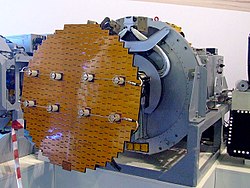
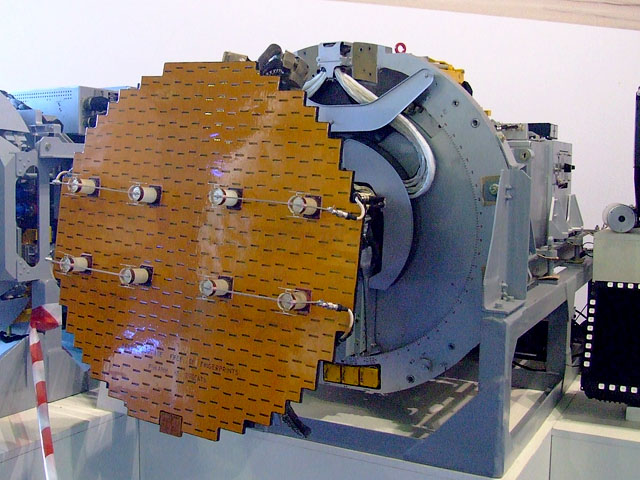
Airborne pulse-Doppler radar antenna

A pulse-Doppler radar is a radar system that determines the range to a target using pulse-timing techniques, and uses the Doppler effect of the returned signal to determine the target object's velocity. It combines the features of pulse radars and continuous-wave radars, which were formerly separate due to the complexity of the electronics.

The first operational pulse-Doppler radar was in the CIM-10 Bomarc, an American long range supersonic missile powered by ramjet engines, and which was armed with a W40 nuclear weapon to destroy entire formations of attacking enemy aircraft.[1] Pulse-Doppler systems were first widely used on fighter aircraft starting in the 1960s. Earlier radars had used pulse-timing in order to determine range and the angle of the antenna (or similar means) to determine the bearing. However, this only worked when the radar antenna was not pointed down; in that case the reflection off the ground overwhelmed any returns from other objects. As the ground moves at the same speed but opposite direction of the aircraft, Doppler techniques allow the ground return to be filtered out, revealing aircraft and vehicles. This gives pulse-Doppler radars "look-down/shoot-down" capability. A secondary advantage in military radar is to reduce the transmitted power while achieving acceptable performance for improved safety of stealthy radar.[2]

Pulse-Doppler techniques also find widespread use in meteorological radars, allowing the radar to determine wind speed from the velocity of any precipitation in the air. Pulse-Doppler radar is also the basis of synthetic aperture radar used in radar astronomy, remote sensing and mapping. In air traffic control, they are used for discriminating aircraft from clutter. Besides the above conventional surveillance applications, pulse-Doppler radar has been successfully applied in healthcare, such as fall risk assessment and fall detection, for nursing or clinical purposes.[3]

History

[edit]

The earliest radar systems failed to operate as expected. The reason was traced to Doppler effects that degrade performance of systems not designed to account for moving objects. Fast-moving objects cause a phase-shift on the transmit pulse that can produce signal cancellation. Doppler has maximum detrimental effect on moving target indicator systems, which must use reverse phase shift for Doppler compensation in the detector.

Doppler weather effects (precipitation) were also found to degrade conventional radar and moving target indicator radar, which can mask aircraft reflections. This phenomenon was adapted for use with weather radar in the 1950s after declassification of some World War II systems.

Pulse-Doppler radar was developed during World War II to overcome limitations by increasing pulse repetition frequency. This required the development of the klystron, the traveling wave tube, and solid state devices. Early pulse-dopplers were incompatible with other high power microwave amplification devices that are not coherent, but more sophisticated techniques were developed that record the phase of each transmitted pulse for comparison to returned echoes.

Early examples of military systems includes the AN/SPG-51B developed during the 1950s specifically for the purpose of operating in hurricane conditions with no performance degradation.

The Hughes AN/ASG-18 Fire Control System was a prototype airborne radar/combination system for the planned North American XF-108 Rapier interceptor aircraft for the United States Air Force, and later for the Lockheed YF-12. The US's first pulse-Doppler radar,[4] the system had look-down/shoot-down capability and could track one target at a time.

It became possible to use pulse-Doppler radar on aircraft after digital computers were incorporated in the design. Pulse-Doppler provided look-down/shoot-down capability to support air-to-air missile systems in most modern military aircraft by the mid 1970s.

Principle

[edit]
Principle of pulse-Doppler radar

Range measurement

[edit]
Principle of pulsed radar

Pulse-Doppler systems measure the range to objects by measuring the elapsed time between sending a pulse of radio energy and receiving a reflection of the object. Radio waves travel at the speed of light, so the distance to the object is the elapsed time multiplied by the speed of light, divided by two – there and back.

Velocity measurement

[edit]
Change of wavelength caused by motion of the source

Pulse-Doppler radar is based on the Doppler effect, where movement in range produces frequency shift on the signal reflected from the target.

Radial velocity is essential for pulse-Doppler radar operation. As the reflector moves between each transmit pulse, the returned signal has a phase difference, or phase shift, from pulse to pulse. This causes the reflector to produce Doppler modulation on the reflected signal.

Pulse-Doppler radars exploit this phenomenon to improve performance.

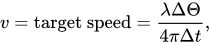
The amplitude of the successively returning pulse from the same scanned volume is where

  • is the distance radar to target,
  • is the radar wavelength,
  • is the time between two pulses.

So

This allows the radar to separate the reflections from multiple objects located in the same volume of space by separating the objects using a spread spectrum to segregate different signals: where is the phase shift induced by range motion.
Benefits

[edit]

Rejection speed is selectable on pulse-Doppler aircraft-detection systems so nothing below that speed will be detected. A one degree antenna beam illuminates millions of square feet of terrain at 10 miles (16 km) range, and this produces thousands of detections at or below the horizon if Doppler is not used.

Pulse-Doppler radar uses the following signal processing criteria to exclude unwanted signals from slow-moving objects. This is also known as clutter rejection.[5] Rejection velocity is usually set just above the prevailing wind speed (10 to 100 mph or 20 to 160 km/h). The velocity threshold is much lower for weather radar.[6]

In airborne pulse-Doppler radar, the velocity threshold is offset by the speed of the aircraft relative to the ground. where is the angle offset between the antenna position and the aircraft flight trajectory.

Surface reflections appear in almost all radar. Ground clutter generally appears in a circular region within a radius of about 25 miles (40 km) near ground-based radar. This distance extends much further in airborne and space radar. Clutter results from radio energy being reflected from the earth surface, buildings, and vegetation. Clutter includes weather in radar intended to detect and report aircraft and spacecraft.[7]

Clutter creates a vulnerability region in pulse-amplitude time-domain radar. Non-Doppler radar systems cannot be pointed directly at the ground due to excessive false alarms, which overwhelm computers and operators. Sensitivity must be reduced near clutter to avoid overload. This vulnerability begins in the low-elevation region several beam widths above the horizon, and extends downward. This also exists throughout the volume of moving air associated with weather phenomenon.

Pulse-Doppler radar corrects this as follows.

  • Allows the radar antenna to be pointed directly at the ground without overwhelming the computer and without reducing sensitivity.
  • Fills in the vulnerability region associated with pulse-amplitude time-domain radar for small object detection near terrain and weather.
  • Increases detection range by 300% or more in comparison to moving target indication (MTI) by improving sub-clutter visibility.[8]

Clutter rejection capability of about 60 dB is needed for look-down/shoot-down capability, and pulse-Doppler is the only strategy that can satisfy this requirement. This eliminates vulnerabilities associated with the low-elevation and below-horizon environment.

Pulse compression and moving target indicator (MTI) provide up to 25 dB sub-clutter visibility. An MTI antenna beam is aimed above the horizon to avoid an excessive false alarm rate, which renders systems vulnerable. Aircraft and some missiles exploit this weakness using a technique called flying below the radar to avoid detection (nap-of-the-earth). This flying technique is ineffective against pulse-Doppler radar.

Pulse-Doppler provides an advantage when attempting to detect missiles and low observability aircraft flying near terrain, sea surface, and weather.

Audible Doppler and target size support passive vehicle type classification when identification friend or foe is not available from a transponder signal. Medium pulse repetition frequency (PRF) reflected microwave signals fall between 1,500 and 15,000 cycle per second, which is audible. This means a helicopter sounds like a helicopter, a jet sounds like a jet, and propeller aircraft sound like propellers. Aircraft with no moving parts produce a tone. The actual size of the target can be calculated using the audible signal.[citation needed]

Detriments

[edit]
Maximum range from reflectivity (red) and unambiguous Doppler velocity range (blue) with a fixed pulse repetition rate.

Ambiguity processing is required when target range is above the red line in the graphic, which increases scan time.

Scan time is a critical factor for some systems because vehicles moving at or above the speed of sound can travel one mile (1.6 km) every few seconds, like the Exocet, Harpoon, Kitchen, and air-to-air missiles. The maximum time to scan the entire volume of the sky must be on the order of a dozen seconds or less for systems operating in that environment.

Pulse-Doppler radar by itself can be too slow to cover the entire volume of space above the horizon unless fan beam is used. This approach is used with the AN/SPS 49(V)5 Very Long Range Air Surveillance Radar, which sacrifices elevation measurement to gain speed.[9]

Pulse-Doppler antenna motion must be slow enough so that all the return signals from at least 3 different PRFs can be processed out to the maximum anticipated detection range. This is known as dwell time.[10] Antenna motion for pulse-Doppler must be as slow as radar using MTI.

Search radar that include pulse-Doppler are usually dual mode because best overall performance is achieved when pulse-Doppler is used for areas with high false alarm rates (horizon or below and weather), while conventional radar will scan faster in free-space where false alarm rate is low (above horizon with clear skies).

The antenna type is an important consideration for multi-mode radar because undesirable phase shift introduced by the radar antenna can degrade performance measurements for sub-clutter visibility.

Signal processing

[edit]

The signal processing enhancement of pulse-Doppler allows small high-speed objects to be detected in close proximity to large slow moving reflectors. To achieve this, the transmitter must be coherent and should produce low phase noise during the detection interval, and the receiver must have large instantaneous dynamic range.

Pulse-Doppler signal processing also includes ambiguity resolution to identify true range and velocity.

The received signals from multiple PRF are compared to determine true range using the range ambiguity resolution process.

The received signals are also compared using the frequency ambiguity resolution process.

Range resolution

[edit]

The range resolution is the minimal range separation between two objects traveling at the same speed before the radar can detect two discrete reflections:

In addition to this sampling limit, the duration of the transmitted pulse could mean that returns from two targets will be received simultaneously from different parts of the pulse.

Velocity resolution

[edit]

The velocity resolution is the minimal radial velocity difference between two objects traveling at the same range before the radar can detect two discrete reflections:

Special consideration

[edit]

Pulse-Doppler radar has special requirements that must be satisfied to achieve acceptable performance.

Pulse repetition frequency

[edit]

Pulse-Doppler typically uses medium pulse repetition frequency (PRF) from about 3 kHz to 30 kHz. The range between transmit pulses is 5 km to 50 km.

Range and velocity cannot be measured directly using medium PRF, and ambiguity resolution is required to identify true range and speed. Doppler signals are generally above 1 kHz, which is audible, so audio signals from medium-PRF systems can be used for passive target classification.

Angular measurement

[edit]

Radar systems require angular measurement. Transponders are not normally associated with pulse-Doppler radar, so sidelobe suppression is required for practical operation.[11][12]

Tracking radar systems use angle error to improve accuracy by producing measurements perpendicular to the radar antenna beam. Angular measurements are averaged over a span of time and combined with radial movement to develop information suitable to predict target position for a short time into the future.

The two angle error techniques used with tracking radar are monopulse and conical scan.

Coherency

[edit]

Pulse-Doppler radar requires a coherent oscillator with very little noise. Phase noise reduces sub-clutter visibility performance by producing apparent motion on stationary objects.

Cavity magnetron and crossed-field amplifier are not appropriate because noise introduced by these devices interfere with detection performance. The only amplification devices suitable for pulse-Doppler are klystron, traveling wave tube, and solid state devices.

Scalloping

[edit]

Pulse-Doppler signal processing introduces a phenomenon called scalloping. The name is associated with a series of holes that are scooped-out of the detection performance.

Scalloping for pulse-Doppler radar involves blind velocities created by the clutter rejection filter. Every volume of space must be scanned using 3 or more different PRF. A two PRF detection scheme will have detection gaps with a pattern of discrete ranges, each of which has a blind velocity.

Windowing

[edit]

Ringing artifacts pose a problem with search, detection, and ambiguity resolution in pulse-Doppler radar.

Ringing is reduced in two ways.

First, the shape of the transmit pulse is adjusted to smooth the leading edge and trailing edge so that RF power is increased and decreased without an abrupt change. This creates a transmit pulse with smooth ends instead of a square wave, which reduces ringing phenomenon that is otherwise associated with target reflection.

Second, the shape of the receive pulse is adjusted using a window function that minimizes ringing that occurs any time pulses are applied to a filter. In a digital system, this adjusts the phase and/or amplitude of each sample before it is applied to the fast Fourier transform. The Dolph-Chebyshev window is the most effective because it produces a flat processing floor with no ringing that would otherwise cause false alarms.[13]

Antenna

[edit]

Pulse-Doppler radar is generally limited to mechanically aimed antennas and active phased arrays.

Mechanical RF components, such as wave-guide, can produce Doppler modulation due to phase shift induced by vibration. This introduces a requirement to perform full spectrum operational tests using shake tables that can produce high power mechanical vibration across all anticipated audio frequencies.

Doppler is incompatible with most passive electronically steered phased-array antenna. This is because the phase-shifter elements in the antenna are non-reciprocal and the phase shift must be adjusted before and after each transmit pulse. Spurious phase shift is produced by the sudden impulse of the phase shift, and settling during the receive period between transmit pulses places Doppler modulation onto stationary clutter. That receive modulation corrupts the measure of performance for sub-clutter visibility. Phase shifter settling time on the order of 50ns is required. Start of receiver sampling needs to be postponed at least 1 phase-shifter settling time-constant (or more) for each 20 dB of sub-clutter visibility.

Most antenna phase shifters operating at PRF above 1 kHz introduce spurious phase shift unless special provisions are made, such as reducing phase shifter settling time to a few dozen nanoseconds.[14]

The following gives the maximum permissible settling time for antenna phase shift modules. where
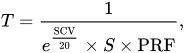
  • T = phase shifter settling time,
  • SCV = sub-clutter visibility in dB,
  • S = number of range samples between each transmit pulse,
  • PRF = maximal design pulse repetition frequency.

The antenna type and scan performance is a practical consideration for multi-mode radar systems.

Diffraction

[edit]

Choppy surfaces, like waves and trees, form a diffraction grating suitable for bending microwave signals. Pulse-Doppler can be so sensitive that diffraction from mountains, buildings or wave tops can be used to detect fast moving objects otherwise blocked by solid obstruction along the line of sight. This is a very lossy phenomenon that only becomes possible when radar has significant excess sub-clutter visibility.

Refraction and ducting use transmit frequency at L-band or lower to extend the horizon, which is very different from diffraction. Refraction for over-the-horizon radar uses variable density in the air column above the surface of the earth to bend RF signals. An inversion layer can produce a transient troposphere duct that traps RF signals in a thin layer of air like a wave-guide.

Subclutter visibility

[edit]

Subclutter visibility involves the maximum ratio of clutter power to target power, which is proportional to dynamic range. This determines performance in heavy weather and near the earth surface.

Subclutter visibility is the ratio of the smallest signal that can be detected in the presence of a larger signal.

A small fast-moving target reflection can be detected in the presence of larger slow-moving clutter reflections when the following is true:

Performance

[edit]

The pulse-Doppler radar equation can be used to understand trade-offs between different design constraints, like power consumption, detection range, and microwave safety hazards. This is a very simple form of modeling that allows performance to be evaluated in a sterile environment.

The theoretical range performance is as follows.

where

R = distance to the target,
Pt = transmitter power,
Gt = gain of the transmitting antenna,
Ar = effective aperture (area) of the receiving antenna,
σ = radar cross section, or scattering coefficient, of the target,
F = antenna pattern propagation factor,
D = Doppler filter size (transmit pulses in each Fast Fourier transform),
kB = Boltzmann constant,
T = absolute temperature,
B = receiver bandwidth (band-pass filter),
N = noise figure.

This equation is derived by combining the radar equation with the noise equation and accounting for in-band noise distribution across multiple detection filters. The value D is added to the standard radar range equation to account for both pulse-Doppler signal processing and transmitter FM noise reduction.

Detection range is increased proportional to the fourth root of the number of filters for a given power consumption. Alternatively, power consumption is reduced by the number of filters for a given detection range.

Pulse-Doppler signal processing integrates all of the energy from all of the individual reflected pulses that enter the filter. This means a pulse-Doppler signal processing system with 1024 elements provides 30.103 dB of improvement due to the type of signal processing that must be used with pulse-Doppler radar. The energy of all of the individual pulses from the object are added together by the filtering process.

Signal processing for a 1024-point filter improves performance by 30.103 dB, assuming compatible transmitter and antenna. This corresponds to 562% increase in maximal distance.

These improvements are the reason pulse-Doppler is essential for military and astronomy.

Aircraft tracking uses

[edit]

Pulse-Doppler radar for aircraft detection has two modes.

  • Scan
  • Track

Scan mode involves frequency filtering, amplitude thresholding, and ambiguity resolution. Once a reflection has been detected and resolved, the pulse-Doppler radar automatically transitions to tracking mode for the volume of space surrounding the track.

Track mode works like a phase-locked loop, where Doppler velocity is compared with the range movement on successive scans. Lock indicates the difference between the two measurements is below a threshold, which can only occur with an object that satisfies Newtonian mechanics. Other types of electronic signals cannot produce a lock. Lock exists in no other type of radar.

The lock criterion needs to be satisfied during normal operation.[15]

Lock eliminates the need for human intervention with the exception of helicopters and electronic jamming.

Weather phenomenon obey adiabatic process associated with air mass and not Newtonian mechanics, so the lock criterion is not normally used for weather radar.

Pulse-Doppler signal processing selectively excludes low-velocity reflections so that no detections occurs below a threshold velocity. This eliminates terrain, weather, biologicals, and mechanical jamming with the exception of decoy aircraft.

The target Doppler signal from the detection is converted from frequency domain back into time domain sound for the operator in track mode on some radar systems. The operator uses this sound for passive target classification, such as recognizing helicopters and electronic jamming.

Helicopters

[edit]

Special consideration is required for aircraft with large moving parts because pulse-Doppler radar operates like a phase-locked loop. Blade tips moving near the speed of sound produce the only signal that can be detected when a helicopter is moving slow near terrain and weather.

A helicopter appears like a rapidly pulsing noise emitter except in a clear environment free from clutter. An audible signal is produced for passive identification of the type of airborne object. Microwave Doppler frequency shift produced by reflector motion falls into the audible sound range for human beings (20–20000 Hz), which is used for target classification in addition to the kinds of conventional radar display used for that purpose, like A-scope, B-scope, C-scope, and RHI indicator. The human ear may be able to tell the difference better than electronic equipment.

A special mode is required because the Doppler velocity feedback information must be unlinked from radial movement so that the system can transition from scan to track with no lock.

Similar techniques are required to develop track information for jamming signals and interference that cannot satisfy the lock criterion.

Multi-mode

[edit]

Pulse-Doppler radar must be multi-mode to handle aircraft turning and crossing trajectory.

Once in track mode, pulse-Doppler radar must include a way to modify Doppler filtering for the volume of space surrounding a track when radial velocity falls below the minimum detection velocity. Doppler filter adjustment must be linked with a radar track function to automatically adjust Doppler rejection speed within the volume of space surrounding the track.

Tracking will cease without this feature because the target signal will otherwise be rejected by the Doppler filter when radial velocity approaches zero because there is no change in frequency.

Multi-mode operation may also include continuous wave illumination for semi-active radar homing.

See also

[edit]
[edit]

References

[edit]
Revisions and contributorsEdit on WikipediaRead on Wikipedia
from Grokipedia
Pulse-Doppler is a specialized system that measures the range to a target through pulse-timing techniques while employing the of the returned signal to determine the target's , allowing it to distinguish moving objects from stationary clutter. This coherent processing integrates high (PRF) transmissions with synchronized reception to reject ground or weather clutter, enhancing detection in challenging environments. The system's operation relies on the two-way Doppler shift, expressed as fd=2VRλcosψ0f_d = \frac{2V_R}{\lambda} \cos \psi_0, where VRV_R is the relative , λ\lambda is the , and ψ0\psi_0 is the angle between the radar beam and the line to the target. The development of Pulse-Doppler radar traces back to , with early research from 1940 to 1945 in countries including , Britain, the , and , aimed at improving target detection amid sea and land echoes. These efforts built on (MTI) techniques but advanced to coherent pulse processing for better resolution, with initial implementations in airborne systems by the mid-1940s. Post-war refinements, particularly in the and , focused on high PRF modes to handle ambiguities in range and , leading to widespread adoption in military radars. In military applications, Pulse-Doppler radar excels in airborne surveillance and interceptor roles, providing long-range detection, precise range and velocity data, and clutter rejection for like the F-16's system. Ground-based variants support air defense by tracking multiple targets in severe clutter. Civilian uses include weather monitoring, as in the U.S. National Weather Service's WSR-88D network, which employs pulsed Doppler to measure speed and direction for severe storm warnings. It also aids and maritime navigation by detecting velocity shifts in dynamic environments. Key advantages of Pulse-Doppler radar include its ability to detect low-amplitude moving targets against intense clutter backgrounds through Doppler filtering, though it introduces range and ambiguities that require advanced to resolve. Modern systems often incorporate digital techniques for multitarget tracking and adaptive PRF selection, improving performance in multifunctional roles.

History

Early Development

The development of pulse-Doppler radar emerged in the as a response to the limitations of conventional pulse radars in detecting moving targets against backgrounds of stationary clutter, such as ground or sea returns. British scientists, including E.G. Bowen, contributed foundational work on pulsed transmitters for airborne radar systems. In parallel, U.S. efforts under the (NDRC) accelerated following the introduction of the British cavity in late 1940, enabling microwave pulse radars with improved resolution. Research during this period, including in , Britain, the , and , laid early groundwork for pulse-Doppler techniques. During , prototypes like the SCR-584 anti-aircraft , with development beginning in 1941, production starting in 1943, and first deployed in combat in 1944, incorporated conical scan tracking but relied on non-coherent , which hindered precise Doppler and left systems vulnerable to clutter interference. By mid-1945, (MTI) kits were developed and tested on SCR-584 units and other systems like the AN/CPS-1, providing basic Doppler filtering through delay-line cancellers to suppress stationary echoes and highlight moving targets, though limited by phase instability and incomplete coherence. These prototypes addressed key hurdles, including receiver sensitivity and antenna sidelobe clutter, but non-coherent techniques restricted velocity resolution and sensitivity to low-speed targets. Following the war's end in , pulse-Doppler concepts transitioned to broader adoption in enhanced anti-aircraft and systems. Early post-war prototypes, building on wartime MTI foundations, were integrated into U.S. Air Force projects for airborne applications, marking the shift from analog non-coherent methods to coherent pulse-Doppler architectures. Coherent processing, enabled by advancements like the amplifier in the early , provided stable phase reference for accurate Doppler extraction and superior clutter rejection.

Key Advancements

In the 1950s, significant milestones in pulse-Doppler radar emerged with the development of systems like the AN/SPG-51B, a Raytheon-built for , which received a major U.S. Navy contract in June 1958 for production and integration into naval platforms such as Tartar missile-equipped ships. This radar operated as a pulse-Doppler system. Concurrently, the system achieved initial operational status with the CIM-10A in 1959, while the CIM-10B variant, incorporating the Westinghouse AN/DPN-53 as the world's first operational pulse-Doppler seeker radar, became operational in 1961. The 1960s and 1970s marked the transition to in pulse-Doppler radars, exemplified by the Hughes developed for high-altitude interceptors like the YF-12A. Introduced in the mid-1960s, the employed coherent analog processing for integration and filtering, achieving approximately 80 dB of clutter rejection that enabled pioneering capabilities against low-altitude targets masked by ground returns. This approach significantly improved real-time velocity discrimination over analog predecessors, supporting integration into for beyond-visual-range engagements. Refinements in the late solidified pulse-Doppler adoption in operational aircraft, notably with the in the , which featured the Hughes AN/APG-63 multimode radar. The F-15's advanced supported seamless pulse-Doppler operation across air-to-air and air-to-ground modes while rejecting clutter in diverse scenarios. This advancement enhanced the system's scalability for fleet-wide deployment, providing pilots with automated and tracking at extended ranges.

Principles of Operation

Range Measurement

Pulse-Doppler radar determines the distance to a target, known as range, by transmitting short bursts of radiofrequency (RF) energy as pulses and measuring the time delay for the echo to return after reflection from the target. This time-of-flight principle relies on the constant speed of electromagnetic waves in free space, approximately the speed of light c=3×10⁸c = 3 \times 10^8 m/s. The range RR is calculated using the formula: R=ct2R = \frac{c \cdot t}{2} where tt is the round-trip time from transmission to reception of the echo. The factor of 2 accounts for the signal traveling to the target and back. This method provides direct measurement of slant range along the radar beam, with timing precision typically achieved through high-resolution clocks in modern systems. The duration of each transmitted pulse, or pulse width τ\tau, directly influences the accuracy of range measurement, particularly the range resolution—the minimum separable distance between two targets along the same beam. Range resolution ΔR\Delta R is given by: ΔR=cτ2\Delta R = \frac{c \cdot \tau}{2} Shorter pulses yield finer resolution but require higher peak power to maintain sufficient signal energy for detection at distance. For example, a pulse width of 0.1 μs provides about 15 m resolution, suitable for high-precision applications like air traffic control, while a 1 μs pulse offers 150 m resolution, common in surveillance radars balancing resolution and power efficiency. Peak transmit power must be elevated for short pulses to ensure the echo-to-noise ratio supports reliable detection, as energy per pulse is proportional to power times width; typical values range from kilowatts to megawatts depending on operational range requirements. In pulse-Doppler systems, received echoes are processed using range gates—fixed time windows that sample the return signal in the to isolate reflections from specific intervals. Each gate corresponds to a narrow range bin, typically on the order of the , allowing subsequent Doppler analysis on isolated segments without interference from nearby echoes. This time-domain gating divides the radar's volume into discrete radial slices, facilitating coherent integration across multiple pulses for estimation within each bin.

Velocity Measurement

In pulse-Doppler radar systems, velocity measurement relies on the , which causes a shift in the returned echo from a moving target relative to the transmitted signal. This shift arises because the target's motion alters the path length of the radar wave during the round trip, resulting in a change in the received that is proportional to the target's component toward or away from the . The core principle enables the extraction of information from the phase progression across multiple pulses, after isolating the target's echo via range gating. The Doppler frequency shift fdf_d for a target with radial velocity vv (positive for approaching) is given by fd=2vf0c,f_d = \frac{2 v f_0}{c}, where f0f_0 is the transmitted radar frequency and cc is the speed of light. This formula accounts for the two-way propagation: the transmitted wave experiences an initial Doppler shift as it encounters the moving target, and the reflected wave undergoes a second identical shift on its return path, doubling the total effect compared to a one-way scenario. To derive this, consider a target at initial range rr moving with velocity vv along the line of sight. The round-trip path length at time tt is 2(r+vt)2(r + v t), so the instantaneous phase of the received signal is ϕ(t)=4πf0(r+vt)c\phi(t) = \frac{4\pi f_0 (r + v t)}{c}. The Doppler shift is the time derivative of this phase divided by 2π2\pi, yielding fd=dϕ/dt2π=2vf0cf_d = \frac{d\phi/dt}{2\pi} = \frac{2 v f_0}{c}. For non-zero angles, the effective velocity is vcosθv \cos \theta, where θ\theta is the angle between the target's velocity vector and the radar line of sight, but the radial component vv is used in the base equation. For practical illustration in an X-band radar operating at f0=10f_0 = 10 GHz, the Doppler sensitivity is approximately 67 Hz per m/s of , since 2f0c66.7\frac{2 f_0}{c} \approx 66.7 Hz/(m/s). This means a target approaching at 10 m/s produces a detectable shift of about 667 Hz, which is processed coherently over pulse trains to estimate . Such scaling highlights the higher sensitivity of higher-frequency radars to small velocities, though it also amplifies ambiguities at high speeds. Velocity measurements in pulse-Doppler systems are subject to due to the (PRF), which sets the Nyquist limit for Doppler frequencies at ±\pm PRF/2. The maximum unambiguous is thus vmax=cPRF4f0v_{\max} = \frac{c \cdot \text{PRF}}{4 f_0}, as Doppler shifts exceeding this fold back into lower frequencies, mimicking slower targets. To resolve ambiguities for velocities beyond vmaxv_{\max}, multiple pulses are integrated using techniques such as staggered PRFs across coherent processing intervals, allowing unwrapping of the true by comparing measurements from different unambiguous ranges. This ties directly to PRF selection, where higher values expand the velocity window but risk range ambiguities.

Clutter Rejection

In pulse-Doppler radar systems, clutter arises primarily from stationary or slow-moving environmental sources such as ground surfaces, states, and weather phenomena like or , producing Doppler spectra centered near zero frequency due to minimal relative motion. Ground clutter, often the most dominant, results from reflections and can exhibit a narrow spectral spread, while clutter shows moderate broadening influenced by wave motion and . clutter, including returns, is diffuse and wind-displaced but remains concentrated at low Doppler velocities. These clutter signals typically overpower target echoes, with ground clutter intensities reaching 50 to 60 dB above target returns in many scenarios, sea clutter about 20 to 30 dB weaker than ground, and rain clutter approximately 30 dB stronger than targets. Such high power levels degrade detection unless mitigated, as clutter can mask fast-moving targets within the same range-Doppler cell. Clutter rejection relies on high-pass Doppler filters to suppress low-velocity returns, isolating echoes from rapidly moving targets. (MTI) processing integrates these filters through delay-line cancellers, such as two-pulse (output = current - previous pulse) or three-pulse configurations, which create notch responses at zero Doppler. In look-down geometries, prevalent in airborne radars, platform motion induces Doppler shifts across ground patches, spreading clutter into a "ridge" that requires adaptive high-pass or notch filtering to avoid target loss. These mechanisms yield substantial signal-to-clutter ratio enhancements; for instance, a three-pulse MTI canceller achieves up to 42 dB improvement in clutter rejection under ideal conditions. In medium (PRF) modes, combining staggered PRFs with Doppler filtering provides 30-50 dB overall suppression, enabling reliable target detection amid intense clutter.

Advantages and Limitations

Benefits

Pulse-Doppler radar provides enhanced target discrimination by leveraging the Doppler shift to separate moving targets from stationary clutter, enabling the detection of fast-moving objects in environments rich with ground or weather returns. This capability is particularly valuable for tracking low-altitude that would otherwise be masked by reflections in conventional pulse radars. For instance, the system's use of Doppler filtering allows it to isolate targets with radial velocities distinct from clutter, improving detection in scenarios where traditional radars struggle with high clutter-to-signal ratios. A key operational advantage is the capability, which permits to detect and engage low-flying targets against a ground clutter background. This feature became feasible with the maturation of pulse-Doppler technology in the early 1970s, enabling integration into for air-to-air combat. Early examples include the AN/AWG-10 radar in the F-4 Phantom, which provided head-on look-down functionality, and the in the F-14 Tomcat, supporting guidance by the mid-1970s. Such systems revolutionized by allowing engagements without requiring targets to be above the horizon. Medium (PRF) operation in pulse-Doppler radars offers benefits for achieving range- unambiguity, allowing simultaneous accurate measurements of both parameters without extensive blind zones. By balancing ambiguities in range and Doppler, medium PRF enables better separation of clutter from targets, particularly for low-speed closing , and supports resolution techniques like staggered PRFs for unambiguous tracking over broader operational envelopes. This contrasts with low or high PRF modes, providing a versatile compromise for applications requiring reliable discrimination alongside reasonable range coverage.

Detriments

Pulse-Doppler radars suffer from inherent ambiguities in range and measurements due to the pulse repetition frequency (PRF). The maximum unambiguous range is limited by the formula Rmax=c2×PRFR_{\max} = \frac{c}{2 \times \mathrm{PRF}}, where cc is the , meaning higher PRFs necessary for resolution reduce the detectable range without echoes from multiple pulses. Similarly, blind speeds occur at vblind=nλ×PRF2v_{\mathrm{blind}} = n \frac{\lambda \times \mathrm{PRF}}{2}, where λ\lambda is the and n=1,2,n = 1, 2, \dots, causing targets moving at these speeds to appear stationary and evade detection, particularly in medium-PRF modes common for airborne applications. The system's reliance on coherent processing imposes significant computational and hardware demands, elevating costs and complexity beyond those of non-coherent radars. Coherent integration requires phase-stable waveforms, high-speed of I/Q channels, and extensive for Doppler filtering, often necessitating specialized hardware like FPGAs or GPUs to handle real-time data rates exceeding tens of MB/s. In contrast, simple radars use amplitude-only detection with far less processing overhead, making pulse-Doppler designs more expensive for equivalent power outputs. Platform motion in airborne or vehicular installations exacerbates these issues by introducing false Doppler shifts, where the radar's relative to the ground spreads clutter spectra across bins, masking true target returns. For instance, at speeds of 200 m/s, ground clutter can alias into the main Doppler , reducing detection sensitivity without compensation techniques to align phase centers or stabilize references. This sensitivity limits operational envelopes in dynamic environments compared to ground-based systems.

Signal Processing

Resolution Capabilities

The range resolution in pulse-Doppler radar, which determines the minimum separable distance between two targets along the line of sight, is fundamentally limited by the transmitted pulse width τ\tau. It is given by the formula ΔR=cτ2\Delta R = \frac{c \tau}{2}, where cc is the speed of light (3×1083 \times 10^8 m/s). This arises because the radar measures round-trip time, and the echoes from two closely spaced targets must not overlap significantly for distinction. For instance, a pulse width of 1 μ\mus corresponds to ΔR=150\Delta R = 150 m, enabling separation of targets at that spacing under ideal conditions. Velocity resolution, the ability to distinguish targets with different radial velocities, depends on the Doppler processing applied to a coherent integration of NN pulses. In typical implementations using the fast Fourier transform (FFT), the Doppler frequency resolution is Δfd=PRFN\Delta f_d = \frac{\mathrm{PRF}}{N}, leading to a velocity resolution of Δv=λPRF2N\Delta v = \frac{\lambda \cdot \mathrm{PRF}}{2 N}, where λ\lambda is the radar wavelength and PRF is the pulse repetition frequency. This resolution improves with larger NN (longer integration time), providing finer velocity discrimination, but introduces trade-offs such as reduced real-time update rates and increased susceptibility to platform motion in airborne systems. Pulse-Doppler radars form a joint range-Doppler map through two-dimensional , often a 2D FFT across fast-time (range) and slow-time (Doppler) dimensions, to resolve multiple simultaneously in both domains. This displays target returns as peaks in a grid of range bins and Doppler bins, allowing separation of targets with overlapping ranges but distinct velocities, or vice versa, which is essential for clutter rejection and multi-target tracking. While general overviews may describe the map qualitatively, detailed derivations of the resolution limits and processing effects appear in specialized references.

Pulse Repetition Frequency

In pulse-Doppler radar systems, the (PRF) serves as a fundamental parameter that determines the trade-offs between unambiguous range and measurements, influencing the radar's ability to resolve target parameters without . Low PRF modes, typically below 1.5 kHz, prioritize unambiguous range determination by allowing sufficient time for echoes to return before the next is transmitted, enabling detection out to hundreds of kilometers but introducing severe ambiguities and blind speeds that limit Doppler . High PRF modes, exceeding 10 kHz, enhance unambiguous resolution by sampling the Doppler more frequently, supporting measurements up to several hundred meters per second, though they result in range folding where distant targets appear at incorrect closer ranges. Medium PRF modes, ranging from 3 to 30 kHz, offer a compromise suited to pulse-Doppler operation, providing moderate power-aperture products for clutter rejection while accepting manageable ambiguities in both range and that can be resolved through , as seen in systems like the . These PRF selections inherently lead to ambiguities, particularly blind speeds where moving targets produce Doppler shifts that alias to zero , rendering them indistinguishable from stationary clutter; the nth blind speed is given by vb=n×λ×PRF2v_b = n \times \frac{\lambda \times \mathrm{PRF}}{2}, where λ\lambda is the and nn is a positive . To extend the unambiguous regions and mitigate blind speeds, techniques such as staggered PRF employ varying pulse intervals within a burst—e.g., alternating between two or more PRFs like 2 kHz and 1.75 kHz—to shift patterns and recover information across a broader spectrum without introducing new low-order blinds. Multiple bursts with distinct PRFs further resolve range and ambiguities by comparing Doppler estimates across sequences, effectively unfolding aliased returns and improving detection in cluttered environments. In modern applications, adaptive PRF schemes dynamically adjust the repetition rate based on environmental conditions to optimize performance in dynamic scenarios.

Coherent Processing

Coherent processing in pulse-Doppler radar refers to the preservation of phase information across transmitted and received pulses, enabling the extraction of Doppler shifts by maintaining a stable phase reference between the transmitter and receiver. This stability is essential for comparing the phase or of target echoes against a reference signal from a low-noise oscillator, allowing the system to detect velocity-induced shifts accurately. Achieving coherency typically involves phase-stable oscillators such as klystrons, which provide consistent phase relationships pulse-to-pulse due to their amplifier design, or magnetrons paired with to inject a stable reference signal and lock the oscillator's phase. In magnetron-based systems, the inherent phase instability of self-oscillating magnetrons—where RF phase varies randomly from pulse to pulse—necessitates an external exciter to establish coherency, often through injection locking techniques. Modern implementations increasingly use digital exciters based on direct digital synthesis (DDS), which generate precise, programmable waveforms to ensure phase and timing coherence while improving flexibility over analog methods. The received signals undergo in-phase (I) and quadrature (Q) demodulation to produce complex baseband samples that capture both and phase information, forming the basis for Doppler . This I/Q demodulation splits the (IF) signal using a synchronous detector referenced to the stable , enabling the representation of the as a complex for subsequent analysis. In the processing chain, coherent integration of multiple pulses occurs via (FFT) applied across the pulse train to generate Doppler spectra, where each FFT bin corresponds to a specific . This integration enhances (SNR) by a factor of 10 log_{10} N dB, where N is the number of coherently integrated pulses—for instance, integrating 128 pulses yields approximately 21 dB of gain, improving detection of weak moving targets against noise. The resulting spectra reveal Doppler frequencies, distinguishing targets from stationary clutter based on phase progression over time. Phase noise from oscillators poses a significant challenge, as it introduces random phase fluctuations that broaden spectral lines, degrade Doppler resolution, and reduce the ability to detect targets near clutter residues. Stabilization techniques include using low-phase-noise voltage-controlled oscillators (VCOs) locked to a high-stability reference, such as crystal oscillators, and employing phase-locked loops (PLLs) to minimize jitter across the transmit-receive chain. In digital systems, advanced calibration and compensation algorithms further mitigate these effects by estimating and correcting phase errors in real-time.

Advanced Topics

Angular and Antenna Considerations

Angular resolution in pulse-Doppler radar is fundamentally limited by the antenna's beamwidth, which determines the minimum angular separation at which two targets at the same range can be distinguished. The beamwidth θ\theta, typically measured at the -3 dB points, is approximated by θKλD\theta \approx K \frac{\lambda}{D}, where λ\lambda is the , DD is the antenna , and KK is a beamwidth factor that varies with antenna design, often around 1 for illumination. For a typical X-band pulse-Doppler radar operating at 10 GHz (λ0.03\lambda \approx 0.03 m) with a 1 m parabolic antenna, this yields a beamwidth of approximately 1.7 degrees, limiting resolution to about 300 m separation at 10 km range. In contrast, phased-array antennas achieve similar beamwidths but enable electronic steering, allowing faster scanning rates compared to mechanical systems, which are constrained by physical rotation limits of 10-30 rpm. Antenna types for pulse-Doppler radar primarily include parabolic reflectors and phased arrays, each influencing angular performance through principles. Parabolic antennas focus energy via a reflective dish, producing a narrow beam dictated by at the edges, where the far-field spreads as θλ/D\theta \propto \lambda / D. These are common in stationary pulse-Doppler systems for their simplicity and high gain but require mechanical scanning, limiting update rates to seconds per volume scan. Phased-array antennas, particularly active electronically scanned arrays (AESAs), consist of numerous radiating elements with phase shifters, enabling electronic without moving parts; this supports pulse-Doppler operations by providing rapid updates (up to kilohertz rates) for tracking high-speed targets while maintaining diffraction-limited beamwidths. basics in both types arise from wave propagation limits, where the sets the fundamental resolution boundary, though phased arrays mitigate scan losses through adaptive phasing. Monopulse techniques enhance angular precision in pulse-Doppler radar beyond simple beamwidth limits by using simultaneous sum and difference patterns from a single pulse. These systems divide the aperture into quadrants or subarrays to generate and difference signals (Δ\Delta), allowing angle error estimation via θe=ΔΣθb2\theta_e = \frac{\Delta}{\Sigma} \cdot \frac{\theta_b}{2}, where Σ\Sigma is the sum signal and θb\theta_b is the beamwidth; this achieves accuracies of 0.1 beamwidth or better. In modern AESA integrations post-2000, such as the APG-79 for the F/A-18E/F, monopulse is realized through digital beamforming across segmented arrays, providing gap-free tracking of multiple targets without mechanical aids. This evolution supports 3D range-Doppler-angular tracking in dynamic environments.

Scalloping and Windowing Effects

In pulse-Doppler radar systems, scalloping loss refers to the amplitude variation in the Doppler spectrum caused by the discrete uniform sampling grid of the (FFT) used for coherent processing. When a target's Doppler aligns perfectly with an FFT bin center, the signal amplitude is maximized, but if it falls midway between bins, the energy spreads across adjacent bins, resulting in a reduction of up to 3.92 dB in detected signal power. This "picket fence" effect degrades detection sensitivity for certain velocity combinations, particularly in high-resolution Doppler filters. To mitigate scalloping loss and , window functions are applied to the received pulse train prior to FFT computation. The rectangular () window, which assumes no weighting, exhibits first at approximately -13 dB and incurs the full 3.92 dB scalloping loss, but it provides the narrowest mainlobe for optimal resolution. In contrast, the Hamming window reduces to about -43 dB and scalloping loss to around 1.8 dB, while the Blackman window achieves even greater attenuation of -58 dB with scalloping reduced to less than 1 dB. These improvements come at the cost of mainlobe broadening—typically 1.5 to 2 times wider than the rectangular case—which trades off Doppler resolution for better and reduced false detections from clutter . The interaction between antenna patterns and window functions further influences Doppler spectral artifacts, as the antenna's diffraction-limited beam shape weights incoming signals before digital processing. In modern simulations using post-2015 digital signal processing tools, such as those in MATLAB's Radar Toolbox, antenna patterns are integrated with windowed FFT outputs to model how beam broadening and sidelobes interact with window-induced effects, revealing up to 2 dB additional loss in non-uniform illumination scenarios. This analysis fills gaps in traditional models by accounting for realistic diffraction propagation in cluttered environments.

Subclutter Visibility and Performance

Subclutter visibility (SCV) quantifies a Pulse-Doppler radar's capability to detect moving targets embedded within strong clutter backgrounds, defined as the ratio (in dB) of the input clutter power to the minimum detectable target signal power after in the Doppler filter. This factor measures the system's ability to maintain reliable detection even when the target echo is significantly weaker than the surrounding clutter, typically after Doppler has suppressed stationary returns. SCV depends on the clutter's Doppler width, integration time, and filter characteristics; for a single-delay canceler with clutter spectrum typical of moderate wind-induced motion, it can achieve approximately 13 dB, allowing detection of targets whose echoes are about 20 times weaker than the input clutter. In clutter-limited scenarios, Pulse-Doppler performance is assessed using the range equation for received power, with processing gains from coherent integration and Doppler filtering applied to enhance the signal-to-clutter (SCR) by 10–30 dB depending on the design and integration time: Pr=PtGtGrλ2σ(4π)3R4P_r = \frac{P_t G_t G_r \lambda^2 \sigma}{(4\pi)^3 R^4} where PrP_r is the received power, PtP_t is the transmitted power, GtG_t and GrG_r are the transmit and receive antenna gains, λ\lambda is the , σ\sigma is the target cross-section, and RR is the range. In such environments, the equation shifts focus from noise-limited to clutter-limited detection, where the effective SCR determines the maximum range for a given probability of detection, often requiring adaptive thresholds to handle varying clutter residues. Evaluation of Pulse-Doppler systems in cluttered settings relies on (ROC) curves plotting probability of detection PdP_d against probability of PfaP_fa, which illustrate trade-offs in detection reliability under low SCR conditions. Traditional benchmarks, such as those for (CFAR) processors, show PdP_d approaching 90% at Pfa=106P_{fa} = 10^{-6} only when SCR exceeds 13–15 dB post-processing. Recent AI-enhanced methods, however, have improved these metrics; for example, a deep learning-based meta-detector (IfCMD) applied to Pulse-Doppler data in dynamic sea clutter achieves Pd=80%P_d = 80\% at Pfa=106P_{fa} = 10^{-6} with 2–4 dB lower required SCNR compared to conventional MTI-MTD/CFAR approaches, demonstrating robustness near clutter edges and for range-spread targets.

Applications

Military and Aviation

Pulse-Doppler radar systems are integral to for detecting and tracking airborne targets in cluttered environments, enabling precise engagement in beyond-visual-range (BVR) scenarios. These radars operate by measuring the Doppler shift in returned echoes to distinguish moving targets from stationary ground clutter, supporting modes such as single-target track (STT), (TWS), and multi-target tracking. In STT mode, the radar focuses its beam on a single target for high-accuracy updates, while TWS maintains continuous surveillance over a wide volume by correlating detections across scans to build and update multiple track files without interrupting the search pattern. Multi-target engagement extends this capability, allowing simultaneous tracking of several threats—up to 10 or more in advanced systems—for coordinated weapons assignment, as demonstrated in airborne interceptors where TWS integrates with fire-control processors to cue missiles like the . This multi-mode operation enhances in dynamic combat environments, such as fighter sweeps or intercepts. For low-speed targets like hovering helicopters, pulse-Doppler radars exploit micro-Doppler signatures from rotor blades to achieve detection even at near-zero , where conventional Doppler filtering might fail. Techniques such as (STFT) analysis of the received signals reveal these subtle frequency modulations, enabling probabilities of detection up to 60% at low signal-to-noise ratios (e.g., -24 dB) using X-band frequencies and coherent processing intervals of 150 ms. Look-down/shoot-down tactics represent a cornerstone of pulse-Doppler application in fighter aircraft, allowing detection and engagement of low-altitude targets against ground clutter by filtering echoes based on radial velocity. Integrated into platforms like the F-16 Fighting Falcon via the AN/APG-66 and upgraded AN/APG-68 radars, these systems provide all-aspect, all-altitude tracking with look-down capabilities, supporting BVR shots at ranges exceeding 40 nautical miles even in severe clutter. The F-16's multi-mode operations seamlessly switch between air-to-air modes for intercepting high-speed threats and air-to-ground modes for precision strikes, leveraging the radar's digital signal processing to maintain track continuity during transitions, as evidenced in combat operations like the 1991 Gulf War where 48% of victories involved such BVR engagements. In missile guidance, pulse-Doppler technology underpins in weapons like the , where the seeker's monopulse Doppler processing enables autonomy after mid-course updates from the launch platform. The missile transitions to terminal active guidance within its effective range, using inertial navigation augmented by two-way data links for retargeting against maneuvering threats. Recent upgrades, including the AIM-120D variant's hardware refresh and software enhancements, extend range and lethality for engaging high-speed targets, with variants like the AMRAAM-Extended Range (AMRAAM-ER) designed for intercepts at higher altitudes and velocities, addressing evolving airborne threats through improved seeker performance and networking.

Modern Civilian Uses

Pulse-Doppler radar plays a crucial role in modern weather monitoring systems, particularly through networks like the Next Generation Weather Radar (NEXRAD), which employs S-band pulse-Doppler technology to detect precipitation, wind patterns, and severe weather phenomena such as wind shear and tornadoes. These radars measure radial velocity by analyzing the Doppler shift in returned pulses, enabling forecasters to track storm rotation and issue timely warnings for hazardous conditions. Recent advancements include the integration of dual-polarization capabilities, upgraded across the NEXRAD network in the 2010s but continuing to evolve with software enhancements in the 2020s for improved debris detection in tornadoes and better discrimination between rain and hail. As of 2025, plans are underway to replace legacy WSR-88D units with phased-array systems by 2040, promising faster scan times—down to one minute from the current 5-8 minutes—while maintaining pulse-Doppler principles for enhanced volume coverage and real-time data processing. In the automotive sector, pulse-Doppler radar has been integrated into advanced driver-assistance systems (ADAS) and autonomous vehicles, particularly at 77 GHz millimeter-wave frequencies, to sense relative velocities of pedestrians, vehicles, and obstacles for functions like and collision avoidance. These systems transmit short pulses and process the Doppler-shifted echoes to estimate speeds with high accuracy, even in adverse , supporting features in vehicles from manufacturers like and . Advancements in the include higher-resolution 4D imaging radars that combine range, , , and data, improving object classification and reducing false positives in complex urban environments; the automotive radar market was valued at approximately USD 5.4 billion in 2025 and is projected to grow to USD 22.8 billion by 2030, driven by regulatory mandates for safety features. Although frequency-modulated (FMCW) dominates, pulse-Doppler variants offer advantages in peak power for longer-range detection up to 200 meters. Beyond weather and automotive applications, pulse-Doppler radar enhances and drone detection, addressing growing management needs. In air traffic systems, such as the Terminal Doppler Weather Radar (TDWR), pulse-Doppler processing discriminates from ground clutter and detects microbursts, providing data to prevent runway incursions. For drone detection, compact pulse-Doppler units operating in Ku-band (15.4-16.6 GHz) track small unmanned aerial systems (UAS) with velocities up to 100 m/s, enabling real-time classification at airports and sensitive sites. Regulatory adaptations by the FCC in 2025 propose expanding radiolocation operations in the 24.45–24.65 GHz band specifically for UAS detection, facilitating non-interfering civilian deployments without impacting existing services. These developments support safer integration of drones into national , with systems like EchoShield achieving detection ranges exceeding 1 km for cooperative and non-cooperative targets.

References

Add your contribution
Related Hubs
User Avatar
No comments yet.