Hubbry Logo
Cardiff city centreCardiff city centreMain
Open search
Cardiff city centre
Community hub
Cardiff city centre
logo
8 pages, 0 posts
0 subscribers
Be the first to start a discussion here.
Cardiff city centre
Cardiff city centre
from Wikipedia

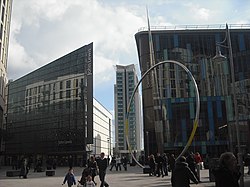
Stadium House (left) and South Gate House (right), in the west of the city centre

Key Information

Cardiff city centre (Welsh: Canol Dinas Caerdydd) is the city centre and central business district of Cardiff, Wales. The area is tightly bound by the River Taff to the west, the Civic Centre to the north and railway lines and two railway stations – Central and Queen Street – to the south and east respectively. Cardiff became a city in 1905.

The city centre in Cardiff consists of principal shopping streets: Queen Street, St. Mary's Street and the Hayes, as well as large shopping centres, and numerous arcades and lanes that house some smaller, specialized shops and boutiques.

The city centre has undergone a number of redevelopment projects, including St. David's 2,[1] which extended the shopping district southwards, creating 100 new stores and a flagship John Lewis, the only branch in Wales and the largest outside London. Compared to nearby cities, the new St David's Centre has more retail space than the whole of Newport or Swansea.[citation needed]

In 2008–9, the annual footfall of shoppers was 55 million, and is expected to have risen to 66 million by 2009–10.[needs update][2] Cardiff is the sixth most successful shopping destination in the United Kingdom – behind London, Glasgow, Birmingham, Manchester and Liverpool.[3]

History

[edit]
St John the Baptist Church, Cardiff's only medieval parish church in the city centre.
John Speed's 1610 map of Cardiff

Cardiff was granted city status by Edward VII in 1905.[4]

In the 1960s, planners described Cardiff city centre as "worn out, inconvenient, drab and dangerous". The centre had escaped the extensive wartime bomb damage inflicted on other cities, so little redevelopment took place in the 1950s and 1960s. The Buchanan Plan of 1964 envisaged a highly ambitious extended city centre, crossed with urban motorways. The council scrapped the proposed motorway network and focused on the small commercial core of the city; its proposed redevelopment scheme, in partnership with a private developer, would have seen almost all of the city centre (except St Mary Street and Working Street) demolished, replaced by modernist office towers of up to 21 storeys and pedestrianised decks linking multi‑storey car parks to covered shopping malls.[5]

By the time the legal agreement to implement 'Centreplan 70' was signed, the 1973 property crash had made it unviable. However, one legacy of the scheme was the future segregation of office and retail development, with the west end of Newport Road as the principal office area with secondary concentrations on Churchill Way, Greyfriars Road and Westgate Street.[5]

Development in the 1970s and 80s was more piecemeal than envisaged in Centreplan, with the building of the St. David's Centre and St David's Hall, new multi‑storey car parks, and the grant‑supported construction of the 14‑storey Holiday Inn (now the Marriott) and World Trade Centre (now the Cardiff International Arena), which gave a fillip to the city's conference and exhibition business. In the mid–1980s developers returned to Queen Street, creating three medium‑sized malls, helping it to become one of the best performing shopping streets in the country in terms of footfall and rental levels.[5]

In the 1990s the Mill Lane cafe quarter was developed in partnership with the Welsh Development Agency, a pedestrian forecourt was created for the refurbished Central railway station, a new walkway was constructed alongside the Taff and the Millennium Stadium was built on the site of the National Stadium and Empire Pool. The latter became, according to official publicists, one of the icons of Cardiff's new image.[5]

Castle Quarter

[edit]

The Castle Quarter includes some of Cardiff's Victorian and Edwardian arcades: Castle Arcade, High Street Arcade and Duke Street Arcade, and principal shopping streets: St Mary Street, High Street, Castle Street and Duke Street.

Development of the area began in February 2010 and is expected to be completed by July 2011. Cardiff Council says that work to create the Castle Quarter as a pedestrian friendly environment for High Street and St Mary Street is designed to enhance the city centre.[6]

Castle Street/Duke Street/Kingsway

[edit]
Duke Street Arcade

Castle Street follows on from Cowbridge Road East from Canton and begins after Cardiff Bridge, over the River Taff. It becomes Duke Street after the junction with High Street before turning north and becoming Kingsway, leading to Cardiff Civic Centre. From west to east, streets that begin from the southern side of this stretch are Westgate Street, Womanby Street, High Street (St Marys Street), St Johns Street (The Hayes), Queen Street and Greyfriars Road. Cardiff Castle and Bute Park dominate the northern side of the street. On the southern side are pubs, bars, retail and hotel units. Castle Arcade and Duke Street Arcades begin from this stretch.

St. Mary Street and High Street

[edit]
St. Mary Street south end
Womanby Street looking south

St. Mary Street (Welsh: Heol Eglwys Fair) and High Street (Welsh: Heol Fawr). The former street is named after the 11th century church of St. Mary, the largest in Cardiff until it was destroyed by the Bristol Channel floods of 1607. Today the stretch of road is the home of a number of bars, night clubs and restaurants, as well as branches of many major banks. Also fronting onto the street is Howells department store, which stretches from just after Cardiff Central Market to the corner of Wharton Street. From August 2007 the street was closed to private vehicles, leaving only buses, cycles and taxis allowed to access the whole street.[citation needed] The street is usually closed to all traffic every Friday and Saturday night to allow the efflux from night clubs and pubs located in that part of the street to clear. It is also closed when major events take place such as at the Millennium Stadium.[7] The Prince Of Wales is a prominent J D Wetherspoon establishment at the junction with Wood Street, which leads to Central Station. At the northern end of the street is Castle Street and Cardiff Castle. To the south is Callaghan Square.

Womanby Street

[edit]

Womanby Street is one of Cardiff's oldest streets. It is known for its small, independent live music venues and is home to Clwb Ifor Bach. It is accessed from Castle Street, between Westgate Street and High Street.

Queen Street and vicinity

[edit]
Queen Street

Queen Street (Welsh: Heol y Frenhines) is the main thoroughfare in the city, now wholly pedestrianised. Most of Queen Street, from the castle moat to Dumfries Place, used to be called Crockherbtown (Crockherbtown Lane can still be found off Park Place),[8] but the street was renamed in honour of Queen Victoria in 1886.[9] Queen Street was pedestrianised in 1974 and is served by Cardiff Queen Street railway station on Station Terrace. It meets Dumfries Place/Newport Road at its eastern end, Duke Street/Castle Street at its western, and Park Place approximately halfway along. Further down Park Place is the New Theatre, a local landmark is Principality House, head office of the Principality Building Society.[10] To the north running parallel is Greyfriars Road, referring to the site of an old monastery, a traditional office location that has recently seen conversion to bars, apartments and hotels as offices move to the new business parks on the edge of the city, or to the better connected southern end of the city centre.

Charles Street, named after the landowner (and twice Cardiff mayor) Charles Vachell, was originally built in the 1840s as luxury housing.[8] When Cardiff's new drainage was being devised, in 1849, Charles Street was described as Cardiff's "principal street".[11] It joins the north side of Queen Street about halfway along its length. The street became more commercial later in the 1800s. In the 1970s it became the home of the Welsh Arts Council's Oriel gallery.[8] It is also the location of St Davids Catholic Cathedral.

Cathays Park (Civic Centre)

[edit]
Cathays Park

Cathays Park is the civic centre of Cardiff. The Edwardian architecture of Cardiff City Hall, National Museum and Gallery of Wales, Cardiff University, Cardiff Crown Court, and the administrative headquarters of the Welsh Government dominate the area. Behind the City Hall is the Welsh National War Memorial. Bute Park also dominates the northwest of the area, running behind Cardiff Castle along the River Taff southward to Westgate Street and northward to Gabalfa. Cardiff's Winter Wonderland ice rink and fairground returns to the front lawn of the City Hall every winter.[12]

Boulevard de Nantes and Stuttgarter Strasse, named after Cardiff's twin cities, run through the southern end and act as a northern bypass of parallel Queen Street for the A4161. To the west, it is connected to Kingsway (leading to Castle Street and St Mary Street), and Dumfries Place/ Newport Road to the east. Park Place runs north to south through the area, linking it to the A470 in the north and Queen Street in the south

Eastern city centre

[edit]

Dumfries Place/Newport Road

[edit]
The junction of Newport Road, Queen Street and Dumfries Place

Dumfries Place is named after the Earl of Dumfries, a courtesy title given to the Marquis of Bute's eldest son.

Newport Road, the major road leading east from Queen Street towards the neighbouring city of Newport, has been one of the prime office locations of central Cardiff since the 1960s. Some of the original buildings have been converted from office use to residential (e.g. The Aspect, Admiral House[13] or hotel use including the Mercure Holland House. Occupancy of the remaining commercial property has increased, reflecting a shortage of office space in the city and there is now little scope for further conversion. Newport Road is also home to several buildings owned by Cardiff University, and Shand House, occupied by Cardiff Institute for the Blind.

Newport Road is also the site for the Cardiff Royal Infirmary, now providing long-term care and rehabilitation. The hospital once housed 500 beds and provided the main A&E service for Cardiff before the University Hospital of Wales took over these functions.

The eastern side of Churchill Way

Churchill Way

[edit]

Churchill Way runs parallel to the west of Station Terrace (Cardiff Queen Street station) and joins Queen Street in the north and Bute Terrace in the south. The Capitol Centre is on the corner with Queen Street. Further along this road are office and modern apartment developments. The Cardiff office of the Driving Standards Agency, former British Gas offices in Helmont House (now a Premier Inn), and an Ibis Hotel are located on this street. The Cardiff office of the DSA subsequently closed.[14] [15]

Cardiff Masonic Hall occupies a major site on the corner of Guildford Street, adjacent to Churchill Way.[16]

Southwestern city centre

[edit]

Wood Street

[edit]
Wood Street in December 2019

Wood Street is the main access point for Cardiff Central railway and Central bus stations, with the latter undergoing reconstruction since early 2008. The street also had bus stands running along the length of the street as well. St David's House, which ran most of its length, was demolished in 2019.[17] Travelling westwards along this street are the Millennium Stadium, Millennium Plaza (with bars, night clubs, comedy clubs and a Vue cinema), Stadium House, Media Wales (offices of the South Wales Echo and Western Mail) and Southgate House, (which houses among other organisations the Cardiff offices for the Armed Forces).

Central Square

[edit]

Central Square is a large public space between Wood Street and Cardiff Central railway station. It includes Cardiff bus station. In 2012 plans were announced to redevelop the square and rename it 'Capital Square'.[18]

Westgate Street

[edit]
The southern end of Westgate Street towards the perpendicular Wood Street

Westgate Street runs parallel just west of St Marys Street for about half of the latter's length, linked by several alleys and lanes. Linking Castle Street and Wood Street, Cardiff Arms Park and the Millennium Stadium dominate its western side, whereas pubs and bars and hotels dominate its eastern side, with the Angel Hotel at the north end and the Royal Hotel to the south.

The Hayes

[edit]
Morgan Arcade
Caroline Street looking south

The Hayes (Welsh: Yr Ais) is where the department store Howells, Bwyty Hayes Island Snack Bar, Spillers Records, St David's Hall, and elegant Victorian arcades are found. At the northern end is Cardiff's Grade II* listed Old Library building (location of the Cardiff Story people's museum).

The Hayes used to be home to David Morgan department store, an historic local landmark that dominated the shop fronts on the western side of The Hayes. Since its closure in 2005, the Grade I‑listed David Morgan Buildings have been subdivided into several retail units, and the upper floors converted into 56 luxury apartments. The exterior of the building received a comprehensive refurbishment, with the street clock being reinstated and the façade being restored to its original design, following many alterations since its construction in the late 1800s.

The eastern side of the Hayes is fronted by the new St. Davids 2 shopping centre. Prior to this it was home to Oxford Arcade, a post war construction that dated quickly and was underused given its central location.

Alliance in front of Cardiff Central Library

The southern end features the John Lewis department store and the new Cardiff Central Library, which opened in March 2009. The previous Central Library closed in 2006 to make way for the construction of the St. David's 2 shopping centre and was located a few hundred yards north-east on Bridge Street.

As part of the St Davids 2 development, the Hayes was pedestrianised and repaved. A new public square was created at its southern end with a large, interactive public artwork as its centrepiece called Alliance, a 25 metres (82 ft) high sculpture consisting of a large stainless steel and enamelled metal ring and an arrow column, which was initially meant to feature lights that would rise and fall with the tide.

Caroline Street

[edit]

Caroline Street is a pedestrianised link between St Mary Street and The Hayes. The street has been a host to all kinds of stores but has seen a surge in chip and kebab shops, and as such is commonly known as Chip Lane or Chip Alley. Around 2003, the north side of the street was redeveloped after the demolition of the old Brains Brewery. In its place were luxury flats encircling the Old Brewery Quarter, where new shops, bars and restaurants were erected. The pavement on the street was re‑tiled as part of this development.

Southeastern city centre

[edit]

Callaghan Square

[edit]

This development, built in 1999, extends the central business district south of the mainline railway. Eventually the main development will include approximately 850,000 square feet (77,000 m2) of office space and other uses, of which approximately 350,000 square feet (33,000 m2) is complete (with the largest occupiers being Eversheds and British Gas). Further phases are unlikely to be built on a speculative basis. The initial masterplan suggest that the final phase, yet to be commenced, will also include hotel and residential use. Nearby offices on Tresillian Way (housing The AA, and Lloyds TSB Black Horse finance amongst others) plus further potential developments have turned the area relatively quickly into one of the largest office locations in Central Cardiff. Within a few years total office space in the area will exceed 1 million square feet (90,000 m2).[citation needed]

Atrium

Custom House Street/Bute Terrace/Adam Street

[edit]

These two roads have traditionally formed the southern and southeastern boundaries of the central business district of Cardiff, and in the 2000s have seen a great deal of new development. Recent developments such as the 23‑storey Altolusso apartment complex, and the Big Sleep Hotel were set to be joined by (from west to east), a new 11‑storey office building (on the site of the 120-year-old Central Hotel – destroyed by fire in early 2003;[19] the Meridian Gate development (consisting of an 11‑storey apartment block and a 21‑storey Radisson SAS Hotel); a new John Lewis department store as part of the St. David's 2 shopping expansion; Harlech Court (consisting of apartments and a rooftop restaurant); the University of South Wales's ATRiuM campus (which opened in 2007) along with the 21‑storey Tŷ Pont Haearn student halls; and 3 further residential towers (of up to 13 storeys) with lower floor retail and commercial use.

Access

[edit]

From the north, North Road (A470) meets the city centre at the junction with Castle Street and Boulevard de Nantes, with the latter route forming a northern and eastern by‑pass, meeting Newport Road (A4161) and then Callaghan Square, just south of the city centre.

From the west, the centre is accessed from Castle Street (A4161), Wood Street and Penarth Road (A4160), with St. Mary's Street connecting the three, but is restricted to no‑car traffic. Penarth Road terminates at Callaghan Square.

From the south, Lloyd George Avenue (A470), Bute Street and the Central Link (A4234) originate from Cardiff Bay and meet the city centre at Callaghan Square.

Transport in the city centre

[edit]

Bus

[edit]

The vast majority of Cardiff Bus services run to or through the city centre, approaching from the west along either Tudor Street or Westgate Street, from the north along North Road or Newport Road, from the east along Newport Road and from the south along Callaghan Square. Most services circle the city centre, creating a "bus box". Some terminate or pass through Cardiff Central bus station, off Wood Street, which is currently being redeveloped. Other major interchanges include The Hayes, Dumfries Place, Westgate Street, Greyfriars Road and St. Mary Street, with taxi stands being located next to most of these.

The Baycar service circles the city centre every 10 minutes before continuing to Cardiff Bay.

Rail

[edit]
Cardiff Central station
Cardiff Queen Street station

The city centre is served by two railway stations. Cardiff Queen Street is in the east of the centre and is the city's main hub for urban services to the rest of Cardiff, its valleys and the Vale of Glamorgan. Cardiff Central, located in the south of the city centre, is the largest station in the city and one of the busiest in the United Kingdom, focusing on mainline services. Central railway station is located next to Central bus station forming an interchange.

Cathays railway station, Grangetown railway station and Ninian Park railway station are all within 1.5 miles (2.4 km) of the centre serving edges of the city centre.

Road

[edit]

The A470 bypasses the centre to the east running southbound to Cardiff Bay and northbound to North Cardiff, Pontypridd, Merthyr Tydfil and Brecon. The A470 road meets the A4232 at Cardiff Bay, leading to Culverhouse Cross and the M4 motorway, and also meets the A48 Carmarthen–Gloucester road at Gabalfa, north of the centre.

Some city centre taxis can be hailed. They are usually, but not always, black with a white bonnet or hackney carriages.

Water

[edit]

The Cardiff Waterbus has stops at Cardiff Castle and Taff Mead Embankment, next to the Millennium Stadium, with services to Cardiff Bay.

Cycle

[edit]

A cycle hire system, similar to those in other large cities, launched in September 2009, and included 70 bikes and 35 hire points (initially 7) around the centre and the south of the city. The cycle hire system was shut down in 2012. [20][21] In early 2018, Nextbike offered a new cycle hire scheme with docking stations throughout the city.

See also

[edit]

References

[edit]
[edit]
Revisions and contributorsEdit on WikipediaRead on Wikipedia
from Grokipedia
Cardiff city centre is the bustling commercial, retail, and cultural hub of , the of , encompassing a compact area of historic landmarks, Victorian-era architecture, and contemporary amenities that attract millions of visitors annually. Bounded by the River Taff to the west, the Civic Centre to the north, and railway lines to the east and south, it serves as the primary focus for , dining, , and administration in the region. The history of Cardiff city centre traces back to the 1st century AD, when a Roman fort was established on the site of present-day to guard the estuary of the River Taff. Following the in the late 11th century, the area developed into a medieval , with the rebuilt as a stone motte-and-bailey structure that later passed to the influential Bute family in 1766. The marked explosive growth as Cardiff became the world's largest coal-exporting port, fueled by the Glamorganshire Canal opened in 1798 and the construction of docks, leading to in 1905 and recognition as 's capital in 1955. Post-industrial decline in the 20th century gave way to revitalization, including the redevelopment of and the creation of national institutions like the , transforming the centre into a modern multicultural metropolis. In recent years, ongoing urban regeneration projects have further enhanced its vibrancy. At its core lies Cardiff Castle, a 2,000-year-old landmark with Roman foundations, Norman towers, and opulent Victorian Gothic interiors designed by William Burges in the 1860s, now a major tourist attraction drawing crowds for its historical tours and panoramic views. Surrounding it are cultural gems such as the National Museum Cardiff, which houses extensive collections of art, natural history, and Welsh archaeology, and the Museum of Cardiff, offering free entry to exhibits on the city's heritage. The centre's pedestrian-friendly layout features six preserved Victorian arcades—including the Royal Arcade and Morgan Arcade—home to independent boutiques, the world's oldest record shop at Spillers Records (established 1894), and artisanal crafts. Modern retail thrives at the expansive St David's Dewi Sant shopping centre, Wales's largest with over 200 stores like John Lewis and an Apple Store, alongside the historic Cardiff Market, a glass-roofed Victorian hall built in 1891 on a site where markets have traded since the 1700s, offering fresh produce, baked goods, and street food. Queen Street, named the UK's top high street in 2024, anchors the vibrant shopping scene with seasonal markets like the Cardiff Christmas Market. Economically, Cardiff city centre drives the capital's growth as the largest retail destination in , supporting sectors like financial and that employ around 63,000 people across as of 2025, with as the primary hub. plays a pivotal role, with nearly 22 million visitors in 2017 generating £1.3 billion in economic impact (pre-COVID figures; tourism had not fully recovered by 2023-2024). This includes , such as the Final hosted at the nearby Principality Stadium, and a diverse dining scene ranging from The Ivy to local eateries. Well-connected by including two main railway stations ( Central and Queen Street), the area facilitates easy access to Bay's waterfront and the surrounding countryside, enhancing its appeal as a dynamic urban destination.

History

Origins and early growth

The origins of Cardiff city centre trace back to the medieval period, when it emerged as a Norman settlement centered around . The invaded in 1081, establishing their first castle on the site around 1091 as a strategic base for controlling the region. This motte-and-bailey structure, built atop a Roman fort from the late AD, marked the foundation of the town, which developed as a small and administrative hub under Norman lords. formed the core of this early settlement, serving as the principal thoroughfare linking the castle to the River Taff and facilitating local trade in agriculture and wool. Cardiff's transformation into an industrial hub accelerated in the 18th and 19th centuries, driven by the booming trade from the . The opening of the Glamorganshire Canal in 1794 connected to , enabling efficient transport of and iron to the for , which spurred rapid population and urban expansion. This influx of trade wealth led to the extension and development of key streets, including , which evolved from a medieval lane into a bustling commercial artery lined with shops and warehouses by the mid-19th century. 's role as a premier solidified, with shipments dominating the economy and drawing migrants to the growing town center. The Victorian era brought further refinement to the city centre, with architectural innovations reflecting its prosperity. Shopping arcades, such as the Royal Arcade opened in 1858, introduced elegant covered passages that enhanced pedestrian retail experiences and symbolized the era's commercial optimism. Similarly, market halls proliferated to accommodate expanding trade; Cardiff Central Market, opened on its current site in 1891, became a vital hub for fresh produce and goods, underscoring the centre's role in daily commerce. These developments, including additional arcades like Castle Arcade, integrated ornate ironwork and glass roofs, blending functionality with aesthetic appeal. By the early 20th century, Cardiff's industrial foundations culminated in its elevation to city status, granted by King Edward VII in 1905, recognizing its economic significance. This milestone paved the way for subsequent modern planning efforts that would reshape the centre in the decades ahead.

20th-century redevelopment

In the 1960s, urban planners in Cardiff drew inspiration from Colin Buchanan's national report on traffic management to address growing congestion in the city centre. The Cardiff Probe Study, commissioned in 1964, proposed a comprehensive overhaul including ring roads such as the "Hook Road" to bypass the core and a Peripheral Distributor Road for better access, alongside dedicated pedestrian zones with covered walkways and escalators to separate foot traffic from vehicles. While ambitious elements like the Hook Road and extensive demolitions of historic areas were abandoned due to public opposition and economic constraints, partial implementations included enhanced bus stations and initial pedestrian precincts that influenced later traffic calming measures. The 1970s saw the Centreplan 70 initiative, a city council-led scheme to redevelop the central area through public-private partnerships, emphasizing modern retail and transport integration. This plan envisioned an indoor shopping centre, arts facilities, and multi-storey towers up to 21 storeys, with sunken dual carriageways to prioritize pedestrian flow in key streets. Although a proposed single-developer model collapsed in 1975 amid a property recession, it paved the way for fragmented projects, including the opening of St David's Shopping Centre on 24 March 1982, which became one of the UK's top 20 retail destinations by the mid-1980s with over 100 stores. The scheme also advanced pedestrianization efforts, notably in Queen Street during the early , transforming it into a traffic-free shopping artery, while St Mary Street saw phased restrictions that enhanced its role as a vibrant commercial spine. By the late 1990s, the construction of the marked a pivotal shift toward sports-oriented redevelopment in the city centre. Built between September 1997 and June 1999 at a cost of £114 million, primarily funded by the Millennium Commission, the stadium replaced the aging with a 74,500-seat venue featuring the UK's first fully . It opened as the National Stadium of Wales, hosting the and subsequent international events that drew over 1.3 million visitors annually, boosting and integrating the area with nearby civic spaces like the River Taff waterfront. The 1990s expansions in , driven by the Cardiff Bay Development Corporation from 1987 to 2000, indirectly influenced central infrastructure through improved linkages. Investments totaling around £1.8 billion created 18,000 jobs and 4,500 homes in the docklands, culminating in the 1999 barrage that formed a 200-hectare freshwater lake. The construction of Lloyd George Avenue as a direct boulevard connected the Bay to the , facilitating better transport flows and spillover economic activity, though integration challenges like railway barriers limited full synergy.

Post-2000 transformations

The post-2000 era in Cardiff city centre marked a period of significant retail and commercial revitalization, building on the foundational infrastructure developments of the that had established key transport links and public spaces. A landmark project was the opening of the St David's 2 extension on 22 October 2009, which expanded the existing St David's shopping centre by over 50 new stores and introduced the largest department store outside as its . This £675 million development significantly boosted the city centre's appeal as a retail destination, with projections estimating an increase in overall annual to 66 million by 2010, driven by enhanced shopping options and connectivity. Parallel to these retail expansions, redevelopment plans for the historic Howells department store on St Mary Street were initiated in the late , aiming to transform the Grade II-listed building from a traditional retail space into a mixed-use hub. Announced in 2019, the proposals included leisure facilities, restaurants, and commercial spaces to revitalize the site and integrate it more seamlessly with surrounding areas like Cardiff Market, fostering increased footfall and economic activity without altering its architectural heritage. As of 2025, the Howells redevelopment continues with approved plans for an 11-storey mixed-use tower. The 2012 London Olympics also influenced accessibility improvements in , as the city hosted football matches at the and contributed 32 accredited facilities across under the London Organising Committee. These events spurred enhancements to local transport networks, including better public realm access and integration with rail services, which improved overall connectivity to the for visitors and residents alike. Complementing these initiatives, the Callaghan Square area saw substantial growth in office spaces during the , expanding from its initial 2000 completion as a civic link between the and . Developments such as the addition of Grade A office buildings, including over 300,000 square feet of commercial space by the mid-2010s, attracted major es and reinforced the area's role as a district adjacent to Central station. This expansion supported economic diversification, with the square's boulevard design enhancing pedestrian flow and urban integration.

Geography and layout

Boundaries and extent

Cardiff city centre is geographically defined by natural and infrastructural features, with the River Taff forming its western boundary, the Civic Centre marking the northern limit, and the railway lines connected to Cardiff Central and Queen Street stations delineating the southern and eastern edges. This compact area, approximately centred at coordinates 51°29′N 3°10′W, reflects a strategic urban core focused on retail, business, and civic functions as outlined in Cardiff Council's planning framework. The primary postcode district is CF10, which encompasses much of the central business and shopping areas, with extensions into adjacent districts CF11 (covering parts of Grangetown) and CF24 (including fringes near Cathays). These postcodes align with the administrative delineation by , which treats the as a distinct strategic zone separate from the broader . is explicitly excluded from this definition, designated instead as the independent Bay Business Area to support its specialized regeneration and waterfront development. Within these limits, the administrative boundaries incorporate peripheral fringes such as Adam Street, integrating them into the city centre's economic and residential fabric while emphasizing brownfield redevelopment and transport connectivity. Following Cardiff's elevation to in , the boundaries evolved through incremental urban expansion and planning policies, adapting to industrial growth in the docks and later post-industrial transformations, as reflected in the current Local Development Plan's Proposals Map. This progression has maintained a focus on the core area bounded by the Taff and key civic-transport nodes, excluding expansive southern developments like the .

Topography and key features

Cardiff city centre occupies a predominantly flat , shaped by its position on reclaimed marshland along the of the River Severn. The area sits at an of approximately 10 metres above , contributing to its vulnerability to tidal influences and occasional flooding. This low-lying landscape facilitates a compact urban layout, with minimal variation allowing for seamless movement across the core. The River Taff serves as the central waterway bisecting the city centre, flowing southwards from the through the urban heart before joining the River Ely at the estuary to form the inlet of . Historically vital for powering mills and supporting trade, the Taff now functions as a key ecological corridor, supporting migratory fish, otters, and diverse bankside vegetation while enhancing the aesthetic appeal of riverside paths. Adjacent to the northern edge lies Bute Park, a 56-hectare green space that acts as a vital buffer between the dense and the surrounding hills, offering landscaped gardens, historic tree collections, and recreational areas that integrate with the River Taff's eastern bank. The architectural fabric of the city centre reflects a blend of historical and contemporary styles, with Victorian-era covered arcades featuring ornate ironwork and glass canopies providing sheltered shopping passages amid the commercial bustle. To the north, the Civic Centre boasts grand Edwardian buildings constructed in , exemplifying influences in structures like City Hall. Modern developments introduce sleek glass and steel facades, such as those in Stadium Plaza, adding transparency and lightness to the urban silhouette. The skyline is iconically dominated by the spires of the Principality Stadium (formerly ), a 74,500-seat venue completed in 1999 that rises prominently over the River Taff and defines the city's visual identity from multiple vantage points. Emerging high-rises like the 108-metre Altolusso tower (2005) and the 85-metre (2020) punctuate the horizon, with recent completions such as the 105-metre Guildford Crescent towers (2024) and approved projects including the 180-metre Central Square tower (expected 2028) signaling ongoing vertical development while the stadium remains the preeminent landmark.

Core districts

Castle Quarter

The Castle Quarter forms the historic core of Cardiff city centre, revolving around , a landmark with roots tracing back to the late 11th century when constructed a motte-and-bailey stronghold on the site of a Roman fort to assert control over the region. The castle evolved through medieval and early modern periods but underwent transformative Victorian renovations starting in 1866 under architect , commissioned by the 3rd , who infused the structure with Gothic Revival elements including ornate towers, intricate interiors with murals, , marble fireplaces, and themed rooms evoking Mediterranean, Italian, and Arabian styles. These enhancements, completed by Burges's death in 1881, blended the castle's ancient foundations with opulent 19th-century fantasy, establishing it as a major tourist draw that anchors the quarter's cultural and retail identity. Key streets radiate from the , blending heritage architecture with contemporary commerce. Castle Street, enhanced for pedestrians since the early 2010s, is lined with boutique shops, cafes, and historic buildings, offering visitors a direct visual link to the 's towers while facilitating easy exploration on foot. Duke Street, adjacent and featuring the Duke Street Arcade completed in 1902, hosts a mix of art dealers, hairdressers, and vintage-oriented retailers that evoke the area's antique charm. Kingsway, running parallel to the 's western edge, accommodates upscale hotels like the Hilton Cardiff and professional offices, contributing to the quarter's role as a hub for visitors seeking accommodation amid historic surroundings. The quarter's Victorian arcades exemplify Cardiff's architectural legacy, providing covered retail passages that enhance . Castle Arcade, constructed between 1882 and 1889 with its distinctive glass roof and wrought-iron balconies, houses independent boutiques, jewelers, and eateries such as Madame Fromage and , framing views of the castle through its central archway. Womanby Street, a narrow lane just off the castle grounds, stands out for its vibrant —featuring murals like the 2015 tribute to musician Gwenno—and its concentration of independent pubs and live music venues that fuel the area's nightlife scene. A redevelopment project from 2010 to 2011 significantly improved pedestrian connectivity in the Castle Quarter, including the creation of a new signalized crossing and plaza directly outside Cardiff Castle's entrance to better integrate the site with surrounding streets and arcades. This initiative, part of broader city centre upgrades, removed barriers and added paving to prioritize foot traffic, enhancing the quarter's accessibility for tourists and shoppers while preserving its historic fabric.

Queen Street and vicinity

Queen Street serves as the principal north-south commercial artery in Cardiff city centre, functioning as a vibrant pedestrian-friendly retail corridor. Originally named Crockherbtown after a nearby lock on the Glamorganshire Canal, the street was renamed Queen Street in December 1886 to honour , reflecting the era's Victorian expansion and civic pride. In the mid-1970s, it underwent pedestrianization to prioritize shopping and leisure over vehicular traffic, transforming it into a key destination that now links to the Castle Quarter via adjacent streets like Working Street. The street is dominated by major retail chains, including Primark's flagship store at 48 Queen Street, which offers affordable fashion and home goods across multiple floors. It also encompasses the site of the former department store, a once-central anchor that closed in amid broader high-street challenges, leaving space for potential . These outlets contribute to a diverse mix of high-street brands, drawing shoppers with accessible pricing and variety. Adjacent to Queen Street, Greyfriars Road features cultural landmarks such as the New Theatre, a Grade II-listed venue established in 1906 that hosts touring musicals, dramas, comedies, and family shows, seating over 1,000 patrons. Parallel to this, Park Place accommodates key facilities, including the historic (a Grade II*-listed structure from 1909 housing administrative and lecture spaces) and the , fostering an academic presence amid the commercial bustle. The vicinity extends northeast via City Road to Albany Road, where independent boutiques, cafes, and specialist shops provide a contrast to Queen Street's chain-dominated landscape, supporting local entrepreneurship in the Roath area. This network drives substantial economic activity, with Queen Street alone recording approximately 28 million annual visitors as of 2021—peaking at 125,000 on Saturdays—bolstering the city centre's total footfall of over 40 million each year as of 2021.

The Hayes

The Hayes serves as a vibrant southern hub in Cardiff city centre, renowned for its blend of historic Victorian arcades and contemporary retail developments that attract shoppers seeking both heritage charm and modern conveniences. This pedestrianised area, centred around Hayes Island, integrates seamlessly with the surrounding commercial landscape, fostering a leisurely atmosphere amid bustling foot traffic. Prior to 2020, The Hayes contributed significantly to the city centre's high visitor numbers, with the broader area drawing over 40 million annual visitors and an average daily footfall of 70,000, underscoring its role as a key retail and leisure destination. Among its standout features are the Victorian arcades, which exemplify 19th-century architectural elegance and continue to house independent boutiques and eateries. The Royal Arcade, established in 1858 as Cardiff's oldest covered shopping passageway and the city's inaugural shopping centre, connects via a small link to the adjacent Morgan Arcade, built between 1896 and 1899 by the Cardiff Arcade Company. These arcades, with their ornate ironwork and glass canopies, offer an intimate alternative to larger high streets, preserving Cardiff's trading heritage while drawing visitors for unique retail experiences. A iconic landmark within The Hayes is the Hayes Island Snack Bar, ' oldest continuously operating snack bar since its opening in 1948; originally constructed in 1911 as a parcels depot for Cardiff Corporation Tramways, it remains a beloved spot for quick bites amid the area's cafes. The area's modern retail evolution is epitomised by the integration of the St David's shopping centre, whose original phase opened to the public in January 1981— with an official launch in March 1982—and expanded dramatically in 2009 with St David's 2, adding over 967,500 square feet of space and transforming The Hayes into a prime gateway for flagship stores. This development built directly upon The Hayes' established pedestrian zones, enhancing connectivity and leisure options. Nearby, the historic Howells department store, first opened in 1865 in The Hayes before relocating to St Mary Street in 1867, has long anchored the district's retail legacy; its site, spanning 270,000 square feet, is currently undergoing redevelopment by the Thackeray Group, with plans approved in November 2025 for an 11-storey red-brick tower incorporating apartments, offices, a hotel, and restaurants while retaining the building's façades. Caroline Street, running parallel to The Hayes and often nicknamed "Chippy Lane" for its array of affordable takeaways, functions as a lively bargain-oriented market strip where vendors offer low-cost street food and snacks, epitomising the area's casual, value-driven vibe. This pedestrianised thoroughfare buzzes with street performers, impromptu buskers, and casual cafes, providing a relaxed to the more upscale arcades and malls, and briefly linking to the broader shopping corridor along Queen Street.

Civic and administrative areas

Cathays Park

Cathays Park serves as the northern civic enclave of Cardiff city centre, forming the administrative heart of the city following its elevation to in 1905. This area was developed in the early as a grand civic centre, purchased from the in the to accommodate public buildings and open spaces rather than commercial development. Its design emphasizes and , with minimal commercial activity and a focus on monumental institutions that reflect Cardiff's growing status as the Welsh capital. The park's layout is axial, centered on King Edward VII Avenue, which connects key buildings in a formal, symmetrical arrangement surrounded by ornamental gardens and green spaces. Prominent Edwardian structures dominate the site, constructed primarily of to convey grandeur and permanence. The City Hall, designed by H. V. Lanchester, T. R. Rickards, and E. A. Rickards following a 1897 competition, was completed and opened in October 1906 as the centrepiece of the civic ensemble. Adjacent to it, the Law Courts, by the same architects, were built between 1901 and 1904 and officially opened in 1906, serving as a Grade I listed venue for judicial proceedings. The , intended from its inception as a national institution under a 1907 , was designed by Arnold Dunbar Smith and Cecil Brewer in a Beaux-Arts influenced style departing slightly from strict ; its foundation stone was laid in 1912, and it opened to the public in October 1922. Enhancing the architectural prominence are numerous statues and monuments commemorating influential figures, many sculpted by Sir William Goscombe John, positioned along the avenue and in adjacent gardens like Alexandra Gardens. Notable examples include the bronze statue of Henry Austin Bruce, 1st Baron Aberdare (1815–1895), created by Herbert Hampton between 1895 and 1898, unveiled in 1899, and relocated to the park in 1914, honoring his role as the first president of the University College of and . Cathays Park adjoins Bute Park to the west across North Road, allowing the green spaces to support larger public events and processions that extend into the civic area.

Central Square

Central Square, located immediately south of Cardiff's historic core, has undergone significant transformation from its origins as Temperance Town, a 19th-century industrial slum area characterized by dense housing and workshops amid the city's rapid coal trade expansion. By the mid-20th century, the site had become dominated by utilitarian , including Cardiff's principal operational from 1954 to 2015, which prioritized functionality over public amenity and contributed to a fragmented urban landscape. This evolution reflects broader shifts in Cardiff's from and transport logistics to a multifunctional public plaza emphasizing civic, cultural, and connective roles. Redevelopment initiatives gained momentum around 2010–2012 as part of Cardiff Council's Local and regeneration strategies, aiming to reposition the square as a high-quality urban gateway with enhanced public realm features. Early proposals envisioned ambitious improvements to foster vibrancy and pedestrian appeal. These plans laid the groundwork for creating flexible events spaces, with the square now accommodating temporary markets, live performances, and gatherings that activate the area as a communal hub. By 2014, updated schemes under the Central Square Regeneration outlined integrating office, retail, and public amenities to improve accessibility and aesthetic quality. The regeneration culminated in the opening of the new Cardiff Bus Interchange in June 2024, integrating modern transport facilities adjacent to the railway station. The square's strategic adjacency to Cardiff Central railway station—Wales's busiest transport node, handling millions of passengers annually—underscores its role in enhancing city-wide connectivity, serving as an immediate arrival point for visitors and commuters. This positioning facilitates seamless integration with pedestrian routes, including direct access along Wood Street to nearby cultural institutions such as the Sherman Theatre (formerly Sherman Cymru), a prominent venue for Welsh-language and contemporary productions since 1973. To the west, Westgate Street provides vital linkage to Principality Stadium, where the square experiences heightened activity on rugby matchdays, accommodating fan flows and post-event dispersal while supporting temporary installations like fan zones and street performances. Ongoing efforts, including a 2025 design competition by the Royal Society of Architects in Wales, continue to prioritize inclusive public realm enhancements for biodiversity, events, and crowd management, ensuring the square's adaptability amid southwestern district expansions.

Peripheral districts

Eastern city centre

The eastern city centre of encompasses arterial routes and office-focused areas east of the core districts, characterized by mid-20th-century developments prioritizing commercial and functions over retail vibrancy. Dumfries Place and Newport Road form a key office corridor that emerged in the and as a hub for , transitioning from earlier residential and institutional uses to accommodate growing needs amid the city's expansion. This corridor features a mix of older office buildings, often of mid-century design, alongside hotels such as the nearby Cardiff City Centre and various eateries, supporting the area's role in and local commerce. The presence of these amenities reflects the corridor's evolution into a functional extension of the , though demand has shifted in recent decades toward newer developments elsewhere. Churchill Way serves as a vital inner in the eastern , constructed in the to alleviate by covering the disused Bute Docks feeder canal and repurposing the route for vehicular flow. Originally comprising parallel terraces divided by the canal, the road was redeveloped following a 1948 safety incident that led to the canal's closure, enabling single-file traffic and echelon parking to connect key areas including Greyfriars Road. This infrastructure facilitated easier access to the eastern periphery, linking to broader arterial routes and supporting growth without the high retail density seen in western core areas. Transport links via Churchill Way provide efficient connectivity for commuters and businesses, integrating the zone with the city's rail and road networks. The eastern city centre has seen the development of business parks, such as Eastern Business Park, which emphasize office and light industrial uses with modern facilities like gyms and on-site dining to attract knowledge-based enterprises. These parks, located on the eastern fringes, contribute to lower retail density compared to the central districts, focusing instead on B1 office allocations and strategic employment sites as outlined in local development plans. This orientation stems from initiatives, including the Centreplan 70 scheme, which prioritized road widening and dual carriageways in areas like Dumfries Place to enhance and accommodate commercial expansion at the expense of historic structures. Demolitions for these carriageways reshaped the layout, embedding a car-oriented framework that persists in the area's emphasis on business over pedestrian retail environments.

Southwestern city centre

The southwestern city centre of encompasses key streets and landmarks that blend cultural , historic , and vibrant social spaces, situated adjacent to Central Square. This area serves as a transitional zone from the core districts toward the west, characterized by pedestrian-friendly redevelopment and proximity to major venues. Recent urban improvements, including enhanced public realms and , have revitalized the locale for both daily use and event-driven activity. Wood Street forms a prominent in this district, running parallel to the River Taff and linking central areas to entertainment hubs. Lined with bars, restaurants, and modern residential developments like Wood Street House, the street underwent significant transformation in the late and early , earning acclaim for its sustainable redesign that incorporates rain gardens, , and improved pedestrian connectivity. Nearby, the on Bute Place enhances the area's theatre-oriented appeal, hosting large-scale musicals, opera, and dance productions that draw crowds along Wood Street en route to performances. This positioning establishes Wood Street as a lively prelude to cultural outings, with its ground-level amenities fostering pre-show gatherings. Westgate Street anchors the southwestern quadrant, renowned as a pre- and post-event hub surrounding the Principality Stadium. The street buzzes with activity during rugby matches and concerts, where fans congregate at traditional pubs and eateries to celebrate or unwind, creating an electric atmosphere of Welsh sporting culture. Its central location facilitates easy access from the city core, with the surrounding pavements and venues accommodating surges in visitors for high-profile fixtures. This event-centric dynamic underscores Westgate Street's role in amplifying Cardiff's communal energy without delving into venue operations. At the heart of the area lies Cardiff Central Market, a Grade II*-listed Victorian structure opened in 1891 and designed by borough surveyor William Harpur. Originally focused on fresh produce, the market features over 100 stalls specializing in fruit, vegetables, seafood, and artisanal foods, maintaining its tradition as a bustling indoor trading hall with a distinctive iron-framed roof and glazed atrium. Urban regeneration efforts, secured with £2.1 million in National Lottery funding in 2023, aim to restore original features like historic stalls, entrances, and roofing while adding modern seating and accessibility improvements; construction was planned to begin in summer 2024 but delayed as of early 2025 to preserve its heritage amid contemporary city needs. Nightlife in the southwestern city centre thrives through spillover from events at nearby venues, with Wood Street and Westgate Street hosting a cluster of pubs, cocktail bars, and live music spots that extend the day's energy into the evening. Establishments along these thoroughfares offer craft beers, live , and casual dining, attracting locals and visitors for post-theatre drinks or match-day revelry. This symbiotic nightlife scene integrates seamlessly with the area's focus, providing diverse options from traditional Welsh ales to contemporary lounges.

Southeastern city centre

The southeastern city centre of Cardiff encompasses emerging business districts situated south and east of the core, adjacent to the historic docks and serving as a transitional zone toward Cardiff Bay. This area features modern office developments alongside repurposed industrial structures, fostering a blend of professional and residential spaces with relatively subdued activity compared to more central locales. Callaghan Square, a key public plaza and development hub, originated as an office-led project initiated in the late 1990s by the Cardiff Bay Development Corporation, with Phase I construction completing in 1999 and the adjacent Lloyd George Avenue opening in 2000. The site was renamed in 2002 to honor James Callaghan, the former British Prime Minister who represented Cardiff South and Penarth for 42 years. Overall plans envisioned approximately 850,000 square feet of office, retail, and leisure space, though completion has proceeded in phases, with the Welsh Government acquiring a major 7.5-acre portion in 2013 for further regeneration focused on grade A offices. As of 2025, ongoing developments include the acquisition and refurbishment of buildings like No. 2 Callaghan Square and Phase 2 expansions with a new railway station as part of the Cardiff Crossrail project, further solidifying its status as a key business district. Adjacent streets such as Custom House Street, Bute Terrace, and Adam Street host mixed residential-commercial developments, where historic warehouses and buildings from the 19th and early 20th centuries have been converted to sustain the area's industrial heritage. For instance, the Grade II-listed on Bute Street, constructed in 1845 for customs oversight along the Glamorganshire Canal, has seen proposals since the 2010s to transform it into apartments and a , addressing long-term vacancy while integrating modern amenities. Similarly, structures like the former Co-op Warehouse on Bute Terrace, built around 1900, exemplify in this zone, supporting residential units alongside commercial functions. This district benefits from proximity to Mermaid Quay in Cardiff Bay, approximately one mile south, allowing spillover of business activity from the waterfront's leisure and office clusters, yet it maintains lower tourist footfall, emphasizing professional use over visitor-oriented vibrancy. During the 2010s, expansions targeted tech firms, with occupiers like relocating and growing to nearly 20,000 square feet at 5 Callaghan Square in 2013, and challenger banks such as and securing spaces in the vicinity by to support digital operations. Other tech entities, including and , established presences here in the 2010s, contributing to the area's evolution as a hub for IT services and innovation.

Economy and commerce

Retail and shopping

Cardiff city centre serves as a prominent retail destination in , anchored by major shopping centres, historic arcades, and vibrant markets that draw millions of visitors annually. St David's Dewi Sant, the largest shopping centre in , spans over 1.4 million square feet of retail and leisure space and houses more than 180 stores, including flagship brands and dining options. Following its expansion in 2009, it became one of the top ten most attractive shopping centres in the UK, contributing significantly to the city's retail landscape and attracting over 30 million visitors each year pre-pandemic. In its debut year post-expansion, the centre saw 36 million visitors, underscoring its role in boosting footfall along nearby thoroughfares like Queen Street. Complementing the modern retail hubs are Cardiff's historic shopping arcades, renowned for their Victorian and and unique charm. The city boasts seven such arcades, the oldest being the Royal Arcade opened in 1858, which collectively house over 100 independent shops, cafes, and boutiques offering specialized goods from to artisanal crafts. High Street Arcade, in particular, exemplifies this independent spirit, featuring a mix of quirky retailers and local vendors that provide an intimate alternative to high-street chains. These covered passages, with their ornate ironwork and glass roofs, preserve a 19th-century tradition while supporting small businesses in the . Markets further enhance the retail diversity, blending tradition with everyday bargains. Cardiff Central Market, a Grade II* listed Victorian structure opened in 1891, operates as an indoor hub under a vast glass roof, offering fresh produce, household goods, and from local traders. Nearby, Caroline Street hosts an open-air bargain market known for affordable clothing, accessories, and textiles, attracting budget-conscious shoppers. Seasonal food markets, such as the weekly Riverside, Roath, and Rhiwbina farmers' markets, as well as the annual Cardiff Christmas Market, provide fresh local produce, crafts, and festive stalls, fostering and supporting regional producers. Prior to the COVID-19 pandemic, the retail sector played a vital role in Cardiff's economy, employing a significant portion of the workforce and generating substantial visitor expenditure, with sectors like distribution, retail, and hospitality accounting for over 20% of local jobs. St David's alone contributed to this impact through high footfall, while the arcades and markets sustained independent trade and cultural retail vibrancy.

Business and offices

Cardiff city centre serves as a primary hub for the region's professional services, finance, and technology sectors, with key concentrations in areas like Callaghan Square and Dumfries Place. Callaghan Square, located adjacent to Cardiff Central railway station, has emerged as a focal point for finance and tech firms, hosting tenants such as Lloyds Banking Group, which leased 110,000 square feet of office space in 2024 for over 3,000 staff, and engineering consultancy Mott MacDonald. Refurbishments at buildings like 2 and 4 Callaghan Square are targeting premium rents of £35-£38 per square foot, underscoring the area's appeal to challenger banks and professional services amid a 20% year-on-year rental growth in the city centre market. Dumfries Place, within the established professional quarter near Queen Street, accommodates and modern workspaces, including Coal House at 10 Dumfries Place, a sustainable development powered entirely by and offering up to 25,995 square feet of grade A space. Notable corporate presence includes Admiral Group plc, ' only FTSE 100 company, whose headquarters at Tŷ Admiral on nearby employs thousands in and , contributing to the area's status as a base for major insurers and publishers. The city centre's office landscape has expanded significantly since the early 2000s, with over 1.5 million square feet of new space developed from 2011 onward, driven by projects like Central Square and Capital Quarter that attracted anchors such as BBC Wales and the Government. This growth has been bolstered by a £125 million influx of into in 2023, primarily supporting tech and startups, which has reinforced the city's position as the fastest-growing major city outside according to the 2025 Good Growth for Cities Index. Co-working spaces have proliferated in converted heritage buildings, adapting to hybrid work trends and attracting freelancers and SMEs. Examples include Temple Court, a refurbished former near offering boutique serviced offices, and Hodge House, a restored Grade II-listed building now housing firm Go.Compare's headquarters. These conversions enhance the city centre's vibrancy by repurposing underutilized structures into flexible, modern environments that support the broader B2B economy.

Culture and entertainment

Landmarks and attractions

stands as a central landmark in the city centre, blending medieval origins with Victorian . Guided tours allow visitors to explore key features such as the Animal Wall, which features fifteen intricately carved stone animals originally positioned along the castle's boundary in the late , and various towers including the with its opulent interiors designed for the . These tours provide insights into the castle's 2,000-year history, from Roman fortifications to its role as a noble residence. In 2019, the castle drew 502,224 visitors, underscoring its popularity as a paid attraction in ; as of recent estimates, it attracts approximately 300,000 visitors annually. Adjacent in Cathays Park, the houses one of Europe's premier art collections, encompassing over 500 years of European and Welsh art, including Impressionist works by Monet and Van Gogh alongside British and contemporary pieces. The museum also displays natural history exhibits, such as fossils and geological specimens, and maintains free admission to promote public access to . This civic setting enhances the area's grandeur with surrounding historic buildings like the City Hall. The Principality Stadium, an iconic sports venue in the city centre, boasts a capacity of 74,500 and serves as the home of Welsh rugby, hosting international matches and tournaments. Beyond sports, it accommodates diverse events, including weddings in its hospitality suites and lounges, offering pitch-side views for celebrations. Womanby Street, a lively alley in the heart of the , is celebrated for its scene, with murals by local artists adorning walls of music venues and buildings, such as those at Clwb Ifor Bach depicting Welsh cultural figures. Nearby, though just outside the core approximately 2 miles northwest, offers a serene contrast as a medieval site with notable features like Jacob Epstein's sculpture .

Events and festivals

Cardiff city centre serves as a vibrant hub for recurring cultural events and festivals, drawing crowds with a mix of , , culinary experiences, and commemorative celebrations up to 2025. These gatherings highlight local talent, themes, and community engagement, often utilizing iconic venues like City Hall, the Principality Stadium, and Tramshed. The annual Cardiff Food and Drink Festival showcases over 100 independent producers, stalls, farmers' markets, and live performances, attracting thousands to its summer edition. While traditionally associated with central areas like the Hayes for markets and pop-ups, the festival emphasizes Welsh delights and family-friendly activities. The Immersed Festival's 2025 edition, held in March, explored themes of music, , and under the banner of "Regeneration," featuring screenings, fringe gigs, installations, and performances by emerging artists like Frankie Stew and Harvey Gunn, Porij, and Douvelle19 at Tramshed in the . Curated by creative industries students in partnership with Music Declares Emergency, it promoted eco-friendly practices in live events and broadcast highlights via Immersed TV. Launched as part of 's 2019 Music Strategy to position the city as a global music hub, the Cardiff Music City Festival in 2025 ran from 3 to 18 October across 20 venues, including intimate gigs at grassroots spots like Porters and The Canopi, with over 200 artists performing. The event emphasized local and Welsh talent through showcases like CVC's one-off set and Sŵn Festival's multi-venue program, alongside talks and installations supporting talent development and venue sustainability. The Festival, a bilingual annual event for young readers, occurred from 24 to 30 March 2025, with public weekend activities on 29 and 30 March at City Hall, featuring £5-ticketed workshops, readings, and crafts by authors and illustrators. Free school programs earlier in the week engaged thousands of local pupils, fostering creativity through storytelling and book-related fun in the historic City Hall setting. Commemorating the 80th anniversary of VE Day on 8 May 2025, events included a free picnic and celebration in grounds on 5 May, with the castle illuminated in red, white, and blue hues that evening as part of national tributes. Street parties and a "Victory Days" exhibition at the Museum of Cardiff further marked the occasion, blending historical reflection with community gatherings in the . The Principality Stadium hosts major recurring events, including Wales' home matches in the annual Guinness Six Nations rugby championship, such as the sold-out 2025 clashes against in February and in March, drawing massive crowds to the city centre. The venue also welcomed high-profile concerts, exemplified by Taylor Swift's performance on 18 June 2024, where she greeted fans in Welsh and delivered a setlist spanning her career to over 70,000 attendees.

Transport and access

Rail and stations

Cardiff city centre serves as a major railway hub in , with its stations facilitating both local commuter services and long-distance travel across the . The network is operated primarily by (TfW) and Great Western Railway (GWR), connecting the city to destinations in , , and beyond. Rail infrastructure here dates back to the mid-19th century, with key developments enhancing connectivity and capacity over time. Cardiff Central station, the principal intercity and regional terminus, is located in the southern part of the city centre and handles the majority of rail traffic. Opened in 1850 as Cardiff General, it features platforms originally constructed in the , with expansions over the decades to accommodate growing demand. Prior to the , the station saw approximately 13 million passengers annually (2018–19), underscoring its role as one of the busiest stations outside . It offers direct services to Paddington via GWR's high-speed routes, as well as connections to , , and Birmingham through TfW and other operators. Adjacent to Cardiff Central is Cardiff Queen Street station, which primarily serves local and Valley Lines services within the Cardiff suburban network. Handling around 15 million passengers per year pre-2020, it connects to northern valleys towns like , Treherbert, and , with frequent electric multiple-unit trains. The station, originally opened in , was rebuilt in the and upgraded further in the to support the region's metro-style operations. The project, initiated in the , is transforming the rail network through and infrastructure upgrades to create a and heavy rail integrated system. Key progress includes the full electrification of the Treherbert line, completed in 2023, enabling battery-electric and overhead-wire services for zero-emission travel; the line reopened to passengers in February 2024. In November 2024, new tri-mode electric trains entered service on the Treherbert, Merthyr, and lines. This £1 billion-plus initiative, funded by the , aims to double capacity on core routes by 2026, reducing journey times and integrating with the city centre's transport nodes. In 2025, a proposed £140 million for Central includes a new southern entrance, a glass canopy arch over the tracks, and improved accessibility features to modernize the Victorian-era facility. This scheme, part of broader regeneration, would enhance passenger flow and integrate better with the adjacent bus interchange. The station's national links via GWR ensure seamless access to the broader rail network, with services reaching as far as in the southwest and in the north.

Bus and road networks

The Cardiff Bus Interchange, located adjacent to , opened on 30 June 2024 and serves as the primary hub for bus services in the city centre. This modern facility features 14 bus bays and is designed to handle high volumes of passengers, welcoming up to 9,000 daily users and reaching two million passengers in its first year of operation by June 2025. It supports up to 58 bus services per hour, with ambitions to expand to 60 services per hour to enhance connectivity across the region. Cardiff Bus operates the majority of local services, providing extensive coverage of the and surrounding areas through routes that integrate with key arterial roads. For instance, route 95, which connects Cardiff to Barry via King Square and , underwent timetable changes effective from 31 August 2025 to improve frequency and reliability. Many routes utilize the A470 for northward links from the , facilitating access to northern suburbs and beyond, while Churchill Way functions as an inner that enables efficient circulation for buses around the central area, avoiding bottlenecks in pedestrian-heavy zones. To address and promote , proposed a £2 daily congestion charge in 2020 for non-resident vehicles entering the , as part of broader efforts to reduce car dependency and fund infrastructure improvements. Although the charge has not been implemented as of 2025, with potentially in 2026, complementary measures include the establishment of pedestrian zones, such as on St. Mary Street, which was fully pedestrianised in to prioritize foot traffic and enhance the retail environment while diverting buses to peripheral routes. These initiatives align with the Cardiff Transport , published in 2019 and outlining a 10-year strategy through the 2020s to combat the climate emergency by emphasizing low-emission , reduced private vehicle use, and integrated mobility solutions. The plan prioritizes bus priority corridors and to lower emissions and improve air quality in the .

Cycling and walking

Cardiff's includes the Taff Trail, a 55-mile multi-use path that follows the River Taff from northward to , providing a dedicated route for cyclists and through urban and rural landscapes. The trail integrates with the city centre via riverside paths, promoting safe and scenic commuting options away from main roads. Additionally, the city's bike hire scheme, initially launched in 2009 and discontinued in 2012 due to operational challenges, was relaunched in May 2018 under the Nextbike partnership but ceased operations in January 2024 owing to widespread and . A new electric bike hire scheme, potentially including up to 2,500 e-bikes, is planned to launch in early 2026. Pedestrian facilities in the city centre feature several fully pedestrianized streets, such as Queen Street, which has been closed to vehicles since the to create a vibrant corridor, and The Hayes, a largely car-free area redeveloped in the early to enhance and . These zones prioritize foot traffic, with wide pavements and minimal vehicular intrusion. Complementing this, Bute Park offers extensive accessible footpaths, including flat, firm trails like the Nature Activity Trail and River Trail, designed for inclusive use by wheelchair users and those with mobility needs. Since September 2023, has implemented city-wide 20mph speed limits on restricted roads as part of ' default policy, reducing vehicle speeds to improve safety for cyclists and pedestrians. Accessibility enhancements for pedestrians have been guided by the , with supplementary planning documents emphasizing audits and provisions for safe walking routes in developments post-2010. The city's Transport White Paper outlines active travel targets, aiming to increase walking and cycling journeys to 50% by 2030 while significantly reducing overall car use to address congestion and emissions.

Recent developments

Urban regeneration projects

Urban regeneration in Cardiff city centre has accelerated since 2020, building on pre-2020 initiatives to modernize the area through high-density developments. The has undergone a significant transformation, with more than 10 new high-rise buildings constructed since 2015, shifting the city's profile from its predominantly low-rise to a more contemporary urban landscape dominated by towers exceeding 20 storeys. This evolution reflects broader efforts to increase residential and commercial density while preserving historical elements where possible. A prominent example is the Guildford Crescent development, where a 31-storey tower known as The Rise began construction in late 2024, set to become Cardiff's tallest building upon completion in 2026. The project, acquired by Lloyds Living from in November 2024, will provide 272 build-to-rent apartments in a location near Principality Stadium, enhancing the residential offerings in the core city area. Similarly, plans for the redevelopment of the former Howells site—branded as The Percy and The Bethany—were first revealed in late 2023, with approval granted in November 2025 for the mixed-use transformation, including an 11-storey red-brick tower containing 105 apartments, offices, and leisure spaces, integrating a public square and rooftop terrace. Supporting this growth, expansions at key sites like Admiral's headquarters have included a major pre-let agreement in 2025 for an additional 220,000 square feet of in an 11-storey building adjacent to St David's shopping centre, bolstering the business district's capacity. These initiatives align with Cardiff Council's post-pandemic City Centre Recovery , published in 2022 following 2021 consultations, which emphasizes leisure-oriented revitalization through enhanced public realms, cultural hubs, and mixed-use developments to foster vibrancy after disruptions. Complementing these are residential additions such as the 318 build-to-rent apartments integrated into the Interchange development at Central Square, completed in phases from 2020 onward to support urban densification.

Infrastructure and transport upgrades

The Cardiff Bus Interchange, located adjacent to Cardiff Central station, officially opened on 30 June 2024, providing a dedicated hub for regional and local bus services with modern facilities including waiting areas and real-time information displays. In its first year of operation (ending June 2025), the interchange handled over two million passengers and now serves between 8,000 and 9,000 users daily, accommodating up to 58 bus services per hour. This development enhances connectivity in the by integrating bus operations more efficiently with rail and other transport modes. In parallel, the has undergone significant service enhancements, as part of a broader timetable revision effective from 15 December 2024. These changes aim to improve frequency and reliability across the network, with additional services on key routes through to support commuter demand. Central station, the city's principal rail hub, is set for a comprehensive upgrade with plans submitted in March 2025 for up to £140 million in investments to modernize the 1930s-era facility. The proposals include expanding the concourse, adding new gate lines to reduce congestion, and constructing a three-storey building on Platform Zero featuring additional retail spaces, enhanced waiting areas, and improved cycle storage. In September 2025, initial design work advanced with a £10.4 million awarded to for the early phases, focusing on spatial improvements and passenger amenities. Bus operations in Cardiff saw targeted timetable adjustments in September 2025, primarily to align with the academic year and optimize routes for efficiency. These tweaks included minor revisions to services such as Route 9 to better serve residential areas like Castle Drive Estate in , alongside updated frequencies for back-to-school travel on key lines into the . Broader efforts under the Southeast Wales transport transformation, guided by the Llwybr Newydd Wales Transport Strategy, emphasize rail electrification and measures to alleviate congestion on major routes like the . Key initiatives include extending electric traction to reduce emissions and journey times, alongside multi-modal solutions recommended by the South East Wales Transport Commission to promote uptake and ease pressures in the . In response to the climate emergency declared in 2019, Cardiff has implemented measures to support sustainable transport, including the expansion of electric vehicle (EV) charging infrastructure as outlined in the city's EV Strategy. This involves a city-wide rollout of public charging points to encourage low-emission travel and reduce reliance on fossil fuels. Complementing this, air quality monitoring has been bolstered with the addition of 47 stations in 2023, enabling real-time tracking of pollutants like nitrogen dioxide across the city centre and beyond. These efforts have contributed to compliance with national air quality objectives in monitored areas as of 2024. As of November 2025, ongoing progress in these areas continues to support urban sustainability goals.

References

Add your contribution
Related Hubs
User Avatar
No comments yet.