Hubbry Logo
RadiofaxRadiofaxMain
Open search
Radiofax
Community hub
Radiofax
logo
7 pages, 0 posts
0 subscribers
Be the first to start a discussion here.
Radiofax
Radiofax
from Wikipedia

Radiofacsimile, radiofax or HF fax is an analogue mode for transmitting grayscale images via high frequency (HF) radio waves. It was the predecessor to slow-scan television (SSTV). It was the primary method of sending photographs from remote sites (especially islands) from the 1930s to the early 1970s. It is still in limited use for transmitting weather charts and information to ships at sea.

History

[edit]
Children read a wirelessly-transmitted newspaper in 1938.
December 1945 advertisement for New York City FM station WGHF, featuring the station's experimental broadcast facsimile service using a subcarrier transmission[1]

Richard H. Ranger, an electrical engineer working at Radio Corporation of America (RCA), invented a method for sending photographs through radio transmissions. He called his system the wireless photoradiogram, in contrast to the fifty-year-old telefacsimile devices which used first telegraphic wires, and then later was adapted to use the newer telephone wires.

On 29 November 1924, Ranger's system was used to send a photograph from New York City to London. It was an image of President Calvin Coolidge and was the first transoceanic radio transmission of a photograph. Also that year, AT&T engineer Herbert E. Ives transmitted the first color photograph.[2]

Charles J. Young, son of the RCA founder Owen D. Young, and Ernst Alexanderson, developed a radio facsimile system for General Electric. On 12 August 1931 this system successfully transmitted a copy of the Union-Star newspaper of Schenectady, New York to the transatlantic liners America and Minnekahda. It took 15 minutes to copy a single page measuring 8+12 by 9 inches (220 by 230 mm).[3]

Beginning in the late 1930s, the Finch Facsimile system was used to transmit a "radio newspaper" to private homes via commercial AM radio stations and ordinary radio receivers equipped with Finch's printer, which used thermal paper. Sensing a new and potentially golden opportunity, competitors soon entered the field, but the printer and special paper were expensive luxuries, AM radio transmission was very slow and vulnerable to static, and the newspaper was too small. After more than ten years of repeated attempts by Finch and others to establish such a service as a viable business, the public, apparently quite content with its cheaper and much more substantial home-delivered daily newspapers, and with conventional spoken radio bulletins to provide any "hot" news, still showed only a passing curiosity about the new medium.[4]

During World War II thousands of photographs were transmitted from Europe, and from the Pacific Islands, to the United States. The major news agencies (AP, UPI, Reuters), maintained their own transoceanic radio facsimile transmitters as close to the action as they could. The iconic flag raising on Iwo Jima was printed in hundreds of American newspapers within a day of being taken, because it was transmitted from Guam to New York City by wireless radiofacsimile, a distance of 12,781 km (7,942 mi).[5][better source needed]

By the late 1940s, radiofax receivers were sufficiently miniaturized to be fitted beneath the dashboard of Western Union's "Telecar" telegram delivery vehicles.[6]

In the 1960s, the United States Army transmitted the first photograph via satellite facsimile to Puerto Rico from the Deal Test Site using the Courier satellite.

Weatherfax

[edit]
UK Marine Radiofax Broadcast, received on April 24, 2024

A decade after the introduction of radiofax National Weather Service (NWS) began transmitting weather maps using the radiofax technology. The NWS named this new service weatherfax (portmanteau word from the words "weather facsimile") The cover of the regular NOAA publication on frequencies and schedules states "Worldwide Marine Radiofacsimile Broadcast Schedules".

Facsimile machines were used in the 1950s to transmit weather charts across the United States via land-lines first and then internationally via HF radio. Radio transmission of weather charts provides an enormous amount of flexibility to marine and aviation users for they now have the latest weather information and forecasts at their fingertips to use in the planning of voyages.

Radiofax relies on facsimile technology where printed information is scanned line by line and encoded into an electrical signal which can then be transmitted via physical line or radio waves to remote locations. Since the amount of information transmitted per unit time is directly proportional to the bandwidth available, then the speed at which a weather chart can be transmitted will vary depending on the quality of the media used for transmission.

Today radiofax data is available via FTP downloads from sites in the Internet such as the ones hosted by the National Oceanic and Atmospheric Administration (NOAA). Radiofax transmissions are also broadcast by NOAA from multiple sites in the country at regular daily schedules. Radio weatherfax transmissions are particularly useful to shipping, where there are limited facilities for accessing the Internet.

The term weatherfax was coined after the technology that allows the transmission and reception of weather charts (surface analysis, forecasts, and others) from a transmission site (usually the meteorological office) to a remote site (where the actual users are).

Newspaper fax

[edit]
A marine radio fax news from Tokyo Radio JJC Station received using MIXW with a SSB HF communication receiver

Radiofax may also be used to transmit pages of newspapers. Stations like JJC use this way of transmitting news by using radio facsimile technology.

Transmission details

[edit]
Radiofax decoded

Radiofax is transmitted in single sideband which is a refinement of amplitude modulation. The signal shifts up or down a given amount to designate white or black pixels. A deviation less than that for a white or black pixel is taken to be a shade of grey. With correct tuning (1.9 kHz below the assigned frequency for USB, above for LSB), the signal shares some characteristics with SSTV, with black at 1.5 kHz and peak white at 2.3 kHz.

Usually, 120 lines per minute (LPM) are sent (For monochrome fax, possible values are: 60, 90, 100, 120, 180, 240. For colour fax, LPM can be: 120, 240[7]). A value known as the index of cooperation (IOC) must also be known to decode a radio fax transmission - this governs the image resolution, and derives from early radio fax machines which used drum readers, and is the product of the total line length and the number of lines per unit length (known sometimes as the factor of cooperation), divided by π. Usually the IOC is 576.

Automatic Picture Transmission format (APT)

[edit]

APT format permits unattended monitoring of services. It is employed by most terrestrial weather facsimile stations as well as geostationary weather satellites.

  • The start tone triggers the receiving system. It was originally meant to allow enough time for the drum of mechanical systems to get up to speed. It consists of rapid modulation of the video carrier, resulting in a characteristic rasp-like sound.
  • The phasing signal, consisting of a periodic pulse, synchronizes the receiver so that the image will be centered on the paper.
  • The stop tone, optionally followed by black, marks the end of the transmission.
Signal Duration IOC576 IOC288 Remarks
Start tone 5s 300 Hz 675 Hz 200 Hz for colour fax modes.
Phasing signal 30s Black line interrupted by a white pulse.
Image Variable 1200 lines 600 lines At 120 lpm.
Stop tone 5s 450 Hz 450 Hz
Black 10s

Stations

[edit]

Today, radiofax is primarily used worldwide for the dissemination of weather charts, satellite weather images, and forecasts to ships at sea. The oceans are covered by coastal stations in various countries.

In the United States, fax weather products are prepared by a number of offices, branches, and agencies within the National Weather Service (NWS) of the National Oceanic and Atmospheric Administration (NOAA).

Tropical and hurricane products come from the Tropical Analysis and Forecast Branch, part of the Tropical Prediction Center/National Hurricane Center. They are broadcast over US Coast Guard communication stations NMG, in New Orleans, LA, and NMC, the Pacific master station on Point Reyes, California. After Hurricane Katrina damaged NMG, the Boston Coast Guard station NMF added a limited schedule of tropical warning charts. NMG is back at full capability, but NMF continues to broadcast these.

All other products come from the Ocean Prediction Center (OPC) of the NWS, in cooperation with several other offices depending on the region and nature of information. These also use NMG, NMC, and NMF, plus Coast Guard station NOJ in Kodiak, Alaska, and Department of Defense station KVM70 in Hawaii.

Ever since the loss of the RMS Titanic highlighted the dangers of icebergs in the North Atlantic, an International Ice Patrol has also originated weather data, and its charts are broadcast by the Boston station during the prime iceberg season of February through September, using the call sign NIK.

CBV, Playa Ancha Radio in Valparaiso, Chile broadcasts a daily schedule of Armada de Chile weather fax for the southeastern Pacific, all the way to the Antarctic. Also in the Pacific, Japan has two stations, as does the Bureau of Meteorology in Australia. Most European countries have stations, as does Russia.

Kyodo News is the only remaining news agency to transmit news via radiofax. It broadcasts complete newspapers in Japanese and English, often at 60 lines per minute instead of the more normal 120 because of the greater complexity of written Japanese. A full day's news takes dozens of minutes to transmit. Kyodo has a dedicated transmission to Pacific fishing fleets from Kagoshima Prefectural Fishery Radio, and a relay from 9VF/252, which is said to be located in Singapore. These transmitters are considerably more powerful than others used for this mode.

The German Meteorological Service (Deutscher Wetterdienst, DWD) transmits a regular daily schedule of weather charts on three frequencies 3.855 MHz, 7.88 MHz and 13.8825 MHz from their LF and HF transmitting facility in Pinneberg.

History

[edit]
  • 1911: The first amplitude modulator for fax machines is patented, permitting transmission via telephone lines.
  • 1913: Edouard Belin's Belinograph
  • 1922: The first transatlantic facsimile services was provided by RCA.
  • 1922–1925: RCA faxes photos across the Atlantic in six minutes; AT&T, RCA and Western Union develop "high-speed" fax systems. Arthur Korn's facsimile system is used to transmit, by radio, a photograph of Pope Pius XI from Rome to Maine, US. The picture is published the same day in the New York World newspaper—a major feat in an era when news pictures crossed the ocean by ship.
  • 1925: AT&T wirephoto starts operations
  • 1926: RCA radiophoto starts operations
  • 1926: Rudolf Hell introduced the Hellschreiber.
  • 1927: First Siemens-Karolus-Telefunken facsimile between Berlin and other European cities
  • 1933: First tests of the Finch Facsimile system in New Jersey[4]
  • 1937: First broadcast of a radiofax newspaper, in the Minneapolis/St-Paul area[8]
  • 1939: W9XZY St. Louis delivers first daily newspaper by radio facsimile. More than 1,000 U.S. households are experimentally equipped with fax receivers that electronically print morning newspapers overnight.[9]
  • 1941: Fax is enlisted by the military to transmit maps, orders and weather charts during World War II.
  • 1947: Alexander Muirhead's fax
  • 1948: Western Union installs fax machines in "Telecar" telegram delivery vehicles.[10]
  • 1960: First SSTV test transmissions in the USA
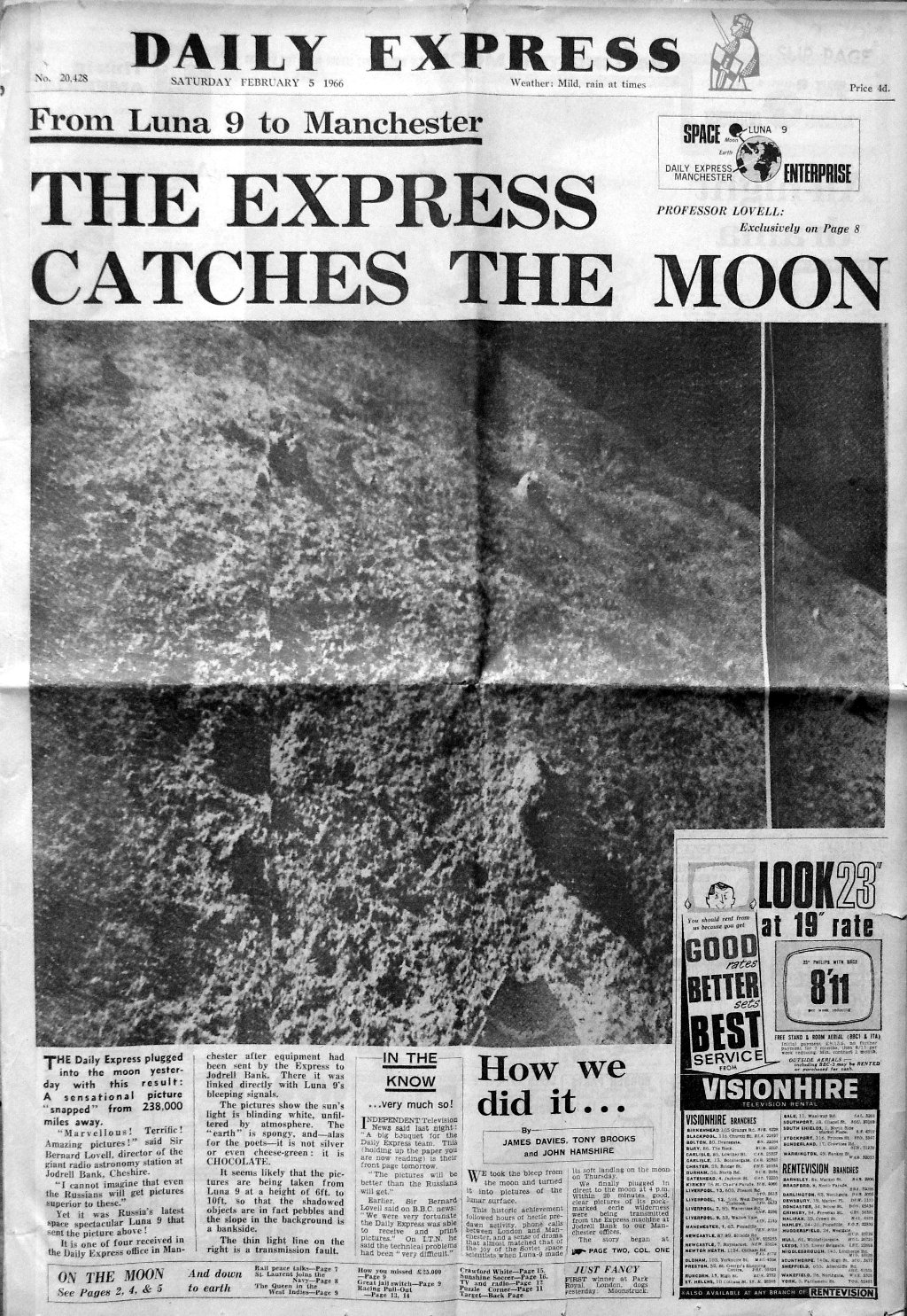
  • 1966: First photographs from the surface of the Moon, transmitted by Soviet Luna 9 using radiofax format, and decoded by a Daily Express receiver at Jodrell Bank Observatory[11]
  • 1972: First SSTV transmissions in Germany

See also

[edit]

References

[edit]
[edit]
Revisions and contributorsEdit on WikipediaRead on Wikipedia
from Grokipedia
Radiofax, also known as radio facsimile or HF fax, is an analog technology that transmits still —such as weather charts, documents, and photographs—over radio waves using frequency-modulated audio signals generated by scanning the original line by line. The process encodes variations between black (typically 1500 Hz tone) and white (2300 Hz tone), with transmissions occurring at speeds like 120 lines per minute and an index of cooperation of 576 for , allowing reception on shortwave radios connected to recorders or software-equipped computers. Originally developed for transfer, radiofax has been a vital tool for remote communication where digital alternatives are unavailable or unreliable. The roots of radiofax trace back to early 19th-century facsimile experiments, with Scottish inventor Alexander Bain patenting the first electrochemical recording telegraph in 1843, which laid the groundwork for scanning and transmitting images electrically. Radio-specific advancements emerged in the early 20th century; German engineer Arthur Korn demonstrated photo transmission in 1904, and by 1924, RCA engineers Richard H. Ranger and Charles J. Young achieved the first transatlantic radiofax of an image—President Calvin Coolidge's portrait—from New York to . In the 1930s, inventor William G. H. Finch refined the technology with recording, enabling experimental broadcasts like the daily facsimile newspaper from station W9XZY starting in 1939, while RCA's systems supported newspaper photo distribution and weather map delivery to ships. During , militaries on both sides employed radiofax for reconnaissance photos, artillery targeting, and weather dissemination, highlighting its strategic value in analog form before . Postwar, radiofax evolved into a standard for maritime and ; the U.S. Weather Bureau began broadcasting weather charts via radiofacsimile in 1926, with postwar expansion through high-frequency radio from U.S. stations for international use. These broadcasts, which take about 10 minutes per chart, provide essential data on , waves, and fronts for vessels at sea. As of 2025, radiofax remains in active use despite digital alternatives like files, with NOAA continuing transmissions from four U.S. sites—; , ; Belle Chasse, ; and —to support global shipping and ensure safety in areas with limited satellite connectivity. International stations, including Germany's DWD and Australia's VMC, also contribute to this network, preserving radiofax as a reliable, low-bandwidth legacy system.

Overview and History

Definition and Basic Principles

Radiofax, also known as radiofacsimile, HF fax, or weatherfax, is an analog mode for transmitting or images via high-frequency (HF) radio waves in the 3-30 MHz range. This technology converts fixed graphic materials, such as charts, into electrical signals for remote reproduction on receiving equipment. The basic principles of radiofax center on line-by-line scanning of the source image using a rotating or electronic scanner to capture optical variations. These variations are then encoded into audio tones via (FSK), a form of (F3C emission), where white pixels generate higher frequencies (e.g., 2300 Hz) and black pixels lower frequencies (e.g., 1500 Hz), centered around 1900 Hz with a ±400 Hz shift. The resulting signal is transmitted using single sideband (SSB) modulation over HF channels, allowing reception on compatible radio equipment connected to a recorder or decoder. Key parameters include a typical resolution of 1-2 mm per line vertically, determined by scanning density, and an of 1:6 (height to width) to ensure proportional . The Index of Cooperation (IOC) measures resolution quality, calculated as π×\pi \times drum circumference in mm divided by line spacing in mm; for example, an IOC of 576 provides standard quality with a line spacing of approximately 0.83 mm on a drum with 152 mm circumference. Primarily, radiofax serves the purpose of real-time image dissemination in remote or mobile settings lacking reliable wired or connectivity, such as maritime vessels and operations.

Historical Development

The development of radiofax, or radio , began in the early with foundational patents enabling image transmission over communication lines. In 1911, the first amplitude modulator for machines was patented, allowing for the transmission of images via lines and laying the groundwork for radio-based adaptations. German Korn demonstrated the first transmission of photographs in 1904, adapting earlier wired systems for radio use. This innovation facilitated the shift toward methods, culminating in 1924 when Richard H. Ranger, an at the Radio Corporation of America (RCA), invented the photoradiogram. On November 29, 1924, Ranger successfully transmitted the first photograph—a of President —from New York to via , marking the debut of transoceanic radio technology. Advancements in focused on practical applications for , particularly newspapers. In 1931, Ernst F. W. Alexanderson, chief engineer at , developed a system for the radio transmission of pictures, enabling the scanning and sending of images line by line. Building on this, the Finch Facsimile system, invented by W.G.H. Finch, emerged in the late 1930s as a low-cost method for transmitting "radio newspapers" to homes via AM radio stations and wire recorders. From 1938 to 1940, experiments like those by demonstrated domestic subscription services, printing news on continuous paper rolls, though widespread adoption was limited by the onset of . During , radiofax saw expanded military use for transmitting reconnaissance photos, maps, and weather charts, supporting operational needs in remote and mobile environments. By the late 1940s, technological refinements allowed for miniaturized receivers, such as those integrated into Western Union's "Telecar" telegram delivery vehicles, enhancing portability for field applications. In the post-war era, radiofax became integral to and . The U.S. (NWS) adopted radiofax in the 1950s to broadcast weather maps, providing mariners with graphical forecasts that served as a lifeline for global navigation until digital alternatives emerged. A notable milestone occurred in 1966 when the Soviet probe achieved the first soft landing on the and transmitted photofacsimile images of the lunar surface back to Earth, using standard news wire facsimile machines for decoding at receiving stations. By the 1970s, (SSTV), a related analog technology for transmitting images including motion over shortwave, gained popularity among amateurs, offering improved resolution and color capabilities compared to traditional radiofax. In the from the 1970s to 2025, radiofax has transitioned amid digital advancements like , yet persists in maritime communications due to the reliability of high-frequency (HF) radio in areas without . The NWS continues NOAA broadcasts, with 2020s receivers increasingly employing to decode analog transmissions, enabling software-based hybrid systems for enhanced clarity on personal computers and SDR hardware. Newspaper applications have largely declined, but weatherfax schedules remain active, including the Met Office's transmissions from Northwood (callsign GYA) as of 2025, providing essential charts to vessels worldwide.

Applications

Weatherfax

Weatherfax, a specialized application of radiofax technology, emerged in the 1950s when the U.S. —now part of the (NOAA)—initiated high-frequency (HF) broadcasts of weather maps to support marine and aviation users. These early transmissions provided critical graphical weather data to vessels and aircraft operating in areas with limited communication infrastructure, marking the beginning of radiofax as a reliable tool for meteorological dissemination at sea. The content transmitted via weatherfax includes a variety of meteorological charts essential for and safety, such as surface charts depicting current patterns, wind and wave forecasts for 24, 48, 72, and 96 hours, satellite composites like imagery, full-disk meteorological satellite images from geostationary satellites such as Japan's Himawari, and upper-air charts including 500 mb and 850 mb levels. Broadcasts follow typical 24-hour cycles aligned with (UTC) updates at 00Z, 06Z, 12Z, and 18Z, with maps refreshed every 6 to 12 hours to reflect evolving conditions; for example, NOAA's station (NMF) transmits North Atlantic surface analyses and wave charts multiple times daily on frequencies like 4235 kHz and 9110 kHz. These schedules ensure continuous coverage for global maritime regions, with stations such as , (NMC), and New Orleans, (NMG), handling Pacific and transmissions, respectively. The Japan Meteorological Agency's JMH station in Tokyo broadcasts MSAT pictures, including full-disk views from the Himawari satellite, on frequencies such as 3622.5 kHz, 7795 kHz, and 13988.5 kHz, with these transmissions ongoing as of 2025. As of 2025, fax remains essential for ships navigating remote oceans where satellite or is unreliable or unavailable, with NOAA continuing HF broadcasts in the WEFAX format through dedicated stations to deliver real-time meteorological data. While digital alternatives like (FTP) supplements are increasingly integrated for enhanced accessibility—allowing users to request charts via to [email protected]—the analog HF method persists as a vital layer, particularly for transoceanic voyages in the North Atlantic where NOAA's NMF broadcasts provide indispensable information. The advantages of weatherfax lie in its low-bandwidth requirements, resembling audio signals that can be received using simple single-sideband (SSB) radios without specialized equipment, making it cost-effective and accessible for smaller vessels. This simplicity enables reception on standard HF setups during extended voyages, such as those crossing the North Atlantic, where it supports strategic weather avoidance and enhances safety without dependency on high-data satellite links. Despite its enduring utility, weatherfax faces challenges including vulnerability to solar interference from flares and geomagnetic storms, which can cause HF signal blackouts and disrupt reception for hours or days by altering ionospheric . Usage has shown signs of decline amid the rise of digital satellite systems, though it is far from obsolete; reports from 2024 and 2025 highlight increased reliance on HF weatherfax during satellite outages and events, underscoring its role as a for critical marine .

Newspaper Fax

Radiofax found one of its earliest and most ambitious applications in the dissemination of content, allowing printed pages to be transmitted over radio waves and reproduced on receiving devices. In , broadcasters experimented with sending full editions or bulletins directly to homes, envisioning a "newspaper of the air" that could deliver timely without physical distribution. These efforts primarily used shortwave or ultrahigh frequency (UHF) bands, with systems scanning pages line by line and modulating the signal for facsimile reproduction on thermal or . Early experiments began in the mid-1930s, with RCA developing a photoelectric scanning system that enabled the transmission of newspaper images and text. The first regular radiofax newspaper broadcasts using RCA technology started in February 1939 from station W9XZY in , , operating on 31,600 kHz with 100 watts, delivering daily editions overnight to subscribers within a 20-mile radius. Concurrently, inventor William G. H. introduced his amplitude-modulated facsimile system in 1933, with commercial tests by 1935 through Finch Telecommunications Laboratories; stations like WWJ in transmitted bulletins using this setup as early as 1938, printing 5-inch-wide pages on . By 1939, at least nine U.S. AM stations, including WOR in New York and WGN in , were authorized by the FCC for experimental overnight facsimile news services, often limited to 6 hours for multi-page editions due to regulatory noise restrictions. Usage peaked in the late 1930s with over two dozen U.S. newspapers adopting radiofax for domestic delivery, but it saw limited expansion during and after World War II for international news to remote areas, hampered by paper shortages and wartime priorities. Post-war, the technology persisted in niche international contexts, such as Japan's Kyodo News Agency using single-sideband high-frequency (SSB HF) transmissions from Tokyo's JJC station to broadcast Japanese and English newspapers to Pacific fishing fleets and isolated regions. These broadcasts, starting in the mid-20th century, focused on sequential page delivery for news, sports, and navigational updates, serving areas with limited print infrastructure. Technical adaptations for newspaper transmission involved high-resolution scanning of pages to capture fine text and images, followed by sequential broadcasting with phasing signals—periodic pulses for line synchronization—and optional stop tones to mark page ends. Finch's system operated at around 60 lines per minute (LPM), taking approximately 20 minutes per 12-inch page, while RCA setups achieved similar speeds, often requiring 10-20 minutes per page at 60-120 LPM depending on resolution and content density. Receivers, priced at 6060-260, used thermal or carbon mechanisms to print grayscale reproductions, with synchronization ensured by 60 Hz tones to align the image on the paper roll. By the 1950s, radiofax newspapers declined sharply, replaced by faster wire services, television, and eventually the , due to slow transmission times, high equipment costs, static interference, and lack of standardization. As of 2025, widespread adoption never materialized, but continues niche HF broadcasts from JJC on 16,971 kHz, transmitting full editions at 60 LPM for Pacific audiences, including morning and evening news in Japanese and English. The concept of radiofax newspapers influenced early broadcast media by promoting the idea of instantaneous, wireless print delivery in , inspiring demonstrations at events like the and fostering visions of integrated radio-print ecosystems, though public adoption was minimal owing to technical limitations.

Other Uses

Radiofax found applications in military operations beyond standard weather dissemination, particularly for transmitting maps, orders, and imagery in challenging environments. During , the U.S. Army Air Corps adopted facsimile transmission in 1943 for relaying weather maps and other graphics, enhancing coordination in remote theaters where wired infrastructure was unavailable. In the era, military forces utilized radiofax for secure image relay in isolated operations, such as relaying reconnaissance-derived charts from forward bases to command centers, leveraging its robustness over high-frequency radio links in contested areas. In space exploration, radiofax principles enabled early interplanetary image transmission. The Soviet Luna 9 mission in 1966 achieved the first soft landing on the Moon and used a facsimile-style camera to scan and transmit panoramic images back to Earth via radio signals, with the lander sending 27 frames over three days that revealed the lunar surface's rocky horizon and craters. Early U.S. Mariner probes, such as Mariner 4 in 1965, employed similar facsimile camera systems to capture and relay close-up images of Mars, marking the first planetary photographs transmitted over vast distances using analog scanning techniques adapted for deep-space radio. Amateur radio enthusiasts have long incorporated radiofax into hobbyist activities, often receiving weatherfax broadcasts for signal decoding practice. Modern ham operators use shortwave receivers and software like to capture and decode WEFAX signals from stations such as NOAA's, fostering skills in HF data modes while monitoring global maritime forecasts. As a digital evolution of radiofax's analog image exchange, (SSTV) emerged in the among amateurs, allowing real-time static image transmission over voice-sideband frequencies, building on facsimile's line-scanning foundation for in amateur bands. Other niche applications included press photo services and support in the mid-20th century. In the 1940s and 1950s, radiophoto systems extended technology over radio links, enabling news agencies like the to transmit breaking images from remote correspondents to newspapers, such as event photos scanned and broadcast via shortwave for rapid domestic relay. Pre-satellite era aviation relied on radiofax for disseminating en route charts and weather overlays, with pilots tuning HF receivers to military or civilian stations for updated graphical forecasts essential for transoceanic flights lacking real-time satellite data. By 2025, radiofax remains rare and largely historical, supplanted by digital satellite and internet-based imagery, though it retains niche relevance in emergencies. In disaster zones with disrupted infrastructure, such as the 2024 earthquake in , radiofax broadcasts from services like provided critical updates to affected areas, serving as a resilient analog backup for disseminating maps and alerts when power grids and cellular networks fail.

Technical Transmission

Signal Generation and Modulation

In historical radiofax systems, image preparation involved wrapping the original or around a rotating scanner, where a source and phototube (or photocell) scanned it line by line to detect variations in light intensity, converting the analog into a series of black and white elemental areas through rasterization. The resolution of this rasterization was governed by the Index of Cooperation (IOC), a defining the total number of picture elements per revolution of the , resulting in horizontal resolutions of approximately 200 elemental areas per inch for standard setups (e.g., IOC 576 for standard weather maps). Modern electronic preparation, however, uses files (e.g., BMP or at 1809 pixels wide) that are processed line by line to match these resolution standards before modulation. The core of signal generation lies in encoding the rasterized image using (FSK) to produce an audio-frequency tone signal, where black areas correspond to a Hz and white areas to a 2300 Hz (or inverted in some legacy variants, with white at Hz and black at 2300 Hz), resulting in an Hz total shift. This varying tone signal, representing through proportional shifts between the extremes, is then fed into a single-sideband (SSB) modulator to impose it on a high-frequency (HF) carrier, typically in the 8-16 MHz for global propagation. The resulting emission is classified as F1C under ITU designations, occupying a narrow bandwidth of 400-500 Hz suitable for voice-grade radio channels. Synchronization is essential to align the transmitter and receiver scanning rates and prevent image skew; transmissions commence with a start tone of 300 Hz for 5 seconds, followed by phasing lines—alternating bars of nearly full black (95%) interrupted by thin white pulses (5%) over 20-30 seconds—that allow the receiver to calibrate its or line advance, and end with a stop tone of 450 Hz for 5 seconds. These phasing elements ensure precise horizontal and vertical alignment without ongoing per-line pulses. Transmission speeds are standardized to balance image quality and channel efficiency, with common rates of 60, 90, or 120 lines per minute (LPM); for instance, 120 LPM is widely used for weatherfax broadcasts, completing a typical chart in several minutes while maintaining compatibility with IOC 576. Equipment for signal generation has evolved significantly from the 1930s, when vacuum-tube scanners, phototubes, and analog modulators (e.g., MD-168A/UX converters) dominated naval and meteorological stations, to contemporary software-defined radios (SDRs) as of 2025, where tools like FLDigi enable fully digital image loading, FSK tone synthesis, and SSB modulation via computer interfaces for amateur and experimental transmissions.

Reception and Decoding

Reception of radiofax signals typically requires a standard high-frequency (HF) single sideband (SSB) receiver tuned to the broadcast frequency minus approximately 1.9 kHz in upper sideband (USB) mode to center the audio tones properly. The receiver's audio output is then connected via a patch cable to a dedicated fax demodulator, or more commonly in modern setups, to a personal computer's sound card input for software-based processing. Popular software tools as of 2025 include SeaTTY, fldigi, and MultiPSK, which handle the decoding from the audio signal. An appropriate antenna, such as a dipole or active HF antenna, is essential to achieve sufficient signal-to-noise ratio (SNR), with grounding and placement away from noise sources recommended to minimize interference. The demodulation process begins with (FSK) detection, where the receiver converts the modulated audio tones—typically 1500 Hz for black pixels and 2300 Hz for white pixels—into binary representations of the image data. A phasing signal, transmitted for several seconds before the image data (often 20-40 lines of alternating black and white pulses), enables initial to align the scan lines and correct for any drift or clock mismatches. Line is maintained through detection of start pulses or ongoing tone patterns, with software adjustments for slant (rotation) and offset to compensate for tuning errors or propagation-induced shifts. This analog-derived process lacks robust digital error correction, relying instead on basic noise filtering to mitigate distortions. Historically, decoded signals were output to thermal paper printers in dedicated receivers, such as Alden models, which used electrosensitive or chemically treated rolls to produce direct prints of weather charts or images. In contemporary systems, the output is primarily digital, displaying or black-and-white images on computer screens via software interfaces, with options to save as or TIFF files for later printing on standard inkjet printers if needed. Common challenges in reception include propagation fading due to ionospheric variations, which can cause signal strength fluctuations and result in incomplete or blurred images, particularly during nighttime or over long distances. Interference from other HF signals or further degrades quality, with low SNR leading to or loss of fine details in the decoded . Modern tools address these issues through software-defined radios (SDRs), such as the SDRplay RSPduo or KiwiSDR, which enable automated tuning, enhanced filtering, and direct digital for improved . Additionally, applications integrating GPS for precise timing help align receptions with broadcast schedules, reducing manual intervention.

Formats

WEFAX Standard

The WEFAX (Weather Facsimile) format evolved in the 1960s from U.S. Navy applications for transmitting , initially leveraging (APT) systems on naval ships and remote stations to support maritime operations in areas with limited communication infrastructure. It was standardized in the 1970s by the International Radio Consultative Committee (CCIR) for high-frequency (HF) radio transmission, establishing a common analog protocol for global weather data dissemination. The transmission structure begins with a header featuring a start signal of 5 seconds of alternating black and white tones at 300 Hz, followed by a phasing signal consisting of 60 scan lines, each comprising three black-white cycles with a 5 ms white portion for . The main data follows in raster format, where each line starts with a 25 ms white level sync pulse and 475 ms of variable tone content representing the picture elements, scanned sequentially until the image is complete. The footer includes an end-of-transmission (EOT) signal of 5 seconds of alternating black and white at 450 Hz, followed by 10 seconds of black tone to signal completion. Key parameters include an Index of Cooperation (IOC) of 576, which defines the helical scan resolution on facsimile drums, and a transmission speed of 120 lines per minute (LPM), equivalent to 2 lines per second. The modulation uses (FSK) with a 1900 Hz carrier, a 400 Hz shift ( at +400 Hz, black at -400 Hz), enabling typical image dimensions such as 286 lines high by 1810 pixels wide for an A4-equivalent chart. is supported through intermediate frequencies between and black tones, with varying durations within each line's 475 ms window to represent shades. WEFAX remains the dominant format for NOAA's HF weather broadcasts and international marine services, providing reliable dissemination of charts and satellite images to ships via scheduled transmissions. As of 2025, while satellite-based WEFAX has largely transitioned to digital protocols like Low Rate Information Transmission (LRIT), HF radiofax retains its core analog structure with minor enhancements in hybrid receiver software for improved decoding stability.

Automatic Picture Transmission (APT)

Automatic Picture Transmission (APT) was developed in the 1960s by the () as an analog system for real-time image transmission from meteorological satellites, initially tested on TIROS-8 in December 1963 and first operational on Nimbus 1 in August 1964. The format originated to enable low-cost ground stations worldwide to receive cloud cover photographs directly from polar-orbiting satellites without complex equipment, addressing limitations in early observation by allowing automated, unattended image capture. Adapted for HF radiofax in the 1970s, APT facilitated similar for terrestrial broadcasts of satellite-derived , permitting receivers to activate and record transmissions remotely without operator intervention. The APT transmission sequence is designed for reliable in unattended operations. It commences with a 5-second start tone at 300 Hz (for IOC 576 mode) to trigger receiver activation, followed by a 30-second phasing signal of alternating black and lines—typically a black line interrupted by a pulse every 186 pixels—to align the receiver's scan timing and index of cooperation. The main image phase then transmits the grayscale data, often 1200 lines at 120 lines per minute (LPM) for a standard 10-minute chart, before ending with a 5-second stop tone at 450 Hz, optionally followed by 10 seconds of black to ensure complete recording. This structure mirrors the satellite heritage while accommodating HF propagation variability. Key parameters of APT include a line rate of 120 LPM for the original satellite configuration and HF radiofax, providing compatibility with standard facsimile equipment. The format uses an Index of Cooperation (IOC) of 576, providing 1810 pixels per line for moderate resolution, and supports images up to 1200 lines, though shorter 800-line variants were common for quicker transmissions. APT's primary advantages lie in its , allowing timer-independent recording via tone detection, which was essential for relaying early NOAA polar orbiter to remote maritime and meteorological stations without dedicated attendance. This enabled widespread dissemination of real-time weather data, such as cloud patterns from TIROS and Nimbus missions, enhancing global forecasting accessibility in resource-limited areas. As of 2025, direct APT transmissions have been phased out following the decommissioning of on August 19, 2025, with modern polar orbiters shifting to digital formats like HRPT for higher resolution. However, the APT protocol persists in HF radiofax for broadcasting legacy weather charts and emulated images, supported by software decoders for historical and use.

Legacy and Variant Formats

The Finch Facsimile system, developed by inventor William G. H. Finch in the 1930s, represented an early commercial effort to transmit newspapers over radio waves for home reception. The system employed a scanning mechanism to convert printed pages into electrical signals broadcast via shortwave, with receivers using a on chemically treated paper to reproduce text and images line by line. Transmission times averaged 15 to 20 minutes per page, limiting its practicality for timely news delivery, though it was demonstrated at the . By the late , the technology became obsolete as television's rise provided faster visual news, leading to Finch's company bankruptcy in 1952. RCA's Wirephoto system, introduced in the , facilitated the rapid transmission of press photographs using telegraph, telephone, or radio lines, marking a shift toward higher-fidelity image distribution for newspapers. The process involved wrapping originals around a rotating drum scanned by a to generate analog signals, often at speeds around 60 lines per minute to prioritize vertical resolution for sharper photo details. Integrated with existing wire services like the , it enabled transatlantic sends in hours rather than days, but required specialized equipment and was gradually supplanted by digital alternatives. Earlier precursors included Richard H. Ranger's photoradiogram system from the 1920s, which achieved the first transoceanic radio transmission of a in 1924—a portrait of President from New York to —using techniques that laid groundwork for later standards. Soviet adaptations extended radiofax into , notably with the Luna 9 mission in 1966, where images of the lunar surface were broadcast in the standard Radiofax format at 10 lines per minute and 560 lines resolution, allowing global decoding including by British amateurs before official release. In , (SSTV) emerged as a bridge from analog radiofax to modes, enabling hobbyists to transmit or color pictures over voice frequencies since the 1950s, with modern software handling error correction for robust shortwave exchanges. These legacy formats declined primarily due to their analog nature, which imposed slow transmission rates—often minutes per image—making them inefficient compared to emerging digital technologies. By the 1990s, and provided instantaneous, high-resolution alternatives for , , and , rendering radiofax obsolete for most professional uses outside niche maritime applications. As of 2025, no active legacy variants persist beyond standardized formats like WEFAX, but software emulations such as MultiMode and FLDigi allow hobbyists to recreate and decode historical radiofax signals, including Finch and Wirephoto styles, using sound card interfaces for educational shortwave listening. SSTV tools like MMSSTV further preserve the analog-to-digital transition, fostering community experiments on amateur bands.

Stations and Operations

Major Global Stations

Major global radiofax stations primarily broadcast weather charts for maritime navigation, utilizing the WEFAX standard on high-frequency (HF) bands to reach ships at sea. These transmissions, operating continuously or near-continuously, provide essential data such as surface analyses, wind and wave forecasts, , and ice charts, supporting safe passage in remote ocean areas. While weather-related content dominates, a small fraction includes specialized transmissions like newspaper editions from . Frequencies typically fall within the 2-22 MHz range, with most in the 4-16 MHz HF bands, and transmitter powers ranging from 1 to 10 kW to ensure reliable propagation over long distances. In the United States, the National Oceanic and Atmospheric Administration (NOAA) operates four key stations through U.S. Coast Guard facilities in its Weather Radiofax network, delivering 24/7 weather charts tailored to regional marine needs. The station at Point Reyes, California (call sign NMC), transmits on 4346 kHz, 8682 kHz, 12786 kHz, 17151.2 kHz, and 22527 kHz, focusing on Pacific surface analyses and forecasts. Belle Chasse, Louisiana (NMG), uses 4317.9 kHz, 8503.9 kHz, 12789.9 kHz, and 17146.4 kHz for Gulf of Mexico and Atlantic coverage, including tropical cyclone warnings. Marshfield, Massachusetts (NMF), broadcasts via 4235 kHz, 6340.5 kHz, 9110 kHz, and 12750 kHz, emphasizing North Atlantic wind/wave data and ice charts. Kodiak, Alaska (NOJ), operates on 2054 kHz, 4298 kHz, 8459 kHz, and 12412.5 kHz to serve Arctic routes with sea ice and satellite imagery. Additionally, the Department of Defense operates the Honolulu, Hawaii station (KVM70) on 9982.5 kHz, 11090 kHz, and 16135 kHz, covering the central Pacific with equatorial forecasts. These stations maintain round-the-clock schedules without reported consolidations as of November 2025. Internationally, stations from multiple nations enhance global coverage, particularly in the Pacific, Atlantic, and Indian Oceans. Japan's Meteorological Agency runs JMH in on 3622.5 kHz, 7795 kHz, and 13988.5 kHz for comprehensive North Pacific weather maps, including transmissions of satellite imagery such as full-disk images from Japanese satellites, while JFX in transmits on 4274 kHz, 8658 kHz, 13074 kHz, 16907.5 kHz, and 22559.6 kHz (updated 2025) for southern regional data including sea surface temperatures. Australia's operates VMC in Charleville on 2628 kHz, 5100 kHz, 11030 kHz, 13920 kHz, and 20469 kHz, supplying Indian and prognoses. In , Germany's (DWD) from Hamburg/Pinneberg (DDH3/DDK) uses 3855 kHz, 7880 kHz, and 13882.5 kHz at 10 kW for North Atlantic and Baltic analyses. Russia's RBW in broadcasts on 5336 kHz, 6446 kHz, 7908.8 kHz, 8444 kHz, and 10130 kHz, prioritizing ice charts and northern sea routes. Chile's maritime service includes CBV in on 4228 kHz, 8677 kHz, and 17146.4 kHz for southeastern Pacific forecasts, and CBM in on 4322 kHz and 8696 kHz for sub-Antarctic coverage. China's XSQ in operates on 4199.75 kHz, 8412.5 kHz, 12629.25 kHz, and 16826.25 kHz, extending reach into the with updates. A notable non-weather use persists with Japan's agency, the sole remaining provider of radiofax newspaper transmissions, active as of mid-2025 on 16971 kHz from (call sign JJC). These broadcasts deliver full editions in Japanese and English at scheduled times (e.g., 0200 UTC evening edition, 0300 UTC ), serving Pacific fleets with , sports, and navigational warnings at 60 lines per minute—contrasting the standard 120 lines per minute for weatherfax. This represents less than 5% of global radiofax activity, underscoring the medium's primary role in .

Operational Practices and Equipment

Radiofax broadcast practices follow fixed schedules to ensure reliable delivery of weather charts and forecasts to maritime users. For instance, the (NWS) operates transmissions through U.S. stations, with charts disseminated at intervals ranging from every 15 to 60 minutes depending on the product and region, such as surface analyses every 6 hours and specialized forecasts more frequently. These schedules are coordinated internationally to cover global sea areas, with redundancy achieved by broadcasting the same content across multiple high-frequency (HF) bands to account for varying conditions influenced by time of day and ionospheric activity. In cases of urgent weather events, such as tropical cyclones expected within four days, manual interventions allow for unscheduled or accelerated transmissions, including 3-hour interval updates during active storms. Transmitter equipment at major stations, like those operated by the NWS and , relies on automated systems for efficiency. Images from meteorological data sources are input via computers connected to facsimile scanners, which convert digital charts into analog signals for modulation onto HF carriers. These systems incorporate HF amplifiers to achieve the necessary power levels—typically 2.5 to 10 kW—for long-range , along with built-in monitoring tools to assess signal quality, modulation fidelity, and transmission continuity in real time. Reception on the user end, particularly in maritime settings, utilizes HF single-sideband (SSB) radios interfaced with dedicated decoders. Equipment such as the Icom M803 SSB , certified for non-SOLAS vessels, integrates with external interfaces to demodulate and print incoming signals. For cost-effective setups, PC-based decoders employing standard s—coupled with like those supporting WEFAX protocols—allow decoding via a connected to an SSB receiver, outputting to or inkjet printers for hard copies or digital displays. Basic configurations, including a used HF receiver, adapter, and printer, remain accessible under $500 in 2025. Maintenance of radiofax networks involves adherence to International Telecommunication Union (ITU) regulations for , where HF bands (typically 3-30 MHz) are allocated to the fixed and mobile services under Article 5 of the Radio Regulations, requiring coordination among nations to prevent interference. Contingencies for solar flares, which disrupt HF through ionospheric disturbances, include predefined frequency hopping to less-affected bands and fallback to voice broadcasts or satellite services when available. Ship officers receive mandatory training under the Global Maritime Distress and Safety System (GMDSS), covering HF radio operations including radiofax reception, as part of SOLAS Chapter IV requirements to ensure competency in distress and safety communications. Looking ahead, radiofax operations face a gradual transition toward digital HF alternatives, such as those defined in MIL-STD-188-110C for data modems, enabling higher-speed image and text transmission over HF channels. However, analog radiofax remains mandated under SOLAS for GMDSS compliance in remote sea areas (A3 and A4), where satellite coverage is limited, ensuring continued reliability for essential weather dissemination in 2025 and beyond.

References

Add your contribution
Related Hubs
User Avatar
No comments yet.